New Semester
Started
Get
50% OFF
Study Help!
--h --m --s
Claim Now
Question Answers
Textbooks
Find textbooks, questions and answers
Oops, something went wrong!
Change your search query and then try again
S
Books
FREE
Study Help
Expert Questions
Accounting
General Management
Mathematics
Finance
Organizational Behaviour
Law
Physics
Operating System
Management Leadership
Sociology
Programming
Marketing
Database
Computer Network
Economics
Textbooks Solutions
Accounting
Managerial Accounting
Management Leadership
Cost Accounting
Statistics
Business Law
Corporate Finance
Finance
Economics
Auditing
Tutors
Online Tutors
Find a Tutor
Hire a Tutor
Become a Tutor
AI Tutor
AI Study Planner
NEW
Sell Books
Search
Search
Sign In
Register
study help
physics
particle physics
Principles And Practice Of Physics 2nd Edition Eric Mazur - Solutions
If a person is \(20 \%\) shorter than average, what is the ratio of his walking pace (that is, the frequency \(f\) of his motion) to the walking pace of a person of average height? Assume that a person's leg swings like a pendulum and that the angular amplitude of everybody's stride is about the
A pendulum consists of a bob of mass \(m_{\text {bob }}\) hanging at the end of a light rod of mass \(m_{\text {rod }}\) and length \(\ell\). If you ignore the mass of the rod, the period is \(T_{0}\), and if you use \(m_{\text {rod }}\) in your calculation, the period is \(T\). How far from the
Verify that the time constant \(\tau=m / b\) has units of time for damped oscillations.
As the quality factor \(Q\) for a damped oscillation increases but the period \(T\) of undamped motion is held constant, what happens to the angular frequency \(\omega_{\mathrm{d}}\) of the damped motion?
Express, as a function of \(\tau\), the time interval needed for the amplitude of an oscillation to reduce to half of its initial value.
A \(0.400-\mathrm{kg}\) object is oscillating on a spring for which the force constant is \(300 \mathrm{~N} / \mathrm{m}\). A damping force that is linearly proportional to the object's velocity is exerted on the system, and the damping coefficient is \(b=5.00 \mathrm{~kg} / \mathrm{s}\).(a) Verify
A simple pendulum consists of a \(1.00 \mathrm{~kg}\) bob on a string \(1.00 \mathrm{~m}\) long. During a time interval of \(27.0 \mathrm{~s}\), the maximum angle this pendulum makes with the vertical is found to decrease from \(6.00^{\circ}\) to \(5.40^{\circ}\). Determine the numerical values of
A \(0.25-\mathrm{kg}\) bob is suspended from a string that is \(0.60 \mathrm{~m}\) long. When the pendulum is set into small-amplitude oscillation, the amplitude decays to half of its initial value in \(35 \mathrm{~s}\).(a) What is the time constant \(\tau\) for the pendulum?(b) At what instant is
A restoring force of unknown magnitude is exerted on a object that oscillates with a period of \(0.50 \mathrm{~s}\). When the object is in an evacuated container, the motion is simple harmonic motion, with an amplitude of \(0.10 \mathrm{~m}\). When air is allowed into the container, the amplitude
A \(0.500-\mathrm{kg}\) block oscillates up and down on a vertical spring for which \(k=12.5 \mathrm{~N} / \mathrm{m}\). The initial amplitude of the motion is \(0.100 \mathrm{~m}\).(a) What is the natural angular frequency \(\omega\) ?(b) If the observed angular frequency is
A damped oscillator has a quality factor of 20 .(a) By what fraction does the energy decrease during each cycle?(b) By what percentage does the damped angular frequency \(\omega_{\mathrm{d}}\) differ from the undamped angular frequency?
One reference book states that, after a large earthquake, Earth can be treated as an oscillator that has a period of \(54 \mathrm{~min}\) and a quality factor of 400 .(a) What percentage of the energy of oscillation is lost to damping forces during each cycle?(b) What fraction of the original
A gong makes a loud noise when struck. The noise gradually gets less and less loud until it fades below the sensitivity of the human ear. The simplest model of how the gong produces the sound we hear treats the gong as a damped harmonic oscillator. The tone we hear is related to the frequency \(f\)
Critical damping is a term used to describe a situation where the damping coefficient \(b\) is just great enough that no oscillation occurs. (In critical damping, a moving part is displaced but returns to its equilibrium position quickly without overshooting it.) This is how you want the springs in
A small \(3.0-\mathrm{kg}\) object dropped from the roof of a tall building acquires a terminal speed of \(25 \mathrm{~m} / \mathrm{s}\). Assume the drag force exerted on the object has the same form as the damping force exerted on a damped oscillator; that is, the force is opposed to the motion,
An object resting on a table oscillates on the end of a horizontal spring. Because the table is covered with a viscous substance, the motion is damped and the amplitude gets smaller with each cycle. At \(t=1.5 \mathrm{~s}\), the object is \(60 \mathrm{~mm}\) from its equilibrium position, and this
Do the turning points in simple harmonic motion have to be equidistant from the equilibrium position?
If the amplitude of a simple harmonic motion doubles, what happens to \((a)\) the energy of the system, \((b)\) the maximum speed of the moving object, and \((c)\) the period of the motion?
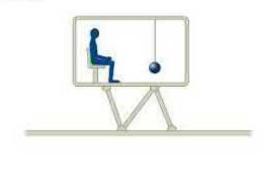
A pendulum is swinging in a stationary elevator. What happens to the period when the elevator \((a)\) accelerates upward, (b) travels downward at constant speed, and (c) travels downward and gradually slows to a stop?
You measure the oscillation frequency \(f_{\text {whole }}\) of a vertical block-spring system. You then cut the spring in half, hang the same block from one of the halves, and measure the frequency \(f_{\text {half }}\). What is the ratio \(f_{\text {half }} / f_{\text {whole }}\) ?
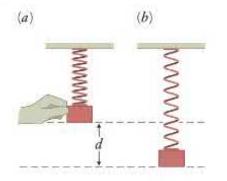
The hand in Figure P15.80a holds a vertical blockspring system so that the spring is compressed. When the hand lets go, the block, of mass \(m\), descends a distance \(d\) in a time interval \(\Delta t\) before reversing direction (Figure P15.80b). Once the system comes to rest, the block is
Two oscillatory motions are given by \(x(t)=A \sin (m \omega t)\) and \(y(t)=A \sin (n \omega t+\phi)\), where \(m\) and \(n\) are positive integers. Consider displaying these motions on a single graph with \(x\) and \(y\) axes oriented perpendicular to each other. What restrictions are necessary
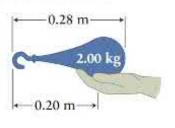
You have a teardrop-shaped \(2.00-\mathrm{kg}\) object that has a hook at one end and is \(0.28 \mathrm{~m}\) long along its longest axis (Figure P15.83). When you try to balance the object on your fingers, it balances when your fingers are \(0.20 \mathrm{~m}\) from the hook end. When you hang the
What would be the period of oscillation of this book if you held it at one corner between index finger and thumb and allowed it to swing slightly? To first order, ignore any effect on the oscillation by friction between your fingers and the book.
A \(2.00-\mathrm{kg}\) object is free to slide on a horizontal surface. The object is attached to a spring of spring constant \(200 \mathrm{~N} / \mathrm{m}\), and the other end of the spring is attached to a wall. The object is pulled in the direction away from the wall until the spring is
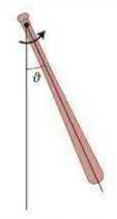
A hole is drilled through the narrow end of a \(0.960-\mathrm{kg}\) baseball bat, and the bat is hung on a nail so that it can swing freely (Figure P15.85). The bat is \(0.860 \mathrm{~m}\) long, the hole is drilled \(0.0300 \mathrm{~m}\) from the end, and the center of mass is located \(0.670
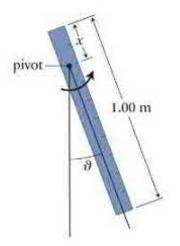
A meter stick is free to pivot around a position located a distance \(x\) below its top end, where \(0(a) What is the frequency \(f\) of its oscillation if it moves as a pendulum?(b) To what position should you move the pivot if you want to minimize the period?Data from Figure P15.86 pivot- 1.00 m
To determine what effect a spring's mass has on simple harmonic motion, consider a spring of mass \(m\) and relaxed length \(\ell_{\text {spring }}\). The spring is oriented horizontally, and one end is attached to a vertical surface. When the spring is stretched a distance \(x\), the potential
(a) Show that for an object moving in simple harmonic motion, the speed of the object as a function of position is given by \(v(x)=\omega \sqrt{A^{2}-x^{2}}\).(b) Noting that \(v_{x}=d x / d t\), isolate \(d t\) and integrate to determine how long it takes for an oscillator to move from its
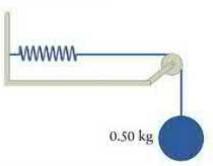
In physics lab, you are measuring the period of a vertically hung spring-ball system in which the mass of the ball is \(0.50 \mathrm{~kg}\). As the system oscillates up and down, it also swings from side to side, a motion that interferes with your measurements of the vertical motion. After running
The King's clock fails to keep time, and because you designed it, he's holding you responsible. Examining the spring-ball system you used as the central timekeeping oscillator, you realize that a simple pendulum might be more reliable, and there happens to be a bit of thin, strong wire handy.
You are aboard the International Space Station and are required to keep track of your mass because of your long stay in the free-fall conditions of deep space. To carry out this task, you hook a 215 -kg cargo box to one end of a stiff spring and hook yourself to the spring's other end. With the
The position of a particle undergoing simple harmonic motion is given by \(x(t)=20 \cos (8 \pi t)\), where \(x\) is in millimeters and \(t\) is in seconds. For this motion, what are the (a) amplitude, (b) frequency \(f\), (c) period? (d) What are the first three instants at which the particle
If the matter that makes up a planet is distributed uniformly so that the planet has a fixed, uniform density, how does the magnitude of the acceleration due to gravity at the planet surface depend on the planet radius?
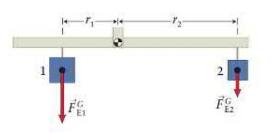
In Figure P13.2, suppose the mass of object 1 is three times the mass of object 2. (a) At Earth's surface, what ratio \(r_{1} / r_{2}\) is needed to have the rod stay horizontal? (b) What is this ratio on the Moon, where the magnitude of the gravitational force is only one-sixth of the magnitude of
Suppose you're making a scale model of the solar system showing the eight planets (not including the dwarf planet Pluto) and having each planet at its farthest position from the Sun. If you use a marble of radius \(10 \mathrm{~mm}\) for Mercury, how far from the Sun must you place your outermost
Four identical objects are placed at the four corners of a square, far from any star or planet. (a) Choose one object and draw to scale the vectors that represent the gravitational forces exerted on it by the other three objects. (b) Draw a vector that represents the vector sum of the forces
Two basketballs, each of mass \(0.60 \mathrm{~kg}\) and radius \(0.12 \mathrm{~m}\), are placed on a floor so that they touch each other. Two golf balls, each of mass \(0.045 \mathrm{~kg}\) and radius \(22 \mathrm{~mm}\), are placed on a table so that they touch each other. What is the ratio of the
An astronaut on the International Space Station gently releases a satellite that has a mass much smaller than the mass of the station. Describe the motion of the satellite after release.
An isolated object of mass \(m\) can be split into two parts of masses \(m_{1}\) and \(m_{2}\). Suppose the centers of these parts are then separated by a distance \(r\). What ratio of masses \(m_{1} / m_{2}\) would produce the largest gravitational force on each part?
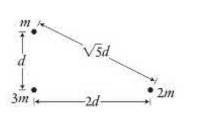
Particles of mass \(m, 2 m\), and \(3 m\) are arranged as shown in Figure P13.8, far from any other objects. These three particles interact only gravitationally, so that each particle experiences a vector sum of forces due to the other two. Call these \(\vec{F}_{m}, \vec{F}_{2 m}\), and
Angular momentum can be represented as a vector product and interpreted in terms of the rate of change of an area with respect to time. Give a similar interpretation of another vector product: torque. (Consider derivatives.)
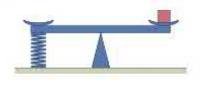
Suppose the spring/balance device in Figure P13.10 is adjusted so that the spring is slightly stretched and the balance arm is level when the device is in an elevator at rest relative to the ground and a \(1.0-\mathrm{kg}\) object is placed as shown. If the elevator accelerates upward, does the
Suppose that you were to step gently onto a bathroom scale, read the dial, and then jump from a chair onto the same scale. (a) Would the dial show different readings in the two cases? (b) Would the gravitational force exerted by Earth on you change?
A balance is purposefully prepared in an unbalanced condition, with too much mass on one side. It is carefully held with two hands, one on the base of the balance and one on the heavier end, so that the balance arm is level. Then both hands release the system from rest at the same instant. While it
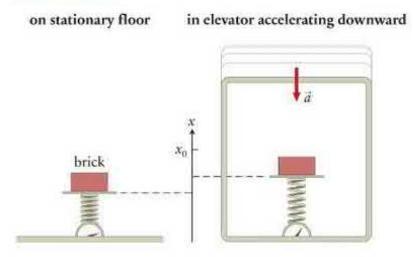
(a) For what downward acceleration does the spring scale in Figure P13.13 read zero? (b) What would the answer in part \(a\) be if the experiment were done on the Moon? (c) How would your conclusion about the spring forces change if the brick were hung from the spring scale rather than supported by
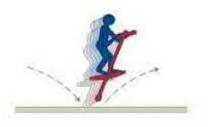
You ride your pogo stick (Figure P13.14) across a diving board and into the local swimming pool. Your pogo stick is a special model equipped with a sensor that records the force measured by the spring. Describe the values of force recorded during your ride, using the gravitational force exerted on
A commercial airliner hits a pocket of turbulence and experiences a downward acceleration of about \(2 \mathrm{~g}\). A person who is not fastened into a seat by a safety belt "falls" to the ceiling and suffers a broken neck. Explain how this injury can be so severe.
How should the simulator in Figure P13.16 be tilted to simulate a left turn in a bobsled? Assume that the bobsled run has banked turns and that the sled exerts no tangential force on the ice.Data from Figure P13.16
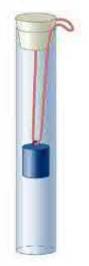
A vertical accelerometer for measuring Figure P13.17 accelerations on a roller coaster can be constructed using a piece of clear plastic pipe, a cork, a rubber band, and a metal bob (Figure P13.17). Where the bob hangs down normally is where you make a mark for an acceleration of \(g\). Without
Consider two satellites simultaneously launched \(180 \mathrm{~km}\) apart at the equator, each placed in a circular orbit that passes above the North Pole and its launch point. (a) Describe their relative motion with respect to Earth and with respect to each other. (b) Does this motion imply that
Let us explore whether there is any way to distinguish acceleration due to rotation from acceleration due to a gravitational force. Imagine a deep bowl with a small volume of milk in it. (a) What happens to the milk when you spin the bowl about a perpendicular axis that runs through the center of
What is the magnitude of the gravitational force exerted (a) by the Sun on Mars and (b) by Mars on the Sun? Approximate Mars's orbit as circular.
What is the magnitude of the gravitational force between two \(1.0 \mathrm{~g}\) marbles placed \(100 \mathrm{~mm}\) apart?
The gravitational force between two spherical celestial bodies, one of mass \(2 \times 10^{12} \mathrm{~kg}\) and the other of mass \(5 \times 10^{20} \mathrm{~kg}\), has a magnitude of \(3 \times 10^{7} \mathrm{~N}\). How far apart are the two bodies?
Mars has a mass that is about one-ninth of Earth's and a radius that is about half of Earth's. What is the ratio of the acceleration due to gravity on Mars to that on Earth?
Gravity is the weakest of the fundamental interactions (see Section 7. 6).(a) This being so, what makes it such an important force on Earth?(b) What makes it the dominant force in galaxies?Data from Section 7. 6.... An interaction is fundamental if it cannot be explained in terms of other
A neutron star has about two times the mass of our Sun but has collapsed to a radius of \(10 \mathrm{~km}\). What is the acceleration due to gravity on the surface of this star in terms of the free-fall acceleration at Earth's surface?
Which pulls harder on the Moon: Earth or the Sun?
How far above the surface of Earth do you have to go before the acceleration due to gravity drops by \(0.10 \%\), \(1.0 \%\) and \(10 \%\) ?
(a) As a spacecraft travels along a straight line from Earth to the Moon, at what distance from Earth does the force of gravity exerted by Earth on the coasting spacecraft cancel the force of gravity exerted by the Moon on the spacecraft? (b) What do the passengers in the spacecraft notice, if
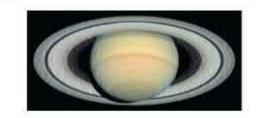
From the picture of Saturn in Figure P13.29 and known values, estimate the orbital period of particles in Saturn's rings.Data from Figure P13.29
The Sun and Moon both exert a gravitational force on Earth. (a) Which force has greater magnitude? (b) What is the ratio of the two force magnitudes?
Given that the acceleration due to gravity is \(0.0500 \mathrm{~m} / \mathrm{s}^{2}\) at the surface of a spherical asteroid that has a radius of \(3.75 \times 10^{4} \mathrm{~m}\), determine the asteroid's mass.
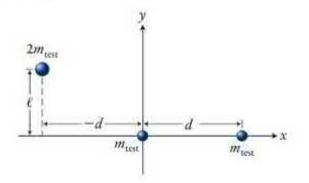
A test object of mass \(m_{\text {test }}\) is placed at the origin of a two-dimensional coordinate system (Figure P13.33). An object 1 , of the same mass, is at (d, 0), and an object 2 , of mass \(2 m_{\text {test }}\) is at (-d, l). What is the magnitude of the vector sum of the gravitational
Using \(g\) for the acceleration due to gravity is valid as long as the height \(b\) above Earth's surface is small. Derive an expression for a more accurate value of the acceleration due to gravity as a quadratic function of \(h\).
Calculate the acceleration due to gravity inside Earth as a function of the radial distance \(r\) from the planet's center. (Imagine that a mine shaft has been drilled from the surface to Earth's center and an object of mass \(m\) has been dropped down the shaft to some radial position \(r
What is the gravitational potential energy of the EarthSun system?
The asteroid known as Toro has a radius of about \(5.0 \mathrm{~km}\) and a mass of \(2.0 \times 10^{15} \mathrm{~kg}\). Could a \(70-\mathrm{kg}\) person standing on its surface jump free of Toro?
(a) How much gravitational potential energy does a system comprising a \(100 \mathrm{~kg}\) object and Earth have if the object is one Earth radius above the ground? (b) How fast would a \(100-\mathrm{kg}\) object have to be moving at this height to have zero energy?
An object 1 of mass \(m_{1}\) is separated by some distance \(d\) from an object 2 of mass \(2 m_{1}\). An object 3 of mass \(m_{3}\) is to be placed between them. If the potential energy of the three-object system is to be a maximum (closest to zero), should object 3 be placed closer to object 1 ,
Two particles, each of mass \(m\), are initially at rest very far apart. Obtain an expression for their relative speed of approach at any instant as a function of their separation distance \(d\) if the only interaction is their gravitational attraction to each other.
Consider an alternate universe in which the magnitude of the attractive force of gravity exerted by Earth on a meteor of mass \(m_{\mathrm{m}}\) approaching Earth is given by \(F=C m_{\mathrm{m}} m_{\mathrm{E}} / \mathrm{r}^{3}\), where \(\mathrm{C}\) is some positive constant and \(r\) is the
Derive expressions for the orbital speed and energy for a satellite of mass \(m_{\mathrm{s}}\) traveling in a circular orbit of radius \(a\) around a planet of mass \(m_{\mathrm{p}} \gg m_{\mathrm{s}}\).
What maximum height above the surface of Earth does an object attain if it is launched upward at \(4.0 \mathrm{~km} / \mathrm{s}\) from the surface?
(a) Derive an expression for the energy needed to launch an object from the surface of Earth to a height \(h\) above the surface. (b) Ignoring Earth's rotation, how much energy is needed to get the same object into orbit at height \(b\) ?
A spacecraft propelled by a solar sail is pushed directly away from the Sun with a force of magnitude \(C / r^{2}\), where \(\mathrm{C}\) is a constant and \(r\) is the spacecraft-Sun radial distance. The craft has a mass of \(5.0 \times 10^{4} \mathrm{~kg}\) and starts from rest at a distance
In 1865, Jules Verne wrote a story in which three men went to the Moon by means of a shell shot from a large cannon sunk in the ground. (a) What muzzle speed must the cannon have in order for the shell to reach the Moon? (b) If the acceleration was constant throughout the muzzle, how long would the
The center-to-center distance between a \(200 \mathrm{~g}\) lead sphere and an \(800 \mathrm{~g}\) lead sphere is \(0.120 \mathrm{~m}\). A \(1.00 \mathrm{~g}\) object is placed \(0.0800 \mathrm{~m}\) from the center of the \(800 \mathrm{~g}\) sphere along the line joining the centers of the two
Derive an expression for the gravitational potential energy of a system consisting of Earth and a brick of mass \(m\) placed at Earth's center. Take the potential energy for the system with the brick placed at infinity to be zero.
Is approximating the gravitational potential energy near the surface of the Sun as \(m g_{s} \Delta x\) accurate over a smaller or larger range of values than approximating the gravitational potential energy near the surface of Earth as \(m g_{\mathrm{F}} \Delta x\) ?
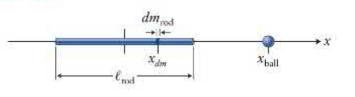
A uniform rod of mass \(m_{\text {rod }}\) and length \(\ell_{\text {rod }}\) lies along an \(x\) axis far from any stars or planets, with the center of the rod at the origin (Figure P13.50). A ball of mass \(m_{\text {ball }}\) is located at position \(x_{\text {ball }}\) on the axis. (a) Write an
The parabolic orbit of any comet around the Sun might be described as a collision between the two objects. Would it be better described as an elastic collision or an inelastic collision?
Assume a particle is located at the surface of the Sun. (a) If the particle has mass \(m\), how fast must it be moving away from the Sun's center of mass to escape the gravitational influence of the Sun? (b) At what speed must a particle of mass \(2 m\) move in order to escape the Sun's
What is the speed of a space probe when it is very far from Earth if it was launched from the surface of Earth at twice its escape speed?
Which trip takes more rocket fuel: from Earth to the Moon or from the Moon to Earth?
A satellite moves at speed \(v\) in very low orbit about a moon that has no atmosphere. You launch a projectile vertically from the same moon's surface at the same speed \(v\). To what height does it rise?
A satellite in an elliptical orbit around Earth has a speed of \(8032 \mathrm{~m} / \mathrm{s}\) when it is at perigec, the position in the orbit closest to Earth. At this position, the satellite is \(112 \mathrm{~km}\) above Earth's surface. How far above the ground is the satellite when it is at
A certain comet comes in on a parabolic approach around the Sun. Its perihelion is about the same distance from the Sun as the orbit of Mercury. How much faster than Mercury (expressed as a ratio) is the comet traveling at pcrihelion?
Show that for circular orbits of two objects about their center of mass, \(E=\frac{1}{2} U=-K\). This is a special case of the more general mathematical statement known as the virial theorem.
An attractive central force exerted on a particle of mass \(m\) causes the particle to travel in a bound orbit. The orbit is clliptical with semimajor axis \(a\), and the force has magnitude \(\mathrm{C} m / r^{2}\), where \(\mathrm{C}\) is a constant and \(r\) is the orbit radius. If the
A particle is leaving the Moon in a direction that is radially outward from both the Moon and Earth. What speed must it have to escape the Moon's gravitational influence?
A meteoroid passes through a position in space where its speed is very small relative to Earth's and it is at a perpendicular distance of 19 Earth radii above Earth's surface. The meteoroid is moving in such a way that Earth captures it. What is the speed of the meteoroid when it is one Earth
A space probe can be either launched at escape speed from Earth or transported to a "parking orbit" above Earth and then launched. (a) If the parking orbit is \(180 \mathrm{~km}\) above Earth's surface, what is the escape speed from the orbit? (b) What launch speed is required to have the probe
Two identical stars, each of mass \(3.0 \times 10^{30} \mathrm{~kg}\), revolve about a common center of mass that is \(1.0 \times 10^{11} \mathrm{~m}\) from the center of either star. (a) What is the rotational speed of the stars? (b) If a meteoroid passes through the center of mass, perpendicular
Kepler's third law says that the square of the period of any planet is proportional to the cube of its mean distance from the Sun. Show that this law holds for elliptical orbits if one uses the semimajor axis as the mean distance. (Said another way, orbits that have the same energy but different
Two celestial bodies of masses \(m_{1}\) and \(m_{2}\) are orbiting their center of mass at a center-to-center distance of \(d\). Assume each body travels in a circular orbit about the center of mass of the system, and derive the general Newtonian form of Kepler's third law: \(T^{2}=4 \pi^{2} d^{3}
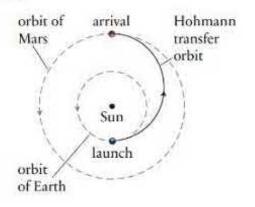
To travel between Earth and any other planet requires consideration of such things as expenditure of fuel energy and travel time. To simplify the calculations, one chooses a path such that the position in Earth's orbit where the launch occurs and the position in the other planet's orbit when the
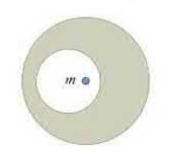
A small disk of mass \(m\) is at the center of a larger disk that has an off-center hole drilled in it (Figure P13.67). What is the direction of the gravitational force exerted by the larger disk on the small one?Data from Figure P13.67
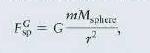
Is Eq. 13. 37 for the gravitational force exerted by a solid sphere of mass \(m_{5}\) on some object of mass \(m_{0}\) when the two are a radial distance \(r\) apart, \(F_{\mathrm{so}}^{G}=G m_{o} m_{\mathrm{s}} / r^{2}\), valid for a sphere whose mass is not distributed uniformly?Data from Eq. 13.
Showing 3300 - 3400
of 4962
First
27
28
29
30
31
32
33
34
35
36
37
38
39
40
41
Last
Step by Step Answers

 Get 50% OFF
Claim Now
Get 50% OFF
Claim Now