New Semester
Started
Get
50% OFF
Study Help!
--h --m --s
Claim Now
Question Answers
Textbooks
Find textbooks, questions and answers
Oops, something went wrong!
Change your search query and then try again
S
Books
FREE
Study Help
Expert Questions
Accounting
General Management
Mathematics
Finance
Organizational Behaviour
Law
Physics
Operating System
Management Leadership
Sociology
Programming
Marketing
Database
Computer Network
Economics
Textbooks Solutions
Accounting
Managerial Accounting
Management Leadership
Cost Accounting
Statistics
Business Law
Corporate Finance
Finance
Economics
Auditing
Tutors
Online Tutors
Find a Tutor
Hire a Tutor
Become a Tutor
AI Tutor
AI Study Planner
NEW
Sell Books
Search
Search
Sign In
Register
study help
physics
particle physics
Principles And Practice Of Physics 2nd Edition Eric Mazur - Solutions
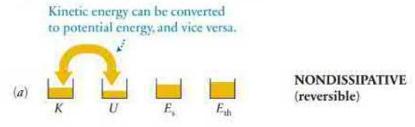
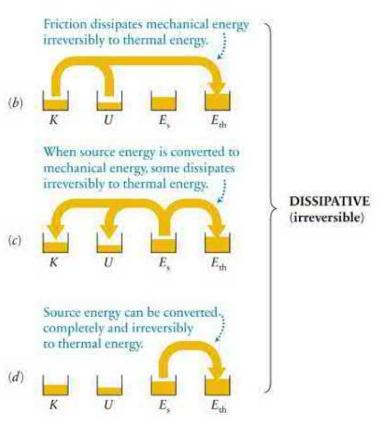
For each of the following scenarios, choose a closed system, identify the energy conversions that take place, and classify each conversion according to the four processes shown in Figure 7.13. (a) A person lifts a suitcase. (b) A toy suspended from a spring bobs up and down. (c) A pan of water is
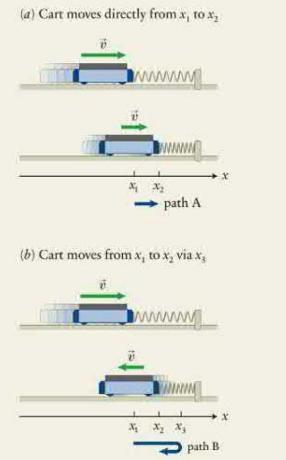
Figure 7.26 shows a cart striking a spring. In Figure 7.26a, consider the motion of the cart along the direct path from the initial position \(x_{1}\), which is the position at which the cart makes initial contact with the free end of the spring, to the position \(x_{2}\) (path A). In Figure \(7.26
Ball \(A\) is released from rest at a height \(b\) above the ground. Ball \(B\) is launched upward from the same height at initial speed \(v_{\mathrm{B}, \mathrm{i}}\). The two balls have the same inertia \(m\). Consider this motion from the instant they are released to the instant they hit the
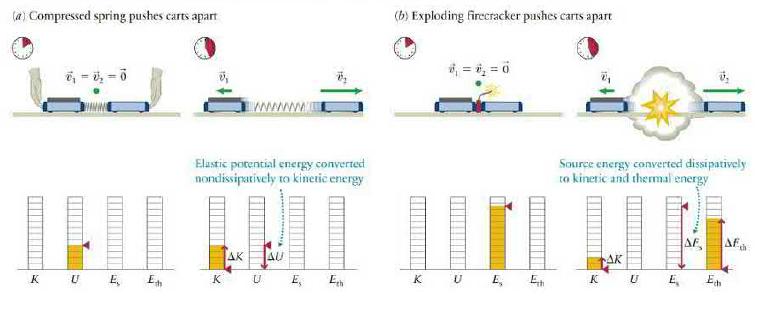
A \(1000-\mathrm{kg}\) car traveling at \(10 \mathrm{~m} / \mathrm{s}\) collides with and attaches to an identical car that is initially at rest. (a) How much energy is dissipated in the collision? (b) Use Eq. 7.26 to verify your result.Data from Eq. 7.26 = AE AK (1-e).
Standing a few meters from a skateboard, a boarder begins running and then jumps onto the board. Make bar diagrams like the ones in Figure 7.32 to illustrate the energy conversions \((a)\) while he accelerates and \((b)\) while he jumps onto the board. Are the interactions dissipative or
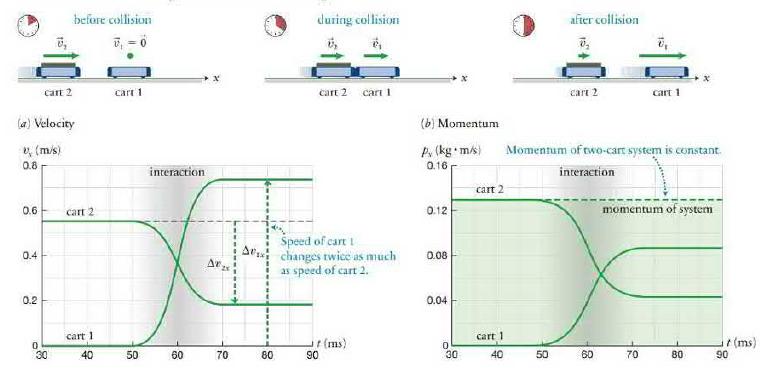
Two carts are about to collide head-on on a track. The inertia of cart 1 is greater than the inertia of cart 2, and the collision is elastic. The speed of cart 1 before the collision is higher than the speed of cart 2 before the collision. (a) Which cart experiences the greater acceleration during
Which of the following deformations are reversible and which are irreversible:(a) the deformation of a tennis ball against a racquet, \((b)\) the deformation of a car fender during a traffic accident,(c) the deformation of a balloon as it is blown up, \((d)\) the deformation of fresh snow as you
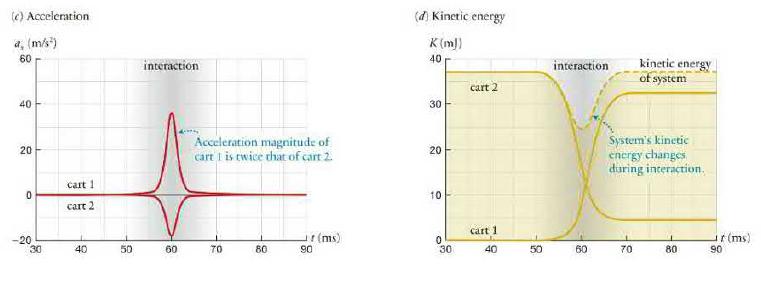
Translate the kinetic energy graph in Figure 7. 2 into three sets of energy bars: before the collision, during the collision, and after the collision. In each set, include a bar for \(K_{1}\), a bar for \(K_{2}\), and a bar for the internal energy of the system, and assume that the system is
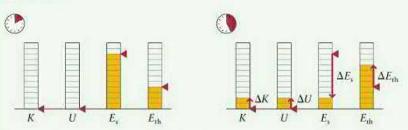
Describe a scenario to fit the energy bars shown in Figure 7. 22. What happens during the interaction?Data from Figure 7. 22 AE, AE LLEF AK AU K U E E K U E, E
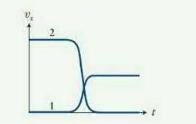
Describe a scenario to fit the velocity-versus-time curves for two colliding objects shown in Figure 7. 23. All motion is confined to the \(x\) axis. What happens to the initial energy of the system of colliding objects during the interaction?Data from Figure 7. 23
A truck is traveling at a constant \(25 \mathrm{~m} / \mathrm{s}\) when a motorcycle speeds past at a constant \(40 \mathrm{~m} / \mathrm{s}\). On which vehicle, if either, is the magnitude of the vector sum of forces exerted on the vehicle greater?
You wish to move a crate. (a) Is there a minimum value for the magnitude of the pushing force you have to exert to set the crate in motion? (b) Is there a minimum value for the magnitude of the vector sum of forces that must be exerted on the crate to set it in motion?
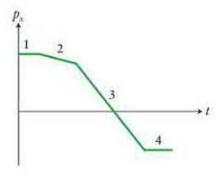
Sketch the \(\sum F_{x}(t)\) curve for the vector sum of forces exerted on the object whose \(x\) component of momentum is plotted in Figure P8.3. Curve sections are numbered for reference.Data from Figure P8.3 2
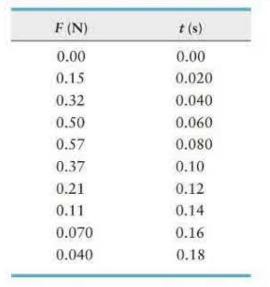
The \(x\) component of the vector sum of forces exerted on a cart moving on a low-friction track is measured in the laboratory with the aid of a spring-loaded sensor and a monitoring computer. From the data in the table, sketch the \(\Sigma F_{x}(t)\) curve of the cart and use your graph to
If a single known force is exerted on an object of unknown initial velocity for a certain time interval, you know the change in the object's momentum. However, you don't know its change in kinetic energy. Why not?
Consider a coal mining cart being loaded with coal as it moves along a horizontal track. Suppose that a tractor exerts a constant horizontal force on this cart. Is there any situation in which the cart-coal system would not accelerate?
A worker pushes a box in a factory. In each case, decide which force has the greater magnitude: the force exerted by the worker on the box or the force exerted by the box on the worker. (a) The box is heavy and does not move no matter how hard the worker pushes. (b) Some contents are removed, and
In many science fiction movies, someone is portrayed moving something with her or his mind-an amazing feat called telekinesis. What does your knowledge of forces predict about the effect of a telekinetic event on the gifted person?
Which of the following can exert a force: \((a)\) a hammer,(b) a nail,(c) a person,(d) a chair, \((e)\) a ship, \((f)\) water, (g) Earth?
During a tennis volley, a ball that arrives at a player at \(40 \mathrm{~m} / \mathrm{s}\) is struck by the racquet and returned at \(40 \mathrm{~m} / \mathrm{s}\). The other player, realizing that the ball is out of bounds, catches it in her hand. Assuming the time interval of contact is the same
A pitcher throws a fastball toward home plate. (a) When the ball is halfway to the plate, is the pitcher's push still exerted on the ball? (b) What forces, if any, are exerted on the ball at the halfway location?
A car's acceleration forward must be due to a force exerted on the car, and the only thing that can push forward on the car is the road (in contact with the tires). So, what purpose does the engine have?
A baby is bouncing in a seat fastened by an elastic cord to a hook on the ceiling. At the top of his bounce, his velocity is instantaneously zero. Is the vector sum of forces exerted on him at that instant zero? Why or why not?
(a) Can an object ever exert both a contact force and a field force on another object? (b) Can an object ever exert a contact force on something without exerting a field force on that same object?
You push on a refrigerator, but it doesn't move. Explain why not.
You are discussing physics homework with a friend while the two of you are riding your bikes. Distracted, you collide with a parked car. The car doesn't move. Your friend says, "Of course not! The force of the collision wasn't enough to overcome the inertia of the car." How do you respond?
What interaction does a bathroom (spring) scale actually measure?
A table sits on the floor, and a vase containing water and flowers sits on top of the table. All objects are at rest. Identify all forces exerted on the table, and describe how these forces are related.
You are in a stationary elevator, so that the contact force exerted by the floor on you is equal in magnitude to the force of gravity exerted on you. When the elevator starts downward, which force changes? What happens to its magnitude?
When you are standing motionless on the ground, your feet exert a force on Earth. Why doesn't Earth move away from you?
You push on a crate, and it starts to move-but you don't. Draw a free-body diagram for you and one for the crate; show only the horizontal forces. Then use the diagrams and your knowledge about forces and interactions to explain why the crate moves but you don't.
The force of air resistance on any object falling through the air increases with the object's speed. What happens to the acceleration of a raindrop as it falls from a cloud?
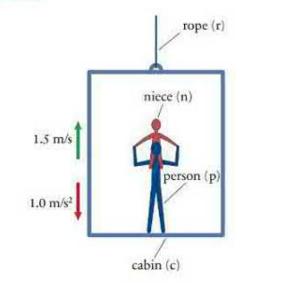
You are carrying your 3-year-old niece on your shoulders in an elevator cabin that is moving upward with velocity \(1.5 \mathrm{~m} / \mathrm{s}\) and constant downward acceleration of \(1.0 \mathrm{~m} / \mathrm{s}^{2}\) (Figure P8.23). Your inertia is \(50 \mathrm{~kg}\), your niece's inertia is
A delivery person in an elevator is holding a package by an elastic cord. (Don't ask why.) (a) What happens to the length of the cord when the elevator accelerates upward? Draw the free-body diagram for the package in this case. (b) What happens to the cord length when the elevator slows to a stop
Suppose a rope that is hanging by one end from the ceiling has a large inertia. Is the tension in the rope uniform throughout the length?
Walking beside a pasture, you and a fellow student see a farmer pulling a mule with a rope and getting nowhere. Your friend says, "The force with which the mule is pulling on the rope has the same magnitude as the force with which the farmer is pulling on the rope, but the two forces point in
In a game of tug of war, the blue team is beating the red team, and the red team is accelerating toward the mud pit between the two teams. Which has the greater magnitude, if either: the force the blue team exerts on the rope or the force the red team exerts on the rope? Assume that the
The standard coupling between railroad cars must be capable of withstanding the maximum tensile force exerted on any coupling in a given train. (a) If a locomotive is pulling ten cars and speeding up, on which coupling is the greatest tensile force exerted? (b) Is this tensile force due to
In an electric breakdown in air (a spark), an electron (inertia \(9.11 \times 10^{-31} \mathrm{~kg}\) ) experiences an electric force of \(4.83 \times 10^{-13} \mathrm{~N}\). What is the magnitude of the electron's acceleration?
A \(2.3-\mathrm{kg}\) object experiences a single, time-dependent force \(F_{x}(t)=(10 \mathrm{~N} / \mathrm{s}) t-(20 \mathrm{~N})\). What is the object's acceleration at \(t=0,2.0 \mathrm{~s}\), and \(4.0 \mathrm{~s}\) ?
Is it possible to figure out an object's past motion if you know its present position and velocity and the history of all the forces exerted on it?
The force exerted by expanding gases is what propels a shell out of a gun barrel. Suppose a force that has an average magnitude \(F\) propels the shell so that it has a speed \(v\) at the instant it reaches the end of the barrel. What magnitude force is required to double the speed of the shell in
A \(50-\mathrm{kg}\) pneumatic hammer is fitted with a shock absorber at the top to lessen the impact on the worker. The vertical displacement of the hammer as a function of time is given by \(x(t)=a t^{2}-b t^{3}\) (during the hammer's bounce), where \(a=15 \mathrm{~m} / \mathrm{s}^{2}\) and
You push with a steady force of \(19 \mathrm{~N}\) on a \(48-\mathrm{kg}\) desk fitted with casters (wheels that swivel) on its four feet. How long does it take you to move the desk \(5.9 \mathrm{~m}\) across a warehouse floor?
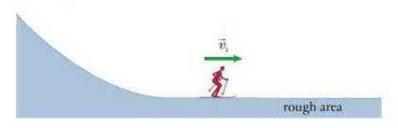
In Figure P8.35, a \(50-\mathrm{kg}\) skier heads down a slope, reaching a speed of \(35 \mathrm{~km} / \mathrm{h}\). She then slides across a horizontal snow field but hits a rough area. Assume the snow before the rough area is so slippery that you can ignore any friction between the skis and the
A \(2.34-\mathrm{kg}\) cart on a long, level, low-friction track is heading for a small electric fan at \(0.23 \mathrm{~m} / \mathrm{s}\). The fan, which was initially off, is turned on. As the fan speeds up, the magnitude of the force it exerts on the cart is given by \(a t^{2}\), where \(a=0.0200
What is the magnitude of the gravitational force exerted by Earth on a \(1.0 \mathrm{~kg}\) brick when the brick is \((a)\) in free fall and \((b)\) resting on a table?
Estimate the magnitude of the force of gravity exerted on(a) a packet of sugar,(b) a cup of water,(c) a packed carryon suitcase, \((d)\) an adult gorilla, and(e) a midsize car.
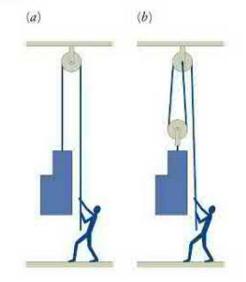
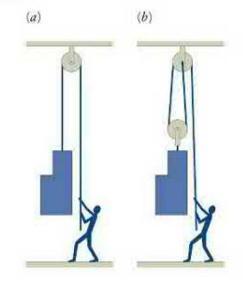
The magnitude of the gravitational force exerted on the piano in Figure P8.39 is 1500 N. With how much force do you have to pull on the rope in order to hold up the piano \((a)\) with the single pulley and \((b)\) with the double pulley?Data from Figure P8.39 (a) (b)
The piano in Figure P8.39 is being lowered with an acceleration of magnitude exactly \(g / 8\). To maintain this acceleration, with what force magnitude must the person pull on the rope \((a)\) with the single pulley and \((b)\) with the double pulley?Data from Figure P8.39 (a) (b)
If the force of gravity exerted by Earth on a fully suited astronaut at Earth's surface is \(1960 \mathrm{~N}\), what is the magnitude of the gravitational force exerted on her \((a)\) on Jupiter, where the acceleration due to gravity is \(25.9 \mathrm{~m} / \mathrm{s}^{2}\), and \((b)\) on the
You are climbing a rope straight up toward the ceiling. (a) What are the magnitude and direction of the force you must exert on the rope in order to accelerate upward at \(1.5 \mathrm{~m} / \mathrm{s}^{2}\), assuming your inertia is \(60 \mathrm{~kg}\) ? (b) If the maximum tension the rope can
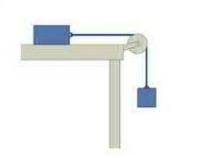
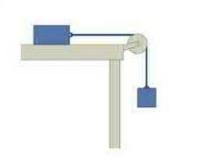
Two blocks are tied together by a cord draped over a pulley (Figure P8.43). (a) At first, the block on the table does not slip. How does the tension in the cord compare with the gravitational force exerted on the hanging block? \((b)\) You tip the table a bit, and the block on the table begins to
Assume that the block on the table in Figure P8.43 has twice the inertia of the hanging block. (a) You give the block on the table a push to the right so that it starts to move. If the magnitude of the frictional force exerted by the table on the block is half the magnitude of the gravitational
Assume that the block on the table in Figure P8.43 has half the inertia of the hanging block. (a) You push the block on the table to the right so that it starts to move. If the magnitude of the frictional force exerted by the table on the table block is half the magnitude of the gravitational force
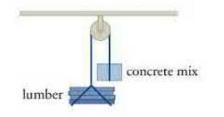
A bag of concrete mix is tied to one end of a rope that is looped over a pulley attached to the ceiling, and the other end of the rope is tied to a pallet of lumber (Figure P8.46), The concrete mix has a greater inertia than the lumber. When both loads are released from rest so that the system is
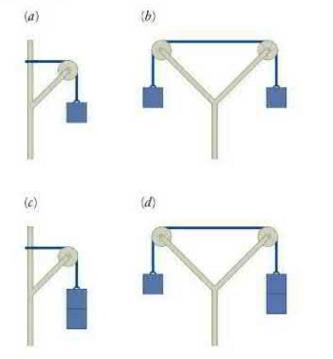
All blocks in Figure P8.47 are identical and you can ignore any friction in the pulleys. Rank the configurations in increasing order of tension in the rope. (Use free-body diagrams.)Data from Figure P8.47 (a) (b) (c) (d)
Picture an object in free fall. If the leading face of the object (which means the face closest to the ground) has a large surface area, air resistance becomes important. For low speeds, the force due to air resistance may be approximated as proportional to the object's velocity according to the
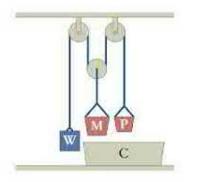
At a munitions factory, chemicals \(M\) and \(P\) have to be added to a vat containing chemical \(\mathrm{C}\). Chemicals \(\mathrm{M}\) and \(\mathrm{P}\) have to be added simultaneously to prevent an accidental detonation. Your task, as the chemical engincer in charge, is to come up with a way of
A \(66-\mathrm{kg}\) person experiences a gravitational force of about \(660 \mathrm{~N}\). Yet, if this person were to jump onto a spring scale, the scale would briefly read about \(2400 \mathrm{~N}\). Why does the scale register a force so much larger than the gravitational force exerted on the
A \(20-\mathrm{kg}\) child stands in the center of a trampoline. (a) If the trampoline center is \(0.11 \mathrm{~m}\) lower than before she got on, what is the spring constant of the trampoline? (b) Assuming the trampoline acts like a spring, how low would her \(75-\mathrm{kg}\) father sink if he
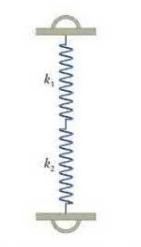
Two springs have spring constants \(k_{1}\) and \(k_{2}>k_{1}\). Connected as shown in Figure P8.52, they act like one spring. Compute the spring constant of the combination, and determine whether it is smaller than \(k_{1}\), cqual to \(k_{1}\), between \(k_{1}\) and \(k_{2}\), equal to
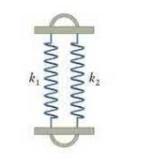
Two springs have spring constants \(k_{1}\) and \(k_{2}>k_{1}\). Connected as shown in Figure P8.53, they act like one spring. Compute the spring constant of the combination. Is the combination smaller than \(k_{1}\), equal to \(k_{1}\), between \(k_{1}\) and \(k_{2}\), equal to \(k_{2}\), or
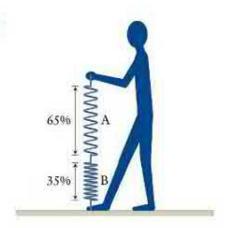
Two springs are hooked together end to end. When a \(4.0-\mathrm{kg}\) brick is suspended from one end of the combination, the combination stretches \(0.15 \mathrm{~m}\) beyond its relaxed length. (a) What is the spring constant of the combination? (b) If the top spring stretches \(0.10
When a \(5.0-\mathrm{kg}\) box is hung from a spring, the spring stretches to \(50 \mathrm{~mm}\) beyond its relaxed length. In an elevator accelerating upward at \(2.0 \mathrm{~m} / \mathrm{s}^{2}\), how far does the spring stretch with the same box attached?
Suppose that when you lie on your bed, your body is supported by 30 of the springs in the mattress. Assuming that all the springs are identical and that your body presses on each spring equally, estimate their spring constant. (Experiment: Lie on your bed and see how far down you sink.)
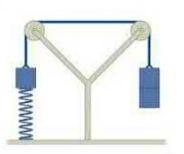
In the modified Atwood machine shown in Figure P8.57, each of the three blocks has the same inertia \(m\). One end of the vertical spring, which has spring constant \(k\), is attached to the single block, and the other end of the spring is fixed to the floor. The positions of the blocks are
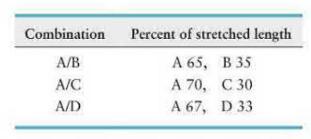
Your boss hands you a bag containing four springs, A, B, C, and D, and tells you that they all have the same relaxed length. He wants you to rank them by the values of their spring constants. He locks you in a room with only the springs, a ruler, and a pad and pencil, and tells you to knock when
A \(5.0-\mathrm{kg}\) red book is suspended from a spring attached to the ceiling of an elevator that is accelerating downward. Attaching the book causes the spring to stretch \(71 \mathrm{~mm}\) beyond its relaxed length. You also have a yellow book of unknown inertia. When you attach the yellow
Why does a dropped dinner plate break when it lands on a tile floor but not when it lands on carpet?
If you try to pound a nail into a board with a \(2.5-\mathrm{kg}\) rubber mallet, you will have less luck than if you use a 0. 8 kg steel hammer. Why?
In a baseball game, a batter hits the \(0.150-\mathrm{kg}\) ball straight back at the pitcher at \(180 \mathrm{~km} / \mathrm{h}\). If the ball is traveling at \(160 \mathrm{~km} / \mathrm{h}\) just before it reaches the bat, what is the average force exerted by the bat on it if the collision lasts
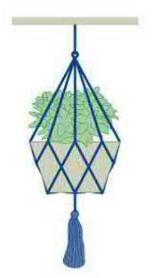
In Figure P8.63, a heavy potted plant hangs by an enveloping hanger made of heavy yarn. (a) If you pull slowly on the tassel at the bottom, where is the hanger most likely to break? Why? (b) If you yank quickly on the tassel, where is the hanger most likely to break?Data from Figure P8.63
Estimate the impulse delivered by a hammer to a nail being driven into a wood plank.
A \(1500-\mathrm{kg}\) car goes from 0 to \(100 \mathrm{~km} / \mathrm{h}\) in \(60 \mathrm{~s}\). (a) What is the impulse delivered to the car? (b) What is the average vector sum of forces exerted on the car?
A horizontal force \(F_{\text {slide }}\) is exerted on a \(5.0-\mathrm{kg}\) box sliding on a polished floor. As the box moves, the magnitude of \(F_{\text {slide }}\) increases smoothly from 0 to \(5.0 \mathrm{~N}\) in \(5.0 \mathrm{~s}\). What is the box's speed at \(t=5.0 \mathrm{~s}(a)\) if it
Just before hitting the ground, a partially inflated \(0.625-\mathrm{kg}\) basketball has a speed of \(3.30 \mathrm{~m} / \mathrm{s}\). Then it loses half of its kinetic energy as it bounces. (a) What is the ball's speed immediately after it bounces? (b) If the ball is in contact with the ground
A \(1.2-\mathrm{kg}\) ball dropped from a height of \(3.0 \mathrm{~m}\) onto a steel plate rigidly attached to the ground bounces back up to a height of \(2.5 \mathrm{~m}\). (a) What is the impulse delivered to the ball by the plate? (b) What is the coefficient of restitution of the collision?
A \(0.050-\mathrm{kg}\) egg falls off a table that is \(1.0 \mathrm{~m}\) high and lands on a tile floor. (a) What is the impulse delivered to the egg by the floor? (b) The egg lands on its side, and at the instant of impact the part of the shell farthest from the floor is \(40 \mathrm{~mm}\) above
When it crashes into a bridge support that does not move, a car goes from \(80 \mathrm{~km} / \mathrm{h}\) to 0 in \(1.23 \mathrm{~m}\). (a) What is the impulse delivered to the \(70-\mathrm{kg}\) driver by the seat belt, assuming the belt makes the driver's motion identical to the car's motion?
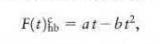
A volleyball player serves the ball. The \(0.27-\mathrm{kg}\) ball was moving straight up and is at the high point of its trajectory when she hits it in a purely horizontal direction. The magnitude of the force exerted on the ball while her hand is in contact with it is given bywhere \(a=3.0 \times
A \(70-\mathrm{kg}\) student is falling toward Earth. (a) Draw one free-body diagram for Earth and one for the student. Assume that air resistance can be ignored. (b) Calculate the student's acceleration and the vector sum of forces exerted on him. (c) Earth's inertia is \(5.97 \times 10^{24}
Two \(5.00-\mathrm{kg}\) carts, one red and the other green, are \(1.00 \mathrm{~m}\) apart on a surface where either cart experiences a constant frictional force of \(5.00 \mathrm{~N}\) when it moves. Throughout the problem, the red cart is pushed with a constant force of \(12.0 \mathrm{~N}\)
Two \(0.500-\mathrm{kg}\) carts are \(100 \mathrm{~mm}\) apart on a low-friction track. You push one of the carts with a constant force of \(2.00 \mathrm{~N}\) directed so that the cart you push moves away from the other cart. Determine the acceleration of the center of mass of the two-cart system
A force of magnitude \(F\) is exerted on the leftmost face of two blocks sitting next to each other on a slippery surface, with two of their faces touching. The inertia of the block on the right is \(m\), and the inertia of the block on the left is \(2 \mathrm{~m}\).(a) What is the magnitude of the
A \(2.0-\mathrm{kg}\) cart and an \(8.0-\mathrm{kg}\) cart are connected by a relaxed, horizontal spring of spring constant \(300 \mathrm{~N} / \mathrm{m}\). You pull the \(8.0-\mathrm{kg}\) cart with some constant horizontal force. The separation between the carts increases for a short time
A \(1500-\mathrm{kg}\) truck and a \(1000-\mathrm{kg}\) car are parked with their rear bumpers nearly touching each other in a level parking lot. Both vehicles have their brakes off so that they are free to roll. A man sitting on the rear bumper of the truck exerts a constant horizontal force on
A \(70-\mathrm{kg}\) skier is being towed on a rope behind a \(450-\mathrm{kg}\) snowmobile on a smooth, snow-covered surface at \(10 \mathrm{~m} / \mathrm{s}\) when the snowmobile hits a patch of muddy ground that brings it to a halt in \(10 \mathrm{~m}\). (a) What is the average acceleration of
A \(4.0-\mathrm{kg}\) block and a \(2.0-\mathrm{kg}\) block are connected to opposite ends of a relaxed spring of spring constant \(300 \mathrm{~N} / \mathrm{m}\). The blocks are pushed toward each other for \(0.50 \mathrm{~s}\). The \(4.0-\mathrm{kg}\) block is pushed with a force of \(50
You push your \(0.70-\mathrm{kg}\) pillow across your bed with a constant force of \(10 \mathrm{~N}\). The bed provides a frictional force of \(6.0 \mathrm{~N}\). What is the acceleration of the center of mass of the pillow?
You and a child are standing on a bathroom scale, which uses compression of a spring to measure the force exerted by your feet on the scale. What happens to the scale reading as you lift the child onto your shoulders?
You build a \(2.0-\mathrm{kg}\) mound of mashed potatoes on a kitchen scale (which is a spring scale). You then use a large spoon to press on the top of the mound at a constant force of \(3.0 \mathrm{~N}\). While you are doing this, the scale reading increases by \(5.0 \%\). (a) What is the
You use a rope of length \(\ell\) to tie the front of a \(1500-\mathrm{kg}\) truck to the rear of a \(1000-\mathrm{kg}\) car and then use an identical rope of length \(\ell\) to tie the front of the car to the rear of a \(500-\mathrm{kg}\) trailer. Each rope will break if its tension exceeds \(2000
A tugboat pulls two barges down the river. The barge connected to the tugboat, carrying coal, has an inertia of \(2.0 \times 10^{5} \mathrm{~kg}\), and the other barge, carrying pig iron, has an inertia of \(3.0 \times 10^{5} \mathrm{~kg}\). The resistive force between the coal barge and the water
A farmer is trying to haul three \(500-\mathrm{kg}\) trailers connected together with identical ropes that will break if their tension exceeds \(2000 \mathrm{~N}\). The first trailer is connected to his tractor with a rigid hitch. (a) If the tractor has to overcome a frictional force of \(900
A train engine is pulling four boxcars, each of inertia \(m\). The engine can exert a force of magnitude \(F\) on what it is pulling. Assuming that friction can be ignored, what is the tension in each of the four couplers as the train starts off?
A red \(10-\mathrm{kg}\) cart is connected to a \(20-\mathrm{kg}\) cart by a relaxed spring of spring constant \(60 \mathrm{~N} / \mathrm{m}\). The \(20-\mathrm{kg}\) cart is resting against another \(10-\mathrm{kg}\) cart, this one blue. All are on a low-friction track. You push the red
A toy wagon initially at rest is pulled by a child from one end of a driveway to the other end. The magnitude of the force the wagon exerts on the child is the same as the magnitude of the force the child exerts on the wagon. So, how does the child get the wagon moving?
In years past, car frames were built as stiff as possible, but today's cars are built with "crumple zones" in the front and rear portions of the frame. What is the purpose of this design change?
A \(60-\mathrm{kg}\) student is in an elevator moving downward with constant velocity. He uses a bathroom scale to measure the upward force exerted on his feet. What force magnitude does the scale read \((a)\) when the elevator is traveling at constant velocity, \((b)\) when the elevator slows to a
Showing 4100 - 4200
of 4962
First
35
36
37
38
39
40
41
42
43
44
45
46
47
48
49
Last
Step by Step Answers

 Get 50% OFF
Claim Now
Get 50% OFF
Claim Now