New Semester
Started
Get
50% OFF
Study Help!
--h --m --s
Claim Now
Question Answers
Textbooks
Find textbooks, questions and answers
Oops, something went wrong!
Change your search query and then try again
S
Books
FREE
Study Help
Expert Questions
Accounting
General Management
Mathematics
Finance
Organizational Behaviour
Law
Physics
Operating System
Management Leadership
Sociology
Programming
Marketing
Database
Computer Network
Economics
Textbooks Solutions
Accounting
Managerial Accounting
Management Leadership
Cost Accounting
Statistics
Business Law
Corporate Finance
Finance
Economics
Auditing
Tutors
Online Tutors
Find a Tutor
Hire a Tutor
Become a Tutor
AI Tutor
AI Study Planner
NEW
Sell Books
Search
Search
Sign In
Register
study help
physics
particle physics
Principles And Practice Of Physics 2nd Edition Eric Mazur - Solutions
Having seen in Example 10. 6 that there is a simple expression for the horizontal range of a projectile across level ground, you begin to wonder whether there is an expression for the horizontal range of an object that is thrown with initial speed \(v_{1}\) at an angle \(\theta\) above the
You have inherited property in Vermont that would make an excellent ski resort. One of the slopes has a cliff on the other side of the hill, and this gives you a moneysaving idea. Instead of a chair lift or motorized tow rope, you decide to attach a pulley to the top of the cliff and then drape the
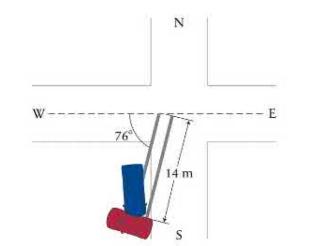
You are investigating a rural accident. The evidence at the scene suggests that a car was traveling west when struck by a van traveling south. The crushed vehicles stuck together, then came to rest at the end of skid marks of length \(14 \mathrm{~m}\) along a \(76^{\circ}\) line as shown in Figure
A \(0.45-\mathrm{kg}\) soccer ball is kicked at an angle \(\theta\) above the ground with initial speed \(v_{\mathrm{i}}\). (a) Determine the height of the ball as a function of the horizontal distance it travels down the field. (b) For \(\theta=30^{\circ}\), what initial speed must the ball have
A ballistic pendulum is a device for measuring bullet speeds. One of the simplest versions consists of a block of wood hanging from two long cords. (Two cords are used so that the bottom face of the block remains parallel to the floor as the block swings upward.) A 9. 5-g bullet is fired into a
A \(0.010-\mathrm{kg}\) bullet traveling at \(300 \mathrm{~m} / \mathrm{s}\) hits a \(2.0-\mathrm{kg}\) ballistic pendulum like the one described in Problem 110. However, the block is not thick enough for this bullet, and the bullet passes through the block, exiting with onethird of its original
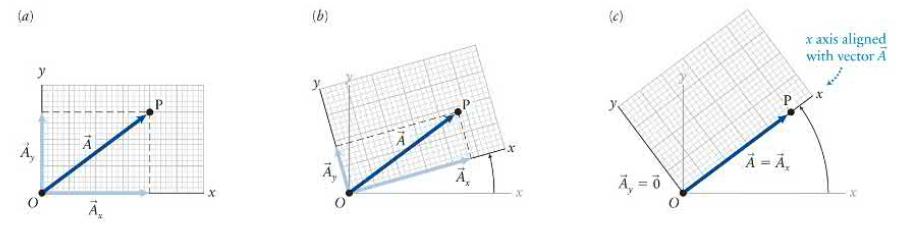
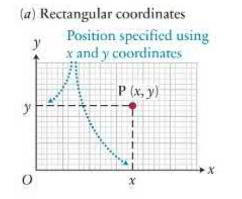
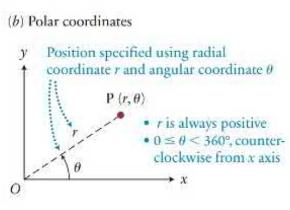
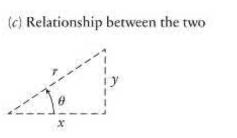
If each major grid unit in Figure 10.9 corresponds to \(1 \mathrm{~m}\), specify the location of point \(\mathrm{P}\) in terms of its \(x\) and \(y\) coordinates in each of the three coordinate systems.Data from Figure 10.9 (a) A y x A (b) A A A = A = A x axis aligned with vector A X
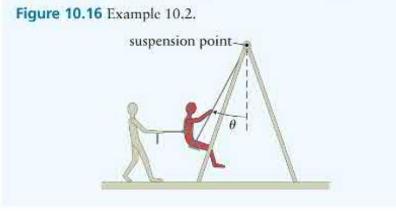
Using a rope, you pull a friend sitting on a swing (Figure 10.16). (a) As you increase the angle \(\theta\), does the magnitude of the force \(\vec{F}_{\mathrm{rp}}^{c}\) required to hold your friend in place increase or decrease? (b) Is the magnitude of that force larger than, equal to, or smaller
If each major grid unit in Figure 10.27 corresponds to \(1 \mathrm{~m}\), specify the location of point \(\mathrm{P}\) in polar coordinates.Data from Figure 10.27 (a) Rectangular coordinates y Position specified using x and y coordinates P(x, y) y 0 x x
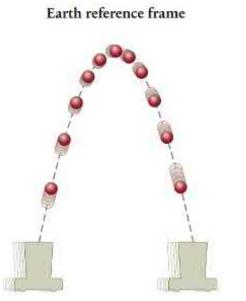
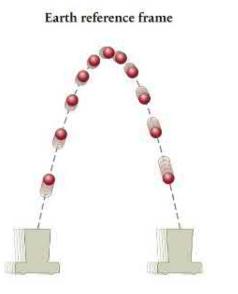
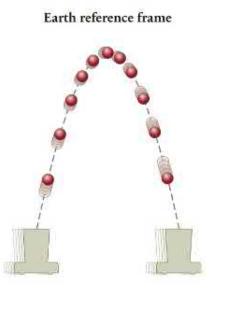
The ball of Figure 10.32 is launched from the origin of an \(x y\) coordinate system. Write expressions giving, at the top of its trajectory, the ball's rectangular coordinates in terms of the components of its initial speed \(v_{\mathrm{i}}\) and the acceleration due to gravity \(g\).Data from
How far from the launch position is the position at which the ball of Figure 10.32 is once again back in the cart? (This distance is called the horizontal range of the projectile.)Data from Figure 10.32 Earth reference frame
Pucks 1 and 2 slide on ice and collide. The inertia of puck 2 is twice that of puck 1 . Puck 1 initially moves at \(1.8 \mathrm{~m} / \mathrm{s}\); puck 2 initially moves at \(0.20 \mathrm{~m} / \mathrm{s}\) in a direction that makes an angle of \(45^{\circ}\) with the direction of puck 1 . After
A hiker is helping a friend up a hill that makes an angle of \(30^{\circ}\) with level ground. The hiker, who is farther up the hill, is pulling on a cable attached to his friend. The cable is parallel to the hill so that it also makes an angle of \(30^{\circ}\) with the horizontal. If the
While designing a conveyor belt system for a new airport, you determine that, when a typical suitcase is moving up an incline of \(20^{\circ}\), the magnitude of the maximum forward acceleration a rubber belt can give such a suitcase before the suitcase begins slipping is \(4.0 \mathrm{~m} /
In the diagrams in Figure 10. 22, the velocity of an object is given along with the vector representing a force exerted on the object. For each case, determine whether the object's speed increases, decreases, or remains constant. Also determine whether the object's direction changes in the
Draw the sum \(\vec{A}+\vec{B}\) and the difference \(\vec{A}-\vec{B}\) of each vector pair in Figure 10. 23 .Data from Figure 10. 23 88 (a) (9) L 189 (c) 109 F V 100 B (P)
Each diagram in Figure 10. 24 indicates the momentum of an object before and after a single force is exerted on it. For each case determine the direction of the force.Data from Figure 10. 24 (a) TA Pi (b) Pe (d) Pe P Pe
While driving to school, you place your coffee cup on the dashboard. Which type of force of friction allows the cup to stay put on the dashboard when the car speeds up? Does this force do any work on the cup?
A mosquito splatters onto the windshield of a moving bus and sticks to the glass. (a) During the collision, is the magnitude of the change in the mosquito's momentum smaller than, larger than, or equal to the magnitude of the change in the bus's momentum? (b) During the collision, is the magnitude
Identify all the forces exerted on the italicized object in each situation: (a) A book is lying on top of a magazine on a table. (b) A ball moves along a trajectory through the air. (c) A person is sitting on a chair on the floor of a room. (d) A magnet floats above another magnet that is lying on
Draw a free-body diagram for a book lying motionless on the floor.
Consider a person hanging motionless from a ring suspended from a cable, with the person's feet not touching the floor. Draw a free-body diagram for the ring.
A woman stands in an elevator that is accelerating upward. Draw a free-body diagram for her.
If two people, \(A\) and \(B\), pull on opposite ends of a rope that is at rest, each exerting a horizontal tensile force of magnitude \(F\), the tension in the rope is \(\mathcal{T}=F\). Suppose instead that one end of the rope is tied to a tree and A pulls on the other end by himself with the
A person is sitting on a stool in an elevator. The forces exerted on the stool are a downward force of magnitude \(60 \mathrm{~N}\) exerted by Earth, a downward force of magnitude \(780 \mathrm{~N}\) exerted by the person, and an upward force of magnitude \(850 \mathrm{~N}\) exerted by the elevator
A tennis ball of inertia \(0.20 \mathrm{~kg}\) is launched straight up in the air by hitting it with a racquet. If the magnitude of the acceleration of the ball while it is in contact with the racquet is \(9 \mathrm{~g}\), what are the magnitude and direction of the force exerted by the racquet on
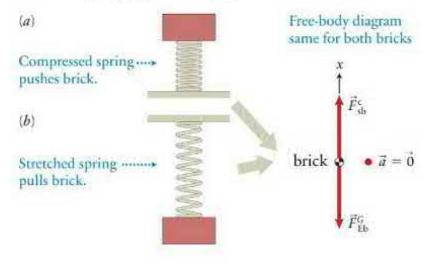
A book of inertia \(1.2 \mathrm{~kg}\) is placed on top of the spring in Figure 8.18. What is the displacement of the top end of the spring from the relaxed position when the book is at rest on top of the spring?Data from Figure 8.18 (a) Compressed spring..... pushes brick. Free-body diagram same
(a) Two forces, one twice the magnitude of the other, are exerted on identical objects during the same time interval. Which force causes the greater change in momentum? (Assume that no other forces act on the objects.) (b) Two identical forces are exerted on identical objects, one during a time
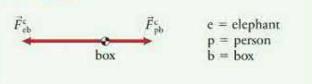
The free-body diagram of a box subjected to forces is shown in Figure 8. 13. Because we are concerned about only the horizontal motion, the forces in the vertical direction have been omitted.(a) What is the direction of the change in the momentum of the box? (b) If the box is at rest before the
A block of wood rests on a shelf, and a second block of wood rests on top of the first. (a) List the objects in the environment of the top block. (b) List the objects in the environment of the bottom block. (c) Draw a free-body diagram for each block.
Complete the following sentences, applying the reciprocity of forces. (Example: If I push down on the seat of my chair, the seat of my chair pushes up on me.)If I push to the right on the wall, . . . If I pull to the right on a spring, ...If the floor pushes up on my feet, . . . If Earth pulls down
If an impulse is delivered to a system, is work necessarily done on the system?
Hitting a door with your bare fist hurts more than hitting a sofa cushion. In work terms, explain why this is so.
If you drop a brick from a height of \(50 \mathrm{~mm}\) onto your toe, it probably won't hurt much, but if you drop the brick from a height of \(0.5 \mathrm{~m}\), it will hurt. The force of gravity exerted on the brick is the same in both cases. Explain why it hurts more from the increased height.
An object moves with constant velocity. What can you say about the work done on a system that includes only this object?
You hold a small steel ball in your hand above a laundry basket. Then you throw it straight up and watch as it rises, falls, and comes to rest in the pile of dirty laundry. Ignoring friction, discuss the forces exerted on the ball, the force displacements associated with those forces, and the work
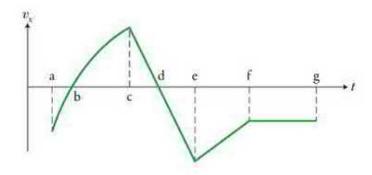
The \(x\) component of velocity of a particle as a function of time is shown in Figure P9.6. Over what intervals is the work done on the particle \((a)\) positive, \((b)\) negative, (c) zero?Data from Figure P9.6 9 d e
When you stand up from a seated position, you push down with your legs. Does this mean you do negative work when you stand up?
Mountain climbers know that it is harder to hike down a hill than to walk on level ground. Why is this so?
As a car accelerates from rest to highway speed, a pedestrian watching the motion sees positive work done on the car because its kinetic energy increases. However, from the reference frame of someone driving in the same direction at highway speed, the car is initially moving (backward) and then
A system consists of two interacting particles 1 and 2 , with particle 1 confined to an \(x\) axis and the system in equilibrium when particle 1 is at a given position on that axis. If displacing particle 1 in either direction from this position requires positive work to be done on the system by an
Does work done on a system necessarily change the system's kinetic energy?
Taking off on a runway, a small jet experiences a forward force of \(90,000 \mathrm{~N}\) exerted by the engine and a backward force of \(16,000 \mathrm{~N}\) exerted by the air. Choose a system and draw an energy diagram using the beginning and end of the runway as your initial and final positions.
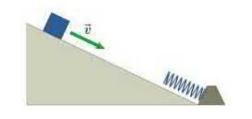
A block launched at speed \(v\) down an incline slides down the incline (there is friction between the block and incline) and into a spring (Figure P9.13), where it slows to zero speed as the spring compresses. (a) Draw an energy diagram for this process using a system consisting of the block,
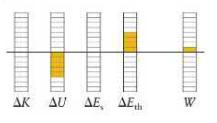
What, if anything, is wrong in the energy diagram in Figure P9.14 for a system comprising Earth, an inclined plane, and a block sliding along the incline? The block slides down the incline at constant speed. The only forces exerted on the block are the force of gravity and friction with the
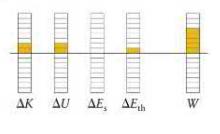
What possible scenario is described by the energy diagram in Figure P9.15?Data from Figure P9.15 AK AU , W
You are lifting a ball at constant velocity.(a) When the system is the ball, is work done on the system? If so, by what agent \((s)\) ? \((b)\) Describe the potential energy of this system during the lift.(c) When the system comprises the ball and Earth, is work done on the system? If so, by what
You throw a ball straight up into the air. If air resistance affects the motion of the ball, which takes longer: the upward trip or the downward trip? Analyze using three different systems.
A tomato is launched vertically from a spring-loaded toy cannon placed on the pavement. The tomato rises to some maximum height and then falls back, but you have removed the cannon so that the tomato splats on the pavement. Discuss the energy conversions during this process using the following
A ball in motion collides elastically with an identical ball at rest. If we treat each ball as a separate system, is the work done on each ball the same?
How much work does gravity do on a \(2.0-\mathrm{mg}\) raindrop as the drop falls to the ground from a cloud \(2000 \mathrm{~m}\) above the ground?
At the end of a delivery ramp, a skid pad exerts a constant force on a package so that the package comes to rest in a distance \(d\). When the pad is replaced by one that requires a distance of \(2 d\) to stop the same package, what happens to the length of time it takes for the package to stop?
At the end of a delivery ramp, a skid pad exerts a constant force on a package so that the package comes to rest in a distance \(d\). The ramp is changed so that the same package arrives at the skid pad at a higher speed and the stopping distance is \(2 d\). What happens to the time interval
A \(55-\mathrm{kg}\) acrobat must jump high and land on his brother's shoulders. To accomplish this, he leaps from a crouched position to a height where his center of mass is \(1.20 \mathrm{~m}\) above the ground. His center of mass is \(400 \mathrm{~mm}\) above the ground in the crouch and \(900
A beetle that has an inertia of \(4.0 \times 10^{-6} \mathrm{~kg}\) sits on the floor. It jumps by using its muscles to push against the floor and raise its center of mass. (a) If its center of mass rises \(0.75 \mathrm{~mm}\) while it is pushing against the floor and then continues to travel up to
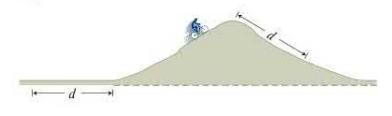
A bicyclist pedals a distance \(d\) at constant speed on a level stretch of road. She then pedals up a hill and passes slowly over the top. As she coasts down the other side of the hill, she applies the brakes and comes to a stop when she is a distance \(d\) past the top (Figure P9.25). Choose an
In emergency braking, a certain car requires \(7.0 \mathrm{~m}\) to come to a stop from an initial speed of \(10 \mathrm{~m} / \mathrm{s}\). Use an argument based on work done on the car to determine the braking distance required if the car's initial speed is \(30 \mathrm{~m} / \mathrm{s}\).
At instant \(t_{0}\), you are sitting on a dock and you begin using a rope to lower a \(4.0-\mathrm{kg}\) lobster trap into the water, \(1.4 \mathrm{~m}\) below. You lower the trap at a constant speed of \(1.0 \mathrm{~m} / \mathrm{s}\). At instant \(t_{1}\) it just reaches the water surface \(1.4
A 1. 1-kg lobster climbs into the trap of Problem 27, and at instant \(t_{3}\) you begin to haul the trap up onto the dock. The trap moves at a constant \(0.40 \mathrm{~m} / \mathrm{s}\) through the water, and it breaks the surface of the water at instant \(t_{4}\). You adjust your pull so that it
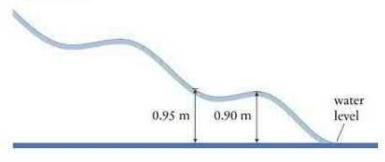
A \(20-\mathrm{kg}\) child runs up the amusement-park wave slide shown in Figure P9.29. When she is nearly at the top of the first hump, which is \(0.90 \mathrm{~m}\) above the water, she flops down and slides over the top of the hump at \(1.5 \mathrm{~m} / \mathrm{s}\). She slides down the other
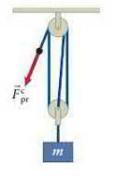
In the block-and-tackle arrangement shown in Figure P9.30, three segments of the single rope pull on the block. (a) Show that the magnitude \(F_{\mathrm{pr}}^{\mathrm{c}}\) of the force exerted by a person on the rope to raise the block at constant speed is \(m g / 3\), where \(m\) is the inertia
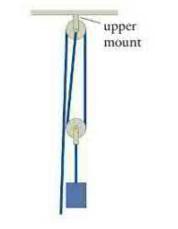
The pair of pulleys shown in Figure P9.31 is used to lift a \(50-\mathrm{kg}\) block \(0.25 \mathrm{~m}\). The constant acceleration of the block during the lift is \(+2.5 \mathrm{~m} / \mathrm{s}^{2}\), and the pulleys and rope have negligible inertia and negligible friction. What is the
You push a blob of gelatin with a constant force of \(3.0 \mathrm{~N}\) across a wet table on which it slides easily. Because the blob shape distorts, its center of mass moves only \(30 \mathrm{~mm}\) during the time interval in which the point of application of your force moves \(50
A \(1000-\mathrm{kg}\) car traveling at \(5.0 \mathrm{~m} / \mathrm{s}\) runs into the side of an underpass. The concrete wall is not affected, but the car crumples such that in the time interval from the instant of impact to the instant at which the car comes to rest, its center of mass travels
A \(60-\mathrm{kg}\) ice skater stands facing a wall with his arms bent and then pushes away from the wall by straightening his arms. At the instant at which his fingers lose contact with the wall, his center of mass has moved \(0.50 \mathrm{~m}\), and at this instant he is traveling at \(3.0
Two \(0.50-\mathrm{kg}\) carts, one red and one green, sit about half a meter apart on a low-friction track. You push on the red one with a constant force of \(2.0 \mathrm{~N}\) for \(0.15 \mathrm{~m}\) and then remove your hand. The cart moves \(0.35 \mathrm{~m}\) on the track and then strikes the
Two \(0.50-\mathrm{kg}\) carts are pushed toward each other from starting positions at cither end of a \(6.0-\mathrm{m}\) low-friction track. Each cart is pushed with a force of \(3.0 \mathrm{~N}\), and that force is exerted for a distance of \(1.0 \mathrm{~m}\). (a) What is the work done on the
You have a \(2.0-\mathrm{m}\) chain lying on the floor alongside ten \(0.10-\mathrm{kg}\) cubical blocks, each \(0.20 \mathrm{~m}\) on a side. Each block is resting on the floor, and the inertia of the chain is \(1.0 \mathrm{~kg}\). Which process requires less work: lifting one end of the chain so
A \(1.0-\mathrm{kg}\) cart and a \(0.50-\mathrm{kg}\) cart sit at different positions on a low-friction track. You push on the \(1.0-\mathrm{kg}\) cart with a constant \(2.0-\mathrm{N}\) force for \(0.15 \mathrm{~m}\). You then remove your hand, and the cart slides \(0.35 \mathrm{~m}\) and strikes
Two \(1.0-\mathrm{kg}\) blocks, one gray and one tan, are lined up along a horizontal \(x\) axis. The gray block is at \(x=-4.0 \mathrm{~m}\), and the \(\tan\) one is at \(x=+4.0 \mathrm{~m}\). A constant force of \(1.0 \mathrm{~N}\) is exerted on the gray block in the positive \(x\) direction
Two identical \(0.50-\mathrm{kg}\) carts, each \(0.10 \mathrm{~m}\) long, are at rest on a low-friction track and are connected by a spring that is initially at its relaxed length of \(0.50 \mathrm{~m}\) and is of negligible inertia. You give the cart on the left a push to the right (that is,
Because the soles of your shoes have cleats, you can exert a backward force of \(100 \mathrm{~N}\) on ice, allowing you to exert a similar forward force if you throw an object. A \(10-\mathrm{kg}\) picnic cooler is at rest on a frozen pond, and you want to get it to shore, up the bank, and stuck in
A bullet of inertia \(m\) traveling at speed \(v\) is fired into a wooden block that has inertia \(4 m\) and rests on a level surface. The bullet passes through the block and emerges with speed \(v / 3\), taking a negligible amount of the wood with it. The block moves to the right but comes to rest
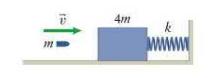
You fire a bullet of inertia \(m\) into the block shown in Figure P9.43. The bullet is initially traveling at speed \(v\), and the inertia of the block is \(4 \mathrm{~m}\). The surface on which the block sits is rough, and the spring has spring constant \(k\). The bullet becomes embedded in the
Spring B is stiffer than spring A. Which one has more energy stored in it if you (a) compress both springs with the same force and \((b)\) compress both springs the same displacement from their relaxed lengths?
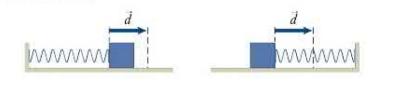
Which arrangement in Figure P9.45 requires more work to give the block a rightward displacement \(\vec{d}\) ? The springs, blocks, and surfaces are identical in the two arrangements and the springs are initially at their relaxed length.Data from Figure P9.45 wwwwww wwwww
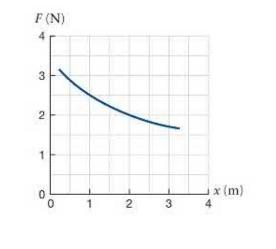
Estimate the work done by the force plotted in Figure P9.46 for an object displaced from \(x=1.0 \mathrm{~m}\) to \(x=3.0 \mathrm{~m}\).Data from Figure P9.46 F(N) 3 2 1 2 3 x (m) 4
Stretching a certain spring \(0.10 \mathrm{~m}\) from its relaxed length requires \(18 \mathrm{~J}\) of work. How much more work does it take to stretch this spring an additional \(0.10 \mathrm{~m}\) ?
A force varies with time according to the expression \(F=a \Delta t\), where \(a=2.0 \mathrm{~N} / \mathrm{s}\). From this information, can you determine the work done on a particle that experienced this force over a displacement of \(0.50 \mathrm{~m}\) ?
In pushing a \(0.024-\mathrm{kg}\) dart into a toy dart gun, you have to exert an increasing force that tops out at \(6.0 \mathrm{~N}\) when the spring is compressed to a maximum value of \(0.12 \mathrm{~m}\). (a) What is the launch speed of the dart when fired horizontally? (b) Does your answer
The work done by a certain force is given by \(W(\Delta x)=\) \(a \Delta x+b(\Delta x)^{3}\). Write an expression for the force as a function of \(\Delta x\).
A \(6.0-\mathrm{kg}\) bowling ball is held \(10 \mathrm{~mm}\) above a mattress and then released from rest and allowed to fall, sinking into the mattress. Model the mattress as a single spring with spring constant \(k=500 \mathrm{~N} / \mathrm{m}\). (a) Calculate the ball's kinetic energy, the
In a carnival game, the player throws a ball at a haystack. For a typical throw, the ball leaves the hay with a speed exactly one-half of the entry speed. (a) If the frictional force exerted by the hay is a constant \(6.0 \mathrm{~N}\) and the haystack is \(1.2 \mathrm{~m}\) thick, derive an
The force exerted on a certain object varies with the object's position according to the function \(F_{x}(x)=a x^{2}+b x^{3}\) where \(a=3.0 \mathrm{~N} / \mathrm{m}^{2}\) and \(b=-0.50 \mathrm{~N} / \mathrm{m}^{3}\). What is the work done on the object by this force as the object moves from
You devise a wind-up car powered by a spring for trips to the grocery store. The car has an inertia of \(500 \mathrm{~kg}\) and is \(4.2 \mathrm{~m}\) long. It should be able to accelerate from rest to \(20 \mathrm{~m} / \mathrm{s}\) at least 50 times before the spring needs winding. The spring
A \(0.15 \mathrm{~kg}\) cart on wheels is at rest at the origin of an \(x\) axis between (but not connected to) two relaxed springs aligned along that axis. When the cart is pushed to the left of the origin, the left spring \(\left(k_{1}=4.0 \mathrm{~N} / \mathrm{m}\right)\) is compressed and
To complement the baseball-pitching machines at the sports complex where you work, you have designed a catching machine using a mitt, a spring, and a latch that locks the spring in place when the ball has stopped moving. Your boss wants to know the speed of the baseballs coming out of a pitching
Suppose a jogger has to exert a force of \(25 \mathrm{~N}\) against air resistance to maintain a velocity of \(+5.0 \mathrm{~m} / \mathrm{s}\). At what rate is the jogger expending energy?
A \(35-\mathrm{kg}\) girl climbs a \(10-\mathrm{m}\) rope in \(25 \mathrm{~s}\). What is her average power?
Hiking trails on steep slopes often zigzag back and forth rather than running in a straight path up the slope. What does having a zigzag path accomplish, given that getting to the top of the slope requires the same amount of energy regardless of the path?
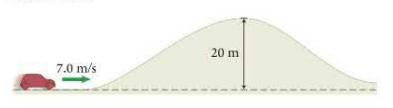
Your \(1000-\mathrm{kg}\) car, moving at \(7.0 \mathrm{~m} / \mathrm{s}\), approaches the bottom of a hill that is \(20 \mathrm{~m}\) high (Figure P9.60). To save gas, you use on average only \(3.3 \mathrm{~kW}\) of engine power, realizing that half of the energy delivered by the engine and half of
A constant, nondissipative external (net) force is exerted on a particle. Is the same work done on the particle each second?
A team of dogs accelerates a \(200-\mathrm{kg}\) dogsled from 0 to \(5.0 \mathrm{~m} / \mathrm{s}\) in \(3.0 \mathrm{~s}\). (a) What is the magnitude of the force exerted by the dogs on the sled? \((b)\) What is the work done by the dogs on the sled in the \(3.0 \mathrm{~s}\) ? (c) What is the
A \(20-\mathrm{kg}\) child wants to slide along a horizontal yard toy that consists of a slick plastic sheet covered with a thin layer of water to reduce friction to almost zero. To cause him to slide, you squirt him with a stream of water from a hose.(a) If the water from the hose exerts a
A cog system on the beginning segment of a roller coaster needs to get 25 occupied cars up a \(100-\mathrm{m}\) vertical rise over a time interval of \(60 \mathrm{~s}\). Each car experiences a gravitational force of \(5670 \mathrm{~N}\). The cars start at rest and end up moving at \(0.50
A box slides across a frozen pond toward the left shore as two children standing on opposite shores pull on the box with ropes. The child on the left shore pulls with a force of \(3.0 \mathrm{~N}\), and the child on the right shore pulls with a force of \(2.0 \mathrm{~N}\). At a certain instant,
A motor must lift a 1000-kg elevator cab. The cab's maximum occupant capacity is \(400 \mathrm{~kg}\), and its constant "cruising" speed is \(1.5 \mathrm{~m} / \mathrm{s}\). The design criterion is that the cab must achieve this speed within \(2.0 \mathrm{~s}\) at constant acceleration, beginning
An elevator operated by an electric motor rises at a constant speed. What is the work done on the elevator as it rises a distance \(b\) ?
Is it possible for a force to be exerted on an object along the direction of the object's motion and still produce no change in the object's kinetic energy? If yes, give an example. If no, explain why not.
A shopping cart that has an inertia of \(12 \mathrm{~kg}\) when empty is loaded with \(38 \mathrm{~kg}\) of groceries. A child pushing the loaded cart loses control, and the cart rolls into a concrete lamppost, which sustains no damage. The cart is moving at \(2.0 \mathrm{~m} / \mathrm{s}\) when it
Showing 3900 - 4000
of 4962
First
33
34
35
36
37
38
39
40
41
42
43
44
45
46
47
Last
Step by Step Answers

 Get 50% OFF
Claim Now
Get 50% OFF
Claim Now