New Semester
Started
Get
50% OFF
Study Help!
--h --m --s
Claim Now
Question Answers
Textbooks
Find textbooks, questions and answers
Oops, something went wrong!
Change your search query and then try again
S
Books
FREE
Study Help
Expert Questions
Accounting
General Management
Mathematics
Finance
Organizational Behaviour
Law
Physics
Operating System
Management Leadership
Sociology
Programming
Marketing
Database
Computer Network
Economics
Textbooks Solutions
Accounting
Managerial Accounting
Management Leadership
Cost Accounting
Statistics
Business Law
Corporate Finance
Finance
Economics
Auditing
Tutors
Online Tutors
Find a Tutor
Hire a Tutor
Become a Tutor
AI Tutor
AI Study Planner
NEW
Sell Books
Search
Search
Sign In
Register
study help
physics
particle physics
Principles And Practice Of Physics 2nd Edition Eric Mazur - Solutions
An object travels at a constant velocity of \(10 \mathrm{~m} / \mathrm{s}\) north in the time interval from \(t=0\) to \(t=8 \mathrm{~s}\). What additional information must you know in order to determine the position of the object at \(t=5 \mathrm{~s}\) ?
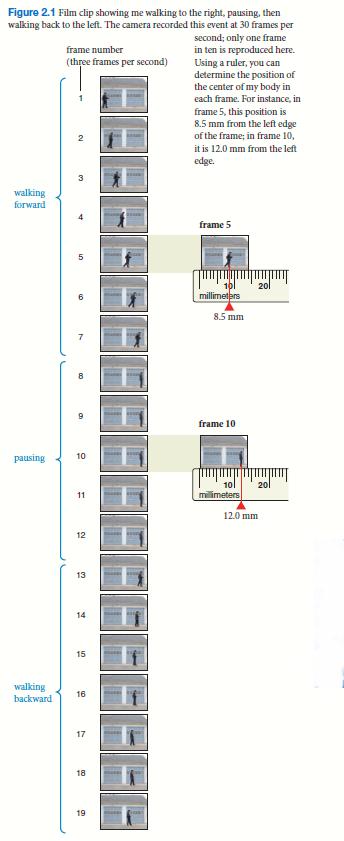
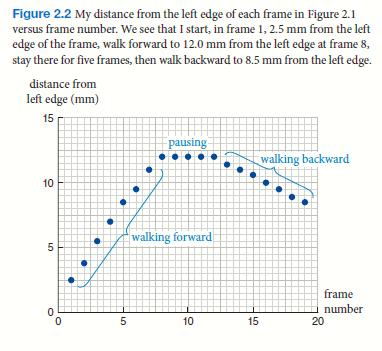
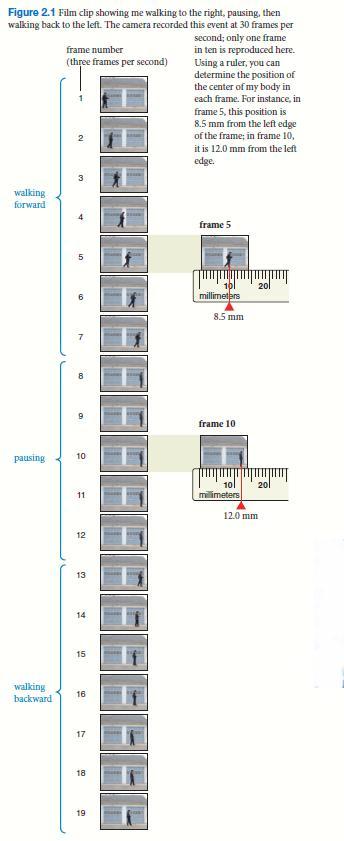
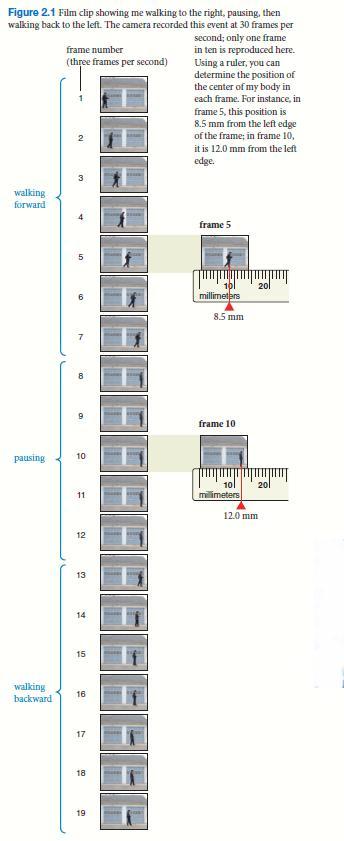
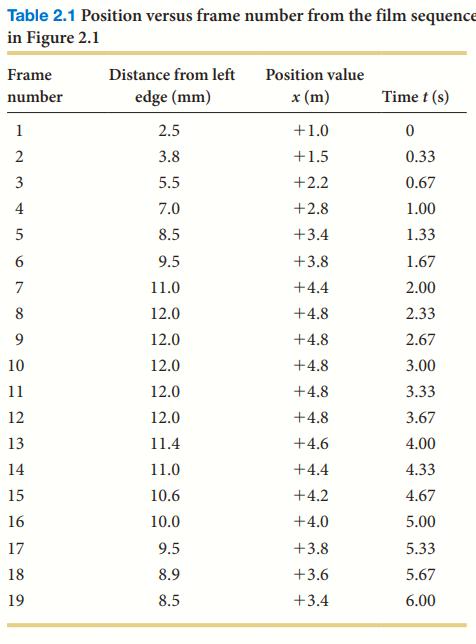
(a) Using a metric ruler, measure the position of the center of my body from the left edge in each frame of Figure 2.1. Compare your list of values with the positions given in Table 2.1. (b) Plot the positions you measured as a function of frame number-no need for graph paper, just draw your axes
(a) In Figure 2.2 the data points for frames 8-12 are all at position \(12.0\mathrm{~mm}\). Explain what this alignment of data points means in terms of what is happening in the real world.(b) The data points for frames 7 and 14 are aligned horizontally. What does this alignment imply about the
(a) Take a reasonable guess at my height and calculate what real-world distance \(1\mathrm{~mm}\) in Figure 2.1 corresponds to.(b) Using this result, calculate the distance I walked between frames 1 and 10 . Figure 2.1 Film clip showing me walking to the right, pausing, then walking back to the
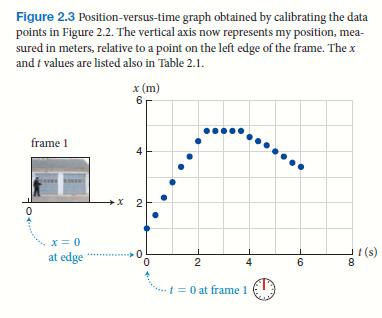
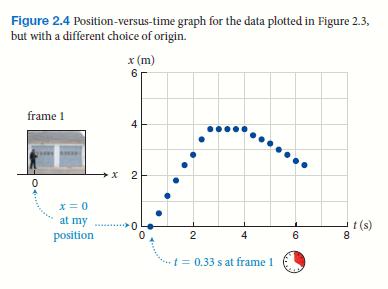
(a) What are the final position values in Figures 2.3 and 2.4? (b) What values are obtained by subtracting the initial position value from the final position value in each figure? Figure 2.3 Position-versus-time graph obtained by calibrating the data points in Figure 2.2. The vertical axis now
Suppose you walk in a straight line from a point \(\mathrm{P}\) to a point \(\mathrm{Q}, 2 \mathrm{~m}\) away from \(\mathrm{P}\), and then walk back along the same line to P. (a) What is the \(x\) component of your displacement for the round trip? (b) What distance did you travel during the round
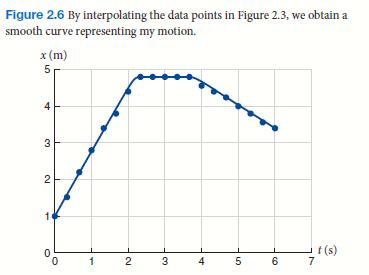
(a) From Figure 2.6, how many seconds did it take me to go from \(x=+1.0 \mathrm{~m}\) to \(x=+4.0 \mathrm{~m}\) ? (b) From \(x=+2.0 \mathrm{~m}\) to \(x=+3.0 \mathrm{~m}\) ? (c) At what instant did I reach \(x=+2.5 \mathrm{~m}\) ? (d) For how long was I at \(x=+2.5 \mathrm{~m}\) ? Figure 2.6 By
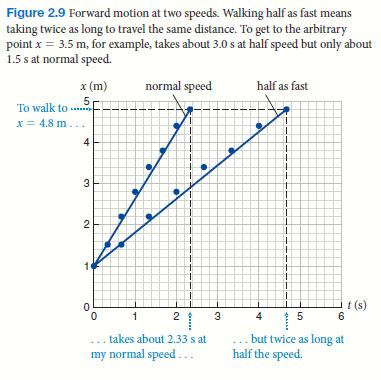
For each speed in Figure 2.9, what are (a) the distance traveled between \(t=0\) and \(t=1.50 \mathrm{~s}\) and \((b)\) the ratio of the distance traveled to the corresponding time interval? For each speed, what are (c) the time interval required to move from \(x=2.00 \mathrm{~m}\) to \(x=3.50
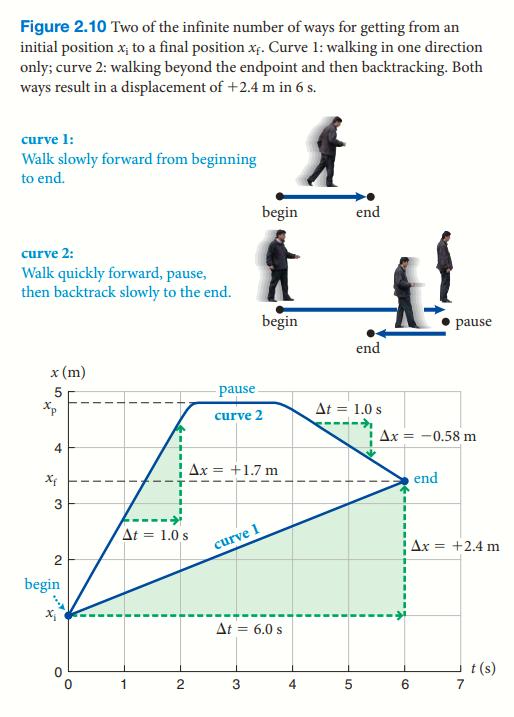
(a) At what instant did I first pass the position \(x_{\mathrm{f}}=+3.4 \mathrm{~m}\) (see curve 2 in Figure 2.10)?(b) What was my average speed up to that instant? Figure 2.10 Two of the infinite number of ways for getting from an initial position x; to a final position x. Curve 1: walking in one
In Example 2.3, what was your average speed during the time interval that you walked \((a)\) away from and \((b)\) back toward your dorm? (c) Is the average of your answers to parts \(a\) and \(b\) the same as the average speed calculated in Example 2.3? Why or why not?Data From Example 2.3:With
(a) Suppose an object moves from an initial position \(x_{\mathrm{i}}=-1.2 \mathrm{~m}\) to a final position \(x_{\mathrm{f}}=-2.3 \mathrm{~m}\) without reversing its direction of travel. Is the \(x\) component of its average velocity positive or negative?(b) Repeat for an object moving from
Are the following quantities vectors or scalars: \((i)\) the price of a movie ticket, (ii) the average velocity of a ball launched vertically upward, (iii) the position of the corner of a rectangle, (iv) the length of a side of that rectangle?
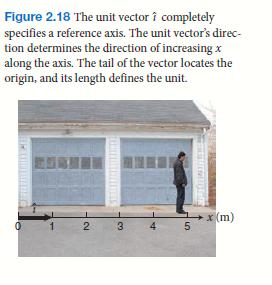
Consider the axis and unit vector shown in Figure 2.18. Let the vector \(\vec{r}\) have its tail at the origin and its tip at my feet. (a) What is the \(x\) component of that vector?(b) Write the vector \(\vec{r}\) in terms of its \(x\) component and the unit vector. (c) What does the vector
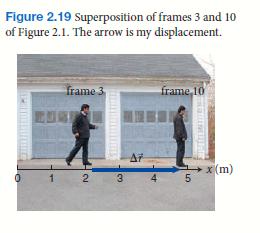
(a) What is the \(x\) component of the displacement shown in Figure 2.19? (b) Write the displacement in terms of its \(x\) component and the unit vector. Figure 2.19 Superposition of frames 3 and 10 of Figure 2.1. The arrow is my displacement. frame 3 frame.10 1 2 3 4 5 (w) x +
(a) Consider an \(x\) axis on which positive values of \(x\) are to the right of the origin. For an object initially located to the left of the origin, is the \(x\) component of a displacement to the right positive or negative? (b) Does the answer to part \(a\) depend on whether or not the object
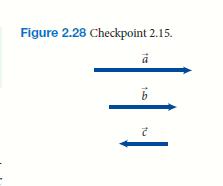
Consider the three vectors illustrated in Figure 2.28. (a) Make a sketch representing the vectors \(\vec{a}+\vec{c}, \vec{a}-\vec{b}\), and \(\vec{c}-\vec{b}\). (b) Are the vectors \(\vec{a}+\vec{c}\) and \(\vec{c}+\vec{a}\) identical? (c) Are the vectors \(\vec{c}-\vec{b}\) and \(\vec{b}-\vec{c}\)
(a) Consider my motion between frames 6 and 17 in Figure 2.1. Use the values in Table 2.1 to determine the answers to these questions: What is my average speed over this time interval? What is the \(x\) component of my average velocity? What is the average velocity? (b) Repeat for the motion
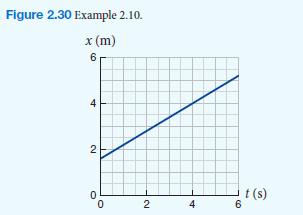
In Example 2.10, suppose I had taken \(x_{\mathrm{i}}\) to be the \(x\) coordinate of the object's position not at \(t=0\) but at \(t=2.0 \mathrm{~s}\). Show that the expression for the \(x\) coordinate of the position is the same as the one I obtained in Example 2.10b.Data From Example 2.10:Figure
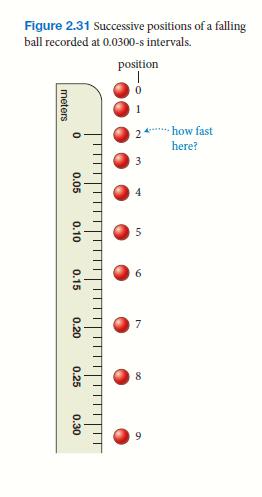
(a) Determine the \(x\) component of the ball's average velocity between positions 2 and 9 in Figure 2.31. (b) Repeat between positions 2 and 8. (c) Repeat for increasingly smaller time intervals. (d) As the time interval decreases, does the \(x\) component of the average velocity increase,
(a) Suppose the position for a certain object is constant. Determine the \(x\) component of its velocity by using Eq. 2.22 and by evaluating the limit in Eq. 2.21 of the ratio of the \(x\) component of the displacement over a finite time interval. (b) Repeat for the case where the \(x\) coordinate
The average radius of Earth is \(6371 \mathrm{~km}\). Give order-ofmagnitude estimates of what the mass of Earth would be if the planet has the mass density of \((a)\) air \(\left(\approx 1.2 \mathrm{~kg} / \mathrm{m}^{3}\right)\), (b) \(5515 \mathrm{~kg} / \mathrm{m}^{3}\), and \((c)\) an atomic
Suppose \(x=a y^{3 / 2}\), where \(a=7.81 \mu \mathrm{g} / \mathrm{Tm}\). Determine the value of \(y\) when \(x=61.7\left(\mathrm{Eg} \cdot \mathrm{fm}^{2}\right) /\left(\mathrm{ms}^{3}\right)\). Express the result in scientific notation and simplify the units. (Hint: Refer to Principles Table 1.3,
Express the distance of the Kentucky Derby in kilometers to the same number of significant digits needed to answer Problem 42.
What is the order of magnitude of the number of moles of matter in the observable universe?
Estimate the order of magnitude of the number of times the letter d occurs in this text.
Estimate the combined length of all the hairs on the head of a person who has a full head of shoulder-length hair.
How many axes of rotational symmetry does a cone have?
How many significant digits are appropriate in expressing the result of an addition or subtraction?
At what height above the surface of Pluto is the acceleration due to gravity half its surface value?
How far above Farth's surface must a \(10,000-\mathrm{kg}\) boulder be moved to increase the mass of the Earthboulder system by \(2.50 \mathrm{mg}\) ? Assume the same ratio of energy change to mass change as in Excrcise 14.5(b): \(8.98 \times 10^{16} \mathrm{~J} / \mathrm{kg}\).Data from Exercise
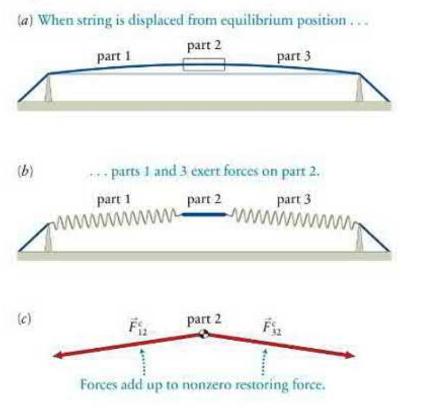
Show that for small displacements the restoring force exerted on part 2 of the displaced string in Figure 15.14 is linearly proportional to the displacement of that part from its equilibrium position.Data from Figure 15.14 (a) When string is displaced from equilibrium position... (b) part 1 part 2
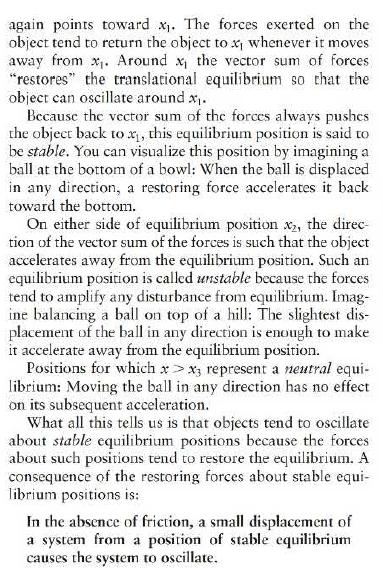
Is an oscillating object in translational equilibrium?
If you photograph a flock of birds taking off from ground level, some of the wings will be blurred in the photograph even though the bodies are in focus. In which wing positions are the wings least blurry?
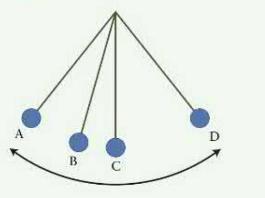
A pendulum bob swings through a circular arc defined by positions A and D in Figure 15. 18.(a) At A, B, and C, what are the possible directions of the velocity of the bob and of the restoring force exerted on it?(b) What is the direction of the bob's acceleration at \(\mathrm{A}\) and
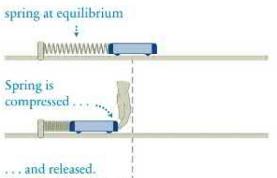
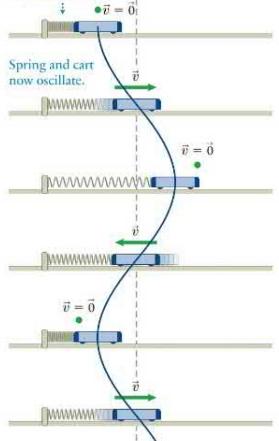
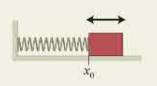
Consider the spring-cart system of Figure 15.1 again. The cart is pulled away from its equilibrium position in the positive \(x\) direction and then released at \(t=0\).(a) What is the initial phase of the cart's oscillation? What is the phase of the cart's oscillation (b) half a period later
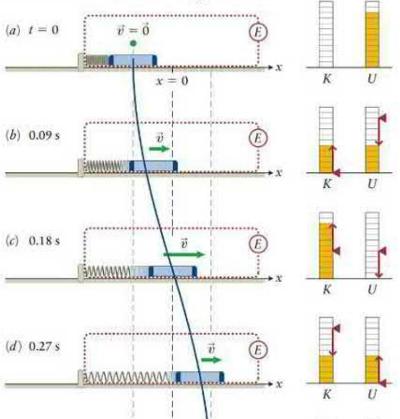
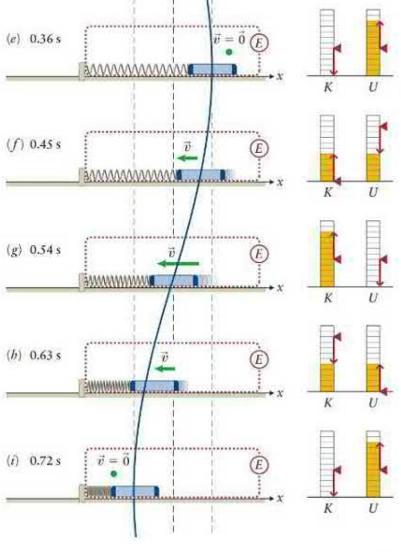
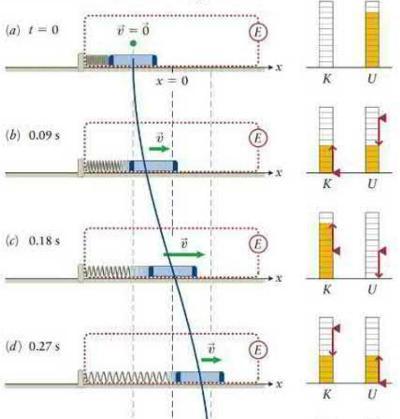
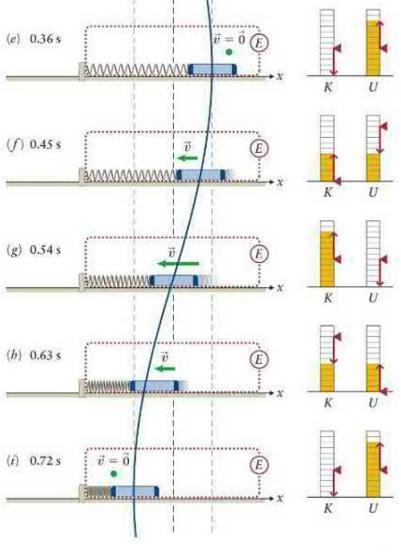
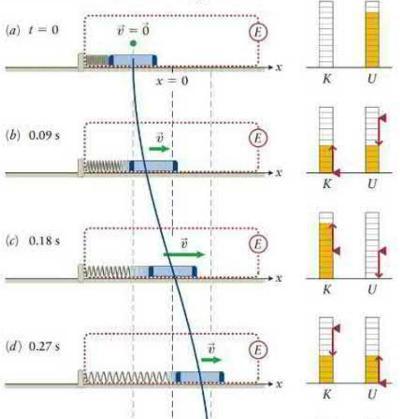
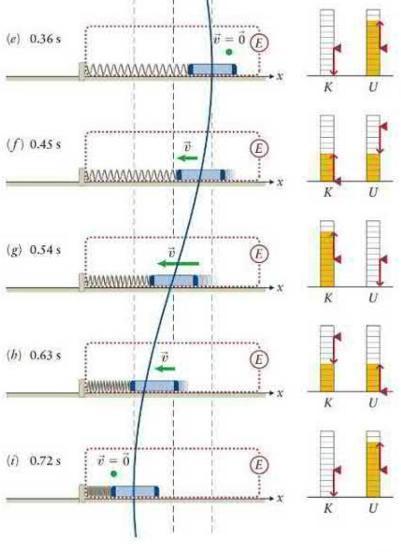
Plot kinetic energy and potential energy as a function of time for the cart in Figure 15. 2.Data from Figure 15. 2 (a) t=0 5=0 (b) 0.09 s (c) 0.18 s x=0 E (d) 0.27 s E K U K U KU KU
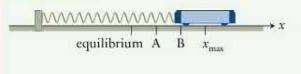
The cart-spring system shown in Figure 15. 19 is undergoing simple harmonic motion.(a) Is the cart's speed greater at A or at B?(b) At which of these two positions is the restoring force acting on the cart greater?(c) At which of these two positions is the cart's acceleration greater?Data from
A cart of mass \(m=0.50 \mathrm{~kg}\) fastened to a spring of spring constant \(k=14 \mathrm{~N} / \mathrm{m}\) is pulled \(30 \mathrm{~mm}\) away from its equilibrium position and then released with zero initial velocity. What are the cart's position and the \(x\) component of velocity \(2.0
Based on the energy diagrams in Figure 15. 2, sketch a graph showing velocity as a function of position for the cart represented in the figure.Data from Figure 15. 2 (a) t=0 5=0 (b) 0.09 s (c) 0.18 s x=0 E (d) 0.27 s E K U K U KU KU
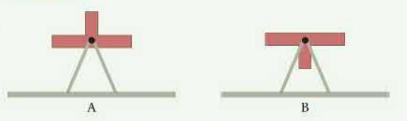
A T-shaped wooden structure is balanced on a pivot in the two configurations shown in Figure 15. 20. Which configuration is in stable equilibrium? Which configuration is likely to oscillate?Data from Figure 15. 20 A B
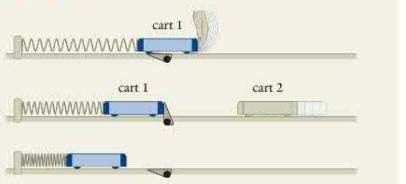
Cart 1 of mass \(m=0.50 \mathrm{~kg}\) fastened to a spring of spring constant \(k=14 \mathrm{~N} / \mathrm{m}\) is pushed \(15 \mathrm{~mm}\) in from its equilibrium position and held in place by a ratchet (Figure 15.27). An identical cart 2 is launched at a speed of \(0.10 \mathrm{~m} /
(a) At what displacement (expressed as a fraction of the amplitude of the motion) is the kinetic energy of the cart in Figure 15. 2 half its maximum value? (b) What is the velocity (expressed as a fraction of the maximum velocity) at this displacement?Data from Figure 15. 2 (a) t=0 5=0 (b) 0.09 s
A block of mass \(m=0.50 \mathrm{~kg}\) is suspended from a spring of spring constant \(k=100 \mathrm{~N} / \mathrm{m}\).(a) How far below the end of the relaxed spring at \(x_{0}\) is the equilibrium position \(x_{\mathrm{eq}}\) of the suspended block (Figure 15.29a)?(b) Is the frequency \(f\)
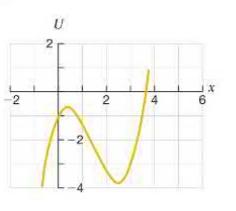
Figure P15.5 shows a graph of the potential energy \(U\) of a moving object as a function of its position \(x\). What is the maximum range of \(x\) values possible for periodic motion in this system?Data from Figure P15.5 -2 2 U -2 2 4 x 6
Suppose a simple pendulum consisting of a bob of mass \(m\) suspended from a string of length \(\ell\) is pulled back and released. What is the period of oscillation of the bob?
What distance does an oscillator of amplitude \(A\) travel in 2. 5 periods?
The oscillations of a thin rod can be used to determine the value of the acceleration due to gravity. A rod that is \(0.800 \mathrm{~m}\) long and suspended from one end is observed to complete 100 oscillations in \(147 \mathrm{~s}\). What is the value of \(g\) at the location of this experiment?
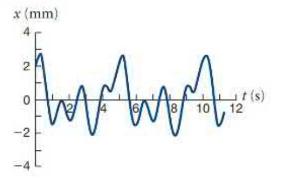
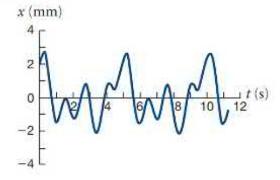
What is the period of the motion represented by the curve in Figure P15.7?Data from Figure P15.7 x (mm) 2 0 -2 10 12
The angular frequency \(\omega\) of a simple pendulum can be calculated by treating the pendulum as a one-dimensional oscillator. In Section 15.4, we used this approach to analyze the restoring force exerted on a pendulum, considering the effect of the force of gravity on the horizontal
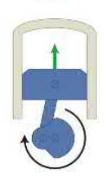
(a) Explain why the motion of the engine piston in Figure P15.8 is only approximately simple harmonic motion.(b) What must you do to the length of the connecting rod if you want to make the motion more nearly simple harmonic motion?Data from Figure P15.8
Is the typical up-and-down motion of a yo-yo periodic motion, assuming no energy is dissipated? Is it simple harmonic motion?
A highly elastic ball is dropped from a height of \(2.0 \mathrm{~m}\) onto a hard surface. Assume the collision is clastic and no energy is lost to air friction.(a) Show that the ball's motion after it hits the surface is periodic.(b) Determine the period of the motion.(c) Is it simple harmonic
Fourier analysis of a particular periodic function includes the harmonic frequencies \(889 \mathrm{~Hz}, 1143 \mathrm{~Hz}\), and \(1270 \mathrm{~Hz}\). What is the fundamental frequency \(f_{1}\), assuming that \(f_{1}>100 \mathrm{~Hz}\) ?
Suppose you create a periodic function by adding together only sine functions whose amplitudes decrease like \(1 / n^{2}\), where \(n\) is any odd integer multiple of the fundamental frequency, and where every other term is subtracted rather than added.(a) What general properties would this
Even when a piano and a trumpet play the same note (which means the sounds have the same frequency \(f\) ), the two instruments sound completely different. What is it about the sound from the instruments that accounts for this difference?
Estimate the number of harmonics (counting the fundamental frequency) that contribute significantly in the Fourier analysis of the spectrum in Figure P15.7.Data from Figure 15.7 x (mm) 0 -2 10 12 t(s) T
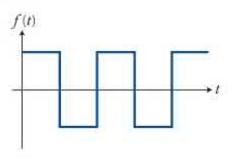
What harmonic series is required to produce a "square wave" of amplitude 1, as illustrated in Figure P15.15?Data from Figure 15.15 f(t)
Which of these forces could result in simple harmonic motion: (a) \(F(x)=2 x\), (b) \(F(x)=-2 x\), (c) \(F(x)=\) \(-2 x^{2},(d) F(x)=2 x^{2},(e) F(x)=-2 x+2,(f) F(x)=\) \(-2(x-2)^{2}\) ?
When you dive off a diving board, the board oscillates while you are flying toward the swimming pool. (These oscillations are significantly damped for a good diving board.) Identify the restoring force (or torque) responsible for these oscillations as well as the relevant mass.
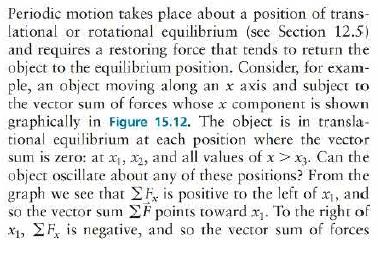
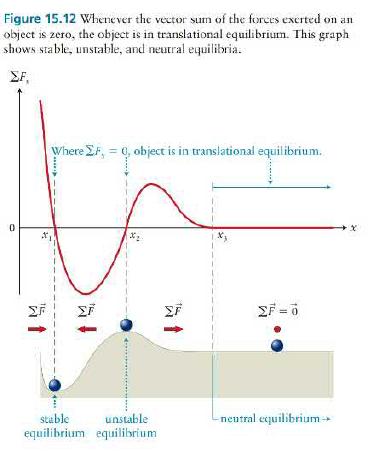
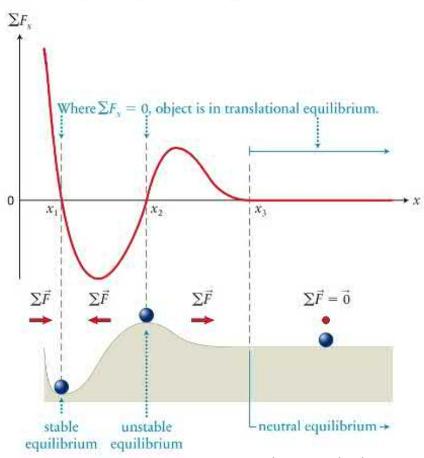
Figure 15. 12 illustrates the \(x\) component of the vector sum of forces on an object for conditions of stable, unstable, and neutral equilibrium.(a) Examine this graph carefully. What visible feature differs in the three types of equilibrium?(b) Express your result as a set of mathematical
A spring-cart system and a simple pendulum both have the same period near Earth's surface. What happens to the period of each motion when both systems are in orbit inside the International Space Station?
Write Eqs. \(15.6,15.7\), and 15. 8 in terms of the period \(T\) of the motion.Data from Eq. 15.6Data from Eq. 15.7Data from Eq. 15.8 => x(t) A sin(t) == A sin(wt) (simple harmonic motion),
(a) When air resistance is ignored, does a pendulum clock run faster or slower at higher altitude? (b) Does your answer change if you don't ignore the effects of air resistance?
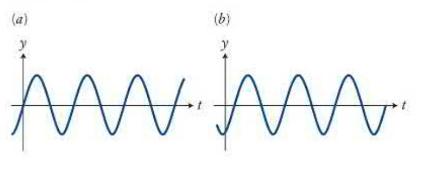
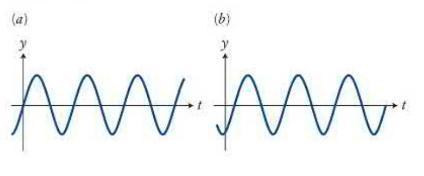
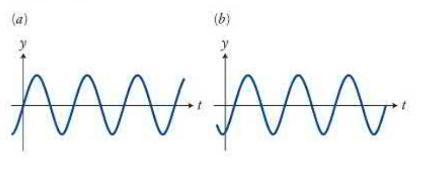
Is the initial phase \(\phi_{\mathrm{i}}\) positive, zero, or negative for each oscillation graphed in Figure P15.22?Data from Figure 15.22 (a) (b) WM
In Figure 15. 22, the vertical component of the phasor moves in simple harmonic motion.(a) Does the horizontal component also move in simple harmonic motion?(b) What is the phase difference \(\Delta \phi=\phi_{\mathrm{y}}-\phi_{\mathrm{h}}\) between the vertical and horizontal components?Data from
Consider the nearly circular orbit of Earth around the Sun as seen by a distant observer standing in the plane of the orbit. What is the effective "spring constant" of this simple harmonic motion?
Consider the reference circle shown in Figure 15. 22.(a) In terms of the rotational speed \(\omega\) of the phasor, what is the magnitude of the tangential velocity \(\vec{v}\) of the phasor tip? What is the vertical component of this velocity? How does this phasor velocity compare with the
An object undergoes simple harmonic motion along an \(x\) axis with a period of \(0.50 \mathrm{~s}\) and amplitude of \(25 \mathrm{~mm}\). Its position is \(x=14 \mathrm{~mm}\) when \(t=0\).(a) Write an equation of motion with all variables identified.(b) Draw a position-versus-time graph for this
You are standing next to a table and looking down on a record player sitting on the table. Take the spindle (axis of rotation) to be the center of your coordinate system and the \(y\) axis to be perpendicular to the side of the player you are standing next to. Long-playing records revolve \(33
A \(1.0-\mathrm{kg}\) object undergoes simple harmonic motion with an amplitude of \(0.12 \mathrm{~m}\) and a maximum acceleration of \(5.0 \mathrm{~m} / \mathrm{s}^{2}\). What is its energy?
The position of a particle undergoing simple harmonic motion is given by \(x(t)=a \cos (b t+\pi / 3)\), where \(a=8.00 \mathrm{~m}\) and \(b=2.00 \mathrm{~s}^{-1}\). What are the (a) amplitude, (b) frequency \(f\),(c) period?(d) What are the speed and acceleration magnitude of the particle at
For any simple harmonic motion, the position, velocity, and acceleration can all be written as the same type of trigonometric function (sine or cosine) by correctly adding a relative phase factor.(a) Show that an \(x\) component of the position function given by \(x(t)=\beta \cos (\omega
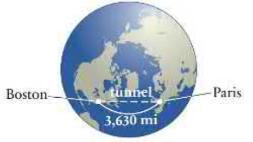
You get a crazy idea to dig a tunnel through Earth from Boston to Paris, a surface distance of \(5850 \mathrm{~km}\), and run a passenger train between the two cities (Figure P15.32). The train would move down the first part of the tunnel under the pull of gravity and then coast upward against
You have developed a method in which a paint shaker is used to measure the coefficient of static friction between various objects and a known surface. The shaker oscillates with a fixed amplitude of \(50 \mathrm{~mm}\), but you can adjust the frequency of the motion. You have affixed a horizontal
Even a spring without a block hanging on the end of it has an oscillation period. Why isn't the period zero?
A vertical spring on which is hung a block of mass \(m_{1}\) oscillates with frequency \(f\). With an additional block of mass \(m_{2} eq m_{1}\) added to the spring, the frequency is \(f / 2\). What is the ratio \(m_{1} / m_{2}\) ?
Two vertical springs have identical spring constants, but one has a ball of mass \(m\) hanging from it and the other has a ball of mass \(2 m\) hanging from it. If the energies of the two systems are the same, what is the ratio of the oscillation amplitudes?
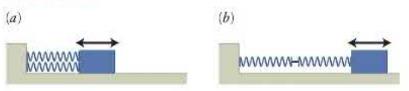
A horizontal spring-block system made up of one block and one spring has oscillation frequency \(f\). A second spring, identical to the first, is to be added to the system.(a) Does \(f\) increase, decrease, or stay the same when the two springs are connected as shown in Figure P15.37a?(b) What
Two balls of unequal mass are hung from two springs that are not identical. The springs stretch the same distance as the two systems reach equilibrium. Then both springs are compressed and released. Which one oscillates faster?
A table outfitted with springs on its feet bounces vertically in simple harmonic motion. A cup of coffee is sitting on the table. Discuss whether any of the following changes to this system could cause the cup to lose contact with the table: \((a)\) increase the amplitude, \((b)\) increase the
A \(2.0-\mathrm{kg}\) cart is attached to a horizontal spring for which the spring constant is \(50 \mathrm{~N} / \mathrm{m}\). The system is set in motion when the cart is \(0.24 \mathrm{~m}\) from its equilibrium position, and the initial velocity is \(2.0 \mathrm{~m} / \mathrm{s}\) directed away
A vertical spring-block system with a period of \(2.3 \mathrm{~s}\) and a mass of \(0.35 \mathrm{~kg}\) is released \(40 \mathrm{~mm}\) below its equilibrium position with an initial upward velocity of \(0.12 \mathrm{~m} / \mathrm{s}\). For this system, determine the (a) amplitude, (b) angular
A \(5.0-\mathrm{kg}\) object is suspended from the ceiling by a strong spring, which stretches \(0.10 \mathrm{~m}\) when the object is attached. The object is lifted \(0.050 \mathrm{~m}\) from this equilibrium position and released. Determine the amplitude and period of the resulting simple
A \(5.0-\mathrm{kg}\) block is suspended from the ceiling by a strong spring and released to perform simple harmonic motion with a period of \(0.50 \mathrm{~s}\). The block is brought to rest, and the length of the spring with the block attached is measured. By how much is this length reduced when
A \(4.0-\mathrm{kg}\) object is suspended from the ceiling by a spring and undergoes simple harmonic motion with an amplitude of \(0.50 \mathrm{~m}\). At the highest position in the motion, the spring is at the length that would be its relaxed length if no object were attached.(a) Calculate the
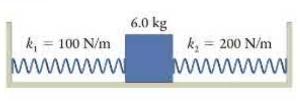
A \(6.0-\mathrm{kg}\) block free to slide on a horizontal surface is anchored to two facing walls by springs (Figure P15.45). Both springs are initially at their relaxed length. The block is then displaced \(20 \mathrm{~mm}\) to the right and released.(a) What is the effective spring constant of
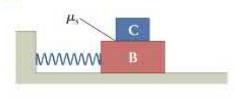
Block B in Figure P15.46 is free to slide on the horizontal surface. With block C placed on top of B, the system undergoes simple harmonic motion with an amplitude of \(0.10 \mathrm{~m}\). Block B has a speed of \(0.24 \mathrm{~m} / \mathrm{s}\) at a displacement of \(0.060 \mathrm{~m}\) from its
After gluing two \(0.50-\mathrm{kg}\) blocks together, you determine that you can pull the blocks apart with a force of \(20 \mathrm{~N}\) applied to one block. You attach the top block to a vertical spring for which the spring constant is \(500 \mathrm{~N} / \mathrm{m}\). What is the maximum
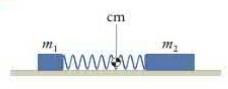
Two blocks, of masses \(m_{1}\) and \(m_{2}\), are placed on a horizontal surface and attached to opposite ends of a spring as in Figure P15.48. The blocks are then pushed toward each other to compress the spring. When the blocks are released, \((a)\) describe the motion of the center of mass of
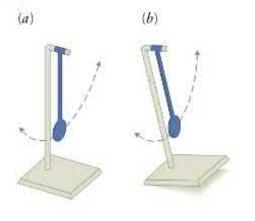
What happens to the period of the pendulum shown in Figure P15.50a when the stand supporting the pendulum is tipped backward as shown in Figure P15.50b?Data from Figure P15.50 (a) (b)
You want to build a pendulum clock in which the time interval between the "tick" sound (when the pendulum is swinging one way) and the "tock" sound (when the pendulum is swinging the other way) is \(0.50 \mathrm{~s}\). If we assume the pendulum is a simple one, what should its length be?
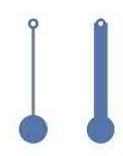
Which pendulum in Figure P15.51 has the greater period?Data from Figure P15.51 !!
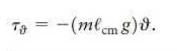
A small-angle approximation was used to derive Eq. 15. 31, \(\tau=-(m \ell g) \vartheta .(a)\) What constitutes small in this context? In other words, how large can \(\vartheta\) be before it can no longer be called small? (b) As a quantitative benchmark, how large does \(\vartheta\) have to be
The maximum angle from the vertical reached by a simple pendulum of length \(\ell\) is \(\vartheta_{\max }\). What is the linear speed \(v\) of the bob for any angle \(\vartheta\) from the vertical?
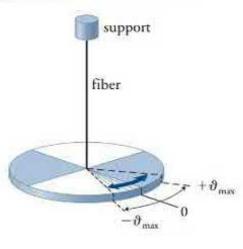
The 800-mg balance wheel of a certain clock is made up of a thin metal ring of radius \(15 \mathrm{~mm}\) connected by spokes of negligible mass to a fine suspension fiber as in Figure 15. 31. The back-and-forth twisting of the fiber causes the wheel to move in simple harmonic motion with period
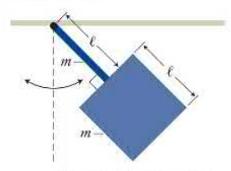
A rod of mass \(m\) and length \(\ell\) is rigidly connected at a right angle to the midpoint of one face of a uniform cube of mass \(m\) and side length \(\ell\) (Figure P15.56). The other end of the pivot so that the system can oscillate freely. What is the period of small oscillations about the
A thin \(0.100 \mathrm{~kg}\) rod that is \(250 \mathrm{~mm}\) long has a small hole drilled through it \(62.5 \mathrm{~mm}\) from one end. A metal wire is strung through the hole and fixed horizontally, and the rod is free to rotate about the wire and to oscillate.(a) Determine the rod's
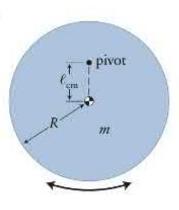
A uniform disk of mass \(m\) and radius \(R\) lies in a vertical plane and is pivoted about a point a distance \(\ell_{\mathrm{cm}}\) from its center of mass (Figure P15.58). When given a small rotational displacement about the pivot, the disk undergoes simple harmonic motion. Determine the period
A simple pendulum of length \(0.30 \mathrm{~m}\) has a \(0.30-\mathrm{kg}\) bob. At \(t=0\), the bob passes through the lowest position in its motion, and at this instant it has a horizontal speed of \(0.25 \mathrm{~m} / \mathrm{s}\).(a) What is the maximum angular displacement \(\vartheta_{\max
A thin \(0.50-\mathrm{kg}\) ring of radius \(R=0.10 \mathrm{~m}\) hangs vertically from a horizontal knife-edge pivot about which the ring can oscillate freely. If the amplitude of the motion is kept small, what is the period?
Showing 3200 - 3300
of 4962
First
26
27
28
29
30
31
32
33
34
35
36
37
38
39
40
Last
Step by Step Answers

 Get 50% OFF
Claim Now
Get 50% OFF
Claim Now