New Semester
Started
Get
50% OFF
Study Help!
--h --m --s
Claim Now
Question Answers
Textbooks
Find textbooks, questions and answers
Oops, something went wrong!
Change your search query and then try again
S
Books
FREE
Study Help
Expert Questions
Accounting
General Management
Mathematics
Finance
Organizational Behaviour
Law
Physics
Operating System
Management Leadership
Sociology
Programming
Marketing
Database
Computer Network
Economics
Textbooks Solutions
Accounting
Managerial Accounting
Management Leadership
Cost Accounting
Statistics
Business Law
Corporate Finance
Finance
Economics
Auditing
Tutors
Online Tutors
Find a Tutor
Hire a Tutor
Become a Tutor
AI Tutor
AI Study Planner
NEW
Sell Books
Search
Search
Sign In
Register
study help
physics
particle physics
Principles And Practice Of Physics 2nd Edition Eric Mazur - Solutions
Is it possible for the acceleration and velocity vectors of an object to be always perpendicular to each other? If no, explain why not. If yes, describe the motion.
A baseball player hits a long fly ball to center field. What can we say about the direction of the ball's acceleration at the highest point of its flight? (Consider air resistance.)
Can an object be accelerated without changing its kinetic energy?
(a) Can two vectors of unequal lengths add up to zero?(b) What about three vectors of unequal lengths?
Three swimmers who all swim at the same speed discuss how to cross a river in the shortest amount of time. Swimmer A will swim straight across the river at a right angle to the current. Swimmer B reasons that the current will carry \(A\) downstream, meaning that \(A\) will cover a greater distance
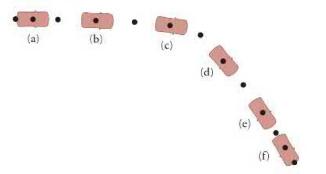
Figure P10.9 shows the position of a regularly flashing light on top of a car (bird's-eye view) as the car moves from (a) to (f). Describe the acceleration of the car at each labeled position based on the information in the figure.Data from Figure P10.9 (a) (b) (c) (d) (e) (f)
Which is harder to slow down: a car going up a hill or a car going down a hill? Why?
A sweater hanging on a clothesline makes the line sag in the center. Could you tighten the clothesline enough (assuming whatever material for the line you want) to eliminate the sag completely?
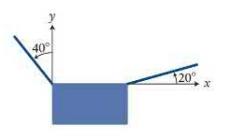
A sign is suspended by two wires as shown in Figure P10.12. Is the tension in each wire larger than, equal to, or smaller than the gravitational force exerted on the sign by Farth?Data from Figure P10.12 40 120 x
A man is crossing a roof that is inclined at an angle of \(30^{\circ}\) above the horizontal. His path takes him parallel to the roof ridge but \(4.0 \mathrm{~m}\) (along the roof surface) below the peak. He is supported by two ropes, one attached to an object above each end of the roof. The left
A common parlor trick is to yank a tablecloth hard so that any dishes and glasses on the cloth stay put instead of falling onto the floor. (a) Explain how this happens. (b) Why, if you pull on the cloth too slowly, do the dishes and glasses get dragged off the table?
When a car accelerates gradually (no squealing tires), is the friction between tires and road kinetic or static?
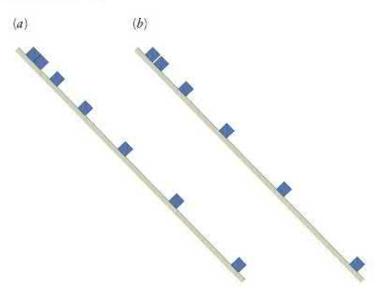
Figure \(\mathrm{P} 10. 16\) represents two stroboscopic pictures (taken at the same flash rate) of a block moving along a ramp that exerts a frictional force on the block. In one sketch, the block is released from rest at the top of the ramp and moves downward. In the other sketch, the block is
You keep a chalkboard eraser pressed against the chalkboard by using your finger to exert a horizontal force on the back of the eraser. (a) Which type of force (call it force A) keeps the eraser from falling? (b) What is the magnitude of force A? (c) Does the magnitude of force A (which keeps the
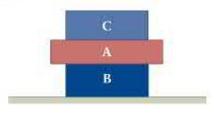
In Figure P10.18, all surfaces experience friction. Is the magnitude of the horizontal component of the force exerted by \(A\) on \(B\) greater than, equal to, or less than the magnitude of the horizontal force exerted by \(\mathrm{A}\) on \(\mathrm{C}\) if the system of blocks is \((a)\) moving at
A factory worker pulls on a rope attached to a pallet loaded with a crate, dragging the combination at constant speed across a rough factory floor. The tension in the rope acts horizontally on the pallet. Draw a free-body diagram for the pallet and one for the crate when the pallet \((a)\) is on
What is the direction of the frictional force exerted on a coffee cup (a) sitting on a stationary table, (b) being pulled to the right across a table, and (c) sitting on a table while the table is dragged to the right?
A worker places a circular saw on top of a long board that is lying on the floor. Then she and a coworker lift the ends of the board and carry it across the construction site, placing it across two sawhorses at its destination. Discuss the work done by the normal force and the force of static
A resort uses a rope to pull a \(55-\mathrm{kg}\) skier up a \(15^{\square}\) slope at constant speed for \(100 \mathrm{~m}\). (a) Determine the tension in the rope if the snow is slick enough to allow you to ignore any frictional effects. (b) How much work does the rope do on the skier?
A friend claims that her car can accelerate from a stop to \(60 \mathrm{mi} / \mathrm{h}(26.8 \mathrm{~m} / \mathrm{s})\) in \(5.1 \mathrm{~s}\), but the speedometer is broken. You decide to test her claim by riding with her, and you bring along a small metal washer, a short length of string, a
You drive a car onto a 100 -vehicle ferry, park, and have a short nap. When the ferry arrives at its destination, you start the car and drive off to begin your vacation. Estimate the magnitude of work done by the forces of static friction between the car tires and either the roadway or the ferry
Two children slide down playground slides of identical heights but different angles, one shallow and one steep. (a) Suppose the slides are so slippery that the force of friction is negligibly small. Which child, if either, moves faster at the bottom of the slide? Which one, if either, arrives at
For the vectors \(\vec{A}=2.0 \hat{\imath}+3.0 \hat{\jmath}\) and \(\vec{B}=-4.0 \hat{\imath}+5.0 \hat{\jmath}\), calculate \((a) \vec{A}+\vec{B}\) and (b) \(\vec{A}-\vec{B}\). (c) If the direction (but not the magnitude) of \(\vec{B}\) is allowed to change by any amount you like, how large can
For the vectors \(\vec{A}=3.0 \hat{\imath}+2.0 \hat{\jmath}\) and \(\vec{B}=-2.0 \hat{\imath}+2.0 \hat{\jmath}\), determine \((a) \vec{A}+\vec{B}\) and \((b)\) the magnitude of \(|\vec{A}+\vec{B}|\).
Determine the polar coordinates of vectors \((a) \vec{A}=3.0 \hat{\imath}+2.0 \hat{\jmath}\) and \((b) \vec{B}=-2.0 \hat{\imath}+2.0 \hat{\jmath}\).
Your directions on a scavenger hunt map say to walk \(36 \mathrm{~m}\) east, then \(42 \mathrm{~m}\) south, then \(25 \mathrm{~m}\) northwest. With the positive \(x\) direction being east, what is your displacement \((a)\) in polar coordinates and \((b)\) in Cartesian coordinates?
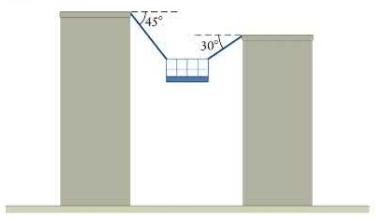
In Figure P10.30, if the tension in the cable attaching the platform to the building on the right is \(800 \mathrm{~N}\), what are (a) the tension in the cable attaching the platform to the building on the left and (b) the inertia of the platform?Data from Figure P10.30 45 30
You leave your house and walk east for \(1.0 \mathrm{~h}\), northeast for \(1.5 \mathrm{~h}\), south for \(1.0 \mathrm{~h}\), and southwest for \(2.5 \mathrm{~h}\), always moving at the same speed. Realizing it is going to get dark soon, you head directly home. How long does it take to walk
An object's displacement is given by \(\vec{r}(t)=\left(A t+B t^{3}\right) \hat{t}+\) \(\left(C-D t^{2}\right) \hat{\jmath}\). (a) Write the expression for \(\vec{v}(t)\) for this motion and the expression for \(\vec{a}(t)\). (b) Using the values \(A=2.0 \mathrm{~m} / \mathrm{s}, \quad B=0.10
Translate the position function \(\vec{r}(t)=A \cos (\omega t) \hat{t}+\) \(A \sin (\omega t) \hat{\jmath}\) into polar coordinates, where \(A\) and \(\omega\) are constants.
A plane travels in a straight line from position A to position B in \(65 \mathrm{~min}\), moving at an average speed of \(400 \mathrm{~km} / \mathrm{h}\). In a car traveling from \(A\) to \(B\), the driver finds that the trip is \(600 \mathrm{~km}\) long by the route he is forced to take, which
A child rides her bike five blocks east and then three blocks north. It takes her \(15 \mathrm{~min}\), and each block is \(160 \mathrm{~m}\) long. What are \((a)\) the magnitude of her displacement, \((b)\) her average velocity, and (c) her average speed?
(a) In a Cartesian coordinate system that has axes \(x\) and \(y\), the coordinates of a certain point \(\mathrm{P}\) are \((x, y)\). What are the coordinates of \(\mathrm{P}\) in a Cartesian coordinate system that has axes \(x^{\prime}\) and \(y^{\prime}\) if the origins coincide but the
(a) Suppose you have two arrows of equal length on a tabletop. If you can move them to point in any direction but they must remain on the tabletop, how many distinct patterns are possible such that the arrows, treated as vectors, sum to zero? [Note: If a pattern cannot be rotated on the tabletop to
A ball is hurled horizontally out of a window \(10 \mathrm{~m}\) off the ground with an initial speed of \(15 \mathrm{~m} / \mathrm{s}\). How far from the building does the ball hit the ground?
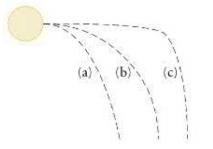
Which is the best representation in Figure P10.39 of the trajectory of a cantaloupe thrown horizontally off a bridge? What is wrong with the other paths?Data from Figure P10.39 W
A bullet is fired horizontally from a high-powered rifle. At the same instant, a bullet that was resting on top of the rifle falls off. Which bullet hits the ground first?
A rifle is aimed horizontally at a target \(100 \mathrm{~m}\) away, and the bullet leaves the rifle barrel at \(650 \mathrm{~m} / \mathrm{s}\). If the gun is aimed right at the bull's-eye, by how much does the bullet miss the center?
On a rifle that has a telescopic sight, the telescope is usually not parallel to the barrel of the rifle. The angle the telescope makes with the barrel has to be adjusted for the distance to the target. Explain why.
A ball rolls off a table and lands on the floor. The horizontal distance between the position at which the ball lands and the edge of the table is \(0.50 \mathrm{~m}\), and the tabletop is \(0.80 \mathrm{~m}\) above the floor.(a) How long does it take the ball to reach the floor? \((b)\) What is
A package is dropped from a helicopter traveling at \(15 \mathrm{~m} / \mathrm{s}\) (horizontally) at an altitude of \(200 \mathrm{~m}\), but the parachute attached to the package fails to open. (a) How long does it take for the package to hit ground? (b) How far does the package travel
The velocity of an object is given in SI units by \(\vec{v}=\left(a t-b t^{2}\right) \hat{\imath}+c \hat{\jmath}\), with \(a=14 \mathrm{~m} / \mathrm{s}^{2}, b=10 \mathrm{~m} / \mathrm{s}^{3}\), and \(c=22 \mathrm{~m} / \mathrm{s}\). (a) If the initial position of the object at \(t=0\) is at the
A golf ball is hit from the tee and travels above level ground. Accounting for air resistance, where is the horizontal location of the peak of the flight: at a position that is less than half the range, at a position that is half the range, or at a position that is more than half the range?
A cannon fires a shell at an angle such that the shell's initial velocity has a horizontal component of \(20 \mathrm{~m} / \mathrm{s}\) and a vertical component of \(35 \mathrm{~m} / \mathrm{s}\). Draw the approximate location of the shell at the instants \(0,1.0 \mathrm{~s}, 2. 0 \mathrm{~s}\),
Taking air resistance into account, draw the acceleration vector of a golf ball at five positions along its trajectory from tee to green. Assume for simplicity that the force of air resistance has a constant magnitude.
How far does a fastball released from the pitcher's hand at a speed of \(42 \mathrm{~m} / \mathrm{s}\) fall as it travels from pitcher to batter, a distance of \(18.4 \mathrm{~m}\) ? (Your answer gives you a good idea of why the pitcher stands on a mound of dirt.)
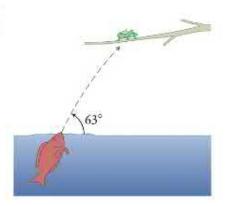
The fish in Figure P10.51, peering from just below the water surface, spits a drop of water at the grasshopper and knocks it into the water. The grasshopper's initial position is \(0.45 \mathrm{~m}\) above the water surface and \(0.25 \mathrm{~m}\) horizontally away from the fish's mouth. If the
A burglar evading the police is running as fast as he can on a building's flat rooftop. At the edge, he sees another flat rooftop across an alley. The horizontal distance across the alley is \(8.0 \mathrm{~m}\), the other rooftop is \(3.0 \mathrm{~m}\) lower than the one on which the burglar is
You throw a ball at an angle of \(30^{\circ}\) above the horizontal at a wall \(20 \mathrm{~m}\) away. The ball's initial speed is \(15 \mathrm{~m} / \mathrm{s}\), and it leaves your hand at a height of \(1.5 \mathrm{~m}\) above the ground. (a) How long does the ball take to get to the wall? (b)
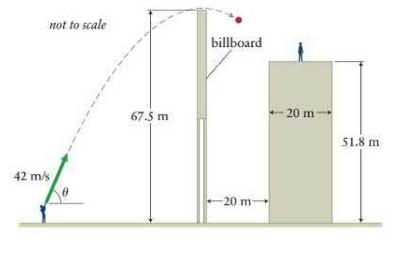
Figure P10.54 shows a friend standing on the roof of a building that is \(51.8 \mathrm{~m}\) tall. The roof is square and measures \(20 \mathrm{~m}\) on a side. You want to shoot a paintball so that it lands on the roof and startles your friend, using a gun that shoots paintballs at a muzzle speed
A brush fire is burning on a rock ledge on one side of a ravine that is \(30 \mathrm{~m}\) wide. A fire truck sits on the opposite side of the ravine at an elevation \(8.5 \mathrm{~m}\) above the burning brush. The firehose nozzle is aimed \(35^{\circ}\) above horizontal, and the firefighters
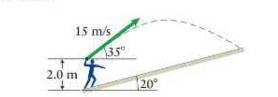
You are standing on a slope of \(20^{\circ}\) to the horizontal and are going to throw a ball at \(15 \mathrm{~m} / \mathrm{s}\) up the incline (Figure P10.56). If you throw the ball at \(35^{\circ}\) with respect to the horizontal, at what distance up the incline from your feet does it land?
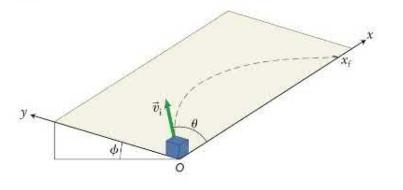
A block of inertia \(m\) sits at the origin of an \(x y\) coordinate system aligned along an incline that makes an angle \(\phi\) with respect to the horizontal (Figure P10.57). You launch the block up the incline, with initial speed \(v_{\mathrm{i}}\) directed at an angle \(\theta\) with respect
A shell explodes prematurely in midair. What happens to the center of mass of the shell?
A cue ball of inertia \(m\) is given a speed \(v\) before it collides elastically with a full rack of 15 stationary balls in a game of pool. If each of the 16 balls has an inertia \(m\), what are \((a)\) the average speed of each ball after they fly apart and \((b)\) the average momentum of each
Object \(A\), at rest on a low-friction table, is struck a glancing blow by object \(\mathrm{B}\). Show that, if the collision is elastic and the two objects have equal inertias, the angle between the final directions of motion of the two objects is 90°.
Disk 1 (of inertia \(m\) ) slides with speed \(1.0 \mathrm{~m} / \mathrm{s}\) across a low-friction surface and collides with disk 2 (of inertia \(2 \mathrm{~m}\) ) originally at rest. Disk 1 is observed to bounce off at an angle of \(15^{\circ}\) to its original line of motion, while disk 2 moves
A system of inertia \(0.50 \mathrm{~kg}\) consists of a spring gun attached to a cart. The system is at rest on a horizontal low-friction track. A \(0.050-\mathrm{kg}\) projectile is loaded into the gun, then launched at an angle of \(40^{\circ}\) with respect to the horizontal plane. With what
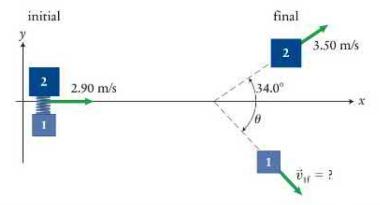
A spring \((k=3800 \mathrm{~N} / \mathrm{m})\) is compressed between two blocks: block 1 of inertia \(1.40 \mathrm{~kg}\) and block 2 of inertia \(2.00 \mathrm{~kg}\). The combination is held together by a string (not shown in Figure P10.63). The combination slides without spinning across
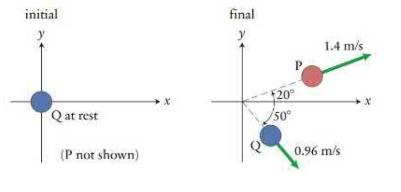
Disk P (inertia \(0.40 \mathrm{~kg}\) ) moves at an unknown velocity across a low-friction horizontal surface and collides with disk Q (inertia \(0.70 \mathrm{~kg}\) ), which is initially at rest. After the collision, the two (now slightly dented) disks move apart without spiming. Velocity
If the angle between vectors \(\vec{A}\) and \(\vec{B}\) is \(165^{\circ}\) and if \(A=3.0 \mathrm{~m}\) and \(B=2.5 \mathrm{~m}\), what is the value of \(\vec{A} \cdot \vec{B}\) ?
Vector \(\vec{A}\) has a magnitude of 3. 5 units, and vector \(\vec{B}\) has a magnitude of 11 units. If the value of \(\vec{A} \cdot \vec{B}\) is 22. 4 units squared, what is the angle between \(\vec{A}\) and \(\vec{B}\) ?
Vector \(\vec{A}\) points in the negative \(y\) direction and has a magnitude of 5. 0 units. Vector \(\vec{B}\) has a positive \(x\) component of 3. 0 units and a negative \(y\) component of 7. 0 units.(a) What is the angle between the vectors? (b) Determine \(\vec{A} \cdot \vec{B}\) .
A force \(\vec{F}=F_{x} \hat{i}+F_{y} \hat{\jmath}\) with \(F_{x}=50 \mathrm{~N}\) and \(F_{y}=12 \mathrm{~N}\) is exerted on a particle as the particle moves along the \(x\) axis from \(x=1.0 \mathrm{~m}\) to \(x=-5.0 \mathrm{~m}\). (a) Determine the work done by the force on the particle. (b)
A force \(\vec{F}=F_{x} \hat{\imath}+F_{y} \hat{\jmath}\) with \(F_{x}=3.0 \mathrm{~N}\) and \(F_{y}=2.0 \mathrm{~N}\) is exerted on a particle that undergoes a displacement \(\vec{D}=D_{x} \hat{\imath}+D_{y} \hat{\jmath}\) with \(D_{x}=2.0 \mathrm{~m}\) and \(D_{y}=-2.0 \mathrm{~m}\).(a) Determine
Calculate \(\vec{C} \cdot(\vec{B}-\vec{A})\) if \(\vec{A}=3.0 \hat{\imath}+2.0 \hat{\jmath}, \quad \vec{B}=\) \(1.0 \hat{\imath}-1.0 \hat{\jmath}\), and \(\vec{C}=2.0 \hat{\imath}+2.0 \hat{\jmath} .00\)
You are playing with a toy in which a marble launched by a spring rolls along a track full of loop-the-loops and curves with almost no energy dissipated. You want the marble to have a speed of \(0.70 \mathrm{~m} / \mathrm{s}\) when it arrives at the top of a loop that is \(0.30 \mathrm{~m}\) higher
You are unloading a refrigerator from a delivery van. The ramp on the van is \(5.0 \mathrm{~m}\) long, and its top end is \(1.4 \mathrm{~m}\) above the ground. As the refrigerator moves down the ramp, you are on the down side of the ramp trying to slow the motion by pushing horizontally against the
A \(20-\mathrm{kg}\) boy slides down a smooth, snow-covered hill on a plastic disk. The hill is at a \(10^{\circ}\) angle to the horizontal, and the slope is \(50 \mathrm{~m}\) long. (a) If the boy starts from rest, what is his speed at the bottom of the hill? (b) His sister then hauls him and the
Two children pull a third child on a tricycle by means of two ropes tied to the handlebars. The combined inertia of the child and tricycle is \(35 \mathrm{~kg}\). One child pulls with a constant force of \(100 \mathrm{~N}\) directed to the right of the straight-ahead direction at an angle of
If \(\vec{A}=A_{x} \hat{i}+A_{y} \hat{\jmath}\) and \(\vec{B}=B_{x} \hat{i}+B_{y} \hat{\jmath}\), show that \(\vec{A} \cdot \vec{B}=\) \(A_{x} B_{x}+A_{y} B_{y}\). You may wish to use the fact that the scalar product satisfies the distributive property: \(\vec{a} \cdot(\vec{b}+\vec{c})=\) \(\vec{a}
Starting from rest, an intern pushes a \(45-\mathrm{kg}\) gurney \(40 \mathrm{~m}\) down the hall with a constant force of \(80 \mathrm{~N}\) directed downward at an angle of \(35^{\circ}\) with respect to the horizontal. (a) What is the work done by the intern on the gurney during the
You know you can provide \(500 \mathrm{~W}\) of power to move large objects. You need to move a \(50-\mathrm{kg}\) safe up to a storage loft, \(10 \mathrm{~m}\) above the floor. (a) With what average speed can you pull the safe straight up? (b) How much work do you do on the safe in doing this? (c)
A bartender gives a full mug of beer an initial speed vfull vfull , and the mug stops in front of a patron sitting at the end of the bar. This patron later asks for a mug only half full. The bartender stands at the same position as when she sent the full mug to the patron and gives the
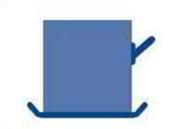
The heavy crate in Figure P10.79 has plastic skid plates on its bottom surface and a tilted handle attached to one side. Which is easier: pushing the crate or pulling it? Assume your force is exerted along the incline of the handle in either case, and consider friction.Data from Figure P10.79
You want to walk down your icy driveway without sliding. If the incline of the driveway is \(15^{\circ}\) from the horizontal, what must the coefficient of static friction be between your shoes and the ice?
Moving a \(51-\mathrm{kg}\) box across a floor, you discover that it takes \(200 \mathrm{~N}\) of force to get the box moving, and then \(100 \mathrm{~N}\) keeps it moving at constant speed. What are the coefficients of static and kinetic friction between box and floor?
Starting from rest, you push your physics book horizontally along a table. Plot the magnitude of the force of friction exerted on the book as a function of the magnitude of the force you exert. Include both static and kinetic cases in the range of force magnitudes you consider.
A resort uses a rope to pull a \(55-\mathrm{kg}\) skier up a \(40^{\circ}\) slope at constant speed for \(100 \mathrm{~m}\). (a) Calculate the tension in the rope if the coefficient of kinetic friction between snow and skis is \(\mu_{k}=0.20\). (b) How much work does the rope do on the skier?
When moving on level ground, cross-country skiers slide their skis along the snow surface to stay moving. The coefficients of friction for a given set of skis and given snow conditions can be modified by various types of waxes. In order to move across the snow as fast as possible, (a) should you
A janitor is pushing an \(11-\mathrm{kg}\) trashcan across a level floor at constant speed. The coefficient of friction between can and floor is 0. 10 . (a) If the janitor is pushing horizontally, what is the magnitude of the force he exerts on the can? (b) If he pushes at an angle of
A hockey puck on the ice starts out moving at \(10.50 \mathrm{~m} / \mathrm{s}\) but after \(40.00 \mathrm{~m}\) has slowed to \(10.39 \mathrm{~m} / \mathrm{s}\). (a) What is the coefficient of kinetic friction between ice and puck? (b) On this same ice, what is the speed after \(40.00
The coefficient of kinetic friction between tires and dry pavement is about 0. 80 . Assume that while traveling at \(27 \mathrm{~m} / \mathrm{s}\) you lock your brakes and as a result the only horizontal force on the car is the frictional one. (a) How many seconds does it take you to bring your car
A block of inertia \(m\) is placed on an inclined plane that makes an angle \(\theta\) with the horizontal. The block is given a shove directly up the plane so that it has initial speed \(v\), and the coefficient of kinetic friction between the block and the plane surface is \(\mu_{k}\). (a) How
A \(1.0-\mathrm{kg}\) block on a horizontal tabletop is pushed against the free end of a spring (the other end is attached to a wall) until the spring is compressed \(0.20 \mathrm{~m}\) from its relaxed length. The spring constant is \(k=100 \mathrm{~N} / \mathrm{m}\), and the coefficient of
A man exerts a constant force to pull a \(50-\mathrm{kg}\) box across a floor at constant speed. He exerts this force by attaching a rope to the box and pulling so that the rope makes a constant angle of \(36.9^{\circ}\) above the horizontal. The coefficient of kinetic friction for the box-floor
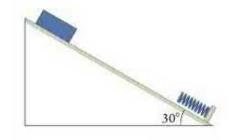
An inclined plane that makes an angle of \(30^{\circ}\) with the horizontal has a spring of spring constant \(4500 \mathrm{~N} / \mathrm{m}\) at the bottom (Figure P10.91). A 2. 2-kg block released near the top of the plane moves down the plane and compresses the spring a maximum of \(0.0240
You push down on a book of inertia \(m\) resting on a table with a force directed at an angle \(\theta\) away from vertical. The coefficient of static friction between book and table is \(\mu_{s}\). If \(\theta\) is not larger than some critical value, you cannot get the book to slide no matter how
You push a \(2.0-\mathrm{kg}\) block up a ramp by exerting a \(100-\mathrm{N}\) force directed parallel to the ramp, which is at a \(30^{\circ}\) angle to the horizontal. (a) Ignoring any effects due to friction, calculate the block's speed when you have pushed it \(2.0 \mathrm{~m}\) if its upward
A platform that rolls on wheels and has inertia \(m_{p}\) is attached to a wall by a horizontal spring of spring constant \(k\). A load of inertia \(m_{\ell}\) sits on the platform, and the coefficient of static friction between platform and load is \(\mu_{s}\). If you pull the platform away from
You have to specify the power output of a motor for a ski tow rope that will carry 20 skiers at a time. The grade of the ski slope is \(32^{\circ}\) above horizontal, and the average coefficient of kinetic friction between skis and snow is 0. 12. If the tow speed is to be \(3.0 \mathrm{~m} /
A spring of spring constant \(k\) is attached to a support at the bottom of a ramp that makes an angle \(\theta\) with the horizontal. A block of inertia \(m\) is pressed against the free end of the spring until the spring is compressed a distance \(d\) from its relaxed length. Call this position
A sports car skids to a stop, lcaving skid marks \(290 \mathrm{~m}\) long. If the coefficient of kinetic friction between tires and pavement is 0. 50 , how fast was the car going before the skid?
If you were to throw a penny horizontally as hard as you could from the top floor of the Empire State Building, about how far from the basc would it land?
Watering the garden, you need to have the water reach farther and instinctively raise the hose nozzle to increase the range of the water stream. You realize that increasing the angle the nozzle makes with the ground increases the time interval during which the water is in flight, thereby letting
A particle initially at the origin of an \(x y\) coordinate system and having an initial velocity of \((40 \mathrm{~m} / \mathrm{s}) \hat{i}\) experiences a constant acceleration of \(\vec{a}=a_{x} \hat{i}+a_{y} \hat{\jmath}\), with \(a_{x}=-1.0 \mathrm{~m} / \mathrm{s}^{2}\) and \(a_{y}=-0.50
Describe the properties of two vectors for which (a) \(\vec{A}+\vec{B}=\vec{A}-\vec{B}\) and (b) \(|\vec{A}|+|\vec{B}|=|\vec{A}+\vec{B}| \)
Three forces are exerted on a \(2.00-\mathrm{kg}\) block initially at rest on a slippery surface: a \(100-\mathrm{N}\) force directed along the positive \(x\) axis, a \(50.0-\mathrm{N}\) force that makes an angle of \(30.0^{\circ}\) with the positive \(x\) axis, and a \(144-\mathrm{N}\) force that
An airline pilot begins a trip to Duluth from an airport located \(1500 \mathrm{~km}\) south of Duluth. Her air speed is \(260 \mathrm{~m} / \mathrm{s}\), but a wind blows from west to east at \(40 \mathrm{~m} / \mathrm{s}\) that takes her off course if she flies directly north. She has the choice
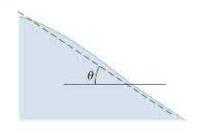
The coefficient of static friction between layers of snow is 3. 7 under ideal conditions. What is the steepest angle a snow field can form ( \(\theta\) in Figure P10.105) before there is an avalanche?Data from Figure P10.105
Showing 3800 - 3900
of 4962
First
32
33
34
35
36
37
38
39
40
41
42
43
44
45
46
Last
Step by Step Answers

 Get 50% OFF
Claim Now
Get 50% OFF
Claim Now