New Semester
Started
Get
50% OFF
Study Help!
--h --m --s
Claim Now
Question Answers
Textbooks
Find textbooks, questions and answers
Oops, something went wrong!
Change your search query and then try again
S
Books
FREE
Study Help
Expert Questions
Accounting
General Management
Mathematics
Finance
Organizational Behaviour
Law
Physics
Operating System
Management Leadership
Sociology
Programming
Marketing
Database
Computer Network
Economics
Textbooks Solutions
Accounting
Managerial Accounting
Management Leadership
Cost Accounting
Statistics
Business Law
Corporate Finance
Finance
Economics
Auditing
Tutors
Online Tutors
Find a Tutor
Hire a Tutor
Become a Tutor
AI Tutor
AI Study Planner
NEW
Sell Books
Search
Search
Sign In
Register
study help
physics
particle physics
Principles And Practice Of Physics 2nd Global Edition Eric Mazur - Solutions
A beam of \(550-\mathrm{nm}\) light illuminates six parallel slits spaced \(0.125 \mathrm{~mm}\) apart, and the resulting pattern is viewed on a screen. (a) What are the angular positions of the first-order and second-order principal maxima? (b) What are the angular positions of all the dark
You shine a red \((\lambda=650 \mathrm{~nm})\) laser beam and a green \((\lambda=532 \mathrm{~nm})\) laser beam at a diffraction grating that has 400 slits/ \(\mathrm{mm}\) to create an interference pattern on a wall \(3.00 \mathrm{~m}\) from the grating. If the two lasers are directly on top of
Is it possible to shine two laser beams of visible light into the same diffraction grating so that the dark fringes created by one beam overlay the bright fringes created by the other beam for all values of \(m\) ?
Light of wavelength \(570 \mathrm{~nm}\) passes through a pair of parallel slits that are \(0.115 \mathrm{~mm}\) apart. It then falls on a screen that is \(45.0 \mathrm{~mm}\) from the slits and centered directly opposite them. What must the minimum screen width be in order to have all the bright
A beam of light containing all the visible wavelengths from \(400 \mathrm{~nm}\) to \(700 \mathrm{~nm}\) passes through a pair of parallel slits that are \(2.50 \mu \mathrm{m}\) apart. These slits spread the beam into a series of full-color spectra. How many complete full-color spectra are formed?
You are designing a diffraction grating that, for \(566.0-\mathrm{nm}\) light, will produce second-order bright fringes that are an angular distance of \(22.00^{\circ}\) from the central bright fringe. How many equally spaced slits should this grating contain across its width if it is \(24.00
You want to use a diffraction grating to resolve a beam of visible light into its component wavelengths, from \(390 \mathrm{~nm}\) to \(750 \mathrm{~nm}\). Do the spectra from different orders overlap; that is, does a color from one order overlap with a different color from another order? If so,
The spectrum of the radiation emitted by hydrogen atoms has a peak at \(\lambda_{\mathrm{r}}=656.3 \mathrm{~nm}\) (red) and a peak at \(\lambda_{\mathrm{b}}=486.1 \mathrm{~nm}\) (blue-green). (a) If this radiation is passed through a double-slit apparatus in which the slit separation is \(d=0.100
How many slits are needed in a diffraction grating that must resolve the \(m=1\) maxima of two spectral lines at \(\lambda_{\mathrm{s}}=610 \mathrm{~nm}\) and \(\lambda_{\mathrm{l}}=615 \mathrm{~nm}\) ?
A \(0.500-\mu \mathrm{m}\)-thick flake of glass \(\left(n_{\text {glass }}=1.52\right)\) from a broken cover slip is floating on water \(\left(n_{\text {water }}=1.33\right)\). If white light initially traveling in the air \(\left(n_{\text {air }}=1.00\right)\) is incident normal to the surface of
You are designing a thin transparent reflective coating for the front surface of a sheet of glass. The index of refraction of the glass is 1. 52 , and when it is in use the coated glass has air on both sides. Because the coating is expensive, you want to use a layer that has the minimum thickness
A sheet of glass \(\left(n_{\text {glass }}=1.5\right)\) is coated with a \(90.6-\mathrm{nm}-\) thick layer of magnesium fluoride \(\left(n_{\text {coaring }}=1.38\right)\) to prevent reflection in the visible spectrum. What is the longest wavelength of light strongly reflected from this coated
The thin film that forms a soap bubble has an index of refraction of 1. 42 . When white light strikes the outer surface of the film at normal incidence, \(625-\mathrm{nm}\) reflected light is especially bright. Derive an expression for the possible thicknesses of the film.
You are working with the mineral fluorite \(\left(\mathrm{CaF}_{2}, n_{\text {fluorite }}\right.\) \(=1.43\) ) and have a sample that is coated with a layer of liquid \(158 \mathrm{~nm}\) thick. When you shine visible light of various wavelengths at normal incidence onto the surface of the liquid,
A thin film that is \(175 \mathrm{~nm}\) thick and has an index of refraction smaller than 1.56 covers the front surface of a vertical sheet of glass that has an index of refraction of 1. 56. The back surface of the glass interfaces with air, as does the front surface of the film. When a beam of
When \(633-\mathrm{nm}\) light shines on a fracture-line crack in a thin piece of metal, a diffraction pattern is observed on a screen located \(L=0.90 \mathrm{~m}\) from the metal. If the width of the central bright fringe is \(w=12 \mathrm{~mm}\), what is the width of the crack in the metal?
How wide does a single slit have to be so that \(650-\mathrm{nm}\) light passing through the slit has its first dark fringe \(30.0^{\circ}\) from the center of the interference pattern?
You send \(400-\mathrm{nm}\) violet light through a slit that is \(0.500 \mathrm{~mm}\) wide. How far from the slit must you place a screen so that the distance between the \(n=1\) fringes is \(10.0 \mathrm{~mm}\) ?
Red laser light \((\lambda=656.5 \mathrm{~nm})\) passes through a slit of width \(a=0.100 \mathrm{~mm}\). On a screen a distance \(L=2.000 \mathrm{~m}\) from the slit, what is the linear distance between the central bright fringe and either first-order dark fringe?
Monochromatic \(545-\mathrm{nm}\) light is incident on a 15 - \(\mu \mathrm{m}\)-wide slit. If the diffraction pattern is cast on a screen \(710 \mathrm{~mm}\) from the slit, what is the linear distance from the center of the pattern to the \(n=4\) dark fringe?
A student makes the following claim: For radiation of any wavelength passing through a single slit, the separation distance between any two adjacent dark fringes is twice the source-screen distance when the slit width equals the wavelength. Evaluate this claim.
At sunset, red light travels horizontally through the doorway in the western wall of your beach cabin, and you observe the light on the eastern wall. What is the width of the central maximum in the interference pattern created by the doorway "slit"?
An experimental setup consists of a \(550-\mathrm{nm}\) laser, a screen at a distance of \(0.50 \mathrm{~m}\), and an adjustable-width single slit. At what slit width is the width of the central maximum of the interference pattern the same as that of the bright spot it would make in the absence of
When \(440-\mathrm{nm}\) light is incident on a slit that is \(75 \mu \mathrm{m}\) wide, the diffraction pattern is cast on a screen \(0.450 \mathrm{~m}\) from the slit. How wide is the central bright fringe?
A slit \(0.002470 \mathrm{~mm}\) wide is used to study a light ray made up of two wavelengths, \(482.0 \mathrm{~nm}\) and \(517.3 \mathrm{~nm}\), and the diffraction pattern is viewed on a screen \(0.220 \mathrm{~m}\) from the slit. In the pattern, what is the distance between the \(n=2\) dark
A 485-nm light beam passes through a slit and forms a diffraction pattern on a screen \(0.320 \mathrm{~m}\) from the slit. The \(n=1\) and \(n=-1\) dark fringes are \(22.4 \mathrm{~mm}\) apart on the screen. (a) How wide is the slit? (b) What is the greatest angle from the original beam direction
Two extremely narrow, parallel slits are cut in a sheet of cardboard, with the width \(a\) of each slit very much smaller than the distance \(d\) between them. When the slits are illuminated by a coherent beam of \(620-\mathrm{nm}\) light, the angular position of the two third-order bright fringes
In the interference pattern created by \(800-\mathrm{nm}\) radiation passing through a single slit \(45 \mu \mathrm{m}\) wide, what is the angular separation between the \(n=3\) and \(n=5\) dark fringes on the same side of the central maximum?
In the interference pattern created by light diffracted from a single slit, which are wider: the first-order bright fringes or the third-order bright fringes? (Plot or plug in typical numerical values for the slit width and wavelengths to make an educated guess.)
A laser beam passes through a slit that is \(1500 \mathrm{~nm}\) wide. In the interference pattern created on a distant screen, the angular positions of the two first-order dark fringes are \(\pm 25. 0^{\mathrm{a}}\). The beam then is shone on a soap film \(\left(n_{\text {film }}=1.40\right)\)
A pinhole of diameter \(0.20 \mathrm{~mm}\) is illuminated with \(550 \mathrm{~nm}\) light. What is the width of the Airy disk on a screen \(1.5 \mathrm{~m}\) away?
The human eye is most sensitive to green light at \(550 \mathrm{~nm}\), which is why this wavelength is most frequently used when calculating the resolution limits of telescopes. A telescope for amateur astronomers has a focal length of \(1200 \mathrm{~mm}\) and an aperture diameter of \(200
You wish to use a lens to focus a beam of light that has a diameter of \(40.0 \mathrm{~mm}\). Which lens focuses the beam to the smallest point: lens A, 10. 0-mm diameter, \(25.0-\mathrm{mm}\) focal length; lens B, \(150-\mathrm{mm}\) diameter, \(50.0-\mathrm{mm}\) focal length; or lens
The Spitzer Space Telescope, launched in 2003, has a mirror that is \(0.85 \mathrm{~m}\) in diameter and detects infrared light with wavelengths from \(3.00 \mu \mathrm{m}\) to \(180 \mu \mathrm{m}\). If the instrument is used to study a pair of stars, what are the resolvable angular separations of
For an eye in which the pupil has a radius of \(3.0 \mathrm{~mm}\), what is the smallest angular separation that can be resolved (a) when two violet \((\lambda=400 \mathrm{~nm})\) objects are placed side by side and \((b)\) when two \(\mathrm{red}(\lambda=650 \mathrm{~nm})\) objects are placed side
A \(530-\mathrm{nm}\) laser beam passes through a circular aperture that has diameter \(0.400 \mathrm{~mm}\). What is the diameter of the first dark fringe on a screen \(800 \mathrm{~mm}\) away from the aperture?
The pupil of the human eye can vary in diameter from \(2.00 \mathrm{~mm}\) in bright light to \(8.00 \mathrm{~mm}\) in dim light. The cye has a focal length of about \(25 \mathrm{~mm}\), and the visible spectrum extends from \(390 \mathrm{~nm}\) (violet) to \(750 \mathrm{~nm}\) (red). What range of
In vacuum, the Airy disk generated by a pinhole in a metal sheet has radius \(y_{r, v a c}\). How does the disk radius change when the sheet is submerged in water \((n=1.33)\) ?
When \(500-\mathrm{nm}\) light is incident on a circular aperture that has diameter \(d=30.0 \mu \mathrm{m}\), a diffraction pattern forms on a screen \(350 \mathrm{~mm}\) from the aperture. Calculate the area of the central bright fringe.
Two objects emitting \(550-\mathrm{nm}\) light are placed side by side \(30.0 \mathrm{~mm}\) apart. For an eye in which the pupil has a diameter of \(6.00 \mathrm{~mm}\), what is the minimum cye-objects distance \(L\) at which the objects are not resolvable?
You are using your telescope to view stars by observing the visible light they emit. If the diameter of the lens is \(60.0 \mathrm{~mm}\), what must the minimum angular separation of two stars be in order for you to resolve them?
A satellite studying Earth's surface uses a telescope mirror \(2.75 \mathrm{~m}\) in diameter to focus light of wavelength \(525 \mathrm{~nm}\). If the satellite orbits at an altitude of \(25,000 \mathrm{~km}\) and points the mirror straight downward, what is the diameter of the smallest surface
A beam of \(650-\mathrm{nm}\) light passes through a small round hole and falls on a screen \(350 \mathrm{~mm}\) past the hole. If the diameter of the Airy disk on the screen is \(139 \mathrm{~mm}\), what is the diameter of the hole?
The red brake lights of a car are \(2.00 \mathrm{~m}\) apart. Standing \(300 \mathrm{~m}\) away from the rear of the car, you use a \(f=50 \mathrm{~mm}\) lens with an aperture of diameter \(d=4.00 \mathrm{~mm}\) to photograph the illuminated brake lights. Are the lights likely to be resolved in the
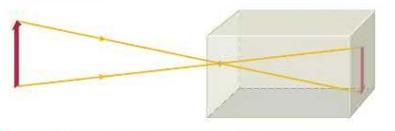
You are building a pinhole camera, which uses a small hole instead of a lens to produce an image (Figure P34.84). (a) If the distance between the hole and the film is \(100 \mathrm{~mm}\) and the hole diameter is \(0.300 \mathrm{~mm}\), what is the smallest resolved image point you can have on the
What happens to \((a)\) the kinetic energy of a marble when its speed is reduced to half its initial speed and \((b)\) the energy of a photon when its speed is reduced to half its initial speed (as, for instance, when the photon travels from a medium with an index of refraction of 1 into a medium
What is the energy of (a) a 400 -nm photon and (b) a 700-nm photon?
What is the wavelength of a gamma-ray photon that has energy of \(8.0 \times 10^{-14} \mathrm{~J}\) ?
What is the momentum of a photon that has energy of \(8.0 \times 10^{-14} \mathrm{~J}\) ?
Aluminum has a work function of \(E_{0}=6.54 \times 10^{-19} \mathrm{~J}\). What is the maximum wavelength of light that can free electrons from the surface?
If the work function of a material is such that red light of wavelength \(700 \mathrm{~nm}\) just barely initiates the photoelectric effect, what must the maximum kinetic energy of ejected electrons be when violet light of wavelength \(400 \mathrm{~nm}\) illuminates the material?
When \(410-\mathrm{nm}\) light is incident on a sheet of metal, the maximum kinetic energy of electrons ejected from the metal surface is measured to be \(K_{\max }=3.5 \times 10^{-20} \mathrm{~J}\). What is the work function of the metal?
When three metals, 1, 2, and 3, are illuminated with light of frequency \(f\) in a photoelectric-effect experiment, the relationship of the stopping potential differences is found to be \(V_{\text {stop }, 1}>V_{\text {stop }, 2}>V_{\text {stop }, 3}\). Which material has (a) the lowest frequency
In a photoelectric-effect experiment, the stopping potential difference is found to be \(3.4 \mathrm{~V}\) when 140 -nm light is used. What is the work function of the metal?
A metal alloy has a work function of \(E_{0}=4.6 \times 10^{-19} \mathrm{~J}\). It is irradiated with light of different wavelengths, and the maximum kinetic energy of ejected electrons is measured. What are the maximum kinetic energy and the maximum electron speed (a) when 390-nm light is used
You determine that light of minimum-frequency \(7.20 \times 10^{14} \mathrm{~Hz}\) is needed to eject electrons from the surface of a certain metal. What frequency should the light have in order for the ejected electrons to have a maximum speed of \(8.50 \times 10^{5} \mathrm{~m} / \mathrm{s}\) ?
A helium-neon laser that has a power rating of \(0.250 \mathrm{~mW}\) operates at a wavelength of \(633 \mathrm{~nm}\) and a beam diameter of \(2.00 \mathrm{~mm}\). Calculate \((a)\) the energy per photon, (b) the number of photons emitted per second, (c) the momentum per photon, and \((d)\) the
(a) If the kinetic energy of an electron and the energy of a photon are both \(2.00 \times 10^{-18} \mathrm{~J}\), calculate the ratio of the de Broglie wavelength of the electron to the wavelength of the photon. Which particle has the shorter wavelength? (b) If the wavelength of a photon and the
A 3. 50-W beam of 216-nm laser light shines on the surface of a metal for which the work function is \(2.00 \times 10^{-19} \mathrm{~J}\). What is the maximum number of electrons per second the beam can cause to be ejected from the metal?
A laser beam with an intensity of \(60 \mathrm{~W} / \mathrm{m}^{2}\) shines on a black object of mass \(2.3 \mathrm{mg}\). The beam hits an area of \(4.5 \mathrm{~mm}^{2}\) head-on (that is, the beam is perpendicular to the surface). Assuming a totally inelastic collision (meaning the incident
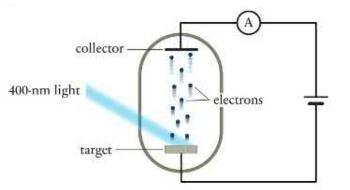
In the vacuum tube of Figure P34.100, the lower metal plate, the target, is irradiated with \(400-\mathrm{nm}\) light of intensity \(5.50 \mathrm{~W} / \mathrm{m}^{2}\). The frequency of the light is great enough to cause electrons to be ejected from the target and travel to the upper metal plate,
When 550-nm light passes through a thin slit and then travels to a screen, the first-order dark fringe in the interference pattern is at \(32.5^{\circ}\) from the center of the screen. When a beam of electrons, each having kinetic energy equal to the energy of the photons in the \(550-\mathrm{nm}\)
A uniform film of a material that has index of refraction 1. 30 covers the front surface of a pane made of glass with index of refraction 1. 55 . When a beam of monochromatic light initially traveling in air strikes the film at normal incidence, the minimum film thickness for which the light
Monochromatic light of which wavelength diffracts the most through a \(3.0-\mu \mathrm{m}\) aperture: \(400 \mathrm{~nm}, 500 \mathrm{~nm}\), or \(600 \mathrm{~nm}\) ?
A double-slit barrier with slit separation distance \(d\) is a distance \(L\) from a screen, with \(L \gg d\). When green laser light \(\left(\lambda_{\mathrm{g}}=532 \mathrm{~nm}\right)\) passes through the barrier, the bright fringes on the screen are a distance \(y_{\mathrm{g}}\) apart. When red
On a screen \(2.5 \mathrm{~m}\) from a slit \(0.0500 \mathrm{~mm}\) wide, you measure a separation distance of \(31 \mathrm{~mm}\) between adjacent \(n=1\) and \(n=2\) dark fringes of a laser interference pattern. What is the wavelength of the laser radiation? The screen is far enough away and the
NASA plans to use \(x\)-ray diffraction to identify minerals on the surface of Mars. If the wavelength of the \(x\) rays is \(0.155 \mathrm{~nm}\), what is the lattice spacing in a crystalline sample if the crystal strongly reflects \(\mathrm{x}\) rays at an incident angle of \(51.7^{\circ}\) in
Babinet's principle states that, except for differences in intensity, the interference pattern created by light passing around an opaque object is the same as the pattern created by the same light passing through a hole of the same size and shape as the object. You shine a \(690-\mathrm{nm}\) laser
Many hundreds of planets beyond our solar system have been discovered in recent years, but they have all been too far away to be resolved by present-day optical telescopes. Using light of wavelength \(525 \mathrm{~nm}\), what must the minimum mirror diameter of a space telescope be in order to
You shine light of frequency \(f_{\mathrm{i}}\) on a diffraction grating and create a diffraction pattern on a screen made up of tiny photon detectors.(a) How does the pattern change if you increase the frequency of the light? \((b)\) How does the pattern change if you replace the initial light
A layer of oil \(\left(n_{\text {oil }}=1.48\right) 0. 0100 \mathrm{~mm}\) thick is resting on a puddle of water \(\left(n_{\text {water }}=1.33\right)\). If white light is incident on the oil, what is the smallest angle from normal at which green light \((\lambda=510 \mathrm{~nm})\) is strongly
When a monochromatic beam of light passes through a thin slit, the \(n=9\) dark fringe is \(10^{\circ}\) beyond the adjacent \(n=8\) dark fringe. What is the ratio of the wavelength of the light to the width of the slit?
In a double-slit interference pattern, it is the amplitudes of the light waves from each slit that add, not the light intensities. Usually, in the analysis of interference patterns, the radiation intensity (or amplitude) is assumed to be exactly the same for both slits. Because of inaccurate
Electrons are accelerated from rest through a \(2.0-\mathrm{kV}\) potential difference. What are \((a)\) their speed after this acceleration and \((b)\) their wavelength? (c) If the accelerated electrons are incident on a graphite crystal that has a lattice spacing of \(0.123 \mathrm{~nm}\), do you
You are designing a diffraction grating that will disperse white light into its spectrum \((400-\mathrm{nm}\) violet to \(700-\mathrm{nm}\) red). In the first-order spectrum, you want the angular separation between the shortest and longest wavelengths to be \(12.0^{\circ}\). (a) How many slits per
Monochromatic light passes through a small round hole \(1.36 \mu \mathrm{m}\) in radius. The light then strikes a detector \(120 \mathrm{~mm}\) away from the hole and is absorbed by the detector surface. If the radius of the Airy disk on the detector is \(33.3 \mathrm{~mm}\), how much energy and
A young adult with good vision is reading a document placed at her near point. She is using ordinary reading light of wavelength \(500 \mathrm{~nm}\), and the diameter of her pupil is \(3.0 \mathrm{~mm}\). Under these conditions, what is the height of the smallest letter she can resolve on the
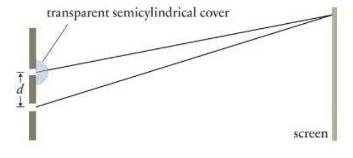
In experiment 1 , a laser beam of \(750-\mathrm{nm}\) light is passed through a double-slit barrier and creates a diffraction pattern on a screen. In experiment 2 , one slit is covered with a semicylindrical piece of material that has an index of refraction of \(n=1.001\), as shown in Figure
You have an unlabeled container in the laboratory that contains the solid lithium fluoride (LiF) and an identical unlabeled container that contains the solid sodium chloride \((\mathrm{NaCl})\). You know that both materials crystallize in a cubic structure, with alternating \(\mathrm{Na}\) and
As a mission engineer for NASA, you are working on a mission to map the surface of Mars. Your boss asks you to design the optical system for a satellite that can resolve surface features as small as \(2.00 \mathrm{~m}\) across in the visible part of the electromagnetic spectrum. He tells you the
During an airplane flight let it gets positively charges due to the friction with air and the dust particles. In that situation the flux of electric field into the aircraft is zero, positive or negative? Justify your answer.
Two positive charges having magnitude \(+q\) each are separated by a distance \(6 \mathrm{~mm}\) apart. Compute the electric field at a point located \(3 \mathrm{~mm}:\)(a) on the line joining of the two charges (b) not on the line joining of the two charges.
Consider 500 uniform electric field lines that pass through a hollow tube of length \(10 \mathrm{~m}\) and cross-sectional area \(1 \mathrm{~m}^{2}\). If the tube is cut at the middle in such way the new cross-section makes an angle of \(60^{\circ}\) with the electric field lines, then compare the
An aluminum tube of length \(8 \mathrm{~m}\) has been uniformly charged with \(10 \mu \mathrm{C}\) of charge. Considering symmetry, estimate the electric field at the geometric center of the tube lying on the axial position.
A negative charge is located inside the swim ring. Is there any location on the surface of the swim ring where the electric field line flux is positive?
A charge of \(+2 q\) is enclosed inside a hollow copper sphere having a wall thickness of \(5 \mathrm{~mm}\). Compute the electric flux through the copper sphere.
(a) Can a car protect the driver and the passengers from an external electric field?(b) Also, justify the need of keeping sophisticated electronic devices enclosed inside a metallic box.
A charge of \(35 \mathrm{nC}\) is placed at the center of the rugby ball. Calculate the net flux through the balls surface. Comment on the location on the ball's surface where the electric field is minimum.
A charge of \(50 \mathrm{nC}\) is located at the center of a hollow sphere of radius \(10 \mathrm{~cm}\). For what radius of the sphere will the electric field line density over the surface be:(a) doubled (b) halved?
A particle carries a charge of \(10 \mu \mathrm{C}\). Calculate the electric flux through single face if the charge is placed at the geometric center of (a) an octahedron (b) a dodecahedron.
A uniformly charged sphere \(5 \mathrm{~cm}\) in radius carries a charge of \(8.0 \mathrm{nC}\). A thick hollow conducting spherical shell of inner radius \(10 \mathrm{~cm}\) and outer radius \(12 \mathrm{~cm}\) having a charge \(4.0 \mathrm{nC}\) is concentric with the sphere.(a) Calculate the
A particular closed surface has four sides. The electric flux is \(+800 \mathrm{Nm}^{2} / \mathrm{C}\) through side \(1,+300 \mathrm{Nm}^{2} / \mathrm{C}\) through side 2, and \(-1200 \mathrm{Nm}^{2} / \mathrm{C}\) through side 3.(a) If no surplus charge is enclosed by the surface, what is the flux
Consider a dipole located at the center of a cylindrical Gaussian surface such that the axis of the dipole aligns with the axis of the cylinder.(a) Find the total flux through the Gaussian surface.(b) Comment on the total flux through the Gaussian surface if the if the dipole is translated in such
A positively charged hollow conducting sphere of radius \(20 \mathrm{~cm}\) has a charge of \(10 \mathrm{nC}\). If the same charge is distributed over the volume of a sphere having the radius \(20 \mathrm{~cm}\), compare the magnitude of the electric field at a distance of \(1 \mathrm{~m}\) for
A positively charged thin cylindrical shell of length 50 \(\mathrm{cm}\) and radius \(1 \mathrm{~mm}\) has no end caps and a uniform surface charge density of \(3 \times 10^{-6} \mathrm{C} / \mathrm{m}^{2}\).(a) What is the charge on the shell? Determine the electric field magnitude far from either
A positively charged solid non-conducting cylinder of length \(\ell=1 \mathrm{~m}\) and radius \(R=2 \mathrm{~cm}\) has a uniform volume charge density of \(9 \times 10^{-6} \mathrm{C} / \mathrm{m}^{3}\).(a) What is the charge inside the cylinder? Avoiding the regions near the ends, determine the
Three nonconducting infinite sheets are parallel to each other. Each sheet has a uniform surface charge density. Sheet 1 is negatively charged with surface charge density \(-\sigma\), and is defined to be the plane \(x=0\). Sheet 2 has an unknown surface charge density and is at a distance of 2.0
An infinitely long positively charged wire carries a uniform linear charge density \(\lambda\). A charged particle, carrying a charge \(q\), is placed at a distance \(2 d\) from the wire.(a) What is the relation between \(q\) and \(\lambda\) so that the magnitude of the electric field at the
The nonuniform volume charge density inside a positively charged solid nonconducting sphere of radius \(R\) is \(ho(r)=ho_{0} r / R\), where \(r\) is the radial distance from the sphere center.(a) Calculate the electric field as a function of \(r\) for \(rR\). Repeat for volume charge densities
In electrostatics, the electric field lines are always associated with source charges. If there is no electric field at a particular location in space, can we say that there are no charges surrounding that location?
Showing 500 - 600
of 4962
1
2
3
4
5
6
7
8
9
10
11
12
13
14
15
Last
Step by Step Answers

 Get 50% OFF
Claim Now
Get 50% OFF
Claim Now