New Semester
Started
Get
50% OFF
Study Help!
--h --m --s
Claim Now
Question Answers
Textbooks
Find textbooks, questions and answers
Oops, something went wrong!
Change your search query and then try again
S
Books
FREE
Study Help
Expert Questions
Accounting
General Management
Mathematics
Finance
Organizational Behaviour
Law
Physics
Operating System
Management Leadership
Sociology
Programming
Marketing
Database
Computer Network
Economics
Textbooks Solutions
Accounting
Managerial Accounting
Management Leadership
Cost Accounting
Statistics
Business Law
Corporate Finance
Finance
Economics
Auditing
Tutors
Online Tutors
Find a Tutor
Hire a Tutor
Become a Tutor
AI Tutor
AI Study Planner
NEW
Sell Books
Search
Search
Sign In
Register
study help
physics
particle physics
Principles And Practice Of Physics 2nd Global Edition Eric Mazur - Solutions
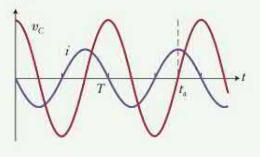
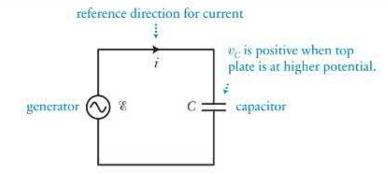
Figure 32. 41 shows the time-varying potential difference and current for the circuit of Figure 32. 8. At the instant labeled \(t_{\mathrm{a}}\), what are the charge on the capacitor plates and the direction of the current?Data from Figure 32. 41Data from Figure 32.8 T
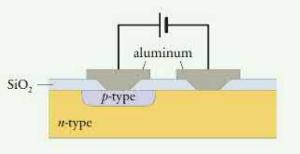
Is there any current in a diode connected as shown in Figure 32. 42?Data from Figure 32. 42 SiO 11-type p-type aluminum
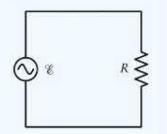
Figure 32.6 shows a circuit consisting of an \(\mathrm{AC}\) source and a resistor. The emf produced by the generator varies sinusoidally in time. Sketch the potential difference across the resistor as a function of time and the current in it as a function of time.Data from Figure 32.6 www R
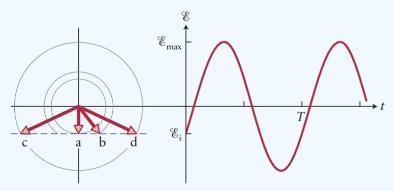
Consider the oscillating emf represented in the graph of Figure 32.12. Which of the phasors a-d, each shown at \(t=0\), correspond(s) to this oscillating emf?Data from Figure 32.12 1. T
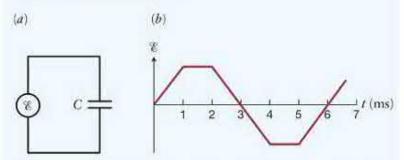
When a certain capacitor is connected to a nonsinusoidal source of \(\mathrm{cmf}\) as in Figure 32.15a, the \(\mathrm{cmf}\) varies in time as illustrated in Figure 32.15b. Sketch a graph showing the current in the circuit as a function of time.Data from Figure 32.15 (a) (b) 1 2 3 4 50 (ms) 6
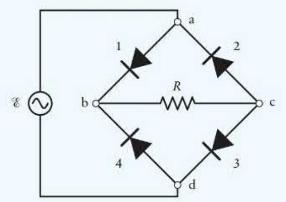
Consider the arrangement of ideal diodes shown in Figure 32.29. This arrangement, called a rectifier, converts alternating current (AC) to direct current (DC). Sketch a graph showing, for a sinusoidally alternating source, the current in the resistor in the direction from \(\mathrm{b}\) to
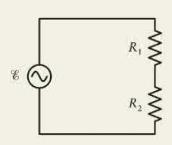
In Figure 32.46, the resistances are \(R_{1}=100 \Omega\) and \(R_{2}=\) \(60 \Omega\), the amplitude of the \(\mathrm{emf}\) is \(\mathscr{E}_{\max }=160 \mathrm{~V}\), and its frequency is \(60 \mathrm{~Hz}\).(a) What is the amplitude of the potential difference across each resistor? \((b)\)
When a \(3.0-\mathrm{H}\) inductor is the only element in a circuit connected to a \(60-\mathrm{Hz} \mathrm{AC}\) source that is delivering a maximum emf of \(160 \mathrm{~V}\), the current amplitude is \(I\). When a capacitor is the only element in a circuit connected to the same source, what must
Use phasors to determine the sum of the oscillating potential differences \(v_{1}=(2.0 \mathrm{~V}) \sin \omega t\) and \(v_{2}=(3.0 \mathrm{~V}) \cos \omega t\).
A circuit that allows emfs in one angular-frequency range to pass through essentially unchanged but prevents emfs in other angular-frequency ranges from passing through is called a filter. Such a circuit is useful in a variety of electronic devices, including audio electronics. An example of a
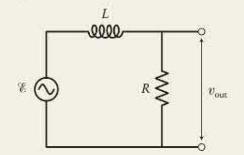
Consider the circuit shown in Figure 32.60. (a) Determine the cutoff angular frequency \(\omega_{\mathrm{c}}\) and the phase constant at which \(V_{R}=V_{L}\). (b) Can this circuit be used as a low-pass or high-pass filter?Data from Figure 32.60 8 L elle R www Vout
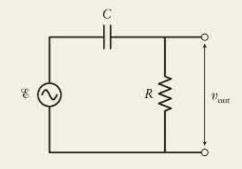
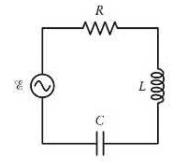
Consider an RLC circuit, such as the one shown in Figure 32.58. The source emf has amplitude \(160 \mathrm{~V}\) and frequency \(60 \mathrm{~Hz}\). The resistance is \(R=50 \Omega\) and the inductance is \(L=0.26 \mathrm{H}\). If the amplitudes of the potential difference across the capacitor and
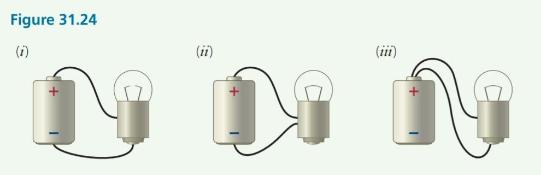
Why are none of the bulbs in Figure 31. 24 lit?Data from Figure 31. 24 Figure 31.24 (1) (iii) NNN
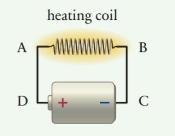
In Figure 31. 25, identify the energy conversions that occur between points \(A\) and \(B, B\) and \(\mathrm{C}, \mathrm{C}\) and \(\mathrm{D}\), and \(\mathrm{D}\) and \(\mathrm{A}\).Data from Figure 31. 25 A heating coil B D C
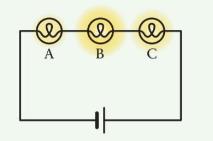
In Figure 31. 26, bulb B is brighter than bulb C, which in turn is brighter than bulb A. Rank, largest first, \((a)\) the magnitudes of the potential differences across the bulbs, \((b)\) the currents in them, and \((c)\) their resistances.Data from Figure 31. 26 e C A B
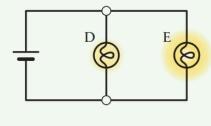
In Figure 31. 27, bulb E is brighter than bulb D. Which bulb has \((a)\) the greater potential difference across it, \((b)\) more current in it, and \((c)\) more resistance?Data from Figure 31. 27 D E
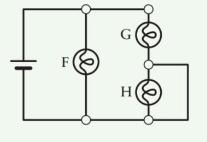
In Figure 31. 28, which of the three bulbs \(F, G\), and \(H\) light up?Data from Figure 31. 28 (e) H
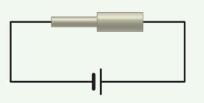
A thick resistor and a thin resistor of the same length and material are connected in series, as shown in Figure 31. 29. Which resistor has \((a)\) the greater potential difference across it and \((b)\) the greater resistance?Data from Figure 31. 29
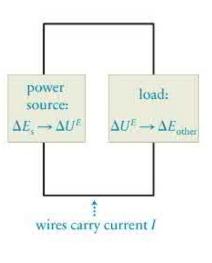
A solar cell, which converts solar energy (a form of source energy, see Section 7.4) to electric potential energy, is connected to a small fan. Represent this circuit by a diagram analogous to Figure \(31.2 a\) and describe the energy conversions taking place in this circuit.Data from Figure
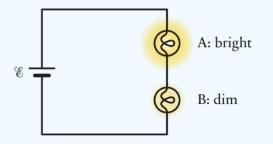
In Figure 31.8, two light bulbs are connected to each other by a wire and the combination is connected to a battery. In steady state, bulb A glows brightly and bulb B glows dimly. If the magnitude of the potential difference across the battery terminals is \(9 \mathrm{~V}\), what can you say about
Two identical light bulbs can be connected in parallel or in series to a battery to form a closed circuit. How do the magnitudes of the potential differences across each bulb and the current in the battery compare with those in a single-bulb circuit when the bulbs in the two-bulb circuit are
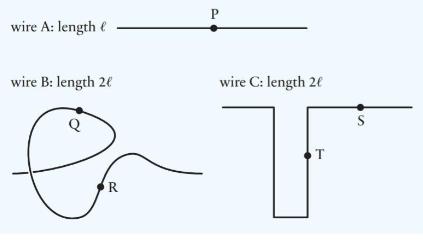
Consider the three pieces of wire in Figure 31.20. All three are made of the same material and have identical circular cross sections. Conductor A has length \(\ell\); conductors B and \(C\) have length \(2 \ell\). With the wires kept in the configurations shown, a positively charged conducting
Figure 31.22 shows a rod made of three pieces of conducting material connected end to end. The pieces are of equal size but are made of different materials; pieces A and C have negligible resistance, but piece \(B\) has significant resistance. Consider connecting two oppositely charged plates to
Consider a piece of copper wire that is \(10 \mathrm{~m}\) long and has a diameter of \(1.0 \mathrm{~mm}\). The number density of free electrons in copper is \(8.4 \times 10^{28}\) electrons \(/ \mathrm{m}^{3}\). If the wire carries a current of \(2.0 \mathrm{~A}\), what are \((a)\) the magnitude
Consider the circuit shown in Figure 31.36, containing two resistors with resistances \(R_{1}\) and \(R_{2}\) and a battery with an emf \(\mathscr{E}\). Determine the current in the circuit in terms of \(R_{1}, R_{2}\), and \(\mathscr{E}\).Data from Figure 31.36
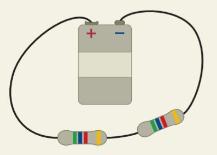
Even the best batteries dissipate some energy, which means that not all the chemical energy is converted to electric potential energy. We can take this dissipation into account by modeling a nonideal battery as consisting of an ideal battery of emf \(\mathscr{E}\) in series with a small resistor
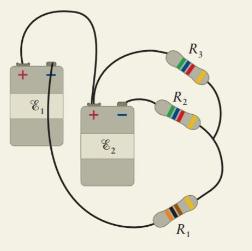
Consider the circuit shown in Figure 31.42. Determine the magnitude of the potential difference across \(R_{1}\) if \(\mathscr{E}_{1}=\) \(\mathscr{E}_{2}=9.0 \mathrm{~V}\) and \(R_{1}=R_{2}=R_{3}=300 \Omega\).Data from Figure 31.42 R3 R R
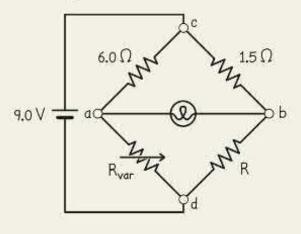
The circuit shown in Figure 31.44 includes a variable resistor, the resistance \(R_{\text {var }}\) of which can be adjusted, and a resistor of unknown value \(R\). A circuit with such a network of resistors is called a Wheatstone bridge and can be used to determine the value of the unknown
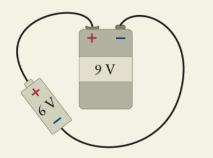
A \(9.0-\mathrm{V}\) and a \(6.0-\mathrm{V}\) battery are connected to each other (Figure 31.47). Each battery has an internal resistance of \(0.25 \Omega\). At what rate is energy dissipated in the \(6.0-\mathrm{V}\) battery?Data from Figure 31.47 19 6 V A + 9V
With a standard deck of 52 playing cards, what is the probability of randomly picking any(a) ace; (b) spade;(c) black-faced card; (d) an even-numbered card?
When a pair of standard dice are thrown, what is the probability that the two dice show the(a) same number; (b) a pair of odd numbers?
A bag contains 13 blue balls, 7 red balls, 10 green balls, and 5 yellow balls. What is the probability of drawing two green balls consecutively?
When three standard dice are rolled, find the probability that the sum of the dots on the three top faces will be 5 ?
A closed container holds 35 monatomic A particles that have a combined energy of 90 units. 85 monatomic \(B\) particles with an unknown amount of combined energy are then added to the container. If, at thermal equilibrium, each particle have 2 units of energy, how much combined energy do the B
A certain container holds 50 monatomic particles with a combined energy of 200 units. 25 diatomic particles, with each particle having 2 units of energy, str then added and the system is allowed to reach thermal equilibrium. How many units of energy does each particle in the container have?
The mass of an oxygen atom is \(2.6567 \times 10^{-26} \mathrm{~kg}\). Calculate the rms speed of an oxygen molecule with an average kinetic energy of \(1.38 \times 10^{-25} \mathrm{~J}\).
What is the average kinetic energy of a system made up of \(1.00 \mathrm{~mol}\) of krypton atoms having an average speed of \(125 \mathrm{~m} / \mathrm{s}\) ? The mass of a krypton atom is \(1.39 \times 10^{-25} \mathrm{~kg}\).
What is the change in entropy of a half a mole of ideal monatomic gas having an initial thermal energy of \(75.0 \mathrm{~J}\) when this energy is doubled?
Three monatomic ideal gas particles have the following velocities (written in component form) in a coordinate system: \((3.0,4.0) \mathrm{m} / \mathrm{s},(-6.0,8.0) \mathrm{m} / \mathrm{s},(-5.0,-7.0) \mathrm{m} / \mathrm{s}\). Calculate the (a) average speed (b) root-mean-square speed of the
Find the rate of change of entropy with respect to thermal energy of a system with an absolute temperature of \(100{ }^{\circ} \mathrm{C}\).
Find the rms speed of an oxygen molecule at \(0{ }^{\circ} \mathrm{C}\). The mass of an oxygen atom is \(2.657 \times 10^{-26} \mathrm{~kg}\) ?
The molar mass of oxygen \((32 \mathrm{~g})\) is slightly greater than that of nitrogen \((14 \mathrm{~g})\). But in a tank, the molecules of oxygen have the same rms speed as the molecules of nitrogen in another identical tank. How could this be possible? \(\cdot\)
A \(1.00-\mathrm{m}\) long cylindrical container with a diameter of \(1.20 \mathrm{~m}\) contains monatomic ideal gas at \(2.00 \mathrm{~atm}\).(a) How much thermal energy do the particles of this gas contain?(b) If this thermal energy were converted to the gravitational potential energy of a
A jar contains a mixture of helium gas and krypton gas, with the sample containing equal masses of the two gases, \(m_{\text {sample, } \mathrm{He}}=m_{\text {sample,Kr }}\). Both gases are monatomic, they behave ideally, and the system is in equilibrium.(a) What percentage of the pressure in the
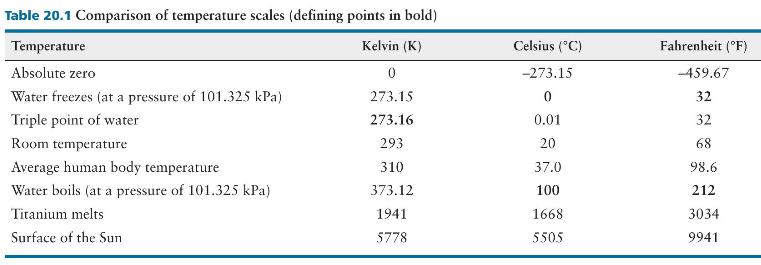
A Kelvin thermometer and a Fahrenheit thermometer both give the same reading for a certain sample at what numerical value?
You poured freshly brewed hot tea into a cup. A thermometer indicates that its temperature is \(96.8^{\circ} \mathrm{C}\). Convert this temperature into the Fahrenheit and Kelvin scales.
You are monitoring the temperature of a solution in the laboratory. Using a thermometer, you recorded a temperature of \(40.5^{\circ} \mathrm{C}\). Two hours later, about to do the same measurement, you accidentally dropped the thermometer you previously used and broke it. Instead, you used a
While converting a list of degrees Celsius temperatures to degree Fahrenheit, you notice that both scales have the same numerical value at a certain reading. What is this number?
When a certain ideal gas thermometer is placed in water at the freezing point, the mercury level in the right arm is \(869 \mathrm{~mm}\) above the reference mark. How far is the mercury level above the reference mark when this thermometer is placed at room temperature where the atmospheric
When a certain ideal glass thermometer is at room with a temperature of \(25^{\circ} \mathrm{C}\), the mercury level in the right arm is \(245 \mathrm{~mm}\) above the reference mark. When the thermometer is then dipped into a saline solution, the mercury level drops by \(25 \mathrm{~mm}\).(a) What
When a certain ideal gas thermometer is immersed in water at the triple point, the mercury level in the right arm is \(124 \mathrm{~mm}\) above the reference mark. When this thermometer is then immersed in a liquid of unknown temperature, the mercury level drops by \(68.0 \%\).(a) What is the
How much energy is needed to boil \(750 \mathrm{~g}\) of water at freezing point?
A 250-g piece of an unknown metal has been in boiling water for several minutes. To bring this metal at room temperature \(\left(20^{\circ} \mathrm{C}\right), 89.8 \mathrm{~kJ}\) of heat must be removed.(a) Calculate the specific heat of the metal.(b) Determine what type of metal is the sample
How much heat energy is needed to convert a mixture of \(20.0 \mathrm{~g}\) of ice and \(35.0 \mathrm{~g}\) of water at thermal equilibrium to steam at \(100.0^{\circ} \mathrm{C}\) ? If this energy were used to lift a truck, to what height could a \(1.00 \times 10^{4}-\mathrm{kg}\) truck be lifted?
A \(0.350-\mathrm{kg}\) aluminum calorimeter contains \(0.110 \mathrm{~kg}\) of water, and both are at room temperature \(\left(20.0^{\circ} \mathrm{C}\right)\). A \(0.280-\mathrm{kg}\) block of lead at \(90.0^{\circ} \mathrm{C}\) is then dropped into the container. Assuming no heat loss to the
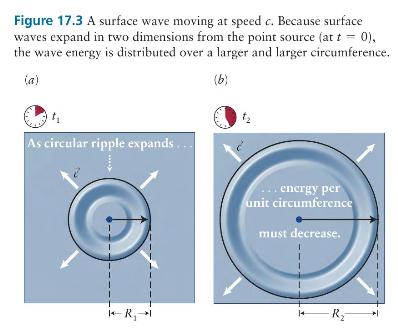
Let \(t_{2}=2 t_{1}\) in Figure 17.3. (a) How does \(R_{1}\) compare with \(R_{2}\) ? (b) If the energy in the wave is \(E\) and there is no dissipation of energy, what is the energy per unit length along the circumference at \(R_{1}\) ? At \(R_{2}\) ? (c) How does the energy per unit length along
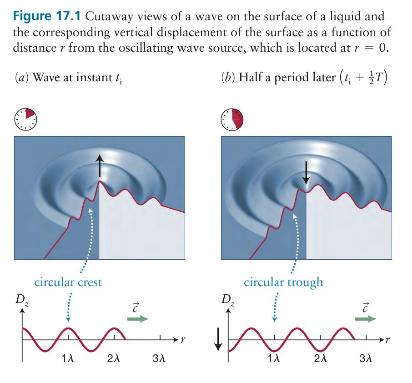
Notice that in the views of the surface wave in Figure 17.1 the amplitude does not decrease with increasing radial distance \(r\). How could such waves be generated? Figure 17.1 Cutaway views of a wave on the surface of a liquid and the corresponding vertical displacement of the surface as a
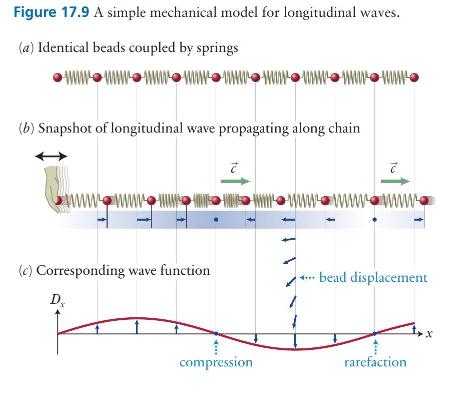
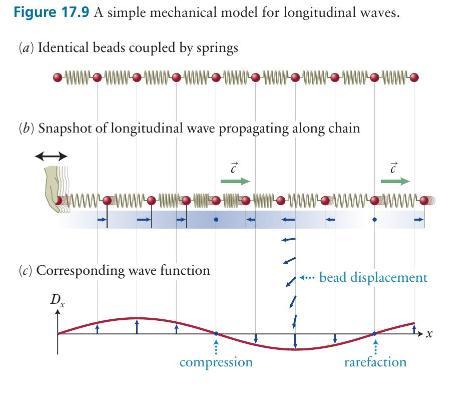
Does the wave speed along the chain shown in Figure 17.9 increase or decrease when(a) the spring constant of the springs is increased and(b) the mass of the beads is increased? Figure 17.9 A simple mechanical model for longitudinal waves. (a) Identical beads coupled by springs
(a) Plot the velocity of the beads along the chain in Figure \(17.9 b\) as a function of their equilibrium position \(x\). (b) Plot the linear density (number of beads per unit length) as a function of \(x\). Figure 17.9 A simple mechanical model for longitudinal waves. (a) Identical beads coupled
Even though the sound of a common type of loudspeaker carries in all directions, the loudness in front of the speaker is considerably greater than the loudness behind it. What is the shape of the wavefronts produced by such a loudspeaker?
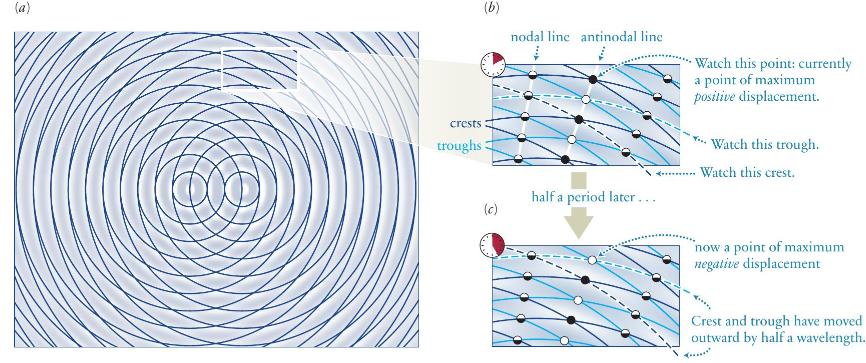
(a) What is the medium displacement at a point halfway between a filled circle and a neighboring open circle in Figure 17.14 b? (b) Sketch the variation of this displacement as a function of time. (c) What is the medium displacement at all points between two neighboring half-filled circles? (d)
Is a point halfway between a filled and a neighboring open circle in Figure 17.14 b a node?Figure 17.14 (a) ( crests troughs (b) nodal line antinodal line Watch this point: currently a point of maximum positive displacement. Watch this trough. Watch this crest. half a period later... (c) now a
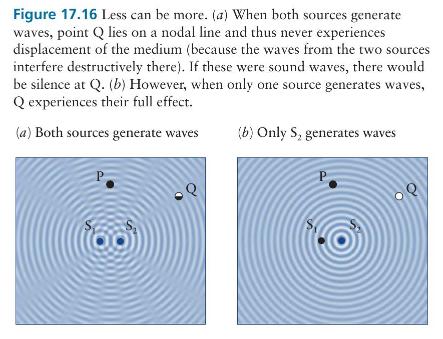
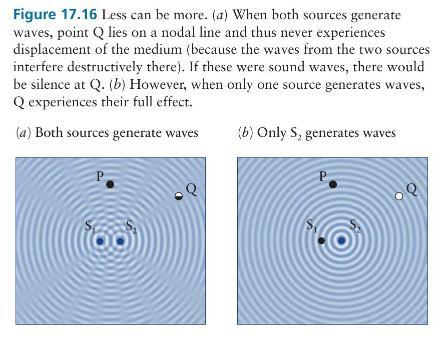
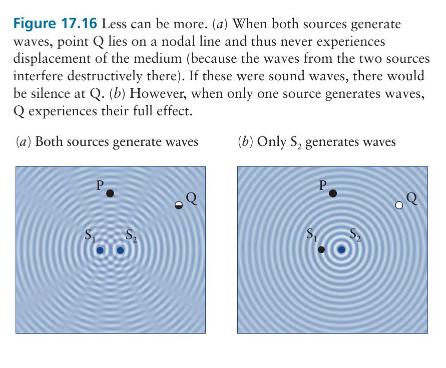
(a) If the amplitude of the wave generated by each source in Figure 17.16 is \(A\) at points \(\mathrm{P}\) and \(\mathrm{Q}\), what is the overall amplitude at \(\mathrm{P}\) in Figure 17.16 a? In Figure 17.16 b? (b) Given that the wave energy that passes \(Q\) in Figure \(17.16 b\) becomes zero
By how many wavelengths are the sources in Figure \(17.16 a\) separated? Figure 17.16 Less can be more. (a) When both sources generate waves, point Q lies on a nodal line and thus never experiences displacement of the medium (because the waves from the two sources interfere destructively there). If
Along the leftward and rightward extensions of the straight line joining \(S_{1}\) and \(S_{2}\) in Figure 17.16, why are there no nodes to the left of \(S_{1}\) and to the right of \(S_{2}\) ? Figure 17.16 Less can be more. (a) When both sources generate waves, point Q lies on a nodal line and
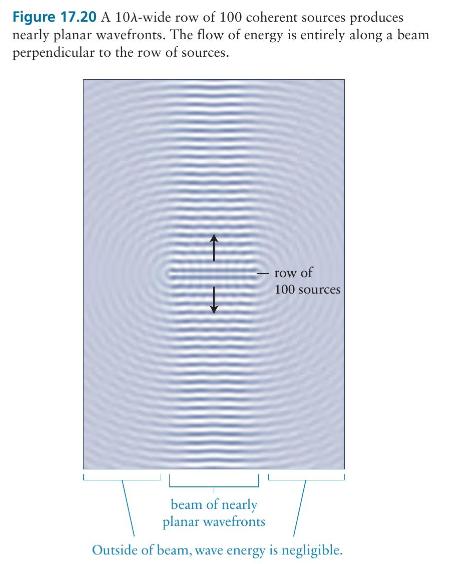
How does the wave amplitude along the beam of wavefronts in Figure 17.20 change with distance from the row of sources? Figure 17.20 A 10A-wide row of 100 coherent sources produces nearly planar wavefronts. The flow of energy is entirely along a beam perpendicular to the row of sources. row of 100
Suppose the barriers in Figure 17.22 were held at an angle to the incident wavefronts. Sketch the transmitted wavefronts for the case where the width of the gap is much smaller than the wavelength of the incident waves.
In Exercise 17.5, how many clarinets must play at the same time in order to increase the intensity level from \(70 \mathrm{~dB}\) to \(80 \mathrm{~dB}\) ?Exercises 17.5A clarinet can produce sound waves of intensity level about \(70 \mathrm{~dB}\). By how much does the intensity level increase if a
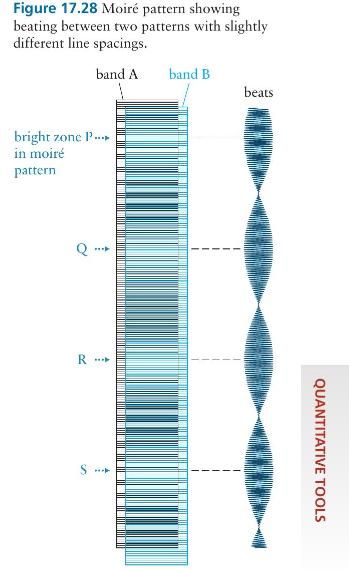
The lines in band A in Figure 17.28 are more closely spaced than those in band B.(a) How many more lines does band A have between points P and S?(b) Describe what happens to the pattern if band B is displaced downward by one-half the spacing between its lines. Figure 17.28 Moir pattern showing
Do two sound waves of slightly different frequencies and different amplitudes cause beats?
In Example 17.8, what is the frequency of the sound the horn makes?Data from Example 17.8Standing alongside a straight section of railroad track as a train passes, you record the sound of the train's horn. By analyzing the recording, you determine that the frequency of the sound was \(483
(a) Suppose an observer moves at half the speed of sound toward a stationary source of sound waves. By what factor does the observed frequency differ from the emitted frequency? (b) By what factor does the observed frequency differ if, instead of the observer moving, the source moves toward the
Does an observer moving at twice the speed of sound toward a stationary sound source detect a sonic boom?
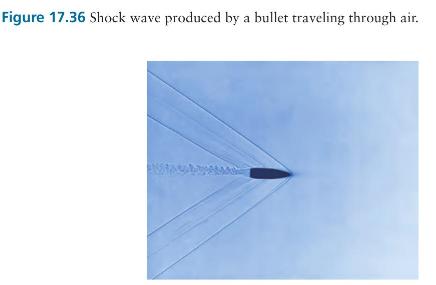
Estimate the speed of the bullet in Figure 17.36. Figure 17.36 Shock wave produced by a bullet traveling through air.
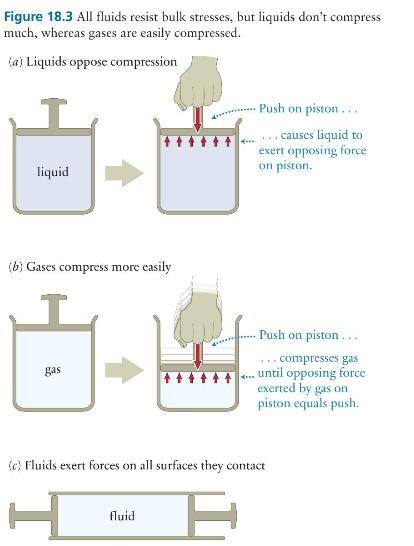
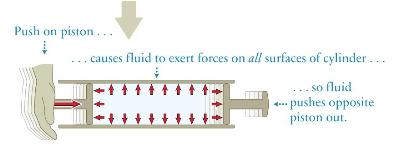
In Figure 18.3c, suppose you push the left piston rightward with a force of magnitude \(10 \mathrm{~N}\). (For now, ignore normal forces.) (a) To keep the water in the cylinder at rest, what force must you exert on the (identical) right piston? (b) How does the force \(\vec{F}_{\text {wr }}^{c}\)
Consider a plastic cup full of water. (a) Is the water exerting a force on the bottom of the cup? (b) On the sides of the cup? (c) Is the water pressure negative, zero, or positive?
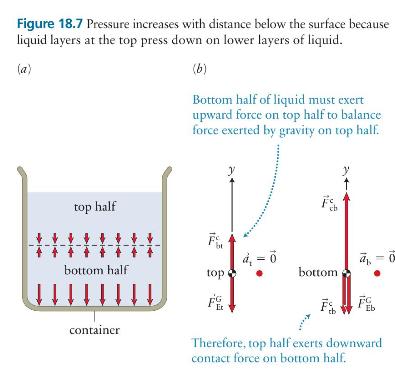
How does the pressure in the liquid vary with height above the bottom of the container in Figure 18.7? Figure 18.7 Pressure increases with distance below the surface because liquid layers at the top press down on lower layers of liquid. (a) (b) Bottom half of liquid must exert upward force on top
How far below the surface of a deep body of water is the pressure twice what it is at the surface?
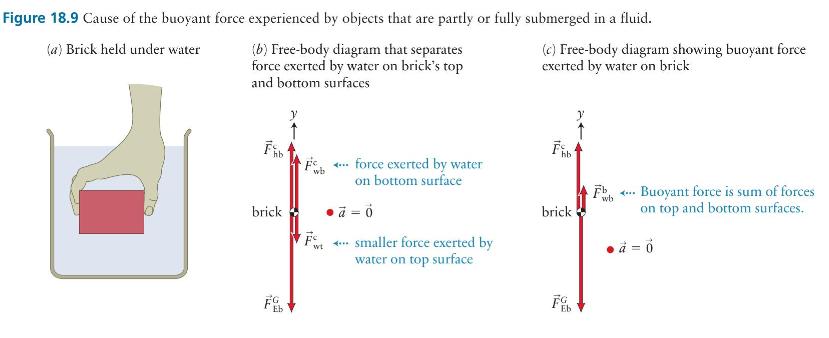
(a) What happens to the pressure difference between the top and bottom of the brick in Figure 18.9a when the brick is held deeper in the water?(b) What happens to the pressure difference when the pressure at the surface of the water is increased?(c) What is the effect of the pressure in the water
If the buoyant force exerted on an object is always equal in magnitude to the force of gravity exerted on the fluid displaced by the object, why does a brick placed in a barrel of water sink?
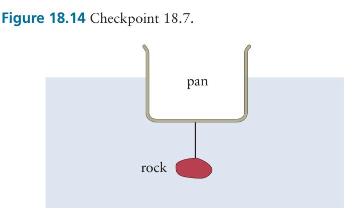
A pan with a rock in it is floating in water. Suppose you remove the rock and use a very lightweight string to suspend it from the bottom of the pan (Figure 18.14). If the combination still floats, is the volume of water displaced when the rock is suspended greater than, equal to, or smaller than
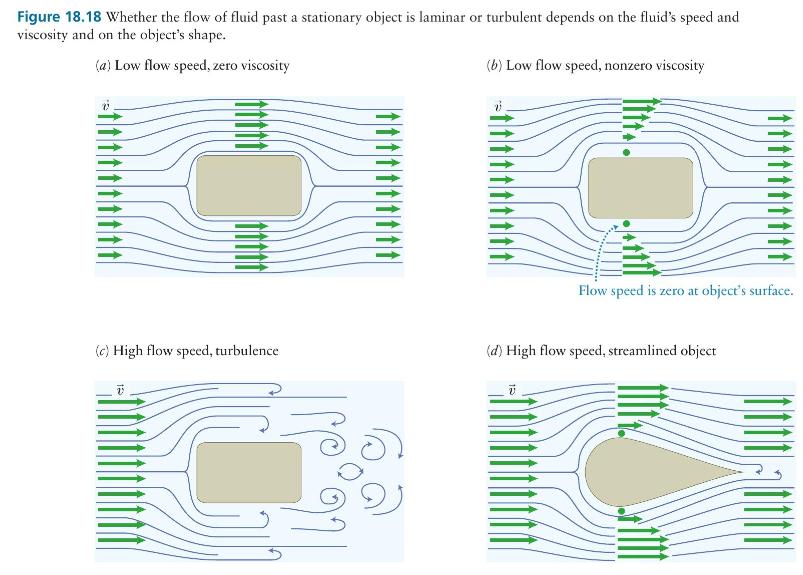
Instead of laminar fluid flow past a stationary object as in Figure 18.18a, consider the motion of an object moving at constant velocity through a stationary fluid. Do you expect the flow pattern surrounding the object to be the same as in Figure 18.18 a or different? Figure 18.18 Whether the flow
The cloth roof of a convertible car often bulges at high speed, even when the top fits tightly and no wind is getting caught under it. Explain what causes the bulging.
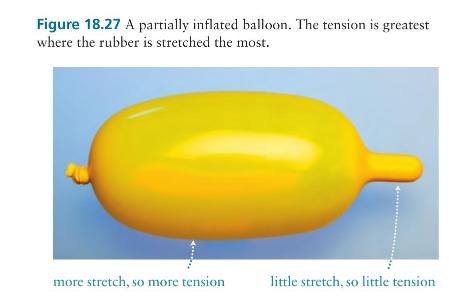
How does the air pressure in the uninflated part of the balloon in Figure 18.27 compare with the air pressure in the inflated part? Figure 18.27 A partially inflated balloon. The tension is greatest where the rubber is stretched the most. more stretch, so more tension little stretch, so little
(a) What is the difference between the pressure just below the water surface in a pool and the pressure in the air just above it? (b) Is the pressure inside a raindrop greater than, equal to, or smaller than the pressure in the surrounding air? (c) How does the pressure inside a small raindrop
Explain why surface effects cannot support a large solid cylinder made of the same material as a needle.
Consider a book lying on a table at sea level with the front cover facing up. The book is \(0.28 \mathrm{~m}\) tall, \(0.22 \mathrm{~m}\) wide, and \(50 \mathrm{~mm}\) thick; its mass is \(3.0 \mathrm{~kg}\). How does the force exerted by the atmosphere on the front cover compare with the force of
A dart that has a suction cup at one end sticks to a ceiling. Describe what force holds the dart against the ceiling.
An object floats with \(80 \%\) of its volume submerged in water. How does the average mass density of the object compare with that of water?
Oil and water don't mix, and the mass density of oil is smaller than that of water. Suppose water is poured into a U-shaped tube that is open at both ends until the water surface is halfway up each leg of the tube, and then some oil is poured on top of the water in the right leg. Once the system
In the derivation of Eq. 18.21, we ignored the effect of atmospheric pressure on the two pistons. How is the result we obtained affected by atmospheric pressure? F = A2 F1- A1 (18.21)
Suppose that the diameter of the hole in Example 18.9 is \(10.0 \mathrm{~mm}\), the bucket diameter is \(0.50 \mathrm{~m}\), and the distance from the hole to the water surface is \(0.30 \mathrm{~m}\). At what speed does the water emerge from the hole?Data from Example 18.9Water leaks out of a
What is Laplace's law, Eq. 18.51, for a soap bubble? 2y Pin - Pout (spherical surface). (18.51) R
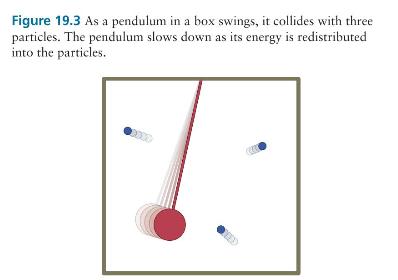
The nitrogen molecules in Exercise 19.1 move considerably faster than the pendulum and continuously bombard the pendulum from all sides.(a) Why does this bombardment slow the pendulum down? (b) When the pendulum is at rest, why don't we see the effects of this continuous bombardment?Data from
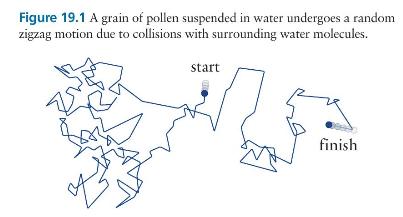
How would Brownian motion change if the mass of the grain in Figure 19.1 were increased? Figure 19.1 A grain of pollen suspended in water undergoes a random zigzag motion due to collisions with surrounding water molecules. start finish
What sum of dots are you most likely to throw with two dice?
Suppose you are tossing four coins and decide to define the system's macrostate after any throw as the number of heads thrown. How many (a) macrostates(b) basic states are there for this system?(c) What is the probability of tossing three heads?(d) What is the most likely macrostate after any toss?
What are the six ways in which you can distribute three energy units over three particles such that one of the particles has two energy units?
What is the probability of finding (a) all of the energy in the pendulum and(b) either zero or one unit of energy in the pendulum?
(a) Averaged over a long time interval, for what fraction of the time interval does the pendulum in Figure 19.3 have more than \(50 \%\) of the energy of the system? (b) Does this fraction increase, decrease, or stay the same as we increase the number of particles? Figure 19.3 As a pendulum in a
Showing 1000 - 1100
of 4962
First
4
5
6
7
8
9
10
11
12
13
14
15
16
17
18
Last
Step by Step Answers

 Get 50% OFF
Claim Now
Get 50% OFF
Claim Now