New Semester
Started
Get
50% OFF
Study Help!
--h --m --s
Claim Now
Question Answers
Textbooks
Find textbooks, questions and answers
Oops, something went wrong!
Change your search query and then try again
S
Books
FREE
Study Help
Expert Questions
Accounting
General Management
Mathematics
Finance
Organizational Behaviour
Law
Physics
Operating System
Management Leadership
Sociology
Programming
Marketing
Database
Computer Network
Economics
Textbooks Solutions
Accounting
Managerial Accounting
Management Leadership
Cost Accounting
Statistics
Business Law
Corporate Finance
Finance
Economics
Auditing
Tutors
Online Tutors
Find a Tutor
Hire a Tutor
Become a Tutor
AI Tutor
AI Study Planner
NEW
Sell Books
Search
Search
Sign In
Register
study help
physics
particle physics
Principles And Practice Of Physics 2nd Edition Eric Mazur - Solutions
A ball rolls off a \(0.65-\mathrm{m}\) high table and lands on the floor. The speed of the ball as it hits the floor is \(4.6 \mathrm{~m} / \mathrm{s}\). (a) How fast was the ball rolling as it left the table? (b) What is the horizontal distance from the edge of the table to the ball's landing
You throw a textbook to a friend who is at their dormitory window \(2.2 \mathrm{~m}\) above you. You are standing \(4.0 \mathrm{~m}\) away from the building and your throw is perfectly made such that when the book arrives at your friend it is travelling exactly horizontally. What is the book's
If the angle between vectors \(\vec{A}\) and \(\vec{B}\) is \(110^{\circ}\) and if \(A=1.7 \mathrm{~N}\) and \(B=2.0 \mathrm{~m}\), what is the value of \(\vec{A} \cdot \vec{B}\) ?
A force \(\vec{F}=F_{x} \hat{\imath}+F_{y} \hat{\jmath}\) with \(F_{x}=50 \mathrm{~N}\) and \(F_{y}=12 \mathrm{~N}\) is exerted on a particle as the particle moves along the \(x\) axis from \(x=1.0 \mathrm{~m}\) to \(x=-5.0 \mathrm{~m}\).(a) Determine the work done by the force on the
A traveller walks \(30 \mathrm{~m}\) along a train platform, dragging their suitcase behind them using a strap attached to the top. The traveller's hand is \(0.25 \mathrm{~m}\) above the top of the suitcase, and the \(0.80-\mathrm{m}\) long strap maintains a tension of \(120 \mathrm{~N}\) as the
You have lost your skateboard, so you choose to walk around the various sections of the local skate park. The coefficient of static friction between your shoes and the concrete surface is 0.53 . What is the angle of the steepest ramp you can stand on without slipping? \(\cdot\)
Suppose the current shown in Figure 30. 19 discharges the capacitor. What are the directions of \(\vec{E}\), \(\Delta \vec{E}\), and \(\vec{B}\) between the plates of the discharging capacitor?Data from Figure 30. 19 00-
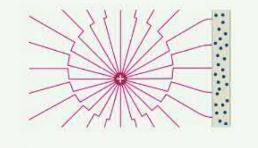
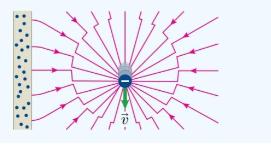
A positively charged particle creates the electric field shown in Figure 30. 20. When the kinks in the electric field lines reach the rod, what is the direction of the current induced in the rod?Data from Figure 30. 20
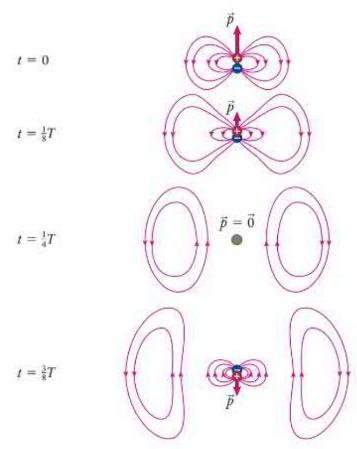
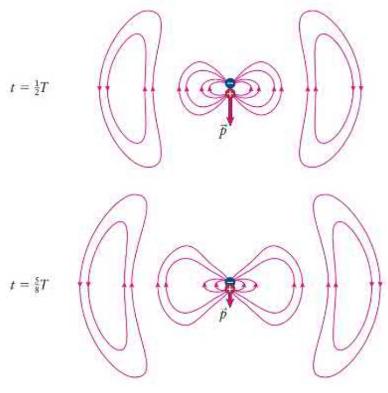
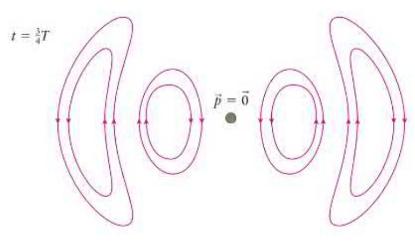
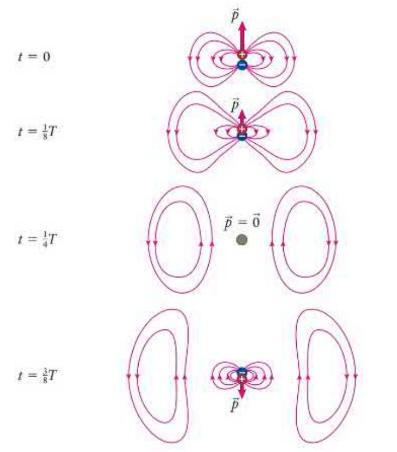
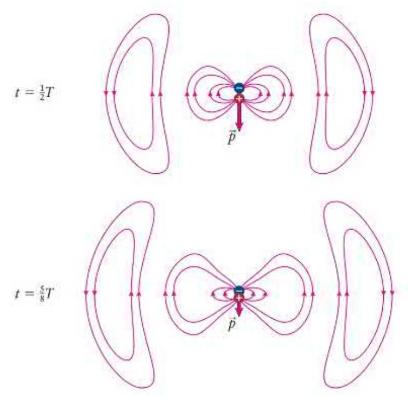
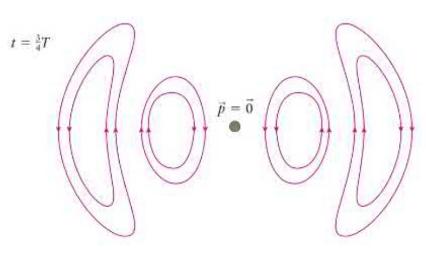
For the oscillating dipole of Figure 30. 14, sketch the electric field pattern at \(t=\frac{5}{4} T\).Data from Figure 30.14 0=1 t = T t=T 1=T O O D
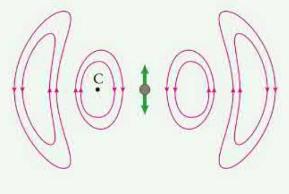
In the electric field pattern for a sinusoidally oscillating dipole shown in Figure 30. 21, what are (a) the direction of the change in the electric field \(\Delta \vec{E}\) at point \(\mathrm{C}\) as the electric field propagates and (b) the direction of the magnetic field loop near C?Data from
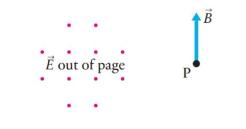
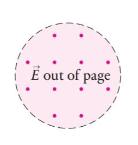
The magnitude of the electric field of Figure P30.1 is changing with time. As a result of this change, there is an upward-pointing magnetic field at position \(\mathrm{P}\). Is the electric field magnitude increasing or decreasing?Data from Figure P30.1 E out of page 199 B
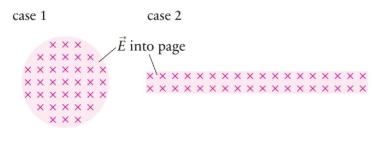
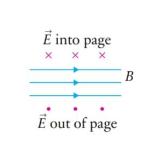
Figure P30.2 shows two electric fields, one in a region of circular cross-section and one in a long flat region. In both cases, the electric field decreases over time. What is the direction of the accompanying magnetic field in each case?Data from Figure P30.2 case 1 XX XXX XXXXXXX x xx case 2 E
A parallel-plate capacitor is charged until it carries charge \(+q\) on one plate and charge \(-q\) on the other plate. The capacitor is then disconnected from the power supply and isolated. What is the direction of the magnetic field that surrounds the charged capacitor?
The uniform electric field shown in Figure P30.4 points out of the page and is contained in a cylindrical volume of space. If the electric field is rapidly turned off, a magnetic field is produced. (a) What is the direction of this magnetic field? (b) Does this magnetic field exist only in the
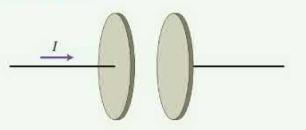
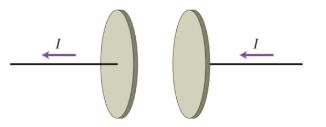
The capacitor of Figure P30.5 is being charged by a steady current \(I\). What are the directions of \((a)\) the electric field between the plates, \((b)\) the change in the electric field, and (c) the magnetic field between the plates?Data from Figure P30.5 +00
Figure P30.6 shows an increasing magnetic field and the electric field that accompanies it according to Faraday's law. If the magnetic field is increasing at an increasing rate, \((a)\) is the electric field magnitude constant, increasing, or decreasing?(b) Does the behavior of the electric field
Are the radiating electric field lines around a charged particle straight lines when the particle \((a)\) is stationary, (b) moves at constant velocity, (c) accelerates?
Would a charged particle moving at a high speed in a circle create kinks in its electric field?
A positively charged particle moving to the right is stopped rapidly. Sketch the resultant radiated pulse.
Is any type of electric field produced when (a) a wire having zero surplus charge carries a constant current, (b) a wire having zero surplus charge carries a timevarying current, (c) a bar magnet moves translationally at constant velocity, \((d)\) a bar magnet rotates about an axis that passes
Is any magnetic field produced when (a) a uniformly charged sphere rotates at constant rotational speed about an axis that passes through its fixed center, \((b)\) a charged particle moves translationally at constant velocity, (c) a charged particle that is moving translationally accelerates?
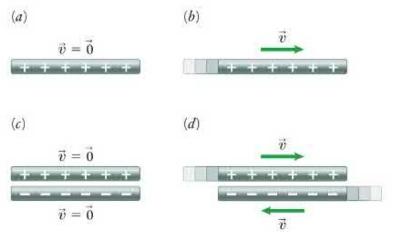
Sketch the electric and magnetic field line patterns produced by the four situations shown in Figure P30.13:(a) a stationary charged rod carrying a linear charge density of \(+\lambda\) (b) a charged rod carrying a linear charge density of \(+\lambda\) that moves at constant velocity along the
What antenna length should be used to create a dipole antenna that emits \(100-\mathrm{MHz}\) electromagnetic waves, a frequency typical of FM radio broadcasts?
An electromagnetic wave is traveling eastward. If at a given instant the magnetic field for one section of the wave points south, in which direction does the electric field for that section point at that instant?
An electric dipole with its center located at the origin of a Cartesian coordinate system oscillates along the \(x\) axis, creating an electromagnetic wave. At a position on the \(z\) axis far from the origin, (a) what is the polarization of the wave and \((b)\) which axis are the magnetic field
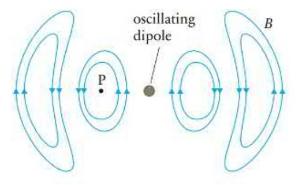
Figure P30.17 shows a magnetic field line pattern radiating from an oscillating electric dipole. (a) What is the direction of the change, over the next infinitesimal time interval, in the magnetic field at P? (b) Use your answer to part \(a\) to determine the direction of the electric field loop
A router used for wireless Internet access follows the \(802.11 \mathrm{~g}\) standard, which operates at \(2.4 \mathrm{GHz}\). (a) What is the wavelength of the electromagnetic waves emitted by the router? (b) How tall would a dipole antenna need to be? Is this length comparable to the length of
Why are radio transmission towers oriented vertically rather than laid horizontally on the ground?
To detect an incoming planar electromagnetic wave, we observe a single charged particle that begins at rest and is free to move only in the \(x y\) plane. If we observe the particle oscillating along the \(y\) axis, with no motion along the \(x\) axis, what can we say about the direction of the
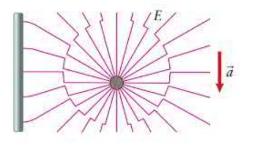
In Figure P30.21, a charged particle has been suddenly accelerated downward, producing the electric field line pattern shown. When the kinks in the field lines reach the metal rod at the left, they produce a downward current in the rod. Is the particle that has been accelerated positively or
A parallel-plate capacitor with circular plates has a steady charging current of \(5.0 \mathrm{~A}\). The wires into and out of the plates attach to the plate centers. If the radius of each plate is \(40 \mathrm{~mm}\) and there is no dielectric between the plates, what is the magnetic field
A specified volume of space contains an electric field for which the magnitude is given by \(E=E_{0} \cos (\omega t)\). Suppose that \(E_{0}=10 \mathrm{~V} / \mathrm{m}\) and \(\omega=1.0 \times 10^{7} \mathrm{~s}^{-1}\).(a) What is the maximum displacement current through a \(0.50-\mathrm{m}^{2}\)
Instead of a capacitor in a circuit, we can get the same effect by slicing a thick wire in two, making our cut perpendicular to the wire's long axis. If the wire diameter is \(10.0 \mathrm{~mm}\) and we place the two parallel circular surfaces of the cut wire \(0.010 \mathrm{~mm}\) apart, what is
A parallel-plate capacitor has a steady charging current of \(5.0 \mathrm{~A}\). What are \((a)\) the time rate of change of the electric flux between the plates and \((b)\) the displacement current between the plates?(c) How do your answers to parts \(a\) and \(b\) change if there is a
A parallel-plate capacitor with circular plates of radius \(r\) is charging with constant current \(I\). At some instant, \(B=\) \(1.6 \times 10^{-8} \mathrm{~T}\) at a position \(7.0 \mathrm{~mm}\) from the center of a long wire leading to the capacitor. (a) Calculate the current magnitude at that
For a capacitor of capacitance \(C\), show that the displacement current between the capacitor's plates is given by \(C(d V / d t)\), where \(V\) is the potential difference across the capacitor.
The circular plates of a parallel-plate capacitor have a radius of \(30 \mathrm{~mm}\). A steady 2.0 -A current is charging the initially uncharged capacitor, and the surface charge on the plates is distributed uniformly.(a) Derive an expression for the magnitude of the electric field between the
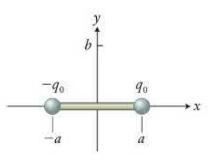
A short wire runs along an \(x\) axis from \(x=a\) to \(x=-a\) (Figure P30.30). At \(t=0\), there is a small sphere carrying charge \(+q_{0}\) at \(x=a\) and a small sphere carrying charge \(-q_{0}\) at \(x=-a\). As the spheres discharge and a current is established in the wire, show that, for
A parallel-plate capacitor has circular plates of radius \(R=\) \(0.300 \mathrm{~m}\) and plate separation distance \(d=0.10 \mathrm{~mm}\). While it is charging, the potential difference across the plates is given by \(V(t)=V_{\max }\left(1-e^{-t / \tau_{0}}\right)\), where \(V_{\max }=\) \(15
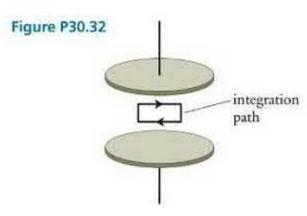
When you use Maxwell's equations to determine electric and magnetic fields, a lot depends on making the "right" choice for the integration path. What happens if you choose the "wrong" path? Do the equations still hold? Consider a parallel-plate capacitor with circular plates, but use a rectangular
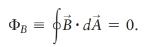
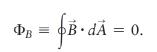
Using Eq. 30. 11, show that the normal component of the magnetic field is continuous across any surface.Data from Eq. 30. 11 B. d = 0.
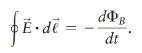
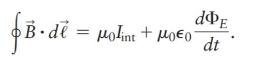
In free space, Maxwell's equations simplify greatly. The two equations involving surface integrals of the fields (Eqs. 30. 10 and 30. 11) are zero, and the two equations involving line integrals of the fields (Eqs. 30. 12 and 30. 13) have values proportional to the rate of flux change of the other
For a perfect conductor, \(E=0\) everywhere inside, and all the charge resides on the surface even when charge carriers are flowing. (a) Use Maxwell's equations to show that the magnetic field inside a conductor is constant. (b) Use Maxwell's equations to show that the magnetic flux through a
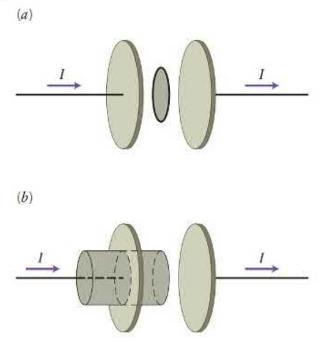
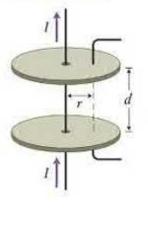
A physics teacher tries to build a device that illustrates Maxwell's generalization of Ampère's law. She drills a hole in the center of each plate of a parallel-plate capacitor and then runs a wire through the holes (Figure P30.36). There is no connection between the wire and the plates, and the
The frequency of AM radio channels is typically on the order of \(10^{5} \mathrm{~Hz}\) or \(10^{6} \mathrm{~Hz}\). What is the wavelength of these waves? FM waves have wavelengths between \(1.0 \mathrm{~m}\) and \(10 \mathrm{~m}\). What is the frequency of these waves?
The speed of light drops to \(2.26 \times 10^{8} \mathrm{~m} / \mathrm{s}\) in water. What is the dielectric constant of water?
The optical fibers used for telecommunications links have dielectric constant \(\kappa=1.6\). How long does a signal originating in California take to reach New York in a fiber-optic cable?
A phone call you make from the United States to Germany is routed via a satellite that is in a geostationary orbit at an altitude of \(36,000 \mathrm{~km}\). How long is the time interval between the instant you say "Hello" to the instant your greeting arrives in Germany? Ignore the distance
The antenna of a WiFi access point has a length of about \(80 \mathrm{~mm}\). What does this say about the likely frequency of the wireless network?
(a) At a distance from an emitting antenna where the electric field has a maximum magnitude of \(15 \mathrm{~V} / \mathrm{m}\) when the air is dry, what is the maximum magnetic field magnitude? (b) How does the value of \(E_{\max }\) change when the air is very damp, increasing the dielectric
Using electromagnetic waves, you generally cannot resolve any structures that are smaller than the wavelength you are using. CD, DVD, and Blu-ray players use small "pits" that encode the 0s and 1s of the digital information stored on them-the smaller the pits, the more information you can store. A
Blue light has a wavelength of \(430 \mathrm{~nm}\) in vacuum. What is its wavelength after it enters a medium for which the dielectric constant \(\kappa=1.45\) ?
\(3 K\) cosmic background radiation is energy left over from events that occurred when the universe was in a very early stage of development. Given that the amount of energy associated with any radiation is linearly proportional to the radiation frequency and that the energy associated with a
If the electric field in an electromagnetic wave \(100 \mathrm{~mm}\) from a radio-emitting antenna has a maximum magnitude of \(6.0 \times 10^{5} \mathrm{~V} / \mathrm{m}\), what is the maximum magnetic field magnitude \(500 \mathrm{~m}\) from the antenna?
An electromagnetic wave has an average Poynting vector magnitude of \(8.00 \times 10^{-7} \mathrm{~W} / \mathrm{m}^{2}\). What is the maximum value of the magnitude of the electric field?
An electromagnetic wave has root-mean-square magnetic field magnitude \(B_{\mathrm{rms}}=1.5 \times 10^{-6} \mathrm{~T}\). What are the root-mean-square electric field magnitude and the average intensity of the wave?
The power of a laser is much smaller than the power of an incandescent light bulb, but the laser light does not spread out very much. Explain why this tendency not to spread has such an effect over long distances.
A \(1.0-\mathrm{mW}\) laser has a beam radius of \(0.6 \mathrm{~mm}\). What is the intensity of this beam?
The intensity of the HERCULES laser, one of the world's most powerful, is \(2.0 \times 10^{20} \mathrm{~W} / \mathrm{mm}^{2}\). Granted, the beam pulse lasts for only \(30 \mathrm{fs}\), but if we assume the beam is an electromagnetic pulse, what is its average energy density, and what energy can
Radio signals typically have a very small intensity. Imagine that a vehicle receives a signal of \(10 \mu \mathrm{W} / \mathrm{m}^{2}\).(a) What are the maximum magnitudes of the electric and magnetic fields? \((b)\) If the tower emitting the radio waves is located \(8.0 \mathrm{~km}\) away from
For a constant current of \(0.20 \mathrm{~A}\), what time interval is required to deliver 1. 0 MW of power to the space between the plates of an initially discharged capacitor if the plates are circular and parallel, their diameter is 150 \(\mathrm{mm}\), and their separation distance is \(0.200
Assume a \(60-\mathrm{W}\) incandescent light bulb radiates uniformly in all directions. At a distance of \(2.0 \mathrm{~m}\) from the bulb, determine \((a)\) the intensity of the electromagnetic waves, \((b)\) the maximum electric field magnitude, and (c) the maximum magnetic field magnitude.
The emitting antenna of a \(100-\mathrm{kW}\) radio station radiates equally in all directions. What are the magnitudes \(E_{\max }\) and \(B_{\max }(a) 100 \mathrm{~m}\) from the antenna and \((b) 50 \mathrm{~km}\) from the antenna? (c) For these two distances from the antenna, calculate the
A laser beam has a radius of \(1.5 \mathrm{~mm}\). How powerful does the laser have to be for the maximum magnitude of the magnetic field in the beam to be \(5.0 \mu \mathrm{T}\) ?
Sunlight on Earth has an intensity of about \(S=\) \(1.0 \mathrm{~kW} / \mathrm{m}^{2}\). How much power can be harvested from a solar energy panel that is \(2.0 \mathrm{~m}\) long and \(1.6 \mathrm{~m}\) wide if the sunlight comes in at an angle of \(\theta=20^{\circ}\) with respect to the surface
You want to use your microwave oven to heat \(0.20 \mathrm{~L}\) of water from room temperature to boiling. The water is in a cup that has a radius of \(30 \mathrm{~mm}\), and you want the water to reach its boiling point in \(3.00 \mathrm{~min}\). What are the required \((a)\) average power,
The human eye can detect light intensities as small as \(S_{\text {min }}=10^{-12} \mathrm{~W} / \mathrm{m}^{2}\). If an incandescent 100 -W light bulb is about \(10 \%\) efficient, how far away could you see it under the simplest assumptions? Does your result make sense?
Similar to perceived loudness in hearing, the brightness the human eye and brain perceive for light is logarithmic rather than linear. For example, you do not perceive light that has an intensity of \(S\) as being twice as bright as light of intensity \(S / 2\). What happens to the perceived
The Poynting vector for an electromagnetic wave is given by \(\left(100 \mathrm{~W} / \mathrm{m}^{2}\right) \sin ^{2}\left[\left(1000 \mathrm{~m}^{-1}\right) z-\left(3.0 \times 10^{11} \mathrm{~s}^{-1}\right) t\right] \hat{k}\). What are \((a)\) the wave's propagation direction and(b) the
A cylindrical solenoid of radius \(R\) and height \(b\) consists of \(N\) windings. There is a current through the windings, and this current increases with time as \(I=\alpha t\), where \(\alpha\) is a constant.(a) Describe the directions of the electric field, the magnetic field, and the Poynting
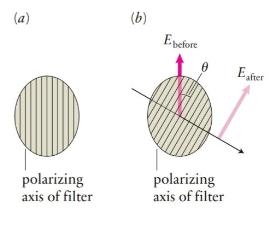
A polarizing filter is a plastic sheet that allows only certain components of the electric field in an electromagnetic wave to pass through, and a wave that has passed through such a filter is said to be polarized. After an initially unpolarized wave has passed through the filter shown in Figure
Liquid argon has a dielectric constant of 1. 5 . What is the speed of an electromagnetic wave pulse through this medium?
What would be the length of a half-wave antenna for a radio station that emits its signal at \(90.5 \mathrm{MHz}\) ?
Full-body scanners at airports are sometimes referred to as millimeter-wave scanners and sometimes as terahertz scanners. Does this make sense?
A home microwave oven typically uses \(2.45-\mathrm{GHz}\) microwaves, and a microwave oven in a restaurant kitchen is more likely to run at \(915 \mathrm{MHz}\). Calculate the wavelength for each frequency and the length of the emitting antenna needed in each case.
A sinusoidal electromagnetic wave has a maximum electric field magnitude of \(E_{\max }=500 \mathrm{~N} / \mathrm{C}\). What is the root-mean-square value of the electric field?
By focusing an ultraviolet laser pulse, you can produce an apparently hovering plasma point in midair. If it takes an electric field magnitude of \(1.0 \times 10^{6} \mathrm{~N} / \mathrm{C}\) to ionize air, what must the intensity of the pulse be?
A \(500-W\) industrial carbon dioxide cutting laser is capable of curting \(3.0-\mathrm{mm}\) thick steel at a rate of \(20 \mathrm{~mm} / \mathrm{s}\). Carbon dioxide lasers operate at a wavelength of \(10.6 \mu \mathrm{m}\). If the spot size of the cutting laser is \(0.17 \mathrm{~mm}\) in
A radio station sends out its signal via a \(20-\mathrm{kW}\) emitting antenna. Assuming the signal is emitted equally in all directions and no signal strength is lost, how much power per unit area remains in the signal at a location \(10 \mathrm{~km}\) from the emitting antenna?
It takes sunlight about \(8 \mathrm{~min}\) to travel from the Sun to Earth, where it has an average intensity of \(1400 \mathrm{~W} / \mathrm{m}^{2}\). If it takes \(44 \mathrm{~min}\) for light to travel from the Sun to Jupiter, what is the sunlight intensity there?
The intensity of sunlight striking Earth's upper atmosphere is approximately \(1.35 \times 10^{3} \mathrm{~W} / \mathrm{m}^{2}\). (a) Calculate \(E_{\text {max }}\) and \(B_{\max }\) at this location. (b) Given that Earth is \(1.5 \times 10^{11} \mathrm{~m}\) from the Sun, what is the power output
At a distance of \(50 \mathrm{~mm}\) (about the distance from your ear to the center of your brain), the \(824.6-\mathrm{MHz}\) microwave radiation from a cell phone has an intensity of \(35 \mathrm{~W} / \mathrm{m}^{2}\). The maximum permissible radiation leaking from a microwave oven at the same
Some people are concerned about "electromagnetic smog" and install meshes on their windows to absorb electromagnetic waves. A particular product advertises "50-dB attenuation in the range from \(10 \mathrm{MHz}\) to \(3 \mathrm{GHz}\)," with attenuation defined as\[\text { attenuation
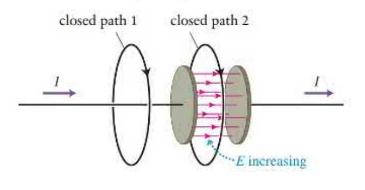
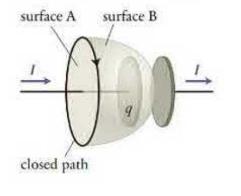
Consider a capacitor being charged with a constant current \(I\) and a dielectric between the plates. Is the magnitude of the magnetic field around a closed path spanning the capacitor (such as closed path 2 in Figure 30.4) any different from what it would be without the dielectric? Why or why
A particle carrying a negative charge is suddenly accelerated in a direction parallel to the long axis of a conducting rod, producing the electric field pattern shown in Figure 30.11.Data from Figure 30.11
Consider the electric field pattern of a sinusoidally oscillating dipole in Figure 30.14. (a) At \(t=\frac{3}{4} T\), where along the horizontal axis bisecting the straight line connecting the two poles is the electric field increasing with time? Where is it decreasing? (b) Based on your answer to
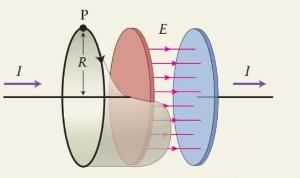
The parallel-plate capacitor in Figure 30.25 has circular plates of radius \(R\) and is charged with a current of constant magnitude \(I\). The surface is bounded by a circle that passes through point \(\mathrm{P}\) and is centered on the wire leading to the left plate and perpendicular to that
A parallel-plate capacitor has circular plates of radius \(R=\) \(0.10 \mathrm{~m}\) and a plate separation distance \(d=0.10 \mathrm{~mm}\). While a current charges the capacitor, the magnitude of the potential difference between the plates increases by \(10 \mathrm{~V} / \mu \mathrm{s}\). What is
Suppose a slab of dielectric with dielectric constant \(\kappa\) is inserted between the plates of the capacitor in Figure 30.23 and the capacitor is charged with a current \(I\), as considered in Example 30.1. How does Eq. 30.6 have to be modified to account for the dielectric?Data from Figure
What is the form of Maxwell's equations in a region of space that does not contain any charged particles?
At what speed does an electromagnetic wave pulse propagate through a dielectric for which the dielectric constant is \(\kappa\) ?
The average intensity \(S\) of the Sun's radiation at Earth's surface is approximately \(1.0 \mathrm{~kW} / \mathrm{m}^{2}\). Assuming sinusoidal electromagnetic waves, what are the root-mean-square values of the electric and magnetic fields?
A parallel-plate capacitor with circular plates of radius \(R=0.10 \mathrm{~m}\) and separation distance \(d=0.10 \mathrm{~mm}\) is charged by a constant current of \(1.0 \mathrm{~A}\). (a) What is the magnitude of the Poynting vector associated with the electric and magnetic fields at the edge of
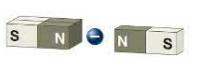
A negatively charged particle sits midway between the two magnets in Figure P28.1, at rest relative to the magnets. If the magnet on the left is twice as strong as the magnet on the right, what is the direction of the magnetic force exerted on the particle?Data from Figure P28.1 S N Z S
Two parallel wires each carry a current \(I\) in the positive \(x\) direction. What is the direction of the magnetic field at any point that lies midway between the wires and in the plane defined by them?
Consider a square loop of wire that carries a clockwise current when viewed from above. What is the direction of the magnetic field at the center of the square loop due to \((a)\) the left side, \((b)\) the top side, \((c)\) the right side, and (d) the bottom side?
A negatively charged particle is at rest in a region where a uniform magnetic field points in the positive \(x\) direction and a uniform electric field points in the positive \(y\) direction. What is the direction of the vector sum of the forces exerted on the particle?
Suppose two electrons move on parallel, closely spaced paths in the \(+z\) direction, each with velocity \(\vec{v}\) in the Earth reference frame. Discuss all forces exerted on the electrons.
Two protons are fired toward each other on closely spaced paths, one moving in the \(+z\) direction and one in the \(-z\) direction. As they pass close to each other, is the magnetic force between them attractive, repulsive, or neither?
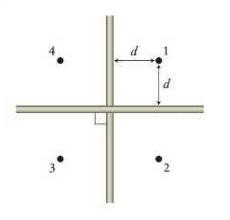
The two insulated, current-carrying wires in Figure P28.7 cross at right angles, and each carries a current \(I\). The locations labeled 1-4 are all in the plane defined by the wires, with each location a perpendicular distance \(d\) from both wires. At how many of these four locations is the
Showing 1400 - 1500
of 4962
First
8
9
10
11
12
13
14
15
16
17
18
19
20
21
22
Last
Step by Step Answers

 Get 50% OFF
Claim Now
Get 50% OFF
Claim Now