New Semester
Started
Get
50% OFF
Study Help!
--h --m --s
Claim Now
Question Answers
Textbooks
Find textbooks, questions and answers
Oops, something went wrong!
Change your search query and then try again
S
Books
FREE
Study Help
Expert Questions
Accounting
General Management
Mathematics
Finance
Organizational Behaviour
Law
Physics
Operating System
Management Leadership
Sociology
Programming
Marketing
Database
Computer Network
Economics
Textbooks Solutions
Accounting
Managerial Accounting
Management Leadership
Cost Accounting
Statistics
Business Law
Corporate Finance
Finance
Economics
Auditing
Tutors
Online Tutors
Find a Tutor
Hire a Tutor
Become a Tutor
AI Tutor
AI Study Planner
NEW
Sell Books
Search
Search
Sign In
Register
study help
physics
particle physics
Principles And Practice Of Physics 2nd Global Edition Eric Mazur - Solutions
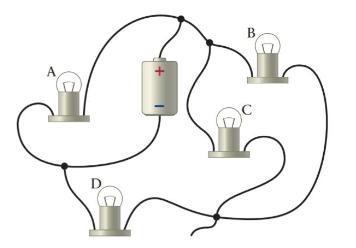
(a) Draw a circuit diagram for the circuit shown in Figure P31.21, which consists of a battery and four identical light bulbs. (b) Do all the bulbs light up? (c) Which bulb is brightest? Dimmest? (d) Which bulbs are connected to each other in parallel? Which are connected in series?Data from Figure
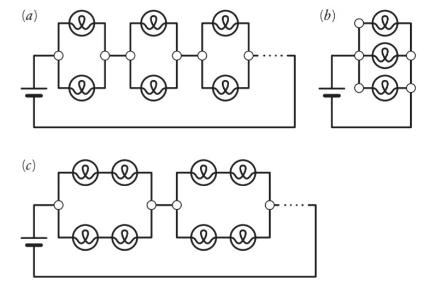
Decades ago, holiday lights were wired in series, so that if one bulb in a string burned out, all the lights in the string went dark because the burned-out bulb interrupted the circuit. Today's lights are wired at least partially in parallel, so that if one light goes out, many others in the string
Are the lights in a house wired in series, in parallel, or a combination of the two?
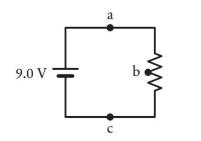
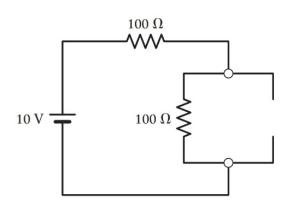
In Figure P31.24, the wire connecting the positive battery terminal to the top end of the resistor is \(100 \mathrm{~mm}\) long, and the wire connecting the negative battery terminal to the bottom end of the resistor is also \(100 \mathrm{~mm}\) long. If the resistor is \(10 \mathrm{~mm}\) long,
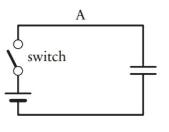
Once the switch in the circuit in Figure P31.25 is closed, the circuit can be used to charge the capacitor. Sketch the electric field inside wire \(\mathrm{A}(a)\) when the switch is open, \((b)\) at the instant just after the switch is closed, and \((c)\) at some instant long after the switch is
A cylindrical wire initially has resistance \(R\) and length \(\ell\). The wire is clamped in place at its midpoint, and the portion to the left of the clamp remains unchanged. The portion to the right of the clamp is stretched out to a length \(\ell\). Express the new resistance \(R^{\prime}\) of
You want to use a length of insulated rigid metal rod to discharge the plates of a parallel-plate capacitor without allowing the electric field in the rod to exceed 1000 N/C. The area \(A\) of each square plate is \(1.00 \mathrm{~m}^{2}\), the plate separation distance is \(d=100 \mathrm{~mm}\),
A copper wire that is \(600 \mathrm{~mm}\) long and has a radius of \(1.0 \mathrm{~mm}\) is connected to the terminals of a \(9.0-\mathrm{V}\) battery. What is the current through the wire \(\left[\sigma_{\text {copper }}=5.9 \times 10^{7} \mathrm{~A} /(\mathrm{V} \cdot \mathrm{m})\right]\) ?
A 6-gauge copper wire \((4.115-\mathrm{mm}\) diameter) carries a current of \(1.20 \mathrm{~A}\). What is the wire's current density?
How strong must an electric field in a metal be in order for electrons in the field to have a drift speed of \(10 \mathrm{~mm} / \mathrm{s}\) if the time interval between electron-ion collisions is \(1.0 \times 10^{-14} \mathrm{~s}\) ?
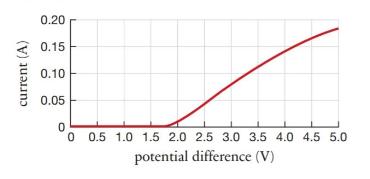
Figure P31.32 is a graph of the current through a lightemitting diode as a function of the potential difference across the diode. What is the resistance of the diode at a potential difference of \(3.0 \mathrm{~V}\) ?Data from Figure P31.32 0.20 0.15 0.10 0.05 current (A) 0 0 0.5 1.0 1.5 2.0 2.5 3.0
Two wires are made of the same material. If both are at the same temperature, but one has twice the diameter and three times the length of the other, which has the greater resistance, and by what factor?
When a potential difference of \(1.00 \mathrm{~V}\) is maintained between opposing faces of a metal that has a charge carrier number density of \(n=6.60 \times 10^{28}\) charge carriers \(/ \mathrm{m}^{3}\), the cube carries current \(I=6.10 \times 10^{5} \mathrm{~A}\). What is the average time
What is the magnitude of the applied electric field inside an aluminum wire of radius \(1.0 \mathrm{~mm}\) that carries a \(4.0-\mathrm{A}\) current \(\left[\sigma_{\text {aluminum }}=3.6 \times 10^{7} \mathrm{~A} /(\mathrm{V} \cdot \mathrm{m})\right]\) ?
For each of these changes in a metal, predict whether the average time interval between collisions of an electron with a lattice ion increases or decreases:(a) spatial density of the lattice ions is increased, \((b)\) size of the lattice ions is decreased,(c) charge of the lattice ions is
In a copper wire that has a diameter of \(1.63 \mathrm{~mm}\), the drift velocity is \(7.08 \times 10^{-4} \mathrm{~m} / \mathrm{s}\). If we assume one free electron per copper atom, what are \((a)\) the current in the wire and \((b)\) the current density?(c) This wire connects a light bulb,
In a particle accelerator, the particles in a beam of protons are traveling toward a target at a speed equal to \(0.100 c_{0}\). If the beam has a radius of \(0.100 \mu \mathrm{m}\) and carries a current of \(2.00 \mathrm{nA}\), how many protons strike the target in \(1.00 \mathrm{~s}\) ? Assume
When you step on the brake pedal in your car, charge carriers flow from the battery to the rear brake lights. Suppose the wire connecting the switch at the pedal to the brake lights is made of copper and has a diameter of \(1.1 \mathrm{~mm}\). If the current through the wire is \(2.0 \mathrm{~A}\),
Even though silver is a better electrical conductor than copper, most electrical cables are made from copper. The main reason is cost: The per-kilogram price of silver is about 100 times the per-kilogram price of copper. If you want a length \(\ell\) of wire to have a resistance \(R\), by what
An electric field of magnitude \(4.50 \times 10^{2} \mathrm{~V} / \mathrm{m}\) is created in a wire that is \(300 \mathrm{~mm}\) long and has a radius of \(1.00 \mathrm{~mm}\). The number density of the charge carriers in the wire is \(1.20 \times 10^{27}\) charge carriers \(/ \mathrm{m}^{3}\). How
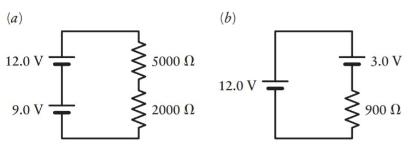
What are the magnitude and direction of the current in each circuit in Figure P31.44?Data from Figure P31.44 (a) (b) 12.0 V 5000 3.0 V 12.0 V 9.0 V 2000 L 900
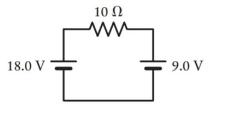
What are the magnitude and direction of the current in the circuit in Figure P31.45?Data from Figure P31.45 18.0 V 10 ww 9.0 V
Three resistors are connected in series to a battery. If the resistances are \(R_{1}=15 \Omega, R_{2}=20 \Omega\), and \(R_{3}=25 \Omega\) and the current through the \(15-\Omega\) resistor is \(2.3 \mathrm{~A}\), what is the potential difference across the battery terminals \((a)\) if the battery
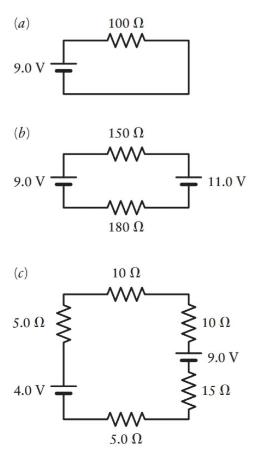
What are the magnitude and direction of the current in each circuit in Figure P31.47?Data from Figure P31.47 (a) 9.0 V 100 ww (b) 9.0 V 150 www 180 (c) 5.0 10 www 11.0 V 10 9.0 V 4.0 V 15 ww 5.0
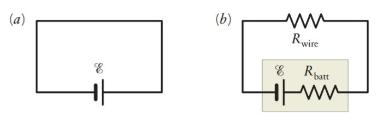
When using the loop rule, what problems do you encounter with the circuit in Figure P31.48a? What do you expect for the current in the more realistic circuit in Figure \(\mathrm{P} 31. 48 b\), which includes a small nonzero resistance in the wire and internal resistance in the battery?Data from
When a nonideal battery is connected to a \(2.0-\Omega\) resistor in a circuit, the current in the circuit is \(2.0 \mathrm{~A}\). When the same battery is connected to a \(1.0-\Omega\) resistor in a circuit, the current in the circuit is \(3.0 \mathrm{~A}\). What are \((a)\) the internal
Two resistors connected in series have an equivalent resistance of \(8.0 \Omega\). The same resistors connected in parallel have an equivalent resistance of \(1.5 \Omega\). What is the resistance of each resistor?
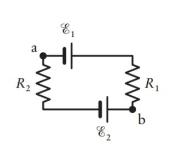
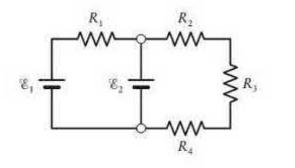
The potential difference between positions a and \(\mathrm{b}\) in Figure P31.51 is \(5.5 \mathrm{~V}\), and \(R_{1}=5.0 \Omega, \mathscr{E}_{1}=8.0 \mathrm{~V}\), and \(\mathscr{E}_{2}=4.0 \mathrm{~V}\). What is the value of the resistance \(R_{2}\) ?Data from Figure P31.51 a R E2 b R
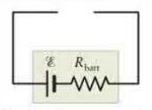
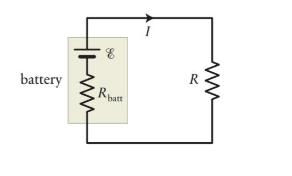
A typical car battery can be modeled as an ideal source \(\mathscr{E}\) connected in series with an internal resistance \(R_{\text {batt }}\). Using a good battery of this design to "jump start" a dead one can be dangerous if done incorrectly.(a) If you want to connect a good battery to a dead one
The internal resistance of a battery is relatively small when the battery is new but increases as the battery ages. When a new \(12.0-\mathrm{V}\) battery is attached to a \(100-\Omega\) load, the potential difference across the load is \(11.9 \mathrm{~V}\). After the circuit has operated for a
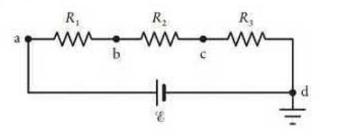
(a) What is the equivalent resistance of the circuit in Figure P31.55? Use the values \(R_{1}=200 \Omega, R_{2}=900 \Omega\), and \(R_{3}=100 \Omega\).(b) What is the current in the circuit? Assume \(\mathscr{E}=12 \mathrm{~V}\).(c) The electric potential at location \(\mathrm{d}\) is defined to be
Resistors 1 and \(2-R_{1}=40 \Omega, R_{2}=70 \Omega\)-are connected in series to a 4. 5 -V battery. (a) What is the potential difference across resistor 1? (b) If you decrease the value of \(R_{1}\), what happens to the current in the circuit and to the potential difference across resistor 1 ?
A light bulb has resistance \(R_{\text {bulb }}=5.0 \Omega\) and should be operated at a potential difference of \(V_{\text {bulb }}=3.0 \mathrm{~V}\). If you must use this bulb in a circuit powered by a battery of \(\mathrm{emf} \mathscr{E}=9.0 \mathrm{~V}\), how much resistance must you add in
You must complete the circuit of Figure P31.58 in such a way that it draws a current of \(0.300 \mathrm{~A}\) from the battery. The battery maintains a potential difference of \(10.0 \mathrm{~V}\) with no load, but has an internal resistance of \(R_{\text {batt }}=18.0 \Omega\). The only material
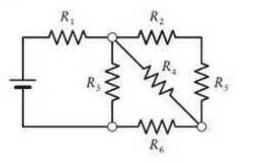
What is the equivalent resistance of the circuit in Figure P31.59? Use the values \(R_{1}=2.0 \Omega, R_{2}=1.5 \Omega\), \(R_{3}=2.0 \Omega, R_{4}=1.5 \Omega, R_{5}=2.0 \Omega\), and \(R_{6}=1.5 \Omega\).Data from Figure P31.59 R R www www R RA www www R R
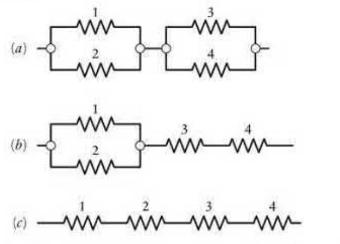
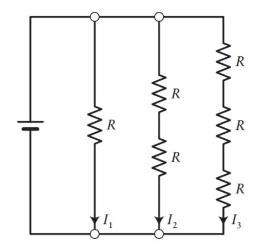
Figure P31.60 shows three circuits containing four identical resistors, each having resistance \(R\). Which circuit has the smallest equivalent resistance? Which has the greatest equivalent resistance?Data from Figure P31.60 (a) www (b) Line www (c) wwwwwwwm
A nonideal ammeter that has an internal resistance of \(0.503 \Omega\) is connected in series with a \(3.00-\mathrm{V}\) battery and a \(40.0-\Omega\) resistor. By what percentage does the measured current differ from that of the same circuit with no ammeter?
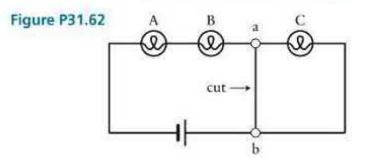
In Figure P31.62, the brightness of each bulb depends on the magnitude of the current through it. Rank these identical bulbs according to brightness, brightest first, \((a)\) before the wire \(a b\) connecting the two junctions is cut and (b) after the wire is cut. (c) Does cutting the wire
Using only \(10.0-\Omega\) resistors (but as many as you like), build a circuit that has a resistance of \(27.5 \Omega\).
A copper wire has a diameter of \(0.20 \mathrm{~mm}\) and is \(\ell_{\text {wirc }}=10 \mathrm{~m}\) long. (a) What is the resistance of the wire? (b) The wire is cut into \(N\) identical pieces, and the pieces are connected in parallel to form a single resistor. What is the minimum value of \(N\)
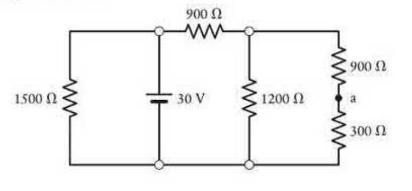
For the circuit in Figure P31.65, take the electric potential to be zero at the negative terminal of the battery. Calculate \((a)\) the equivalent resistance of the circuit, (b) the electric potential at positiona, and \((c)\) the magnitude and direction of the current through each resistor.Data
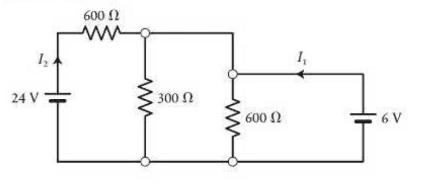
In Figure P31.66, determine the magnitude of current \(I_{1}\).Data from Figure P31.66 24 V 600 12 www 300 500) 600 A9.
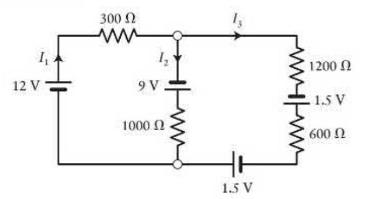
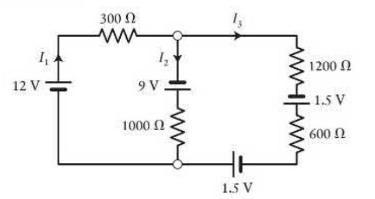
In Figure P31.67, calculate the magnitudes of currents \(I_{1}\), \(I_{2}\), and \(I_{3}\).Data from Figure P31.67 300 2 www I 12 V 9V 1000 1.5 V 1200 Q 1.5 V 600
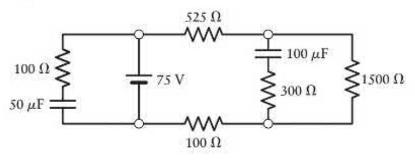
In Figure P31.68, the circuit has been completed for several minutes. Calculate \((a)\) the current through each resistor and \((b)\) the magnitude of charge on each capacitor plate.Data from Figure P31.68 100 50 F 75 V 525 www ww 100 100 F 1500 300
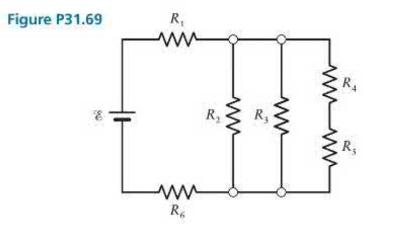
In Figure P31.69, calculate (a) the equivalent resistance of the circuit and \((b)\) the magnitude of the current through each resistor. Use these values: \(R_{1}=1.0 \Omega, R_{2}=2.0 \Omega\), \(R_{3}=2.0 \Omega, R_{4}=3.0 \Omega, R_{5}=1.0 \Omega, R_{6}=1.0 \Omega\), and \(\mathscr{E}=14
In Figure P31.70, determine the magnitudes of the currents \(I_{1}, I_{2}\), and \(I_{3}\) and whether the direction shown for each current is correct or should be reversed. Assume that \(R_{1}=8.0 \Omega, R_{2}=8.0 \Omega, \mathscr{E}_{1}=6.0 \mathrm{~V}, \mathscr{E}_{2}=6.0 \mathrm{~V}\), and
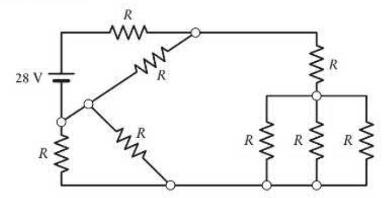
The eight resistors in Figure P31.71 are identical to one another, all having resistance \(R=200 \Omega\). What is the magnitude of the current drawn from the battery?Data from Figure P31.71 28 V R R ww www R R www R
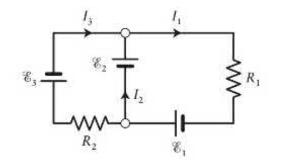
In Figure P31.72, \(\mathscr{E}_{1}=5.0 \mathrm{~V}, \mathscr{E}_{2}=5.0 \mathrm{~V}, \mathscr{E}_{3}=1.5 \mathrm{~V}\), \(R_{1}=50 \Omega, R_{2}=50 \Omega\), and \(R_{3}=50 \Omega\). What are (a) the current in each branch of the circuit and \((b)\) the potential differences \(V_{\mathrm{ab}},
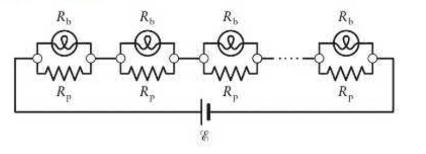
A string of winter holiday lights consists of \(N\) bulbs, each having resistance \(R_{\mathrm{b}}\) (Figure P31.73). Wired in parallel with each bulb is a resistor of resistance \(R_{p}\). What is the resistance of the string? If one of the bulbs burns out, what happens to the other \(N-1\)
An ammeter that has internal resistance \(R_{\mathrm{am}}=0.504 \Omega\) is designed to measure a maximum current of \(I_{\max }=\) \(100 \mathrm{~mA}\). You want to use this ammeter to measure the current in a circuit that consists of a \(3.00-\mathrm{V}\) battery and a resistor that has a
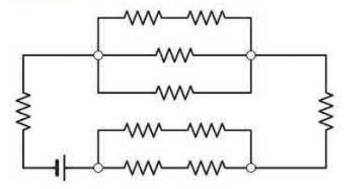
If each resistor in Figure P31.75 has resistance \(R=5.0 \Omega\), what is the equivalent resistance of the combination?Data from Figure P31.75 wwwwww wwwww www www wwwww
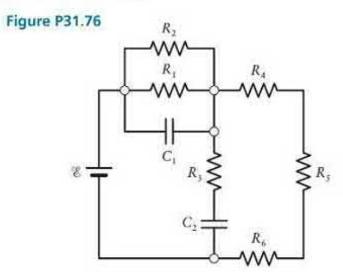
In Figure P31.76, \(R_{1}=2.0 \Omega, R_{2}=1.5 \Omega, R_{3}=2.0 \Omega\), \(R_{4}=1.0 \Omega, R_{5}=2.0 \Omega, R_{6}=1.0 \Omega, C_{1}=20 \mu \mathrm{F}\), \(C_{2}=40 \mu \mathrm{F}\), and \(\mathscr{E}=12.0 \mathrm{~V}\). Assume that the circuit has been connected for several minutes. (a)
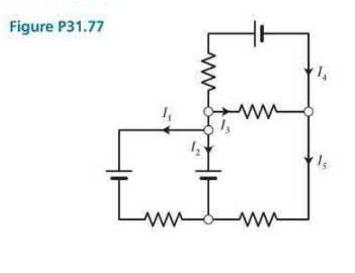
In Figure P31.77, each of the three batteries supplies an emf of \(6.0 \mathrm{~V}\) and each of the four resistors has a resistance of \(3.0 \Omega\). Calculate the magnitudes of the five currents \(I_{1}-I_{5}\).Data from Figure P31.77 Figure P31.77 Im I m
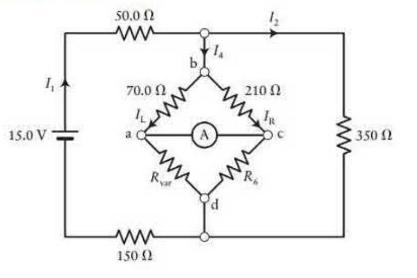
If the ammeter in the Wheatstone bridge of Figure P31.78 measures zero current when the resistance \(R_{\text {var }}\) of the variable resistor is set to \(185 \Omega\), what is the current \(I_{\mathrm{L}}\) through the left side of the bridge?Data from Figure P31.78 50.02 www 15.0 V 70.0 2. ww R
If a light bulb has a resistance of \(5.5 \Omega\) and is dissipating energy at a rate of \(9.0 \mathrm{~W}\), what are (a) the current through the bulb and \((b)\) the potential difference across its terminals?
If the current through a \(10-\Omega\) resistor is \(2.0 \mathrm{~A}\), how much energy is dissipated by the resistor in \(1.0 \mathrm{~h}\) ?
Two light bulbs 1 and 2 are connected in parallel to an \(8.00-\mathrm{V}\) battery. (a) If the bulb resistances are \(R_{1}=4.0 \Omega\) and \(R_{2}=6.0 \Omega\), what is the rate at which each bulb consumes energy? (b) At what rate does the circuit consume energy? (c) Calculate the same three
A car battery is labeled " 12 V 40 Ah." You forget to switch off the light in your glove compartment, which draws \(0.80 \mathrm{~A}\). How long until the battery is drained?
(a) Determine the current through and the potential difference across each resistor in Figure P31.83. Assume that \(R_{1}=R_{2}=R_{3}=R_{4}=50.0 \Omega, \mathscr{E}_{1}=10.0 \mathrm{~V}\), and \(\mathscr{E}_{2}=5.00 \mathrm{~V}\). (b) At what rate is energy dissipated in each resistor? (c) What is
A \(60-\mathrm{W}\) light bulb has resistance \(R=10.00 \Omega\) when connected to a battery with \(\mathrm{emf} \mathscr{E}=120.0 \mathrm{~V}\). What is the internal resistance \(R_{\text {batr }}\) of the battery?
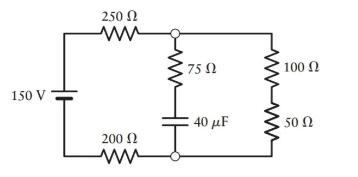
Determine the current through each resistor and the magnitude of the charge on either capacitor plate after the circuit in Figure P31.85 has been connected for a few minutes.Data from Figure P31.85 150 V 250 ww 200 www 75 100 40 F 50022
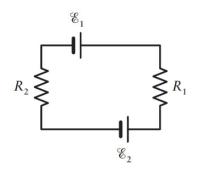
If the rate at which energy is dissipated by resistor 1 in Figure P31.86 is \(0.75 \mathrm{~W}\), and \(R_{1}=12 \Omega, \mathscr{E}_{1}=4.5 \mathrm{~V}\), and \(\mathscr{E}_{2}=8.0 \mathrm{~V}\)(a) what is the value of \(R_{2}\) ?(b) At what rate is energy dissipated in resistor 2?(c) Which
A copper wire of length \(\ell=1.0 \mathrm{~km}\) and radius \(r=\) \(1.2 \mathrm{~mm}\) carries current \(I=20 \mathrm{~A}\). At what rate is energy lost from the wire? Why do long electrical transmission lines usually work with "high voltage"?
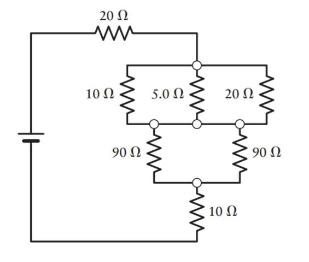
In Figure P31.88, in which resistor is energy dissipated \((a)\) at the greatest rate and \((b)\) at the smallest rate?Data from Figure P31.88 20 www 10 5.0 20 90 10 90
At what rate is energy either delivered by or delivered to each battery in Figure P31.67? At what rate is energy dissipated in each resistor? Does the power summed over all the elements make sense?Data from Figure P31.67 300 2 www I 12V 9V 1000 1.5V www 1200 1.5 V 600
A physics student who needs a magnetic field for a project makes a solenoid coil from "magnet wire," which is copper wire coated with a very thin enamel insulation. (The insulation is so thin that you can ignore its thickness.) He chose 28-gauge wire, which is \(0.321 \mathrm{~mm}\) in diameter,
The filament in an incandescent light bulb is a resistor that has a resistance of \(9.5 \Omega\) at room temperature. By what factor does the resistance increase when a \(100-\mathrm{W}\) bulb connected to a \(120-\mathrm{V}\) power source is turned on and heats up?
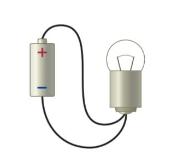
Does the light bulb in Figure P31.92 light up? Why or why not?Data from Figure P31.92 +
In what type of electrical conductor could the charge on the charge carriers in a current have a magnitude other than \(e\) ?
The potential difference across a resistor in a circuit is \(12 \mathrm{~V}\) when a current of \(1.0 \mathrm{~A}\) passes through the resistor. What is the potential difference across the resistor when the current through it is \(3.5 \mathrm{~A}\) ?
The battery in Figure P31.95 has internal resistance \(R_{\text {batt }}=13.0 \Omega\) and maintains an emf \(\mathscr{E}=20.0 \mathrm{~V}\). What is the resistance \(R\) of the resistor connected in series with the battery if the current through the circuit is \(0.100 \mathrm{~A}\) ?Data from
Calculate the values of \(I_{1}\) and \(I_{2}\) in the circuit shown in Figure P31.96 if all the resistors have resistance \(240 \Omega\) and \(I_{3}=2.0 \mathrm{~A}\).Data from Figure P31.96 R R R R R
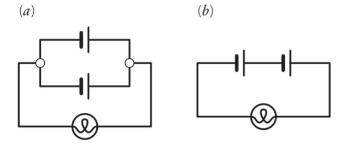
If each battery in Figure P31.97 has an emf of \(9.0 \mathrm{~V}\), what is the potential difference across the light bulb in each circuit?Data from Figure P31.97 (a) e (b) H| e
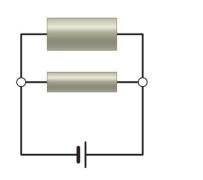
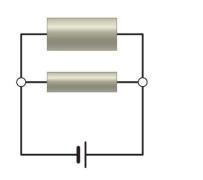
The two resistors in Figure P31.98 are made of the same material and are of equal length. The only difference between them is that the radius of the top one is greater than the radius of the bottom one.(a) Through which resistor is the current greater? \((b)\) Across which resistor is the
If you want to add a third resistor to the circuit in Figure P31.98 to reduce the circuit resistance as much as possible, should you connect it in series or in parallel? Should you add a resistor with a large cross-sectional area, like the top one in Figure P31.98, or one with a small
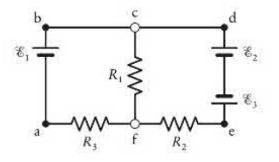
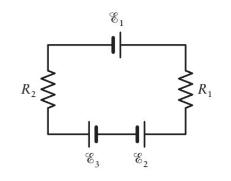
In Figure P31.100, \(\mathscr{E}_{1}=3.0 \mathrm{~V}\) and \(\mathscr{E}_{2}=5.0 \mathrm{~V}\). (a) What value of \(\mathscr{E}_{3}\) causes the potential difference across resistor 1 to be zero? (b) In that situation, what is the current through resistor 2 ?Data from Figure P31.100 R R www H
Your boss has given you the incomplete circuit shown in Figure P31.101 and charged you with determining the greatest and smallest currents that can be drawn from the battery using this circuit. The catch is that you must close the gap with a resistor from your laboratory. You rummage around and
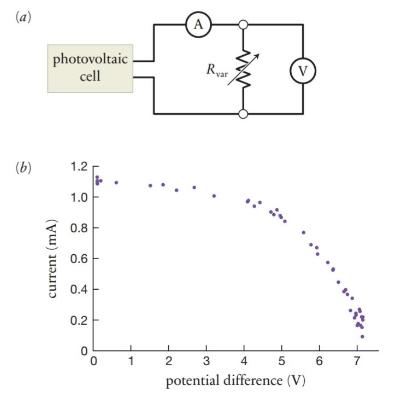
You illuminate a photovoltaic cell with a halogen light bulb. The cell is connected to an ammeter, a voltmeter, and a variable resistor (Figure P31.102a), and the current through and potential difference across the resistor are measured for different settings of the resistor. Figure P31.102 \(b\)
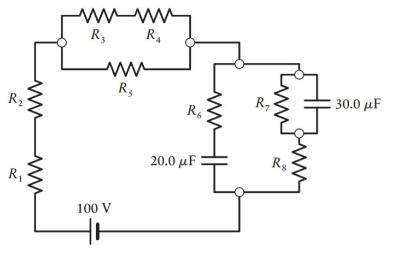
The circuit shown in Figure P31.103 has been connected for a few minutes. Determine the current through each resistor and the battery, and determine the magnitude of charge on either plate of each capacitor. Use resistor values \(R_{1}=R_{2}=5.00 \Omega, R_{3}=4.00 \Omega, R_{4}=6.00 \Omega\),
Three students rent a third-floor apartment. After signing the lease, they realize there's no electricity on the third floor! They run a \(30.5-\mathrm{m}, 18\)-gauge extension cord up from the second floor and plug everything into some power strips plugged into this cord. An electrician visiting
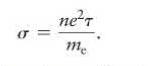
You need a liquid electrical conductor for a project you are working on, and as one possibility you try seawater. You know the number density of the charge carriers and the average time interval between collisions. Your preliminary calculations using Eq. 31. 9 and the mass and charge of an electron
Suppose you could move at nearly the speed of light. If you were to move at this speed for a large portion of your life, would it be possible for you to live long enough to see a later calendar year on Earth than you otherwise would have? Compare your answer with that for Checkpoint 14.8.Data from
An object attached to one end of a spring makes 25 complete oscillations in 5.0 seconds. What are its period and frequency?
The period of a pendulum on the surface of the Earth is 1. It is then brought at a higher altitude. For it to maintain its period, should the length of the pendulum string be made longer or shorter?
On average, Mars takes 687 days to make a complete revolution around the sun. Considering its orbit as nearly circular as seen by a distant observer standing in the plane of the orbit, what is the effective "spring constant" of this simple harmonic motion? \(\cdot\)\(\cdot\)
A \(0.250-\mathrm{kg}\) mass on a spring has velocity as a function of time given by \(v(x, t)=(4.70 \mathrm{~cm} / \mathrm{s}) \cos [(4.16 \mathrm{rad} / \mathrm{s}) t]\). Find the (a) the period; (b) the amplitude; (c) the frequency;(d) the force constant of the spring?
A toy, initially equilibrium position, attached to a spring undergoes simple harmonic motion horizontally with a period of \(0.75 \mathrm{~s}\) and amplitude of \(4.0 \mathrm{~cm}\). Write an equation describing the toy's motion with all variables identified.
A \(0.200-\mathrm{kg}\) small block is attached to an ideal spring with a spring constant of \(316 \mathrm{~N} / \mathrm{m}\) and is moving in simple harmonic motion on a horizontal frictionless surface. Find the energy of the block if its maximum displacement from the equilibrium position is
Two vertical springs, one with spring constant \(k\) and the other with spring constant \(2 k\), each have a ball of mass \(m\) hanging from them. Compare the period of oscillation of the two springs undergoing simple harmonic motion.
An astronaut who recently landed on an unfamiliar planet wants to measure the acceleration due to gravity. He constructs a simple pendulum of length \(40.0 \mathrm{~cm}\) and then finds that the pendulum makes 35.0 complete swings per minute. Find the value of \(g\) on this planet.
A \(5.0-\mathrm{kg}\) cart is attached to a horizontal spring for which the spring constant is \(75 \mathrm{~N} / \mathrm{m}\). The system is set in motion when the cart is \(0.32 \mathrm{~m}\) from its equilibrium position, and the initial velocity is \(1.5 \mathrm{~m} / \mathrm{s}\) directed
A mass attached to a spring oscillates in simple harmonic motion along the \(x\)-axis. The limits of its motion are \(x=-5 \mathrm{~cm}\) and \(x=45 \mathrm{~cm}\) and it goes from one of these extremes to the other in \(0.20 \mathrm{~s}\). Find its (a) amplitude; (b) frequency;(c) period?
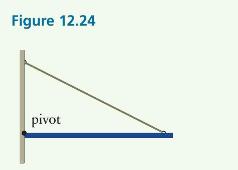
A rope supports one end of a beam as shown in Figure 12.24. Draw the Figure 12.24 lever arm distance for the torque caused by the rope about the pivot. Figure 12.24 pivot
Draw a free-body diagram and an extended free-body diagram for(a) a door hanging on two hinges (b) a bridge supported from each end, with a car positioned at one-quarter of the bridge's length from one support.
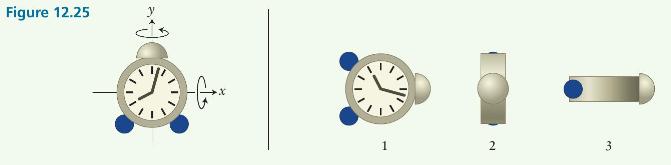
Which diagram in Figure 12.25-1, 2, or 3-shows the alarm clock on the left after it has been rotated in the directions indicated by(a) \(90^{\circ}\) about the \(x\) axis and then \(90^{\circ}\) about the \(y\) axis?(b) \(90^{\circ}\) about the \(y\) axis and then \(90^{\circ}\) about the \(x\)
Give the direction of the rotational velocity vector associated with each spinning object shown in Figure 12.26. ( Figure 12.26 (a) (b) (c) (d)
The orbital period of the Moon around Earth is 27.32 days; that of Earth around the Sun is 365.26 days. (a) Which orbit has the greater rotational speed: Earth's or the Moon's? Are the orbital rotational speeds of Earth and the Moon around the Sun great or small relative to the rotational speeds
If the force of gravity decreases with the inverse square of the distance, why were we allowed, in all our earlier work on the gravitational force, to say that an object sitting on the ground, an object sitting in a tree \(10 \mathrm{~m}\) above the ground, and an object flying at an altitude of
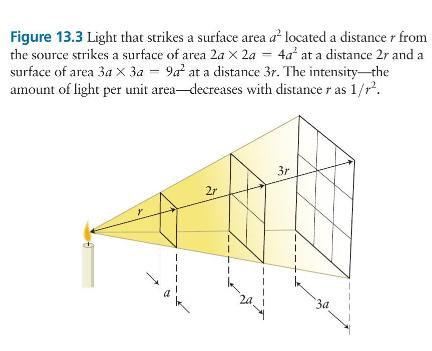
Suppose the universe were two dimensional rather than three dimensional.(a) Following the line of reasoning illustrated in Figure 13.3, describe how the strength of the gravitational force would depend on distance in this flat universe.(b) How would the periods of the planetary orbits be related to
Suppose the force of gravity between two objects 1 and 2 of masses \(m_{1}\) and \(m_{2}\) were proportional to the sum \(m_{1}+m_{2}\) rather than to the product \(m_{1} m_{2}\).(a) Would this dependence be consistent with the following two requirements? (i) The force exerted by 1 on 2 is equal
Showing 1200 - 1300
of 4962
First
6
7
8
9
10
11
12
13
14
15
16
17
18
19
20
Last
Step by Step Answers

 Get 50% OFF
Claim Now
Get 50% OFF
Claim Now