New Semester
Started
Get
50% OFF
Study Help!
--h --m --s
Claim Now
Question Answers
Textbooks
Find textbooks, questions and answers
Oops, something went wrong!
Change your search query and then try again
S
Books
FREE
Study Help
Expert Questions
Accounting
General Management
Mathematics
Finance
Organizational Behaviour
Law
Physics
Operating System
Management Leadership
Sociology
Programming
Marketing
Database
Computer Network
Economics
Textbooks Solutions
Accounting
Managerial Accounting
Management Leadership
Cost Accounting
Statistics
Business Law
Corporate Finance
Finance
Economics
Auditing
Tutors
Online Tutors
Find a Tutor
Hire a Tutor
Become a Tutor
AI Tutor
AI Study Planner
NEW
Sell Books
Search
Search
Sign In
Register
study help
physics
particle physics
Principles And Practice Of Physics 2nd Global Edition Eric Mazur - Solutions
In part \(a\) of Example 13.1, what would the distance between the other person and you have to be for the gravitational force between the two of you to match the gravitational force exerted by Earth on you? Is it possible to verify your prediction?Data from Example 13.1 Compare the gravitational
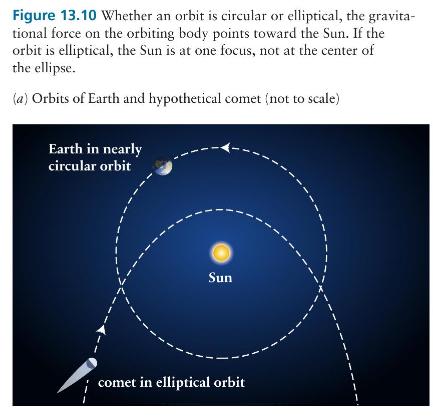
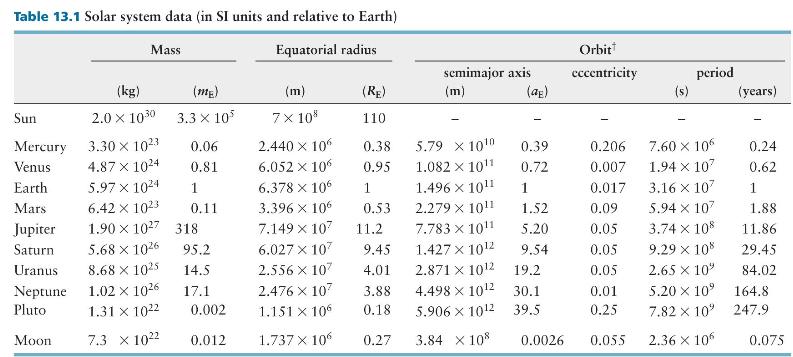
(a) If we ignore the influence of other celestial objects, the Earth-Sun system is isolated, and so it must rotate about the system's center of mass. Using the data in Table 13.1, determine how far from the center of the Sun the center of mass of the system is and what fraction of the Sun's radius
The space shuttle typically orbits Earth at an altitude of about \(300 \mathrm{~km}\).(a) By what factor is the shuttle's distance to the center of Earth increased over that of an object on the ground? (b) The gravitational force exerted by Earth on an object in the orbiting shuttle is how much
A \(1.0-\mathrm{kg}\) brick is placed on a spring scale.(a) What is the magnitude of the force exerted by Earth on the brick?(b) What is the magnitude of the force exerted by the brick on the scale?(c) How many steps are required to answer part \(b\) ?(d) Does the spring scale measure the pull of
A \(1.0-\mathrm{kg}\) brick is placed on a spring scale inside the space shuttle orbiting Earth at \(300 \mathrm{~km}\) altitude.(a) What is the magnitude of the force exerted by Earth on the brick?(b) What is the magnitude of the force exerted by the brick on the spring scale?(c) Does the spring
(a) An object is placed on a spring scale in an elevator moving upward at a constant speed. Is the reading of the scale greater than, smaller than, or the same as the reading obtained in a stationary elevator? (b) How does the reading of a scale in an elevator that has upward acceleration \(a=0.5
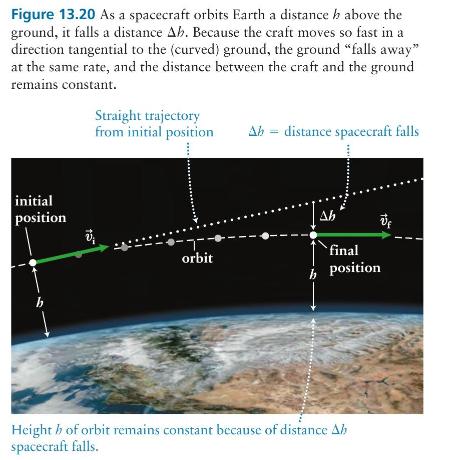
(a) How far does the space shuttle in Figure 13.20, \(300 \mathrm{~km}\) above Earth, fall in \(1.0 \mathrm{~s}\) ?(b) If the radius of Earth is \(6400 \mathrm{~km}\), what is the shuttle's speed? Figure 13.20 As a spacecraft orbits Earth a distance h above the ground, it falls a distance Ah.
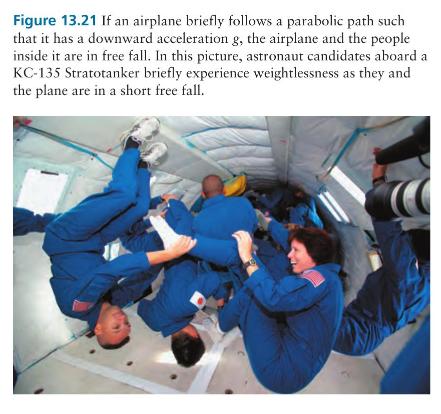
Planes can be put (safely) into free fall for periods up to \(40 \mathrm{~s}\).(a) If the plane shown in Figure 13.21 was flying horizontally before being put into free fall, how much altitude does it lose in those \(40 \mathrm{~s}\) ?(b) What is the plane's final vertical speed of descent?(c) At
Consider an airplane flying at a constant speed of \(900 \mathrm{~km} / \mathrm{h}, 10 \mathrm{~km}\) above the ground. (a) What is the plane's downward acceleration? (b) Draw a free-body diagram for the airplane. (c) Why don't people in the airplane feel weightless as astronauts do traveling \(290
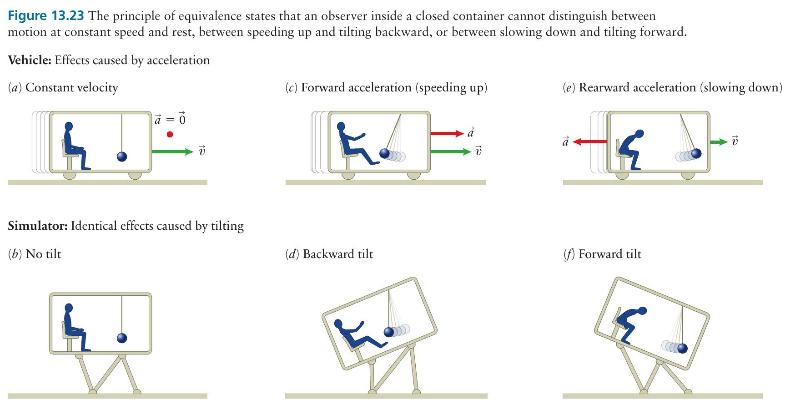
How should the simulator in Figure 13.23 be tilted to simulate a right turn? Figure 13.23 The principle of equivalence states that an observer inside a closed container cannot distinguish between motion at constant speed and rest, between speeding up and tilting backward, or between slowing down
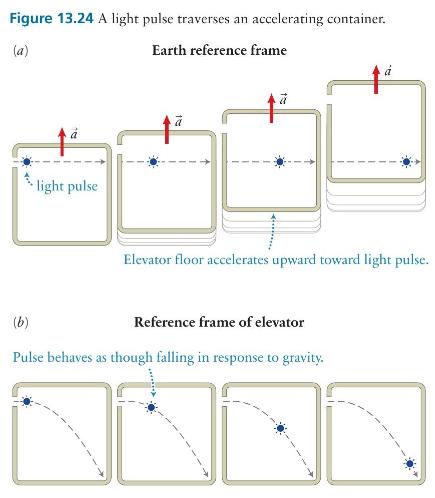
Light travels at approximately \(3.0 \times 10^{8} \mathrm{~m} / \mathrm{s}\). (a) How long does it take for a light pulse to cross an elevator \(2.0 \mathrm{~m}\) wide? (b) How great an acceleration is necessary to make the pulse deviate from a straight-line path by \(1.0 \mathrm{~mm}\) ? Is it
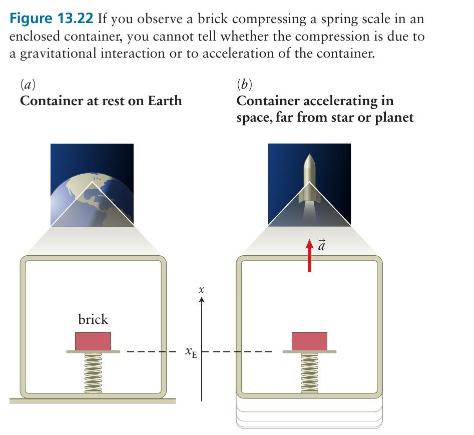
(a) What would the scale reading be if the container in Figure \(13.22 b\) were traveling at constant speed instead of accelerating?(b) Describe the path of the light pulse in the reference frame of the elevator in Figure 13.24 b if the elevator were traveling at constant speed. Figure 13.24 A
For an object released from a height \(h \approx R_{\mathrm{E}}\) above the ground, does the acceleration due to gravity decrease, increase, or stay the same as the object falls to Earth?
Near Earth's surface, when \(\Delta U^{G}=m g \Delta x\), it is customary to let the gravitational potential energy be zero at Earth's surface, instead of at infinite separation as we did in Eq. 13.10. Does this choice of zero yield greater or smaller values for the gravitational potential energy?
(a) If an object of mass \(m\) is released from rest a distance \(r\) from a star of mass \(M \gg m\) and radius \(R_{s}\), is the mechanical energy of the star-object system \(E_{\text {mech }}\) positive, negative, or zero? (b) Describe the motion of the object, and determine the maximum and
(a) If a satellite of mass \(m\) were to reach the position \(r_{\max }\) given by Eq. 13.22, what would its angular momentum be?(b) What would its trajectory have to be to satisfy conservation of angular momentum?(c) If its angular momentum is nonzero, can the satellite ever reach \(r_{\text {max
Consider a planet of mass \(m\) moving at constant speed \(v\) in a circular orbit of radius \(R\) under the influence of the gravitational attraction of a star of mass \(M\).(a) What is the planet's kinetic energy, in terms of \(m, M, G\), and \(R\) ?(b) What is the energy of the star-planet
(a) Determine an expression for the escape speed at Earth's surface. (b) What is the value of this escape speed? (c) Does it matter in which direction an object is fired at the escape speed?
(a) Work out the integral in Eq. 13.35.(b) Show that Eq. 13.33 still holds if the particle of mass \(m\) is inside the shell.(c) What are integration limits with this particle inside the shell? What is the value of the integral in Eq. 13.35 for these limits?Equations GMm R $2 4rR +1)ds. +1 ds.
A certain metallic structure weighs \(2450 \mathrm{~N}\) on earth. The structure is sent to Mars, which has a diameter of \(6.78 \times 10^{6} \mathrm{~m}\) and mass of \(6.42 \times 10^{23} \mathrm{~kg}\). What is the weight of the structure on the surface of the Martian planet?
A person in an elevator lets go of his briefcase but observed that it moves towards the ceiling. How is the elevator moving?
Consider two speres in a system-Sphere 1 has mass \(M\) and radius \(2 R\), while the second Sphere has mass \(2 M\) and radius \(R\). If the two spheres touch each other, find the magnitude of their gravitational force of attraction as a function of mass \(M\) and radius \(R\).
Two spherical celestial bodies, one of mass \(3.5 \times 10^{13} \mathrm{~kg}\) and the other of mass \(2.4 \times 10^{18} \mathrm{~kg}\), experience a gravitational force between them with a magnitude of \(4.0 \times 10^{7} \mathrm{~N}\). How far apart are the two spheres?
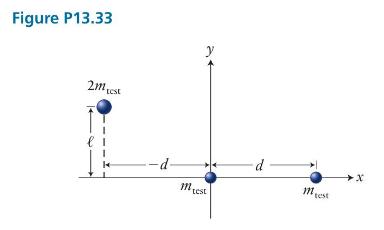
A \(2.0 \times 10^{9}-\mathrm{kg}\) sphere is at the origin, and a second \(5.0 \times 10^{9}-\mathrm{kg}\) sphere is on the \(x\)-axis at \(x=8.0 \mathrm{~km}\). Find the magnitude and direction of the net gravitational attraction force that the two spheres would exert on a third sphere of mass
The mass of a hypothetical planet is \(1 / 80\) that of Earth and its radius is \(1 / 4\) that of Earth. What is the ratio of the acceleration due to gravity on the planet to that on Earth?
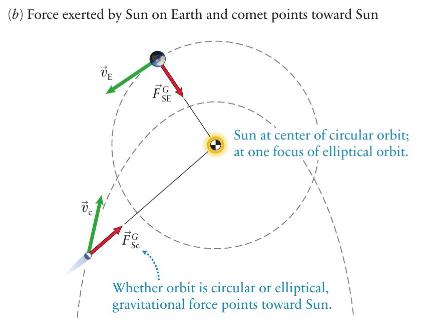
The Sun exerts a gravitational force on the Earth, keeping it in its orbit.(a) As per Newton's third law, what is the reaction to this force?(b) Suppose another planet has the same mass as the Earth but is located twice as far from the Sun. Describe the magnitude of the attraction force.
The acceleration of gravity on the surface of the Moon is about \(1 / 6\) of Earth's \(g\). If the radius of the moon is \(1,737.4 \mathrm{~km}\), approximate the mass of the Moon from the given information.
Three spheres are arranged on a line along the \(x\)-axis. Sphere \(m_{1}=5.00 \mathrm{~kg}\) and is at the origin while sphere \(m_{2}\) is at \(x=+35.0 \mathrm{~m}\). What must be the mass of the second sphere if the net gravitational attraction force experience by a third sphere of mass \(2.00
The Earth has a mass of \(5.972 \times 10^{24} \mathrm{~kg}\), while the Moon has a mass of \(7.348 \times 10^{22} \mathrm{~kg}\). Calculate the gravitational potential energy of the Earth-Moon system when the distance between the two bodies is \(3.844 \times 10^{5} \mathrm{~km}\).
(a) How much gravitational potential energy does a system comprising a 150-kg object and the Moon have if the object is one Moon radius above the ground? (b) How far should this object be from the moon for the gravitational potential become zero? \(\cdot\)
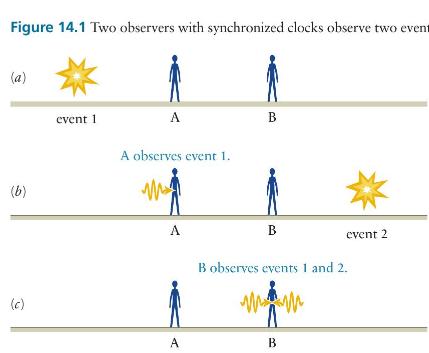
In Figure 14.1, based on the time of arrival of the light signals, which event is observed first according to(a) observer A (b) observer B? (c) Figure 14.1 Two observers with synchronized clocks observe two event (a) (b) event 1 A A observes event 1. A> B A B B observes events 1 and 2. B event 2
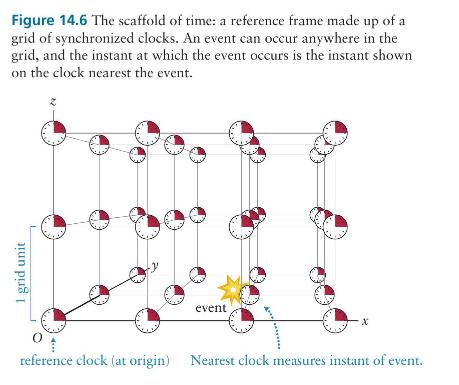
Suppose an observer is standing at the origin in Figure 14.6 and all the clocks are synchronized.(a) Which of the following is true? The observer sees that (i) all the clocks read the same time, (ii) nearby clocks display later times than more distant clocks, (iii) nearby clocks display earlier
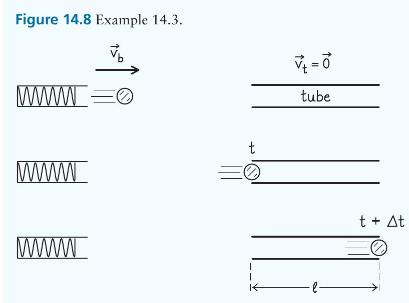
In Example 14.3 what is the time interval \(\Delta t\) it takes the ball to pass through the moving tube if \(v_{\mathrm{b}}=v_{\mathrm{t}}=v\) ? Express your answer in terms of \(\ell\) and \(v\).Data from Example 14.3Consider a spring-loaded device that ejects a ball at some unknown everyday
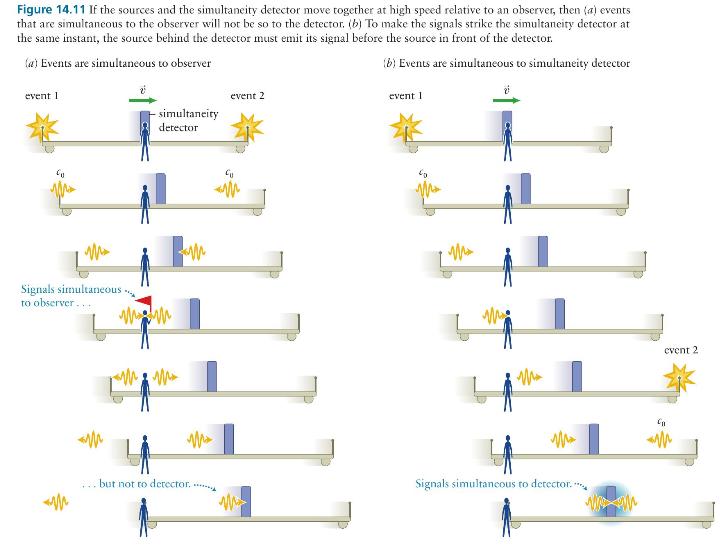
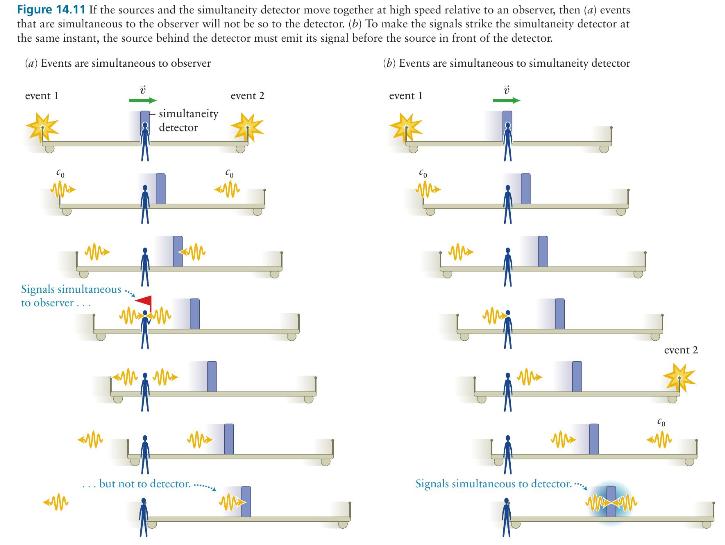
Suppose the observer in Figure 14.11a, at rest relative to the ground and standing midway between the two sources when they emit signals, is joined by another observer who moves along with the simultaneity detector.(a) Based on what the detector tells them, do the observers agree that the light
Suppose the setup in Figure 14.11 is \(10 \mathrm{~m}\) long.(a) How long does it take a light signal to travel from source to detector?(b) If the setup moves at \(20 \mathrm{~m} / \mathrm{s}\), how far does it travel in the time interval you calculated in part \(a\) ?(c) By how much does the
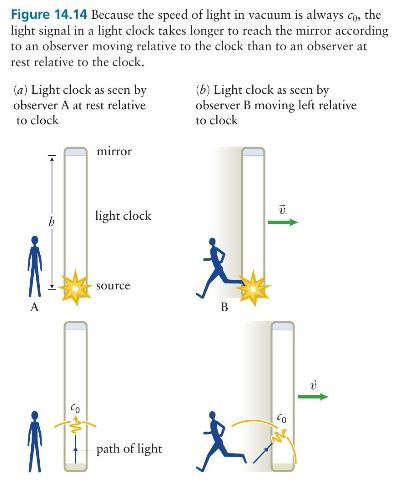
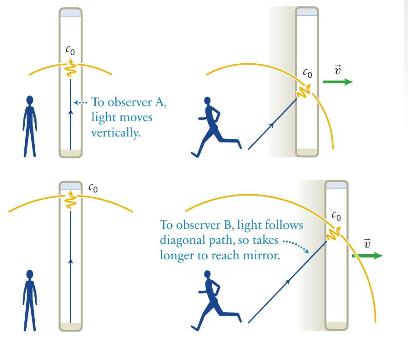
(a) In Figure 14.14, is the period of the clock according to observer \(\mathrm{B}\) greater than, equal to, or less than the period according to \(\mathrm{A}\) ?(b) Does the period of the clock according to \(B\) increase, decrease, or stay the same if we increase \(v\) ? Figure 14.14 Because the
On your desk in front of you are two watches, one mechanical and one electronic. For each minute on the electronic watch, the mechanical watch advances by only 59 s.(a) Is the mechanical watch fast or slow relative to the electronic one? (b) Using the mechanical watch as the standard, is the
Could you lengthen your life by traveling at high speed?
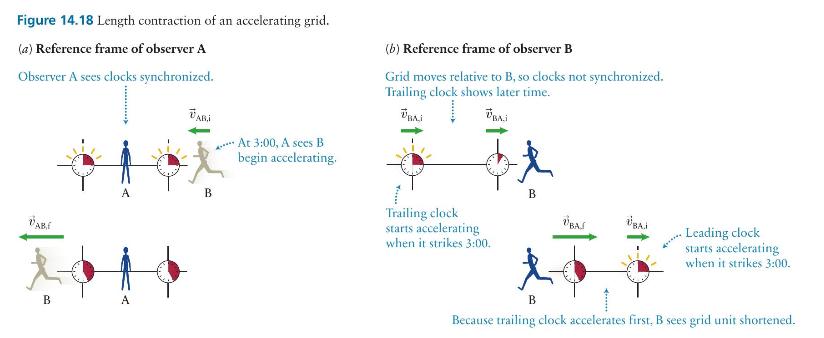
Suppose observer B in Figure 14.18 carries a unit of two synchronized clocks that is identical to the unit that is at rest relative to A. Observer B begins speeding up when the clocks in her reference frame read 3 o'clock. What happens to the length of B's unit according to observer A? Figure 14.18
Consider a long pole moving through a tunnel, with the direction of motion being along the long axis of the pole. An observer on the ground determines that the moving pole has the same length as the tunnel. Does an observer moving along with the pole agree that the pole fits exactly in the tunnel?
Do two observers, one moving at very high speed relative to the other, agree on the inertia of an object? Why or why not?
In each of the following situations, does the mass of the system increase, decrease, or stay the same? (a) A spring is compressed (system: spring). (b) A cup of coffee cools down (system: coffee).
Do the inertia and mass of the system increase, decrease, or remain the same when(a) an elementary particle is accelerated (system: particle) and(b) an elementary particle slams into a metal target (system: particle and target)?
Taking each motion to be relative to the Earth reference frame, calculate \(\gamma\) for (a) a car moving at \(30 \mathrm{~m} / \mathrm{s},\)(b) an airplane moving at \(250 \mathrm{~m} / \mathrm{s},\)(c) a spacecraft moving at \(10,000 \mathrm{~m} / \mathrm{s}\),(d) an electron moving at \(0.60
An elementary particle is observed to disintegrate after traveling \(120 \mathrm{~m}\) in \(5.0 \times 10^{-7} \mathrm{~s}\) from the location where it was created. How long does the particle exist before disintegrating according to an observer at rest relative to the particle?
A car travels \(1.0 \mathrm{~km}\) down a straight road at \(100 \mathrm{~km} / \mathrm{h}\). How much shorter is the road in the car's reference frame?
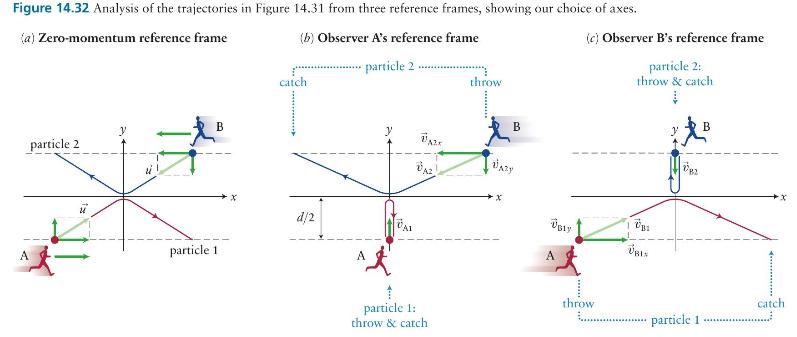
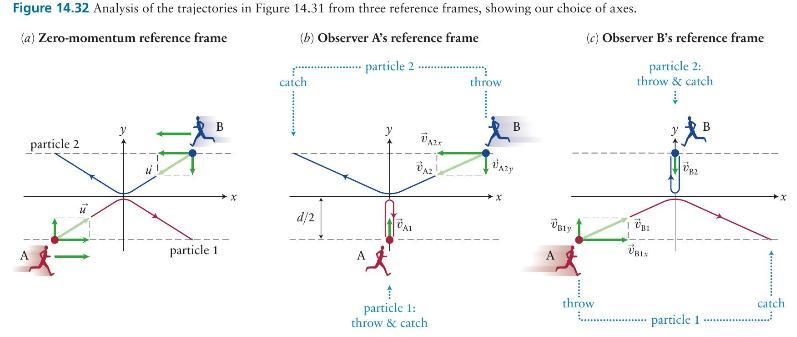
In Figure 14.32, is the time interval between the throw and the catch of particle 1 in reference frame A greater than, equal to, or less than the time interval between the throw and the catch of particle 2 in reference frame \(B\) ? Figure 14.32 Analysis of the trajectories in Figure 14.31 from
(a) According to observer A in Figure 14.32, which particle is moving faster?(b) Does A conclude that the inertia of a particle increases or decreases with speed?(c) Answer these two questions for observer B. Figure 14.32 Analysis of the trajectories in Figure 14.31 from three reference frames,
To what fraction of \(c_{0}\) must an electron at rest in the Earth reference frame be accelerated in order for its inertia to increase by a factor of 1000 ?
In Example 14.11,(a) is the collision elastic, inelastic, or totally inelastic?(b) How fast would the electron have to move if the expression for momentum were \(\vec{p}=m \vec{v}\) instead of Eq. 14.42?Data from Example 14.11A fast-moving electron collides head-on with a proton moving at \(0.60
Use Eq. 14.11, \(\gamma-1 \approx 0.5\left(v^{2} / c_{0}^{2}\right)\), to show that Eq. 14.51 reduces to the familiar \(K=\frac{1}{2} m v^{2}\) at nonrelativistic speeds \(\left(v \ll c_{0}\right)\).Equation y-1= (within two significant digits when v
(a) Draw a simplified energy diagram for the totally inelastic collision between two identical objects moving at speed \(v\) toward each other. After the collision, the two objects form a compound object that is at rest. (b) Which of the following quantities are constant in the collision: kinetic
An atom in the filament of a light bulb emits energy in the form of light. (a) Draw a simplified energy diagram representing this emission. (b) Does the mass of the atom increase, decrease, or stay the same? (c) Does the inertia of the atom increase, decrease, or stay the same? Assume the atom
In Example 14.13, what is the minimum kinetic energy of each proton if they have the same initial speed and collide head-on?Data from Example 14.13Two protons, each of mass \(m_{\mathrm{p}}=1.67 \times 10^{-27} \mathrm{~kg}\), collide to produce a particle that has a mass 300 times the mass of each
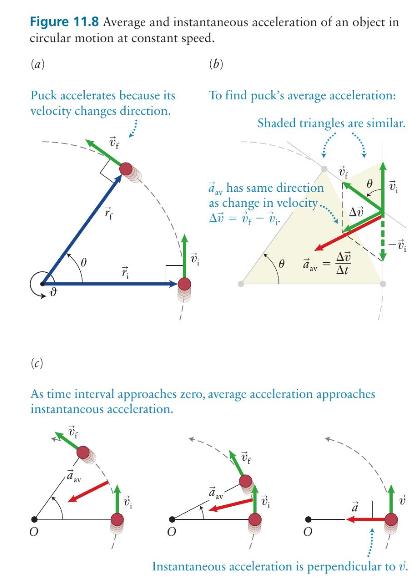
Suppose the object in Figure 11.8 is in accelerated circular motion, so that \(\left|\vec{v}_{\mathrm{f}}\right|>\left|\vec{v}_{\mathrm{i}}\right|\). In which direction does the object's average acceleration point? Figure 11.8 Average and instantaneous acceleration of an object in circular
Suppose I have two cubes on a turntable at equal distances from the axis of rotation. The inertia of cube 1 is twice that of cube 2. Do both cubes begin sliding at the same instant if I slowly increase the rotational velocity?
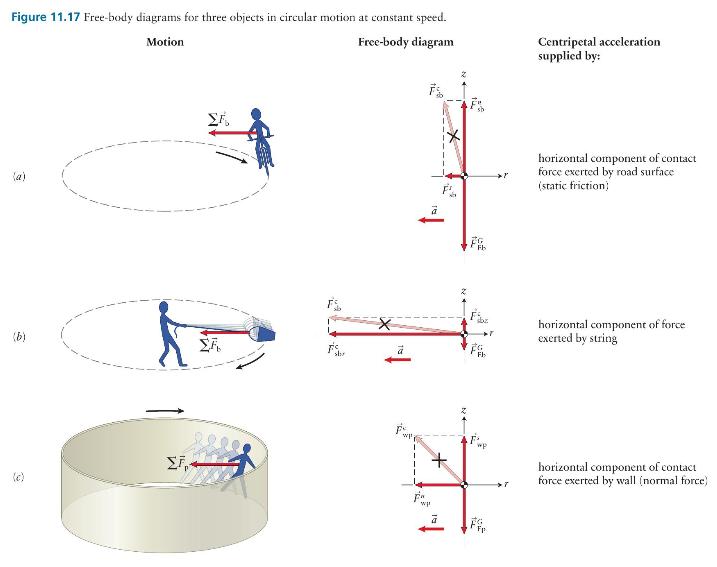
(a) Does a bicycle always have to lean into a curve as illustrated in Figure 11.17a?(b) The rope holding the bucket in Figure \(11.17 b\) makes a small angle with the horizontal. Is it possible to swing the bucket around so that the rope is exactly horizontal? Figure 11.17 Free-body diagrams for
About which axis is the rotational inertia of a pencil(a) largest(b) smallest: (1) a lengthwise axis through the core of the pencil; (2) an axis perpendicular to the pencil's length and passing through its midpoint; (3) an axis perpendicular to the pencil's length and passing through its tip?
Starting from a position with rotational coordinate zero, an object moves in the positive \(\vartheta\) direction at a constant speed of \(3.0 \mathrm{~m} / \mathrm{s}\) along the perimeter of a circle of radius \(2.0 \mathrm{~m}\). (a) What is the object's rotational coordinate after 1.5 s? (b)
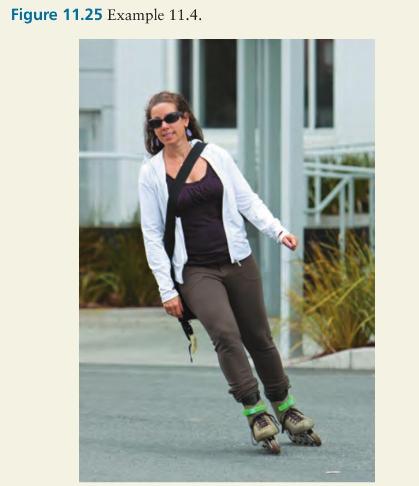
Estimate the maximum speed with which you could take the curve in Example 11.4.Data from Example 11.4A woman is rollerblading to work and, running late, rounds a corner at full speed, sharply leaning into the curve (Figure 11.25). If, during the turn, she goes along the arc of a circle of radius
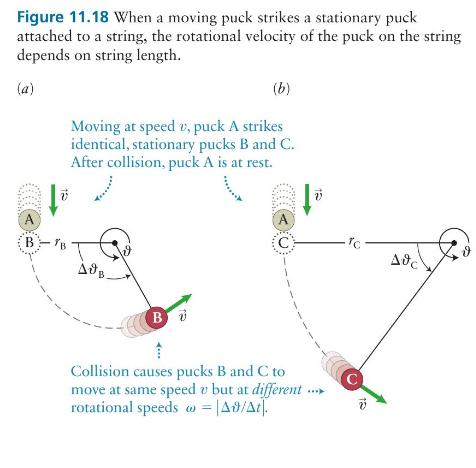
Suppose that in Figure \(11.18 r_{\mathrm{C}}=2 r_{\mathrm{B}}\).(a) What is the ratio of the rotational velocity of \(\mathrm{B}\) to that of \(\mathrm{C}\) ?(b) What is the ratio of the rotational inertia of \(B\) to that of \(C\) ? Figure 11.18 When a moving puck strikes a stationary puck
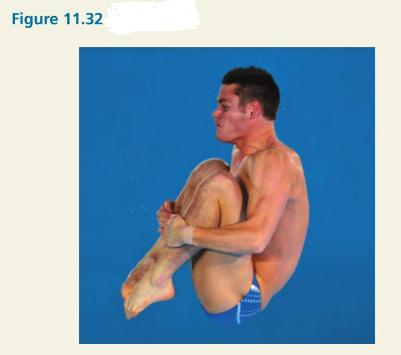
Does the rotational kinetic energy of the diver in Exercise 11.6 change as he pulls his arms in? Explain.Data from Exercises 11.6Divers increase their spin by tucking in their arms and legs (Figure 11.32). Suppose the outstretched body of a diver rotates at 1.2 revolutions per second before he
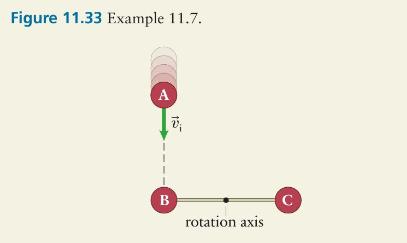
(a) Follow the line of reasoning used in working from Eq. 11.28 to Eq. 11.31 to verify that the rotational inertia of the dumbbell in Example 11.7 is indeed \(\frac{1}{2} m \ell^{2}\).(b) Does the momentum of the system remain constant in the collision of Figure 11.33?Data from Example 11.7In
Calculate the rotational inertia of the rod in Example 11.9 about an axis perpendicular to the long axis of the rod and passing through one end.Data from Example 11.9Calculate the rotational inertia of a uniform solid rod of inertia \(m\) and length \(\ell\) about an axis perpendicular to the long
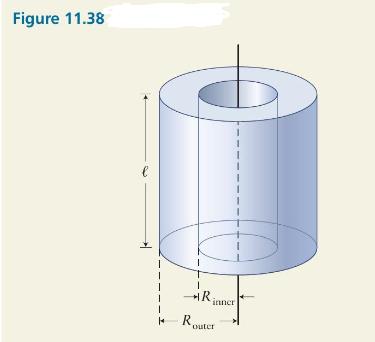
Note in Example 11.10 that the rotational inertia of a thick cylindrical shell is \(\frac{1}{2} m\left(R_{\text {outer }}^{2}+R_{\text {inner }}^{2}\right)\) while that of a solid cylinder is \(\frac{1}{2} m R_{\text {outer }}^{2}\). Does the fact that the factor \(R_{\text {outer }}^{2}+R_{\text
About what axis is the rotational inertia of an extended object smallest?
A race car is negotiating a curve on a banked track. There is a certain speed \(v_{\text {critical }}\) at which friction is not needed to keep the car on the track in the curve. (This is the speed the car should travel if there is an oil slick on the track, for example.) Draw a free-body diagram
You are designing a uniform thin rectangular door to fill a \(1 \mathrm{~m}\) wide \(\times 2 \mathrm{~m}\) tall opening, and you want it to be easy to open.(a) Considering only vertical and horizontal axes, what placement of the axis of rotation would result in the smallest rotational inertia?(b)
Moving at its maximum safe speed, an amusement park carousel takes \(12 \mathrm{~s}\) to complete a revolution. At the end of the ride, it slows down smoothly, taking 2.5 rev to come to a stop. What is the magnitude of the rotational acceleration of the carousel while it is slowing down?
You have a weekend job selecting speed limit signs to put at road curves. The speed limit is determined by the radius of the curve and the bank angle. For a turn of radius \(400 \mathrm{~m}\) and a \(7.0^{\circ}\) bank angle, what speed limit should you post so that a car traveling at that speed
A race car driving on a banked track that makes an angle \(\theta\) with the horizontal rounds a curve for which the radius of curvature is R.(a) As described in Problem 12, there is one speed \(v_{\text {critical }}\) at which friction is not needed to keep the car on the track. What is that speed
A \(30-\mathrm{kg}\) child running at \(1.5 \mathrm{~m} / \mathrm{s}\) jumps onto a playground merry-go-round that has inertia \(190 \mathrm{~kg}\) and radius \(1.7 \mathrm{~m}\). He is moving tangent to the platform when he jumps, and he lands right on the edge. What is the rotational speed of the
One type of wagon wheel consists of a \(3.0-\mathrm{kg}\) hoop fitted with four \(0.90-\mathrm{kg}\) thin rods placed along diameters of the hoop so as to make eight evenly spaced spokes. For a hoop of radius \(0.40 \mathrm{~m}\), what is the rotational inertia of the wheel about an axis
A thin rod, \(0.72 \mathrm{~m}\) long, is pivoted such that it hangs vertically from one end. You want to hit the free end of the rod just hard enough to get the rod to swing all the way up and over the pivot. How fast do you have to make the end go?
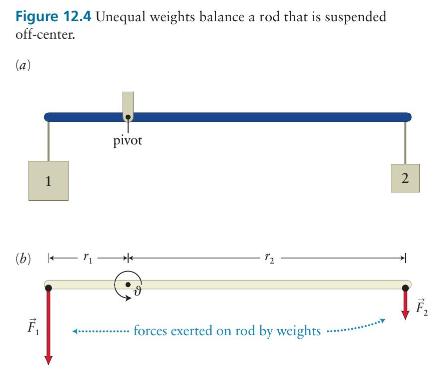
(a) Draw a free-body diagram for the rod of Figure 12.4. Let the inertia of the rod be negligible compared to \(m_{1}\) and \(m_{2}\).(b) Would the free-body diagram change if you slide object 2 to the left?(c) Experiments show that when \(m_{1}=2 m_{2}\) the rod is balanced for \(r_{2}=2 r_{1}\).
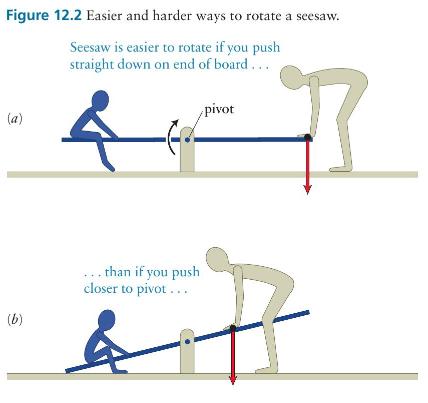
In the situation depicted in Figure 12.2a, you must continue to exert a force on the seesaw to keep the child off the ground. The force you exert causes a torque on the seesaw, and yet the seesaw's rotational acceleration is zero. How can this be if torques cause objects to accelerate rotationally?
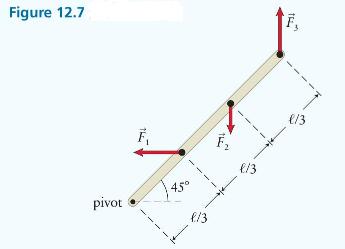
(a) Without changing the magnitude of any of the forces in Example 12.2, how must you adjust the direction of \(\vec{F}_{3}\) to prevent the lever from rotating?(b) If, instead of adjusting the direction of \(\vec{F}_{3}\), you adjust the magnitude of \(\vec{F}_{2}\), by what factor must you change
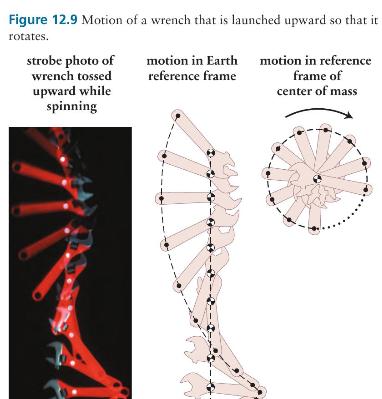
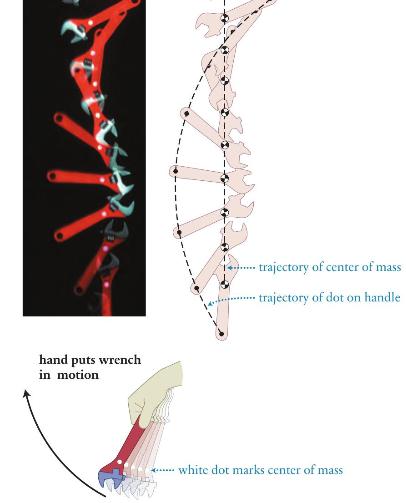
As the wrench in Figure 12.9 moves upward, the upward translational motion of its center of mass slows down. Does the rotation about the center of mass also slow down? Which way does the wrench rotate when it falls back down after reaching its highest position? Figure 12.9 Motion of a wrench that
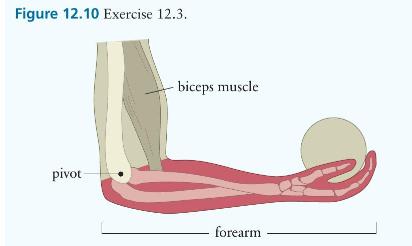
(a) If the biceps muscle in Figure 12.10 were attached farther out toward the wrist, would the torque generated by the muscle about the pivot get greater, get smaller, or stay the same?(b) As the hand is raised above the level of the elbow, so that the forearm makes an angle of \(15^{\circ}\) with
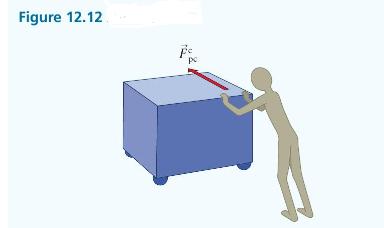
Suppose the force \(\vec{F}_{\mathrm{pc}}^{\mathrm{c}}\) in Exercise 12.4 gives the center of mass of the crate an acceleration \(\vec{a}_{\mathrm{cm}}\). Would this acceleration be greater, smaller, or the same if the force were exerted exactly at the center of the crate?Data from Exercise12.4You
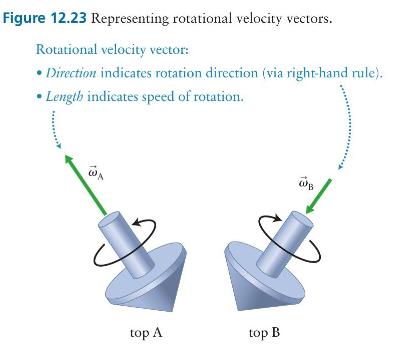
Suppose the rotation of top A in Figure 12.23 slows down without a change in the direction of its axis of rotation.(a) In which direction does the vector \(\Delta \vec{\omega}\) point?(b) Can the top's rotational acceleration be represented by a vector? If so, in which direction does this vector
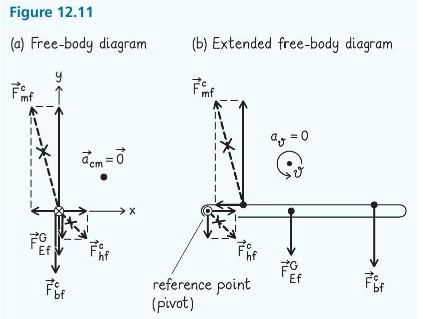
Use the conditions of mechanical equilibrium to express \(\vec{F}_{\mathrm{hf} y}^{\mathrm{c}}\) in Figure \(12.11 b\) in terms of \(\vec{F}_{\mathrm{Ef}}^{G}\) and \(\vec{F}_{\mathrm{bf}}^{\mathrm{c}}\). Let the distance between the ball and the pivot be \(\ell\) and the distance from the point
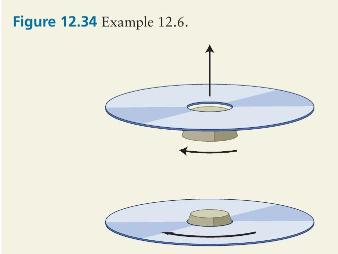
Consider the situation in Example 12.6.(a) Is the vector sum of the forces exerted by the shaft on the disc nonzero while the disc is spinning up?(b) Is the disc isolated?Data from Example 12.6Consider the spinning disc shown in Figure 12.34, in which, a spinning conical shaft rises up into the
(a) A cylindrical shell and a solid cylinder, made of the same material and having the same inertia \(m\) and radius \(R\), roll down a ramp. Is the force of static friction exerted on the shell greater than, smaller than, or equal to that on the solid cylinder? Explain. (b) For \(\mu_{s}=1\), what
(a) In Example 12.7, does the force of static friction exerted on the rear wheel cause a torque on the wheel? If so, in which direction? If not, why not?(b) In what direction is the sum of the torques on the rear wheel? What does this tell you about the relative magnitudes of the individual torques
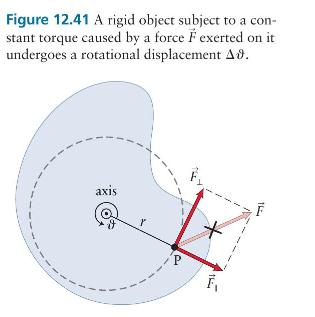
In Figure 12.41, does the force exerted on the rigid object do work on the object? Figure 12.41 A rigid object subject to a con- stant torque caused by a force F exerted on it undergoes a rotational displacement A. axis r P + F
Consider a particle moving at constant speed along a circular trajectory centered on the origin. Write the relationship of the particle's velocity \(\vec{v}\), rotational velocity \(\vec{\omega}\), and position vector \(\vec{r}\) in the form of a vector product.
A 1.6-m uniform rod is being used to balance two buckets of paint, each of inertia \(m\), one at each end of the rod. (a) Where is the pivot located? (b) If paint is removed from one bucket until its inertia is \(m / 3\), where must the pivot now be placed in order to keep the rod balanced? Ignore
A \(0.17-\mathrm{kg}\) turntable of radius \(0.15 \mathrm{~m}\) spins about a vertical axis through its center. A constant rotational acceleration causes the turntable to accelerate from 0 to 33 revolutions per second in \(9.0 \mathrm{~s}\). Calculate (a) the rotational acceleration (b) the
A \(0.30-\mathrm{kg}\) solid cylinder is released from rest at the top of a ramp \(1.0 \mathrm{~m}\) long. The cylinder has a radius of \(0.10 \mathrm{~m}\), and the ramps is at an angle of \(18^{\circ}\) with the horizontal. What is the rotational kinetic energy of the cylinder when it reaches the
A solid \(40 \mathrm{~kg}\) cylinder initially at rest has a radius of \(0.10 \mathrm{~m}\). What minimum work is required to get the cylinder rolling without slipping at a rotational speed of \(25 \mathrm{~s}^{-1}\) ? \(~\)
Which of the following expressions make sense: (a) A (B ), (b) Ax (B-C), (c) A (B)?
Show that, if vectors \(\vec{A}\) and \(\vec{B}\) are both in an \(x y\) plane, \(\vec{A} \times \vec{B}\) is a vector that is perpendicular to the \(x y\) plane and has magnitude |A B| = |AxBy - AyBx.
You are sweeping the floor with a long-handled broom, with the handle making an acute angle to the horizontal floor. Is it easier to push the broom or pull it? Why? \(\cdot\)
A pool ball that is struck gently will roll smoothly across the felt surface of a pool table. However, it is possible to strike the ball in a way that produces "backspin", such that the ball is rotating in the opposite direction to its normal rolling motion as it moves across the table. Describe
You and a friend are standing on the icy surface of a frozen pond. You are wearing boots with cleats that grip the ice, but your friend has smooth-soled shoes that slip a bit when they move their feet. Discuss how you can both walk across the pond in terms of work and friction.
A resort uses a rope to pull a \(65-\mathrm{kg}\) skier up a slope at constant speed. To pull the skier \(75 \mathrm{~m}\) requires \(18 \mathrm{~kJ}\) of work to be done by the rope.(a) Determine the tension in the rope if the snow is slick enough to allow you to ignore any frictional effects.(b)
For the vectors \(\vec{A}=4.0 \hat{\imath}-3.0 \hat{\jmath}\) and \(\vec{B}=-2.0 \hat{\imath}+2.0 \hat{\jmath}\), determine (a) A - B and (b) | B|. -
A runner is training on a perfectly circular track with radius \(85 \mathrm{~m}\). They run at \(7.0 \mathrm{~m} / \mathrm{s}\) for 1.0 minute. What are the athlete's (a) displacement, (b) average velocity,(c) magnitude of average velocity?
An egg is thrown horizontally out of a window \(1.5 \mathrm{~m}\) off the ground with an initial speed of \(8.5 \mathrm{~m} / \mathrm{s}\). How far from the building does the egg hit the ground?
Showing 1300 - 1400
of 4962
First
7
8
9
10
11
12
13
14
15
16
17
18
19
20
21
Last
Step by Step Answers

 Get 50% OFF
Claim Now
Get 50% OFF
Claim Now