New Semester
Started
Get
50% OFF
Study Help!
--h --m --s
Claim Now
Question Answers
Textbooks
Find textbooks, questions and answers
Oops, something went wrong!
Change your search query and then try again
S
Books
FREE
Study Help
Expert Questions
Accounting
General Management
Mathematics
Finance
Organizational Behaviour
Law
Physics
Operating System
Management Leadership
Sociology
Programming
Marketing
Database
Computer Network
Economics
Textbooks Solutions
Accounting
Managerial Accounting
Management Leadership
Cost Accounting
Statistics
Business Law
Corporate Finance
Finance
Economics
Auditing
Tutors
Online Tutors
Find a Tutor
Hire a Tutor
Become a Tutor
AI Tutor
AI Study Planner
NEW
Sell Books
Search
Search
Sign In
Register
study help
physics
particle physics
Principles And Practice Of Physics 2nd Edition Eric Mazur - Solutions
Suppose a container holds a gas made up of two kinds of particles 1 and 2 , with \(m_{2}=2 m_{1}\). Assume the particles interact via elastic collisions. (a) How do the average kinetic energies of the two kinds of particles compare? (b) How do their average speeds compare?
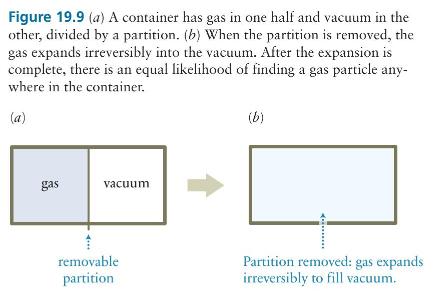
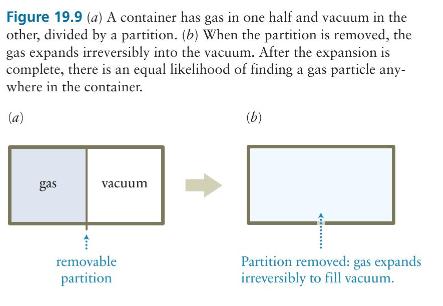
Suppose there are initially two indistinguishable particles in the left compartment of the container in Figure 19.9a. After the partition is removed, what is the probability at any given instant of finding one particle in each half of the container? Figure 19.9 (a) A container has gas in one half
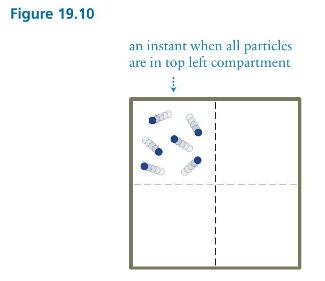
(a) What is the probability of finding all six particles of Figure 19.10 in one compartment?(b) Of finding five particles in one compartment? Figure 19.10 an instant when all particles are in top left compartment 1
Suppose the partition in Figure 19.9 is designed to slide freely to the left and right. It is positioned in the center so that the container is divided into two equal compartments and clamped in place. Then \(2 N\) particles of a gas are added to the left compartment and \(N\) particles are added
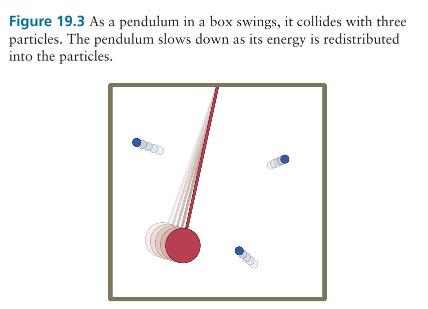
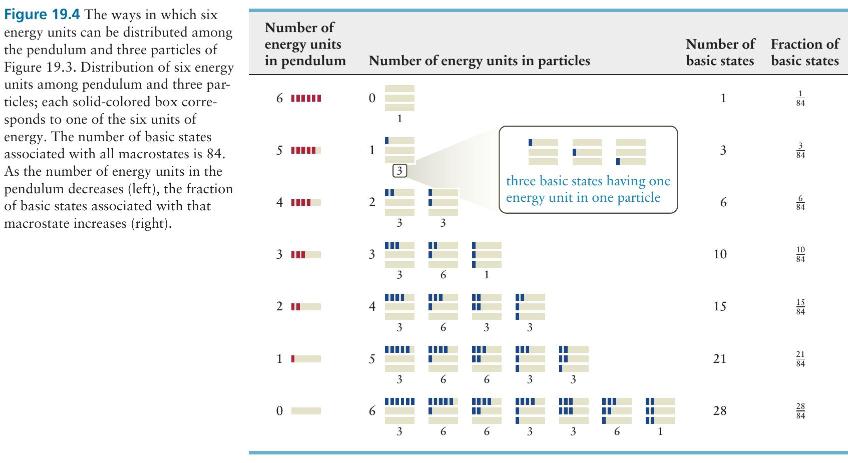
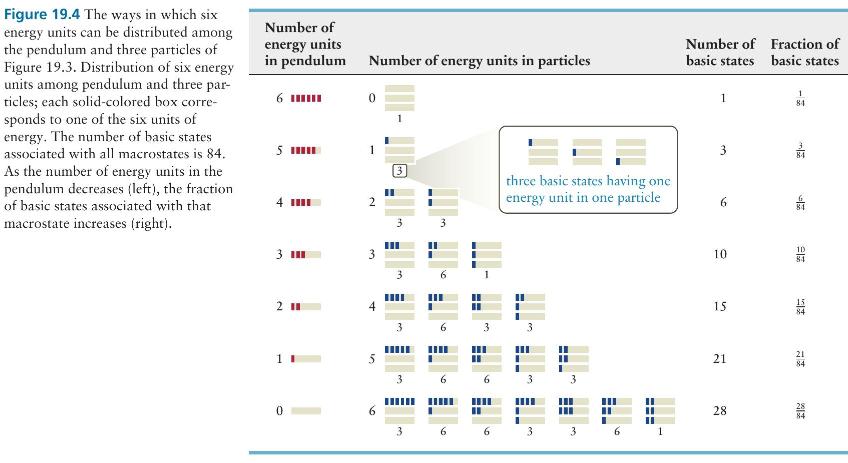
In the system shown in Figures 19.3 and 19.4, suppose each collision transfers exactly one unit of energy from one colliding object to the other.(a) If the system is in the macrostate that has six energy units in the pendulum, which basic state(s) can the system be in after one collision?(b) If the
Suppose the system in Figure 19.4 is in the macrostate in which two energy units are in the pendulum and one collision takes place.(a) What are the accessible macrostates? (b) What is the probability for each of these macrostates? Number of Fraction of Number of energy units in particles basic
How many ways are there to distribute two indistinguishable energy units among six distinguishable particles?
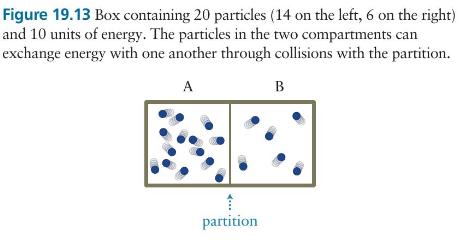
What is the average energy per particle in compartments A and B in Figure 19.13(a) when there is one energy unit in \(\mathrm{A}\) (b) when the system is at equilibrium? Figure 19.13 Box containing 20 particles (14 on the left, 6 on the right) and 10 units of energy. The particles in the two
For which of these systems does \(\Omega\) increase over time:(a) a thermos bottle containing warm water with an ice cube in it, (b) a cup of tea that is at the same temperature as the air in an insulated room,(c) a well-shaken bottle containing oil and water, (d) a seed germinating in soil
If you decrease the size of the compartments in Exercise 19.8 by a factor of 10 , what is the change (a) in the number of basic states and (b) in the natural logarithm of that number?Data from Exercises 19.8Suppose ten distinguishable particles are equipartitioned in a container that is divided
(a) What does a positive entropy change in a closed system imply about the change in the number of basic states?(b) How does Eq.19.8 show that a gas expands if given more room?(c) How does it show that the gas does not contract spontaneously into a subvolume?Equation ASS S = (N In V - N In 8V) - (N
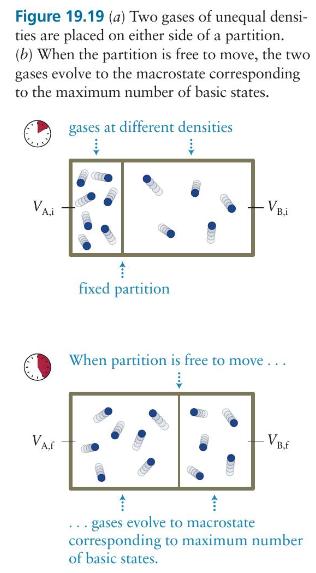
Explain why the changes in entropy in Example 19.10 do not depend on the volume \(V\) of the box.Data from Example 19.10The box in Figure 19.19 contains seven gas particles in compartment \(\mathrm{A}\) and five in compartment \(\mathrm{B}\), and the partition separating the compartments is free to
Five atoms moving along the \(x\) axis have \(x\) components of velocities \(+2.1 \mathrm{~m} / \mathrm{s},-3.2 \mathrm{~m} / \mathrm{s},+4.5 \mathrm{~m} / \mathrm{s},-0.3 \mathrm{~m} / \mathrm{s}\), and \(-3.1 \mathrm{~m} / \mathrm{s}\). Determine (a) the \(x\) component of the average
Work out the algebra between the third and fourth terms in Eq. 19.29.Eq. 19.29. V = (2avms) 2Eth mN 13 = [ 2a (2x+b) 1/2] = (82 ) 3" 3/2 (Eth)/2=b(Eth)/2, (19.29) mN
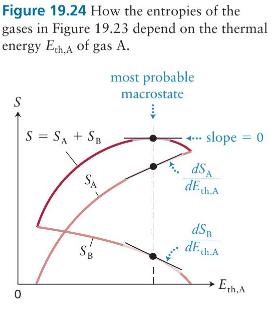
(a) Using Figure 19.24, compare the kinetic energy of an atom in gas \(A\) with that of an atom in gas \(B\) in the thermal equilibrium state (that is, on the dashed line) and in a macrostate to the left of the dashed line. (b) In each of these two macrostates, which gas is "hotter"? (c) For the
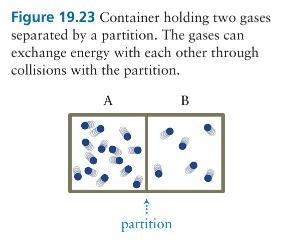
Suppose 14 atoms are in compartment A and six atoms are in compartment B, as shown in Figure 19.23. When thermal equilibrium energy is reached, what percentage of the thermal energy do you expect to find in each compartment? Figure 19.23 Container holding two gases separated by a partition. The
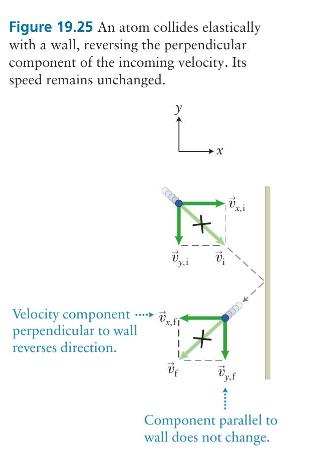
Let the system comprising the atoms and wall in Figure 19.25 be isolated. (a) What is the direction of the atom's change in momentum? (b) What is the direction of the change in momentum of the wall? (c) How are these momentum changes related to the forces that wall and atom exert on each other?
Use the ideal gas law to express the equilibrium condition in Eq. 19.20 in terms of pressure. NA NB (equilibrium), (19.20) VA VB
A certain number of helium atoms are placed in one container, and an equal number of argon atoms are placed in a separate identical container. The pressure is the same in both containers. Helium atoms have a smaller mass than argon atoms. For which gas, if either, (a) is the thermal energy
(a) Does the negative change in entropy in Example 19.12 violate the Eq. 19.5 part of the entropy law?(b) What is the change in the thermal energy of the gas in Example 19.12?Data from Example 19.12A sample of a monatomic ideal gas consisting of \(1.00 \times 10^{23}\) atoms in a volume of \(4.00
Does the entropy of a gas whose temperature is halved and volume doubled increase, decrease, or stay the same?
Waves propagating in a rope are observed to travel at \(35 \mathrm{~cm} / \mathrm{s}\) and their adjacent crests are \(7.0 \mathrm{~cm}\) apart. Find the frequency and the period of the waves?
A ball of mass \(m_{1}\) is attached on a rope and hangs vertically. The mass is slightly disturbed, and it generated a wave traveling through the rope. Suppose the ball is replaced with a heavier mass \(m_{2}\left(m_{2}=2 m_{1}\right)\) and the same disturbance is struck to the ball, compare the
Sinusoidal water waves are generated by a 18 -W mechanical motor in an aquarium tank. How much the kinetic energy is in each \(1.25-\mathrm{Hz}\) wave generated? \(\cdot\)
A kayaker on the near the shore observes 3 waves reaches the shore every \(10 \mathrm{~s}\). At what speed are the waves are moving if he estimates that adjacent crests are \(5.0 \mathrm{~m}\) apart?
While on a sailboat, you notice that the boat is moving up and down fifteen times periodically every minute. Find the period of oscillation and the distance between two adjacent wave crests if the waves are travelling at a rate of \(4.5 \mathrm{~m} / \mathrm{s}\).
A wave traveling along a rope is described by\[y(x, t)=(2.0 \mathrm{~mm}) \sin \left[\left(4.0 \mathrm{~m}^{-1}\right) x-\left(3.0 \mathrm{~s}^{-1}\right) t\right]\](a) Calculate the amplitude, wavelength, frequency, period, and speed of the wave.(b) Compute the \(y\)-component of the string from
You are watching a large ripple tank and observed that the waves generated by a mechanical motor have a period of \(3.5 \mathrm{~s}\) and the distance between two adjacent crests is \(15 \mathrm{~m}\). Write a possible general equation of the observed wave if the waves reach a vertical height of
A wave on a rope is given by\(f(x, t)=(0.750 \mathrm{~cm}) \cos \pi\left[\left(4.00 \mathrm{~m}^{-1}\right) x-\left(4.50 \mathrm{~s}^{-1}\right) t\right]\)Calculate the(a) wavelength,(b) angular frequency,(c) frequency,(d) period, and (e) wave number.
What must be the tension applied to a \(12-\mathrm{m}\) plastic string weighing \(43.5 \mathrm{~N}\) to produce a wave that propagates at a speed of \(25 \mathrm{~m} / \mathrm{s}\) ?
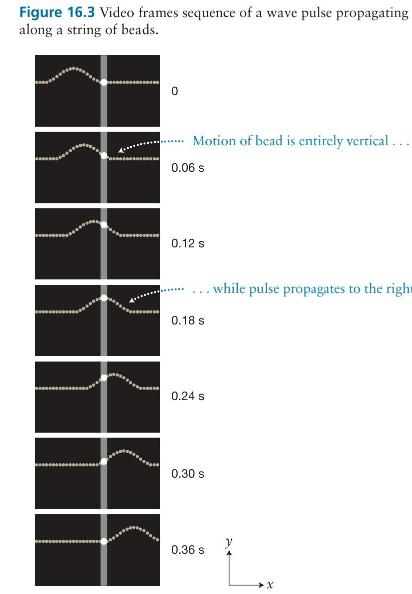
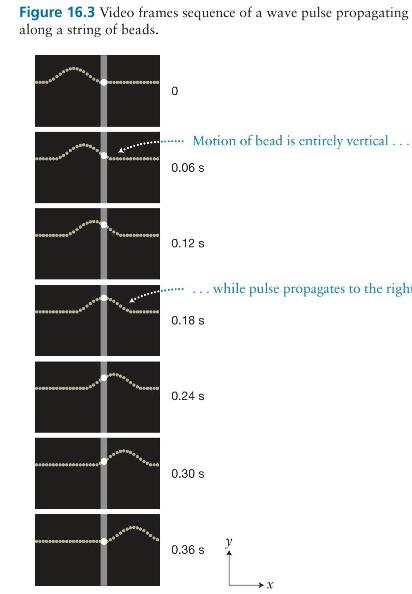
(a) Using the choice of axes shown in Figure 16.3, draw a position-versus-time graph showing how the \(x\) and \(y\) components of the position of the large bead change with time. (b) Are the \(x\) and \(y\) components of the velocity of the large bead positive, zero, or negative while the bead is
(a) Is the wave speed \(c\) of the pulse in Figure 16.3 constant? (b) Determine the wave speed if the distance between the centers of adjacent beads is \(5.0 \mathrm{~mm}\). Figure 16.3 Video frames sequence of a wave pulse propagating along a string of beads. 0 Motion of bead is entirely
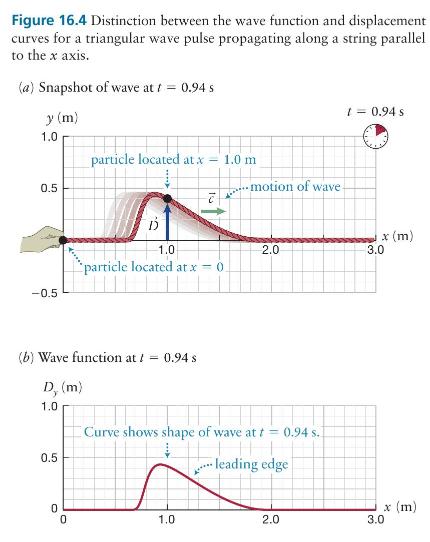
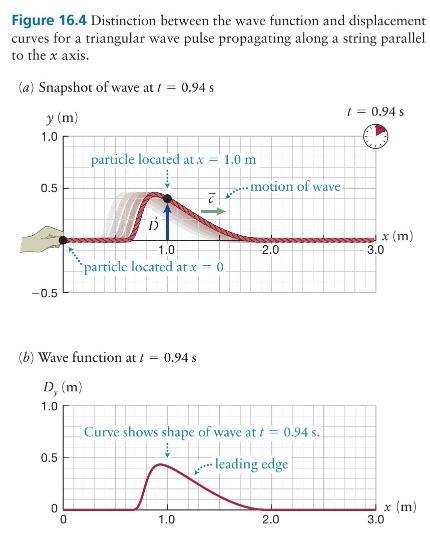
From Figure 16.4a, determine the displacement of a point(a) 1.0 m,(b) \(1.5 \mathrm{~m}\),(c) \(2.0 \mathrm{~m}\) from the left end of the string.(d) On a snapshot taken a short time interval later, is the displacement at \(x=1.5 \mathrm{~m}\) greater than, equal to, or smaller than that shown in
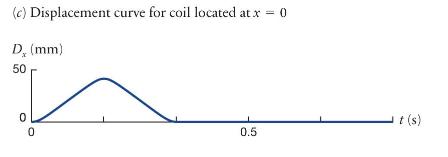
(a) From Figures \(16.4 c\) and \(d\), determine how long it takes the pulse to travel from \(x=0\) to \(x=1.0 \mathrm{~m}\). (b) Using your answer to part \(a\), determine the wave speed. Figure 16.4 Distinction between the wave function and displacement curves for a triangular wave pulse
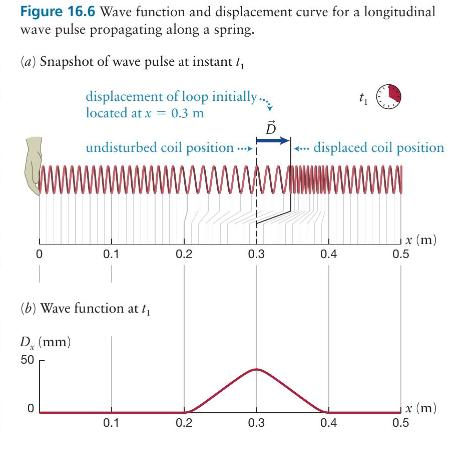
(a) The pulse in Figure \(16.6 b\) is symmetrical even though Figure 16.6a shows that the length of the stretched portion of the spring is \(0.15 \mathrm{~m}\) and the length of the compressed portion of the spring is only \(0.05 \mathrm{~m}\). Explain how the symmetrical curve of Figure \(16.6 b\)
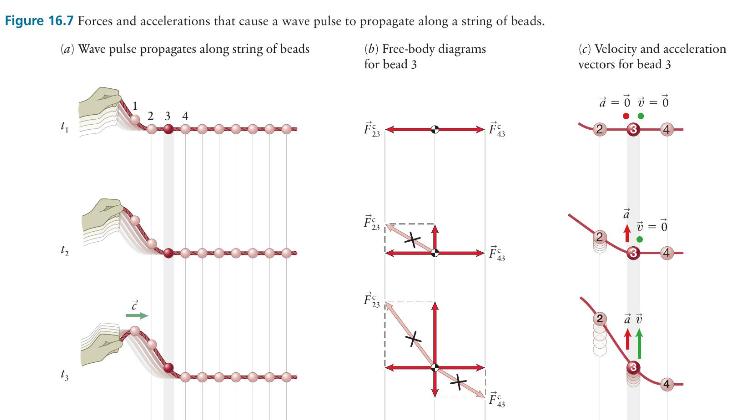
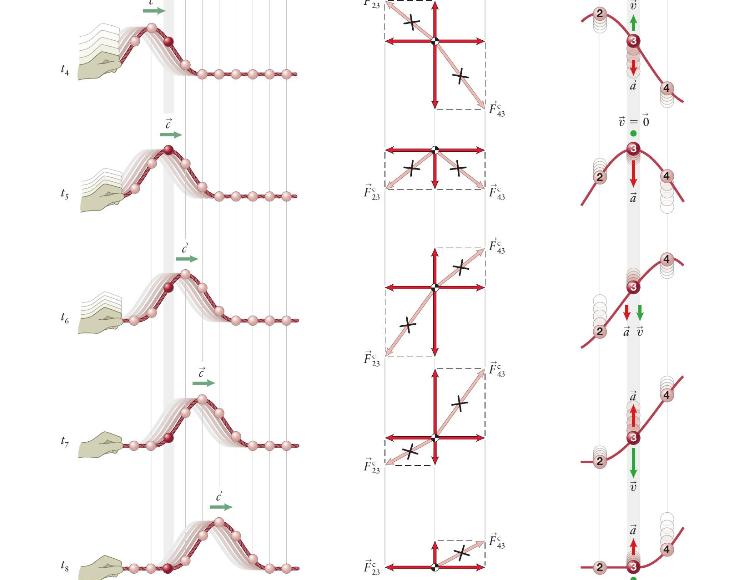
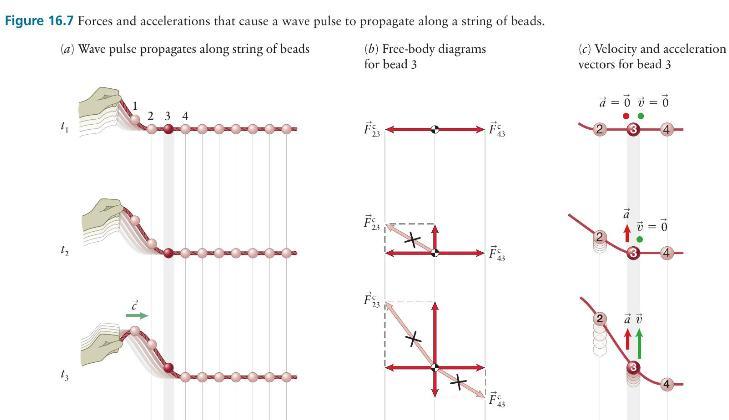
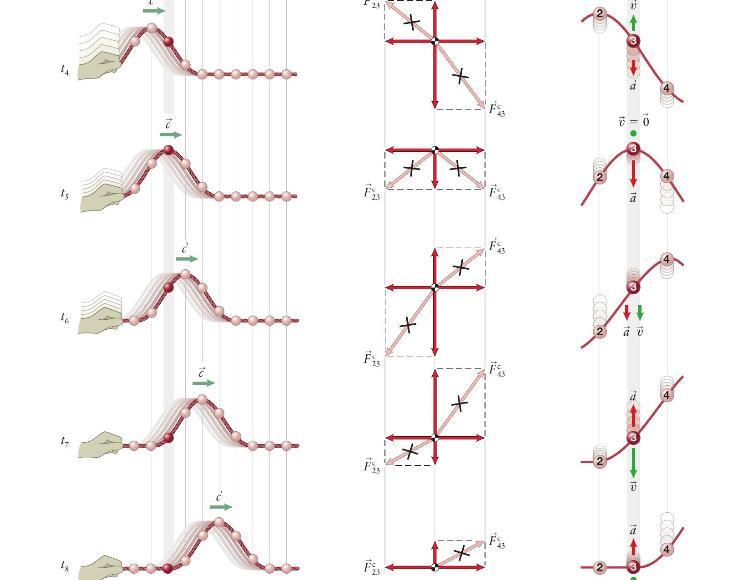
Answer these five questions about the situation at \(t_{1}\) in Figure 16.7, assuming the right end of the string of beads is attached to a wall that is not shown.(a) If \(F_{43}^{c}=5 \mathrm{~N}\), what is the magnitude of the force exerted by the wall on the rightmost bead? ( \(b\) ) What is the
(a) Note that the displacement of bead 4 at \(t_{4}\) in Figure \(16.7 a\) is the same as that of bead 3 at \(t_{3}\). How do the velocity and acceleration of bead 4 at \(t_{4}\) compare with those of bead 3 at \(t_{3}\) ?(b) You move one end of two different strings, A and B, up and down in the
Two strings, A and B, are identical except that the tension in A is greater than that in B. Suppose you move the left end of each string rapidly up and down once. For each string, sketch \((a)\) the wave functions at the instant the pulse on A has traveled halfway down the length of the string and
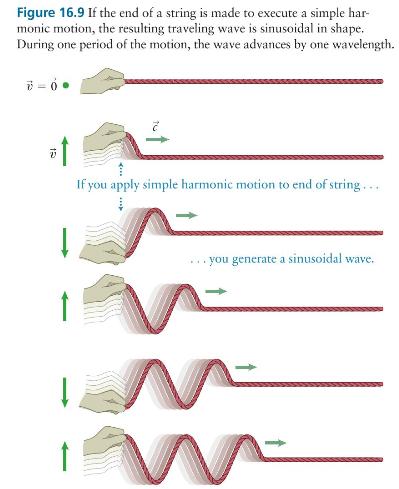
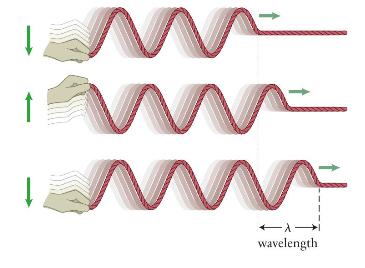
Plot the displacement of the left end of the string in Figure 16.9 as a function of time. What similarities and differences exist between your graph and the shape of the wave in Figure 16.9? Figure 16.9 If the end of a string is made to execute a simple har- monic motion, the resulting traveling
Consider a harmonic wave traveling along a string. Are the following quantities determined by the source of the wave, by the properties of the string, or by both:(a) the period of oscillation of a particle of the string;(b) the speed c at which the wave travels along the string;(c) the
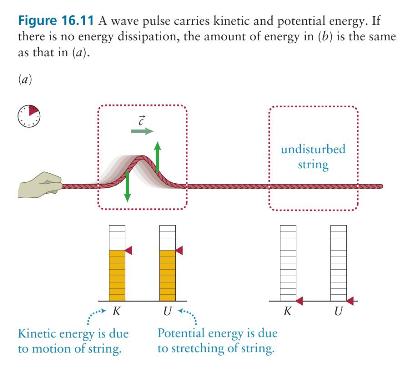
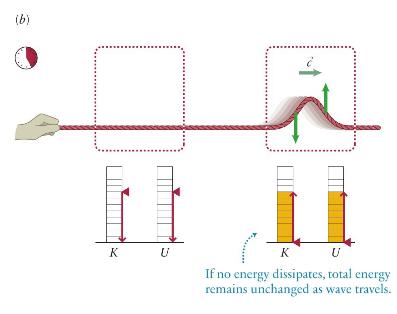
Does the wave pulse in Figure 16.11 also carry along momentum? Justify your answer. Figure 16.11 A wave pulse carries kinetic and potential energy. If there is no energy dissipation, the amount of energy in (b) is the same as that in (a). (a) K U Kinetic energy is due to motion of string. Potential
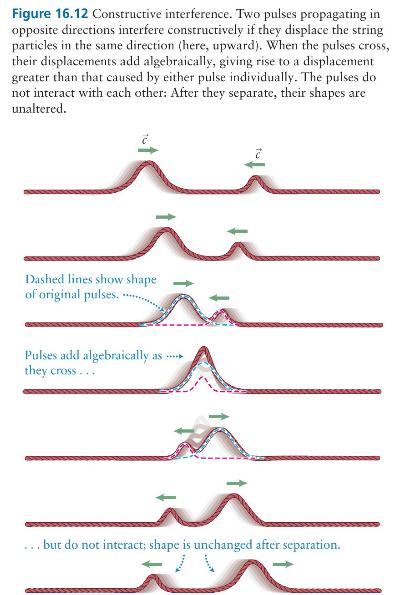
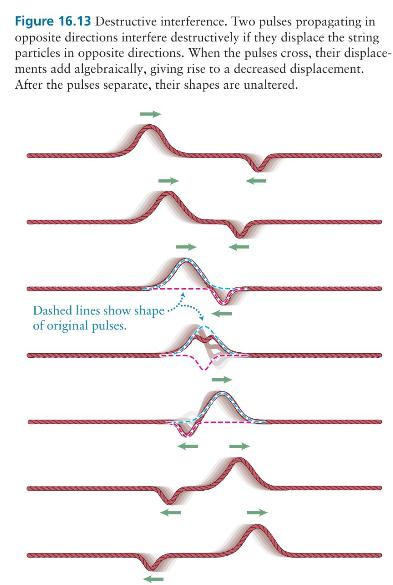
(a) Is the maximum displacement the same for all particles of the string in Figure 16.12? For all particles of the string in Figure 16.13?(b) For each string, sketch a displacement curve for a point near the left end of the string.(c) Repeat part \(b\) for the point of each string at which the
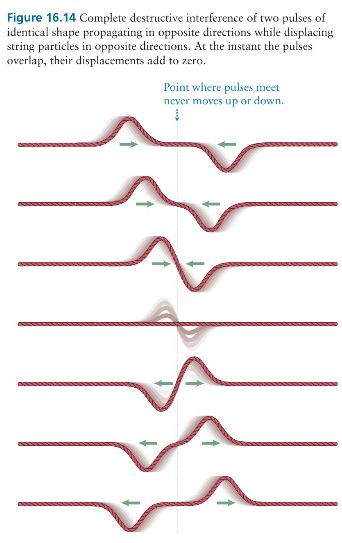
(a) Sketch a displacement curve for the point on the string in Figure 16.14 at which the two pulses meet.(b) When two wave pulses overlap, how is the velocity of a point in the overlap region related to the velocities of the corresponding points of the individual pulses? Figure 16.14 Complete
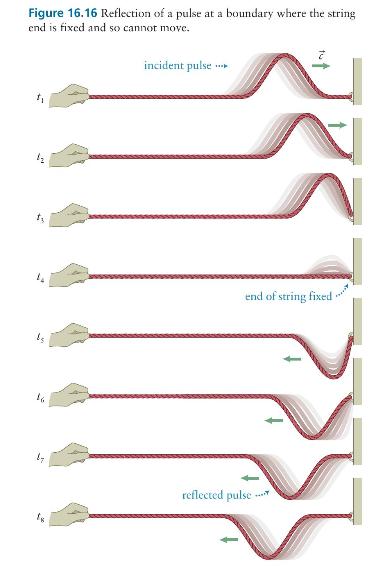
The string in Figure 16.16 is perfectly straight at \(t_{4}\). What has happened to the energy in the incident pulse at that instant? Figure 16.16 Reflection of a pulse at a boundary where the string end is fixed and so cannot move. incident pulse... end of string fixed reflected pulse
(a) When the free end of the string in Figure 16.21 reaches its maximum displacement at \(t_{5}\), what is the kinetic energy in the pulse? (b) What is the potential energy in the pulse? (c) Is the energy in the pulse at this instant the same as the energy at \(t_{1}\) ?
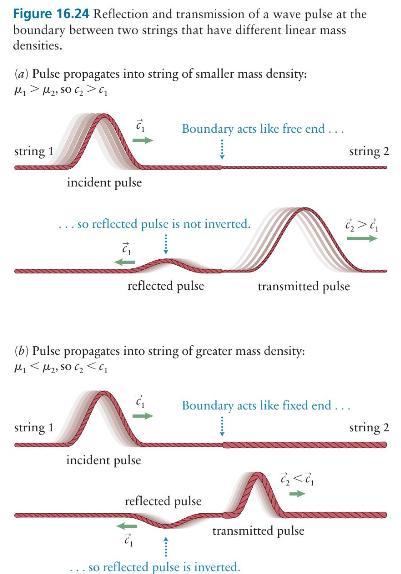
For the strings and pulse in Figure 16.24, what happens in the limit where (a) (b) \(\mu_{2} \rightarrow \infty\),(c) \(\mu_{2}=\mu_{1}\) ?(d) Why is the transmitted pulse in Figure \(16.24 a\) wider than the incident pulse? 2 0,
(a) Which of the following functions could represent a traveling wave?(i) \(A \cos (k x+\omega t)\)(ii) \(e^{-k|x-c t|^{2}}\)(iii) \(b(x-c t)^{2} e^{-x}\)(iv) \(-\left(b^{2} t-x\right)^{2}\)(b) Which of the following functions can be made to represent a traveling wave?(i) \(x /\left(1+b
(a) In the standing wave pattern of Figure 16.37, how is the energy distributed between kinetic and potential at \(t=0, t=\frac{1}{8} T\), and \(t=\frac{1}{4} T\) ? (b) Is the energy in a length of the string corresponding to one wavelength constant? (c) Does the standing wave transport energy? If
(a) Do two counterpropagating waves that have the same wavelength but different amplitudes cause standing waves? (b) Do two counterpropagating waves that have the same amplitude but different wavelengths cause standing waves?
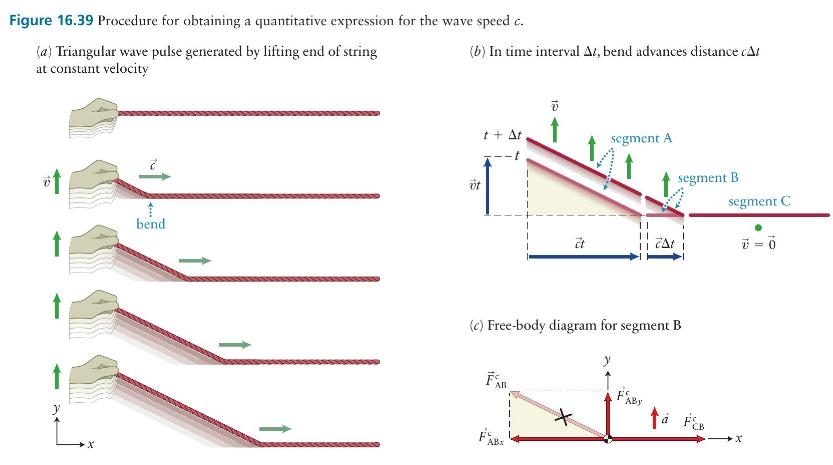
(a) Draw a free-body diagram for segment \(\mathrm{A}\) of the string at instant \(t\) in Figure 16.39. What is the vector sum of the forces exerted on A? (b) What does your answer to part \(a\) tell you about the change in momentum of A? Does your conclusion about A's momentum make sense?(c) Does
Suppose that instead of shaking the end of a very long, taut string, you shake a point in the center of the string, keeping the amplitude and the frequency the same. Is the rate at which you must supply energy smaller than, equal to, or greater than if you shake the end?
If any time-dependent sinusoidal harmonic function, \(f(x, t)=\) \(A \sin (k x-\omega t)\), satisfies the wave equation, what determines the values of the wave number \(k\) and the angular frequency \(\omega\) for, say, a wave on a string?
Describe the pressure of particles at points in a sound wave where the gas is(a) compressed at maximum,(b) minimally compressed.
Phasors are useful for adding waves that are out of phase. For example, assume you have two sources, 1 and 2, that emit sound waves of the same frequency \(f\). At your detector, the waves from source 1 have an amplitude of \(1.00 \times 10^{-8} \mathrm{~m}\), and those from source 2 have an
You measure the sound intensity of a sound wave to be \(1.50 \mathrm{~W} / \mathrm{m}^{2}\) at \(2.60 \mathrm{~m}\) away from a point source. Calculate the power output of the source.
Radio Station DXYZ has a power output of 128 W. While listening at home, you measure the intensity of the sound to be \(3.40 \times 10^{-6} \mathrm{~W} / \mathrm{m}^{2}\). How far away from your home is the radio station?
Examine each situation for two waves and determine if audible beats can be produced. Two wave with(a) the same amplitude; (b) the same frequency; (c) slightly different amplitude;(d) slightly different frequency.
Two stationary tuning forks with frequencies of \(246 \mathrm{~Hz}\) and \(252 \mathrm{~Hz}\) are struck simultaneously. Calculate the frequency of the resulting sound. \(\cdot\)
Two violin players are next to each other on a theater's stage. One plays a \(350-\mathrm{Hz}\) note, while the other simultaneously plays a \(353-\mathrm{Hz}\) note.(a) What is the beat frequency heard by the audience? (b) How many beats does the audience hear in a minute?
Two tuning forks are struck simultaneously, the first one having a frequency of \(762 \mathrm{~Hz}\). If a nearby listener hears 20 beats per second, determine the possible frequency or frequencies of the other tuning fork.
Describe the pitch of an approaching siren if it is (a) coming close to you(b) after it passes you.
A stationary mechanical motor generates \(8.0 \mathrm{~Hz}\) water waves moving at \(3.0 \mathrm{~m} / \mathrm{s}\). What is the frequency of these waves as observed by a person in a motorboat that approaches the source at \(12 \mathrm{~m} / \mathrm{s}\) ?
A jet ski travelling across the surface of water creates a shockwave that makes an angle of \(39^{\circ}\) with the horizontal. If the waves it creates in the water have a speed of \(9.5 \mathrm{~m} / \mathrm{s}\), how fast is the jet ski moving?
A military jet is flying at \(420 \mathrm{~m} / \mathrm{s}\) horizontally. Take the speed of sound to be \(344 \mathrm{~m} / \mathrm{s}\). What is the apex half angle of the conical shock wave it created?
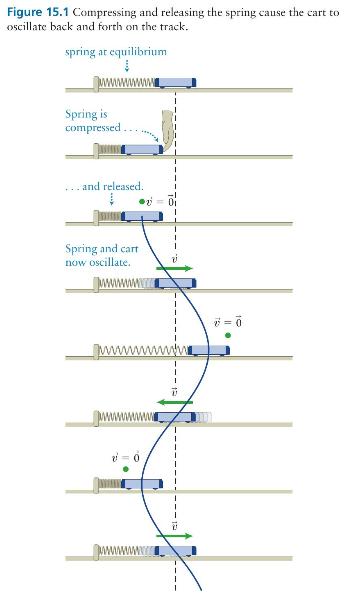
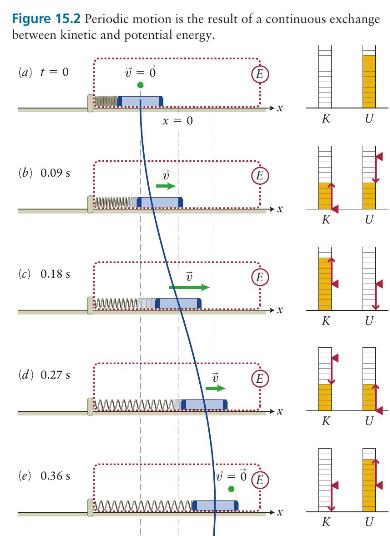
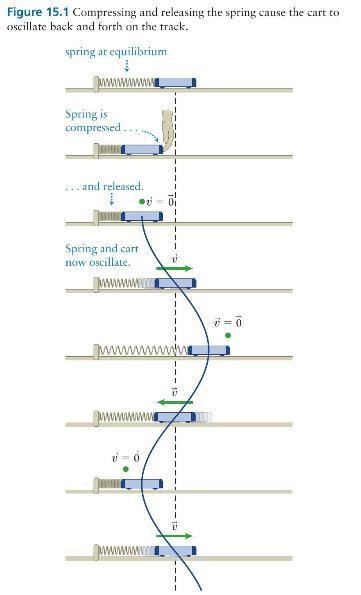
(a) List the forces exerted on the spring-cart system of Figure 15.1 right after it is released, and draw a freebody diagram for each object in the system. (b) Which of these forces do work on the system as it oscillates? (c) As the hand pushes on the cart and compresses the spring, is the work
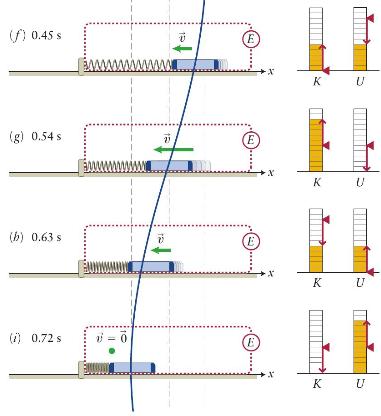
(a) In Figure 15.2e, the cart's displacement from the equilibrium position is maximum. Is the \(x\) component of the cart's acceleration at that instant positive, negative, or zero? (b) At which instant(s) in Figure 15.2 is the magnitude of the cart's acceleration greatest? At which instant(s) is
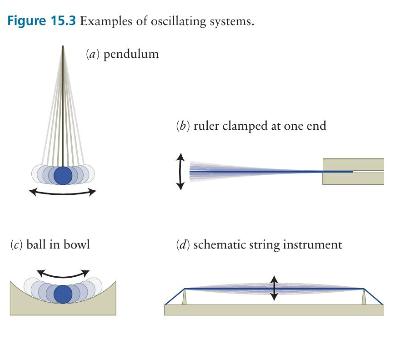
For each system in Figure 15.3, identify (a) the restoring force(b) the type of potential energy associated with the motion. Figure 15.3 Examples of oscillating systems. (a) pendulum (b) ruler clamped at one end (c) ball in bowl (d) schematic string instrument
Suppose the spring in Figure 15.1 is compressed twice as much. (a) By how much does the mechanical energy of the spring-cart system increase? \((b)\) What is the relationship between the amplitude of the oscillation and the mechanical energy in the oscillating system? Figure 15.1 Compressing and
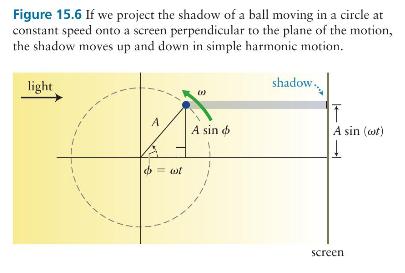
What are(a) the direction of the velocity of the shadow on the screen in Figure 15.6(b) the direction of the shadow's acceleration? Figure 15.6 If we project the shadow of a ball moving in a circle at constant speed onto a screen perpendicular to the plane of the motion, the shadow moves up and
(a) What does the spectrum of a single sinusoidal function of period \(T\) look like? (b) As \(T\) is increased, what change occurs in the spectrum?
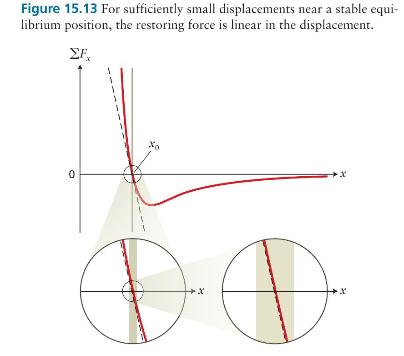
(a) Are there any equilibrium positions in the sum-of-forces-versus-distance graph in Figure 15.13? If so, is the equilibrium stable, unstable, or neutral? \((b)\) Compare the magnitude of the restoring force for equal displacements on either side of \(x_{0}\) in Figure 15.13. Figure 15.13 For
Using a calculator, determine the percent error in the approximation \(\sin \theta \approx \theta\) for polar angles of \(1^{\circ}, 5^{\circ}\), \(10^{\circ}\), and \(20^{\circ}\). (For this "small-angle" approximation, \(\theta\) must be expressed in radians.)
(a) What effect, if any, does increasing the length \(\ell\) of a simple pendulum have on its period? (b) A pendulum and an object suspended from a spring are taken to the Moon, where the acceleration due to gravity is smaller than that on Earth. How does the period of the pendulum on the Moon
(a) What are the algebraic signs of \(x, v_{x}\), and \(a_{x}\) when the phase \(\phi(t)=\omega t+\phi_{\mathrm{i}}\) is between 0 and \(\frac{\pi}{2}\) ? (b) Repeat for \(\pi
(a) Use Eq. 15.15 to determine the maximum potential energy of a simple harmonic oscillator.(b) Does your answer to part \(a\) agree with Eq. 15.17? AU = U(x) - U(x) = mwx - max. (15.15)
(a) In Example 15.3 is the initial condition that \(v_{x}=0\) satisfied by Eq. 15.7?(b) Is it correct to say that the \(x\) component of the velocity given by Eq. 15.7 must be positive whenever \(x\) is negative so as to make sure that the cart moves back to its equilibrium position?Data from
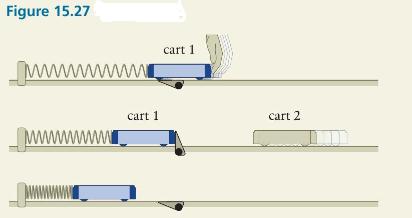
Suppose cart 2 were not removed from the track of Figure 15.27 immediately after the collision but instead were left stationary at the collision point.(a) At what instant do the two carts collide again?(b) Describe the motion of the two carts after this second collision. Figure 15.27 wwwwwwwwwwww
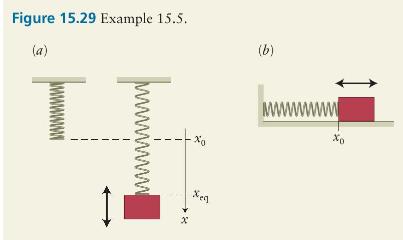
Convince yourself that the argument presented in the solution to Example 15.5 is also valid for displacements of the block above \(x_{\mathrm{eq}}\).Data from Example 15.5A block of mass \(m=0.50 \mathrm{~kg}\) is suspended from a spring of spring constant \(k=100 \mathrm{~N} / \mathrm{m}\). (a)
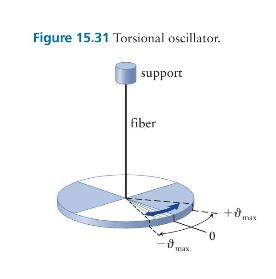
For the torsional oscillator shown in Figure 15.31, what effect, if any, does a decrease in the radius of the disk have on the oscillation frequency \(f\) ? Assume the disk's mass is kept the same. Figure 15.31 Torsional oscillator. support fiber max max
Can you use the experiment described in Example 15.7 to measure the gravitational constant \(G\) ?Data from Example 15.7The oscillations of a thin rod can be used to determine the value of the acceleration due to gravity. A rod that is \(0.800 \mathrm{~m}\) long and suspended from one end is
Imagine placing a pendulum in an elevator. While the elevator accelerates upward, is the frequency \(f\) of the pendulum greater than, smaller than, or equal to the frequency when the elevator is at rest?
A tuning fork that sounds the tone musicians call middle \(\mathrm{C}\) oscillates at frequency \(f=262 \mathrm{~Hz}\). If the amplitude of the fork's oscillation decreases by a factor of 3 in \(4.0 \mathrm{~s}\), what are \((a)\) the time constant of the oscillation and \((b)\) the quality factor?
A battery that initially contains \(3.0 \times 10^{24}\) electrons is used to power a light bulb for some time interval, pumping \(1.1 \times 10^{24}\) electrons through the bulb during that interval. How many electrons remain in the battery?
How can the energy conversions in an electric circuit be represented in terms of two generalized circuit elements?
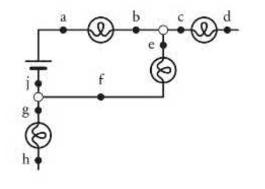
A battery and four identical light bulbs are arranged in the circuit of Figure P31.3. Rank the current magnitudes at the nine lettered locations from greatest to smallest.Data from Figure P31.3 90 e f
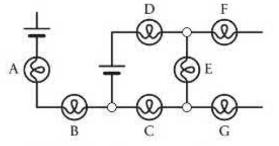
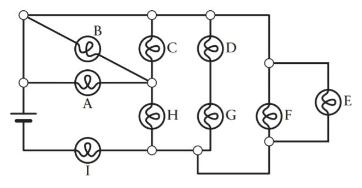
Which of the seven identical light bulbs in the circuit of Figure P31.4 light up?Data from Figure P31.4 D e e E F B C G
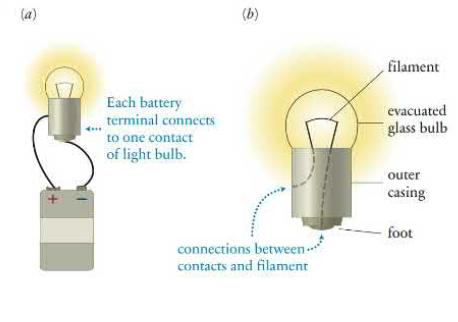
You have a light bulb, a battery, and one wire (which you cannot cut into two pieces). Draw the four ways of connecting these elements so that the bulb lights up.
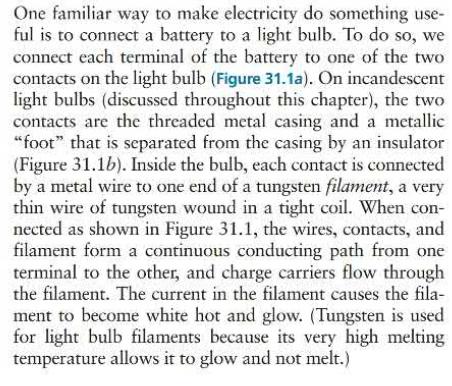
Name any devices other than the three mentioned in Section 31. 1-battery, solar cell, and electric generator that can act as a power source in an electric circuit.Data from Section 31. 1............ One familiar way to make electricity do something use- ful is to connect a battery to a light bulb.
Draw a circuit diagram for a typical home hair dryer. To which form (or forms) of energy is electric potential energy converted when you use the dryer?
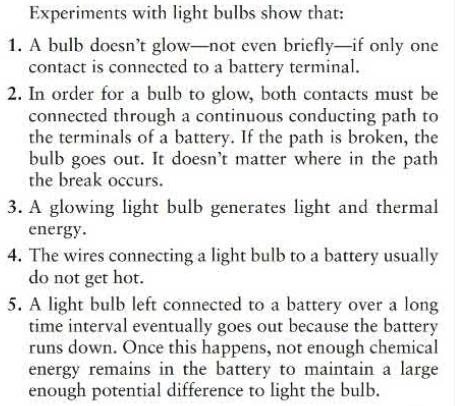
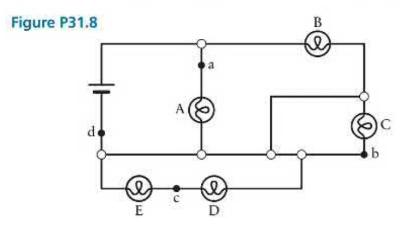
Figure P31.8 shows five identical light bulbs A-E connected to a battery. Initially, some of the bulbs light up because the two terminals of each bulb are connected to opposite terminals of the battery. If any wire in the circuit is cut, some bulbs may go out. Which bulbs, if any, go out when a
You and a colleague want to light a light bulb using a parallel-plate capacitor as a power source. Your colleague objects to this design, stating that the bulb cannot light up if the circuit is not continuous and the circuit is not continuous because the air gap between the capacitor plates
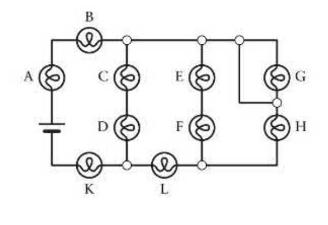
Which of the light bulbs (if any) in Figure P31.10 are connected in series to each other?Data from Figure P31.10 B E F K L e H
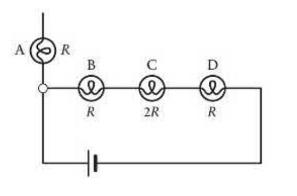
(a) In the circuit of Figure P31.11, do all four bulbs light up? (b) Rank the bulbs according to how brightly they light up, brightest first.Data from Figure P31.11 R B C D e e e R 2R R
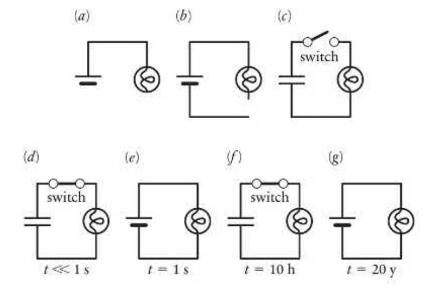
All the power sources (batteries or capacitors) in Figure P31.12 start with a potential difference of \(9.0 \mathrm{~V}\) between their terminals, and all of them run down (decrease in potential difference) over time. Rank the brightness of these identical light bulbs from least bright to most
When light bulbs \(A\) and \(B\) are connected in series to a battery, bulb A glows brightly and bulb B glows dimly. You remove bulb B so that the circuit contains just the battery and bulb \(\mathrm{A}\), and you connect bulb \(\mathrm{B}\) to an identical battery. With the two bulbs connected to
Bulb B produces twice as much light and thermal energy as bulb \(A\), and bulb \(C\) produces three times as much light and thermal energy as bulb \(\mathrm{A}\). The bulbs are connected in series to a \(9.0-\mathrm{V}\) battery, and the steady current through bulb A is \(1.0 \mathrm{~A}\). In
Wires \(\mathrm{A}, \mathrm{B}\), and \(\mathrm{C}\) meet at a junction. The current in wire \(\mathrm{A}\) is \(3.2 \mathrm{~mA}\) into the junction, and the current in wire \(\mathrm{B}\) is \(4.3 \mathrm{~mA}\) out of the junction. What is the current in wire \(\mathrm{C}\), and in what
Which (if any) of the light bulbs in Figure P31.17 are connected to other bulbs in parallel?Data from Figure P31.17 (e) (e) e H (e) e E (e)
Which of the light bulbs in Figure P31.18 are connected to each other in series? Which are connected to each other in parallel?Data from Figure P31.18 A e D e B
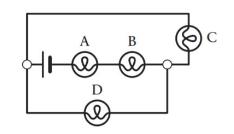
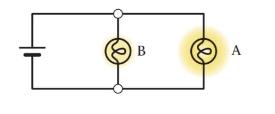
In the circuit of Figure P31.20, bulb \(\mathrm{A}\) is bright and bulb B is dim. Which bulb \((a)\) has the greater potential difference across it, \((b)\) carries the greater current, and \((c)\) has the greater resistance?Data from Figure P31.20 B e e
Showing 1100 - 1200
of 4962
First
5
6
7
8
9
10
11
12
13
14
15
16
17
18
19
Last
Step by Step Answers

 Get 50% OFF
Claim Now
Get 50% OFF
Claim Now