New Semester
Started
Get
50% OFF
Study Help!
--h --m --s
Claim Now
Question Answers
Textbooks
Find textbooks, questions and answers
Oops, something went wrong!
Change your search query and then try again
S
Books
FREE
Study Help
Expert Questions
Accounting
General Management
Mathematics
Finance
Organizational Behaviour
Law
Physics
Operating System
Management Leadership
Sociology
Programming
Marketing
Database
Computer Network
Economics
Textbooks Solutions
Accounting
Managerial Accounting
Management Leadership
Cost Accounting
Statistics
Business Law
Corporate Finance
Finance
Economics
Auditing
Tutors
Online Tutors
Find a Tutor
Hire a Tutor
Become a Tutor
AI Tutor
AI Study Planner
NEW
Sell Books
Search
Search
Sign In
Register
study help
physics
particle physics
Principles And Practice Of Physics 2nd Global Edition Eric Mazur - Solutions
You have a thin lens that is convex on both surfaces. The material of which the lens is made has index of refraction \(n=1.40\), and the radii of curvature are \(\left|R_{1}\right|=300 \mathrm{~mm}\) and \(\left|R_{2}\right|=500 \mathrm{~mm}\). What is the lens focal length in air?
To correct the vision of a near-sighted patient, an optician needs to make a pair of eyeglasses using -3.0-diopter lenses. The lenses are plano-concave, and the front surface (that is, the surface farthest from the eye) is the flat surface. If the glass used for the lenses has an index of
A plano-convex lens has a focal length of \(170 \mathrm{~mm}\), and the material of which the lens is made has an index of refraction of 1. 6. What is the radius of curvature of the convex surface?
The radius of curvature of one surface of a glass lens \((n=1.45)\) is \(1.50 \mathrm{~m}\). If sunlight is focused at a point \(0.300 \mathrm{~m}\) away from the lens, what is the radius of curvature of the other surface?
The two surfaces of a double convex, thin lens made of plastic each have an absolute value of radius of curvature of \(1.8 \mathrm{~mm}\). If the focal length of the lens is \(4.5 \mathrm{~mm}\), what is the index of refraction of the plastic?
A lens has an index of refraction of 1. 50 . Its left side curves outward with an absolute value of radius of curvature of \(0.15 \mathrm{~m}\), and its right side curves inward with an absolute value of radius of curvature of \(0.25 \mathrm{~m}\). What is its focal length if you look through it
A thin lens is made of material that has an index of refraction of 1. 50 . When an object \(10 \mathrm{~mm}\) tall is placed \(500 \mathrm{~mm}\) away from the lens, an upright image \(21.5 \mathrm{~mm}\) tall is formed. One surface of the lens is concave, with an absolute value of radius of
A lens made of glass for which the index of refraction is 1.55 has a focal length of \(0.500 \mathrm{~m}\) in air. What is its focal length when this lens is submerged in water?
The convex surface of a plano-convex lens has an absolute value of radius of curvature of \(40 \mathrm{~mm}\). The index of refraction for the glass of which the lens is made is 1. 5 . (a) What is the focal length of the lens? (b) You take some measurements and determine that the \(40-\mathrm{mm}\)
A thin lens of focal length \(f_{\mathrm{A}}\) is made of a material for which the index of refraction is \(n_{\mathrm{A}}=1.1\). If you make a lens \(B\) that is identical to lens \(A\) in every way except that the index of refraction of the material used to make \(B\) is \(n_{\mathrm{B}}=2
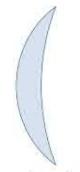
The thin lens in air of Figure P33.109 is drawn showing \(\left|R_{1}\right||\).(a) Is this lens converging or diverging?(b) If the lens were drawn showing \(\left|R_{1}\right|=\left|R_{2}\right|\), would it be converging or diverging?(c) If it were drawn showing
The two surfaces of a lens made of an unknown material have the same magnitude of radius of curvature \(|R|\). When an object is placed a distance \(R\) away from the lens, the image formed is real and twice as large as the object. What is the index of refraction of the material of which the lens
When you shine a laser-beam pointer at a wall, why do you see a dot on the wall but not the beam running from pointer to wall (in the absence of dust or mist)?
A man spearfishing from a dock sees a fish in the water. In order to hit the fish, should he aim the speargun above, below, or directly at the image he sces?
Traveling through an optical cable for which the index of refraction is 1. 6, how long does it take a light signal to travel from New York to Los Angeles, a distance of \(4.0 \times 10^{3} \mathrm{~km}\) ?
In about the years 214-212 BC, the Greek philosopher and scientist Archimedes is said to have repelled a Roman attack with a "death-ray" converging mirror, using sunlight to set the approaching fleet on fire. Assume an early morning attack from the east, with the Sun directly behind the ships. If
What is an application of a converging lens for these situations:(a) object is at twice the focal length, \((b)\) object is at the focal length, and(c) object is at infinity?
An object that is \(40 \mathrm{~mm}\) tall is placed \(60 \mathrm{~mm}\) in front of a converging thin lens. If the image is inverted and \(80 \mathrm{~mm}\) tall, what are \((a)\) the distance from the image to the lens and \((b)\) the focal length of the lens?
A converging lens for which \(f=50 \mathrm{~mm}\) forms an image that is three times larger than the object. How far from the lens is the object?
In vacuum, the wavelength of a certain light wave is \(550 \mathrm{~nm}\). (a) What is the wavelength in a medium where the wave speed is \(2.4 \times 10^{8} \mathrm{~m} / \mathrm{s}\) ? What is the frequency of this light \((b)\) in vacuum and \((c)\) in the medium?
The focal length of a lens can be different for different colors of light. (a) What optical principle causes this problem? (b) Can the problem be corrected? (c) Does the same problem affect mirrors?
When an object is placed \(1.2 \mathrm{~m}\) in front of a diverging mirror, an image of the object is formed \(0.75 \mathrm{~m}\) away from the mirror. (a) Is the image real or virtual? (b) Is it upright or inverted? (c) What is the mirror's radius of curvature?
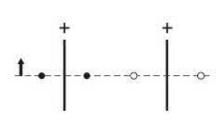
The focal points of the two converging lenses shown in Figure P33.121 are denoted by solid dots for the left lens and open dots for the right lens. Draw a simplified ray diagram to locate the final image.Data from Figure P33.121 + +
Using a camera fitted with a lens for which \(f=50 \mathrm{~mm}\), you take a photograph of a person who is \(1.7 \mathrm{~m}\) tall and is standing \(29 \mathrm{~m}\) away from you. What is the height of the person's image on the film?
A piece of electronic circuitry embedded in a layer of diamond \(\left(n_{\text {diamond }}=2.42\right.\) ) emits light. The diamond is covered by a coating of flint glass \(\left(n_{\text {flint }}=1.65\right)\). The interface between the two materials is flat, as is the interface between the
You and a friend are scuba diving on a calm day when you decide it would be neat to estimate the critical angle for light going from water into air. Your friend is underwater and has a laser pointer and a waterproof earpiece so that he can hear your instructions. He also has a floating marker
You are in charge of the projector in a movic theater. The film passes through a holder, and light from a bright bulb passes first through the film and then through a lens. You have several additional lenses that can be swapped out, and the position of the lens holder is easily adjustable, but
For a lens in air, you have learned the conditions on its radii of curvature to make the lens converging or diverging. You have done some diving, and you realize that a lens has a different focal length underwater than it does in air. That starts you thinking about what would happen if a lens is
Why do you get a clear reflection from the surface of a lake on a calm day but little or no reflection from the surface on a windy day?
(a) As light travels from one medium into another, as shown in Figure 33. 36 ("fast" and "slow" refer to the wave speed in each medium), what happens to the wavelength of the light? (b) Draw the reflected and refracted rays at each surface.Data from Figure 33. 36 fast slow fast slow slow fast slow
In each situation in Figure 33. 37, draw the three rays emanating from the top of the object and reflecting or refracting from the optical element shown. Show the image, and state whether it is real or virtual.Data from Figure 33. 37 (a) (b) (c) mirror object object object
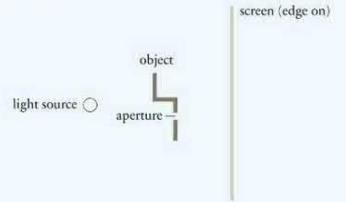
An object that has a small aperture is placed between a light source and a screen, as shown in Figure 33.4. Which parts of the screen are in the shadow?Data from Figure 33.4 object screen (edge on) light source aperture-
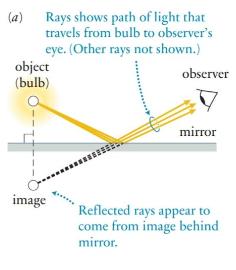
If the light bulb in Figure \(33.8 a\) is \(1.0 \mathrm{~m}\) in front of the mirror, how far behind the mirror is the image?Data from Figure 33.8a (a) Rays shows path of light that travels from bulb to observer's eye. (Other rays not shown.) object (bulb) image observer mirror Reflected rays
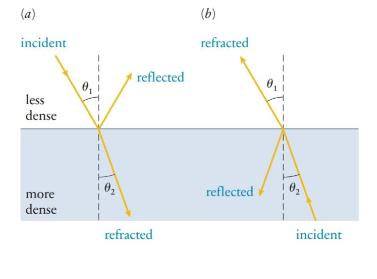
Consider a light ray incident on a parallel-sided slab of glass surrounded by air, as shown in Figure 33.17a. The ray travels all the way through the slab and emerges into air on the other side. In what direction does the ray emerge?Data from Figure 33.17 (a) incident less dense more dense (b)
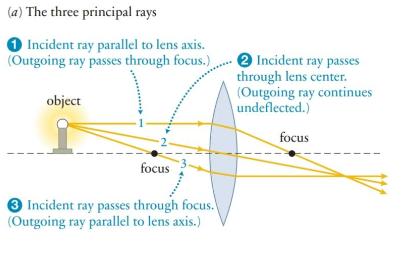
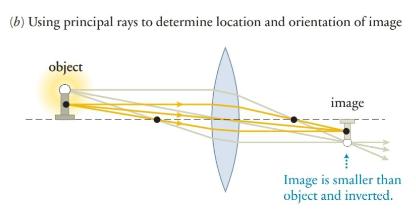
Consider the light bulb that is the object in Figure 33.28. If you move the bulb to the left, does the image shift left, shift right, or stay in the same place?Data from Figure 33.28 (a) The three principal rays Incident ray parallel to lens axis. (Outgoing ray passes through focus.), object
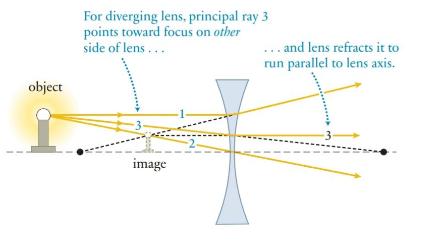
Suppose the object in Figure 33.33 is placed between the focus and the lens. (a) Is the image real or virtual? (b) Is it larger than, smaller than, or the same size as the object?Data from Figure 33.33 object For diverging lens, principal ray 3 points toward focus on other side of lens... ... and
A ray traveling through a medium for which the index of refraction is \(n_{1}\) is incident on a medium for which the index of refraction is \(n_{2}\). At what angle of incidence \(\theta_{1}\), expressed in terms of \(n_{1}\) and \(n_{2}\), must the ray strike the interface between the two media
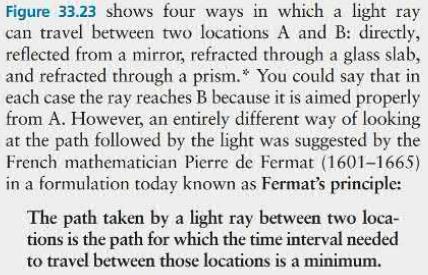
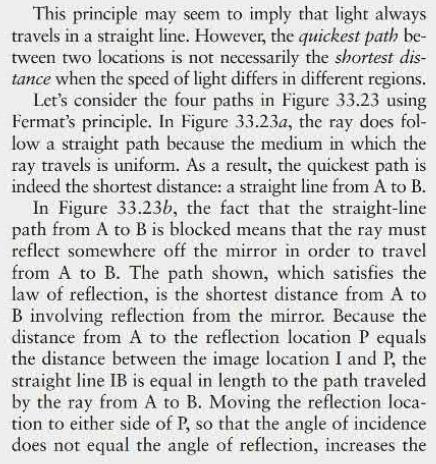
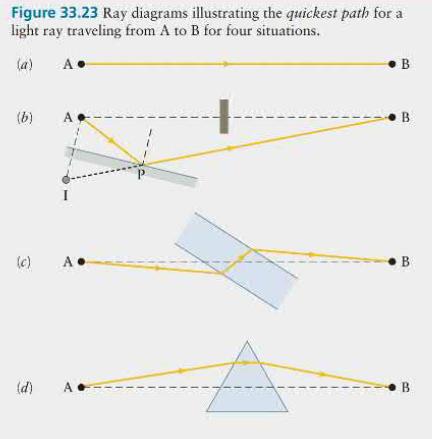
For a light ray that crosses the interface between medium 1 having index of refraction \(n_{1}\) and medium 2 having index of refraction \(n_{2}\), what relationship between \(\theta_{1}\) and \(\theta_{2}\) follows from Fermat's principle (page 1155)?Data from page 1155 Figure 33.23 shows four
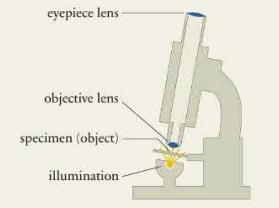
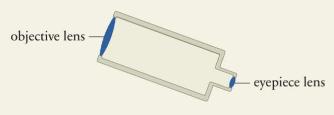
A compound microscope consists of two converging lenses, the objective lens and the eyepiece lens, positioned on a common optical axis (Figure 33.47). The objective lens is positioned to form a real, highly magnified image 1 of the sample being examined, and the eyepiece lens is positioned to form
A refracting telescope, like a compound microscope, contains two converging lenses, the objective lens and the eyepiece lens, positioned on a common optical axis (Figure 33.49). However, a telescope is designed to view large, very distant objects, whereas a microscope is used to view very small
An object is placed \(0.30 \mathrm{~m}\) in front of a converging mirror for which the radius of curvature is \(1.0 \mathrm{~m}\). (a) On which side of the mirror is the image? Is the image real or virtual? (b) If the object is \(50 \mathrm{~mm}\) tall, what is the height of the image?
Suspend a freshly pulled piece of transparent tape from the edge of your desk.(a) What happens when you hold a battery near the tape? Does it matter whether you point the + side or the - side of the battery toward the tape? Does a spent battery yield a different result? Does a wooden object yield a
Suspend a freshly pulled strip of transparent tape from the edge of your desk. (a) Pull a second strip of tape out of the dispenser and hold it near the first strip. What do you notice? (b) Does it matter which sides of the strips you orient toward each other?
Suspend two freshly pulled \(20-\mathrm{cm}\) strips of transparent tape from the edge of your desk. Cut two \(20-\mathrm{cm}\) strips of paper, making each strip the same width as the tape, and investigate the interactions between the paper strips and the tape by bringing them near each other.
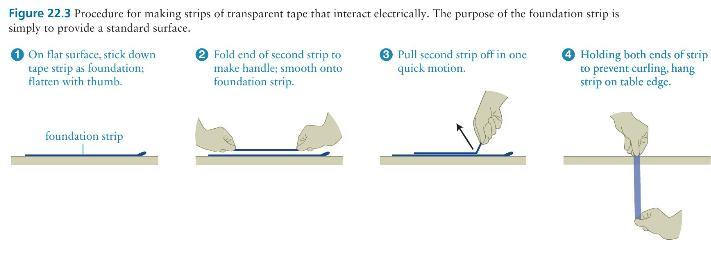
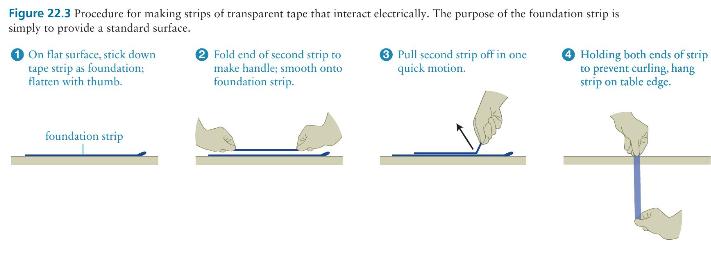
(a) Prepare a charged strip of transparent tape as described in Figure 22.3 and then suspend the strip from the edge of your desk. Verify that the tape interacts as you would expect with your hand, with a strip of paper, and with another charged strip of tape.(b) Rub your fingers along the hanging
Recharge the discharged strip from Checkpoint 22.4 and verify that it interacts as before with your hand, with a strip of paper, and with another charged strip of tape.Data from Check point 22.4Prepare a charged strip of transparent tape as described in Figure 22.3 and then suspend the strip from
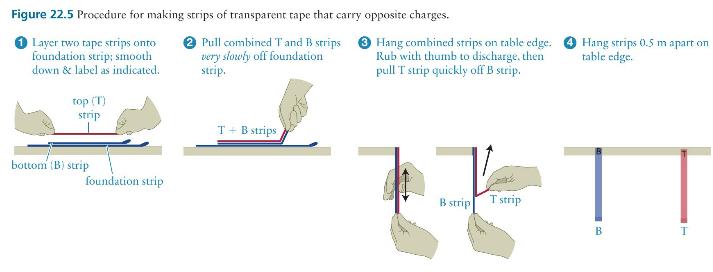
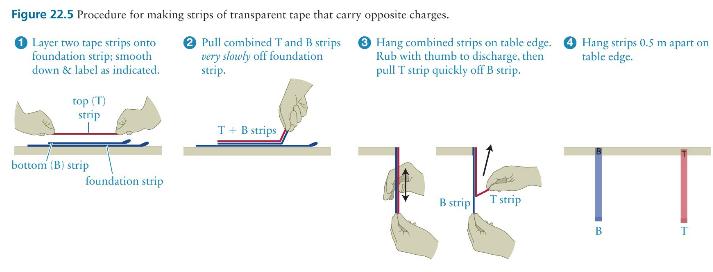
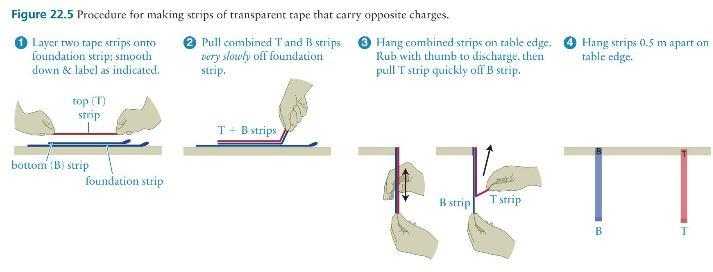
Follow the procedure illustrated in Figure 22.5 to separate a pair of charged strips.(a) How does strip B interact with a neutral object? How does strip T interact with a neutral object? (b) Create a third charged strip and see how it interacts with strip B and with strip T.(c) Is strip T
Make two charged pairs of strips ( \(B\) and \(T\) ) following the procedure illustrated in Figure 22.5. Investigate the interaction of \(\mathrm{B}\) with \(\mathrm{T}, \mathrm{T}\) with \(\mathrm{T}\), and \(\mathrm{B}\) with \(\mathrm{B}\). Figure 22.5 Procedure for making strips of transparent
(a) Prepare one charged strip of tape according to Figure 22.3 and hang it from the edge of your desk. Hang a narrow strip of paper from the desk edge also, about \(0.5 \mathrm{~m}\) away from the tape strip. Pass a plastic comb six times quickly through your hair and then show that the comb is
Does the B strip you created in Checkpoint 22.8 carry a positive charge or a negative charge?Checkpoint 22.8Prepare one charged strip of tape according to Figure 22.3 and hang it from the edge of your desk. Hang a narrow strip of paper from the desk edge also, about \(0.5 \mathrm{~m}\) away from
Imagine having a collection of charged marbles that retain their charge even when they touch other objects. Red marbles are positively charged, and blue marbles are negatively charged. (a) What happens if you place a bunch of red marbles close together on a flat horizontal surface? (b) What happens
(a) Why is it impossible to charge a metal rod held in your hand by rubbing the rod with other materials? (b) Why can you charge a rubber rod even when you hold it in your hand?
When two objects made of the same material are rubbed together, friction occurs but neither material acquires surplus charge. Why?
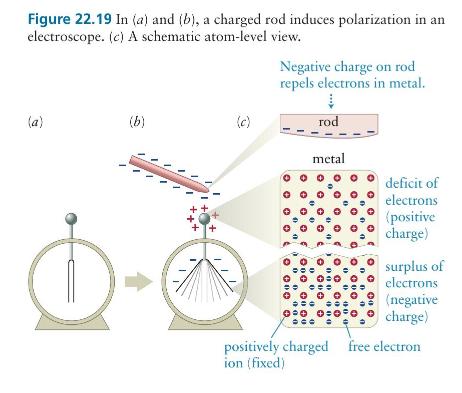
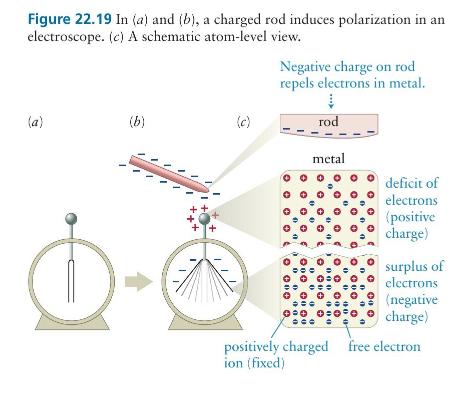
(a) In Figure \(22.19 b\), is the electroscope as a whole positively charged, negatively charged, or neutral? (b) How does the magnitude of the positive charge on the electroscope ball compare with the magnitude of the negative charge on the leaves? (c) Is the force exerted by the rod on the
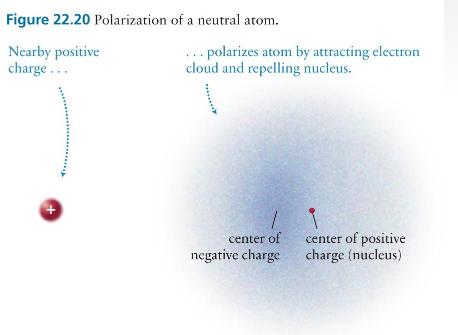
In an atom, what limits the separation between the electron cloud and the nucleus in the presence of an external charge? Why, for example, isn't the electron cloud in Figure \(22.20 b\) pulled all the way to the location of the external positive charge? Figure 22.20 Polarization of a neutral atom.
(a) When a positively charged object is brought near a neutral piece of paper, is the vector sum of the forces exerted by the charged object on the paper attractive or repulsive? (b) Describe what would happen when a negatively charged comb is brought near an electroscope if protons, not electrons,
Two identical conducting spheres, one carrying charge \(+q\) and the other carrying charge \(+3 q\), are initially held a distance \(d\) apart. The spheres are allowed to touch briefly and then returned to separation distance \(d\). Is the magnitude of the force they exert on each other after the
Using your knowledge about work and potential energy, determine whether the potential energy of a closed system of two charged particles carrying like charge increases, decreases, or stays the same when the distance between the two is increased. Repeat for two particles carrying opposite charge.
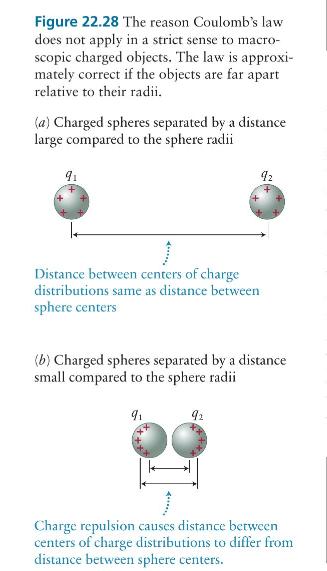
(a) Is the magnitude of the electric force between the two conducting spheres in Figure \(22.28 b\) greater or smaller than that obtained from Coulomb's law, which assumes the charge is concentrated at the center of each sphere? (b) Is the answer to part \(a\) the same if the charge on one of the
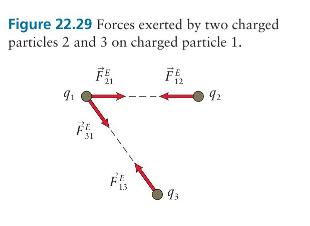
Figure 22.29 shows how a charged particle 1 interacts with two other charged particles 2 and 3. Determine the direction of the vector sum of the electric forces exerted on particle 2. Figure 22.29 Forces exerted by two charged particles 2 and 3 on charged particle 1. 91 92 31 93
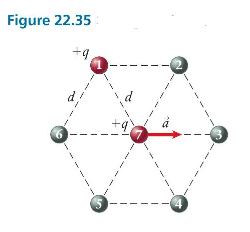
Seven small metal spheres are arranged in a hexagonal pattern as illustrated in Figure 22.35. Spheres 1 and 7 carry equal amounts of positive charge; the other spheres are uncharged. (a) To give sphere 7 an acceleration \(\vec{a}\) that points to the right, what (single) other sphere must be
Compare the magnitudes of the gravitational field that earth feels due to the Sun and the Moon.
Assume an electron is fixed at the origin of a rectangular Cartesian coordinate system. Calculate the magnitude of the electric field at \(15 \mathrm{~mm}\) on the positive \(x\)-axis.
Draw a vector field diagram for particles carrying charges \(+2 q\) and \(-q\) separated by a distance \(r\). Comment on the significance of the vector diagram.
Repeat Problem 9 for the case where the positive charge in Figure P23.9 remains \(+q\) but the negative charge is changed to \(-2 q\).
The Burj Khalifa in Dubai has 163 floors. Compare the gravitational field in a room on the ground floor and one on the \(163^{\text {rd }}\) floor.
A \(10.0-\mathrm{mg}\) oil drop carrying a charge of \(+15 \mu \mathrm{C}\) passes undeflected through a region in which there is a uniform, constant electric field. What is the magnitude and direction of the electric field?
What is the magnitude the net force on an electron when placed at the electric field at a distance of \(100 \mathrm{~mm}\) produced by \(5 \mu \mathrm{C}\) of charge?
Consider a hydrogen atom. The Bohr radius of hydrogen atom is \(0.529 \times 10^{-8} \mathrm{~cm}\). Calculate the electric field halfway between the electron and the proton.
A positively charged particle initially at rest on the ground moves \(4.0 \mathrm{~m}\) upward in \(2.00 \mathrm{~s}\). If the particle has a chargeto-mass ratio of \(10 \mu \mathrm{C} / \mathrm{g}\) and the electric field in this region is constant and uniform, what is the magnitude and direction
A particle, carrying a positive charge of \(4 \mathrm{nC}\), located at \((5 \mathrm{~cm}, 0)\) on the \(x\)-axis experiences an attractive force of magnitude 115.2 \(\mathrm{N}\) due to an unknown charge \(q\) located at the origin.(a) Determine the value of \(q\).(b) Using the relationship
A particle at the origin of a Cartesian coordinate system carries a charge of \(5.0 \times 10^{-9} \mathrm{C}\). What are the magnitude and direction of the electric field at (a) \((4.00 \mathrm{~mm}, 0)\),(b) \((0,4.00 \mathrm{~mm})\),(c) \((-3.00 \mathrm{~mm}, 4.00 \mathrm{~mm})\) ?
A rubber flying ring having a diameter of \(20 \mathrm{~cm}\) is fixed to the \(x y\)-plane of the Cartesian coordinate system such that its geometric center lies on the origin. The ring is uniformly charged with \(+10 \mu \mathrm{C}\).(a) What is the magnitude of the electric field at \(10
Three particles carrying charges \(2 q, q\), and \(-3 q\) are located at the vertices of an equilateral triangle on the \(x y\)-plane. Particles 1 and 2 are located symmetrically on the \(x\)-axis and particle 3 is located on the positive \(y\)-axis. Find the direction of the electric field at the
Two balls of identical size (ball 1 made up of nylon and ball 2 made up of rubber) were rubbed against each other so that they carry a uniformly distributed charge of magnitude \(0.25 \mathrm{nC}\). After charging, the two balls were stuck to the end of a \(15 \mathrm{~cm}\) scale. In that
Two ping pong balls, 1 and 2 , are charged uniformly such that ball 1 gets \(0.5 \mathrm{nC}\) charge and ball 2 gets \(-0.5 \mathrm{nC}\) charge. Calculate the ratio of the magnitudes of the dipole moments produced if they were stuck to the opposite ends of the two sticks of length \(200
A \(20-\mathrm{cm}\)-long rod, with uniform linear charge density \(100 \mathrm{nC} / \mathrm{cm}\), is set up symmetrically on the \(x\) axis. What are the magnitude and direction of the electric field at a point located at a distance of \(5 \mathrm{~cm}\) on the perpendicular bisector of the rod
Among copper and gold, whose polarizability is higher? Justify your answer.
Two oppositely charged identical metallic spheres, each having a mass of \(4 \mathrm{~g}\), lie on a horizontal plane, joined by a tiny insulating rod of length \(2 \mathrm{~cm}\). The magnitude of the charge on each sphere is \(3 \mu \mathrm{C}\). The rod is parallel to a uniform electric field of
A plastic flying disc with radius \(25 \mathrm{~cm}\) is uniformly charged with \(\sigma=8 \mathrm{nC} / \mathrm{m}^{2}\). Find the magnitude of the electric field at \(30 \mathrm{~m}\) on the axial position.
A charge of \(2.86 \mu \mathrm{C}\) is uniformly distributed within a rubber ball having radius \(5.6 \mathrm{~cm}\). Calculate the electric field at \(10 \mathrm{~cm}\) from the center of the rubber ball. \(\cdot\)
Two uniformly charged plates carrying opposite charges are separated by a distance of \(20 \mathrm{~mm}\). The magnitude of the charge density on each plate is \(3 \times 10^{-8} \mathrm{C} / \mathrm{m}^{2}\). An electron is launched with a speed of \(2.1 \times 10^{6} \mathrm{~m} / \mathrm{s}\)
Two infinitely wide charged plates carry opposite charge densities of magnitude \(1.77 \times 10^{-6} \mathrm{C} / \mathrm{m}^{2}\). A small sphere, of mass \(\mathrm{m}=2 \mathrm{~g}\), lies between the plates, attached to the positive charged plate by means of an inextensible insulating wire of
Two objects 1 and 2, of mass \(m_{1}\) and \(m_{2}\), are released from rest far from Earth, at a location where the magnitude of the acceleration due to gravity is much less than \(g=9.8 \mathrm{~m} / \mathrm{s}^{2}\). (a) What is the ratio \(F_{\mathrm{E} 1}^{G} / F_{\mathrm{E} 2}^{G}\) ? (b) For
A communications satellite orbits \(1.4 \times 10^{7} \mathrm{~m}\) from Earth's center, at a location where the magnitude of Earth's gravitational field is \(2.0 \mathrm{~N} / \mathrm{kg}\). (a) If the mass of the satellite is \(m_{\mathrm{s}}=2000 \mathrm{~kg}\), what is the magnitude of
(a) Is the magnitude of the gravitational force exerted by Earth on a ball greater than, equal to, or smaller than the magnitude of the gravitational force exerted by the ball on Earth? (b) Is the magnitude of Earth's gravitational field at the position of the ball greater than, equal to, or
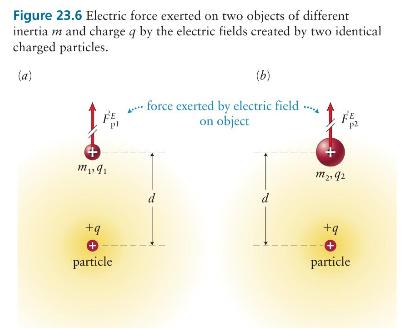
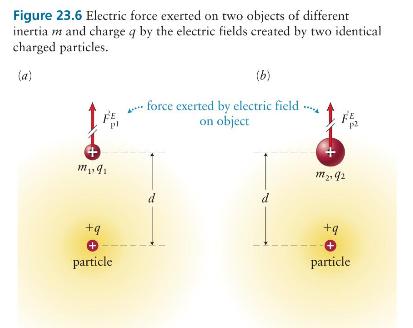
(a) Are the electric forces \(\vec{F}_{\mathrm{p} 1}^{E}\) and \(\vec{F}_{\mathrm{p} 2}^{E}\) in Figure 23.6 equal?(b) What does the quantity \(\vec{F}_{\mathrm{p} i}^{E} / m_{i}\) represent?(c) Is this quantity the same for objects 1 and 2 ? If not, what quantity is the same for both of these
(a) If the particle in Figure 23.6 carries a negative charge \(q(b) Does the electric field created by the particle point toward or away from the particle?(c) If \(q\) and \(q_{2}\) are negative, what are the direction of \(\vec{F}_{\mathrm{p} 2}^{E}\) and the direction of the electric field
If you know the electric field \(\vec{E}\) at some location, how can you determine the magnitude and direction of the electric force exerted by that field on an object carrying a charge \(q\) and placed at that location?
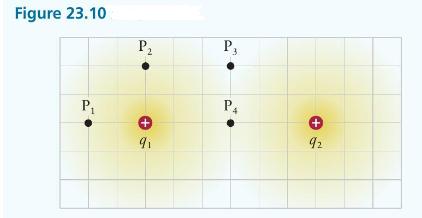
(a) If the charge on particle 2 in Exercise 23.1 is doubled so that \(q_{2}=2 q_{1}\), what happens to the direction of the electric field at points \(P_{1}\) through \(P_{4}\) ?(b) If the charge on particle 2 is negative so that \(q_{2}=-q_{1}\), what is the direction of the electric field at
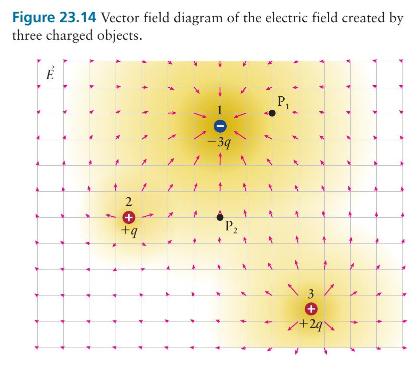
(a) In Figure 23.14, what is the direction of the force \(\sum \vec{F}^{E}\) exerted on a particle carrying a charge \(+q\) and placed at \(\mathrm{P}_{1}\) ?(b) How does \(\sum \vec{F}^{E}\) change when the particle at \(\mathrm{P}_{1}\) carries a charge \(+3 q\) ?(c) Do the magnitude and
A water droplet carrying a positive charge is released from rest in a uniform horizontal electric field near Earth's surface. The horizontal electric force is comparable in magnitude to the gravitational force exerted by Earth. Describe the droplet's trajectory.
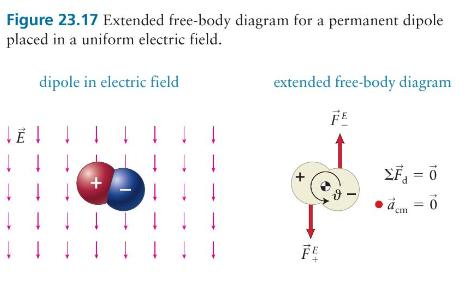
(a) What effect does the torque caused by the electric field have on the electric dipole in Figure 23.17?(b) Is the torque the same for every orientation of the molecule? Figure 23.17 Extended free-body diagram for a permanent dipole placed in a uniform electric field. dipole in electric field
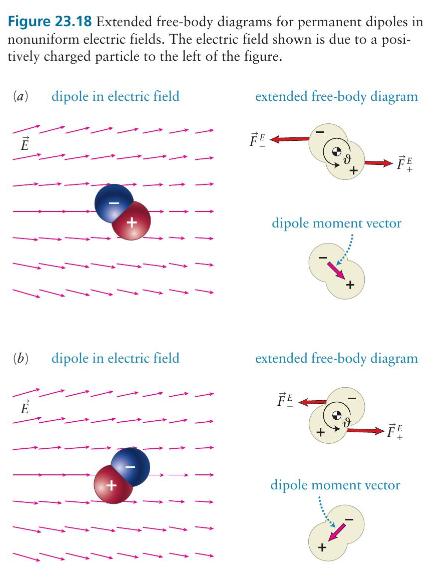
(a) Draw a free-body diagram for the dipole in Figure \(23.18 a\) and determine the direction of the dipole's center-of-mass acceleration.(b) Draw a free-body diagram for the dipole in Figure 23.18b and qualitatively describe the dipole's motion. Figure 23.18 Extended free-body diagrams for
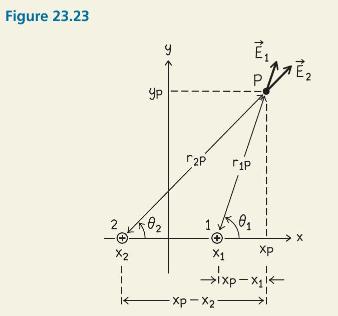
What is the magnitude of the electric force exerted by the electric field on an electron placed at point P in Figure 23.23? (Assume that the only interaction is electrostatic.) What is the initial acceleration of the electron if it is released from rest from that point? \(\left[e=1.6 \times
The magnitude of the electric field created by dipole \(\mathrm{A}\) at a certain point \(\mathrm{P}\) is \(E_{\mathrm{A}}\). If the dipole is replaced with another dipole \(\mathrm{B}\) that has its dipole moment oriented in the same direction, the magnitude of the electric field at point
(a) Describe the electric field between two infinitely large parallel charged sheets if the charge density of one sheet is \(+\sigma\) and that of the other is \(-\sigma\). (b) Describe the electric field outside the sheets.
How does the electric field inside a uniformly charged sphere vary with distance from the sphere center?
Is Eq. 23.20 valid if the center of mass is not halfway between the two charged ends of the dipole?Eq. 23.20 T == 2 (d sin 0) (qpE) = (qpd) E sin 0 = pE sin 0. (23.20)
How does doubling each of the following quantities affect the force between a dipole and a particle placed near the dipole and carrying charge \(q\) :(a) the charge \(q,\) (b) the dipole separation \(d\) of the dipole, (c) the dipole charge \(q_{\mathrm{p}}\),(d) the distance between the dipole
Showing 700 - 800
of 4962
1
2
3
4
5
6
7
8
9
10
11
12
13
14
15
Last
Step by Step Answers

 Get 50% OFF
Claim Now
Get 50% OFF
Claim Now