New Semester
Started
Get
50% OFF
Study Help!
--h --m --s
Claim Now
Question Answers
Textbooks
Find textbooks, questions and answers
Oops, something went wrong!
Change your search query and then try again
S
Books
FREE
Study Help
Expert Questions
Accounting
General Management
Mathematics
Finance
Organizational Behaviour
Law
Physics
Operating System
Management Leadership
Sociology
Programming
Marketing
Database
Computer Network
Economics
Textbooks Solutions
Accounting
Managerial Accounting
Management Leadership
Cost Accounting
Statistics
Business Law
Corporate Finance
Finance
Economics
Auditing
Tutors
Online Tutors
Find a Tutor
Hire a Tutor
Become a Tutor
AI Tutor
AI Study Planner
NEW
Sell Books
Search
Search
Sign In
Register
study help
physics
particle physics
Principles And Practice Of Physics 2nd Global Edition Eric Mazur - Solutions
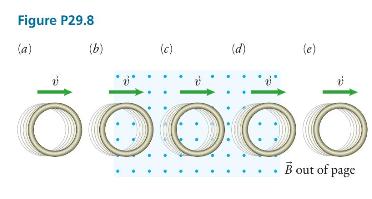
Suppose that in Example 29.1 you used a circular loop rather than a rectangular loop of the same area. What similarities and differences would you observe in each portion of Figure P29.8 parts \(a-e\) ? Data from Example 29.1Consider a rectangular conducting loop traveling from left to right
To measure the magnitude of Earth's magnetic field \(B_{E}\), you use a single conducting coil with an area \(A=10 \mathrm{~cm}^{2}\) rotating at an angular speed \(\omega\), and measure the peak emf induced on the coil. You know that \(B_{E} \simeq 50 \mu \mathrm{T}\). What should the minimum
A conducting loop having radius \(20 \mathrm{~cm}\) is held fixed, and there is a magnetic flux of \(0.6 \mathrm{~T} . \mathrm{m}^{2}\) through the loop. When the magnetic field is turned off, the magnetic flux through the loop becomes zero in \(4 \mathrm{~s}\). What is the average magnitude of the
A rectangular loop of length \(\ell=4 \mathrm{~cm}\), width \(w=3 \mathrm{~cm}\), and internal resistance \(R=0.5 \mathrm{~V} / \mathrm{A}\) is located so that the normal to the loop is parallel to a uniform magnetic field. Suddenly, the loop is turned upside down. A galvanometer measures the total
Suppose you are fabricating a device to measure the orientation of the Erath's magnetic field (i.e., \(50 \mu \mathrm{T}\) ). The device can accommodate a single conducting coil attached to a motor that can make it rotate at a speed of 12000 rotations/minute. If the maximum limit of peak induced
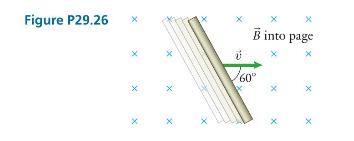
A \(50-\mathrm{cm}\)-long metal rod is placed in a uniform magnetic field with the rod length perpendicular to the field direction (Figure P29.26). The rod moves at \(0.10 \mathrm{~m} / \mathrm{s}\), and its velocity vector makes an angle of \(60^{\circ}\) with the rod length. If the magnitude of
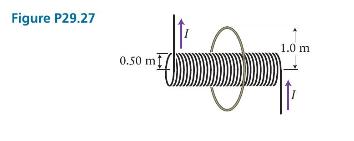
The very long cylindrical solenoid of Figure P29.27 has a radius of \(0.50 \mathrm{~m}\) and 1200 windings per meter along its length. A circular conducting loop of radius \(1.0 \mathrm{~m}\), and resistance \(0.5 \mathrm{~V} / \mathrm{A}\) encircles the solenoid, with the long central axis of the
A uniform magnetic field exists in a circular area. A particle carrying charge \(q=3.0 \mu \mathrm{C}\) is placed in the field a distance \(r_{\mathrm{p}}=5 \mathrm{~cm}\) from the center of the circular area. If the magnetic field drops at a constant rate of \(0.2 \mathrm{~T} / \mathrm{s}\), what
An emf of \(-0.75 \mathrm{~V}\) is induced in an inductor of \(1.25 \mathrm{H}\). Find the rate of change of current. Suggest if the current increases or decreases through the inductor.
If the magnitude of the emf produced in an inductor is 4.0 V when the current through it decreased at a constant rate of \(0.2 \mathrm{~A} / \mathrm{s}\), calculate the inductance of the inductor.
A friend of yours needs an inductance of \(2 \mathrm{H}\) for one of the circuits he is building. You offer him a cylindrical piece of insulating material of length \(30 \mathrm{~cm}\) and radius \(2 \mathrm{~cm}\) to use as a core. How many loops of wire will he need to wrap around this core?
You and a friend have a \(0.65-\mathrm{m}\) length of copper wire that has a diameter of \(4.115 \mathrm{~mm}\) and a wooden rod that is \(85 \mathrm{~mm}\) long and has a diameter of \(10 \mathrm{~mm}\). You're aiming to wind the wire around the rod about 40 times to form an inductor.(a) What is
Estimate the amount of magnetic potential energy stored in a \(1.50 \mathrm{H}\) inductor when the current through it is \(3.0 \mathrm{~A}\).
If \(24 \mathrm{~J}\) of magnetic potential energy is stored in a \(3.0 \mathrm{H}\) inductor, calculate the current in the inductor.
A cylindrical solenoid, of radius \(0.5 \mathrm{~cm}\) and length \(30 \mathrm{~cm}\) has 1200 windings and carries a current of \(0.5 \mathrm{~A}\).(a) What is the inductance of the solenoid? (b) What is the total magnetic potential energy inside the solenoid?(c) What is the magnetic energy
A cylindrical solenoid of length \(\ell\) and radius \(R\) has \(n\) windings per unit length and carries a current \(I\).(a) Use the inductance expression \(L=\left(\mu_{0} N^{2} A\right) / \ell\) from Example 29.8 and Eq. 29.25, \(U^{B}=L I^{2} / 2\), to derive an expression for the magnetic
Calculate the length of the cylindrical solenoid that has 900 windings, such that the radius of each winding is \(2 \mathrm{~cm}\), that shows an inductance of \(8.5 \times 10^{-2} \mathrm{H}\).
A uniform magnetic field exists in a cuboidal volume of space with \(l=3 \mathrm{~cm}, b=2 \mathrm{~cm}\), and \(h=1 \mathrm{~cm}\). If the magnetic energy stored in the volume is \(10 \mathrm{~J}\), what is the magnitude of the magnetic field?
A cylindrical electromagnet produces a uniform \(1.5-\mathrm{T}\) magnetic field between the poles. If the north and south poles of the electromagnet have circular cross-section having radius \(60 \mathrm{~mm}\) and separation \(50 \mathrm{~mm}\), then calculate the magnetic potential energy stored
To construct a solenoid having cross-sectional area \(1.256 \times 10^{-3} \mathrm{~m}^{2}\) and 500 windings that can produce a magnetic field of \(10 \times 10^{-3} \mathrm{~T},\) (a) calculate the length of the solenoid if the current in the device is \(5 \mathrm{~A}\). (b) Calculate the
You have a circular wire loop of radius \(a=20 \mathrm{~cm}\). It carries a current that increases linearly from 0 to \(5 \mathrm{~A}\) in \(0.01 \mathrm{~s}\). At the center of this loop is a wire loop of radius \(b=1 \mathrm{~mm}\) and resistance \(R=1.8 \mathrm{mV} / \mathrm{A}\). The loops are
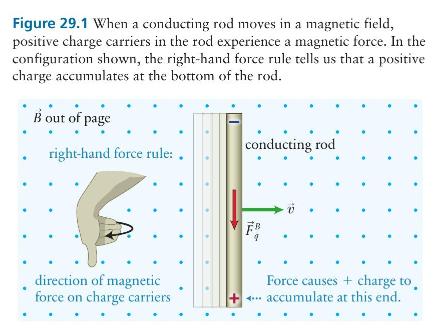
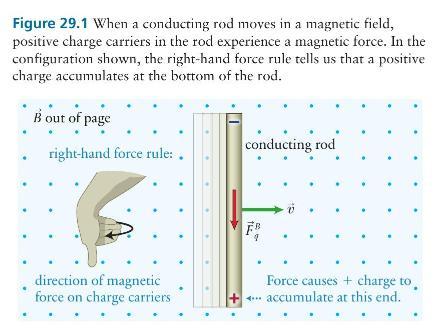
What happens if the rod in Figure 29.1 moves to the left? Figure 29.1 When a conducting rod moves in a magnetic field, positive charge carriers in the rod experience a magnetic force. In the configuration shown, the right-hand force rule tells us that a positive charge accumulates at the bottom of
In Example 29.1, suppose the loop is stationary and the source of the magnetic field is moved to the left such that their relative motion is the same. Do you expect there to be a current through the loop?Data from Example 29.1Consider a rectangular conducting loop traveling from left to right
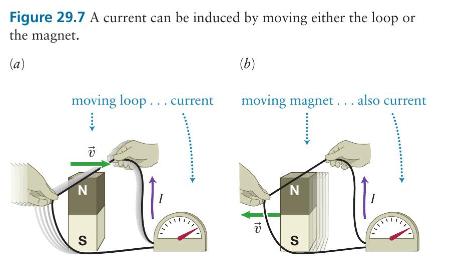
Is a magnetic force exerted on the (stationary) charge carriers in the loop of wire held above the magnet in Figure 29.7b? Figure 29.7 A current can be induced by moving either the loop or the magnet. (a) (b) moving loop... current moving magnet... also current v S S
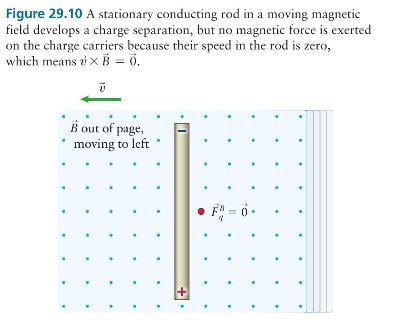
In Figure 29.1, charge accumulates at the ends of the moving rod until the amount at each end reaches an equilibrium value. Mechanical equilibrium is established when the magnetic force due to the motion of the rod counterbalances the electric force due to the charge separation. In Figure 29.10,
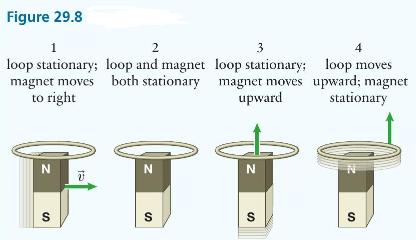
As viewed from above, what is the direction of the induced current in situations 1 and 3 in Figure 29.8? 2 3 4 loop stationary; loop and magnet loop stationary; loop moves magnet moves both stationary magnet moves upward; magnet stationary to right upward Figure 29.8 1 N N N S S S S
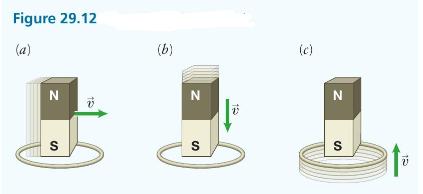
When current is induced in a conducting loop by the motion of a nearby magnet, the induced magnetic field \(\vec{B}_{\text {ind }}\) exerts a force on the magnet. (a) In Figure \(29.12 b\), what is the direction of the force exerted on the magnet by \(\vec{B}_{\text {ind }}\) ? (b) Suppose Lenz's
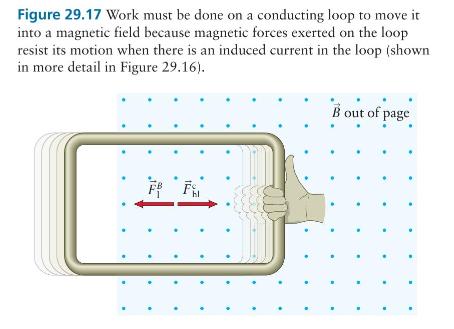
(a) After the left edge of the loop in Figure 29.17 enters the magnetic field, is the work required to continue pulling the loop through the field at constant speed \(v\) positive, negative, or zero? (b) As the right edge emerges from the magnetic field, is the work required positive, negative, or
Which requires doing more work: moving a magnet toward a closed conducting loop or moving it toward a rod? Both motions are at constant speed.
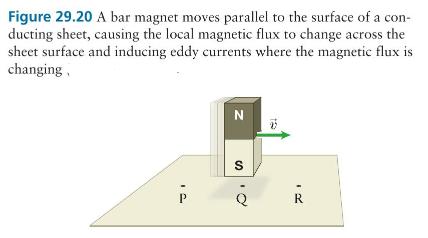
In Figure 29.20, a bar magnet moves parallel to a metal plate. (a) At the instant shown, does the magnitude of the magnetic flux increase, decrease, or stay the same through a small region around points P, Q, and R? (b) Are the eddy currents induced around these points clockwise, counterclockwise,
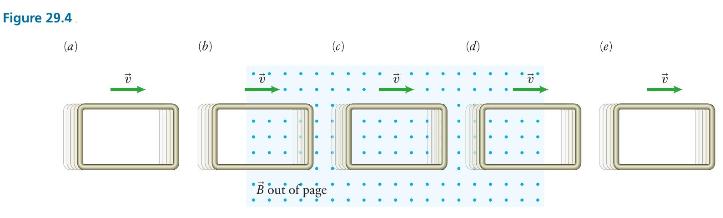
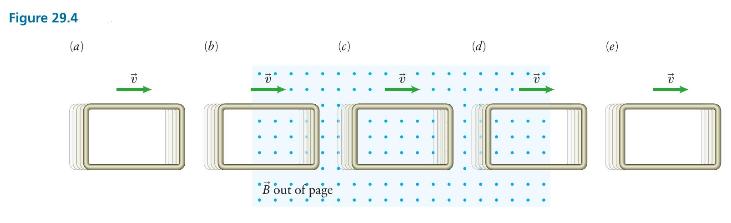
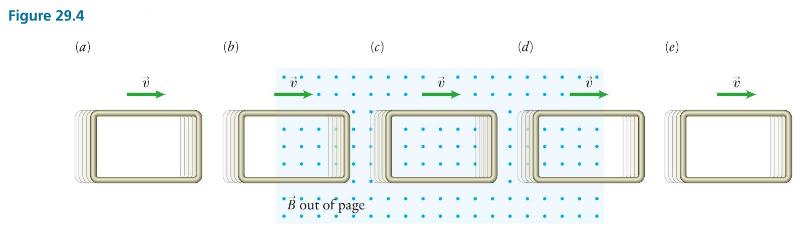
Sketch how the induced emf in the loop in Figure 29.4 varies as the loop moves through the five positions. Figure 29.4 (a) (b) (c) (d) (e) B out of page
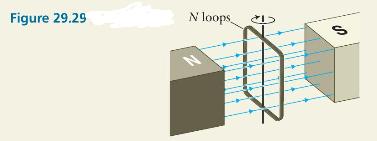
The expression I derived in Example 29.6 indicates that the emf becomes negative after the solenoid has rotated \(180^{\circ}\) and remains negative through the next \(180^{\circ}\) of rotation. However, the solenoid orientation looks the same when the solenoid has rotated \(180^{\circ}\) as when
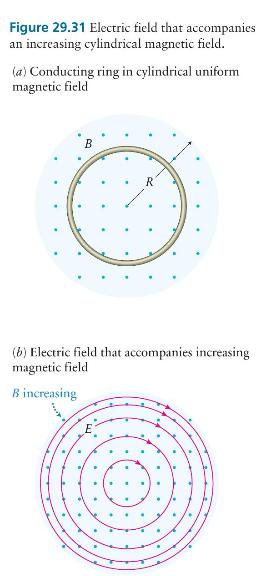
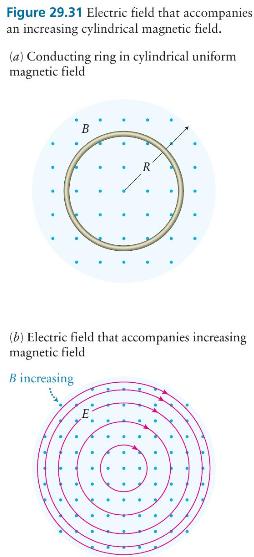
What do the electric field lines look like when the magnitude of the magnetic field in Figure \(29.31 b(a)\) is held constant and \((b)\) decreases steadily? Figure 29.31 Electric field that accompanies an increasing cylindrical magnetic field. (a) Conducting ring in cylindrical uniform magnetic
In Example 29.7 what is the magnitude of the electric field at a distance of \(0.30 \mathrm{~m}\) from the center of the magnetic field?Data from Example 29.7Let the uniform cylindrical magnetic field in Figure 29.31 have a radius \(R=0.20 \mathrm{~m}\) and increase at a steady rate of \(0.050
A solenoid has 2760 windings of radius \(50 \mathrm{~mm}\) and is \(0.60 \mathrm{~m}\) long. If the current through the solenoid is increasing at a rate of \(0.10 \mathrm{~A} / \mathrm{s}\), what is the magnitude of the induced emf?
How does the energy density of a 1.0-T magnetic field compare with the energy density of an \(1.0-\mathrm{V} / \mathrm{m}\) electric field?
A conducting rod moves through a magnetic field as shown in Figure 29.21. Which end of the bar, if any, becomes positively charged? Figure 29.21 (a) x x x (b) (c) x X 19 X x x x x x x
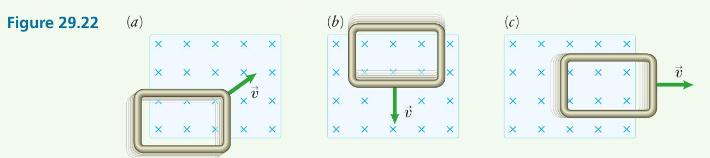
A conducting loop moves through a magnetic field as shown in Figures 29.22a-c. Which way does the current run in the loop at the instant shown in each figure? (a) Figure 29.22 (9) X (c) X x x X N x X x X 15 x X X x x x x X
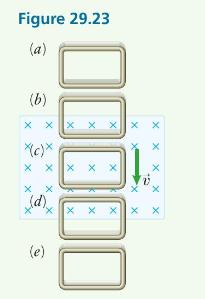
A conducting loop moves through a magnetic field at constant velocity as shown in Figure 29.23. For each case \(a-e\), must the work done on the loop be positive, negative, or zero to keep the loop moving? Figure 29.23 (a) (b) X X X X X X X x ((c)x X X (d), (e) x X X X X X XX x
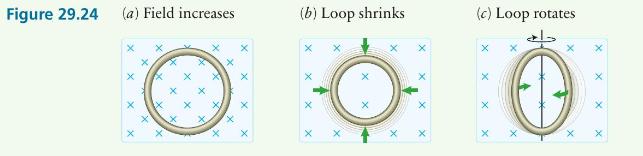
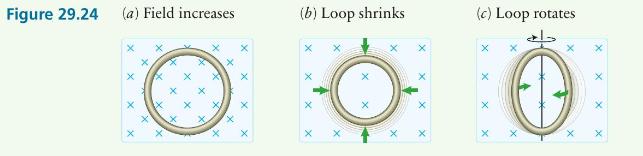
Using Faraday's law, determine whether charge carriers flow in the loop for each situation shown in Figure 29.24. Figure 29.24 (a) Field increases x y Xx x x x X (b) Loop shrinks x. (c) Loop rotates x
Using Lenz's law, determine the direction of the induced current, if any, at the instants shown in Figure 29.24. Figure 29.24 (a) Field increases x y Xx x x x X (b) Loop shrinks x. (c) Loop rotates x
As we saw in Checkpoint 30.9, a receiving dipole antenna has to be aligned with the oscillating electric field in order to produce a measurable potential difference in the antenna. What if we wanted to detect the potential difference caused by the changing magnetic field?(a) What antenna shape
A parallel-plate capacitor with circular plates has a steady charging current of \(3.0 \mathrm{~A}\). The wires into and out of the plates attach to the plate centers. If the radius of each plate is \(5 \mathrm{~cm}\) and there is no dielectric between the plates, what is the magnetic field
A parallel-plate capacitor of capacitance \(10 \mu \mathrm{F}\) is being charged by a voltage source \(V=V_{0} \cos (\omega t)\). Suppose that \(V_{0}=240 \mathrm{~V}\) and \(\omega=50 \mathrm{~s}^{-1}\).(a) What is the maximum displacement current through a cross-sectional area inside the
Instead of a capacitor in a circuit, we can get the same effect by slicing a thick wire in two, making our cut perpendicular to the wire's long axis. If the wire diameter is \(5 \mathrm{~mm}\) and we place the two parallel circular surfaces of the cut wire \(0.02 \mathrm{~mm}\) apart, what is the
A parallel-plate capacitor has a steady charging current of \(4.0 \mathrm{~A}\). What is (a) the time rate of change of the electric flux between the plates (b) the displacement current between the plates?(c) How do your answers to parts \((a)\) and \((b)\) change if there is a dielectric for
A parallel-plate capacitor has circular plates of radius \(R=15 \mathrm{~cm}\) and plate separation distance \(d=1 \mathrm{~mm}\). While it is charging, the potential difference across the plates is given by \(V(t)=V_{0}\left(1-e^{-t / \tau}\right)\) where \(V_{0}=12 \mathrm{~V}\) and \(\tau=4.0
Using Eq. 30.11, show that the normal component of the magnetic field is continuous across any surface. P = B. d = 0. (30.11)
The light produced by a sodium vapor lamp has a wavelength of \(589.3 \mathrm{~nm}\) in vacuum. What is its wavelength after it enters a sheet of glass with dielectric constant \(\kappa=4.8\) ?
If the electric field in an electromagnetic wave \(5 \mathrm{~cm}\) from a radio-emitting antenna has a maximum magnitude of \(3.0 \times 10^{5} \mathrm{~V} / \mathrm{m}\), what is the maximum magnetic field magnitude \(1 \mathrm{~km}\) from the antenna?
An electromagnetic wave has an average Poynting vector magnitude of \(4 \times 10^{-7} \mathrm{~W} / \mathrm{m}^{2}\). What is the maximum value of the magnitude of the electric field?
An electromagnetic wave has root-mean-square magnetic field magnitude \(B_{r m s}=5 \mu \mathrm{T}\). What is the rootmean-square electric field magnitude and the average intensity of the wave?
A \(2.0-\mathrm{mW}\) laser has a beam radius of \(0.5 \mathrm{~mm}\). What is the intensity of this beam?
Radio signals typically have a very small intensity. Imagine that a vehicle receives an average signal of \(20 \mu \mathrm{W} / \mathrm{m}^{2}\).(a) What are the maximum magnitudes of the electric and magnetic fields? (b) If the tower emitting the radio waves is located \(10 \mathrm{~km}\) away
For a constant current of \(2 \mathrm{~A}\), what time interval is required to deliver \(0.5 \mathrm{MW}\) of power to the space between the plates of a capacitor if the plates are circular and parallel, their diameter is \(10 \mathrm{~cm}\), and their separation distance is \(1 \mathrm{~mm}\) ?
Assume a 40-W incandescent light bulb radiates uniformly in all directions. At a distance of \(1 \mathrm{~m}\) from the bulb, determine (a) the intensity of the electromagnetic waves, (b) the maximum electric field magnitude, and(c) the maximum magnetic field magnitude.
The emitting antenna of a \(50-\mathrm{kW}\) radio station radiates equally in all directions. What are the magnitudes \(E_{\max }\) and \(B_{\max }\)(a) \(200 \mathrm{~m}\) from the antenna and(b) \(20 \mathrm{~km}\) from the antenna?(c) For these two distances from the antenna, calculate the
A laser beam has a radius of \(1 \mathrm{~mm}\). How powerful does the laser have to be for the maximum magnitude of the magnetic field in the beam to be \(4 \mu \mathrm{T}\) ?
A radio wave, with a wavelength of \(300 \mathrm{~m}\) in vacuum, has an average intensity of \(200 \mathrm{~W} / \mathrm{m}^{2}\).(a) What is the frequency of this electromagnetic wave?(b) Fix a reference frame with the \(z\) axis along the direction of propagation of the wave. What is the
For a particular electromagnetic wave, \(B_{\mathrm{rms}}\) is \(0.30 \times 10^{-6} \mathrm{~T}\). For this wave, calculate(a) \(E_{\mathrm{rms}},\) (b) the average energy density, (c) the intensity.
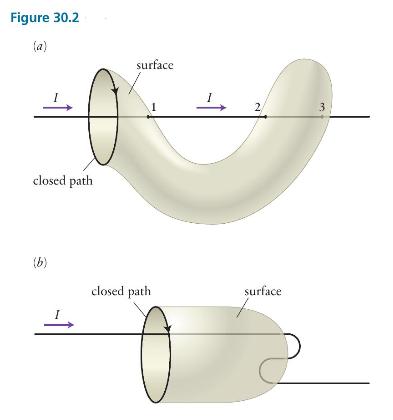
Is the current intercepted by the surface equal to the current encircled by the closed path \((a)\) in Figure 30.2a and \((b)\) in Figure \(30.2 b\) ? Figure 30.2 (a) closed path (b) surface 1 3 closed path surface
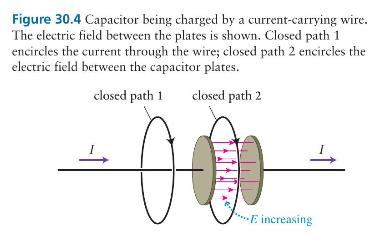
(a) While the capacitor of Figure 30.4 is being charged, is the current through the wire leading to or from the capacitor zero or nonzero? Is the electric field between the plates zero or nonzero? Is it constant or changing? (b) Answer the same questions for the capacitor fully charged. Figure 30.4
Consider disconnecting a charged capacitor from its source of current and allowing it to discharge (to release its charge into an external circuit). During discharge, the current reverses direction (relative to its direction when the capacitor was charging), but the electric field between the
The neutron is a neutral particle that has a magnetic dipole moment. What does this nonzero magnetic dipole moment tell you about the structure of the neutron?
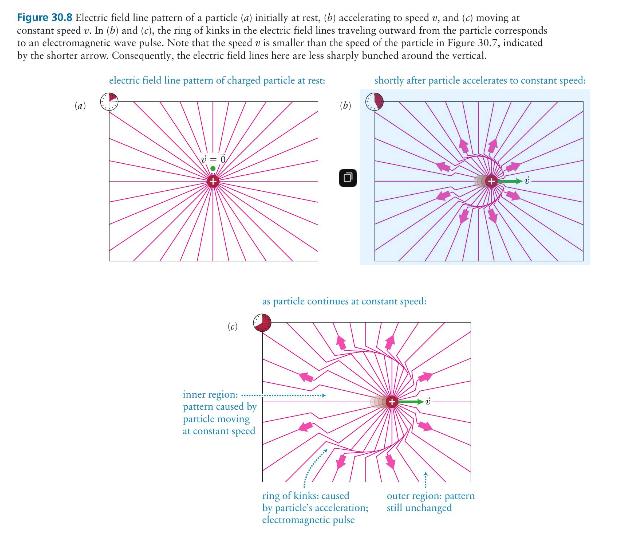
Estimate the final speed \(v\) of the charged particle in Figure 30.8 in terms of the speed of propagation \(c\) of the electromagnetic wave pulse produced by the particle's acceleration. Figure 30.8 Electric field line pattern of a particle (a) initially at rest, (b) accelerating to speed w, and
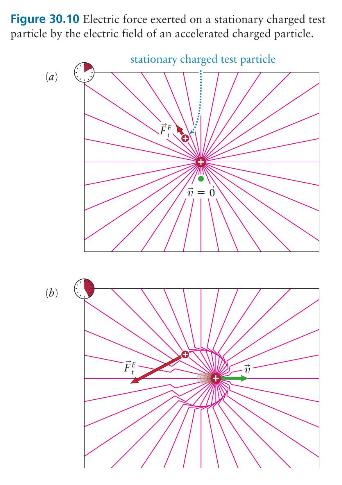
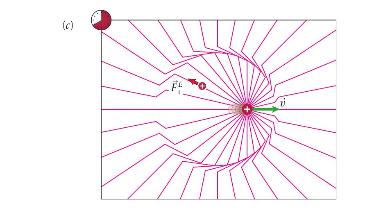
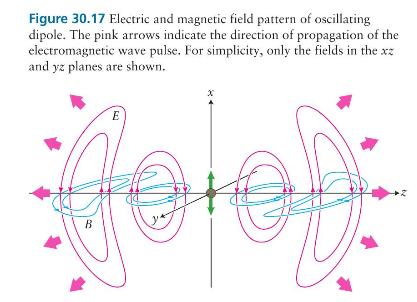
In Figure 30.10, in which regions of space surrounding the accelerating particle does a magnetic field occur? Figure 30.10 Electric force exerted on a stationary charged test particle by the electric field of an accelerated charged particle. stationary charged test particle (a) (b)
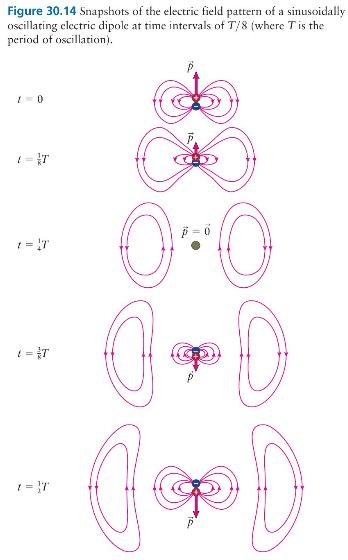
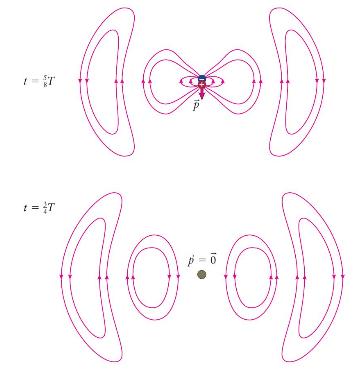
(a) If Figure 30.14 shows the oscillating electric field pattern at its actual size, estimate the wavelength of the electromagnetic wave. \((b)\) If the wave is traveling at speed \(c=3 \times 10^{8} \mathrm{~m} / \mathrm{s}\), what is the wave frequency? (c) What is the period of oscillation?
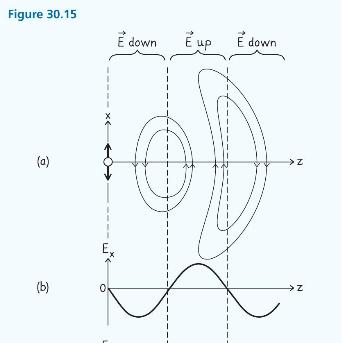
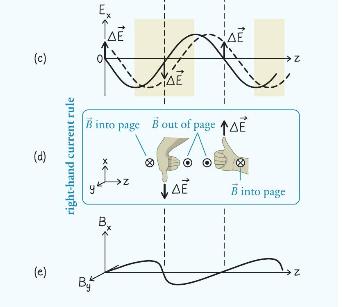
(a) At the origin of the graphs in Figure 30.15, the electric field is zero, but there is a current due to the motion of the charged particles that constitute the dipole. Is this current upward, downward, or zero at the instant shown in Figure 30.15?(b) Is this current (or the absence thereof)
To maximize the magnitude of the current induced in a receiving antenna, should the antenna be oriented parallel or perpendicular to the polarization of the electromagnetic wave?
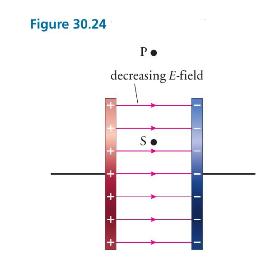
The parallel-plate capacitor in Figure 30.24 is discharging so that the electric field between the plates decreases. What is the direction of the magnetic field \((a)\) at point \(\mathrm{P}\) above the plates and \((b)\) at point \(\mathrm{S}\) between the plates? Both \(\mathrm{P}\) and
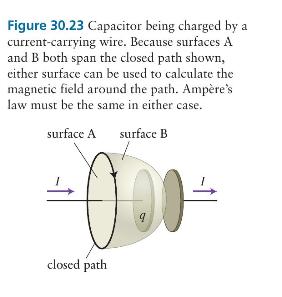
Consider again the parallel-plate capacitor of Figure 30.23. For circular plates of radius \(R\), calculate the magnitude of the magnetic field a distance \(r Figure 30.23 Capacitor being charged by a current-carrying wire. Because surfaces A and B both span the closed path shown, either surface
Suppose that isolated magnetic monopoles carrying a "magnetic charge" \(m\) did exist, and that the interaction between these monopoles depended on \(1 / r^{2}\), where \(r\) is the distance between two monopoles. How would you modify Maxwell's equations to account for these monopoles? Ignore any
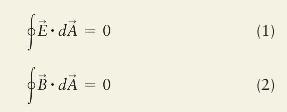
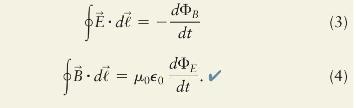
As you saw the magnetic and electric fields in an electromagnetic wave are perpendicular to each other. How do Maxwell's equations in free space (Eqs. 1-4 of Example 30.7) express that perpendicular relationship?Data from Equation 1-4 of Example 30.7 dA (1) dA 0 (2)
An electromagnetic wave with a wavelength of \(600 \mathrm{~nm}\) in vacuum enters a dielectric for which \(\kappa=1.30\). What are the frequency and wavelength of the wave inside the dielectric?
Consider supplying a constant current to a parallel-plate capacitor in which the plates are circular. While the capacitor is charging, what is the direction of the Poynting vector at points that lie on the cylindrical surface surrounding the space between the capacitor plates? What does this
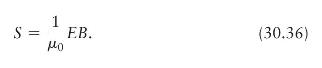
Use Eq. 30.36 to show that the SI units of the Poynting vector are W/m². 1 S= EB. (30.36)
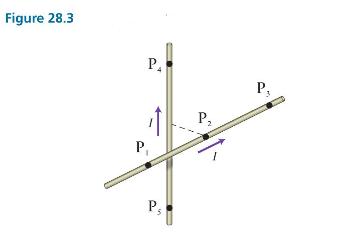
Make a sketch showing the directions of the magnetic forces exerted on each other by (a) an electron moving in the same direction as the current through a wire,(b) a moving charged particle and a stationary charged particle, and(c) two current-carrying wires at a right angle to each other as
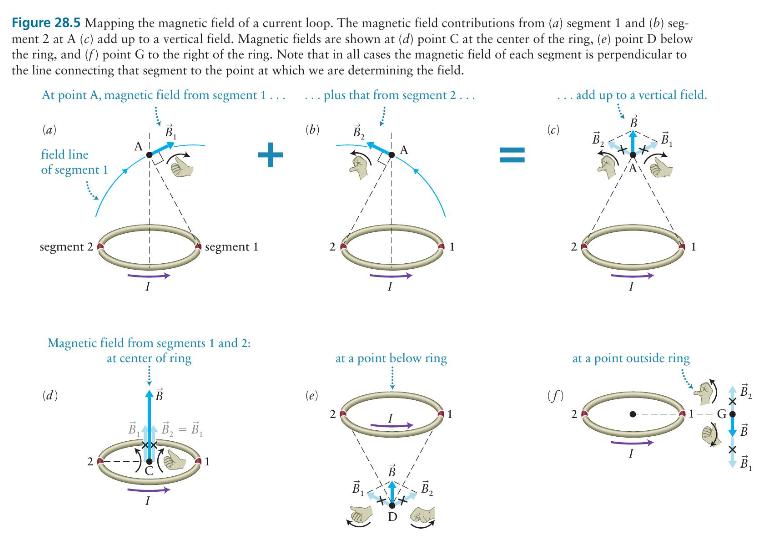
What is the direction of the magnetic field at a point vertically (a) above (b) below segment 1 in Figure 28.5? Figure 28.5 Mapping the magnetic field of a current loop. The magnetic field contributions from (a) segment 1 and (b) seg- ment 2 at A (c) add up to a vertical field. Magnetic fields
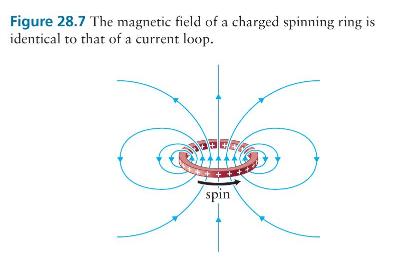
Suppose a negatively charged ring is placed directly above the positively charged ring in Figure 28.7. If both rings spin in the same direction, is the magnetic interaction between them attractive or repulsive? Figure 28.7 The magnetic field of a charged spinning ring is identical to that of a
Does the direction of the electric field along the axis inside an electric dipole coincide with the direction of the electric dipole moment?
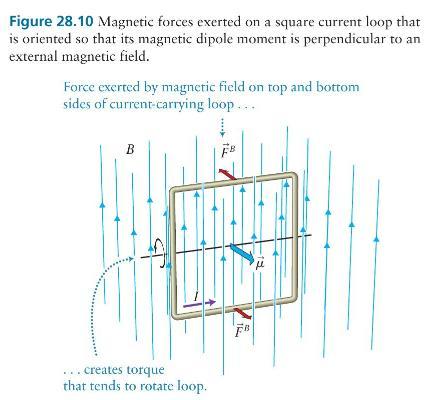
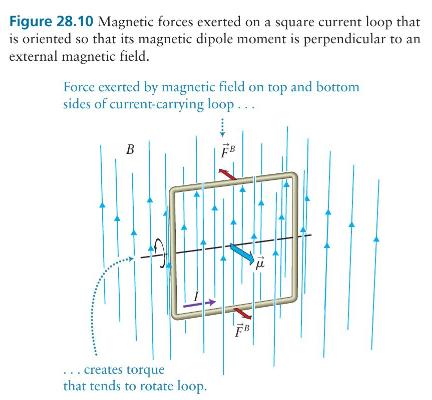
As the current loop in Figure 28.10 rotates over the first \(90^{\circ}\), do the magnitudes of (a) the magnetic force exerted on the horizontal sides and (b) the torque caused by these forces increase, decrease, or stay the same?(c) As the loop rotates, do the two vertical sides experience any
Suppose the square current loop in Figure 28.10 is replaced by a circular loop with a diameter equal to the width of the square loop and with the same current. Does the circular loop experience a torque? If not, why not? If so, how does this torque compare with that on the square loop? Figure 28.10
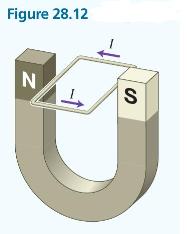
Describe the motion of the current loop in Figure 28.12 if the magnitude of the magnetic field between the poles of the magnet is greater on the left than it is on the right. Figure 28.12 N S
If the magnitude of the current \(I\) through a wire is increased, do you expect the line integral of the magnetic field around a closed path around the wire to increase, decrease, or stay the same?
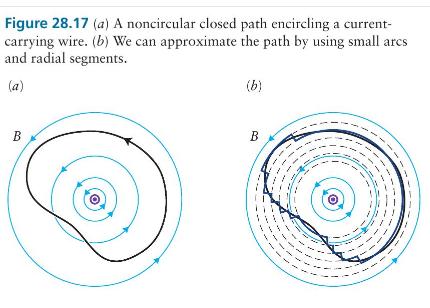
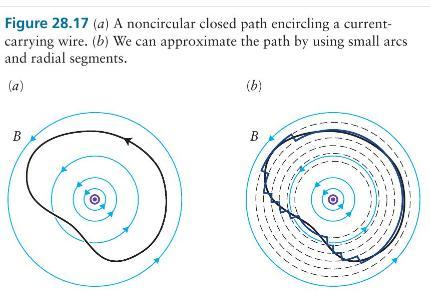
What happens to the value of the line integral along the closed path in Figure \(28.17 a\) when(a) the direction of the current through the wire is reversed;(b) a second wire carrying an identical current is added parallel to and to the right of the first one (but still inside the path);(c) the
Suppose the path in Figure 28.17 were tilted instead of being in a plane perpendicular to the currentcarrying wire. Would this tilt change the value of the line integral of the magnetic field around the path? Figure 28.17 (a) A noncircular closed path encircling a current- carrying wire. (b) We can
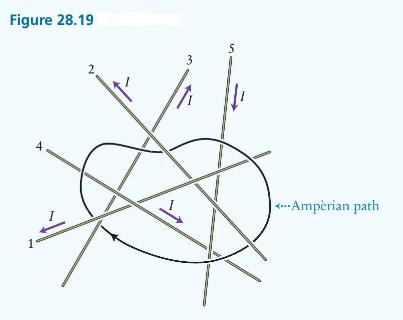
How do the following changes affect the answer to Exercise 28.2:(a) reversing the current through wire \(1,\) (b) reversing the current through wire \(2,\)(c) reversing the direction of the Ampèrian path?Data from Exercises 28.2Consider the Ampèrian path going through the collection of
Suppose the wire in Example 28.3 has a radius \(R\) and the current is uniformly distributed throughout the volume of the wire. Follow the procedure of Example 28.3 to calculate the magnitude of the magnetic field inside \((rR)\) the wire.Data from Example 28.3A long straight wire carries a current
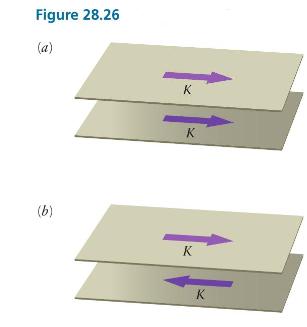
(a) What are the direction and magnitude of the magnetic field between the parallel current-carrying sheets of Figure 28.26a? What is the direction of \(\vec{B}\) outside these sheets? (b) Repeat for the sheets of Figure 28.26b. Figure 28.26 (a) K K (b) K K
Use Ampère's law to determine the magnetic field outside a toroid at a distance \(r\) from the center of the toroid(a) when \(r\) is greater than the toroid's outer radius and(b) when \(r\) is smaller than the toroid's inner radius.
Imagine a long straight wire of semi-infinite length, extending from \(x=0\) to \(x=+\infty\), carrying a current of constant magnitude \(I\). What is the magnitude of the magnetic field at a point \(\mathrm{P}\) located a perpendicular distance \(d\) from the end of the wire that is at \(x=0\) ?
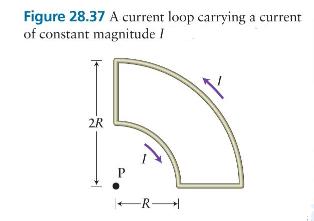
What is the magnitude of the magnetic field(a) at the center of a circular current loop of radius \(R\) and(b) at point \(\mathrm{P}\) near the current loop in Figure 28.37? Both arcs carry a current of constant magnitude I. Figure 28.37 A current loop carrying a current of constant magnitude / 2R
Consider two protons 1 and 2 , each carrying a charge \(+e=\) \(1.6 \times 10^{-19} \mathrm{C}\), separated by \(1.0 \mathrm{~mm}\) moving at \(3 \times 10^{5} \mathrm{~m} / \mathrm{s}\) parallel to each other and perpendicular to their separation.(a) What is the direction of the magnetic force
Consider a conducting wire having a shape of a hexagon carries a current that flows in an anti-clockwise manner when viewed from the above. What is the direction of the magnetic field at the center of the hexagon due to each side of the loop?
A hexagonal wire loop with side \(5 \mathrm{~cm}\) carries a current \(2 \mathrm{~A}\) in a clockwise direction when viewed from the top. Where you can predict the magnitude of the magnetic field inside the loop will be maximum by taking symmetry into consideration?
Consider four identical square current loops arranged in a square with four times the area of one loop. Use this arrangement to predict how the magnetic field far from a small current loop depends on the area of the loop if the current and orientation of the loop is held fixed.
Consider two charged particles 1 and 2, each of them able to translate (move from place to place) and to spin. In which of the following circumstances is there a magnetic interaction between the particles: (a) neither particle translating, neither particle spinning; (b) neither translating, only
A circular current loop lies in the \(x y\) plane of an \(x y z\) coordinate system and is initially oriented so that it carries a clockwise current when viewed from the positive \(z\) axis. It is mounted in such a way that it can rotate about the \(x\)-axis, which passes through its centre,
If a stationary electron experiences a torque when a proton passes near it, then by the principle of relativity, a moving electron also experiences a torque when passing by a stationary proton. The electron orbiting the proton in a hydrogen atom, therefore, experiences a torque due to its intrinsic
A long, straight, current-carrying wire carries a current of magnitude \(3 \mathrm{~A}\). Calculate the magnitude of the magnetic field at a location \(35 \mathrm{~mm}\) away from the wire.
Showing 200 - 300
of 4962
1
2
3
4
5
6
7
8
9
10
11
12
13
14
15
Last
Step by Step Answers

 Get 50% OFF
Claim Now
Get 50% OFF
Claim Now