New Semester
Started
Get
50% OFF
Study Help!
--h --m --s
Claim Now
Question Answers
Textbooks
Find textbooks, questions and answers
Oops, something went wrong!
Change your search query and then try again
S
Books
FREE
Study Help
Expert Questions
Accounting
General Management
Mathematics
Finance
Organizational Behaviour
Law
Physics
Operating System
Management Leadership
Sociology
Programming
Marketing
Database
Computer Network
Economics
Textbooks Solutions
Accounting
Managerial Accounting
Management Leadership
Cost Accounting
Statistics
Business Law
Corporate Finance
Finance
Economics
Auditing
Tutors
Online Tutors
Find a Tutor
Hire a Tutor
Become a Tutor
AI Tutor
AI Study Planner
NEW
Sell Books
Search
Search
Sign In
Register
study help
physics
particle physics
Principles And Practice Of Physics 2nd Global Edition Eric Mazur - Solutions
A long, straight wire carrying a current of 5 A flowing from left to right is placed above a large, flat sheet through which the current per unit width is \(6.0 \mathrm{~A} / \mathrm{m}\) flows from right to left. Calculate the magnitude and direction of the magnetic force per unit length exerted
The magnitude of magnetic field around a straight current carrying wire at a radial point \(25 \mathrm{~mm}\) is \(6 \mathrm{mT}\). (a) At what radial point will the magnitude of magnetic field be \(10 \mathrm{mT}\) ? (b) Calculate the current in the wire.
Two infinitely long, straight, parallel wires are \(6 \mathrm{~cm}\) apart, carrying currents \(2 \mathrm{~A}\) and \(4 \mathrm{~A}\), respectively, in the same direction. A third infinitely long, straight wire, parallel to the other two, and carrying a current \(I\), lies between the two wires.
An electron travels at a velocity of \(3.0 \times 10^{6} \mathrm{~m} / \mathrm{s}\) parallel to a sheet carrying a current to the right. When a uniform electric field of magnitude \(200 \mathrm{~V} / \mathrm{m}\) is applied, it travels at an angle of \(45^{\circ}\) to the current in the sheet, with
An electric current is uniformly distributed throughout a long, straight wire that has a diameter of \(10 \mathrm{~mm}\). If the current through the wire is \(3.0 \mathrm{~A}\), calculate the magnitude of the magnetic field(a) \(4 \mathrm{~mm}\) radially away from the wire center(b) \(12
Two large, flat current-carrying sheets are placed parallel to each other, one sheet above the other. The upper sheet carries a current \(1.0 \mathrm{~A}\) per unit of width to the left, and the lower sheet carries a current 3.0 A per unit of width to the right. Calculate the magnitude of the
An electron travels to the right at \(2.5 \times 10^{6} \mathrm{~m} / \mathrm{s}\) between two large, flat sheets that are parallel to each other and to the electron's line of motion. A current per unit width of \(8.0 \mathrm{~A} / \mathrm{m}\) flows to the right through the top sheet.(a) What
An electron travels at a constant velocity at a distance \(d_{1}=4.0 \mathrm{~mm}\) above a large sheet of metal that carries a current of \(3 \mathrm{~A}\), and at a distance \(d_{2}=3.0 \mathrm{~mm}\) below a very long wire that carries a current \(0.5 \mathrm{~A}\). The wire is parallel to the
A coaxial cable carries a current \(I_{\text {wire }}\) in its inner conducting wire and a current \(I_{\text {shell }}\) in its outer conducting shell. The radius of the wire is \(R_{\text {wire }}\), the distance from the cable center to the inside of the shell is \(R_{\text {shell, }}\), and the
A particle is shot at a velocity of \(3 \times 10^{4} \mathrm{~m} / \mathrm{s}\) to the right and enters the magnetic field generated by a large, flat current-carrying sheet. The current in the sheet is parallel to the particle's initial line of motion. The particle exits the magnetic field \(6.8
A long solenoid having 16 windings per centimeter of length carries a current of \(0.8 \mathrm{~A}\). Calculate the magnitude of magnetic field inside the solenoid.
Considering the magnetic field produced at the center of solenoid is uniform, one need to produce a magnetic field of magnitude \(0.06 \mathrm{~T}\). If the available current that one can use to flow through the windings is \(12 \mathrm{~A}\), calculate the number of windings per centimeter the
A long solenoid with 1000 windings per meter is placed with its central axis parallel to the \(y\) axis and \(20 \mathrm{~mm}\) above a sheet of metal that is \(0.5 \mathrm{~m}\) wide in the \(y\) direction and carries a uniform current of \(20 \mathrm{~A}\) in the positive \(x\) direction. What
A small coil, of area \(2 \mathrm{~cm}^{2}\), carries a current of \(1.5 \mathrm{~A}\). The coil is suspended inside a solenoid at an angle of \(45^{\circ}\) with respect to the magnetic field. The solenoid has 500 turns per meter of length and carries a current of \(4.0 \mathrm{~A}\). Calculate
If the magnitude of magnetic field produced at a radial distance of \(8.5 \times 10^{-2} \mathrm{~m}\) from the center of a toroid of 300 windings is equal to the magnetic field produced inside a solenoid, then calculate the number of turns per unit length of the solenoid. Consider the same current
A current of 10 A flows through a toroid that has 300 circular windings per meter measured along the interior edge of the windings. The radius of each circular winding is \(20 \mathrm{~cm}\), and the inner radius of the toroid is \(40 \mathrm{~cm}\). Find the magnitude of the magnetic field at \(30
A \(100-\mathrm{mm}\) section of wire is bent into a circular arc. What must the radius of the arc be for a current of \(6.0 \mathrm{~A}\) to produce a magnetic field of \(7.5 \times 10^{-5} \mathrm{~T}\) at the centre of the arc?
The magnetic field a distance \(z\) above the centre of a circular loop of radius \(r\) carrying current \(I\) in the \(x y\) plane is \(\vec{B}=\frac{\mu_{0} I r^{2}}{2\left(r^{2}+z^{2}\right)^{3 / 2}} \hat{k}\). (a) Use this result to re-derive the formula for the magnetic field inside a very
A small coil, of area \(2 \mathrm{~cm}^{2}\), carries a current of \(1.5 \mathrm{~A}\). The coil is suspended inside a solenoid at an angle of \(45^{\circ}\) with respect to the magnetic field. The solenoid has 500 turns per meter of length and carries a current of \(4.0 \mathrm{~A}\). Calculate
One runs into trouble when trying to apply Ampère's law to the magnetic field of a moving charge. For instance, what is the current enclosed by an Ampèrian path that encircles the path of the particle? Because of the discrete nature of the charge, any sensible denition is zero most of the time
The electromagnetic force between two particles, both of mass \(m\), with one having charge \(+q\) and the other having charge \(-q\) can cause them to orbit in a circle around the centre of the line that connects them.(a) Relate their velocities to their separation distance \(d\).(b) Without the
The length of a straight solenoid is \(50 \mathrm{~cm}\). If a current of 12 A flows through the solenoid produces a magnetic field of magnitude \(0.06 \mathrm{~T}\) inside it, calculate the number of windings.
Two parallel rods having length \(12 \mathrm{~cm}\) and a separation of \(50 \mathrm{~cm}\) carry current from left to right. If current through wire 1 is \(10 \mathrm{~A}\) and through wire 2 is \(12 \mathrm{~A}\), calculate the magnitude and direction of the magnetic force per unit length exerted
A wire segment of \(1.0 \mathrm{~m}\) and carrying a current of \(5.0 \mathrm{~A}\) is held in a plane in which it can rotate and translate with little friction. A long wire is fixed parallel to this plane, perpendicular to the \(1.0 \mathrm{~m}\) wire and \(50 \mathrm{~mm}\) above its centre. (a)
You have a solenoid for which a current \(I\) per winding produces a magnetic field of magnitude \(B_{1}\) inside the soleniod. You cut the solenoid open parallel to its symmetry axis. You then carefully bend it open to form a flat sheet of parallel wires and electrically connect the wire ends on
You need to design a square toroid such that the magnetic field in the centre of the square windings is \(0.0020 \mathrm{~T}\), and the side length of a square winding is \(3 \mathrm{~cm}\). The wire you are using can carry a current of at most \(0.5 \mathrm{~A}\). The magnetic field anywhere
Is it possible separate positive and negative charges unequally in two objects by a charge-separating method or by any mechanical equipment?
If you are designing a Van de Graaff generator, would you prefer to replace the spherical metallic dome with a dome of some other shape to achieve better charge storage? Justify your answer.
A piece of wool is used to charge two plastic spheres of negligible radius. When the spheres are held \(20 \mathrm{~mm}\) apart, they repel each other with \(16 \mathrm{~N}\) of force. If the wool ends up with a surplus positive charge of \(30 \mu \mathrm{C}\), what is the charge on each of the two
Suppose two capacitor plates have an area of \(1 \mathrm{~cm}^{2}\) and are initially separated by \(2 \mathrm{~mm}\). Each plate holds \(5 \mu \mathrm{C}\) of charge. How much energy is required to double the plate separation?
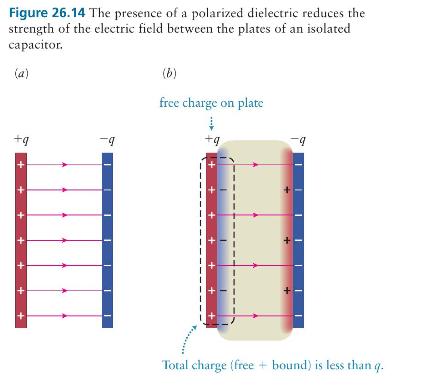
A capacitor connected to a battery initially holds a charge of \(+q\) on its positive plate and \(-q\) on its negative plate. The electric field between the plates is initially \(\vec{E}\). A dielectric material is then inserted that polarizes in such a way as to produce an electric field of
A capacitor initially has a charge of magnitude \(q\) on each plate. When a dielectric is inserted between the plates, the bound surface charge on the two dielectric surfaces facing the plates has a magnitude \(q / 4\). What is the ratio of the electric field magnitude in the empty capacitor to the
The term emf (electromotive force) represents work done per unit charge. Why, then, is it termed erroneously as "force" (or electromotive force)?
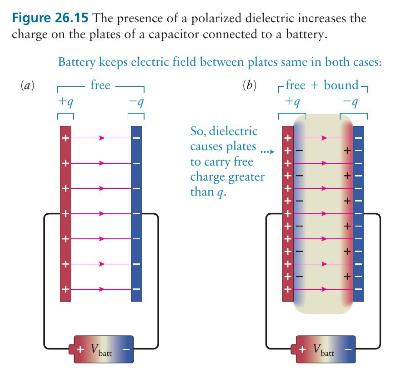
A \(10-\mathrm{V}\) battery is used for a capacitor to get charged with air inside the plates. If the air is replaced with mica, will the voltage of the battery reduce if it is given that mica has higher dielectric constant value than air?
Suppose that the metal electrodes in a battery are shaped like large parallel plates and are \(2.00 \mathrm{~mm}\) apart so that they are essentially a parallel-plate capacitor. If the battery supplies a potential difference of \(1.5 \mathrm{~V}\) between the electrodes, what is the surface charge
A capacitor having capacitance \(10 \mathrm{pF}\) is connected to a \(9-\mathrm{V}\) battery. If you consider a cylindrical Gaussian surface around the capacitor, calculate the net electric flux through it when the capacitor is operational.
Can you increase the capacitance of a parallel plate capacitor to infinity? Explain your answer.
A coaxial capacitor consisting of an inner wire and an outer cylindrical shell has a length of \(50 \mathrm{~cm}\) and an outer diameter of \(4 \mathrm{~mm}\). When connected to a \(16.0-\mathrm{V}\) battery, this capacitor can hold \(3 \mathrm{nC}\) of charge on the wire. What is the wire radius?
How is Farad is a high unit of measuring the capacitance? Explain your argument by considering a parallelplate capacitor having a plate separation of (d) \(20 \mathrm{~cm}\) and plate area \(\mathrm{Am}^{2}\).
In a parallel plate capacitor, transfer of \(2 \times 10^{36}\) electrons takes place when connected to a \(12-\mathrm{V}\) battery. Estimate the energy stored in the capacitor.
Suppose a certain battery has an internal emf of \(15 \mathrm{~V}\) but the potential difference across its terminals is only \(80 \%\) of that value. If that battery is connected to a \(47 \mu \mathrm{F}\) capacitor, how much energy is stored when the capacitor is fully charged?
If you are constructing a parallel-plate capacitor, having air and paper as the dielectric medium between the plates, which dielectric material within the plates will make the capacitor act better? Justify your answer.
A parallel-plate capacitor with air between its plates can hold \(6 \mathrm{pC}\) of charge per volt of potential difference across its plates. When a barium titanate dielectric slab completely fills the space between the plates and the capacitor is connected to a \(9.0-\mathrm{V}\) battery, what
A spherical capacitor has an inner radius of \(5 \mathrm{~cm}\) and an outer radius of \(6 \mathrm{~cm}\). With air between the spheres, the capacitor is connected to a \(12-\mathrm{V}\) battery and allowed to charge fully. With the battery still connected, oil \((\kappa=2.2\) is poured in, filling
A solid conducting sphere of radius \(R\) and carrying charge \(+q\) is embedded in an electrically neutral nonconducting spherical shell of inner radius \(R\) and outer radius \(2 R\). The material of which the shell is made has a dielectric constant of 4.0.(a) Relative to a potential of zero at
A solid conducting sphere of radius \(R=10 \mathrm{~cm}\) is embedded in an electrically neutral nonconducting spherical shell that has inner radius \(R\), outer radius \(2 R\), and is made of a material having dielectric constant \(\kappa\). The potential at the center of the sphere is \(540
Why are capacitors used in external defibrillators instead of high-voltage batteries?
When a parallel-plate capacitor has air between its plates and is connected to a \(12.0-\mathrm{V}\) battery, its capacitance is \(33 \mathrm{nF}\). The capacitor is then submerged in distilled water. What is the charge on the plates (a) if the capacitor is submerged with the battery connected
Because we cannot see any obvious difference between the ends of a bar magnet, could it be that like poles attract each other and unlike poles repel each other?
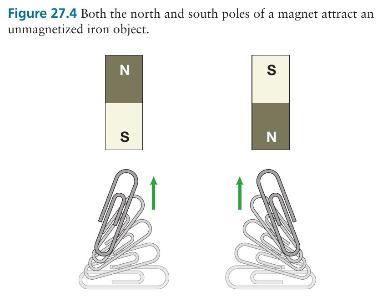
(a) Is the interaction between a charged object and an electrically neutral object always attractive? Why or why not? (b) In Figure 27.4, which type of magnetic pole is induced at the top of each paper clip? S Figure 27.4 Both the north and south poles of a magnet attract an unmagnetized iron
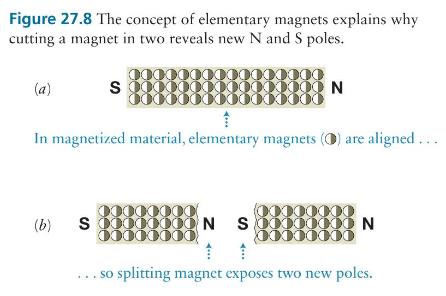
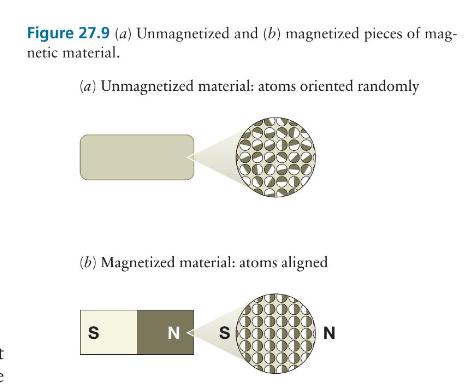
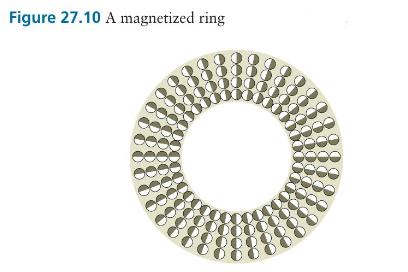
(a) Draw the elementary magnets inside a bar magnet and a horseshoe magnet, using the half-filled-circle format shown in Figures 27.8 and 27.9.(b) How many poles does the magnetized ring in Figure \(\mathbf{2 7 . 1 0}\) have?(c) If someone gave you such a ring, how could you verify that it is
(a) Which end of a compass needle is a north pole: the end that points toward Earth's North Pole or the other end? (b) If you place a compass near the north pole of a magnet, what happens to the compass needle? (c) Is Earth's geographic North Pole a magnetic north pole?
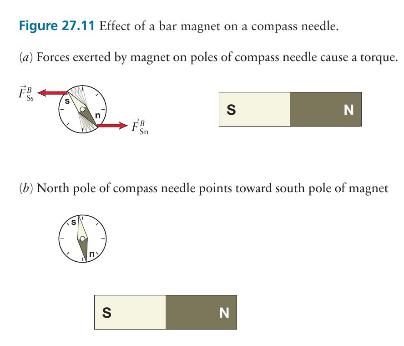
(a) What is the effect of the north pole of the bar magnet on the compass needle in Figure 27.11a? (b) What is the combined effect of the bar magnet's north and south poles on the needle? (c) A compass placed in the position shown in Figure \(27.11 b\) aligns itself in the direction indicated. What
(a) Consider a single elementary magnet inside a closed surface. Given that elementary magnets are particles without spatial extent, is the magnetic field line flux through the closed surface positive, negative, or zero? (b) Does adding a second elementary magnet inside the closed surface change
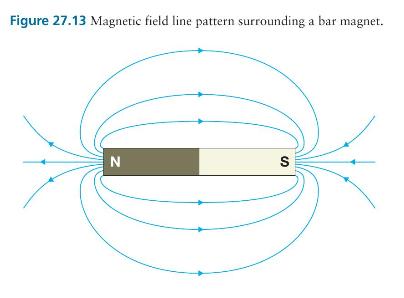
What is the direction of the magnetic field lines inside the bar magnet of Figure 27.13? Figure 27.13 Magnetic field line pattern surrounding a bar magnet. N S
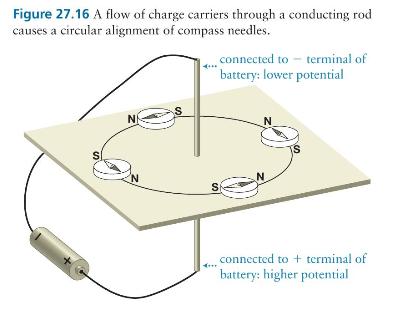
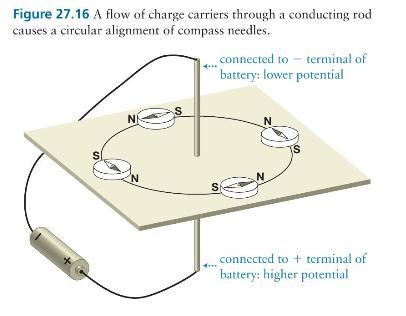
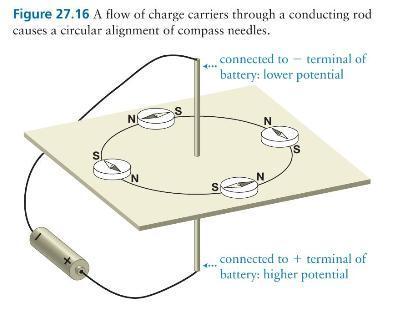
(a) Is the rod in Figure 27.16 electrically charged while connected to the battery? (b) Is there an electric field due to the rod at the positions of the compasses in Figure 27.16? Figure 27.16 A flow of charge carriers through a conducting rod causes a circular alignment of compass needles.
Sketch the magnetic field line pattern in the horizontal plane around the rod in Figure 27.16. Figure 27.16 A flow of charge carriers through a conducting rod causes a circular alignment of compass needles. connected to terminal of battery: lower potential S N N S N connected to + terminal of
Can you replace the current-carrying rod of Figure 27.16 by a magnet and get the same magnetic field? Figure 27.16 A flow of charge carriers through a conducting rod causes a circular alignment of compass needles. connected to terminal of battery: lower potential S NH N S N connected to + terminal
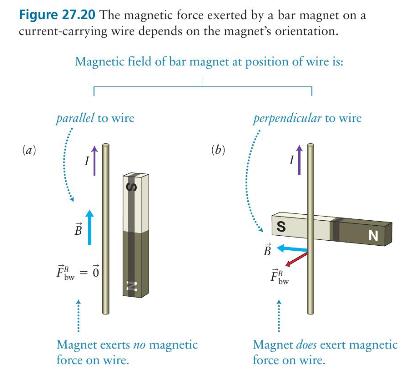
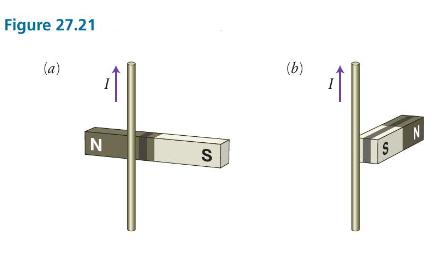
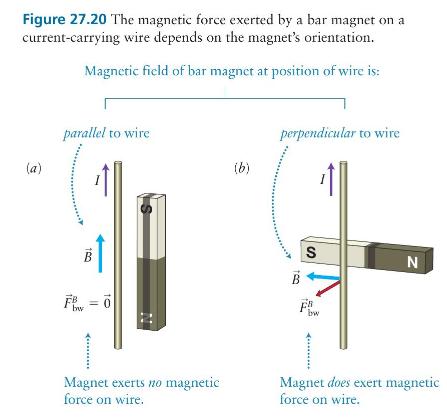
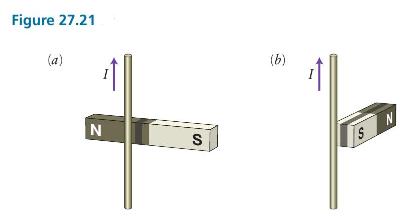
Use Figure 27.20 to determine the direction of the magnetic force exerted by the magnet on the wire when the magnet is in the orientations shown(a) in Figure 27.21a(b) in Figure 27.21b. Figure 27.20 The magnetic force exerted by a bar magnet on a current-carrying wire depends on the magnet's
Determine the directions of the forces exerted by two parallel rods with currents in the same direction.
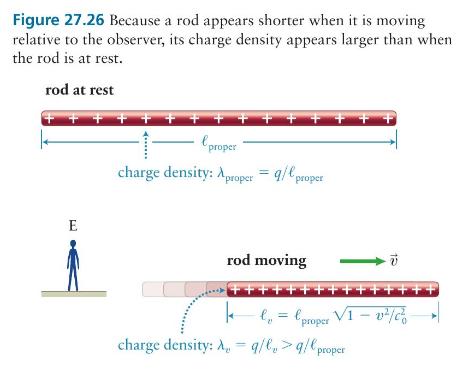
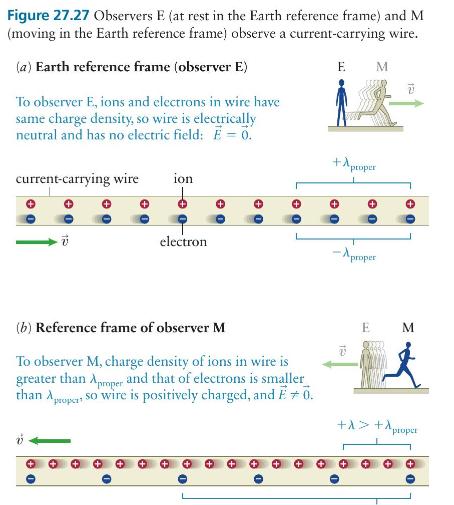
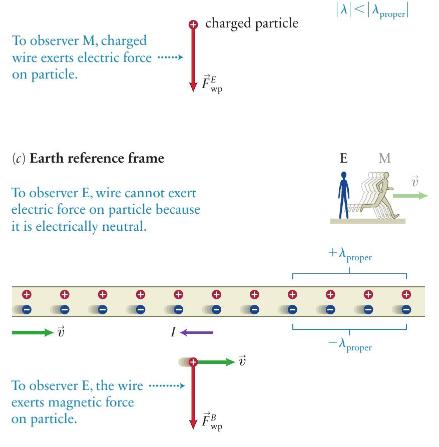
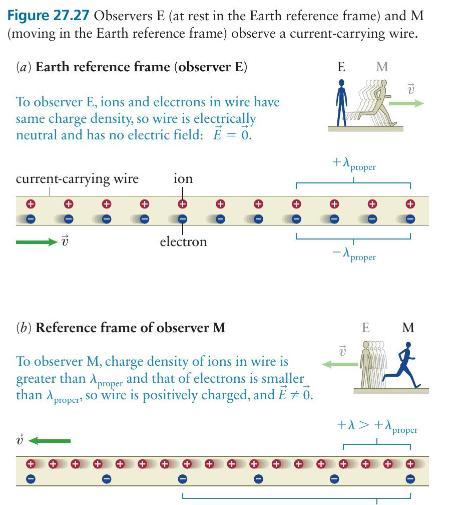
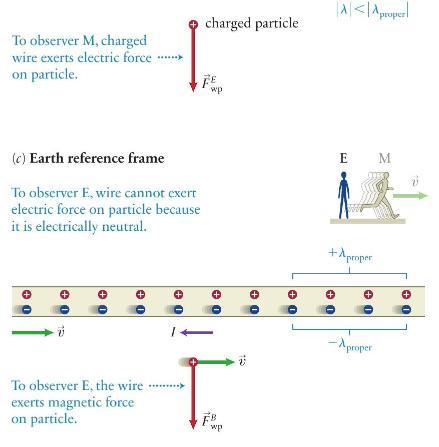
Consider the two identical rods in Figure 27.26, one moving and the other at rest relative to observer E, at rest in the Earth reference frame. Suppose a second observer \(\mathrm{M}\) moves along with the moving rod.(a) Which rod has the greater charge density according to observer M?(b) Suppose
What is the direction of current through the rod in(a) Figure 27.27b and(b) Figure 27.27c?(c) Is the direction of the force in Figure \(27.27 c\) in agreement with what we learned about the interaction of two parallel current-carrying wires in Section 27.3?(d) If the particle moving alongside the
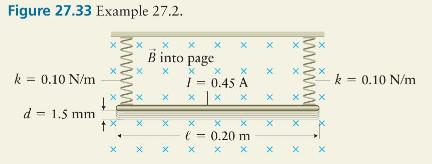
Suppose the charge carriers flowing through the horizontal bar in Example 27.2 are negatively charged. In which direction must they flow so that the magnetic force exerted on the wire is still directed upward?Data from Example 27.2A metal bar \(0.20 \mathrm{~m}\) long is suspended from two springs,
A cube \(1.0 \mathrm{~m}\) on each side is placed in a \(1.0-\mathrm{T}\) magnetic field with the field perpendicular to one surface of the cube. What are (a) the magnetic flux through the side through which the field enters the cube and (b) the magnetic flux through the entire surface of the
A proton and an electron travel through a region of uniform magnetic field \(\vec{B}\). If their speeds are the same, what is the ratio \(R_{\mathrm{p}} / R_{\mathrm{e}}\) of the radii of their circular paths through the field?
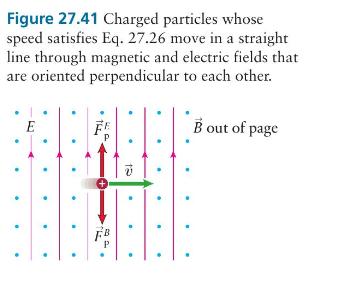
In Figure 27.41, do \(\vec{F}_{\mathrm{p}}^{B}\) and \(\vec{F}_{\mathrm{p}}^{E}\) still cancel if the charged particle(a) carries a negative charge,(b) travels in the opposite direction,(c) travels at a slight angle to the two fields? Figure 27.41 Charged particles whose speed satisfies Eq. 27.26
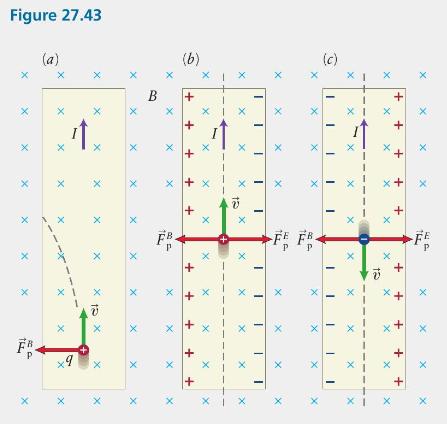
(a) Express the magnitude of the electric field inside the strip in Figure 27.43 in terms of the width \(w\) of the strip and the potential difference \(V_{\mathrm{RL}}\). (b) Given the magnitude \(B\) of the magnetic field, what is the speed at which the charge carriers travel? (c) Show how this
Explain why the \(1 / r\) dependence expressed in Eq. 27.38 is consistent with the symmetry of the wire causing the magnetic field. B = = 2kI rco 2k I (27.38) &
A compass sits on a table with its needle pointing to Earth's North Pole. A bar magnet with its long axis oriented along an east-west line is brought toward the compass from the east. If the needle turns clockwise, which pole of the bar magnet is nearer the compass?
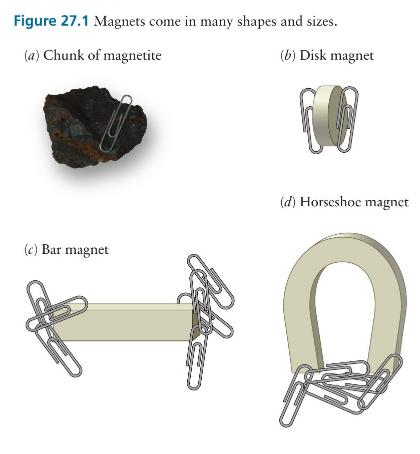
Draw the magnetic field lines associated with the magnets in Figures \(27.1 b-d\) (both outside and inside the magnets). Assume that the pole on the left of each magnet is the north pole. Figure 27.1 Magnets come in many shapes and sizes. (a) Chunk of magnetite (c) Bar magnet (b) Disk magnet (d)
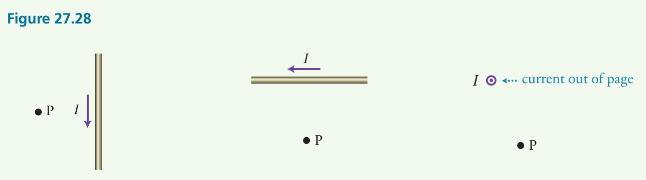
For each situation shown in Figure 27.28, apply the appropriate right-hand rule to determine the direction at position \(\mathrm{P}\) of the magnetic field generated by the current-carrying wire. Figure 27.28 P current out of page P
For each situation in Figures \(27.20a, 27.20 b\), and \(27.21 a\), reverse the polarity of the magnet and then apply the appropriate right-hand rule to determine the direction of the force exerted by the bar magnet on the current-carrying wire. Figure 27.20 The magnetic force exerted by a bar
You place two magnets side by side but, instead of attracting, the magnets repel each other. Provide a possible explanation of your observation.
Is it possible to separate the north pole from the south pole of a bar magnet by cutting it in half? Explain your reasoning.
How can the direction of the magnetic field at a certain point along a curved field be determined?
A \(0.40-\mathrm{m}\) wire carries a current of \(1.7 \mathrm{~A}\) and is at angle to a \(0.20-\mathrm{T}\) uniform external magnetic field. What must be the angle between the wire and the magnetic field so that the field exerts a force of \(0.068 \mathrm{~N}\) on the wire?
A square loop of side \(a=50 \mathrm{~cm}\) is suspended from the left arm of a scale, which is kept at equilibrium by adding weights to the right side. The lower half of the loop is in a uniform magnetic field of magnitude \(0.4 \mathrm{~T}\), orthogonal to the surface of the loop, but the upper
A square loop of side length \(1 \mathrm{~m}\) is placed on a wooden table in a uniform magnetic field of magnitude \(0.5 \mathrm{~T}\). The greatest magnetic flux through the loop is measured when the loop is flat on the table.(a) What is the direction of the magnetic field?(b) What is the flux
A circular loop of diameter \(150 \mathrm{~mm}\) is placed on a wooden table that makes angle of \(24.5^{\circ}\) with a uniform magnetic field. What must be the magnitude of the magnetic field if the magnetic flux through the loop is \(4.20 \times 10^{-4} \mathrm{~T} \cdot \mathrm{m}^{2}\) ?
A square loop of wire has a perimeter of \(60 \mathrm{~cm}\) and is oriented such that two of its parallel sides form a \(30^{\circ}\) angle with the horizontal. A uniform horizontal magnetic field of magnitude 0.2 T passes through the loop.(a) Calculate the magnetic flux through the loop.(b)
An electron is moving at speed \(7.0 \times 10^{10} \mathrm{~m} / \mathrm{s}\) perpendicular to a uniform magnetic field of magnitude \(0.80 \mathrm{~T}\).(a) What is the diameter of the circular path that the electron follows? Calculate the electron's(b) angular frequency(c) period of motion.
An electron that has been accelerated through a \(100-\mathrm{V}\) potential difference moves in a circular orbit perpendicular to a uniform magnetic field of magnitude 0.4 T. For this electron, determine (a) its speed,(b) its angular frequency and period of motion, (c) the radius of its orbit.
The isotopes magnesium-24 (mass \(3.983 \times 10^{-26} \mathrm{~kg}\) ) and magnesium-26 (mass \(4.315 \times 10^{-26} \mathrm{~kg}\) ) are to be separated using a mass spectrometer in which the magnetic field magnitude is \(0.4 \mathrm{~T}\). The ions used are the ones that have lost one electron
A particle that has mass \(m\) and charge \(q\) enters a uniform magnetic field of magnitude \(B\). The initial velocity \(v\) of the particle forms an angle of \(30^{\circ}\) with the magnetic field. After some time \(t\), the velocity of the particle has the same magnitude and direction that it
A horizontal metal strip \(1.0 \mathrm{~mm}\) thick and \(10 \mathrm{~mm}\) wide carries a 12-A current along its length, and both the length and the width are perpendicular to a uniform magnetic field of magnitude \(1.0 \mathrm{~T}\) that is directed vertically up. The potential difference across
When a wire \(2.0 \mathrm{~m}\) long carries a 10-A current in the \(+x\) direction in a uniform external magnetic field, the magnetic force exerted by the field on the wire is \(3 \mathrm{~N}\) in the \(+y\) direction. When the wire is rotated until the charge carriers travel in the \(+y\)
A positively charged particle of mass \(m\) and charge \(+q\) moves in a circle of radius \(r\) in a uniform magnetic field of magnitude \(B\). How does the radius of the particle's motion change when (a) the magnitude of the magnetic field is reduced into half,(b) the mass of the charge is
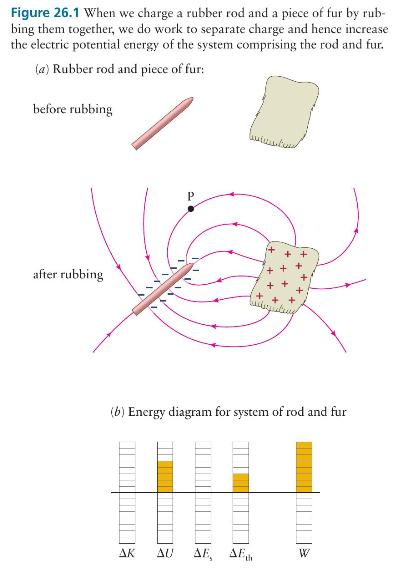
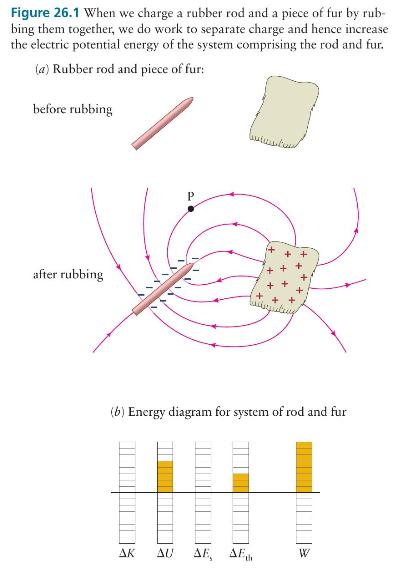
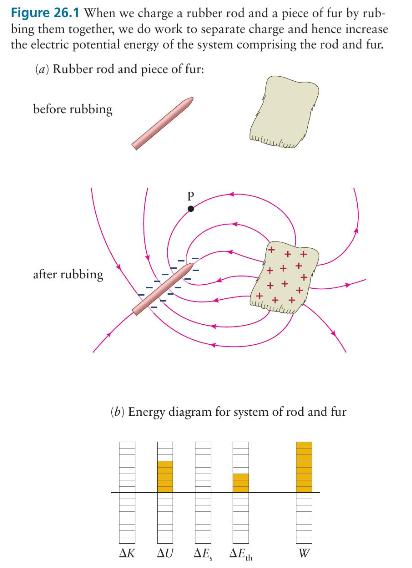
Suppose you repeat the charging (starting again with uncharged rod and fur), but this time you rub longer and twice as much charge accumulates at each point on the two objects. How do the following quantities compare to what they were after the first charging: (i) the direction and magnitude of the
Will doubling the separation distance between the charged rod and fur in Figure 26.1a increase, decrease, or not change the potential energy of the rod-fur system? Figure 26.1 When we charge a rubber rod and a piece of fur by rub- bing them together, we do work to separate charge and hence increase
If you include the person doing the rubbing in the system considered in Figure 26.1, what is the resulting energy diagram? Figure 26.1 When we charge a rubber rod and a piece of fur by rub- bing them together, we do work to separate charge and hence increase the electric potential energy of the
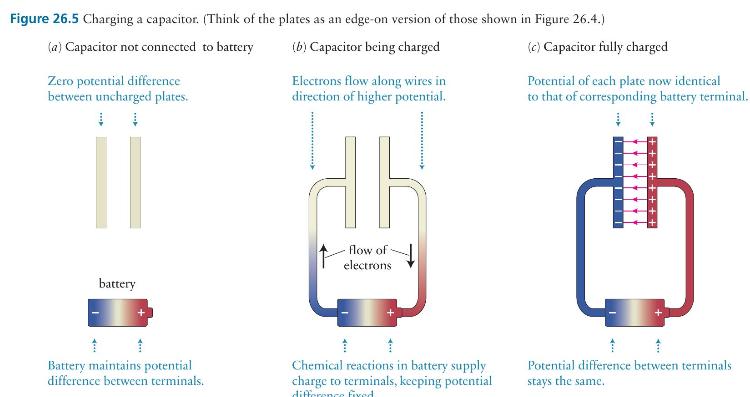
(a) Suppose that we disconnect the wires from the plates after the capacitor is charged as shown in Figure \(26.5 \mathrm{c}\). How does the potential difference between the plates after the wires are disconnected compare to that just before they are disconnected?(b) If we replace the battery in
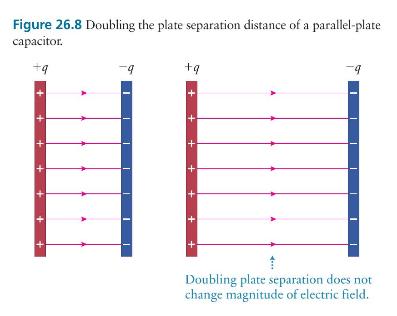
Suppose the two capacitors in Figure 26.8 are each connected to a 9-V battery.(a) Which of the two capacitors stores the greater amount of charge?(b) If, instead of the separation distance increasing, the area of the plates of the capacitor is halved and then the capacitor is connected to a
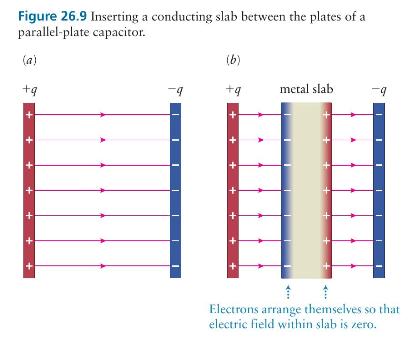
Suppose the capacitor in Figure \(26.9 a\) is charged and then disconnected from the battery.(a) As the conducting slab is inserted in the capacitor, as in Figure 26.9b, does the amount of charge on the capacitor plates increase, decrease, or stay the same?(b) How much charge accumulates on each
(a) Does the position of the slab in Figure 26.9 affect the potential difference across the capacitor? Consider, in particular, the case in which the slab is moved all the way to one side and makes electrical contact with one of the plates. (b) Sketch the potential \(V(x)\) as a function of \(x\),
Why are the electrons displaced in a direction opposite the electric field?
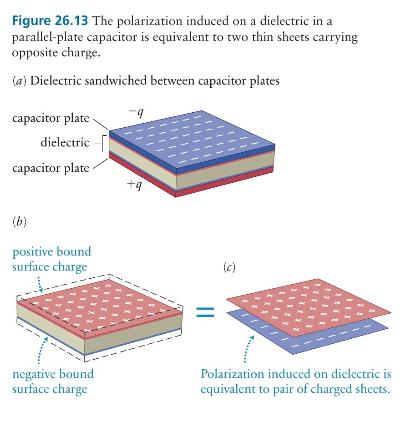
(a) In which direction does the electric field due to the bound surface charge point at a location above the top surface in Figure 26.13c?(b) In which direction does it point at a location between the top and bottom surfaces? Figure 26.13 The polarization induced on a dielectric in a parallel-plate
(a) If the magnitude of the bound surface charge on the dielectric slab in Figure \(26.14 b\) were equal to the magnitude of the free charge on the capacitor plates, what would be the electric field inside the capacitor?(b) Could the magnitude of the bound surface charge ever be greater than the
Given that the electric field is the same in both capacitors in Figure 26.15, which stores the greater amount of electric potential energy? Figure 26.15 The presence of a polarized dielectric increases the charge on the plates of a capacitor connected to a battery. (a) Battery keeps electric field
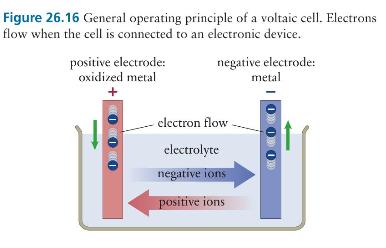
As electrons leave one terminal and are added to the other, ions in the electrolyte must flow in the direction indicated in Figure 26.16 to maintain an even distribution of charge. What must be the direction of the electric field in the bulk of the electrolyte to cause this flow? Figure 26.16
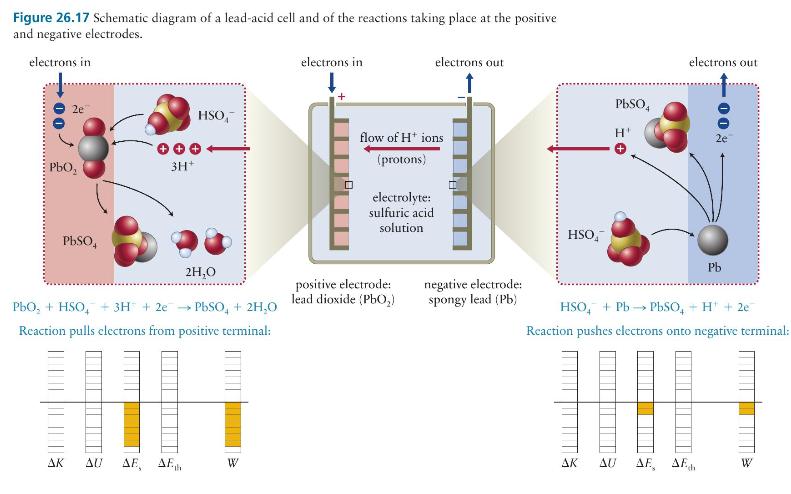
Given that the cell does positive work on the electrons, why is it that the work in both energy diagrams in Figure 26.17 is negative? Figure 26.17 Schematic diagram of a lead-acid cell and of the reactions taking place at the positive and negative electrodes. electrons in 2e 3H+ PbSO4 HSO
Showing 300 - 400
of 4962
1
2
3
4
5
6
7
8
9
10
11
12
13
14
15
Last
Step by Step Answers

 Get 50% OFF
Claim Now
Get 50% OFF
Claim Now