New Semester
Started
Get
50% OFF
Study Help!
--h --m --s
Claim Now
Question Answers
Textbooks
Find textbooks, questions and answers
Oops, something went wrong!
Change your search query and then try again
S
Books
FREE
Study Help
Expert Questions
Accounting
General Management
Mathematics
Finance
Organizational Behaviour
Law
Physics
Operating System
Management Leadership
Sociology
Programming
Marketing
Database
Computer Network
Economics
Textbooks Solutions
Accounting
Managerial Accounting
Management Leadership
Cost Accounting
Statistics
Business Law
Corporate Finance
Finance
Economics
Auditing
Tutors
Online Tutors
Find a Tutor
Hire a Tutor
Become a Tutor
AI Tutor
AI Study Planner
NEW
Sell Books
Search
Search
Sign In
Register
study help
physics
particle physics
Principles And Practice Of Physics 2nd Edition Eric Mazur - Solutions
Two charges \(+q\), each having same mass \(m\), were placed at rest at a distance of \(10 \mathrm{~cm}\) and \(20 \mathrm{~cm}\) above an infinite sheet that has been negatively charged with surface density \(\sigma\). Compare the acceleration of the two charges.
An electron is fired toward a nonconducting infinite sheet carrying a uniformly distributed charge from 5.00 \(\mathrm{m}\) away. The electron has an initial speed of \(3 \times 10^{6} \mathrm{~m} / \mathrm{s}\) along a line perpendicular to the sheet. The electron reverses its motion when it is
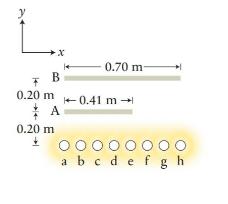
Figure P33.1 shows eight point sources of light, \(a-h\), and two detectors, A and B. The point sources are evenly spaced, with \(0.10 \mathrm{~m}\) between adjacent sources, and detector A shields part of detector B from the point sources. If no light is reflected from any nearby objects, how many
A point source is fixed \(1.0 \mathrm{~m}\) away from a large screen. Call the line normal to the screen surface and passing through the center of the point source the \(z\) axis. When a sheet of cardboard in which a square hole \(0.040 \mathrm{~m}\) on a side has been cut is placed between the
A thin, flat object in which a square hole \(30.0 \mathrm{~mm}\) on a side has been cut is illuminated with a point source. Light that passes through the hole strikes a screen \(300 \mathrm{~mm}\) behind the object. Call the direction normal to the screen the \(z\) direction. The point source is
Sunlight that reaches Earth is blocked by Earth from traveling any farther, so that the region on the side of Earth facing away from the Sun is in shadow. The portion of this region in complete shadow is the umbra, and the portion in partial shadow is the penumbra. The Sun's radius is \(7.0 \times
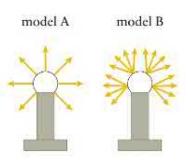
Two models of light emitted from a light bulb are illustrated in Figure P33.5. (a) Describe the difference in the behavior of light in each model. (b) Describe an experiment that can determine which model of light is more accurate.Data from Figure P33.5 model A model B
An aquarium light bulb has a long, straight glowing filament surrounded by a tubular, clear glass bulb. This lighted bulb, with its filament oriented vertically, is placed \(1.0 \mathrm{~m}\) from a screen in an otherwise dark room. A thin sheet of cardboard is placed halfway between the filament
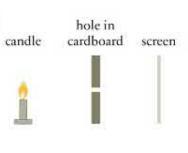
A burning candle is placed in front of a screen, and a sheet of cardboard with a small round hole in it is inserted between the candle and the screen as shown in Figure P33.7. Describe the pattern of light that appears on the screen.Data from Figure P33.7 hole in candle cardboard screen
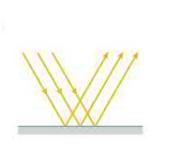
Figure P33.8 shows light rays reflected from a smooth surface. Draw three wavefronts along the rays that have not yet struck the surface and three wavefronts along the reflected rays.Data from Figure P33.8
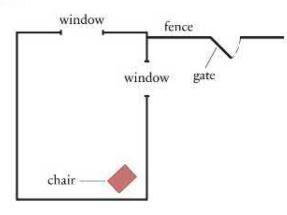
For the room shown in Figure P33.9, draw a diagram that shows where a mirror should be mounted so that a person sitting in the chair has a full view of the gate in the fence outside.Data from Figure P33.9 window fence chair window gate
A classmate exclaims about the professor's bright blue shirt, "Wow, that shirt has a lot of blue in it!" Evaluate your classmate's statement.
A flat mirror oriented perpendicular to the \(y\) axis of a Cartesian coordinate system extends along the \(x\) axis from \(x=0\) to \(x=4.0 \mathrm{~m}\). An object is located in the \(x y\) plane at the point \((1.0 \mathrm{~m}, 2. 0 \mathrm{~m})\). With your eye in the \(x y\) plane in the range
The bottom edge of a wall-mounted mirror aligns with your waist, and the top edge aligns with a point somewhere above your head. Draw a diagram that illustrates, when you stand in front of this mirror, the portion of your whole body that you can see in the image.
The minimum height of a wall mirror in which you can view your entire body is half your height, with the distance from the floor to the bottom of the mirror equal to half the distance between your eyes and feet. This relationship between mirror height/position and object height does not hold for
Standing \(1.0 \mathrm{~m}\) away from a large mirror, you see an image of a flashlight in the mirror. If the image appears to be \(2.0 \mathrm{~m}\) behind the mirror, \(1.0 \mathrm{~m}\) vertically above your eyes, and \(3.0 \mathrm{~m}\) to your right (your actual right, not your reflection's
A classmate believes that the image you see in a mirror is on the mirror surface rather than behind the mirror. What is something you can do to convince your classmate he is incorrect?
A woman holds a mirror stationary and perfectly verti\(\mathrm{cal}\) as a boy runs toward it at a speed of \(1.0 \mathrm{~m} / \mathrm{s}\). (a) In her reference frame, what does the woman observe for the speed at which the boy and his reflection move toward the mirror? (b) In the reference frame
Consider this statement: Think of the reflection of the Moon on a cloudless night: Look in the ocean, you see a large moon. Look in a pond; the same moon is there. In a puddle, in a teacup-cverywhere, diminished somewhat in size, but all the features are there. (a) What physical attribute (referred
You want to see how your new belt buckle matches your new hat. Your eyes are \(110 \mathrm{~mm}\) below the top of the hat and \(800 \mathrm{~mm}\) above the buckle. You walk up to your mirror and notice that the mirror is exactly large enough and exactly in the right position for you to see both
The light bulb in a bathroom ceiling is directly over a toy boat floating in a bathtub filled with water to a depth \(x\). How does the shadow the boat casts on the bottom of the tub compare with the shadow it casts when the water is drained out and the boat is held the same distance \(x\) above
While scuba diving, you have injured yourself and must signal the boat on the surface for help. You have five laser pointers, each emitting light of a different color: red, orange, yellow, green, and blue. When you shine the yellow light up toward the boat, the beam makes such a small angle with
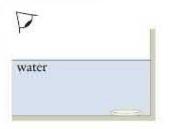
The observer in Figure P33.21 is looking at a coin near the edge of a pool filled with water. To this observer, does the water appear to be shallower or deeper than it really is? Data from Figure P33.21 water
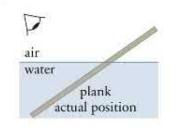
In Figure P33.22, a straight plank of lumber enters a pool of water at an angle. What does the plank look like to the observer?Data from Figure P33.22 air water plank actual position
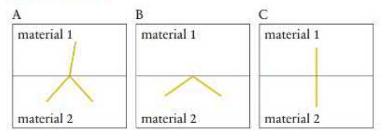
Figure P33.23 depicts incident and all reflected or refracted light rays in three cases, A, B, and C. For each case, state (a) in which material, 1 or 2 , the light travels faster and (b) in which material, 1 or 2 , the ray originates.Data from Figure P33.23 A B material 1 material 1 material 1
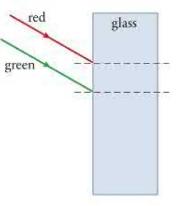
Parallel red and green laser rays are incident on a glass slab as shown in Figure P33.24. Sketch the rays as they pass through the slab and after they have entered the air to the right of the slab. Are the rays parallel after they exit the slab? Is the distance between the rays after they exit the
A thick layer of transparent oil floats on top of water. Sketch what happens to a ray of light coming in at a \(30^{\circ}\) angle away from the normal to the surface.
Suppose a small flashlight bulb is on the bottom of the bathtub of Problem 19, directly under the toy boat. When this bulb is lit and the ceiling light is turned off, how does the size of the shadow cast by the boat on the ceiling change when the water in the tub is replaced by a liquid in which
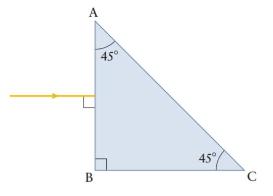
Suppose the prism in Figure P33.27 is immersed in a liquid in which the speed of light is lower than the speed of light in glass. Describe what happens to the light shown entering at normal incidence.Data from Figure P33.27 A 45 45 B C
Driving down a long straight highway, you see a reflection of the sky in the road ahead. It disappears before you get to it but reappears down the road continually. Because there is nothing different about the road from one location to another, explain what is happening in terms of refraction.
White light passing through a prism is dispersed into its constituent colors. Describe how this rainbow of colors can be changed back to white light.
A glass cylinder is placed inside a large beaker, and corn oil is poured into the combination until the beaker is full. If the glass cylinder is now invisible inside the oil, what must you conclude about how light interacts with the oil and the glass?
(a) Draw a simplified ray diagram showing the three principal rays for an object located outside the focal length of a converging lens. (b) Is the image real or virtual? (c) Is it upright or inverted? (d) What happens to the image as the object is moved farther from the lens?
(a) Draw a simplified ray diagram showing the three principal rays for an object located outside the focal length of a diverging lens. (b) Is the image real or virtual? (c) Is it upright or inverted? (d) What happens to the image as the object is moved farther from the lens?
The lens in a magnifying glass is a converging lens, but parallel light rays that pass through a converging lens must converge to a point. This being true, how can a magnifying glass form an image that is larger than the object? Why isn't the image reduced to a point?
A lens has a radius of curvature of magnitude \(R\) on its left surface and a radius of curvature of magnitude \(2 R\) on its right surface. Parallel rays entering the lens from the left are focused to a point \(100 \mathrm{~mm}\) to the right of the right surface. At what distance from the lens is
Looking at an object through a thin lens, you see a virtual image. Which side of the lens is the image on, or does it appear to be inside the lens? What property of this image tells you whether the lens is converging or diverging?
(a) Draw a simplified ray diagram showing the three principal rays for an object located inside the focal length of a diverging lens. \((b)\) Is the image real or virtual?(c) Is it upright or inverted?(d) What happens to the image as the object is moved toward the focal point?
(a) Draw a simplified ray diagram showing the three principal rays for an object located inside the focal length of a converging lens, closer to the lens than to the focal point. (b) Is the image real or virtual? (c) Is it upright or inverted? (d) What happens to the image as the object is moved
An object \(20 \mathrm{~mm}\) tall is placed \(70 \mathrm{~mm}\) to the left of a converging lens that has a focal length of \(100 \mathrm{~mm}\). (a) Draw a scale diagram showing the three principal rays, and use them to locate the image. Is the image (b) real or virtual, (c) inverted or upright,
An object is placed \(80 \mathrm{~mm}\) to the left of a diverging lens for which the focus is \(100 \mathrm{~mm}\) from the lens.(a) Draw a scale diagram showing the three principal rays, and use them to locate the image. Is the image \((b)\) real or virtual, \((c)\) inverted or
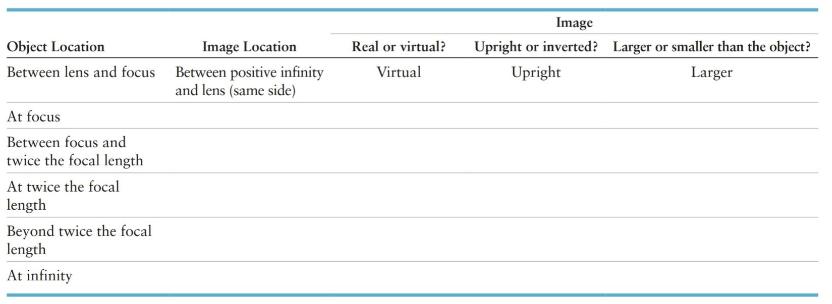
Complete the table below for a converging lens. Object Location Between lens and focus At focus Between focus and twice the focal length At twice the focal length Beyond twice the focal length At infinity Image Location Between positive infinity and lens (same side) Real or virtual? Virtual Image
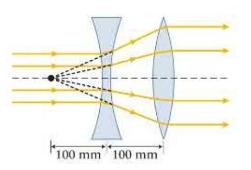
Figure P33.41 shows light passing first through a diverging lens and then through a converging lens placed \(100 \mathrm{~mm}\) to the right of the diverging lens. The rays emerge from the converging lens parallel to one another. Calculate the distance from each lens to its focus.Data from Figure
Two identical converging lenses of focal length \(100 \mathrm{~mm}\) are placed \(400 \mathrm{~mm}\) apart, and an object \(40 \mathrm{~mm}\) tall is placed \(230 \mathrm{~mm}\) to the left of the left lens.(a) Draw a scale diagram showing the three principal rays for the left lens, and use them to
Light is traveling at a speed of \(1.24 \times 10^{8} \mathrm{~m} / \mathrm{s}\) through a certain material. Determine what material it is likely traveling through.
What is the index of refraction of a material in which the speed of light is \(7.50 \%\) slower than the speed of light in vacuum?
Green light has a wavelength of \(530 \mathrm{~nm}\) in air. What are the frequency and wavelength of this light in flint glass (index of refraction \(n=1.65\) )? (index of refraction \(n=1.65\) )?
A light ray traveling through medium 1 , index of refraction \(n_{1}=1.45\), reaches the interface between medium 1 and medium 2, index of refraction \(n_{2}=1.24\). (a) At what minimum angle with respect to the normal must the ray be incident on the interface in order to be totally internally
A light ray travels up from the bottom of a tank containing mineral water (index of refraction \(n=1.37\) ). If the water surface is smooth, at what minimum angle from the normal to that surface would the light ray have to strike the surface in order to reflect back into the tank and not escape?
You shine a laser pointer at an angle of \(30^{\circ}\) from the nor\(\mathrm{mal}\) onto the surface of a thick block of glass for which the index of refraction is \(n=1.5\). (a) What is the angle of refraction of the laser beam? (b) Draw a diagram showing the normal, the surface of the block, and
In vacuum, the wavelength of the light in your laser pointer is \(538 \mathrm{~nm}\). Standing at the shore of a calm pond, you shine the laser beam onto the water surface at an angle of \(60^{\circ}\) from the normal to the surface. If the index of refraction for the water is \(n=1.333\), how do
A light ray is incident on a layer of oil floating on water. The index of refraction of oil is greater than that of water, which is greater than that of air. Call the angle of incidence in air \(\theta_{a}\), the angle of refraction in oil \(\theta_{o}\), and the angle of refraction in water
The index of refraction in flint glass is 1. 66 for blue light and 1. 61 for red light, with the values for other colors between these limits. A ray of white light traveling from left to right through a slab of flint glass undergoes dispersion as it exits the slab and enters the air. If the exiting
What is the critical angle for total internal reflection for an optical fiber cable surrounded by air if the index of refraction is (a) 1. 4 and (b) 1. 8 ? (c) Which fiber could have a sharper bend (smaller radius of curvature) and still be capable of total internal reflection?
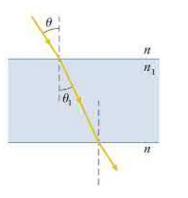
Show that the ray exiting the block in Figure P33.53 is parallel to the ray entering the block.Data from Figure P33.53
Red light for which the wavelength in air is \(700 \mathrm{~nm}\) strikes a diamond \(\left(n_{\text {diamond }}=2.42\right)\) at an angle of \(40.0^{\circ}\) from the normal to the air-diamond interface. Calculate (a) the wavelength and frequency of the light inside the diamond and \((b)\) the
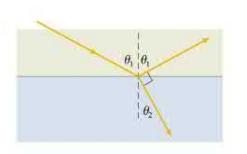
A light ray travels through medium 1 , index of refraction \(n_{1}=1.1\), into medium 2, index of refraction \(n_{2}=1.5\) (Figure P33.55). At what angle with respect to the normal to the interface between the media does the light need to strike the interface so that the reflected and the refracted
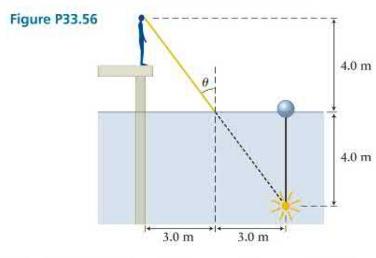
A researcher stands at the end of a lakeside pier, \(4.0 \mathrm{~m}\) above the water surface and \(6.0 \mathrm{~m}\) away from a buoy floating on the lake (Figure P33.56). A rope hangs from the bottom of the buoy down into the water, with a light attached to its end. When the researcher looks at
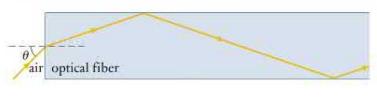
Figure P33.57 depicts a light ray entering an optical fiber from air and being transmitted through the fiber by total internal reflection. (a) If the index of refraction of the fiber is \(n\), what is the maximum value of \(\theta\), the angle the entering ray makes with the normal to the flat end
A ray traveling through a large vat filled with medium 1 , index of refraction \(n_{1}=1.3\), is incident on a flat layer (thickness \(d=12 \mathrm{~mm}\) ) of medium 2, index of refraction \(n_{2}=1.6\). If the light enters medium 2 at an angle \(\theta_{1}=40^{\circ}\) with respect to the normal
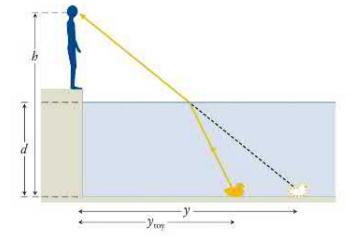
A toy sits on the bottom of a swimming pool with water depth \(d=1.8 \mathrm{~m}\) (Figure P33.59). To a child who stands at the pool edge and whose eyes are a distance \(h=3.5 \mathrm{~m}\) above the pool bottom, the toy appears to be a horizontal distance \(y=4.2 \mathrm{~m}\) away from the
What is the lens strength of a diverging lens that has a focal length of magnitude \(400 \mathrm{~mm}\) ?
Mathematically, why can't a single diverging lens produce a real image?
What is the focal length of eyeglasses that have a lens strength of +1.5 diopters?
Using a converging lens that has focal length \(f=100 \mathrm{~mm}\), how far behind the lens do you expect to see a sharp image of an object located \(2.00 \mathrm{~m}\) in front of the lens?
A cheap cell phone camera uses a single lens to form an image on a sensor that is \(10 \mathrm{~mm}\) high and \(5.8 \mathrm{~mm}\) behind the lens. How far do you need to be away from the Eiffel Tower (height \(324 \mathrm{~m}\) ) to get its whole length in a photograph? Ignore the tilting that
The objective lens in a telescope that produces a 40 -fold angular magnification has a focal length of \(2.0 \mathrm{~m}\). What is the focal length of the eyepiece lens?
An object is placed \(800 \mathrm{~mm}\) away from a thin converging lens that has a focal length of \(500 \mathrm{~mm}\). What are (a) the image distance and (b) the magnification? (c) Draw a simplified ray diagram for this case.
An object is placed \(150 \mathrm{~mm}\) away from a converging thin lens that has a focal length of \(400 \mathrm{~mm}\). What are(a) the image distance and \((b)\) the magnification?(c) Draw a simplified ray diagram for this case.
An object is placed \(600 \mathrm{~mm}\) away from a diverging thin lens for which the focal length is \(-300 \mathrm{~mm}\). What are (a) the image distance and \((b)\) the magnification of the image?
An object is placed \(200 \mathrm{~mm}\) from a diverging thin lens that has a focal length of \(-500 \mathrm{~mm}\). What are(a) the image distance and \((b)\) the magnification?(c) Draw a simplified ray diagram for this case.
A bug is \(30 \mathrm{~mm}\) away from a lens. As you look through the lens, the bug appears to be just at your near point \((0.250 \mathrm{~m}\) in front of your eyes). If the actual distance between your eyes and the bug is \(130 \mathrm{~mm}\), what is the lens focal length?
A woman is not able to focus on objects that are closer to her eyes than \(400 \mathrm{~mm}\) unless she wears eyeglasses. Her glasses enable her to clearly see objects at the near point of an average human (and no closer). What is the strength of the lenses in her glasses?
Two converging lenses are placed facing each other and \(600 \mathrm{~mm}\) apart, with lens 1 to the left of lens 2 . An object is placed \(400 \mathrm{~mm}\) to the left of lens 1 , which has a focal length of \(150 \mathrm{~mm}\).(a) If the focal length of lens 2 is \(200 \mathrm{~mm}\), where
An astronomical telescope of angular magnification \(M_{\theta}\) consists of an objective lens and an eyepiece lens separated by a distance \(d\), such that the focal points of the lenses coincide inside the telescope. In terms of \(M_{\theta}\) and \(d\), what are \((a)\) the focal length of the
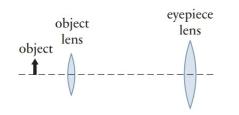
A schematic diagram of a refractive microscope is shown in Figure P33.74. The focal length of the objective lens is \(25 \mathrm{~mm}\), that of the eyepiece lens is \(63 \mathrm{~mm}\), and the two lenses are \(200 \mathrm{~mm}\) apart. If the object is \(30 \mathrm{~mm}\) away from the objective
Two converging lenses, 1 and 2, are positioned facing each other, with lens 1 on the left. The focal length of lens 1 is \(100 \mathrm{~mm}\), that of lens 2 is \(180 \mathrm{~mm}\), and the two lenses are \(150 \mathrm{~mm}\) apart. If an object is \(50 \mathrm{~mm}\) to the left of lens 1,(a) at
Two lenses with focal lengths \(f_{1}=100 \mathrm{~mm}\) and \(f_{2}=\) \(200 \mathrm{~mm}\) are placed facing each other a distance \(d=\) \(550 \mathrm{~mm}\) apart, with lens 1 to the left of lens 2 . What is the location of the image formed of an object placed \(150 \mathrm{~mm}\) to the left
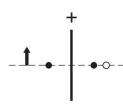
The focal points of the two converging lenses shown in Figure P33.77 are denoted by solid dots for the left lens and open dots for the right lens. Describe the final image.Data from Figure P33.77 +
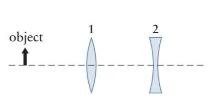
In Figure P33.78, a converging lens 1, of focal length \(100 \mathrm{~mm}\), and a diverging lens 2 , of focal length \(-80.0 \mathrm{~mm}\), are \(160 \mathrm{~mm}\) apart. If the object is \(180 \mathrm{~mm}\) away from lens 1 , what are \((a)\) the distance between lens 2 and the image produced
Problem 42 describes a setup of two identical converging lenses spaced \(400 \mathrm{~mm}\) apart. Each lens has a focal length of \(100 \mathrm{~mm}\), and a \(40-\mathrm{mm}\)-tall object stands \(230 \mathrm{~mm}\) to the left of the left lens.(a) Use an analytical approach to determine the
You need to design a magnification system that provides a magnification of 3. 00 and creates a real, upright image located \(300 \mathrm{~mm}\) from the surface of the final lens in the system. The only lenses you have to work with are two converging lenses, each having a focal length of \(100
You are trying to look at a geosynchronous communications satellite that is \(5.500 \mathrm{~m}\) long. A typical human eye can resolve objects that are \(0.1000 \mathrm{~mm}\) wide when the objects are at the person's near point, and the same angular size applies to objects farther away than the
Sunlight reflected off a mirror you are holding is focused at a point \(160 \mathrm{~mm}\) in front of the mirror. What is the radius of curvature of the mirror?
A spherical mirror for which the radius of curvature is \(R=250 \mathrm{~mm}\) is used to form an image of an object placed a distance \(d=200 \mathrm{~mm}\) in front of the mirror. Where does the image appear?
A bathroom shaving mirror has radius of curvature \(R=400 \mathrm{~mm}\). Describe the image of your face formed when you stand \((a)\) a distance \(d_{\text {close }}=100 \mathrm{~mm}\) from the mirror and \((b)\) a distance \(d_{\mathrm{far}}=1.20 \mathrm{~m}\) from the mirror.
Passenger-side car mirrors often carry the warning "Objects in mirror are closer than they appear." If the mirror on your car has radius of curvature \(R=-800 \mathrm{~mm}\) and the car behind you and one lane to the right is a distance \(o=20.0 \mathrm{~m}\) away, how far away does it appear?
An object is placed \(60 \mathrm{~mm}\) in front of a converging spherical mirror for which the radius of curvature is \(200 \mathrm{~mm}\). What are \((a)\) the image distance and \((b)\) the magnification of the image?(c) Is the image real or virtual?(d) Is it upright or inverted?(e) Draw a ray
A converging mirror that has a radius of curvature of \(70.0 \mathrm{~mm}\) forms an image of an object that is \(20.0 \mathrm{~mm}\) tall and \(150 \mathrm{~mm}\) in front of the mirror. (a) What is the image height? (b) Is the image real or virtual? (c) Is it upright or inverted? (d) Draw a ray
You stand \(0.50 \mathrm{~m}\) in front of a diverging mirror for which the radius of curvature is \(-3.5 \mathrm{~m}\). (a) Is your image real or virtual? (b) Is it upright or inverted? (c) How far away from the mirror surface is it located? (d) What is its magnification?
When you look at yourself in a converging mirror, you appear to be one-fourth your actual size. If you are standing \(1.0 \mathrm{~m}\) in front of the mirror, what is the mirror's radius of curvature?
You wish to use a converging mirror to form an image that is \(N\) times larger than the object. In terms of \(N\) and \(R\), the radius of curvature of the mirror, at what distance ofrom the mirror should you place the object?
A spherical mirror produces a real image of your face that is twice as large as your face. If your face is \(750 \mathrm{~mm}\) from the mirror, what is the radius of curvature of the mirror?
A converging mirror has a focal length of \(300 \mathrm{~mm}\). Calculate the image distance and magnification for an object located \((a)\) halfway between the focal point and the mirror, \((b)\) at the focal point,(c) halfway between the focal point and the center of curvature, \((d)\) at the
Repeat Problem 92 for a diverging mirror. Comment on any similarities or differences with the two types of mirrors.Data from Problem 92A converging mirror has a focal length of \(300 \mathrm{~mm}\). Calculate the image distance and magnification for an object located \((a)\) halfway between the
A security mirror in a shop is designed to give a wide-angle view, but as a result the images it forms are much smaller than their objects. If you want an image that appears \(10.0 \mathrm{~m}\) behind the mirror to have a magnification of \(10.0 \%\), what radius of curvature must the mirror have?
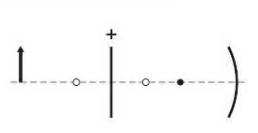
The optical system of Figure P33.95 consists of a converging lens and a converging mirror. The focal points of the lens are marked by open dots and the center of curvature of the mirror by a solid dot. Draw a simplified ray diagram, and describe the final image.Data from Figure P33.95
The kind of image a spherical mirror produces for a real object depends on where the object is located relative to the focal point of the mirror. There are three types of spherical mirrors-converging, diverging, and flat-if you consider a flat mirror as being one portion of a curved surface for
You position an object in front of a spherical mirror for which the magnitude of the radius of curvature is \(R_{1}\). The image formed is real, inverted, and twice as large as the object. You then replace this spherical mirror with one that has a radius of curvature of magnitude \(R_{2}\) (keeping
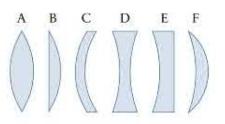
All the lenses in Figure P33.98 are surrounded by air. Which of the lenses are converging, and which are diverging?Data from Figure P33.98 A B C D E F )(II)
Showing 600 - 700
of 4962
1
2
3
4
5
6
7
8
9
10
11
12
13
14
15
Last
Step by Step Answers

 Get 50% OFF
Claim Now
Get 50% OFF
Claim Now