New Semester
Started
Get
50% OFF
Study Help!
--h --m --s
Claim Now
Question Answers
Textbooks
Find textbooks, questions and answers
Oops, something went wrong!
Change your search query and then try again
S
Books
FREE
Study Help
Expert Questions
Accounting
General Management
Mathematics
Finance
Organizational Behaviour
Law
Physics
Operating System
Management Leadership
Sociology
Programming
Marketing
Database
Computer Network
Economics
Textbooks Solutions
Accounting
Managerial Accounting
Management Leadership
Cost Accounting
Statistics
Business Law
Corporate Finance
Finance
Economics
Auditing
Tutors
Online Tutors
Find a Tutor
Hire a Tutor
Become a Tutor
AI Tutor
AI Study Planner
NEW
Sell Books
Search
Search
Sign In
Register
study help
sciences
college physics reasoning
College Physics Reasoning and Relationships 2nd edition Nicholas Giordano - Solutions
The electric field in a particular region of space is constant with a magnitude of 300 V/m and is along the y direction. (a) Sketch how the electric potential varies along y, starting from the origin and ending at y = 4 m. Assume the potential is zero at the origin. (b) Sketch how V varies along
The electrons in a CRT are accelerated through a potential difference of 30 kV. (a) Do the electrons move from a region of high potential to a region of low potential, or vice versa?(b) What is the change in kinetic energy of one of the electrons?(c) If the initial speed is very small, what is
How much work (as measured in joules) is required to push an electron through a region where the potential change is +45 V? Assume the electron moves from a region of low potential to a region of higher potential.
Consider a very small charged sphere that contains 35 electrons. At what distance from the center of the sphere is the potential equal to -60 V?
A proton moves from a location where V = 75 V to a spot where V = -20 V. (a) What is the change in the proton’s kinetic energy? (b) If we replace the proton with an electron, what is the change in kinetic energy?
For the situation described in Problem 17, what is the average electric field along a line 10 cm long that connects the initial and final locations of the electron? Be sure to give both the magnitude and direction of E(vector).Data From Problem 17An electron is moved from an initial location where
The electric potential difference between two infinite, parallel metal plates is V. If the plates are separated by a distance L = 3.0 mm and the electric field between the plates is E = 250 V/m, what is V?
An electron is moved from an initial location where the potential is Vi = 30 V to a final location where Vf = 150 V. What is the change in the electron’s potential energy? Express your answer in joules and in electron-volts.
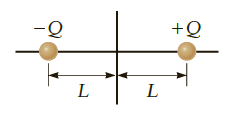
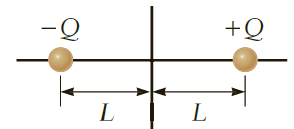
Find the electric potential V at the center of the electric dipole in Figure P18.6. Express your answer in terms of Q and L. Figure P18.6 ? -오 +Q L L
An oxygen ion O2 is a distance r = 5.0 × 10 10 m from a H+ ion. How much energy is required to separate them completely? Treat both ions as point charges.
The two electrons in a helium atom are separated by about 0.10 nm and the separation between either electron and the nucleus is about 0.050 nm. What is the total electric potential energy of the atom? Assume the nucleus is a point charge with q = +2e and for simplicity do not include the potential
Two point charges Q1 = +1.2 µC and Q2 = +3.2 µC are initially separated by 1.0 m and held fixed. The charges are then released, and both move in response to the electric force between them. What is the sum of the kinetic energies of the two particles when they are very far apart?
An electron and a proton are a distance r = 7.5 × 10⁻⁹ m apart. How much energy is required to increase their separation by a factor of two?
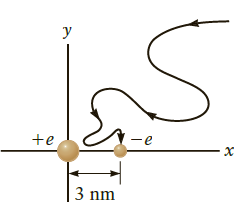
A proton is placed at the origin. An electron that is initially very far away is then taken on the path shown in Figure P18.11 and eventually stops a distance of 3.0 nm (= 3.0 ? 10-9 m) from the proton. How much work was done on the electron to move it along this path? Figure P18.11 ? y +e -e —
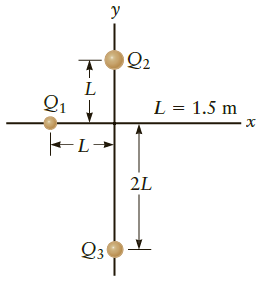
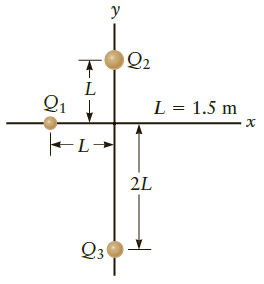
Consider again the three charges in Figure P18.9 with Q1 = 2.5 ?C, Q2 = 4.5 ?C, and Q3 = -3.5 ?C. A fourth charge q = -5.0 ?C is brought from very far away and placed at the origin. ? (a) How much work is required in this process? (b) How much work is required to move q from the origin to a
Three point charges Q1 = 2.5 ?C, Q2 = 4.5 ?C, and Q3 = -3.5 ?C are arranged as shown in Figure P18.9. What is the total electric potential energy of this system? Figure P18.9 ? y Q Q2 L Q1 I L = 1.5 m 2L Q3
The electric field in a particular region of space is found to be uniform, with a magnitude of 400 N/C and parallel to the +y direction. (a) What is the change in electric potential energy of a charge q - 3.5 µC if it is moved from (x, y) - (20 cm, 45 cm) to (5 cm, 30 cm)? (b) What is
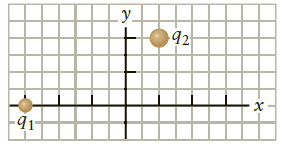
Two point charges are located as shown in Figure P18.7, with charge q1 = +2.5 C at x = -3.0 m, y = 0, and charge q2 = +4.0 C at x = +1.0 m, y = +2.0 m. An electron is now taken from a point very far away and placed at the origin. How much work must be done on the electron to move it to the
Consider an electric dipole consisting of charges +Q and -Q as sketched in Figure P18.6. How much work is required to place a charge q at the origin? Assume q starts from very far away. Figure P18.6 ? -Q +0 L L
A simple model of a hydrogen atom pictures the electron and proton as point charges separated by 0.050 nm, and in Example 18.1 we calculated the associated electric potential energy. If the electron is initially at rest, how much work is required to “break apart” these two charges, that is, to
Two point charges Q1 = 3.5 µC and Q2 = 7.5 µC are initially very far apart. They are then brought together, with a final separation of 2.5 m. How much work does it take to bring them together?
The nucleus of a helium atom contains two protons. In a simple model of this nucleus, the protons are viewed as point particles separated by 1.0 fm (1.0 × 10⁻¹⁵ m). What is the electric potential energy of the two protons?
Two particles with Q1 = 45 µC and Q2 = 85 µC are initially separated by a distance of 2.5 m and then brought closer together so that the final separation is 1.5 m. What is the change in the electric potential energy?
Two point particles of charge Q1 = 45 µC and Q2 = 85 µC are found to have a potential energy of 40 J. What is the distance between the charges?
A certain amount of charge ± q is placed on the plates of a capacitor, and the plates are then disconnected from the outside world. If the capacitor plates are pulled apart, does the amount of electric potential energy stored in the capacitor increase or does it decrease? Explain your answer in
A parallel-plate capacitor is connected to a battery such that a constant electric potential difference is produced between the plates. If the plates are moved farther apart, which of the following quantities change? Do they get larger or smaller?(a) The magnitude of the electric field(b) The
Does a charged capacitor have a different net charge than an uncharged one? If not, explain the difference between a charged capacitor and an uncharged one.
Derive the result for the equivalent capacitance of many capacitors in series in Equation 18.42.
Compared with the applied electric field, is the electric field inside a dielectric material (a) smaller by a factor of k, (b) larger by a factor of k, or (c) larger by a factor of k2? Or, does it (d) depend on the shape of the dielectric? Explain your reasoning.
To increase the energy stored in a capacitor, what might you do? Explain your reasoning. More than one answer may be correct.(a) Increase the charge on the capacitor.(b) Insert a dielectric between the plates while holding the voltage fixed.(c) Move the plates closer together while keeping the
Consider the energy density in the electric field at a distance d away from a positive point charge. If the positive point charge is then replaced with a negative point charge of equal magnitude, how does the energy density change at that same point?
A charged particle reaches a speed v when accelerated through a potential difference of 5 V. How many times faster would it be going if accelerated through a potential difference of 20 V?
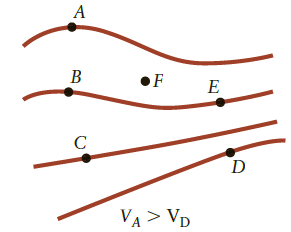
Figure Q18.11 shows points on several equipotential surfaces, with VA > VD. (a) A positive test charge starts at point A and moves to point C. If the test charge starts and ends at rest, which of the following statements applies? (i) A positive amount of work must be done on the test charge by
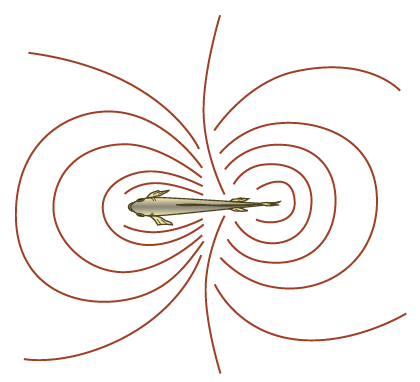
Many species of fish generate electric fields and use these fields to sense their surroundings. If another entity with a dielectric constant different from that of water comes near the fish, the electric field lines generated by the fish are altered, and sensory organs on the fish can detect these
Two particles are at locations where the electric potential is the same. Do these particles necessarily have the same electric potential energy? Explain.
A charged particle is released from rest in an electric field, and the electric force is the only force acting on the particle. Will the particle’s trajectory always follow (i.e., be parallel to) the electric field lines? Explain why or why not. Which of the following quantities are always
Repeat Question 6 for an electron.Data From Problem 6A particle of positive charge is released from rest and is found to move as a result of an electric force. Does the particle move to a region of higher or lower potential energy?
A particle of positive charge is released from rest and is found to move as a result of an electric force. Does the particle move to a region of higher or lower potential energy? Does the particle move to a region of higher or lower electric potential?
Experiments show that in a particular region of space the electric field is uniform (i.e., constant). A separate experiment finds that if an electron is released from rest at the origin, it moves along the 1x direction. Make a sketch showing the direction of the original electric field (before the
Make sketches of the equipotential surfaces around (a) A point charge, (b) An infinite line of charge, (c) An infinite plane of charge, (d) A finite line of charge, and (e) A charged plate of finite size.
Will the electric potential always be zero at any point where the electric field is zero? Why or why not?
Will the electric field always be zero at any point where the electric potential is zero? Why or why not?
If the electric field is zero in a particular region of space, what does that tell you about the electric potential in that region? Is the potential zero, constant, or something else? Explain.
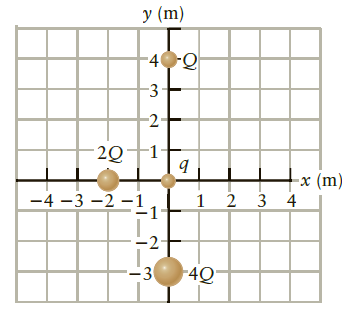
Consider three particles of charge Q, 2Q, and 4Q, where Q = 2.4 C, arranged as shown in Figure P17.98. If a particle of charge q = -1.5 C is placed at the origin,? (a) What are the components of the net electric force on this particle along the x and y directions?? (b) What are the components of
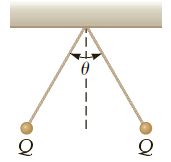
Two particles with the same charge are attached to strings that are 80 cm long and that hang from a ceiling as shown in Figure P17.97. If the angle between the strings is ? = 60? and the particles each have a mass of 250 g, what is the charge on each particle? Figure P17.97 ? Q
Eight point particles, each of charge Q, are located on the corners of a cube. What is the direction of the electric force on one of the particles from the others?
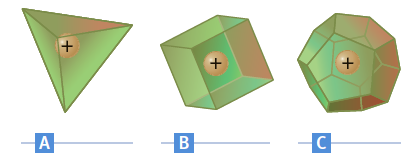
A charge of 1.8 nC is placed in the center of three solids of equal volume as shown in Figure P17.95. Calculate the electric flux out of one face of the (a) tetrahedron if the charge is placed at its center. Repeat for (b) the cube and (c) the dodecahedron. Figure P17.95 ? C A B
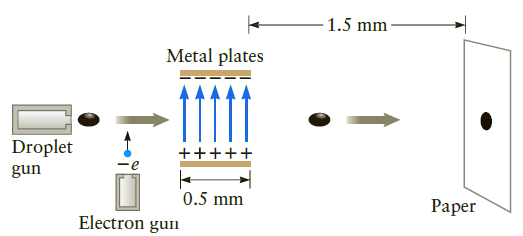
Spray it to say it. A particular inkjet printer uses electrostatic forces to direct droplets of ink to create letters, words, and images at a resolution of 300 dots per inch. Figure P17.94 shows a schematic of the process. Using ultrasound, 100,000 droplets of ink are produced per second out of the
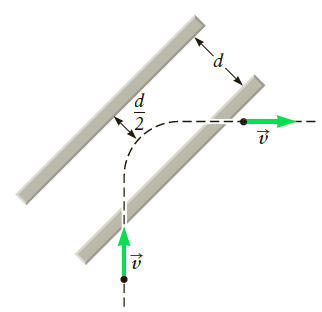
Consider a beam of protons traveling though a vacuum, where each proton has a velocity of 6.0 × 10⁶ m/s. You need to design a means to change the direction of the proton beam by 90°. Consider the charged parallel plates separated by a distance d = 60 cm as depicted in Figure P17.93. Small holes
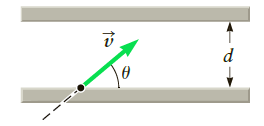
Repeat part (a) of Problem 91, replacing the electron with a proton and reversing the direction of the electric field. Compare your answer with the results obtained with an electron. Data From Problem 91 An electron with an initial velocity of 3.1 ? 106 m/s enters a parallel-plate capacitor at an
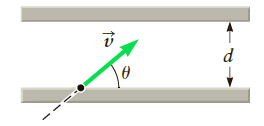
An electron with an initial velocity of 3.1 ? 106 m/s enters a parallel-plate capacitor at an angle of 40? through a small hole in the bottom plate as shown in Figure P17.91.? (a) If the plates are separated by a distance d = 2.4 cm, what minimum electric field must be present to prevent the
An electron gun in the picture tube of a CRT accelerates electrons from rest to a speed of 4.0 × 10⁷ m/s along a distance of 1.0 cm. What is the magnitude of the uniform electric field used by the CRT?
Repeat Problem 88. This time, assume the charges on the Moon and the Earth are not the same magnitude, but the ratio of the charges are the same as the ratio of their masses. Find (a) The charges on the Moon and the Earth and (b) The corresponding number of moles of electrons on
Imagine that the Moon is locked into its orbit around the Earth by electrical forces and the gravitational force between the Earth and Moon is somehow “turned off.” (a) A charge of what magnitude would need to be on each body? Approximate the Moon and the Earth as point particles and
A small drop of water, measuring 0.011 mm in diameter, hangs suspended above the ground due to the Earth’s electric field (see Problem 86). How many extra electrons are on the drop of water?Data From Problem 86.Charged planet. Lightning is striking somewhere on the planet at all times of the day.
Lightning is striking somewhere on the planet at all times of the day. This and other meteorological phenomena produce a sustained vertical electric field—pointing downward toward the center of the Earth—that averages about 140 N/C near the surface. What is the average net charge per unit area
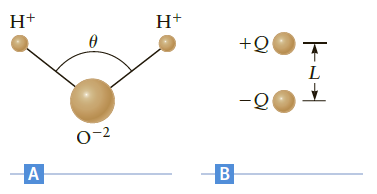
A water molecule (H2O) is shaped as shown in Figure P17.85A. The hydrogen?oxygen bond length is about 9.6 ? 10-11 m, and the bond angle is ? = 104?. To a first approximation, the molecule is composed of three point ions (two H+ ions and one O-2 ion).? (a) What are the magnitude and direction of the
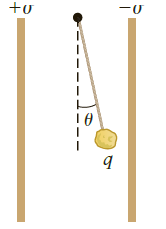
Two very large parallel plates have charge per unit area +2.0 ?C/m2 and -2.0 ?C/m2, respectively. A small grain of pollen of mass m = 200 mg and charge q hangs by a slender thread as shown in Figure P17.84. If the thread makes an angle ? - 30o with the vertical direction, what is q? Figure
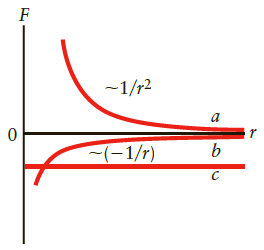
The curves in Figure P17.83 describe the force between two charged objects as a function of the distance r between the objects. Match the curves to the following pairs of objects. Here a positive value of F indicates a repulsive force. More than one answer may be correct.(i) Two positive point
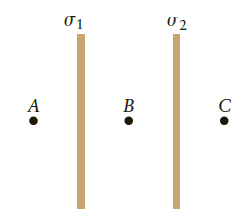
Two infinite, parallel, charged planes have charge per unit area??1 = +3??and??2 = -?, respectively, with???> 0 (Fig. P17.82). What are the magnitude and direction of the electric field at points A, B, and C? Figure P17.82 ? U2 A B C
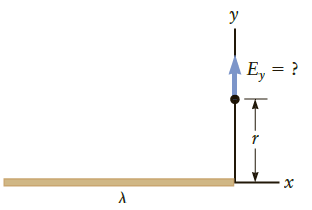
Consider a half-infinite line of charge with charge per unit length l. This line begins at the origin and then goes to infinity to the left (Fig. P17.81). Find the component of the electric field in the direction shown (the y direction, perpendicular to the line) at a distance r from the end of the
Two infinite, parallel planes have excess charge densities σ and -2 σ. If σ > 0, what are the magnitude and direction of the electric field between the planes?
A balloon of N2 at atmospheric pressure and room temperature has a volume of 1.5 m3. What is the total charge of the electrons in the balloon?
Repeat Problem 77 for a neutron. A neutron consists of three quarks of charge +2/3 e, -1/3 e, and -1/3 e.Data From Problem 77A proton consists of three quarks of charge +2/3 e, +2/3 e, and -1/3e. The average spacing between the quarks is approximately 1.0 × 10⁻¹⁵ m. Assuming the quarks are
A proton consists of three quarks of charge +2/3 e, +2/3 e, and -1/3e. The average spacing between the quarks is approximately 1.0 × 10⁻¹⁵ m. Assuming the quarks are arranged to form an equilateral triangle, find the magnitude of the total force on each quark due to the other two quarks. Do you
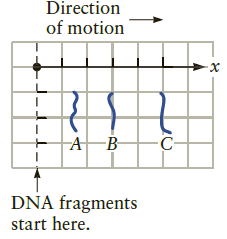
A sample of DNA is prepared for fingerprinting. It contains three fragments of different sizes, all having charge -8e. After a certain amount of time, the fingerprint pattern in Figure P17.76 is found. What are the relative sizes of the three fragments? That is, assuming the fragments are spheres
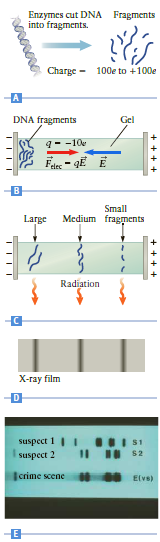
Consider two fragments of DNA of radius r1 = 30 nm and r2 = 35 nm when they are coiled up as they move through a gel. An electrophoresis analysis (Fig. 17.38) is carried out to separate these two fragments. Suppose the drag factor C in Equation 17.19 is C = 5.0 ? 10-5 kg/(m ? s), and assume each
An electrophoresis experiment is performed on two fragments of DNA with radius r1 = 20 nm and charge q1 = -5e, and r2 = 30 nm. The speed of the smaller fragment is two times greater than the speed of the larger fragment. What is the charge on the larger fragment?
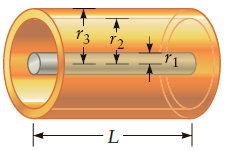
Figure P17.73 shows a cylindrical capacitor; it consists of a solid metal rod of radius r1 surrounded by a metal cylinder with inner radius r2 and outer radius r3. Suppose the capacitor has length L (with L very large). Also suppose a charge +Q is placed on the inner rod and a charge -Q is placed
Consider a uniformly charged sphere with radius R and charge per unit volume ρ. (a) What is the magnitude of the electric field a distance r - R/3 from the center of the sphere? (b) Explain in words why the portion of the sphere that is more than r - R/3 from the sphere’s center does
The electric flux through a large cardboard box is 500 N · m2/C. If the box is a cube whose edges are 1 m long, what is the net charge inside the box?
A spherical metal shell has charge per unit area σ and radius R. What is the magnitude of the electric field at a distance x from the surface of the sphere?
For the metal sphere in Problem 68, what is the electric field inside the sphere?Data From Problem 68Consider a solid metal sphere of radius R. An excess charge Q is placed on the sphere.
Consider a solid metal sphere of radius R. An excess charge Q is placed on the sphere. (a) How will this excess charge be distributed on the sphere? (b) Make a qualitative sketch of the electric field lines outside the metal sphere. (c) Choose a Gaussian surface that matches the
An insulating sphere has a total excess charge Q distributed uniformly throughout the sphere. Use Gauss’s law to calculate the electric field inside the sphere at a distance r from the center of the sphere. Express your answer in terms of the radius of the sphere rs and the total charge Q on the
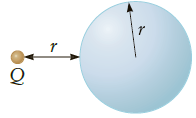
Consider the spherical Gaussian surface shown in Figure P17.66. It is situated near a point charge Q which is located a distance 2r from the center of the sphere and outside the Gaussian surface. Compute the net electric flux through this surface. Figure P17.66 ? Q r r
Consider an arrangement of eight charges Q at the corners of a cube with edges of length L. A spherical surface of radius 3L is arranged so as to completely contain these charges. What is the electric flux through this surface?
A point charge q is located at the center of a cubical box with an edge length L. What is the electric flux through one face of the box?
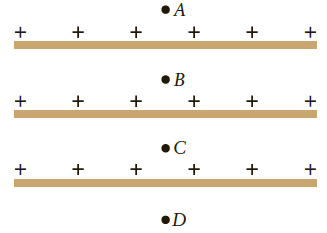
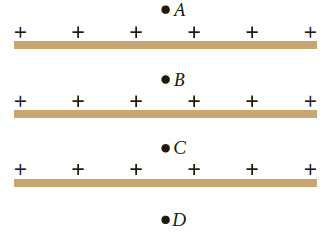
Consider again the charged planes in Problem 62 (Fig. P17.62), but now assume the inner plane has a charge density of -10 µC/cm2 and the outer planes have charge densities +10 µC/cm2. Find the electric field at points A, B, C, and D.Data From Problem 62Consider three very large, parallel planes
Consider three very large, parallel planes of charge that are equally spaced as shown in Figure P17.62. These planes are insulators, and each is charged uniformly with +10 ?C on every square centimeter of area on the top surface of each plane. Use Gauss?s law to determine the field at points A, B,
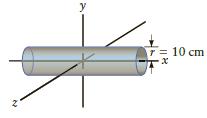
Use the step-by-step approach in Problem 60 to find the electric field produced by the hollow metal cylinder with charge per unit length λ = 1.0 × 10⁻⁶ C/m in Figure P17.61. Be sure to find the electric fields inside and outside the cylinder, assuming you are far from the ends and that
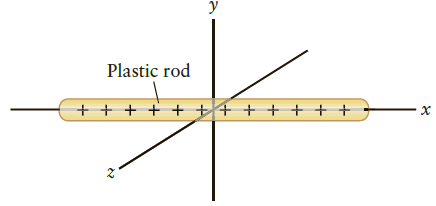
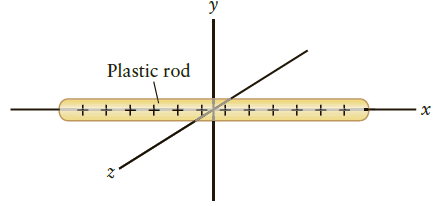
Consider a very long, very thin plastic rod as sketched in Figure P17.60. Assume the rod has length L = 1.0 ? 106 m and a total charge of 1.0 C distributed evenly along the rod. Your job in this problem is to calculate the electric field a distance r = 10 cm from the rod.? (a) What is the direction
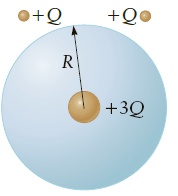
Three point charges are located near a spherical Gaussian surface of radius R (Fig. P17.59). One charge (+3Q) is inside the sphere, and the others are a distance R/3 outside the surface. What is the electric flux through this surface? Figure P17.59 ? +Q +Q• R +3Q
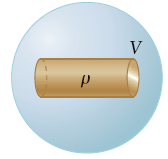
A cylinder has volume V and charge density ρ (Fig. P17.58). What is the electric flux through a sphere of radius R that encloses the cylinder?Figure P17.58 V
An electric dipole is enclosed in a spherical surface. What is the electric flux through the surface?
(a) Explain how the answer to Problem 55 would change if the surface were increased in size (expanded) by a factor of two. (b) How would the answer to Problem 55 change if three more electrons were placed inside the surface?Data From Problem 55Consider an electron and the surface that encloses
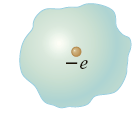
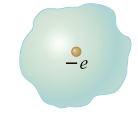
Consider an electron and the surface that encloses it in Figure P17.55. What is the electric flux through this surface? Figure P17.55 ? -e
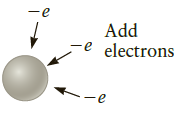
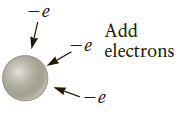
Assume the sphere in Figure P17.52 is a piece of plastic (an insulator). How will that affect (change) the answer to Problem 52? Data From Problem 52 Consider a metal sphere onto which a large number (suppose 106 or more) of extra electrons is placed (Fig. P17.52). Figure P17.52 ? -e Add -e
One million electrons are placed uniformly on the surface of a solid chunk of metal shaped as shown in Figure P17.53 and then released. Suppose you wait a period of time until the electrons are in static equilibrium. Draw the electric field lines inside and outside the metal.Figure P17.53
Consider a metal sphere onto which a large number (suppose 106 or more) of extra electrons is placed (Fig. P17.52). (a) Explain how these electrons will be distributed over the interior and the surface of the sphere.? (b) Draw the electric field lines inside and outside the sphere. Figure P17.52 ?
A small piece of dust of mass m = 1.0 mg travels through an electric air cleaner in which the electric field is 500 N/C. The electric force on the dust particle is equal to the weight of the particle. (a) What is the charge on the dust particle? (b) If this charge is provided by an excess
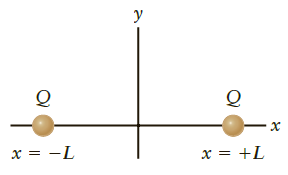
Two point charges, each of charge Q, are located on the x axis as shown in Figure P17.50. A test charge Qtest is placed on the y axis a distance??L from the origin.? (a) Where could you place another charge Qnew on the x axis so as to make the electric field zero at Qtest?? (b) Find the value of
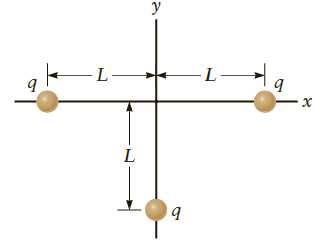
Three point charges all with q = -8.2 C are located as shown in Figure P17.21 with L = 4.5 m. What are the magnitude and direction of the electric field? (a) At the origin and? (b) At the point y = 6.8 m on the y axis? Figure P17.21 ? y -L- L-
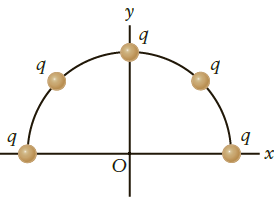
Five point charges, all with q = 7.5 C, are spaced equally along a semicircle as shown in Figure P17.48. If the semicircle has a radius of 2.3 m, what are the magnitude and direction of the electric field at the origin? Figure P17.48 ? y
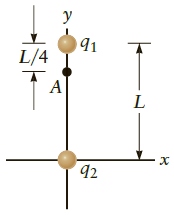
Two point particles with charges q1 and q2 are separated by a distance L as shown in Figure P17.47. The electric field is zero at point A, which is a distance L/4 from q1. What is the ratio q1/q2? Figure P17.47 ? y L/4 A L 92
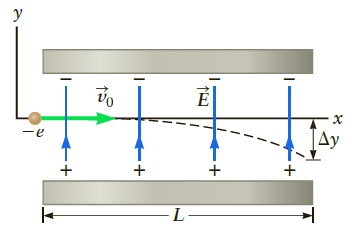
An electron is traveling through a region between two metal plates in which there is a constant electric field of magnitude E along the y direction as sketched in Figure P17.46. This region has a total length L, and the electron has an initial speed v0 along the x direction. (a) How long does
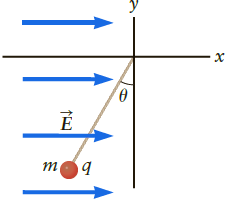
A small, plastic sphere of mass m = 100 g is attached to a string as shown in Figure P17.45. There is an electric field of 100 N/C directed along the +x direction. If the string makes an angle ? = 30? with the y axis, what is the charge on the sphere? Figure P17.45 ? m
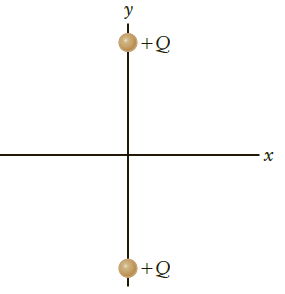
Sketch the electric field lines near the two charges in Figure P17.44. Assume Q is positive.Figure P17.44 +Q х +Q
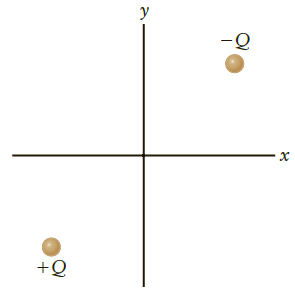
Sketch the electric field lines near the electric dipole in Figure P17.43. Assume Q is positive.Figure P17.43 -Q х +Q
An interesting (but over simplified) model of an atom pictures an electron “in orbit” around a proton. Suppose this electron is moving in a circular orbit of radius 0.10 nm (1.0 × 10 10 m) and the force that makes this circular motion possible is the electric force exerted by the proton on the
Showing 3400 - 3500
of 4913
First
28
29
30
31
32
33
34
35
36
37
38
39
40
41
42
Last
Step by Step Answers

 Get 50% OFF
Claim Now
Get 50% OFF
Claim Now