New Semester
Started
Get
50% OFF
Study Help!
--h --m --s
Claim Now
Question Answers
Textbooks
Find textbooks, questions and answers
Oops, something went wrong!
Change your search query and then try again
S
Books
FREE
Study Help
Expert Questions
Accounting
General Management
Mathematics
Finance
Organizational Behaviour
Law
Physics
Operating System
Management Leadership
Sociology
Programming
Marketing
Database
Computer Network
Economics
Textbooks Solutions
Accounting
Managerial Accounting
Management Leadership
Cost Accounting
Statistics
Business Law
Corporate Finance
Finance
Economics
Auditing
Tutors
Online Tutors
Find a Tutor
Hire a Tutor
Become a Tutor
AI Tutor
AI Study Planner
NEW
Sell Books
Search
Search
Sign In
Register
study help
sciences
general chemistry principles
General Chemistry Principles And Modern Applications 11th Edition Ralph Petrucci, Jeffry Madura, F. Herring, Carey Bissonnette - Solutions
NH3(aq) conducts electric current only weakly. The same is true for CH3COOH(aq). When these solutions are mixed, however, the resulting solution is a good conductor. How do you explain this?
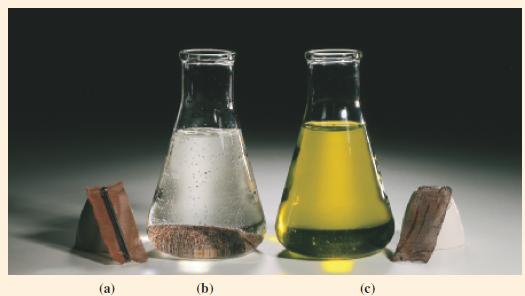
Write equations for the oxidation and reduction processes that occur and the overall equation for the reaction of iron with hydrochloric acid solution to produce H2(g) and Fe2+. The reaction is shown in Figure 5-14. Figure 5-14 (a) (b)
(A) Represent the reaction of aluminum with hydrochloric acid to produce AlCl3(aq) and H2(g) by oxidation and reduction half-equations and an overall equation.(B) Represent the reaction of chlorine gas with aqueous sodium bromide to produce liquid bromine and aqueous sodium chloride by oxidation
Is it possible for two different reactants in a redox reaction to yield a single product? Explain.
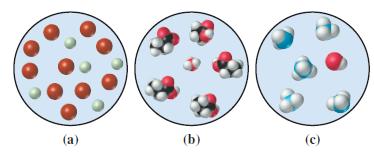
Sketches (a–c) are molecular views of the solute in an aqueous solution. For each of the sketches, indicate whether the solute is a strong, weak, or nonelectrolyte; and which of these substances it is: sodium chloride, propionic acid, hypochlorous acid, ammonia, barium bromide, ammonium chloride,
The reaction described by expression (5.25) below is used to determine the sulfite ion concentration present in wastewater from a papermaking plant. Use the half-equation method to obtain a balanced equation for this reaction in an acidic solution.SO32-(aq) + MnO4-(aq) → SO42-(aq) + Mn2+(aq)
After identifying the three substances represented by the sketches in Exercise 5, sketch molecular views of aqueous solutions of the remaining four substances listed.Exercise 5Sketches (a–c) are molecular views of the solute in an aqueous solution. For each of the sketches, indicate whether the
A newspaper account of an accidental spill of hydrochloric acid in an area where sodium hydroxide solution was also stored spoke of the potential hazardous release of chlorine gas if the two solutions should come into contact. Was this an accurate accounting of the hazard involved? Explain.
Determine the concentration of the ion indicated in each solution. (a) [K+] in 0.238 M KNO3; (b) [NO3-] in 0.167M Ca(NO3)2; (c) [Al3+] in 0.083 M Al2(SO4)3;(d) [Na+] in 0.209 M Na3PO4.
Balance the equation for the reaction in which cyanide ion is oxidized to cyanate ion by permanganate ion in a basic solution, and the permanganate is reduced to MnO2(s).MnO4-(aq) + CN-(aq) → MnO2(s) + OCN-(aq)
(A) Balance the equation for this reaction in basic solution.S(s) + OCl-(aq) → SO32-(aq) + Cl-(aq)(B) Balance the equation for this reaction in basic solution.MnO4-(aq) + SO32-(aq) → MnO2(s) + SO42-(aq)
A 10.00 mL sample of 0.311 M KOH is added to 31.10 mL of 0.100 M HCl. Is the resulting mixture acidic, basic, or exactly neutral? Explain.
Which solution has the greatest [SO42-]? (a) 0.075 M H2SO4;(b) 0.22 M MgSO4;(c) 0.15 M Na2SO4;(d) 0.080 M Al2(SO4)3;(e) 0.20 M CuSO4.
Hydrogen peroxide, H2O2, is a versatile chemical. Its uses include bleaching wood pulp and fabrics and substituting for chlorine in water purification. One reason for its versatility is that it can be either an oxidizing or a reducing agent. For the following reactions, identify whether hydrogen
(A) Is H2(g) an oxidizing or reducing agent in the reaction below? Explain.2 NO2(g) + 7 H2(g) → 2 NH3(g) + 4 H2O(g)(B) Identify the oxidizing agent and the reducing agent in the following reaction.4 Au(s) + 8 CN-(aq) + O2(g) + 2 H2O(l) → 4 [Au(CN)2]-(aq) + 4 OH-(aq)
A solution is prepared by dissolving 0.132 g Ba(OH)2 · 8 H2O in 275 mL of water solution. What is [OH-] in this solution?
Vinegar is a dilute aqueous solution of acetic acid produced by the bacterial fermentation of apple cider, wine, or other carbohydrate material. The legal minimum acetic acid content of vinegar is 4% by mass. A 5.00 mL sample of a particular vinegar is titrated with 38.08 mL of 0.1000 M NaOH. Does
(A) A particular solution of NaOH is supposed to be approximately 0.100 M. To determine the exact molarity of the NaOH(aq), a 0.5000 g sample of KHC8H4O4 is dissolved in water and titrated with 24.03 mL of the NaOH(aq). What is the actual molarity of the NaOH(aq)?HC8H4O4-(aq) + OH-(aq) →
A solution is 0.126 M MgCl2. What are [K+], [Mg2+], and [Cl-] in this solution?
A piece of iron wire weighing 0.1568 g is converted to Fe2+(aq) and requires 26.24 mL of a KMnO4(aq) solution for its titration. What is the molarity of the KMnO4(aq)?5 Fe2+(aq) + MnO4-(aq) + 8 H+(aq) → 5 Fe3+(aq) + Mn2+(aq) + 4 H2O(l)
(A) A 0.376 g sample of an iron ore is dissolved in acid, and the iron reduced to Fe2+(aq) and then titrated with 41.25 mL of 0.02140 M KMnO4. Determine the mass percent Fe in the iron ore.(B) Another substance that may be used to standardize KMnO4(aq) is sodium oxalate. If 0.2482 g Na2C2O4 is
Express the following data for cations in solution as molarities. (a) 14.2 mg Ca2+/L; (b) 32.8 mg K+/100 mL;(c) 225 μg Zn2+/mL.
(A) The amount of potassium chlorate, KClO3, in a 0.1432 g sample was determined as follows. The sample was dissolved in 50.00 mL of 0.09101 M Fe(NO3)2 and the solution was acidified. The excess Fe2+ was back-titrated with 12.59 mL of 0.08362 M Ce(NO3)4 solution. What is the percentage by mass of
What molarity of NaF(aq) corresponds to a fluoride ion content of 0.9 mg F-/L, the federal government’s recommended limit for fluoride ion in drinking water?
Which of the following aqueous solutions has the highest concentration of K+? (a) 0.0850 M K2SO4;(b) A solution containing 1.25 g KBr/100 mL; (c) A solution having 8.1 mg K+/mL.
Which aqueous solution has the greatest [H+]?(a) 0.011 M CH3COOH; (b) 0.010 M HCl; (c) 0.010 M H2SO4;(d) 1.00 M NH3. Explain your choice.
How many milligrams of MgI2 must be added to 250.0 mL of 0.0876 M KI to produce a solution with [I-] = 0.1000 M?
If 18.2 mL H2O evaporates from 1.00 L of a solution containing 15.5 mg K2SO4/mL, what is [K+] in the solution that remains?
Assuming the volumes are additive, what is the [Cl-] in a solution obtained by mixing 225 mL of 0.625 M KCl and 615 mL of 0.385 M MgCl2?
Assuming the volumes are additive, what is the [NO3-] in a solution obtained by mixing 275 mL of 0.283 M KNO3, 328 mL of 0.421 M Mg(NO3)2, and 784 mL of H2O?
Complete each of the following as a net ionic equation, indicating whether a precipitate forms. If no reaction occurs, so state.(a) Na+ + Br- + Pb2+ + 2 NO3- →(b) Mg2+ + 2 Cl- + Cu2+ + SO42- →(c) Fe3+ + 3 NO3- + Na+ + OH- →
Complete each of the following as a net ionic equation. If no reaction occurs, so state.(a) Ca2+ + 2 I- + 2 Na+ + CO32- →(b) Ba2+ + S2- + 2 Na+ + SO42- →(c) 2 K+ + S2- + Ca2+ + 2 Cl- →
Predict in each case whether a reaction is likely to occur. If so, write a net ionic equation.(a) HI(aq) + Zn(NO3)2(aq) →(b) CuSO4(aq) + Na2CO3(aq) →(c) Cu(NO3)2(aq) + Na3PO4(aq) →
Predict in each case whether a reaction is likely to occur. If so, write a net ionic equation.(a) AgNO3(aq) + CuCl2(aq) →(b) Na2S(aq) + FeCl2(aq) →(c) Na2CO3(aq) + AgNO3(aq) →
What reagent solution might you use to separate the cations in the following mixtures, that is, with one ion appearing in solution and the other in a precipitate?(a) BaCl2(s) and MgCl2(s)(b) MgCO3(s) and Na2CO3(s)(c) AgNO3(s) and Cu(NO3)2(s).
What reagent solution might you use to separate the cations in each of the following mixtures?(a) PbSO4(s) and Cu(NO3)2(s)(b) Mg(OH)2(s) and BaSO4(s)(c) PbCO3(s) and CaCO3(s)
You are provided with NaOH(aq), K2SO4(aq), AgNO3(aq), and BaSO4(s). Write net ionic equations to show how you would use one or more of those reagents to obtain (a) SrSO4(s);(b) Mg(OH)2(s);(c) KCl(aq).
Write net ionic equations to show how you would use one or more of the reagents in Exercise 25 to obtain(a) BaSO4(s); (b) AgCl(s); (c) KNO3(aq).Exercise 25You are provided with NaOH(aq), K2SO4(aq), AgNO3(aq), and BaSO4(s). Write net ionic equations to show how you would use one or more of those
Complete each of the following as a net ionic equation. If no reaction occurs, so state.(a) Ba2+ + 2 OH- + CH3COOH →(b) H+ + Cl- + CH3CH2COOH →(c) FeS(s) + H+ + I- →(d) K+ + HCO3-+ H+ + NO3- →(e) Mg(s) + H+ →
Every antacid contains one or more ingredients capable of reacting with excess stomach acid (HCl). The essential neutralization products are CO2 and/or H2O. Write net ionic equations to represent the neutralizing action of the following popular antacids.(a) Alka-Seltzer (sodium bicarbonate)(b) Tums
In this chapter, we described an acid as a substance capable of producing H+ and a salt as the ionic compound formed by the neutralization of an acid by a base. Write ionic equations to show that sodium hydrogen sulfate has the characteristics of both a salt and an acid (sometimes called an acid
A neutralization reaction between an acid and a base is a common method of preparing useful salts. Give net ionic equations showing how the following salts could be prepared in this way: (a) (NH4)2HPO4;(b) NH4NO3; and (c) (NH4)2SO4.
Which solutions would you use to precipitate Mg2+ from an aqueous solution of MgCl2? Explain your choice. (a) KNO3(aq); (b) NH3(aq); (c) H2SO4(aq);(d) HC2H3O2(aq).
Determine which of the following react(s) with HCl(aq) to produce a gas, and write a net ionic equation(s) for the reaction(s). (a) Na2SO4; (b) KHSO3; (c) Zn(OH)2;(d) CaCl2.
Assign oxidation states to the elements involved in the following reactions. Indicate which are redox reactions and which are not.(a) MgCO3(s) + 2 H+(aq) → Mg2+(aq) + H2O(l) + CO2(g)(b) Cl2(aq) + 2 Br-(aq) → 2 Cl-(aq) + Br2(aq)(c) Ag(s) + 2 H+(aq) + NO3-(aq) → Ag+(aq) + H2O(l) + NO2(g)(d) 2
Explain why these reactions cannot occur as written.(a) Fe3+(aq) + MnO4-(aq) + H+(aq) → Mn2+(aq) + Fe2+(aq) + H2O(l)(b) H2O2(aq) + Cl2(aq) → ClO-(aq) + O2(g) + H+(aq).
Complete and balance these half-equations.(a) SO32- → S2O32- (acidic solution)(b) HNO3 → N2O(g) (acidic solution)(c) Al(s) → Al(OH)4- (basic solution)Indicate whether oxidation or reduction is involved.
Complete and balance these half-equations.(a) C2O42- → CO2 (acidic solution)(b) Cr2O72- → Cr3+ (acidic solution)(c) MnO4- → MnO2 (basic solution)Indicate whether oxidation or reduction is involved.
Balance these equations for redox reactions occurring in acidic solution.(a) MnO4- + I- → Mn2+ + I2(s)(b) BrO3- + N2H4 → Br- + N2(g)(c) VO43- + Fe2+ → VO2+ + Fe3+(d) UO2+ + NO3- → UO22+ + NO(g).
Balance these equations for redox reactions occurring in acidic solution.(a) P4(s) + NO3- → H2PO4- + NO(g)(b) S2O32- + MnO4- → SO42- + Mn2+(c) HS- + HSO3- → S2O32-(d) Fe3+ + NH3OH+ → Fe2+ + N2O(g).
Balance these equations for redox reactions in basic solution.(a) MnO2(s) + ClO3- → MnO4- + Cl-(b) Fe(OH)3(s) + OCl- → FeO42- + Cl-(c) ClO2 → ClO3- + Cl-(d) Ag(s) + CrO42- → Ag+ + Cr(OH)3(s).
Refer to the periodic table on the inside front cover, and indicate(a) The element that is in group 14 and the fourth period;(b) Two elements with properties similar to those of molybdenum (Mo);(c) The ion most likely formed from a strontium atom.
Balance these equations for disproportionation reactions.(a) Cl2(g) → Cl- + ClO3- (basic solution)(b) S2O42- → S2O32- + HSO3- (acidic solution).
Balance these equations for disproportionation reactions.(a) MnO42- → MnO2(s) + MnO4- (basic solution)(b) P4(s) → H2PO2- + PH3(g) (basic solution)(c) S8(s) → S2- + S2O32- (basic solution)(d) As2S3 + H2O2 → AsO43- + SO42-.
Write a balanced equation for these redox reactions.(a) The oxidation of nitrite ion to nitrate ion by permanganate ion, MnO4-, in acidic solution (MnO4- ion is reduced to Mn2+).(b) The reaction of manganese(II) ion and permanganate ion in basic solution to form solid manganese dioxide.(c) The
Write a balanced equation for the redox reactions.(a) The reaction of aluminum metal with hydroiodic acid.(b) The reduction of vanadyl ion (VO2+) to vanadic ion (V3+) in acidic solution with zinc metal as the reducing agent.(c) The oxidation of methanol by chlorate ion in acidic solution, producing
The following reactions do not occur in aqueous solutions. Balance their equations by the half-equation method.(a) CH4(g) + NO(g) → CO2(g) + N2(g) + H2O(g)(b) H2S(g) + SO2(g) → S8(s) + H2O(g)(c) Cl2O(g) + NH3(g) → N2(g) + NH4Cl(s) + H2O(l).
The following reactions do not occur in aqueous solutions. Balance their equations by the half-equation method.(a) CH4(g) + NH3(g) + O2(g) → HCN(g) + H2O(g)(b) NO(g) + H2(g) → NH3(g) + H2O(g)(c) Fe(s) + H2O(l) + O2(g) → Fe(OH)3(s).
What are the oxidizing and reducing agents in the following redox reactions?(a) 5 SO32- + 2 MnO4- + 6 H+ → 5 SO42- + 2 Mn2+ + 3 H2O(b) 2 NO2(g) + 7 H2(g) → 2 NH3(g) + 4 H2O(g)(c) 2 [Fe(CN)6]4- + H2O2 + 2 H+ → 2 [Fe(CN)6]3- + 2 H2O.
Thiosulfate ion, S2O32-, is a reducing agent that can be oxidized to different products, depending on the strength of the oxidizing agent and other conditions. By adding H+, H2O, and/or OH- as necessary, write redox equations to show the oxidation of to(a) S4O62- by I2 (iodide ion is another
What volume of 0.0962 M NaOH is required to exactly neutralize 10.00 mL of 0.128 M HCl?
The exact neutralization of 10.00 mL of H2SO4(aq) 0.1012 M requires 23.31 mL of NaOH. What must be the molarity of the NaOH(aq)?H2SO4(aq) + 2 NaOH(aq) → Na2SO4(aq) + 2 H2O(l).
How many milliliters of 2.155 M KOH are required to titrate 25.00 mL of 0.3057 M CH3CH2COOH (propionic acid)?
How many milliliters of 0.0750 M Ba(OH)2 are required to titrate 200.0 mL of 0.0165 M HNO3?
An NaOH(aq) solution cannot be made up to an exact concentration simply by weighing out the required mass of NaOH, because the NaOH is not pure. Also, water vapor condenses on the solid as it is being weighed. The solution must be standardized by titration. For this purpose, a 25.00 mL sample of
Household ammonia, used as a window cleaner and for other cleaning purposes, is NH3(aq). The NH3 present in a 5.00 mL sample is neutralized by 28.72 mL of 1.021 M HCl. The net ionic equation for the neutralization is NH3(aq) + H+(aq) → NH4+(aq)What is the molarity of NH3 in the sample?
We want to determine the acetylsalicyclic acid content of a series of aspirin tablets by titration with NaOH(aq). Each of the tablets is expected to contain about 0.32 g of HC9H7O4. What molarity of NaOH(aq) should we use for titration volumes of about 23 mL? (This procedure ensures good precision
For use in titrations, we want to prepare 20 L of HCl(aq) with a concentration known to four significant figures. This is a two-step procedure beginning with the preparation of a solution of about 0.10 M HCl. A sample of this dilute HCl(aq) is titrated with a NaOH(aq) solution of known
Refer to Example 5-9. Suppose the analysis of all vinegar samples uses 5.00 mL of the vinegar and 0.1000 M NaOH for the titration. What volume of the 0.1000 M NaOH would represent the legal minimum 4.0%, by mass, acetic acid content of the vinegar? That is, calculate the volume of 0.1000 M NaOH so
The electrolyte in a lead storage battery must have a concentration between 4.8 and 5.3 M H2SO4 if the battery is to be most effective. A 5.00 mL sample of a battery acid requires 49.74 mL of 0.935 M NaOH for its complete reaction (neutralization). Does the concentration of the battery acid fall
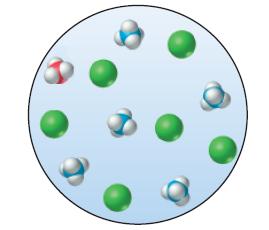
Which of the following points in a titration is represented by the molecular view shown in the sketch?(a) 20% of the necessary titrant added in the titration of NH4Cl(aq) with HCl(aq)(b) 20% of the necessary titrant added in the titration of NH3(aq) with HCl(aq)(c) The equivalence point in the
Using the sketch in Exercise 61 as a guide, sketch the molecular view of a solution in which(a) HCl(aq) is titrated to the equivalence point with KOH(aq)(b) CH3COOH(aq) is titrated halfway to the equivalence point with NaOH(aq).Exercise 61Which of the following points in a titration is represented
A KMnO4(aq) solution is to be standardized by titration against As2O3(s). A 0.1078 g sample of As2O3 requires 22.15 mL of the KMnO4(aq) for its titration. What is the molarity of the KMnO4(aq)?5 As2O3 + 4 MnO4- + 9 H2O + 12 H+ → 10 H3AsO4 + 4 Mn2+
Refer to Example 5-6. Assume that the only reducing agent present in a particular wastewater is SO32-. If a 25.00 mL sample of this wastewater requires 31.46 mL of 0.02237 M KMnO4 for its titration, what is the molarity of SO32- in the wastewater?Example 5-6The reaction described by expression
An iron ore sample weighing 0.9132 g is dissolved in HCl(aq), and the iron is obtained as Fe2+(aq). This solution is then titrated with 28.72 mL of 0.05051 M K2Cr2O7. What is the mass percent Fe in the ore sample?6 Fe2+ + 14 H+ + Cr2O72- → 6 Fe3+ + 2 Cr3+ + 7 H2O
Following are some laboratory methods occasionally used for the preparation of small quantities of chemicals. Write a balanced equation for each.(a) Preparation of H2S(g): HCl(aq) is heated with FeS(s)(b) Preparation of Cl2(g): HCl(aq) is heated with MnO2(s); MnCl2(aq) and H2O(l) are other
When concentrated CaCl2(aq) is added to Na2HPO4(aq), a white precipitate forms that is 38.7% Ca by mass. Write a net ionic equation representing the probable reaction that occurs.
You have a solution that is 0.0250 M Ba(OH)2 and the following pieces of equipment: 1.00, 5.00, 10.00, 25.00, and 50.00 mL pipets and 100.0, 250.0, 500.0, and 1000.0 mL volumetric flasks. Describe how you would use this equipment to produce a solution in which [OH-] is 0.0100 M.
Sodium hydroxide used to make standard NaOH(aq) solutions for acid–base titrations is invariably contaminated with some sodium carbonate. (a) Explain why, except in the most precise work, the presence of this sodium carbonate generally does not seriously affect the results obtained, for example,
A 110.520 g sample of mineral water is analyzed for its magnesium content. The Mg2+ in the sample is first precipitated as MgNH4PO4, and this precipitate is then converted to Mg2P2O7, which is found to weigh 0.0549 g. Express the quantity of magnesium in the sample in parts per million (that is, in
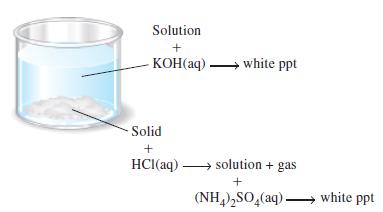
An unknown white solid consists of two compounds, each containing a different cation. As suggested in the illustration, the unknown is partially soluble in water. The solution is treated with NaOH(aq) and yields a white precipitate. The part of the original solid that is insoluble in water
What volume of 0.248 M CaCl2 must be added to 335 mL of 0.186 M KCl to produce a solution with a concentration of 0.250 M Cl-? Assume that the solution volumes are additive.
Balance these equations for reactions in acidic solution.(a) IBr + BrO3- + H+ → IO3- + Br- + H2O(b) C2H5NO3 + Sn → NH2OH + CH3CH2OH + Sn2+(c) As2S3 + NO3- → H3AsO4 + S + NO(d) H5IO6 + I2 → IO3- + H+ + H2O(e) S2F2 + H2O → S8 + H2S4O6 + HF.
Balance these equations for reactions in basic solution.(a) Fe2S3 + H2O + O2 → Fe(OH)3 + S(b) O2- + H2O → OH- + O2(c) CrI3 + H2O2 → CrO42- + IO4-(d) Ag + CN- + O2 + OH- → [Ag(CN)2]- + H2O(e) B2Cl4 + OH- → BO2- + Cl- + H2O + H2.
A method of producing phosphine, PH3, from elemental phosphorus, P4, involves heating the P4 with H2O. An additional product is phosphoric acid, H3PO4. Write a balanced equation for this reaction.
Iron (Fe) is obtained from rock that is extracted from open pit mines and then crushed. The process used to obtain the pure metal from the crushed rock produces solid waste, called tailings, which are stored in disposal areas near the mines. The tailings pose a serious environmental risk because
A sample of battery acid is to be analyzed for its sulfuric acid content. A 1.00 mL sample weighs 1.303 g. This 1.00 mL sample is diluted to 250.0 mL, and 10.00 mL of this diluted acid requires 34.12 mL of 0.00498 M Ba(OH)2 for its titration. What is the mass percent of H2SO4 in the battery acid?
A piece of marble (assume it is pure CaCO3) reacts with 2.00 L of 2.52 M HCl. After dissolution of the marble, a 10.00 mL sample of the resulting solution is withdrawn, added to some water, and titrated with 24.87 mL of 0.9987 M NaOH. What must have been the mass of the piece of marble? Comment on
The reaction below can be used as a laboratory method of preparing small quantities of Cl2(g). If a 62.6 g sample that is 98.5% K2Cr2O7 by mass is allowed to react with 325 mL of HCl(aq) with a density of 1.15 g/mL and 30.1% HCl by mass, how many grams of Cl2(g) are produced?Cr2O72- + H+ + Cl- →
Refer to Example 5-10. Suppose that the KMnO4(aq) were standardized by reaction with As2O3 instead of iron wire. If a 0.1304 g sample that is 99.96% As2O3 by mass had been used in the titration, how many milliliters of the KMnO4(aq) would have been required?As2O3 + MnO4- + H+ + H2O → H3AsO4 +
A new method under development for water treatment uses chlorine dioxide rather than chlorine. One method of producing ClO2 involves passing Cl2(g) into a concentrated solution of sodium chlorite. Cl2(g) and sodium chlorite are the sole reactants, and NaCl(aq) and ClO2(g) are the sole products. If
The active component in one type of calcium dietary supplement is calcium carbonate. A 1.2450 g tablet of the supplement is added to 65.00 mL of 0.4984 M HCl and allowed to react. After completion of the reaction, the excess HCl(aq) requires 38.45 mL of 0.2257 M NaOH for its titration to the
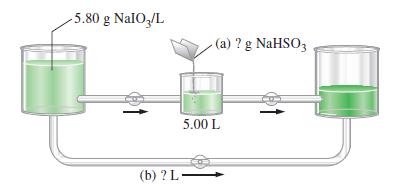
Chile saltpeter is a natural source of NaNO3; it also contains NaIO3. The NaIO3 can be used as a source of iodine. Iodine is produced from sodium iodate in a two-step process occurring under acidic conditions:IO3-(aq) + HSO3-(aq) → I-(aq) + SO42-(aq) (not balanced)I-(aq) + IO3-(aq) → I2(s) +
A 0.4324 g sample of a potassium hydroxide–lithium hydroxide mixture requires 28.28 mL of 0.3520 M HCl for its titration to the equivalence point. What is the mass percent lithium hydroxide in this mixture?
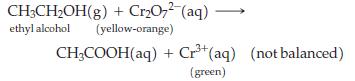
Blood alcohol content (BAC) is often reported in weight–volume percent (w/v%). For example, a BAC of 0.10% corresponds to 0.10 g CH3CH2OH per 100 mL of blood. Estimates of BAC can be obtained from breath samples by using a number of commercially available instruments, including the Breathalyzer
The active ingredients in a particular antacid tablet are aluminum hydroxide, Al(OH)3, and magnesium hydroxide, Mg(OH)2. A 5.00 x 10² mg sample of the active ingredients was dissolved in 50.0 mL of 0.500 M HCl. The resulting solution, which was still acidic, required 16.5 mL of 0.377 M NaOH for
(A) A barometer is filled with diethylene glycol (d = 1.118 g/cm3). The liquid height is found to be 9.25 m. What is the barometric (atmospheric) pressure expressed in millimeters of mercury?(B) A barometer is filled with triethylene glycol. The liquid height is found to be 9.14 m when the
Convert each pressure to an equivalent pressure in atmospheres. (a) 736 mmHg; (b) 0.776 bar;(c) 892 Torr; (d) 225 kPa.
Combustion of 1.110 g of a gaseous hydrocarbon yields 3.613 g CO2 and 1.109 g H2O, and no other products. A 0.288 g sample of the hydrocarbon occupies a volume of 132 mL at 24.8 °C and 1.00 bar. Write a plausible structural formula for a hydrocarbon corresponding to these data.
What is the height of a column of water that exerts the same pressure as a column of mercury 76.0 cm (760 mm) high?
Showing 3100 - 3200
of 4008
First
25
26
27
28
29
30
31
32
33
34
35
36
37
38
39
Last
Step by Step Answers

 Get 50% OFF
Claim Now
Get 50% OFF
Claim Now