New Semester
Started
Get
50% OFF
Study Help!
--h --m --s
Claim Now
Question Answers
Textbooks
Find textbooks, questions and answers
Oops, something went wrong!
Change your search query and then try again
S
Books
FREE
Study Help
Expert Questions
Accounting
General Management
Mathematics
Finance
Organizational Behaviour
Law
Physics
Operating System
Management Leadership
Sociology
Programming
Marketing
Database
Computer Network
Economics
Textbooks Solutions
Accounting
Managerial Accounting
Management Leadership
Cost Accounting
Statistics
Business Law
Corporate Finance
Finance
Economics
Auditing
Tutors
Online Tutors
Find a Tutor
Hire a Tutor
Become a Tutor
AI Tutor
AI Study Planner
NEW
Sell Books
Search
Search
Sign In
Register
study help
sciences
general chemistry principles
General Chemistry Principles And Modern Applications 11th Edition Ralph Petrucci, Jeffry Madura, F. Herring, Carey Bissonnette - Solutions
When 3.06 g hydrogen was allowed to react with an excess of oxygen, 27.35 g water was obtained. In a second experiment, a sample of water was decomposed by electrolysis, resulting in 1.45 g hydrogen and 11.51 g oxygen. Are these results consistent with the law of constant composition? Demonstrate
In one experiment, the burning of 0.312 g sulfur produced 0.623 g sulfur dioxide as the sole product of the reaction. In a second experiment, 0.842 g sulfur dioxide was obtained. What mass of sulfur must have been burned in the second experiment?
In one experiment, the reaction of 1.00 g mercury and an excess of sulfur yielded 1.16 g of a sulfide of mercury as the sole product. In a second experiment, the same sulfide was produced in the reaction of 1.50 g mercury and 1.00 g sulfur.(a) What mass of the sulfide of mercury was produced in the
Sulfur forms two compounds with oxygen. In the first compound, 1.000 g sulfur is combined with 0.998 g oxygen, and in the second, 1.000 g sulfur is combined with 1.497 g oxygen. Show that these results are consistent with Dalton’s law of multiple proportions.
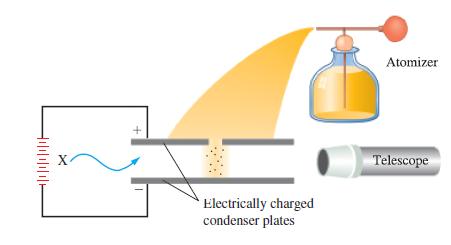
The following observations were made for a series of five oil drops in an experiment similar to Millikan’s (see Figure 2-8). Drop 1 carried a charge of 1.28 x 10⁻¹⁸ C; drops 2 and 3 each carried 1/2 the charge of drop 1; drop 4 carried 1/8 the charge of drop 1; drop 5 had a charge four times
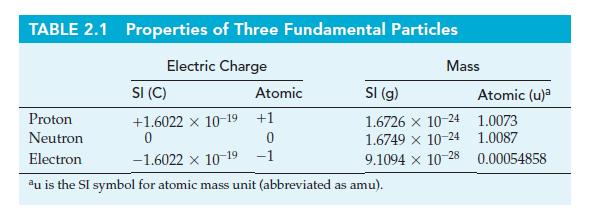
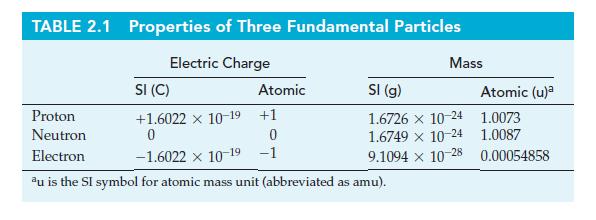
Use data from Table 2.1 to verify that(a) The mass of electrons is about 1/2000 that of H atoms;(b) The mass-to-charge ratio (m/e) for positive ions is considerably larger than that for electrons.Table 2.1 TABLE 2.1 Properties of Three Fundamental Particles Electric Charge SI (C) +1.6022 x 10⁻¹⁹
Determine the approximate value of m/e in grams per coulomb for the ions 12753I- and 3216S2- Why are these values only approximate?
The following radioactive isotopes have applications in medicine. Write their symbols in the form AZE.(a) Cobalt-60; (b) Phosphorus-32; (c) Iron-59; (d) Radium-226.
For the isotope 202Hg, express the percentage of the fundamental particles in the nucleus that are neutrons.
Through an appropriate symbol, indicate the number of protons, neutrons, and electrons in (a) An atom of barium-135 and(b) The double negatively charged ion of selenium-80.
A compound contains only Fe and O. A 0.2729 g sample of the compound was dissolved in 50 mL of concentrated acid solution, reducing all the iron to Fe2+ ions. The resulting solution was diluted to 100 mL and then titrated with a 0.01621 M KMnO4 solution. The unbalanced chemical expression for
Warfarin, C19H16O4, is the active ingredient used in some anticoagulant medications. The amount of warfarin in a particular sample was determined as follows. A 13.96 g sample was first treated with an alkaline I2 solution to convert C19H16O4 to CHI3. This treatment gives one mole of CHI3 for every
Copper refining traditionally involves “roasting” insoluble sulfide ores (CuS) with oxygen. Unfortunately, the process produces large quantities of SO2(g), which is a major contributor to pollution and acid rain. An alternative process involves treating the sulfide ore with HNO3(aq), which
Phosphorus is essential for plant growth, but an excess of phosphorus can be catastrophic in aqueous ecosystems. Too much phosphorus can cause algae to grow at an explosive rate and this robs the rest of the ecosystem of oxygen. Effluent from sewage treatment plants must be treated before it can be
Manganese is derived from pyrolusite ore, an impure manganese dioxide. In the procedure used to analyze a pyrolusite ore for its MnO2 content, a 0.533 g sample is treated with 1.651 g oxalic acid (H2C2O4 · 2 H2O) in an acidic medium. Following this reaction, the excess oxalic acid is titrated with
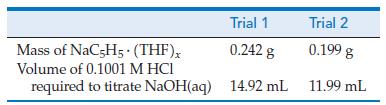
Sodium cyclopentadienide, NaC5H5, is a common reducing agent in the chemical laboratory, but there is a problem in using it: NaC5H5 is contaminated with tetrahydrofuran (THF), C4H8O, a solvent used in its preparation. The THF is present as NaC5H5 · (THF)x, and it is generally necessary to know
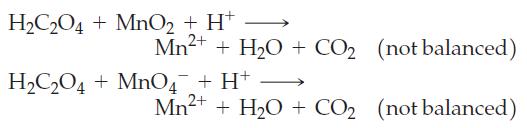
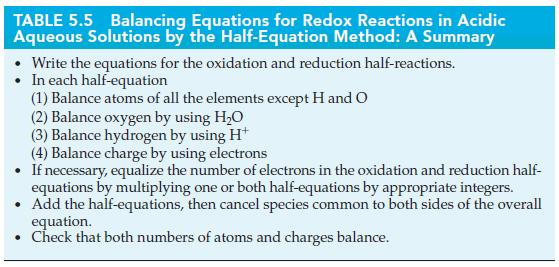
In this problem, we describe an alternative method for balancing equations for oxidation-reduction reactions. The method is similar to the method given previously in Tables 5.5 and 5.6, but it places more emphasis on the assignment of oxidation states. (The method summarized in Tables 5.5 and 5.6
The Kjeldahl method is used in agricultural chemistry to determine the percent protein in natural products. The method is based on converting all the protein nitrogen to ammonia and then determining the amount of ammonia by titration. The percent nitrogen in the sample under analysis can be
In your own words, define or explain the terms or symbols (a) ⇌ (b) [ ]; (c) Spectator ion; (d) Weak acid.
Briefly describe (a) Half-equation method of balancing redox equations; (b) Disproportionation reaction;(c) Titration; (d) Standardization of a solution.
Explain the important distinctions between (a) A strong electrolyte and strong acid; (b) An oxidizing agent and reducing agent; (c) Precipitation reactions and neutralization reactions; (d) Half-reaction and overall reaction.
The number of moles of hydroxide ion in 0.300 L of 0.0050 M Ba(OH)2 is (a) 0.0015; (b) 0.0030; (c) 0.0050;(d) 0.010.
The highest [H+] will be found in an aqueous solution that is (a) 0.10 M HCl; (b) 0.10 M NH3; (c) 0.15 M CH3COOH;(d) 0.10 M H2SO4.
To precipitate Zn2+ from Zn(NO3)2(aq), add(a) NH4Cl; (b) MgBr2; (c) K2CO3; (d) (NH4)2SO4.
When treated with dilute HCl(aq), the solid that reacts to produce a gas is (a) BaSO3; (b) ZnO;(c) NaBr; (d) Na2SO4.
An unknown solid compound dissolves readily when added to water, forming a solution that conducts electricity. A precipitate forms when Ba(NO3)2(aq) is added to a solution of this compound, but not when Cu(NO3)2(aq) is added. When the unknown solid is added to CH3COOH(aq), no gas is produced. When
In the equationthe missing coefficients (a) Are each 2; (b) Are each 4;(c) Can have any values as long as they are the same;(d) Must be determined by experiment. ? Fe²+ (aq) + O₂(g) O₂(g) + 4H+ (aq) 3*(aq) + 2H,O(1) ? Fe3+
What is the net ionic equation for the reaction that occurs when an aqueous solution of KI is added to an aqueous solution of Pb(NO3)2?
When aqueous sodium carbonate, Na2CO3, is treated with dilute hydrochloric acid, HCl, the products are sodium chloride, water, and carbon dioxide gas. What is the net ionic equation for this reaction?
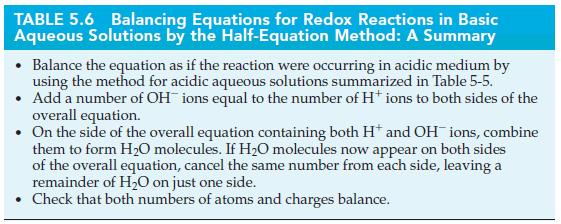
Balance the following oxidation–reduction equations.(a) Cl2(aq) → Cl-(aq) + ClO-(aq) (basic solution)(b) C2O42-(aq) + MnO4-(aq) → Mn2+(aq) + CO2(g) (acidic solution)
Describe the synthesis of each of the following ionic compounds, starting from solutions of sodium and nitrate salts. Then write the net ionic equation for each synthesis.(a) Zn3(PO4)2;(b) Cu(OH)2;(c) NiCO3.
What is the simplest ratio a:b when the equation below is properly balanced?(a) 2:5; (b) 5:2; (c) 1:5; (d) 5:1; (e) 2:3. acidic a CIO (aq) + bl₂(aq) solution cCl(aq) + d IO3(aq)
In the half-reaction in which NpO2+ is converted to Np4+, the number of electrons appearing in the half-equation is (a) 1; (b) 2; (c) 3; (d) 4.
Which list of compounds contains a nonelectrolyte, a weak electrolyte, and a strong electrolyte? (a) CO2, NaCl, MnSO4; (b) H2SO4, CH3COOH, CuCl; (c) SO2, HF, FeSO4; (d) Ba(ClO3)2, K2S2O3, NaMnO4; (e) None of these.
Which list of compounds contains a weak acid, a weak base, and a salt? (a) HCl, NH3, Na2SO4;(b) HNO2, NH3, NH4NO2; (c) HCl, Ca(OH)2, CaSO4;(d) HNO2, KOH, Cs2CrO4; (e) None of these.
Which list of compounds contains two soluble compounds and an insoluble one?(a) HgBr2, MnSO4, Na2C2O4;(b) Na2S2O3, NH4Cl, CoI2;(c) MnS, Cu(OH)2, Al2O3;(d) Pb(ClO4)2, Ca(NO3)2, Hg2SO4;(e) None of these.
Classify each of the following statements as true or false.(a) Barium chloride, BaCl2, is a weak electrolyte in aqueous solution.(b) In the reaction H-(aq) + H2O(l): H2(g) + OH-(aq), water acts as both an acid and an oxidizing agent.(c) A precipitate forms when aqueous sodium carbonate, Na2CO3(aq),
Which of the following reactions are oxidation–reduction reactions?(a) H2CO3(aq) → H2O(l) + CO2(g)(b) 2 Li(s) + 2 H2O(l) → 2 LiOH(aq) + H2(g)(c) 4 Ag(s) + PtCl4(aq) → 4 AgCl(s) + Pt(s)(d) 2 HClO4(aq) + Ca(OH)2(aq) → 2 H2O(l) + Ca(ClO4)2(aq).
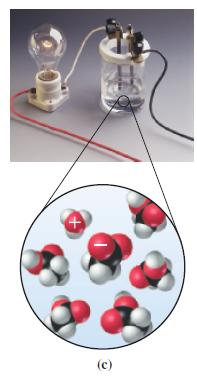
Similar to Figure 5-4(c), but using the formulas HAc, Ac- and H3O+, give a more accurate representation of CH3COOH(aq) in which ionization is 5% complete.Figure 5-4(c) + (c)
For the ion 228Ra2+ with a mass of 228.030 u, determine(a) The numbers of protons, neutrons, and electrons in the ion;(b) The ratio of the mass of this ion to that of an atom of 16O.
An isotope of silver has a mass that is 6.68374 times that of oxygen-16. What is the mass in u of this isotope?
The ratio of the masses of the two naturally occurring isotopes of indium is 1.0177:1. The heavier of the two isotopes has 7.1838 times the mass of 16O. What are the masses in u of the two isotopes?
The four naturally occurring isotopes of strontium have the atomic masses 83.9134 u; 85.9093 u; 86.9089 u; and 87.9056 u. The percent isotopic abundance of the lightest isotope is 0.56% and of the heaviest, 82.58%. Estimate the percent isotopic abundances of the other two. Why is this result only a
The following ratios of masses were obtained with a mass spectrometer: 199F/126C = 1.5832; 3517Cl/199F = 1.8406; 8135Br/3517Cl = 2.3140; Determine the mass of a 8135Br atom in amu.
Which of the following species has(a) Equal numbers of neutrons and electrons;(b) Protons, neutrons, and electrons in the ratio 9:11:8;(c) A number of neutrons equal to the number of protons plus one-half the number of electrons? 24Mg2+, 47Cr, 60Co³+, 35CF, 124Sn²+, 226Th, ⁹0Sr
Given the same species as listed in Exercise 33, which has(a) Equal numbers of neutrons and protons;(b) Protons contributing more than 50% of the mass;(c) About 50% more neutrons than protons?Exercise 33Which of the following species has(a) Equal numbers of neutrons and electrons;(b) Protons,
An isotope with mass number 44 has four more neutrons than protons. This is an isotope of what element?
Identify the isotope X that has one more neutron than protons and a mass number equal to nine times the charge on the ion X3+.
Iodine has many radioactive isotopes. Iodine-123 is a radioactive isotope used for obtaining images of the thyroid gland. Iodine-123 is administered to patients in the form of sodium iodide capsules that contain 123I- ions. Determine the number of neutrons, protons, and electrons in a
Iodine-131 is a radioactive isotope that has important medical uses. Small doses of iodine-131 are used for treating hyperthyroidism (overactive thyroid) and larger doses are used for treating thyroid cancer. Iodine-131 is administered to patients in the form of sodium iodide capsules that contain
Americium-241 is a radioactive isotope that is used in high-precision gas and smoke detectors. How many neutrons, protons, and electrons are there in an atom of americium-241?
Some foods are made safer to eat by being exposed to gamma rays from radioactive isotopes, such as cobalt-60. The energy from the gamma rays kills bacteria in the food. How many neutrons, protons, and electrons are there in an atom of cobalt-60?
Which statement is probably true concerning the masses of individual chlorine atoms: All have, some have, or none has a mass of 35.45 u? Explain.
The mass of a carbon-12 atom is taken to be exactly 12 u. Are there likely to be any other atoms with an exact integral (whole number) mass, expressed in u? Explain.
Magnesium has three naturally occurring isotopes. Their masses are 23.985042 u, 24.985837 u, and 25.982593 u. What is the weighted-average atomic mass of magnesium in a sample for which the percent isotopic abundances of these three isotopes are 78.99%, 10.00%, and 11.01%, respectively?
There are four naturally occurring isotopes of chromium. Their masses and percent isotopic abundances are 49.9461 u, 4.35%; 51.9405 u, 83.79%; 52.9407 u, 9.50%; and 53.9389 u, 2.36%. Calculate the weighted average atomic mass of chromium.
The two naturally occurring isotopes of silver have the following abundances: 107Ag, 51.84%; 109Ag, 48.16%. The mass of 107Ag is 106.905092 u. What is the mass of 109Ag?
Gallium has two naturally occurring isotopes. One of them, gallium-69, has a mass of 68.925581 u and a percent isotopic abundance of 60.11%. What must be the mass and percent isotopic abundance of the other isotope, gallium-71?
The three naturally occurring isotopes of potassium are 39K, 38.963707 u; 40K, 39.963999 u; and 41K. The percent isotopic abundances of 39K and 41K are 93.2581% and 6.7302%, respectively. Determine the isotopic mass of 41K.
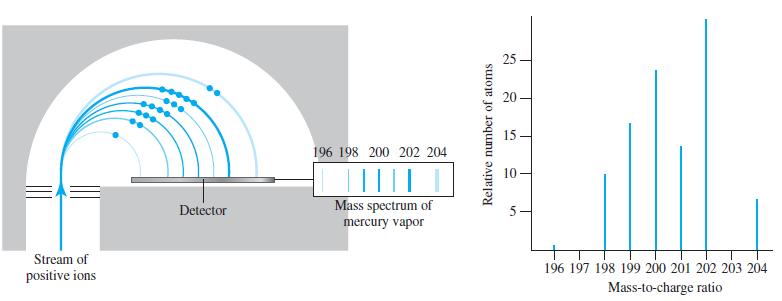
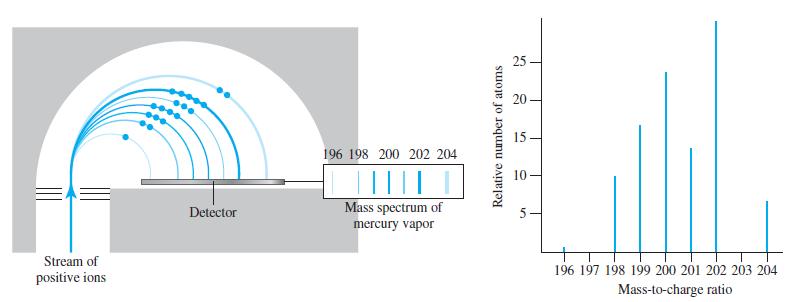
A mass spectrum of germanium displayed peaks at mass numbers 70, 72, 73, 74, and 76, with relative heights of 20.5, 27.4, 7.8, 36.5, and 7.8, respectively.(a) In the manner of Figure 2-14, sketch this mass spectrum.(b) Estimate the weighted-average atomic mass of germanium, and state why this
Use the conventional atomic mass of boron to estimate the fractional isotopic abundances of the two naturally occurring isotopes, 10B and 11B These isotopes have masses of 10.012937 u and 11.009305 u, respectively.
Hydrogen and chlorine atoms react to form simple diatomic molecules in a 1:1 ratio, that is, HCl. The percent isotopic abundances of the chlorine isotopes are 35Cl and 37Cl are estimated to be 75.77% and 24.23%, respectively. The percent isotopic abundances of 2H and 3H are estimated to be 0.015%
Refer to the periodic table inside the front cover and identify(a) The element that is in group 14 and the fourth period(b) One element similar to and one unlike sulfur(c) The alkali metal in the fifth period(d) The halogen element in the sixth period.
Refer to the periodic table inside the front cover and identify(a) The element that is in group 11 and the sixth period(b) An element with atomic number greater than 50 that has properties similar to the element with atomic number 18(c) The group number of an element E that forms an ion E2-(d) An
Assuming that the seventh period of the periodic table has 32 members, what should be the atomic number of (a) The noble gas following radon (Rn);(b) The alkali metal following francium (Fr)?
Find the several pairs of elements that are “out of order” in terms of increasing atomic mass and explain why the reverse order is necessary.
What is the total number of atoms in (a) 15.8 mol Fe;(b) 0.000467 mol Ag; (c) 8.5 x 10⁻¹¹ mol Na?
Without doing detailed calculations, indicate which of the following quantities contains the greatest number of atoms: 6.022 x 10²³ Ni atoms, 25.0 g nitrogen, 52.0 g Cr, 10.0 cm3 Fe (d = 7.86 g/cm3). Fe Explain your reasoning.
Determine(a) The number of moles of Zn in a 415.0 g sample of zinc metal(b) The number of Cr atoms in 147.4 kg chromium(c) The mass of a one-trillion-atom (1.0 x 10¹²) sample of metallic gold(d) The average mass of a fluorine atom.
Determine(a) The number of Kr atoms in a 5.25 mg sample of krypton(b) The molar mass, M, and identity of an element if the mass of a 2.80 x 10²² atom sample of the element is 2.09 g(c) The mass of a sample of phosphorus that contains the same number of atoms as 44.75 g of magnesium.
How many Cu atoms are present in a piece of sterling silver jewelry weighing 33.24 g? (Sterling silver is a silver–copper alloy containing 92.5% Ag by mass.)
How many atoms are present in a sample of plumber’s solder, a lead–tin alloy containing 67% Pb by mass and having a density of 9.4 g/cm3?
How many 204Pb atoms are present in a piece of lead weighing 215 mg? The percent isotopic abundance of 204Pb is 1.4%.
A particular lead–cadmium alloy is 8.0% cadmium by mass. What mass of this alloy, in grams, must you weigh out to obtain a sample containing 7.25 x 10²³ Cd atoms?
Medical experts generally believe a level of 30 μg Pb per deciliter of blood poses a significant health risk (1 dL = 0.1 L). Express this level (a) In the unit mol Pb/L blood;(b) As the number of Pb atoms per milliliter of blood.
During a severe episode of air pollution, the concentration of lead in the air was observed to be 3.11 μg Pb/m3. How many Pb atoms would be present in a 0.500 L sample of this air (the volume of air displaced in the lungs between inhaling and exhaling)?
Without doing detailed calculations, determine which of the following samples has the greatest number of atoms:(a) A cube of iron with a length of 10.0 cm (d = 7.86 g/cm3)(b) 1.00 kg of hydrogen contained in a 10,000 L balloon(c) A mound of sulfur weighing 20.0 kg(d) A 76 lb sample of liquid
A solution was prepared by dissolving 2.50 g potassium chlorate (a substance used in fireworks and flares) in 100.0 mL of water at 40 °C. When the solution was cooled to 20 °C, its volume was still found to be 100.0 mL, but some of the potassium chlorate had crystallized (deposited from the
William Prout (1815) proposed that all other atoms are built up of hydrogen atoms, suggesting that all elements should have integral atomic masses based on an atomic mass of one for hydrogen. This hypothesis appeared discredited by the discovery of atomic masses, such as 24.3 u for magnesium and
Use 1 x 10-13 cm as the approximate diameter of the spherical nucleus of the hydrogen-1 atom, together with data from Table 2.1, to estimate the density of matter in a proton.Table 2.1 TABLE 2.1 Properties of Three Fundamental Particles Electric Charge Atomic Mass SI (C) Proton +1.6022 x 10⁻¹⁹
Fluorine has a single atomic species,19F. Determine the atomic mass of 19F. by summing the masses of its protons, neutrons, and electrons, and compare your results with the value listed on the inside front cover. Explain why the agreement is poor.
Use fundamental definitions and statements from Chapters 1 and 2 to establish the fact that 6.022 x 10²³ u = 1.000 g.
In each case, identify the element in question.(a) The mass number of an atom is 234, and the atom has 60.0% more neutrons than protons.(b) An ion with a +2 charge has 10.0% more protons than electrons.(c) An ion with a mass number of 110 and a 2+ charge has 25.0% more neutrons than electrons.
Determine the only possible +2 ion for which the following two conditions are both satisfied:• The net ionic charge is one-tenth the nuclear charge.• The number of neutrons is four more than the number of electrons.
Determine the only possible isotope (E) for which the following conditions are met:• The mass number of E is 2.50 times its atomic number.• The atomic number of E is equal to the mass number of another isotope (Y). In turn, isotope Y has a neutron number that is 1.33 times the atomic number of
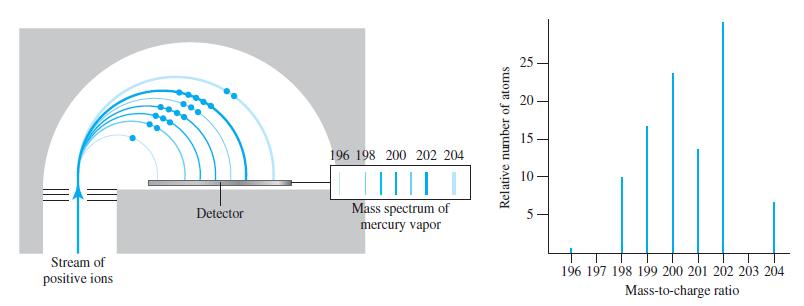
The masses of the naturally occurring mercury isotopes are 196Hg, 195.9658 u; 198Hg, 197.9668 u; 199Hg, 198.9683 u; 200Hg, 199.9683 u; 201Hg, 200.9703 u; 202Hg, 201.9706 u; and 204Hg, 203.9735 u. Use these data, together with data from Figure 2-14, to calculate the weighted-average atomic mass
Suppose we redefined the atomic mass scale by arbitrarily assigning to the naturally occurring mixture of chlorine isotopes an atomic mass of 35.00000 u.(a) What would be the atomic masses of helium, sodium, and iodine on this new atomic mass scale?(b) Why do these three elements have nearly
The two naturally occurring isotopes of nitrogen have masses of 14.0031 and 15.0001 u, respectively. Use the conventional atomic mass of nitrogen to estimate the percentage of 15N atoms in naturally occurring nitrogen.
Germanium has three major naturally occurring isotopes: 70Ge (69.92425 u, 20.85%), 72Ge (71.92208 u, 27.54%), 74Ge (73.92118 u, 36.29%). There are also two minor isotopes: 73Ge (72.92346 u) and 76Ge (75.92140 u). Calculate the percent isotopic abundances of the two minor isotopes. Comment on the
The two naturally occurring isotopes of chlorine are 35Cl (34.9689 u, 75.77%) and 37Cl (36.9658 u, 24.23%). The two naturally occurring isotopes of bromine are 79Br (78.9183 u, 50.69%) and 81Br (80.9163 u, 49.31%). Chlorine and bromine combine to form bromine monochloride, BrCl. Sketch a mass
From the densities of the lines in the mass spectrum of krypton gas, the following observations were made:• Somewhat more than 50% of the atoms were krypton-84.• The numbers of krypton-82 and krypton-83 atoms were essentially equal.• The number of krypton-86 atoms was 1.50 times as great as
How many atoms are present in a 1.50 m length of 20-gauge copper wire? A 20-gauge wire has a diameter of 0.03196 in., and the density of copper is 8.92 g/cm3.
Monel metal is a corrosion-resistant copper–nickel alloy used in the electronics industry. A particular alloy with a density of 8.80 g/cm3 and containing 0.022% Si by mass is used to make a rectangular plate 15.0 cm long, 12.5 cm wide, 3.00 mm thick, and has a 2.50 cm diameter hole drilled
Deuterium, 2H (2.0140 u), is sometimes used to replace the principal hydrogen isotope in chemical studies. The percent isotopic 1H abundance of deuterium is 0.015%. If it can be done with 100% efficiency, what mass of hydrogen gas would have to be processed to obtain a sample containing 2.50 x 10²¹
An alloy that melts at about the boiling point of water has Bi, Pb, and Sn atoms in the ratio 10:6:5, respectively. What mass of alloy contains a total of one mole of atoms?
A particular silver solder (used in the electronics industry to join electrical components) is to have the atom ratio of 5.00 Ag/4.00 Cu/1.00 Zn. What masses of the three metals must be melted together to prepare 1.00 kg of the solder?
A low-melting Sn–Pb–Cd alloy called eutectic alloy is analyzed. The mole ratio of tin to lead is 2.73:1.00, and the mass ratio of lead to cadmium is 1.78:1.00. What is the mass percent composition of this alloy?
In an experiment, 125 cm3 of zinc and 125 cm3 of iodine are mixed together and the iodine is completely converted to 164 cm3 of zinc iodide. What volume of zinc remains unreacted? The densities of zinc, iodine, and zinc iodide are 7.13 g/cm3, 4.93 g/cm3, and 4.74 g/cm3, respectively.
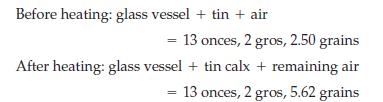
The data Lavoisier obtained in the experiment described on page 35 are as follows:How closely did Lavoisier’s results conform to the law of conservation of mass? (1 livre = 16 onces; 1 once = 8 gros; 1 gros = 72 grains. In modern terms, 1 livre = 30.59 g. ) Before heating: glass vessel + tin +
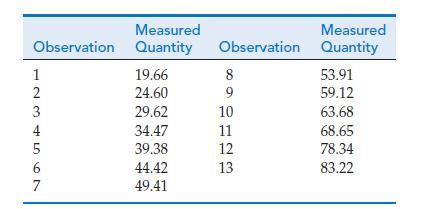
Some of Millikan’s oil-drop data are shown below. The measured quantities were not actual charges on oil drops but were proportional to these charges. Show that these data are consistent with the idea of a fundamental electronic charge. Measured Observation
Showing 3400 - 3500
of 4008
First
27
28
29
30
31
32
33
34
35
36
37
38
39
40
41
Step by Step Answers

 Get 50% OFF
Claim Now
Get 50% OFF
Claim Now