New Semester
Started
Get
50% OFF
Study Help!
--h --m --s
Claim Now
Question Answers
Textbooks
Find textbooks, questions and answers
Oops, something went wrong!
Change your search query and then try again
S
Books
FREE
Study Help
Expert Questions
Accounting
General Management
Mathematics
Finance
Organizational Behaviour
Law
Physics
Operating System
Management Leadership
Sociology
Programming
Marketing
Database
Computer Network
Economics
Textbooks Solutions
Accounting
Managerial Accounting
Management Leadership
Cost Accounting
Statistics
Business Law
Corporate Finance
Finance
Economics
Auditing
Tutors
Online Tutors
Find a Tutor
Hire a Tutor
Become a Tutor
AI Tutor
AI Study Planner
NEW
Sell Books
Search
Search
Sign In
Register
study help
sciences
general chemistry principles
General Chemistry Principles And Modern Applications 11th Edition Ralph Petrucci, Jeffry Madura, F. Herring, Carey Bissonnette - Solutions
Briefly describe each of the following ideas:(a) Hybridization of atomic orbitals; (b) σ-bond framework;(c) Kekulé structures of benzene, C6H6.
A molecule in which sp2 hybrid orbitals are used by the central atom in forming covalent bonds is (a) PCl5;(b) N2;(c) SO2;(d) He2.
Explain the important distinctions between the terms in each of the following pairs: (a) σ and π bonds;(b) Localized and delocalized electrons; (c) Bonding and antibonding molecular orbitals.
The bond angle in H2Se is best described as (a) Between 109° and 120°; (b) Less than in H2S; (c) Less than in H2S, but not less than 90°;(d) Less than 90°.
The hybridization scheme for the central atom includes a d orbital contribution in (a) I3-;(b) PCl3;(c) NO3-;(d) H2Se.
Of the following, the species with a bond order of 1 is(a) H2+;(b) Li2;(c) He2;(d) H2-.
The hybridization scheme for Xe in XeF2 is (a) sp;(b) sp3;(c) sp3d;(d) sp3d2.
Delocalized molecular orbitals are found in (a) H2;(b) HS-;(c) CH4;(d) CO32-.
What is the total number of (a) σ bonds and (b) π bonds in the molecule CH3NCO?
Explain why the molecular structure of BF3 cannot be adequately described through overlaps involving pure s and p orbitals.
Which of the following species are paramagnetic?(a) B2;(b) B2-;(c) B2+.Which species has the strongest bond?
Use the valence molecular orbital configuration to determine which of the following species is expected to have the lowest ionization energy: (a) C2+;(b) C2;(c) C2-.
Use the valence molecular orbital configuration to determine which of the following species is expected to have the greatest electron affinity: (a) C2+; (b) Be2;(c) F2;(d) B2+.
Which of these diatomic molecules do you think has the greater bond energy, Li2 or C2? Explain.
For each of the following ions or molecules, decide whether the structure is best described by a single Lewis structure or by resonance structures. (a) C2O42–;(b) H2CO; (c) NO3-.
Draw Lewis structures for the NO2- and NO2+ ions, and determine the likely geometry for each by using VSEPR theory. How does the hybridization of N differ in these two species?
In which of the following is the central atom sp hybridized? (a) BeCl2; (b) BCl3; (c) CCl4; (d) NCl3;(e) None of these.
Which of the following can be used to explain why all bond distances and angles in methane, CH4, are the same? (a) Resonance; (b) Delocalization of electrons;(c) Bond polarities; (d) Electronegativity; (e) Orbital hybridization.
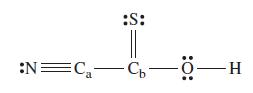
Consider the molecule with the Lewis structure given below.(a) How many σ and π bonds are there?(b) What is the appropriate hybridization scheme for each of Ca, Cb, and O?(c) In which orbitals are the lone pairs located?(d) What are the (ideal) values of the following bond angles?
Construct a concept map that embodies the ideas of valence bond theory.
Construct a concept map that describes the interconnection between valence bond theory and molecular orbital theory in the description of resonance structures.
The Lewis structure of N2 indicates that the nitrogen-to-nitrogen bond is a triple covalent bond. Other evidence suggests that the σ bond in this molecule involves the overlap of sp hybrid orbitals.(a) Draw orbital diagrams for the N atoms to describe bonding in N2.(b) Can this bonding be
Show that both the valence bond method and molecular orbital theory provide an explanation for the existence of the covalent molecule Na2 in the gaseous state. Would you predict Na2 by the Lewis theory?
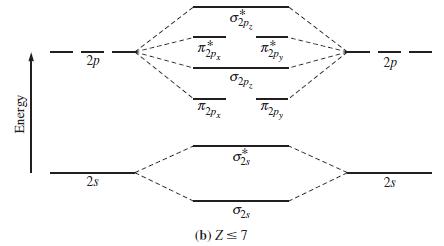
A group of spectroscopists believe that they have detected one of the following species: NeF, NeF+, or NeF-. Assume that the energy-level diagrams of Figure 11-25 apply, and describe bonding in these species. Which of these species would you expect the spectroscopists to have observed?Figure 11-25
For each of the following substances describe the importance of dispersion (London) forces, dipole–dipole interactions, and hydrogen bonding: (a) HCl;(b) Br2;(c) ICl; (d) HF; (e) CH4.
Which would you expect to have the higher boiling point, the hydrocarbon fuel butane, C4H10, or the organic solvent acetone, (CH3)2CO?
When another atom or group of atoms is substituted for one of the hydrogen atoms in benzene, C6H6 the boiling point changes. Explain the order of the following boiling points: C6H6, 80 °C; C6H5Cl, 132 °C; C6H5Br, 156 °C; C6H5OH, 182 °C.
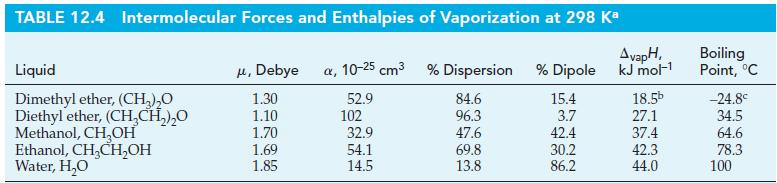
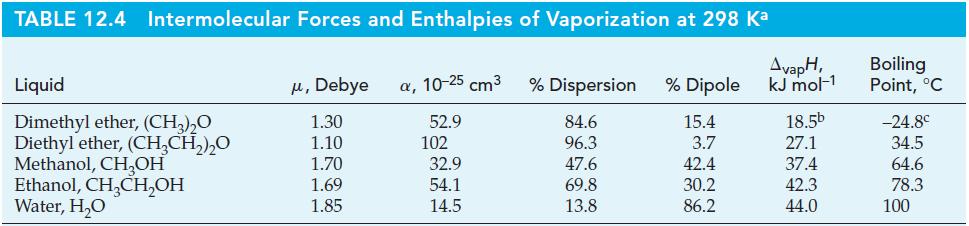
A 0.750 L sample of steam obtained at the normal boiling point of water was allowed to condense on a slightly cooler surface. Using data from Table 12.4, estimate the quantity of heat evolved. Why is the result only an estimate?
Why does a three-minute boiled egg take longer than three minutes to cook in Switzerland and not on Manhattan Island in New York City?
(A) Equilibrium is established between liquid hexane, C6H14, and its vapor at 25.0 °C. A sample of the vapor is found to have a density of 0.701 g/L. Calculate the vapor pressure of hexane at 25.0 °C, expressed in Torr.(B) With the help of Figure 12-18, estimate the density of the vapor in
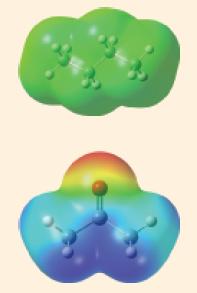
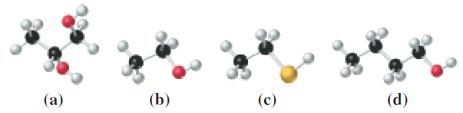
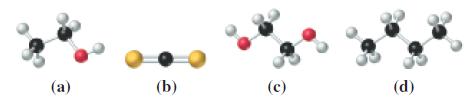
Arrange the liquids represented by the following molecular models in the expected order of increasing viscosity at 25 °C. (a) (b) (c) (d)
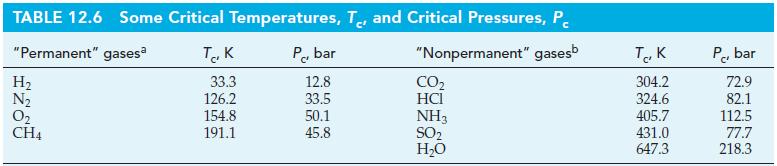
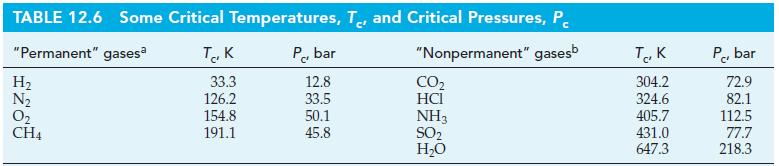
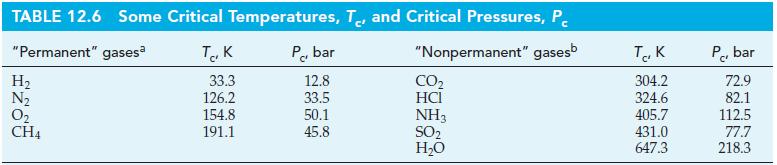
Compare the critical temperatures of NH3 and N2 (Table 12.6). Which gas has the stronger intermolecular forces?Table 12.6 TABLE 12.6 Some Critical Temperatures, T, and Critical Pressures, P "Permanent" gasesa "Nonpermanent" gasesb H₂ N₂ 0₂ CH4 так 33.3 126.2 154.8 191.1 P,
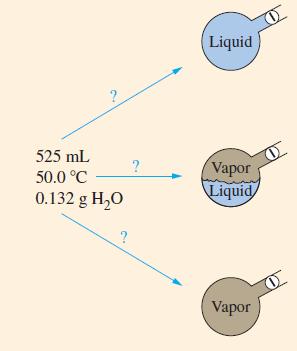
(A) If the reaction described in this example resulted in H2O produced and maintained at would the water be present as vapor only or as liquid and vapor in equilibrium? Explain.(B) For the situation described in Example 12.4, what mass of water is present as liquid and what mass as vapor?Example
Arrange the liquids represented by the following molecular models in the expected order of increasing normal boiling point. (a) (b) (c) (d)
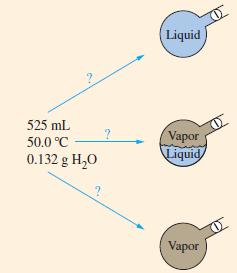
As a result of a chemical reaction, 0.132 g H2O is produced and maintained at a temperature of 50.0 °C in a closed flask of 525 mL volume. Will the water be present as liquid only, vapor only, or liquid and vapor in equilibrium (Fig. 12-19)?Fig. 12-19 525 mL 50.0 °C 0.132 g
(A) A handbook lists the vapor pressure of methyl alcohol as 100 mmHg at 21.2 °C. What is its vapor pressure at 25.0 °C?(B) A handbook lists the normal boiling point of isooctane, a gasoline component, as 99.2 °C and its enthalpy of vaporization (ΔvapH) as 35.76 kJ mol-1 C8H18. Calculate the
Explain why CCl4 has a higher boiling point than CH3Cl, despite the polarity of CH3Cl.
One of the following substances is a liquid at room temperature and the others are gaseous: CH3OH; C3H8; N2; N2O. Which do you think is the liquid? Explain.
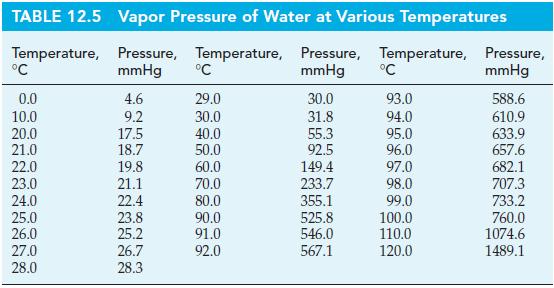
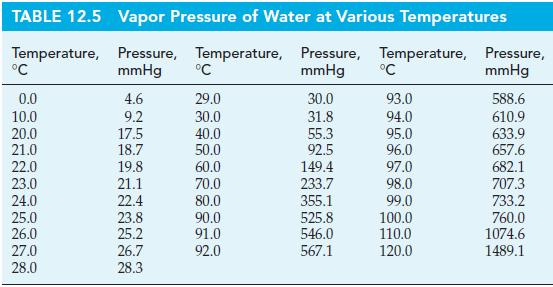
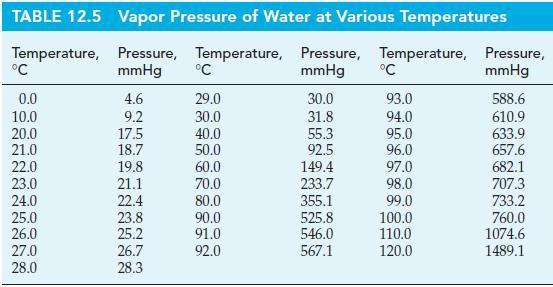
Calculate the vapor pressure of water at 35.0 °C using data from Tables 12.4 and 12.5.Tables 12.4Tables 12.5 TABLE 12.4 Intermolecular Forces and Enthalpies of Vaporization at 298 Ka Liquid Dimethyl ether, (CH₂)₂0 Diethyl ether, (CH₂CH₂)₂0 Methanol, CH₂OH Ethanol, CH₂CH₂OH Water,
Recall the discussion of dew and frost formation. Do the surroundings absorb or lose heat when water vapor condenses to dew or frost? Is the quantity of heat per gram of H2O(g) condensed the same whether the condensate is dew or frost? Explain.
(A) Arrange the following in the expected order of increasing boiling point: Ne, He, Cl2, (CH3)2CO, O2, O3.(B) Following are some values of ΔvapH for several liquids at their normal boiling points: H2, 0.92 kJ mol-1; CH4, 8.16 kJ mol-1; C6H6, 31.0 kJ mol-1; CH3NO2, 34.0 kJ mol-1. Explain the
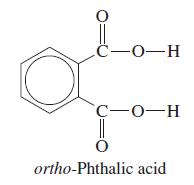
In which of the following compounds might intramolecular hydrogen bonding be an important factor? Explain. (a) CH3CH2COCH3;(b) CH3NH2CH2CH2 COOH;(c) CH3CH2CHFCH2OH; (d) Ortho-phthalic acid. O C-0-H C-O-H -0- O ortho-Phthalic acid
Arrange the following substances in the order in which you would expect their boiling points to increase: CCl4 , Cl2 , ClNO, N2.
One method of restoring water-damaged books after a fire is extinguished in a library is by “freeze drying” them in evacuated chambers. Describe how this method might work.
How many water molecules can hydrogen bond to methanol?
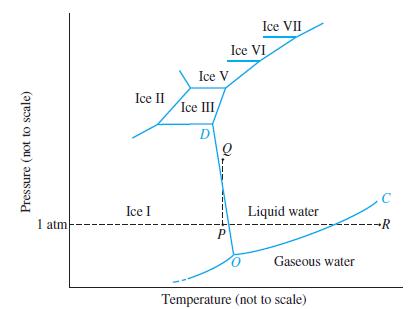
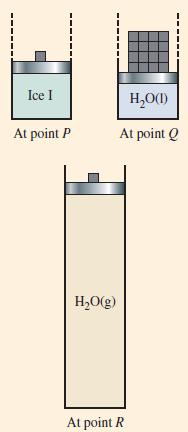
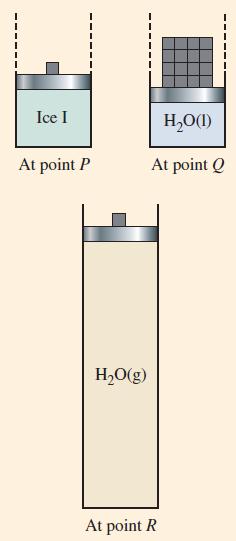
A sample of ice is maintained at 1 atm and at a temperature represented by point P in Figure 12-30. Describe what happens when (a) The temperature is raised, at constant pressure, to point R, and (b) The pressure is raised, at constant temperature, to point Q. The sketches Figure 12-31 suggest
Suppose a first-order diffraction is observed at an angle for a particular plane of atoms by using X-rays of wavelength λ. In order to observe a second-order diffraction from the same plane of atoms at the same angle θ the wavelength of the X-rays must be a multiple of l. What is that multiple?
(A) Cite one ionic compound that you would expect to have a lower melting point than KI and one with a higher melting point than CaO.(B) Which would you expect to have the greater solubility in water, NaI or MgCl2? Explain.
What is the maximum number of hydrogen bonds that can form between two acetic acid molecules?
Which has the higher melting point, KI or CaO?
Buckminsterfullerene C60 crystallizes in a face-centered cubic array. If potassium atoms fill all the tetrahedral and octahedral holes, what is the formula of the resulting compound?
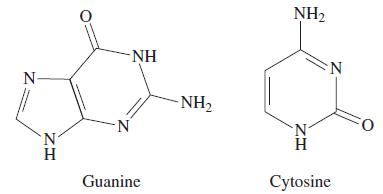
In DNA the nucleic acid bases form hydrogen bonds between them, which are responsible for the formation of the double-stranded helix. Arrange the bases guanine and cytosine to give the maximum number of hydrogen bonds. N ZH N -NH -N Guanine NH₂ NH₂ ZH N N H Cytosine
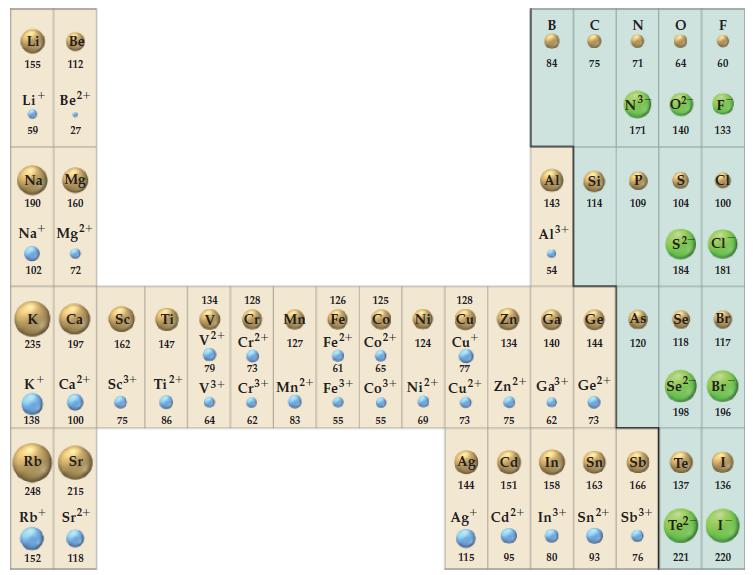
(A) Potassium crystallizes in the bcc structure. What is the length of the unit cell in this structure? Use the metallic radius of potassium given in Figure 9-11.(B) Aluminum crystallizes in an fcc structure. Given that the atomic radius of Al is 143.1 pm, what is the volume of a unit cell?Figure
(A) The normal boiling point of isooctane (a gasoline component with a high octane rating) is 99.2 °C, and its ΔvapH is 35.76 kJ mol-1. Because isooctane and water have nearly identical boiling points, will they have nearly equal vapor pressures at room temperature? If not, which would you expect
A television commercial claims that a product makes water “wetter.” Can there be any basis to this claim? Explain.
Rank the following in order of increasing surface tension (at room temperature): (a) CH3OH;(b) HOCH2CH2OH; (c) CH3CH2OCH2CH3.
Would you predict the surface tension of t-butyl alcohol, (CH3)3COH, to be greater than or less than that of n-butyl alcohol, CH3CH2CH2CH2OH? Explain.
Butanol and pentane have approximately the same mass, however, the viscosity (at 20 °C) of butanol is η = 2.948 cP, and the viscosity of pentane is cP. Explain this difference.
Carbon tetrachloride (CCl4) and mercury have similar viscosities at 20 °C. Explain.
As a liquid evaporated from an open container, its temperature was observed to remain roughly constant. When the same liquid evaporated from a thermally insulated container (a vacuum bottle or Dewar flask), its temperature was observed to drop. How would you account for this difference?
Explain why vaporization occurs only at the surface of a liquid until the boiling point temperature is reached. That is, why does vapor not form throughout the liquid at all temperatures?
Use data from the Integrative Example to determine how much heat is required to convert 25.00 mL of liquid hydrazine at 25.0 °C to hydrazine vapor at its normal boiling point.Integrative ExampleUse data from the table of physical properties of hydrazine, N2H4, to calculate the partial pressure of
A vapor volume of 1.17 L forms when a sample of liquid acetonitrile, CH3CN, absorbs 1.00 kJ of heat at its normal boiling point (81.6 °C and 1 atm). What is ΔvapH in kilojoules per mole of CH3CN?
How much heat is required to raise the temperature of 215 g CH3OH(l) from 20.0 to 30.0 °C and then vaporize it at 30.0 °C? Use data from Table 12.4 and a molar heat capacity of CH3OH(l) of 81.1 J mol-1K-1.Table 12.4 TABLE 12.4 Intermolecular Forces and Enthalpies of Vaporization at 298
How many liters of CH4(g), measured at 23.4 °C and 768 mmHg, must be burned to provide the heat needed to vaporize 3.78 L of water at 100 °C? For CH4, ΔcombH = -8.90 x 10² kJ mol-1. For H2O(l) at 100 °C, d = 0.958 g cm-3, ΔvapH = 40.7 kJ mol-1.
A 50.0 g piece of iron at 152 °C is dropped into 20.0 g H2O(l) at 89 °C in an open, thermally insulated container. How much water would you expect to vaporize, assuming no water splashes out? The specific heats of iron and water are 0.45 and 4.21 J g-1 °C-1, respectively, and ΔvapH = 40.7 kJ
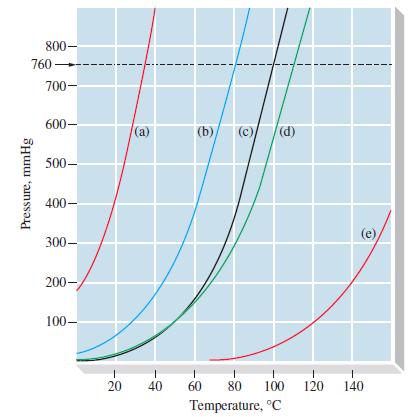
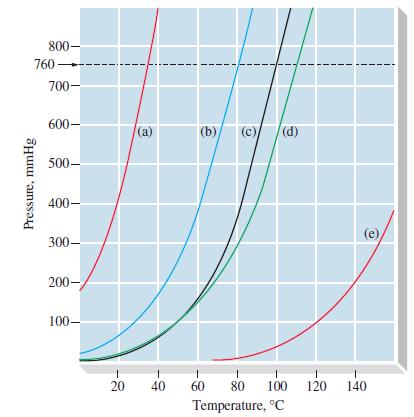
From Figure 12-18, estimate (a) The vapor pressure of C6H5NH2 at 100°C (b) The normal boiling point of C6H5CH3. Figure 12-18 800- 760- Pressure, mmHg 700- 600- 500- 400- 300- 200- 100- 20 (a) (b) (c) (d) 1 1 1 40 60 80 100 Temperature, °C 1 120 1 140
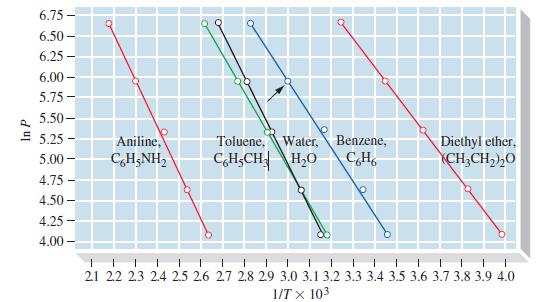
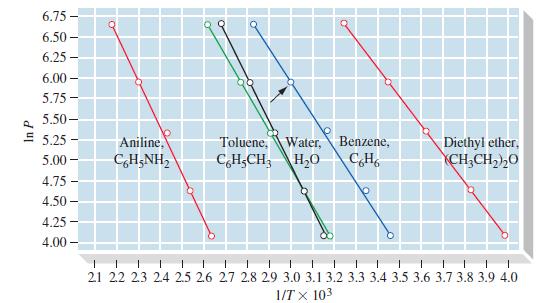
Use data in Figure 12-20 to estimate (a) The normal boiling point of aniline; (b) The vapor pressure of diethyl ether at 25 °C.Figure 12-20 P 6.75 - 6.50- 6.25 6.00- 5.75- 5.50- 5.25 5.00 4.75 - 4.50 - 4.25- 4.00 0 Aniline, CHẠNH, Toluene, Water, Benzene, CH,CH| \ H,O C6H6 P Diethyl
Equilibrium is established between Br2(l) and Br2(g) at 25.0 °C. A 250.0 mL sample of the vapor weighs 0.486 g. What is the vapor pressure of bromine at 25.0 °C in millimeters of mercury?
The density of acetone vapor in equilibrium with liquid acetone, (CH3)2CO, at 32 °C is 0.876 g L-1. What is the vapor pressure of acetone at 32 °C, expressed in kilopascals?
A double boiler is used when a careful control of temperature is required in cooking. Water is boiled in an outside container to produce steam, and the steam condenses on the outside walls of an inner container in which cooking occurs. (A related laboratory device is called a steam bath.) (a) How
Pressure cookers achieve a high cooking temperature to speed the cooking process by heating a small amount of water under a constant pressure. If the pressure is set at 2 atm, what is the boiling point of the water? Use information from Table 12.5.Table 12.5 TABLE
One popular demonstration in chemistry labs is performed by boiling a small quantity of water in a metal can (such as a used soda can), picking up the can with tongs and quickly submerging it upside down in cold water. The can collapses with a loud and satisfying pop. Give an explanation of this
A 25.0 L volume of He(g) at 30.0 °C is passed through 6.220 g of liquid aniline (C6H5NH2) at 30.0 °C. The liquid remaining after the experiment weighs 6.108 g. Assume that the He(g) becomes saturated with aniline vapor and that the total gas volume and temperature remain constant. What is the
A 7.53 L sample of N2(g) at 742 mmHg and 45.0 °C is bubbled through CCl4(l) at 45.0 °C. Assuming the gas becomes saturated with CCl4(g) what is the volume of the resulting gaseous mixture if the total pressure remains at 742 mmHg and the temperature remains at 45 °C? The vapor pressure of CCl4
A 10.0 g sample of liquid water is sealed in a 1515 mL flask and allowed to come to equilibrium with its vapor at 27 °C. What is the mass of H2O(g) present when equilibrium is established? Use vapor pressure data from Table 12.5.Table 12.5 TABLE
Some vapor pressure data for Freon-12, CCl2F2, once a common refrigerant, are -12.2 °C, 2.0 atm; 16.1 °C, 5.0 atm; 42.4 °C, 10.0 atm; 74.0 °C, 20.0 atm. Also, bp = -29.8 °C, Tc = 111.5 °C, Pc = 39.6 atm. Use these data to plot the vapor pressure curve of Freon-12. What approximate pressure
Cyclohexanol has a vapor pressure of 10.0 mmHg at 56.0 °C and 100.0 mmHg at 103.7 °C. Calculate its enthalpy of vaporization, ΔvapH.
The vapor pressure of methyl alcohol is 40.0 mmHg at 5.0 °C. Use this value and other information from the text to estimate the normal boiling point of methyl alcohol.
The normal boiling point of acetone, an important laboratory and industrial solvent, is 56.2 °C and its ΔvapH is 25.5 kJ mol-1. At what temperature does acetone have a vapor pressure of 375 mmHg?
With reference to Figure 12-20, which is the more volatile liquid, benzene or toluene? At approximately what temperature does the less volatile liquid have the same vapor pressure as the more volatile one at 65 °C?Figure 12-20 6.75 - 6.50- 6.25- 6.00- 5.75 - 5.50- 5.25 5.00- 4.75
The vapor pressure of trichloromethane (chloroform) is 40.0 Torr at -7.1 °C. Its enthalpy of vaporization is 29.2 kJ mol-1. Calculate its normal boiling point.
Benzaldehyde, C6H5CHO, has a normal boiling point of 179.0 °C and a critical point at 422 °C and 45.9 atm. Estimate its vapor pressure at 100.0 °C.
Which substances listed in Table 12.6 can exist as liquids at room temperature (about 20.0 °C)? Explain.Table 12.6 TABLE 12.6 Some Critical Temperatures, T, and Critical Pressures, P "Permanent" gasesa "Nonpermanent" gasesb H₂ N₂ 0₂ CH4 так 33.3 126.2 154.8 191.1 P,
Can SO2 be maintained as a liquid under a pressure of 100 atm at 0 °C? Can liquid methane be obtained under the same conditions?
The normal melting point of copper is 1357 K, and ΔfusH of Cu is 13.05 kJ mol-1. (a) How much heat, in kilojoules, is evolved when a 3.78 kg sample of molten Cu freezes?(b) How much heat, in kilojoules, must be absorbed at 1357 K to melt a bar of copper that is 15 cm x 12 cm? (Assume d = 8.92
An ice calorimeter measures quantities of heat by the quantity of ice melted. How many grams of ice would be melted by the heat released in the complete combustion of 1.60 L of propane gas, C3H8(g), measured at 20.0 °C and 735 mmHg?
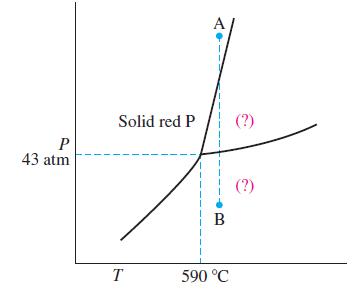
Shown here is a portion of the phase diagram for phosphorus.(a) Indicate the phases present in the regions labeled with a question mark.(b) A sample of solid red phosphorus cannot be melted by heating in a container open to the atmosphere. Explain why this is so.(c) Trace the phase changes that
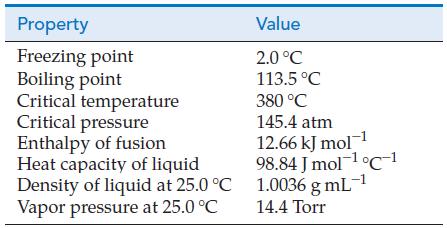
Sketch a plausible phase diagram for hydrazine (N2H4) from the following data: triple point (2.0 °C and 3.4 mmHg), the normal melting point (2 °C) the normal boiling point (113.5 °C), and the critical point (380 °C and 145 atm). The density of the liquid is less than that of the solid. Label
Describe what happens to the following samples in situations like those pictured in Figure 12-31. Be as specific as you can about the temperatures and pressures at which changes occur.(a) A sample of water is heated from -20 to 200 °C at a constant pressure of 600 Torr.(b) The pressure on a sample
A 0.240 g sample of H2O(l) is sealed into an evacuated 3.20 L flask. What is the pressure of the vapor in the flask if the temperature is (a) 30.0 °C;(b) 50.0 °C;(c) 70.0 °C?
Use appropriate phase diagrams and data from Table 12.6 to determine whether any of the following is likely to occur naturally at or near Earth’s surface anywhere on Earth. Explain. (a) CO2(s); (b) CH4(l);(c) SO2(g);(d) I2(l); (e) O2(l).Table 12.6 TABLE 12.6 Some Critical Temperatures, T, and
A 2.50 g sample of H2O(l) is sealed in a 5.00 L flask at 120.0 °C.(a) Show that the sample exists completely as vapor.(b) Estimate the temperature to which the flask must be cooled before liquid water condenses.
Trace the phase changes that occur as a sample of H2O(g), originally at 1.00 mmHg and -0.10 °C, is compressed at constant temperature until the pressure reaches 100 atm.
To an insulated container with 100.0 g H2O(l) at 20.0 °C, 175 g steam at 100.0 °C and 1.65 kg of ice at 0.0 °C are added.(a) What mass of ice remains unmelted after equilibrium is established?(b) What additional mass of steam should be introduced into the insulated container to just melt all of
A 54 cm3 ice cube at -25.0 °C is added to a thermally insulated container with 400.0 mL H2O(l) at 32.0 °C. What will be the final temperature in the container and what state(s) of matter will be present? (Specific heats: H2O(s), 2.01 J g-1 °C-1; H2O(l), 4.18 J g °C-1. Densities: H2O(s), 0.917
You decide to cool a can of soda pop quickly in the freezer compartment of a refrigerator. When you take out the can, the soda pop is still liquid; but when you open the can, the soda pop immediately freezes. Explain why this happens.
Why is the triple point of water (ice–liquid–vapor) a better fixed point for establishing a thermometric scale than either the melting point of ice or the boiling point of water?
Diamond is often used as a cutting medium in glass cutters. What property of diamond makes this possible? Could graphite function as well?
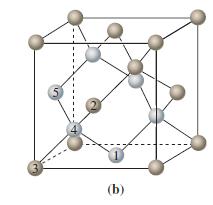
Silicon carbide, SiC, crystallizes in a form similar to diamond, whereas boron nitride, BN, crystallizes in a form similar to graphite.(a) Sketch the SiC structure as in Figure 12-32(b).(b) Propose a bonding scheme for BN.Figure 12-32(b) (b)
Showing 2400 - 2500
of 4008
First
18
19
20
21
22
23
24
25
26
27
28
29
30
31
32
Last
Step by Step Answers

 Get 50% OFF
Claim Now
Get 50% OFF
Claim Now