New Semester
Started
Get
50% OFF
Study Help!
--h --m --s
Claim Now
Question Answers
Textbooks
Find textbooks, questions and answers
Oops, something went wrong!
Change your search query and then try again
S
Books
FREE
Study Help
Expert Questions
Accounting
General Management
Mathematics
Finance
Organizational Behaviour
Law
Physics
Operating System
Management Leadership
Sociology
Programming
Marketing
Database
Computer Network
Economics
Textbooks Solutions
Accounting
Managerial Accounting
Management Leadership
Cost Accounting
Statistics
Business Law
Corporate Finance
Finance
Economics
Auditing
Tutors
Online Tutors
Find a Tutor
Hire a Tutor
Become a Tutor
AI Tutor
AI Study Planner
NEW
Sell Books
Search
Search
Sign In
Register
study help
sciences
general chemistry principles
General Chemistry Principles And Modern Applications 11th Edition Ralph Petrucci, Jeffry Madura, F. Herring, Carey Bissonnette - Solutions
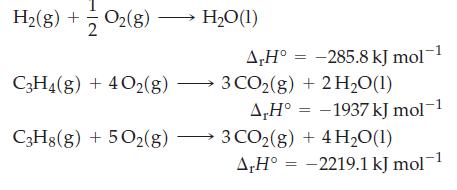
Use Hess’s law to determine ΔrH° for the reaction C3H4(g) + 2 H2(g) → C3H8(g), given that H₂(g) + O2(8) O₂(g) → C3H4(g) + 4O2(g) C3H8(g) + 5O2(g) H₂O(1) A,H° -285.8 kJ mol-1 3 CO2(g) + 2H₂O(1) A,H° -1937 kJ mol-1 3 CO2(g) + 4H₂O(1) A,H° -2219.1 kJ mol-1 = =
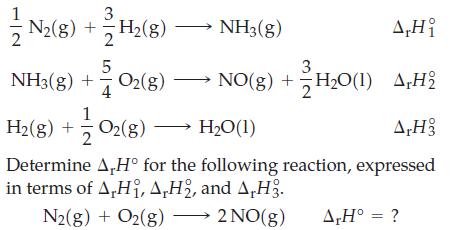
Given the following information: 3 N₂(g) + -H₂(g) — NH3(g) A,Hi 3 NO(g) + H₂O(1) A,H2 H₂O(1) A,H3 Determine A,H° for the following reaction, expressed in terms of A,Hi, A,H2, and A,H₂. N₂(g) + O₂(g) 2 NO(g) NH3(g) + O2(g) H2(g) + O2(g) O2(g) → 2 A,H° = ?
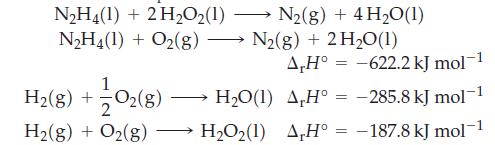
Determine ΔrH° for this reaction from the data below. N₂H4(1) + 2H₂O2(1) N₂H4(1) + O2(g) H₂(g) + O2(g) 1 2 H₂(g) + O₂(g) N₂(g) + 4H₂0(1) N₂(g) + 2 H₂0(1) A,H° -622.2 kJ mol-1 -285.8 kJ mol-1 -187.8 kJ mol-¹ = H₂O(1) A,H° = H₂O₂(1) AH° =
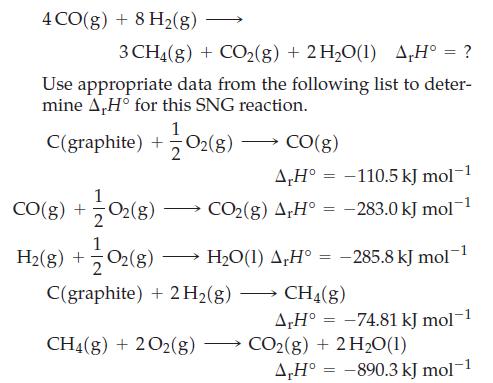
Substitute natural gas (SNG) is a gaseous mixture containing CH4(g) that can be used as a fuel. One reaction for the production of SNG is 4 CO(g) + 8 H₂(g) 3 CH4(g) + CO₂(g) + 2 H₂O(1) A,H° = ? Use appropriate data from the following list to deter- mine A,H° for this SNG
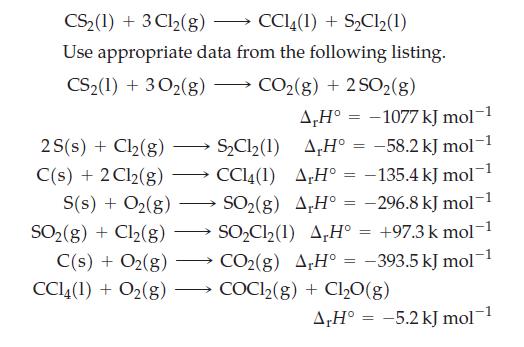
CCl4, an important commercial solvent, is prepared by the reaction of Cl2(g) with a carbon compound. Determine ΔrH° for the reaction CS₂(1) + 3Cl₂(g) CCl4(1) + S₂Cl2 (1) Use appropriate data from the following listing. CS₂(1) + 302(g) CO₂(g) + 2SO2(g) A,H° -1077 kJ mol 2S(s) +
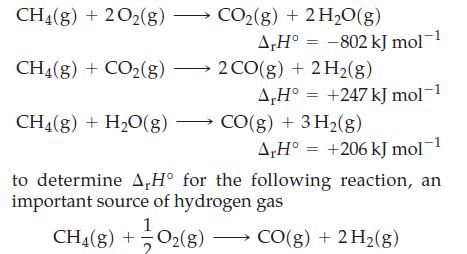
Use Hess’s law and the following data CH4(g) + 2O2(g) → CH4(g) + CO₂(g) — CH₂(g) + H₂O(g) CO₂(g) + 2H₂O(g) A,H° -802 kJ mol 2 CO(g) + 2H₂(g) A,H° = +247 kJ mol-1 CO(g) + 3H₂(g) A,H° +206 kJ mol−1 to determine A,H° for the following reaction, an important source of hydrogen
The standard heats of combustion (ΔrH°) of buta-1,3-diene, C4H6(g); butane, C4H10(g); and H2(g) are -2540.2, -2877.6, and -285.8 kJ mol-1, respectively. Use these data to calculate the heat of hydrogenation of buta-1,3-diene to butane. C4H6(g) + 2 H₂(g) - C4H10(g) A,H° = ?
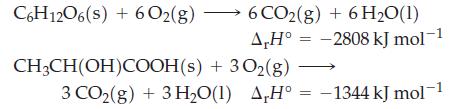
One glucose molecule, C6H12O6(s), is converted to two lactic acid molecules, CH3CH(OH)COOH(s) during glycolysis. Given the combustion reactions of glucose and lactic acid, determine the standard enthalpy for glycolysis. C6H12O6(s) + 602(g) 6 CO2(g) + 6H₂O(1) A,H° ΔΗ° CH₂CH(OH)COOH(s) +
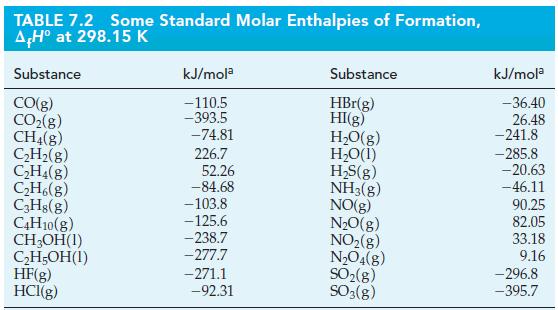
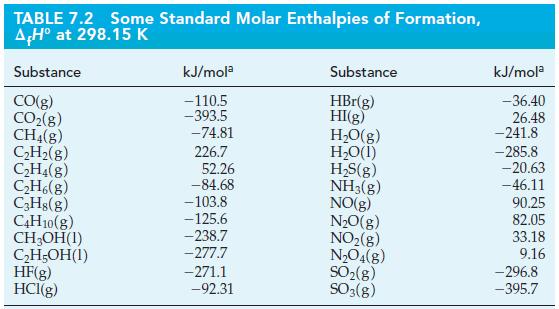
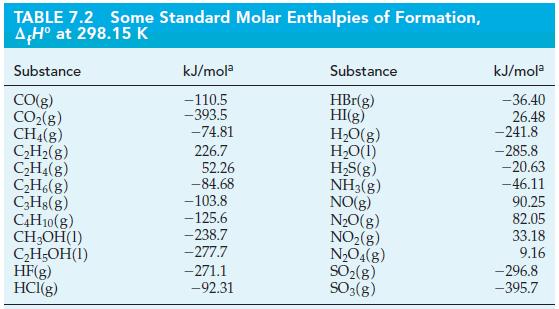
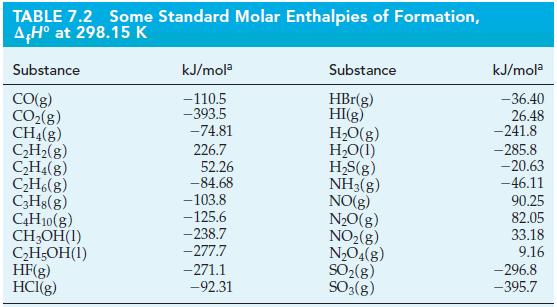
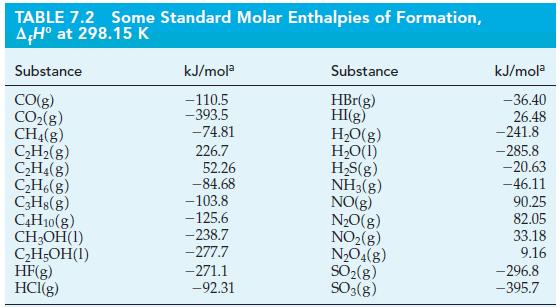
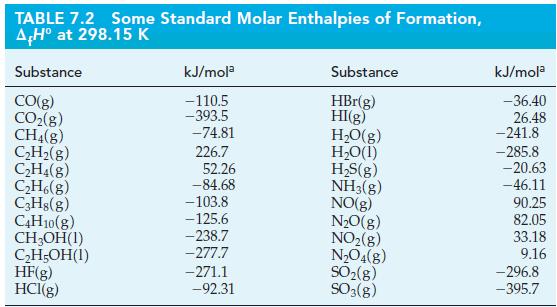
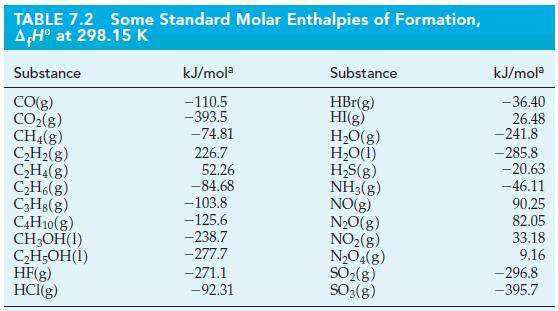
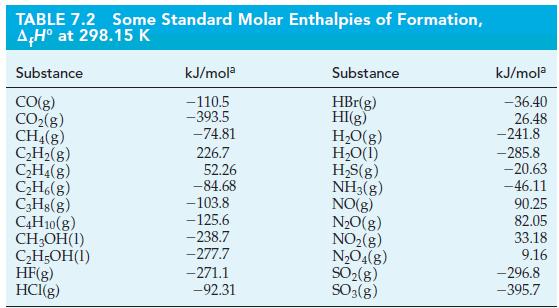
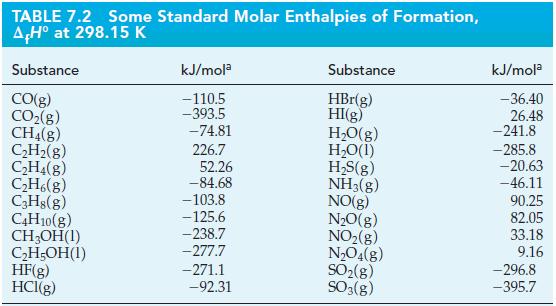
Use standard enthalpies of formation from Table 7.2 and equation (7.22) to determine the standard enthalpy of reaction in the following reactions.Table 7.2Eq. 7.22 (a) C3H8(g) + H₂(g) → C₂H6(g) + CH4(g); (b) 2 H₂S(g) + 30₂(g) →→→2SO₂(g) + 2 H₂O(1).
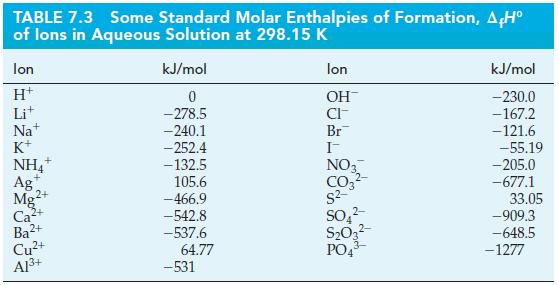
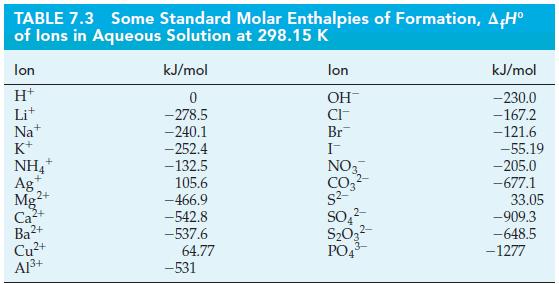
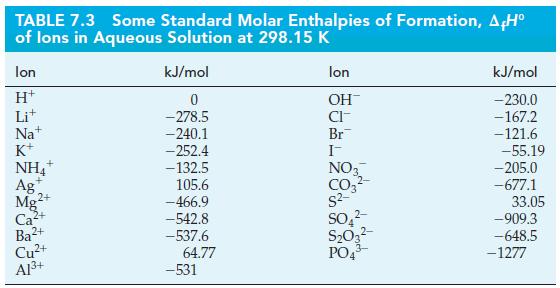
Use standard enthalpies of formation from Tables 7.2 and 7.3 and equation (7.22) to determine the standard enthalpy of reaction in the following reaction.Tables 7.2Tables 7.3Eq. 7.22 NH4+ (aq) + OH(aq) H₂O(1) + NH3(g).
The standard enthalpy of fermentation of glucose to ethanol isUse the standard enthalpy of combustion for glucose to calculate the enthalpy of combustion for ethanol. C6H12O6(s)- 2 CH3CH₂OH(1) + 2 CO₂(g) A,H° -72 kJ mol-1
Use the information given here, data from Appendix D, and equation (7.22) to calculate the standard enthalpy of formation per mole of ZnS(s).Eq.7.22 2 ZnS(s) + 3O₂(g) 2 ZnO(s) + 2 SO₂(g) A,H° -878.2 kJ mol-1
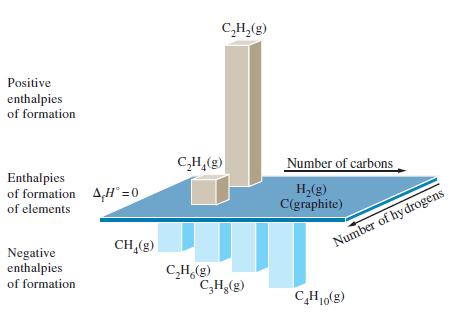
Use the data in Figure 7-18 and information to establish possible relationships between the molecular structure of the hydrocarbons and their standard enthalpies of formation.Figure 7-18 Positive enthalpies of formation Enthalpies of formation AHⓇ=0 of elements Negative enthalpies of
Use standard enthalpies of formation from Table 7.2 to determine ΔrH° at 25 °C for the following reaction.Table 7.2 2 Cl₂(g) + 2 H₂O(1) 4 HCl(g) + O₂(g) A,H° = ?
Use data from Appendix D to calculate ΔrH° for the following reaction at 25 °C. Fe2O3(s) + 3 CO(g) 2 Fe(s) + 3 CO₂(g) A,H° = ?
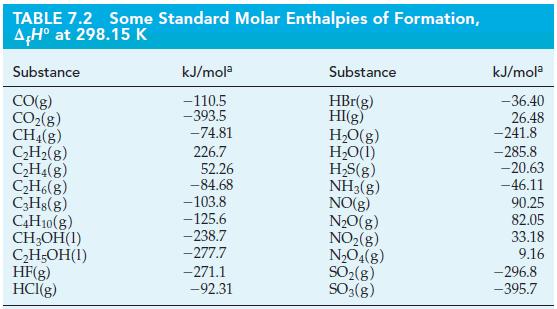
Use data from Table 7.2 to determine the standard heat of combustion of C2H5OH(l), if reactants and products are maintained at 25 °C and 1 bar.Table 7.2 TABLE 7.2 AH° at 298.15 K Substance CO(g) CO₂(g) CH₂(g) C₂H₂(g) C₂H4(g) C₂H6(g) C3H8(g) C4H10(g) CH3OH(1) C₂H5OH(1) Some Standard
Use data from Table 7.2, together with the fact that ΔrH° = -3509 kJ mol-1 for the complete combustion of pentane, C5H12(l), to calculate ΔrH° for the reaction below.Table 7.2 5 CO(g) + 11 H₂(g) - C5H12(1) + 5 H₂O(1) A,H° = ?
Use data from Table 7.2 and ΔrH° for the following reaction to determine the standard enthalpy of formation of CCl4(g) at 25 °C and 1 bar. Table 7.2 CH4(g) + 4Cl₂(g) CCl4(g) + 4HCI(g) AH° -397.3 kJ mol
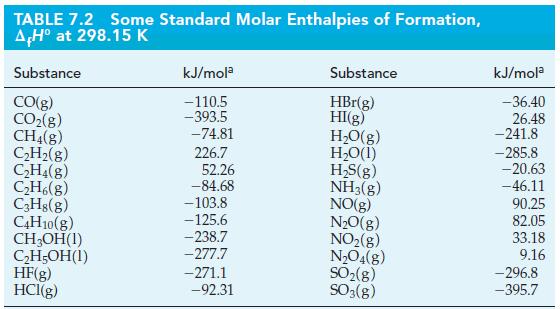
Use data from Table 7.2 and ΔrH° for the following reaction to determine the standard enthalpy of formation of hexane, C6H14(l), at 25 °C and 1 bar.Table 7.2 2 C6H14(1) + 19 O2(g) 12 CO₂(g) + 14 H₂O(1) A,H° -8326 kJ mol-1
Use data from Table 7.3 and Appendix D to determine the standard enthalpy change in the following reaction.Table 7.3 Al³+ (aq) + 3OH(aq) Al(OH)3(s) A,H° = ?
Use data from Table 7.3 and Appendix D to determine ΔrH° the following reaction.Table 7.3 Mg(OH)2(s) + 2NH4+ (aq) Mg2+ (aq) + 2 H₂O(1) + 2NH3(g) A₁H° = ?
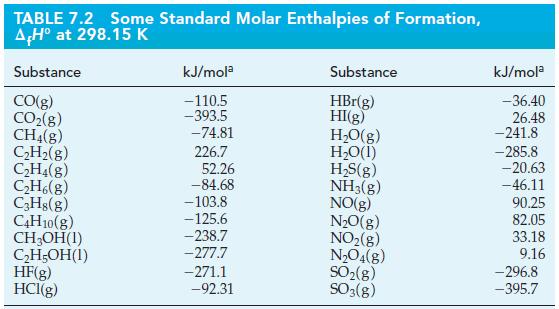
Use data from Table 7.2 to calculate the volume of butane, C4H10(g), measured at 24.6 °C and 756 mmHg, that must be burned to liberate 5.00 x 10⁴ kJ of heat.Table 7.2 TABLE 7.2 Some Standard Molar Enthalpies of Formation, AH° at 298.15
The decomposition of limestone, CaCO3(s), into quicklime, CaO(s), and CO2(g) is carried out in a gas-fired kiln. Use data from Appendix D to determine how much heat is required to decompose 1.35 x 10³ kg CaCO3(s). (Assume that heats of reaction are the same as at 25 °C and 1 bar.)
Ants release formic acid (HCOOH) when they bite. Use the data in Table 7.2 and the standard enthalpy of combustion for formic acid (ΔrH° = -255 kJ/mol) to calculate the standard enthalpy of formation for formic acid.Table 7.2 TABLE 7.2 Some Standard Molar Enthalpies of Formation, AH° at 298.15
Calculate the enthalpy of combustion for lactic acid by using the data in Table 7.2 and the standard enthalpy of formation for lactic acid [CH3CH(OH)COOH(s)]: ΔfH° = -694.0 kJ/mol.Table 7.2 TABLE 7.2 Some Standard Molar Enthalpies of Formation, AH° at 298.15
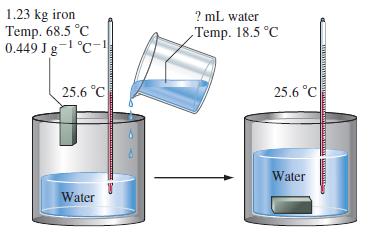
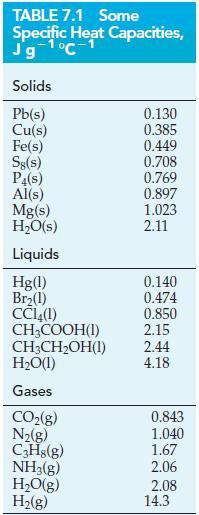
What volume of 18.5 °C water must be added, together with a 1.23 kg piece of iron at 68.5 °C, so that the temperature of the water in the insulated container shown in the figure remains constant at 25.6 °C? 1.23 kg iron Temp. 68.5°C 0.449 Jg-1 °C-1 25.6 °C Water BASAARABALA ? mL water Temp.
A British thermal unit (Btu) is defined as the quantity of heat required to change the temperature of 1 lb of water by 1 °F. Assume the specific heat capacity of water to be independent of temperature. How much heat is required to raise the temperature of the water in a 40 gal water heater from 48
A 7.26 kg shot (as used in the sporting event, the shot put) is dropped from the top of a building 168 m high. What is the maximum temperature increase that could occur in the shot? Assume a specific heat capacity of 0.47 J g-1 °C-1 for the shot. Why would the actual measured temperature increase
An alternative approach to bomb calorimetry is to establish the heat capacity of the calorimeter, exclusive of the water it contains. The heat absorbed by the water and by the rest of the calorimeter must be calculated separately and then added together. A bomb calorimeter assembly containing 983.5
The method of Exercise 98 is used in some bomb calorimetry experiments. A 1.148 g sample of benzoic acid is burned in excess O2(g) in a bomb immersed in 1181 g of water. The temperature of the water rises from 24.96 to 30.25 °C. The heat of combustion of benzoic acid is -26.42 kJ/g. In a second
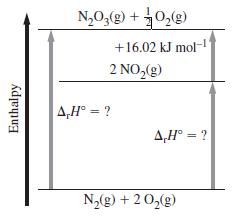
Determine the missing values of ΔrH° in the diagram shown below. Enthalpy N₂O₂(g) + O₂(g) +16.02 kJ mol-1 2 NO₂(g) A,H° = ? A,H° = ? N₂(g) + 2O₂(g)
A handbook lists two different values for the heat of combustion of hydrogen: 33.88 kcal/g if H2O(l) is formed, and 28.67 kcal/g if H2O(g) is formed. Explain why these two values are different, and indicate what property this difference represents. Devise a means of verifying your conclusions.
An overall reaction for a coal gasification process isShow that this overall equation can be established by an appropriate combination of equations. 2 C(graphite) + 2 H₂O(g) CH4(g) + CO2(g)
A particular natural gas consists, in mole percents, of 83.0% CH4, 11.2% C2H6, and 5.8% C3H8. A 385 L sample of this gas, measured at 22.6 °C and 739 mmHg, is burned at constant pressure in an excess of oxygen gas. How much heat, in kilojoules, is evolved in the combustion reaction?
Which of the following gases has the greater fuel value on a per liter (STP) basis? That is, which has the greater heat of combustion?(a) Coal gas: 49.7% H2, 29.9% CH4, 8.2% N2, 6.9% CO, 3.1% C3H8, 1.7% CO2, and 0.5% O2, by volume.(b) Sewage gas, 66.0% CH4, 30.0% CO2, and 4.0% N2, by volume.
For the reactionif the H2O were obtained as a gas rather than a liquid, (a) Would the heat of reaction be greater (more negative) or smaller (less negative) than that indicated in the equation? (b) Explain your answer.(c) Calculate the value of ΔrH° in this case. C₂H4(g) + 3O2(g) 2 CO2(g) + 2
A calorimeter that measures an exothermic heat of reaction by the quantity of ice that can be melted is called an ice calorimeter. Now consider that 0.100 L of methane gas, CH4(g), at 25.0 °C and 744 mmHg, is burned at constant pressure in air. The heat liberated is captured and used to melt 9.53
Some of the butane, C4H10(g), in a 200.0 L cylinder at 26.0 °C is withdrawn and burned at a constant pressure in an excess of air. As a result, the pressure of the gas in the cylinder falls from 2.35 atm to 1.10 atm. The liberated heat is used to raise the temperature of 132.5 L of water in a
An alkane hydrocarbon has the formula CnH2n+2. The enthalpies of formation of the alkanes decrease (become more negative) as the number of C atoms increases. Starting with butane, for each additional CH2 group in the formula, ΔfH°, the enthalpy of formation, changes by about -21 kJ/mol. Use this
The metabolism of glucose, C6H12O6, yields CO2(g) and H2O(l) as products. Heat released in the process is converted to useful work with about 70% efficiency. Calculate the mass of glucose metabolized by a 58.0 kg person in climbing a mountain with an elevation gain of 1450 m. Assume that the work
Upon complete combustion, a 1.00 L sample (at STP) of a natural gas gives off 43.6 kJ of heat. If the gas is a mixture of CH4(g) and C2H6(g), what is its percent composition, by volume?
Refer to the discussion of the gasification of coal, and show that some of the heat required in the gasification reactions (equations 7.26 and 7.27) can be supplied by the methanation reaction. This fact contributes to the success of modern processes that produce synthetic natural gas (SNG).Eq.
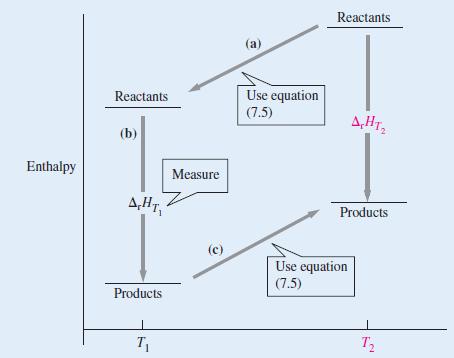
In the Are You Wondering 7-1 box, the temperature variation of enthalpy is discussed, and the equation was introduced to show how enthalpy changes with temperature for a constant-pressure process. Strictly speaking, the heat capacity of a substance at constant pressure is the slope of the line
Under the entry H2SO4, a reference source lists many values for the standard enthalpy of formation. For example, for pure H2SO4(l), ΔfH° = -814.0 kJ/mol; for a solution with 1 mol H2O per mole of H2SO4, -841.8; with 10 mol H2O, -880.5; with 50 mol H2O, -886.8; with 100 mol H2O, -887.7; with 500
A 1.103 g sample of a gaseous carbon–hydrogen–oxygen compound that occupies a volume of 582 mL at 765.5 Torr and 25.00 °C is burned in an excess of O2(g) in a bomb calorimeter. The products of the combustion are 2.108 g CO2(g), 1.294 g H2O(l), and enough heat to raise the temperature of the
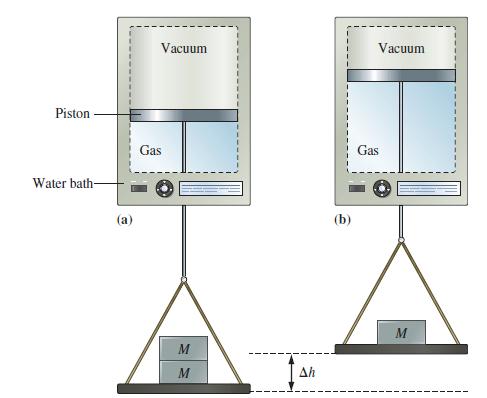
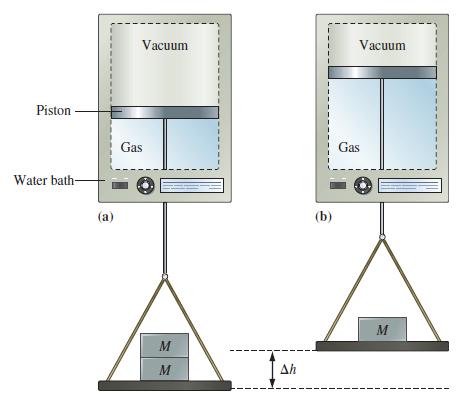
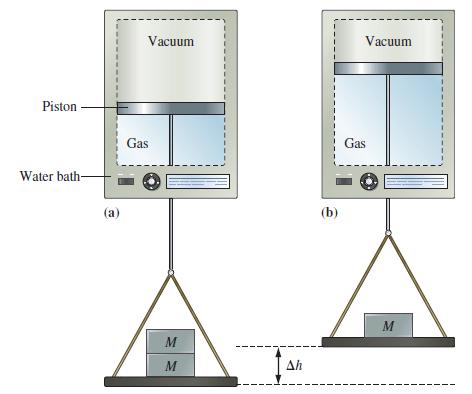
Suppose you have a setup similar to the one depicted in Figure 7-8 except that there are two different weights rather than two equal weights. One weight is a steel cylinder 10.00 cm in diameter and 25 cm long, the other weight produces a pressure of 745 Torr. The temperature of the gas in the
Several factors are involved in determining the cooking times required for foods in a microwave oven. One of these factors is specific heat capacity. Determine the approximate time required to warm 250 mL of chicken broth from 4 °C (a typical refrigerator temperature) to 50 °C in a 700 W
When one mole of sodium carbonate decahydrate (washing soda) is gently warmed, 155.3 kJ of heat is absorbed, water vapor is formed, and sodium carbonate heptahydrate remains. On more vigorous heating, the heptahydrate absorbs 320.1 kJ of heat and loses more water vapor to give the monohydrate.
The oxidation of NH3(g) to NO(g) in the Ostwald process must be very carefully controlled in terms of temperature, pressure, and contact time with the catalyst. This is because the oxidation of NH3(g) can yield any one of the products N2(g), N2O(g), NO(g), and NO2(g), depending on conditions. Show
The standard enthalpy of formation of gaseous H2O at 298.15 K is -241.82 kJ mol-1. Using the ideas contained in Figure 7-16, estimate its value at 100.0 °C given the following values of the molar heat capacities at constant pressure: H2O(g): 33.58 J K-1 mol-1; H2(g): 28.84 J K-1 mol-1; O2(g):
How much heat is required to convert 10.0 g of ice at -5.0 °C to steam at 100.0 ºC? The temperature dependent constant-pressure specific heat capacity of ice is cp(T)/(kJ kg-1 K-1) = 1.0187T - 1.49 x 10⁻². The temperature-dependent constant-pressure specific heat for water is cp(T) / (kJ kg-1
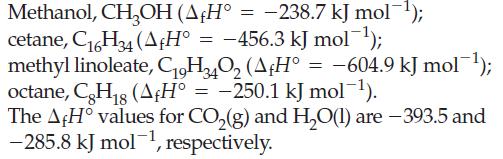
Carbon dioxide emissions have been implicated as a major factor in climate change. Which of the following liquid fuels, when burned completely in oxygen at 25 °C, generates the smallest amount of CO2 per kilojoule of energy output? Methanol, CH₂OH (AfH° = -238.7 kJ mol-¹); cetane, C₁6H34
Cetane, C16H34, is a typical petrodiesel with a standard enthalpy of combustion of -10,699.1 kJ mol-1. Methyl linoleate, C19H34O2, is a biodiesel with a standard enthalpy of combustion of -11,690.1 kJ mol-1. What volume of methyl linoleate provides the same energy as one liter of cetane? The
Based on specific heat capacity measurements, Pierre Dulong and Alexis Petit proposed in 1818 that the specific heat capacity of an element is inversely related to its atomic weight (atomic mass). Thus, by measuring the specific heat capacity of a new element, its atomic weight could be readily
James Joule published his definitive work related to the first law of thermodynamics in 1850. He stated that “the quantity of heat capable of increasing the temperature of one pound of water by 1 °F requires for its evolution the expenditure of a mechanical force represented by the fall of 772
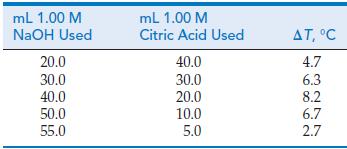
We can use the heat liberated by a neutralization reaction as a means of establishing the stoichiometry of the reaction. The data in the table are for the reaction of 1.00 M NaOH with 1.00 M citric acid, C6H8O7, in a total solution volume of 60.0 mL.(a) Plot ΔT versus mL 1.00 M NaOH, and identify
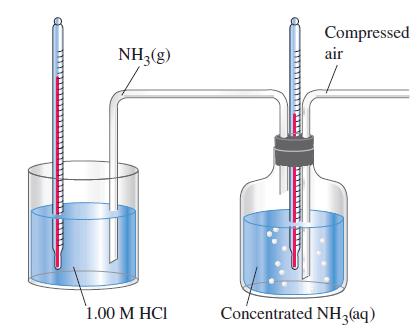
In a student experiment to confirm Hess’s law, the reactionwas carried out in two different ways. First, 8.00 mL of concentrated NH3(aq) was added to 100.0 mL of 1.00 M HCl in a calorimeter. (The NH3(aq) was slightly in excess.) The reactants were initially at 23.8 °C, and the final temperature
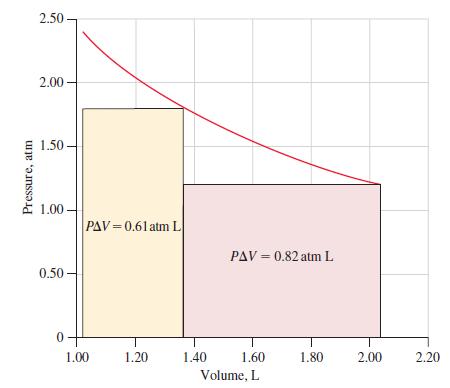
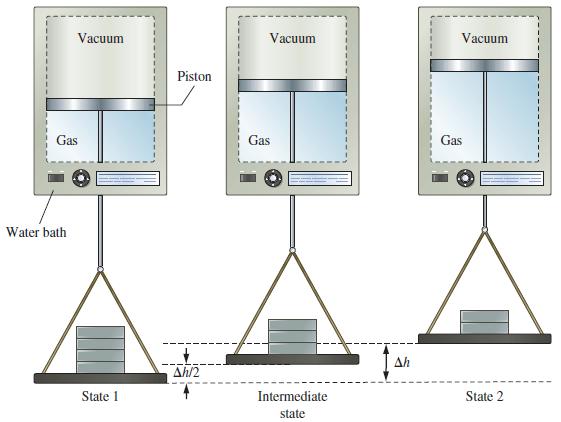
Refer to Example 7-5 dealing with the work done by 0.100 mol He at 298 K in expanding in a single step from 2.40 to 1.20 atm. Review also the two-step expansion (2.40 atm → 1.80 atm → 1.20 atm) described on page 261 (see Figure 7-11).(a) Determine the total work that would be done if the He
When an ideal gas is heated, the change in internal energy is limited to increasing the average translational kinetic energy of the gas molecules. Thus, there is a simple relationship between ΔU of the gas and the change in temperature that occurs. Derive this relationship with the help of ideas
Look up the specific heat capacity of several elements, and plot the products of the specific heat capacities and atomic masses as a function of the atomic masses. Based on the plot, develop a hypothesis to explain the data. How could you test your hypothesis?
In your own words, define or explain the following terms or symbols: (a) ΔrH; (b) –PΔV; (c) ΔfH°;(d) Standard state;(e) Fossil fuel.
Briefly describe each of the following ideas or methods:(a) Law of conservation of energy; (b) Bomb calorimetry; (c) Function of state; (d) Enthalpy diagram;(e) Hess’s law.
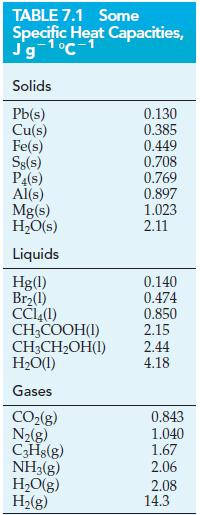
The temperature increase of 225 mL of water at 25 °C contained in a Styrofoam cup is noted when a 125 g sample of a metal at 75 °C is added. With reference to Table 7.1, the greatest temperature increase will be noted if the metal is (a) Lead; (b) Aluminum; (c) Iron;(d) Copper.Table 7.1 TABLE
Explain the important distinctions between each pair of terms: (a) System and surroundings; (b) Heat and work; (c) Specific heat capacity and heat capacity;(d) Endothermic and exothermic; (e) Constant-volume process and constant-pressure process.
A plausible final temperature when 75.0 mL of water at 80.0 °C is added to 100.0 mL of water at 20 °C is (a) 28 °C; (b) 40 °C; (c) 46 °C; (d) 50 °C.
ΔU = 100 J for a system that gives off 100 J of heat and (a) Does no work; (b) Does 200 J of work; (c) Has 100 J of work done on it; (d) Has 200 J of work done on it.
Compute ΔrH° for the following reactions. The value of ΔfH° in kJ mol-1 is given for each substance below its formula. (a) SiO₂ (s) + 4 HF(g) -910.9 -271.1 (b) 2 CuS(s) + 30₂(g) -53.1 0.0 SiF4(g) + 2 H₂O(g) -1615.0 -241.8 2 CuO(s) +2 SO₂(g) -157.3 -296.8
The heat of solution of NaOH(s) in water is -41.6 kJ/mol NaOH. When NaOH(s) is dissolved in water the solution temperature (a) Increases;(b) Decreases; (c) Remains constant; (d) Either increases or decreases, depending on how much NaOH is dissolved.
The standard molar enthalpy of formation of CO2(g) is equal to (a) 0; (b) The standard molar heat of combustion of graphite; (c) The sum of the standard molar enthalpies of formation of CO(g) and O2(g);(d) The standard molar heat of combustion of O2(g);
Write the formation reaction for each of the following compounds: (a) SnCl2(s); (b) C6H5COOH(s);(c) COCl2(g).
When dissolved in water, 1.00 mol LiCl produces 37.12 kJ of heat. What is the final temperature in (in °C) when 5.00 g LiCl dissolves in 110.0 g of water at 20.00 °C? Assume that the solution produced has a specific heat capacity of 4.00 J g-1 °C-1.
When an element is involved in a formation reaction, it does not have to be(a) Pure; (b) At 1.00 M concentration;(c) At 1.00 bar pressure; (d) In its most stable form;(e) None of these.
The standard state of a substance is (a) The pure form at 1 bar; (b) The most stable form at 25 °C and 1 bar; (c) The most stable form at 0 °C; (d) The pure gaseous form at 25 °C; (e) None of these.
Which two of the following statements are false?(a) qV = qP for the reaction N2(g) + O2(g) → 2 NO(g);(b) ΔrH > 0 for an endothermic reaction;(c) By convention, the most stable form of an element must always be chosen as the reference form and assigned the value ΔfH° = 0; (d) ΔU and ΔrH for
Write the balanced chemical equations for reactions that have the following as their standard enthalpy changes. (a) AH° +82.05 kJ/mol N₂O(g) (b) AfH° = -394.1 kJ/mol SO₂Cl₂(1) (c) A H° -1527 kJ/mol = CH3CH₂COOH(1)
A 1.22 kg piece of iron at 126.5 °C is dropped into 981 g water at 22.1 °C. The temperature rises to 34.4 °C. What will be the final temperature if this same piece of iron at 99.8 °C is dropped into 325 mL of glycerol, HOCH2CH(OH)CH2OH(I) at 26.2 °C? For glycerol, d = 1.26 g/mL; Cp = 219 J
The standard molar heats of combustion of C(graphite) and CO(g) are -393.5 and -283 kJ/mol, respectively. Use those data and that for the following reactionto calculate the standard molar enthalpy of formation of COCl2(g). CO(g) + Cl₂(g) COC1₂(g) A,H° -108 kJ mol-¹ =
Can a chemical compound have a standard enthalpy of formation of zero? If so, how likely is this to occur?Explain.
Is it possible for a chemical process to have ΔU < 0 and ΔH > 0? Explain.
Use principles from this chapter to explain the observation that professional chefs prefer to cook with a gas stove rather than an electric stove.
Hot water and a piece of cold metal come into contact in an isolated container. When the final temperature of the metal and water are identical, is the total energy change in this process (a) Zero; (b) Negative;(c) Positive; (d) Not enough information.
Construct a concept map encompassing the ideas behind the first law of thermodynamics.
Construct a concept map to show the use of enthalpy for chemical reactions.
A clay pot containing water at 25 °C is placed in the shade on a day in which the temperature is 30 °C. The outside of the clay pot is kept moist. Will the temperature of the water inside the clay pot (a) Increase; (b) Decrease; (c) Remain the same?
Construct a concept map to show the interrelationships between path-dependent and pathindependent quantities in thermodynamics.
(A) In compressing a gas, 355 J of work is done on the system. At the same time, 185 J of heat escapes from the system. What is ΔU for the system?(B) If the internal energy of a system decreases by 125 J at the same time that the system absorbs 54 J of heat, does the system do work or have work
When charcoal is burned in a limited supply of oxygen in the presence of H2O, a mixture of CO, H2, and other noncombustible gases (mostly CO2) is obtained. Such a mixture is called synthesis gas. This gas can be used to synthesize organic compounds, or it can be burned as a fuel. A typical
In the following reaction, 81.2 mL of O2(g) is collected over water at 23 °C and barometric pressure 751 mmHg. What mass of Ag2O(s) decomposed? (The vapor pressure of water at 23 °C is 21.1 mmHg.)2 Ag2O(s) → 4 Ag(s) + O2(g)
In the neutralization of a strong acid with a strong base, the essential reaction is the combination of H+(aq) and OH-(aq) to form water.Two solutions, 25.00 mL of 2.50 M HCl(aq) and 25.00 mL of 2.50 M NaOH(aq), both initially at 21.1 °C, are added to a Styrofoam-cup calorimeter and allowed to
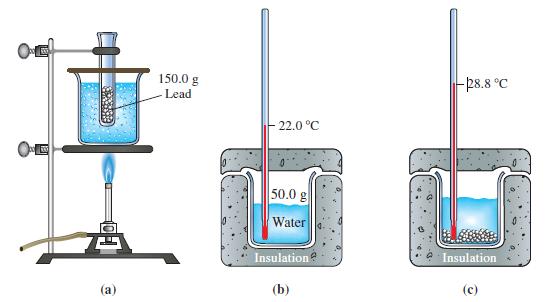
Use data presented in Figure 7-3 to calculate the specific heat capacity of lead.Figure 7-3 OE 200 (a) 150.0 g -Lead 22.0 °C 50.0 g Water Insulation (b) -28.8 °C Insulation C
How much heat is required to raise the temperature of 100.0 mL of water (approximately 100.0 g) from room temperature, typically 21.0 °C, to body temperature, typically 37.0 °C? (Assume the specific heat capacity of water is 4.18 J g-1 °C-1 throughout this temperature range.)
The combustion of 1.010 g sucrose, C12H22O11, in a bomb calorimeter causes the temperature to rise from 24.92 to 28.33 °C. The heat capacity of the calorimeter assembly is 4.90 kJ/°C. (a) What is the heat of combustion of sucrose expressed in kilojoules per mole of C12H22O11? (b) Verify the
Suppose the gas in Figure 7-8 is 0.100 mol He at 298 K, the two weights correspond to an external pressure of 2.40 atm in Figure 7-8(a), and the single weight in Figure 7-8(b) corresponds to an external pressure of 1.20 atm. How much work, in joules, is associated with the gas expansion at constant
A gas, while expanding, absorbs 25 J of heat and does 243 J of work. What is ΔU for the gas?
The enthalpy of reaction for the combustion of sucrose, C12H22O11(s), is ΔrH = -5.65 x 10³ kJ/mol. How much heat is associated with the complete combustion of 1.00 kg of sucrose?
The standard enthalpies of combustion of C(graphite), H2(g) and C3H8(g) are –393.5, –285.8, and –2219.9 kJ mol–1, respectively. Use these values to calculate ΔrH° for reaction (7.19). 3 C(graphite) + 4 H₂(g) - C3H8(g) A₁H° = ?
Calculate ΔH for the process in which 50.0 g of water is converted from liquid at 10.0 °C to vapor at 25.0 °C.
Let us apply equation (7.22) to calculate the standard enthalpy of combustion of ethane, C2H6(g), a component of natural gas.Eq. 7.22 A,H° = [c x AH°c + dx AHD +...] [ax AH°A + bx AfH°B +...] (7.22) weighted sum of A Hº values for the products weighted sum of A Hº values for the reactants
Use the data here and in Table 7.2 to calculate ΔfH° of benzene, C6H6(l).Table 7.2 2 C6H6(1) 15 O₂(g) 12 CO₂(g) + 6H₂O(1) A,H = -6535 kJ mol-1
The enthalpy of formation of formaldehyde is ΔfH° = -108.6 kJ/mol at 298.15 K. Write the chemical equation to which this value applies.
Showing 2900 - 3000
of 4008
First
23
24
25
26
27
28
29
30
31
32
33
34
35
36
37
Last
Step by Step Answers

 Get 50% OFF
Claim Now
Get 50% OFF
Claim Now




![A,H [cx AHc + dx AHD + ...]-[ax AHA + bx AHB +...] (7.22) weighted sum of A H values for the products](https://dsd5zvtm8ll6.cloudfront.net/images/question_images/1699/6/0/4/241654de711110c61699604236540.jpg)



![A.H = [cx AHC + dx AHD +...] [ax AHA + bx AHB + .] (7.22) weighted sum of AcH values for the products](https://dsd5zvtm8ll6.cloudfront.net/images/question_images/1699/6/0/4/689654de8d1674691699604684867.jpg)




















![A,H = [c x AHc + dx AHD +...] [ax AHA + bx AfHB +...] (7.22) weighted sum of A H values for the products](https://dsd5zvtm8ll6.cloudfront.net/images/question_images/1699/4/2/8/827654b39dbd60601699428827613.jpg)