New Semester
Started
Get
50% OFF
Study Help!
--h --m --s
Claim Now
Question Answers
Textbooks
Find textbooks, questions and answers
Oops, something went wrong!
Change your search query and then try again
S
Books
FREE
Study Help
Expert Questions
Accounting
General Management
Mathematics
Finance
Organizational Behaviour
Law
Physics
Operating System
Management Leadership
Sociology
Programming
Marketing
Database
Computer Network
Economics
Textbooks Solutions
Accounting
Managerial Accounting
Management Leadership
Cost Accounting
Statistics
Business Law
Corporate Finance
Finance
Economics
Auditing
Tutors
Online Tutors
Find a Tutor
Hire a Tutor
Become a Tutor
AI Tutor
AI Study Planner
NEW
Sell Books
Search
Search
Sign In
Register
study help
sciences
general chemistry principles
General Chemistry Principles And Modern Applications 11th Edition Ralph Petrucci, Jeffry Madura, F. Herring, Carey Bissonnette - Solutions
What volume of O2(g) is consumed in the combustion of 75.6 L C3H8(g) if both gases are measured at STP?
A 3.57 g sample of a KCl–KClO3 mixture is decomposed by heating and produces 119 mL O2(g), measured at 22.4 °C and 98.3 kPa. What is the mass percent of KClO3 in the mixture? 2 KCIO3(s) 2 KCl(s) + 302(g)
Hydrogen peroxide, H2O2, is used to disinfect contact lenses. How many milliliters of O2(g) at 22 °C and 1.00 bar can be liberated from 10.0 mL of an aqueous solution containing 3.00% H2O2 by mass? The density of the aqueous solution of H2O2 is 1.01 g/mL. 2H,O2(aq) 2 H₂O(1) + O₂(g)
Calculate the volume of H2(g), measured at 26 °C and 751 Torr, required to react with 28.5 L CO(g), measured at 0 °C and 760 Torr, in this reaction. 3 CO(g) + 7 H₂(g) C3H8(g) + 3 H₂O(1)
Which actions would you take to establish a pressure of 2.00 atm in a 2.24 L cylinder containing 1.60 g O2(g) at 0 °C? (a) Add 1.60 g O2;(b) Release 0.80 g O2;(c) Add 2.00 g He; (d) Add 0.60 g He.
A 2.00 L container is filled with Ar(g) at 752 mmHg and 35 °C. A 0.728 g sample of C6H6 vapor is then added.(a) What is the total pressure in the container?(b) What is the partial pressure of Ar and of C6H6?
A mixture of 4.0 g H2(g) and 10.0 g He(g) in a 5.2 L flask is maintained at 0 °C. (a) What is the total pressure in the container?(b) What is the partial pressure of each gas?
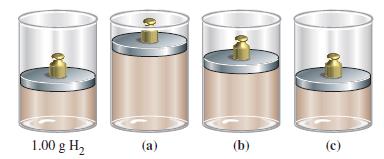
In the drawing below, 1.00 g H2(g) is maintained at 1 atm pressure in a cylinder closed off by a freely moving piston. Which sketch, (a), (b), or (c), best represents the mixture obtained when 1.00 g He(g) is added? Explain. 1.00 g H₂ (a) (b) (c)
The chemical composition of air that is exhaled (expired) is different from ordinary air. Atypical analysis of expired air at 37 °C and 1.00 atm, expressed as percent by volume, is 74.2% N2, 15.2% O2, 3.8% CO2, 5.9% H2O, and 0.9% Ar. The composition of ordinary air is given in Practice Example
A 4.0 L sample of O2 gas has a pressure of 1.0 bar. A 2.0 L sample of N2 gas has a pressure of 2.0 bar. If these two samples are mixed and then compressed in a 2.0 L vessel, what is the final pressure of the mixture? Assume that the temperature remains unchanged.
A 1.65 g sample of Al reacts with excess HCl, and the liberated H2 is collected over water at 25 °C at a barometric pressure of 744 mmHg. What volume of gaseous mixture, in liters, is collected? 2 Al(s) + 6HCl(aq) - 2 AlCl3(aq) + 3H₂(g)
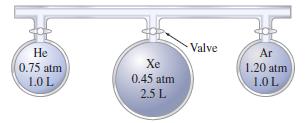
The following figure shows the contents and pressures of three vessels of gas that are joined by a connecting tube.After the valves on the vessels are opened, the final pressure is measured and found to be 0.675 atm. What is the total volume of the connecting tube? Assume that the temperature
A sample of O2(g) is collected over water at 24 °C. The volume of gas is 1.16 L. In a subsequent experiment, it is determined that the mass of O2 present is 1.46 g. What must have been the barometric pressure at the time the gas was collected? (The vapor pressure of water at 24 °C is 22.4 Torr.)
An 89.3 mL sample of wet O2(g) is collected over water at 21.3 °C at a barometric pressure of 756 mmHg (vapor pressure of water at 21.3 °C = 19 mmHg).(a) What is the partial pressure of O2(g) in the sample collected, in millimeters of mercury? (b) What is the volume percent O2 in the gas
A 1.072 g sample of He(g) is found to occupy a volume of 8.446 L when collected over hexane at 25.0 °C and 738.6 mmHg barometric pressure. Use these data to determine the vapor pressure of hexane at 25.0 °C.
At elevated temperatures, solid sodium chlorate (NaClO3) decomposes to produce sodium chloride, NaCl, and O2 gas. A 0.8765 g sample of impure sodium chlorate was heated until the production of oxygen ceased. The oxygen gas was collected over water and occupied a volume of 57.2 mL at 23.0 °C and
When solid KClO3 is heated strongly, it decomposes to form solid potassium chloride, KCl, and O2 gas. A 0.415 g sample of impure KClO3 is heated strongly and the O2 gas produced by the decomposition is collected over water. When the wet O2 gas is cooled back to 26 °C, the total volume is 229 mL
Calculate urms, in meters per second, for Cl2(g) molecules at 30 °C.
The urms of H2 molecules at 273 K is 1.84 x 10³ m/s. At what temperature is urms for H2 twice this value?
Refer to Example 6-14. What must be the molecular mass of a gas if its molecules are to have a root-mean-square speed at 25 °C equal to the speed of the M-16 rifle bullet?Example 6-14Which is the greater speed, that of a bullet fired from a high-powered M-16 rifle (2180 mi/h) or the
Refer to Example 6-14. Noble gases (group 18) exist as atoms, not molecules (they are monatomic). Cite one noble gas whose urms at 25 °C is higher than the speed of the rifle bullet and one whose urms is lower.Example 6-14Which is the greater speed, that of a bullet fired from a high-powered M-16
At what temperature will urms for Ne(g) be the same as urms for He at 300 K?
Determine um, u̅, and urms for a group of ten automobiles clocked by radar at speeds of 38, 44, 45, 48, 50, 55, 55, 57, 58, and 60 mi/h, respectively.
Calculate the average kinetic energy, E̅k for O2(g) at 298 K and 1.00 atm.
Calculate the total kinetic energy, in joules, of 155 g N2(g) at 25 °C and 1.00 atm.
If 0.00484 mol N2O(g) effuses through an orifice in a certain period of time, how much NO2(g) would effuse in the same time under the same conditions?
A sample of N2(g) effuses through a tiny hole in 38 s. What must be the molar mass of a gas that requires 64 s to effuse under identical conditions?
What are the ratios of the diffusion rates for the pairs of gases (a) N2 and O2;(b) H2O and D2O (D = deuterium, i.e., 12H); (c) 14CO2 and 12CO2;(d) 235UF6 and 238UF6?
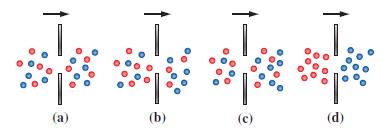
Which of the following visualizations best represents the distribution of O2 and SO2 molecules near an orifice some time after effusion occurs in the direction indicated by the arrows? The initial condition was one of equal numbers of O2 molecules and SO2 molecules on the left side of the
It takes 22 hours for a neon-filled balloon to shrink to half its original volume at STP. If the same balloon had been filled with helium, then how long would it have taken for the balloon to shrink to half its original volume at STP?
The molar mass of radon gas was first estimated by comparing its diffusion rate with that of mercury vapor, Hg(g). What is the molar mass of radon if mercury vapor diffuses 1.082 times as fast as radon gas? Assume that Graham’s law holds for diffusion.
Use both the ideal gas equation and the van der Waals equation to calculate the pressure exerted by 1.50 mol of SO2(g) when it is confined at 298 K to a volume of (a) 100.0 L; (b) 50.0 L; (c) 20.0 L; (d) 10.0 L. Under which of these conditions is the pressure calculated with the ideal gas
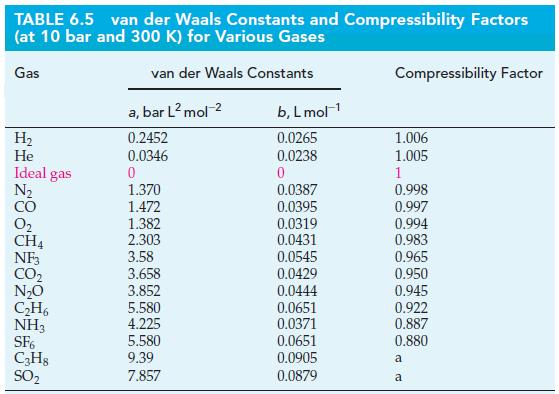
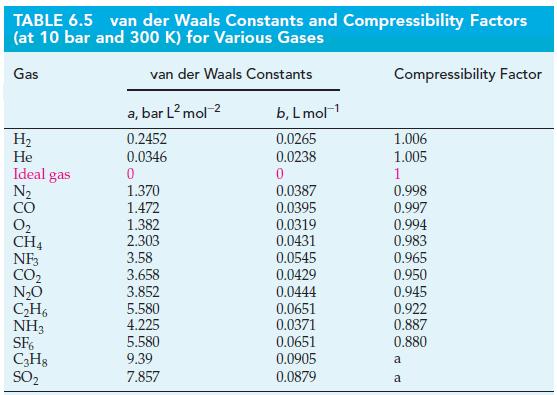
Use the value of the van der Waals constant b for He(g) given in Table 6.5, to estimate the radius, r, of a single helium atom. Give your answer in picometers.Table 6.5 TABLE 6.5 van der Waals Constants and Compressibility Factors (at 10 bar and 300 K) for Various Gases van der Waals
Refer to Example 6-17. Recalculate the pressure of Cl2(g) by using both the ideal gas equation and the van der Waals equation at the temperatures (a) 100 °C;(b) 200 °C;(c) 400 °C.From the results, confirm the statement that a gas tends to be more ideal at high temperatures than at low
(a) Use the value of the van der Waals constant b for CH4(g), given in Table 6.5, to estimate the radius of the CH4 molecule. (See Exercise 89.) How does your estimate of the radius compare with the value r = 228 pm, obtained experimentally from an analysis of the structure of solid methane? (b)
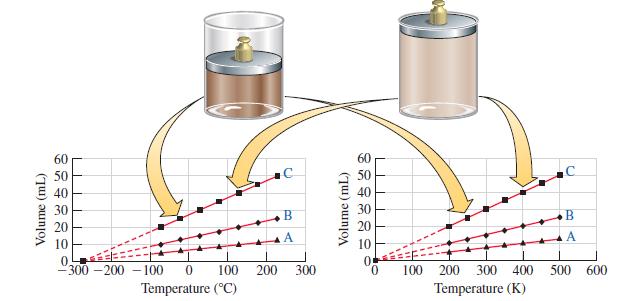
Assume the following initial conditions for the graphs labeled A, B, and C in Figure 6-7. (A) 10.0 mL at 400 K;(B) 20.0 mL at 400 K; (C) 40.0 mL at 400 K. Use Charles’s law to calculate the volume of each gas at 0, -100, -200, -250, and -270 °C. Show that the volume of each gas becomes zero
Explain why it is necessary to include the density of Hg(l) and the value of the acceleration due to gravity, g, in a precise definition of a millimeter of mercury.
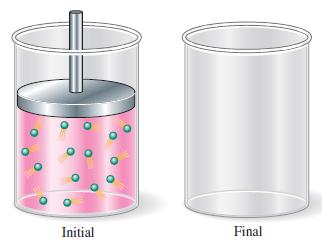
Consider the diagram to the right. The “initial” sketch illustrates, both at the macroscopic and molecular levels, an initial condition: 1 mol of a gas at 273 K and 1.00 bar. With as much detail as possible, illustrate the final condition after each of the following changes.(a) The pressure is
Two evacuated bulbs of equal volume are connected by a tube of negligible volume. One of the bulbs is placed in a constant-temperature bath at 225 K and the other bulb is placed in a constant-temperature bath at 350 K. Exactly 1 mol of an ideal gas is injected into the system. Calculate the final
A compound is 85.6% carbon by mass. The rest is hydrogen. When 10.0 g of the compound is evaporated at 50.0 °C, the vapor occupies 6.30 L at 1.00 atm pressure. What is the molecular formula of the compound?
A 3.05 g sample of NH4NO3(s) is introduced into an evacuated 2.18 L flask and then heated to 250 °C. What is the total gas pressure, in atmospheres, in the flask at 250 °C when the NH4NO3 has completely decomposed? NH4NO3(s) N₂O(g) + 2 H₂O(g)
Ammonium nitrite, NH4NO2, decomposes according to the chemical equation below.What is the total volume of products obtained when 128 g NH4NO2 decomposes at 819 °C and 101 kPa? NH4NO₂ (s)- N2(g) + 2 H₂O(g)
A 0.7178 g sample of a hydrocarbon occupies a volume of 390.7 mL at 65.0 C and 99.2 kPa. When the sample is burned in excess oxygen, 2.4267 g CO2 and 0.4967 g H2O are obtained. What is the molecular formula of the hydrocarbon? Write a plausible structural formula for the molecule.
A mixture of 1.00 g H2 and 8.60 g O2 is introduced into a 1.500 L flask at 25 °C. When the mixture is ignited, an explosive reaction occurs in which water is the only product. What is the total gas pressure when the flask is returned to 25 °C? (The vapor pressure of water at 25 °C? is 23.8 mmHg.)
In the reaction of CO2(g) and solid sodium peroxide (Na2O2), solid sodium carbonate (Na2CO3) and oxygen gas are formed. This reaction is used in submarines and space vehicles to remove expired CO2(g) and to generate some of the O2(g) required for breathing. Assume that the volume of gases exchanged
What is the partial pressure of Cl2(g), in millimeters of mercury, at 0.00 °C and 1.00 atm in a gaseous mixture that consists of 46.5% N2, 12.7% Ne, and 40.8% Cl2, by mass?
When working with a mixture of gases, it is sometimes convenient to use an apparent molar mass (a weighted average molar mass). Think in terms of replacing the mixture with a hypothetical single gas. What is the apparent molar mass of air, given that air is 78.08% N2, 20.95% O2, 0.93% Ar, and
A gaseous mixture of He and O2 has a density of 0.518 g/L at 25 °C and 721 mmHg. What is the mass percent He in the mixture?
A mixture of N2O(g) and O2(g) can be used as an anesthetic. In a particular mixture, the partial pressures of N2O and O2 are 612 Torr and 154 Torr, respectively.Calculate (a) The mass percentage of N2O in this mixture, and (b) The apparent molar mass of this anesthetic.
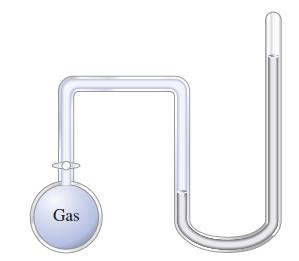
The accompanying sketch is that of a closed-end manometer. Describe how the gas pressure is measured. Why is a measurement of Pbar. not necessary when using this manometer? Explain why the closed-end manometer is more suitable for measuring low pressures and the open-end manometer more suitable for
Gas cylinder A has a volume of 48.2 L and contains N2(g) at 8.35 atm at 25 °C. Gas cylinder B, of unknown volume, contains He(g) at 9.50 atm and 25 °C. When the two cylinders are connected and the gases mixed, the pressure in each cylinder becomes 8.71 atm. What is the volume of cylinder B?
Producer gas is a type of fuel gas made by passing air or steam through a bed of hot coal or coke. Atypical producer gas has the following composition in percent by volume: 8.0% CO2, 23.2% CO, 17.7% H2, 1.1% CH4, and 50.0% N2.(a) What is the density of this gas at 23 °C and 763 mmHg, in grams per
The amount of ozone, O3, in a mixture of gases can be determined by passing the mixture through a solution of excess potassium iodide, KI. Ozone reacts with the iodide ion as follows:The amount of I3- produced is determined by titrating with thiosulfate ion, S2O32-:A mixture of gases occupies a
Chlorine dioxide, ClO2, is sometimes used as a chlorinating agent for water treatment. It can be prepared from the reaction below:In an experiment, 1.0 L Cl2(g) measured at 10.0 °C and 4.66 atm, is dissolved in 0.750 L of 2.00 M NaClO(aq). If 25.9 g of pure ClO2 is obtained, then what is the
A mixture of H2(g) and O2(g) is prepared by electrolyzing 1.32 g water, and the mixture of gases is collected over water at 30 °C and 748 mmHg. The volume of “wet” gas obtained is 2.90 L. What must be the vapor pressure of water at 30 °C? 2 H₂O(1) electrolysis 2 H₂(g) + O2(g)
What volume of air, measured at 298 K and 101 kPa, is required to burn 2.00 kg C8H18? Air is approximately 78.1% N2 and 20.9% O2, by volume. Other gases make up the remaining 1.0%.
Aluminum (Al) and iron (Fe) each react with hydrochloric acid solution (HCl) to produce a chloride salt and hydrogen gas, H2(g). A 0.1924 g sample of a mixture of Al and Fe is treated with excess HCl solution. A volume of 159 mL of H2 gas is collected over water at 19.0 °C and 841 Torr. What is
A 0.168 L sample of O2(g) is collected over water at 26 °C and a barometric pressure of 737 mmHg. In the gas that is collected, what is the percent water vapor (a) By volume; (b) By number of molecules; (c) By mass?(Vapor pressure of water at 26 °C = 25.2 mmHg.)
A 0.1052 g sample of in an 8.050 L sample of H2O(l) dry air at 30.1 °C evaporates completely. To what temperature must the air be cooled to give a relative humidity of 80.0%? Vapor pressures of water: 20 °C, 17.54 mmHg; 19 °C, 16.49 mmHg; 18 °C, 15.48 mmHg; 17 °C, 14.54 mmHg; 16 °C, 13.63
A breathing mixture is prepared in which He is substituted for N2. The gas is 79% He and 21% O2, by volume. (a) What is the density of this mixture in grams per liter at 25 °C and 1.00 atm? (b) At what pressure would the He–O2 mixture have the same density as that of air at 25 °C and 1.00
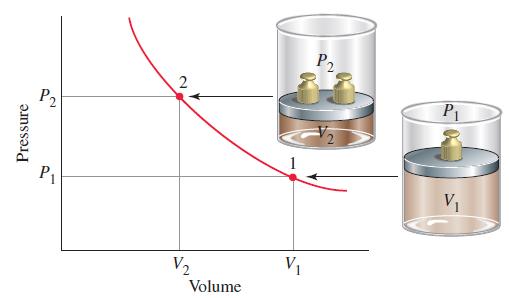
An alternative to Figure 6-6 is to plot P against 1/V. The resulting graph is a straight line passing through the origin. Use Boyle’s data from Feature Problem 125 to draw such a straight-line graph. What factors would affect the slope of this straight line? Explain.Figure 6-6Problem 125Shown
We have noted that atmospheric pressure depends on altitude. Atmospheric pressure as a function of altitude can be calculated with an equation known as the barometric formula:In this equation, P and P0 can be in any pressure units, for example, Torr. P0 is the pressure at sea level, generally taken
Consider a sample of O2(g) at 298 K and 1.0 atm. Calculate (a) urms and (b) The fraction of molecules that have speed equal to urms.
A nitrogen molecule (N2) having the average kinetic energy at 300 K is released from Earth’s surface to travel upward. If the molecule could move upward without colliding with other molecules, then how high would it go before coming to rest? Give your answer in kilometers.
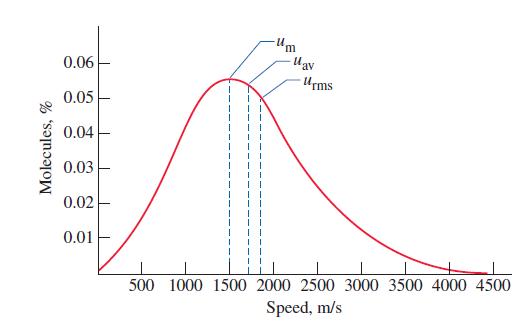
For at and 1 atm, calculate the percentage of molecules that have speed (a) 0 m s-1;(b) 500 m s-1;(c) 1000 m s-1;(d) 1500 m s-1;(e) 2000 m s-1;(f) 2500 m s-1;(g) 3500 m s-1.Graph your results to obtain your own version of Figure 6-15.Figure 6-15 Molecules, % 0.06 0.05 0.04 0.03 0.02 0.01 U m -
If the van der Waals equation is solved for volume, a cubic equation is obtained.(a) Derive the equation below by rearranging equation (6.26).(b) What is the volume, in liters, occupied by 185 g CO2(g) at a pressure of 12.5 atm and 286 K? For CO2(g), and a = 3.61 atm L2 mol-2 b = 0.0429 L mol-1.Eq.
According to the CRC Handbook of Chemistry and Physics (95th ed.), the molar volume of O2(g) is 0.2168 L mol-1 at 280 K and 10 MPa.(a) Use the van der Waals equation to calculate the pressure of one mole of O2(g) at 280 K if the volume is 0.2168 L. What is the % error in the calculated pressure?
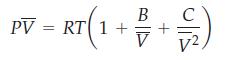
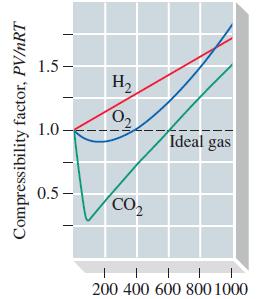
A particular equation of state for O2(g) has the formwhere V̅ is the molar volume, B = -21.89 cm3/mol and C = 1230 cm6/mol2. (a) Use the equation to calculate the pressure exerted by 1 mol O2(g) confined to a volume of at 273 K.(b) Is the result calculated in part (a) consistent with that
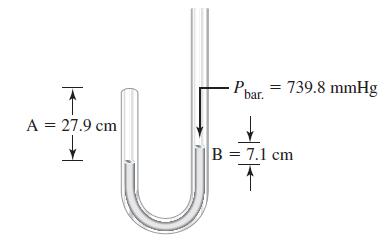
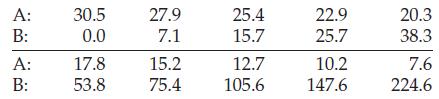
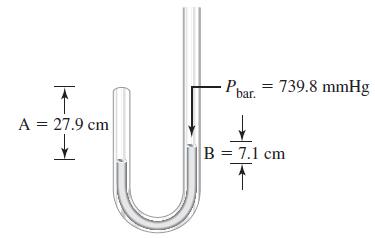
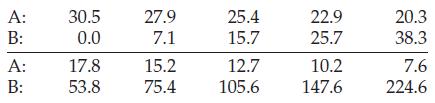
Shown below is a diagram of Boyle’s original apparatus. At the start of the experiment, the length of theair column (A) on the left was 30.5 cm and the heights of mercury in the arms of the tube were equal. When mercury was added to the right arm of the tube, a difference in mercury levels (B)
A 0.156 g sample of a magnesium–aluminum alloy dissolves completely in an excess of HCl(aq). The liberated H2(g) is collected over water at 5 °C when the barometric pressure is 752 Torr. After the gas is collected, the water and gas gradually warm to the prevailing room temperature of 23 °C.
The equation d/P = M/RT, which can be derived from equation (6.14), suggests that the ratio of the density (d) to pressure (P) of a gas at constant temperature should be a constant. The gas density data at the end of this question were obtained for O2(g) at various pressures at 273.15 K.Eq. 6.14(a)
In research that required the careful measurement of gas densities, John Rayleigh, a physicist, found that the density of O2(g) had the same value whether the gas was obtained from air or derived from one of its compounds. The situation with N2(g) was different, however. The density of N2(g) had
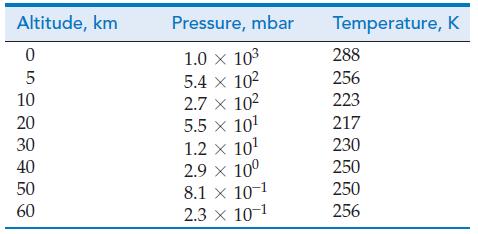
A sounding balloon is a rubber bag filled with H2(g) and carrying a set of instruments (the payload). Because this combination of bag, gas, and payload has a smaller mass than a corresponding volume of air, the balloon rises. As the balloon rises, it expands. From the table below, estimate the
In your own words, define or explain each term or symbol. (a) Atm; (b) STP; (c) R; (d) Partial pressure;(e) urms.
Briefly describe each concept or process: (a) Absolute zero of temperature; (b) Collection of a gas over water; (c) Effusion of a gas; (d) Law of combining volumes.
Explain the important distinctions between(a) Barometer and manometer; (b) Celsius and Kelvin temperature; (c) Ideal gas equation and general gas equation; (d) Ideal gas and real gas.
Which exerts the greatest pressure, (a) A 75.0 cm column of Hg(l) (d = 13.6 g/mL);(b) A column of air 10 mi high; (c) A 5.0 m column of CCl4(l) (d = 1.59 g/mL);(d) 10.0 g H2(g) at STP?
For a fixed amount of gas at a fixed pressure, changing the temperature from 100.0 °C to 200 K causes the gas volume to (a) Double; (b) Increase, but not to twice its original value; (c) Decrease;(d) Stay the same.
Two gases were mixed into a 5.000 L container at 291.0 K. Gas Awas originally confined in 14.20 L at 1.081 bar and 303.1 K. Gas B was originally confined in 1.251 L at 26.77 bar and 327.5 K.(a) What is the final total pressure in the 5.000 L container? (b) What is the partial pressure of gas
A fragile glass vessel will break if the internal pressure equals or exceeds 2.0 bar. If the vessel is sealed at 0 °C and 1.0 bar, then at what temperature will the vessel break? Assume that the vessel does not expand when heated.
Which of the following choices represents the molar volume of an ideal gas at and 1.5 atm?(a) (298 x 1.5/273) x 22.4 L;(b) 22.4 L;(c) (273 x 1.5/298) x 22.4 L;(d) [298/(273 x 1.5)] x 22.4 L;(e) [273/(298 x 1.5)] x 22.4 L.
The gas with the greatest density at STP is (a) N2O;(b) Kr; (c) SO3;(d) Cl2.
Precisely 1 mol of helium and 1 mol of neon are mixed in a container. (a) Which gas has the greater average molecular speed? (b) Which type of molecule strikes the wall of the container more frequently?(c) Which gas exerts the larger pressure?
If the Kelvin temperature of a gas doubles, then which of the following also doubles? (a) The average molecular speed;(b) The speed of every molecule;(c) The kinetic energy of every molecule; (d) The average kinetic energy of the molecules; (e) None of these.
The postulates of the kinetic molecular theory of gases include all those that follow except (a) No forces exist between molecules; (b) Molecules are point masses; (c) Molecules are repelled by the wall of the container; (d) Molecules are in constant random motion; (e) All are postulates.
A sample of O2(g) is collected over water at 23 °C and a barometric pressure of 751 Torr. The vapor pressure of water at 23 °C is 21 mmHg. The partial pressure of O2(g) in the sample collected is(a) 21 mmHg; (b) 751 Torr; (c) 0.96 atm; (d) 1.02 atm.
At 0 °C and 0.500 atm, 4.48 L of gaseous NH3(a) Contains 6.02 x 10²² molecules; (b) Has a mass of 17.0 g;(c) Contains 0.200 mol NH3; (d) Has a mass of 3.40 g.
Carbon monoxide, CO, and hydrogen react according to the equation below.What volume of which reactant gas remains if 12.0 L CO(g) and 25.0 L H2(g) are allowed to react? Assume that the volumes of both gases are measured at the same temperature and pressure. 3 CO(g) + 7 H₂(g) → C3H8(g) + 3
To establish a pressure of 2.00 atm in a 2.24 L cylinder containing 1.60 g O2(g) at 0 °C,(a) Add 1.60 g O2;(b) Add 0.60 g He(g);(c) Add 2.00 g He(g);(d) Release 0.80 g O2(g).
A mixture of 5.0 x 10⁻⁵ mol H2(g) and 5.0 x 10⁻⁵ mol SO2(g) is placed in a 10.0 L container at 25 °C. The container has a pinhole leak. After a period of time, the partial pressure of H2(g) in the container (a) Is less than that of the SO2(g); (b) Is equal to that of the SO2(g); (c) Exceeds
Under which conditions is Cl2 most likely to behave like an ideal gas? Explain. (a) 100 °C and 10.0 atm;(b) 0 °C and 0.50 atm; (c) 200 °C and 0.50 atm;(d) 400 °C and 10.0 atm.
Without referring to Table 6.5, state which species in each of the following pairs has the greater value for the van der Waals constant a, and which one has the greater value for the van der Waals constant b. (a) He or Ne; (b) CH4 or C3H8; (c) H2 or Cl2.
Explain why the height of the mercury column in a barometer is independent of the diameter of the barometer tube.
A gaseous hydrocarbon that is 82.7% C and 17.3% H by mass has a density of 2.35 g/L at 25 °C and 752 Torr. What is the molecular formula of this hydrocarbon?
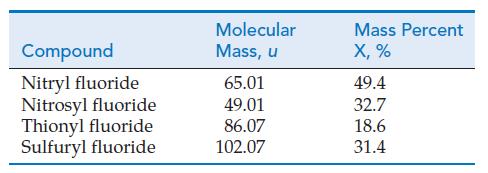
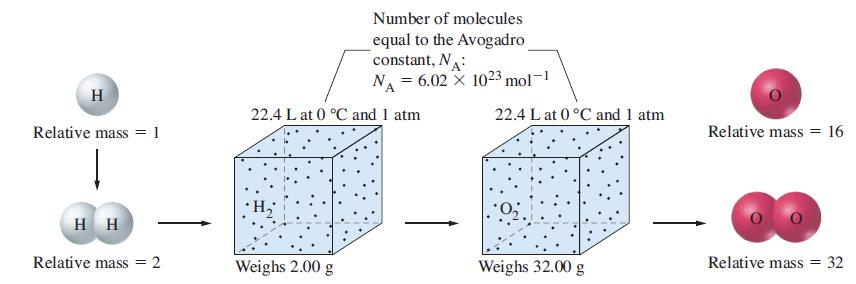
In 1860, Stanislao Cannizzaro showed how Avogadro’s hypothesis could be used to establish the atomic masses of elements in gaseous compounds. Cannizzaro took the atomic mass of hydrogen to be exactly one and assumed that hydrogen exists as H2 molecules (molecular mass = 2). Next, he determined
Phosphorus forms two compounds with chlorine. In the first compound, 1.000 g of phosphorus is combined with 3.433 g chlorine, and in the second, 2.500 g phosphorus is combined with 14.308 g chlorine. Show that these results are consistent with Dalton’s law of multiple proportions.
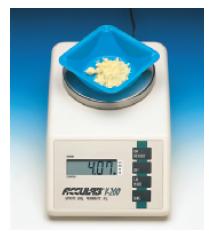
In the sample of sulfur weighing 4.07 g pictured in Figure 2-18, (a) How many moles of sulfur are present, and(b) What is the total number of sulfur atoms in the sample?Figure 2-18 RECCUBERK200
(A) How many Pb atoms are present in a small piece of lead with a volume of 0.105 cm3? The density of Pb = 11.34 g/cm3.(B) Rhenium-187 is a radioactive isotope that can be used to determine the age of meteorites. A 0.100 mg sample of Re contains 2.02 x 10¹⁷ atoms of 187Re. What is the percent
In one experiment, 2.18 g sodium was allowed to react with 16.12 g chlorine. All the sodium was used up, and 5.54 g sodium chloride (salt) was produced. In a second experiment, 2.10 g chlorine was allowed to react with 10.00 g sodium. All the chlorine was used up, and 3.46 g sodium chloride was
Potassium-40 is one of the few naturally occurring radioactive isotopes of elements of low atomic number. Its percent isotopic abundance among K isotopes is 0.012%. How many 40K atoms are present in 225 mL of whole milk containing 1.65 mg K/mL?
Showing 3300 - 3400
of 4008
First
27
28
29
30
31
32
33
34
35
36
37
38
39
40
41
Step by Step Answers

 Get 50% OFF
Claim Now
Get 50% OFF
Claim Now