New Semester
Started
Get
50% OFF
Study Help!
--h --m --s
Claim Now
Question Answers
Textbooks
Find textbooks, questions and answers
Oops, something went wrong!
Change your search query and then try again
S
Books
FREE
Study Help
Expert Questions
Accounting
General Management
Mathematics
Finance
Organizational Behaviour
Law
Physics
Operating System
Management Leadership
Sociology
Programming
Marketing
Database
Computer Network
Economics
Textbooks Solutions
Accounting
Managerial Accounting
Management Leadership
Cost Accounting
Statistics
Business Law
Corporate Finance
Finance
Economics
Auditing
Tutors
Online Tutors
Find a Tutor
Hire a Tutor
Become a Tutor
AI Tutor
AI Study Planner
NEW
Sell Books
Search
Search
Sign In
Register
study help
sciences
introductory chemistry atoms first
Introductory Chemistry Atoms First 5th Edition Steve Russo And Michael Silver - Solutions
Why do two He atoms refuse to form the molecule He2 when brought close to each other?
According to the octet rule:(a) Bonds will form between elements separated by eight spaces on the periodic table.(b) Only atoms with eight valence electrons can form covalent bonds to other atoms.(c) A sufficient number of bonds will form so as to give all atoms a valence octet of electrons.(d)
How many valence electrons are present on each atom in the NF3 molecule?
Why is water H2O and not H3O or something else? Justify your answer with dot diagrams.
A good rule of thumb for forming covalent bonds between atoms is:(a) Unpaired electrons are for sharing (bonding); electrons pairs are not.(b) Electron pairs are used for sharing (bonding); unpaired electrons are not.(c) Representative elements cannot form covalent bonds.(d) Electron pairs on an
Consider ethane, C2H6, a minor component of natural gas. What does this molecule look like? Start with the atoms as dot diagrams and try putting them together so that each C ends up with eight valence electrons, and each H ends up with two valence electrons. Then replace every pair of shared
Draw a dot diagram for hydrazine, N2H4, sometimes used as a rocket fuel.
A multiple bond:(a) Results from the sharing of more than two electrons between two atoms.(b) Is always stronger than a single bond.(c) Should be drawn if, after sharing all unpaired electrons, an atom still has less than an octet.(d) All of the above.
Draw a dot diagram for the acetylene molecule, C2H2.
Draw a dot diagram for hypochlorous acid, HClO.
Electronegativity is:(a) A measure of how negative an electron is.(b) An indication of how effective an atom is at attracting shared electrons to itself.(c) Highest on the left side of the periodic table and lowest on the right side.(d) Lowest for N, O, Cl, and f.
How did we get three different dot diagrams for carbon dioxide?
Draw a dot diagram for propane, C3H8, used as a fuel for heating.
If two atoms with unpaired electrons and vastly different electronegativities approach one another:(a) It will be impossible for a bond to form between them.(b) The unpaired electrons will be transferred from the atom of low electronegativity to the one of higher electronegativity.(c) The unpaired
Draw a dot diagram for carbon dioxide, CO2.
Gallium, Ga, forms a compound with oxygen called gallium oxide. Based on the location of these elements in the periodic table, what is the expected chemical formula of this compound?
A useful rule of thumb is that if EN for the atoms involved in a bond is ≤0.4 (as it is for a C-H bond), this is close enough to zero and the bond can be considered to be nonpolar. This rule makes sense because:(a) The electrons in the bond are shared very unequally between the atoms.(b) The
Draw a dot diagram for propyne, C3H4. One carbon has three hydrogens bound to it, one has one hydrogen bound to it, and one has no hydrogens bound to it.
Why does it make sense to give the more electronegative element in a binary covalent compound the suffix -ide?
Draw a dot diagram for hydrogen cyanide, HCN. The hydrogen is attached to the carbon.
Draw a dot diagram for acetone, C3H6O, the active ingredient in nail polish remover. The oxygen is bound to only one carbon, and that carbon has no hydrogens bound to it.
Draw a dot diagram for the carbonate anion, CO32–.
Draw a dot diagram for neutral SO3.
Draw a dot diagram for the sulfite ion, SO32–.
Are the dot diagrams shown below resonance forms? Explain. O=C=0 :C=0—O:
Draw a dot diagram for NO+.
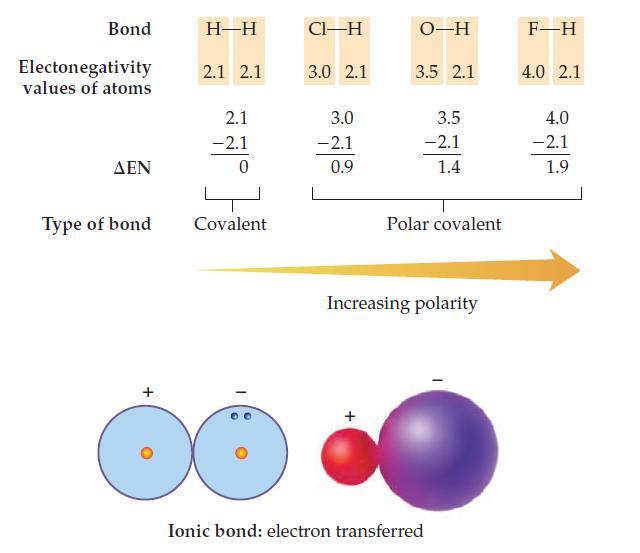
Use the electronegativity values in the chart on page 189 to calculate ΔEN and predict whether the bonds (Ba—Cl, O—O, and Si—O) are covalent, polar covalent, or ionic.BaCl2Data from Page 189 Bond Electonegativity values of atoms ΔΕΝ Type of bond + H-H 2.1 2.1 2.1 -2.1 0 Covalent CI-H 3.0
Use the electronegativity values in the chart on page 189 to calculate ΔEN and predict whether the bonds (Ba—Cl, O—O, and Si—O) are covalent, polar covalent, or ionic.O3Data from Page 189 Bond Electonegativity values of atoms ΔΕΝ Type of bond + H-H 2.1 2.1 2.1 -2.1 0 Covalent CI-H 3.0
Use the electronegativity values in the chart on page 189 to calculate ΔEN and predict whether the bonds (Ba—Cl, O—O, and Si—O) are covalent, polar covalent, or ionic.SiO2Data from Page 189 Bond Electonegativity values of atoms ΔΕΝ Type of bond + H-H 2.1 2.1 2.1 -2.1 0 Covalent CI-H 3.0
Without knowing electronegativity values, a student claims BaCl2 is more ionic than BeCl2. All she has access to is a periodic table. How does she know she is right?
What is wrong with the chemical formula MgCl?
What do all the chemical formulas of the group IIA bromides have in common?
Give the proper name for the compound TiCl4.
Give the proper name for the compound TiCl3.
Give the proper name for the compound N2O.
Give the proper name for the compound NO.
Give the proper name for the compound PCl5.
Give the chemical formula for tetraphosphorus decasulfide.
To indicate the three-dimensional shape of a molecule (a) Bonds that come out of a page are drawn with a solid wedge.(b) Bonds that go back behind the page are drawn with a broken wedge.(c) Bonds that are in the plane of the page are drawn with a solid line.(d) All of the above.
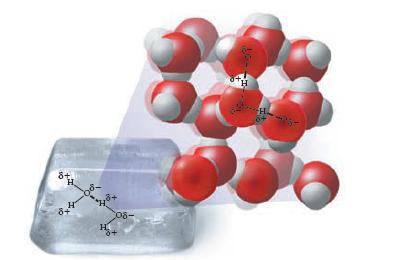
The diagram below shows how bent water molecules in solid ice orient themselves with respect to each other. Notice the large openings in the lattice of water molecules.(a) Discuss why it takes energy to melt ice, and then write a statement that tells what the energy is being used for.(b) Solid ice
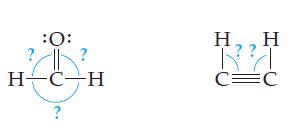
Redraw each structure to get the electron groups as far apart as possible. What angles did you use? :O: ? H CH ? H RA C=C H
Describe the geometry of the electron groups and name the molecular shape resulting from that geometry. Also, draw the molecule, and label the size of all bond angles in your drawing.CO2.
Explain to your partner how a molecule can have polar bonds but still be nonpolar. Make sure your explanation includes the drawing of a hypothetical molecule that goes along with your explanation. Then your partner must make a change to the molecule that results in it now being polar.
VSEPR theory (a) Stands for valence shell electron proton repulsion theory.(b) States that bonds form to minimize a molecule’s energy.(c) States that the shape of a molecule derives from repulsion of valence electrons for each other.(d) States that the shape of a molecule is that which occupies
Why is the theory that governs the shape of molecules called VSEPR and not just EPR?
Draw each ion or molecule showing its threedimensional shape and valence electrons. For each species, name the electron-group geometry around the central atom and the molecular shape. Indicate whether each species has a molecular dipole moment. If so, draw the dipole moment vector.(a) NSF (b)
Which of the following can be thought of as conversion factors?(a) 49.3 kg(b) 4.184 J/°C(c) 350 miles/h(d) 12 eggs per dozen(e) 1 dozen grams
A one-semester chemistry course meets for 1-h sessions three times a week for 15 weeks. How many milliseconds will a student with perfect attendance spend in class during the semester?
A student makes a compound of sulfur and oxygen. She uses 5.00 g of sulfur and 4.99 g of oxygen, and all of the elemental substances are completely used up. What is the percent sulfur in the compound?
The law of conservation of matter says which of the following?(a) Matter is made of atoms.(b) In a chemical reaction, matter changes from reactants to products.(c) In a chemical reaction, matter is always created or destroyed.(d) In a chemical reaction, matter is neither created nor destroyed.
Rutherford’s alpha-particle scattering experiment showed that the nucleus of an atom is tiny. Decide how the experimental results would differ from what Rutherford observed if:(a) The nucleus was much larger than it actually is.(b) The electron was much larger than it actually is.
A student makes two different compounds of nitrogen and oxygen using the masses shown below. In both cases, all of the elemental substances are completely used up.What is the percent oxygen in each compound? Compound 1 10.0 g nitrogen + 11.42 g oxygen Compound 2 10.0 g nitrogen + 22.84 g oxygen
When wood burns, the mass of the ash is less than the mass of the original wood. Yet the law of conservation of matter says that mass cannot be created or destroyed in a chemical reaction. How do you reconcile the result of burning with this law?
Rutherford’s alpha-particle experiment proved which of the following?(a) Atoms are neutral.(b) Electrons have a negative charge.(c) An atom’s nucleus is tiny and contains most of the atom’s mass.(d) An atom’s nucleus is large and contains most of the atom’s mass.
An amu is defined as 1/12 the mass of a 12C atom. Discuss why you think 1/12 was used, and explain why 1 amu is neither the mass of a proton or a neutron. Then, in terms of subatomic particles, define what 1 amu equals.
What led Rutherford to the conclusion that this massive something inside the atom was very small?
Volcanoes spew off hydrogen sulfide, a poisonous, bad-smelling gas. A 100.00-g sample of hydrogen sulfide gas was obtained from some strange volcanic planet. Analysis showed that 94.08 g of it is the element sulfur. The rest of the sample consists of the element hydrogen.(a) What are the
A 101.96-g sample of a compound of aluminum and oxygen is 47.1% by mass oxygen.(a) What is the percent by mass aluminum in this compound?(b) Of the 101.96 g of this compound, how many grams are aluminum?
An atom’s mass number tells you (a) The mass of an atom.(b) How many protons are in the nucleus.(c) How many neutrons are in the nucleus.(d) How many (protons + neutrons) are in the nucleus.
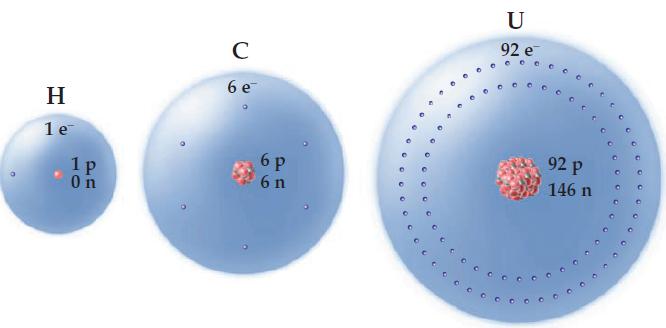
From the figure, what do you think is the rule for determining the number of electrons a neutral atom contains? H T 1 e 1 p On C бе бр 6 n 0cco U 92 e cccccc 92 р 146 п O G000
Other things in nature besides chemical properties are periodic. List as many things in nature as you can that are periodic, and include the period for each.
If a scientist during Dalton’s time found that hydrogen sulfide always had the formula H2S, how would this have been explained?
You visit France, where a local salesperson tries to sell you special water from a mountain spring. This water is supposed to be special because it has the formula H3O. What law does this claim violate?
An atom’s atomic number tells you (a) How many electrons are in the neutral atom.(b) How many protons are in the neutral atom.(c) How many neutrons are in the nucleus when subtracted from the atom’s mass number.(d) All of the above.
Devise a rule which tells how to turn an atom into an anion. Devise a rule which tells how to turn an atom into a cation. Both rules must include subrules which determine what the charge of the ion will be.
Sketch the carbon atom in the following three ways, showing the correct numbers of protons, neutrons, and electrons. All three of your carbon atoms should be electrically neutral.(a) Make the mass number equal to 12.(b) Make the mass number equal to 13.(c) Make the mass number equal to 14.
Two compounds of iodine (I) and chlorine (Cl) are analyzed. Compound A consists of 126.9 g of I and 35.45 g of Cl. Compound B consists of 126.9 g of I and 106.4 g of Cl.(a) What is the percent composition of each element in compound A?(b) What is the percent composition of each element in compound
When coal (essentially pure carbon) is burned, it combines with atmospheric oxygen to produce carbon dioxide gas. Nevertheless, when the coal burns, it seems to disappear. Why is this not a violation of the law of conservation of matter?
Isotopes of an element are (a) Charged atoms, also called ions for short.(b) Actually different elements.(c) The same element but with different number of neutrons in the nucleus.(d) The same elements but with different number of protons in the nucleus.
Suppose you are told that an atom has a mass number of 16. Is this enough information to identify the element? Why?
Suppose 12.0 g of carbon (C) reacts with 70.0 g of sulfur (S) to give 76.0 g of the compound carbon disulfide (CS2). In the process, all the carbon gets used up, but some elemental sulfur is left over.(a) For the law of conservation of matter to be obeyed, how much sulfur is unused?(b) What is the
Using Dalton’s ball-and-hook atomic model, sketch an explanation of how it is possible for hydrogen to combine with oxygen to form two different compounds—water (H2O) and hydrogen peroxide (H2O2).
In the periodic table (a) Elements in the same period have similar chemistry.(b) Groups run left to right (they are rows).(c) Periods run top to bottom (they are columns).(d) Elements in the same group have similar chemistry.
Suppose you are told that an atom with a mass number of 16 contains 9 neutrons. Can the atom be identified now? Which element is this?
Ammonia has the formula NH3, and methane has the formula CH4. According to Dalton, which atom has more hooks on it, N or C, and how many more hooks does it have?
Give the full atomic symbol for an atom that has 16 neutrons and an atomic number of 15.
The periodic table of elements is called periodic because (a) The chemical properties always repeat themselves in repeating intervals of atomic number.(b) The elements in a group have similar chemistry.(c) It was invented by the Russian Dmitri Mendeleev, and periodisky is the Russian word for
An atom is determined to be 4.015 times more massive than 12C. What is the atomic mass of this atom?
Does the stair-step boundary line that separates metals from nonmetals in the periodic table cross into the transition-metal portion of the table?
How much more massive is an “average” oxygen atom than a He atom? (Use the atomic masses from the periodic table.)
Arrange Na, Cs, S, Cl in order of increasing first ionization energy.
Write the name of each element:(a) Be (b) Mg (c) Fe (d) S (e) Ar (f) Cu
A nitrogen atom can combine with three chlorine atoms to yield NCl3. A phosphorus atom can combine with three chlorines to yield PCl3 and also with five chlorine atoms to yield PCl5. How would chemists have explained this in John Dalton’s day?
Suppose two ions have been accelerated down a mass spectrometer, one of light mass and one of heavy mass. Which one do you think will take more voltage to the electromagnet to make it reach the detector? Explain.
How can a mass spectrometer determine if a rack sample is from Earth or from some extraterrestrial source?
The following is true about light:(a) It is also called electronic radiation.(b) Its energy depends on its speed.(c) The larger its wavelength, the smaller its frequency.(d) All of the above.
What is the energy of blue light that has a wavelength of 450.0 nm?
Discuss the type of light that would be given off by electrified atoms if the electrons within these atoms could have any amount of energy. Then work together to draw an energy-level diagram that would go along with such an atom.
Imagine quantum physics applied to objects as large as a car. What would traffic on a highway look like?
To say that something’s energy is quantized means (a) Its charge can be positive and negative.(b) It can have only very tiny amounts of energy.(c) It has energies that cannot be calculated.(d) It can have only certain allowed energies.
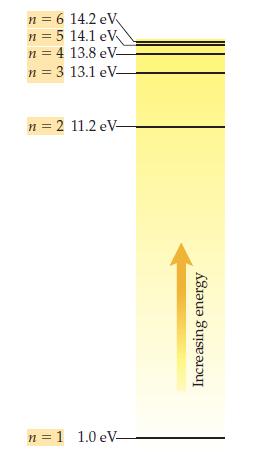
Examine the energy-level diagram for hydrogen shown above, and answer the following questions:(a) If an electron is in the n = 1 shell, what is the electron’s scaled energy in electronvolts?(b) If an electron is in the n = 2 shell, what is the electron’s scaled energy in electronvolts?(c) How
What is the energy of red light with a wavelength of 660.5 nm?
Take turns picking an s-, p-, d-, and f-block element and asking your partner to write its ground-state electron configuration.
According to Bohr’s theory of the atom (a) The energy of an atom’s electrons are quantized.(b) There can be a maximum of 2n2 electrons at a given shell n.(c) Both the energy and the size of an orbit (shell) increase as n increases.(d) All of the above.
What are the wavelength and color of light that has an energy of 3.50 * 10–19 J? ( Use algebraic manipulation to solve the energy equation for λ. You will get an answer in meters. Convert it to nanometers 110–9 nm = 1 m2 and consult the electromagnetic spectrum.)
What is the lowest-energy excited state of the hydrogen atom?
Bohr explained that periodicity was due to (a) Chemical properties repeating themselves.(b) Similar valence-shell electron configurations.(c) Ground-state electron configurations that were similar to excited-state configurations.(d) The existence of only eight main groups.
Which type of electromagnetic radiation has a wavelength roughly on the order of the height of a person? What can you say about the energy of this radiation?
Starting from the ground state, how much more energy does it take to create the n = 3 excited state of hydrogen than the n = 2 excited state?
According to Bohr, the light emitted by atoms (a) Is due to electron excitation between quantized energy levels.(b) Is due to electron relaxation between quantized energy levels.(c) Yields a continuous spectrum due to energy quantization of their electrons.(d) Is always invisible to the human eye.
Showing 2000 - 2100
of 3073
First
14
15
16
17
18
19
20
21
22
23
24
25
26
27
28
Last
Step by Step Answers

 Get 50% OFF
Claim Now
Get 50% OFF
Claim Now