New Semester
Started
Get
50% OFF
Study Help!
--h --m --s
Claim Now
Question Answers
Textbooks
Find textbooks, questions and answers
Oops, something went wrong!
Change your search query and then try again
S
Books
FREE
Study Help
Expert Questions
Accounting
General Management
Mathematics
Finance
Organizational Behaviour
Law
Physics
Operating System
Management Leadership
Sociology
Programming
Marketing
Database
Computer Network
Economics
Textbooks Solutions
Accounting
Managerial Accounting
Management Leadership
Cost Accounting
Statistics
Business Law
Corporate Finance
Finance
Economics
Auditing
Tutors
Online Tutors
Find a Tutor
Hire a Tutor
Become a Tutor
AI Tutor
AI Study Planner
NEW
Sell Books
Search
Search
Sign In
Register
study help
sciences
introductory chemistry atoms first
Introductory Chemistry Atoms First 5th Edition Steve Russo And Michael Silver - Solutions
Why do most solids become more soluble in water with increasing temperature?
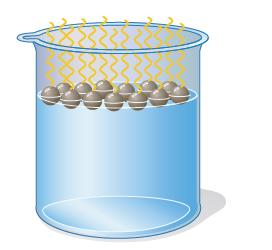
When a small amount of soap is added to a beaker of water, the soap molecules end up positioning themselves at the surface (hence soaps are often called surfactants):Explain why the soap molecules migrate to the surface, and why they orient themselves with their hydrocarbon tails sticking out of
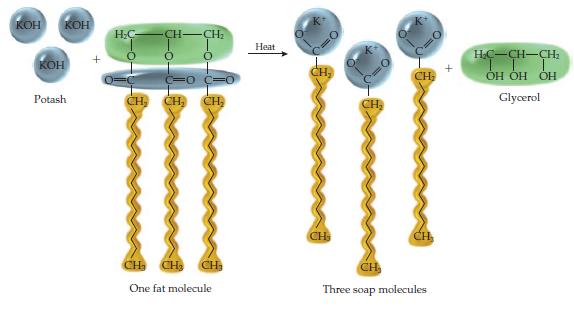
Consider the soap molecules at the top of page 495 and the ionic compound potassium acetate.(a) Draw a dot diagram for the acetate ion, and then place a K+ ion next to the O bonded to C by a single bond.(b) What is the similarity between potassium acetate and a soap molecule? How do they differ?(c)
Draw the structure of the fat molecule that, when it reacts with KOH, forms glycerol and a soap molecule containing 14 carbon atoms.
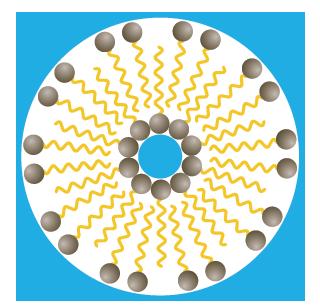
Soap molecules not only form spherical micelles in water, they also form spherical vesicles, which you can picture as thick-walled hollow spheres. Here is a cross section of such a vesicle, with the blue regions representing water:Unlike a micelle, a vesicle traps water in its interior. What gives
A student dilutes 75.0 mL of a 2.00 M solution of iron(III) nitrate with sufficient water to prepare 2.00 L of solution. (a) What is the molar concentration of iron(III) nitrate in the diluted solution? Once in solution, the iron(III) nitrate exists not intact but rather as dissociated ions. What
A student dilutes 45.0 mL of a 0.500 M solution of aluminum sulfate with sufficient water to prepare 1.50 L of solution. (a) What is the molar concentration of aluminum sulfate in the diluted solution? Once in solution, the aluminum sulfate exists not intact but rather as dissociated ions. What
A student combines 60.0 mL of 0.250 M NaOH with 60.0 mL of 0.125 M NaOH. What is the NaOH molar concentration in the resulting solution?
A student combines 60.0 mL of 0.250 M NaOH with 60.0 mL of 0.125 M Ba(OH)2. What is the hydroxide ion molar concentration in the resulting solution?
What is the mass in grams of the nitrogen atoms in 100.0 mL of 1.00 M Ca(NO3)2 solution?
How many grams of NaOH are needed to prepare 500.0 mL of 0.300 M NaOH solution?
What is the molarity of 3.69 mL of solution containing 0.0025 mole of calcium chloride?
How many moles of potassium permanganate, KMnO4, are there in 28.68 mL of a 5.20 × 10⁻³ M solution of KMnO4?
What is the volume in milliliters of 0.0150 M NaOH solution required to neutralize 50.0 mL of 0.0100 M HNO3(aq)?
What is the volume in milliliters of 0.0150 M NaOH solution required to neutralize 50.0 mL of 0.0100 M H2SO4(aq)?
A 50.00-mL sample of hydrochloric acid of unknown concentration was neutralized by 47.35 mL of 0.01020 M sodium hydroxide solution. Calculate the concentration of the original HCl solution.
A solution is prepared by dissolving 5.00 g of sucrose, C12H22O11, in 1.00 L of water. What is the percent by mass concentration of sucrose? (The density of water is 1.00 g/mL).
A solution is prepared by combining 4.00 mL of hexane with a sufficient volume of ethanol to obtain 250.0 mL of solution. What is the percent by volume concentration of hexane?
Air is approximately 21% by volume oxygen, O2. How many grams of oxygen are present in 200.0 L of air at 1.00 atm and 25°C?
When 5.00 g of a solute is dissolved in sufficient solvent to produce 100.0 mL of solution, (a) What is the percent by mass/volume concentration of the solute?(b) What additional information do you need to calculate the percent by mass concentration of the solute, and how would you calculate that
A sample of stainless steel, which is an alloy of iron, chromium, and minor amounts of other components, is 11.5% by mass chromium. How many grams of chromium are there in 250.0 lb of stainless steel?
Your boss says, “Prepare 0.5000 kg of a 1.00% solution of hexane (C6H14, a liquid) in dichloromethane (CH2Cl2, also a liquid).”(a) What is wrong with his request?(b) How would you prepare this solution if he meant a 1.00% by mass solution?
When 26.5 mL of 0.100 M Ca(NO3)2 is combined with 49.8 mL of 0.100 M NaF,(a) What is the theoretical yield of CaF2(s) in grams?(b) What is the molar concentration of Ca2+ (excess reactant) in the combined solution?
Suppose 200.0 mL of a 2.50 M solution of sodium hydroxide is combined with 100.0 mL of a 1.50 M solution of iron(III) nitrate.(a) Write a net ionic equation for the formation of the expected precipitate.(b) What is the theoretical yield of precipitate in grams?(c) Suppose only 10.95 g of
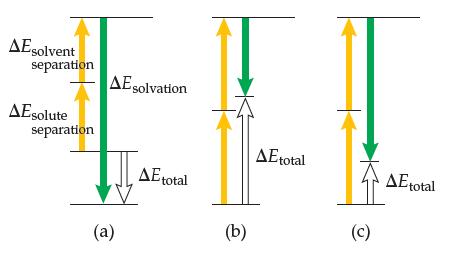
Consider the following diagram:(a) Which step in the dissolving process does it represent?(b) Does this step take energy or release energy?(c) Would more energy be involved with this step if the solvent were CCl4 instead of water?
Suppose 20.0 g of NaBr(s) is added to 50.0 mL of a 2.00 M silver nitrate solution.(a) Write a net ionic equation for the formation of the expected precipitate.(b) What is the theoretical yield of precipitate in grams?(c) Suppose only 15.0 g of precipitate is isolated. What is the percent yield for
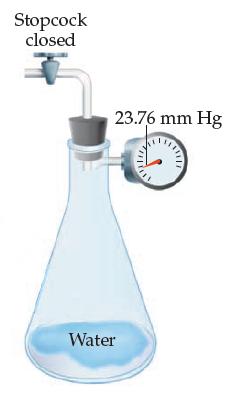
The flask below has been evacuated, so its internal pressure might be expected to read zero, yet it does not. Why does the pressure not equal zero, and why does it stay stopped at the fixed values shown? Stopcock closed 23.76 mm Hg Water
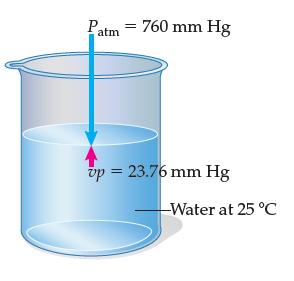
The following situation does not represent boiling. Name two things you could do to the situation to cause the water to boil. Patm = 760 mm Hg vp = 23.76 mm Hg -Water at 25 °C
Consider the following diagram:(a) Which situation represents a soluble solute?(b) Which situation represents an insoluble solute?(c) Which situation represents a case where an entropy increase probably results in a soluble solute? AE solvent separation AEsolute separation AE solvation (a) AE
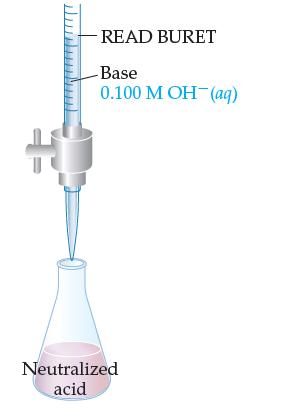
In a titration of HCl with NaOH, you read the buret to see how much base it took to neutralize the acid (turn the indicator pink). You do this titration to determine the molar concentration of the acid.Why is it important to accurately know the amount (volume) of acid that you originally put into
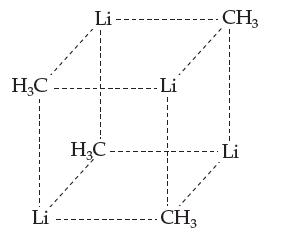
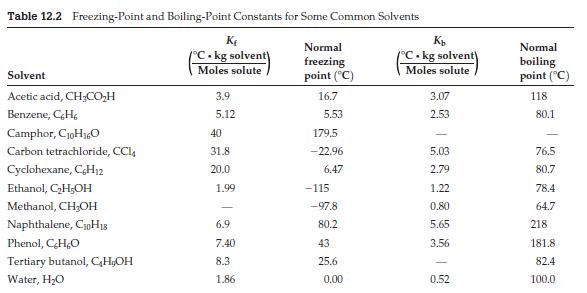
The solvent cyclohexane is in Table 12.2. The compound methyl lithium (CH3Li) is a solute that dissolves readily in cyclohexane. A simple way to think of methyl lithium is as an ionic compound made up of methyl anions (CH3–) and lithium cations (Li+). Dissolving 0.100 moles of it in 0.100 kg of
Calculate the molarity of pure water at 4.0°C. The density of water at 4.0°C is 1.0000 g/mL.
When methanol (CH3OH) dissolves in water, both initially at 22°C, heat is released and the resulting solution is warmer than 22°C. Explain why this is so. (What must be true?)
At 0.00 °C and sea level, dry air can be assumed to have a molar volume of 22.414 L. Given that air is 21.0% by volume oxygen, what is the molar concentration of oxygen in the atmosphere at sea level at 0.00°C?
The amount to which a solvent’s boiling point is elevated and vapor pressure is lowered depends on the number per volume (concentration) and not the chemical identity of solute particles dissolved in it. Explain why this is so in terms of entropy.
The dissolving of a solute (like NaCl) into a solvent (like water) can be thought of as a threestep process.(a) Briefly name or describe these three steps.(b) What are the energy implications of each step? (exothermic, endothermic, depends on the particular solvent/solute)(c) Which of the three
The dissolving of a solute into a solvent can be thought of as a three-step process. The drinking alcohol, ethanol (CH3CH2-OH), is infinitely soluble in water. However, another alcohol called pentanol, with the molecular formula CH3CH2CH2CH2CH2-OH, is nearly insoluble in water.(a) Which of the
Our task is to measure the volume of blood in a live hippopotamus. One way to do this would be to drain its blood into a suitable container and measure its volume. Aside from the obviously disastrous effect this method would have on the hippo, it would not be very accurate since some blood would
Which of the following are electron-transfer reactions? For those that are, indicate which reactant is the reducing agent and which reactant is the oxidizing agent.(a) 3H2SO3 + 2HNO3 → 3H2SO4 + 2NO + H2O(b) Mg + 2H2O → Mg(OH2) + H2(c) SO32– + 2H+ → SO2 + H2O(d) PbO + CO → Pb + CO2
Assign an oxidation state to each atom in HCN.
A battery is made by connecting strips of lead and palladium and dipping each metal into a solution of its ions (Pb2+ and Pd2+ , respectively). Over time, the mass of the lead strip decreases and the mass of the palladium strip increases.(a) Which metal is the anode?(b) Which metal is the
Identify the oxidizing agent and reducing agent in the reaction NO3 + 4 Zn + 70H + 6H₂O → 4 Zn(OH)² + NH3
What is the range of oxidation states possible for carbon?
Galvanized steel is steel coated with zinc. Why is galvanized steel less likely to rust than uncoated steel?
Because of their small size and long life, zinc–mercury batteries were once used in hearing aids, pacemakers, and watches.(a) Which metal is the anode and which is the cathode?(b) Which electrode loses mass over time?
Which of the following are electron-transfer reactions? For those that are, indicate which reactant is the reducing agent and which reactant is the oxidizing agent.(a) PF3 + 3H2O → H3PO3 + 3HF(b) H2 + Cl2 → 2HCl(c) 2Cr2O3 + 3Si → 4Cr + 3SiO2(d) HCl + NaOH → NaCl + H2O
A street vendor sells you a ring he claims is pure gold. However, when you place the ring in a solution of Cu2+ ions, copper plates out on the ring. How do you know the ring is a fake? Could it be made of silver?
Use the shortcut rules to assign an oxidation state to each atom:(a) NaPO3(b) B(OH)3(c) V2O5(d) K2TiF6
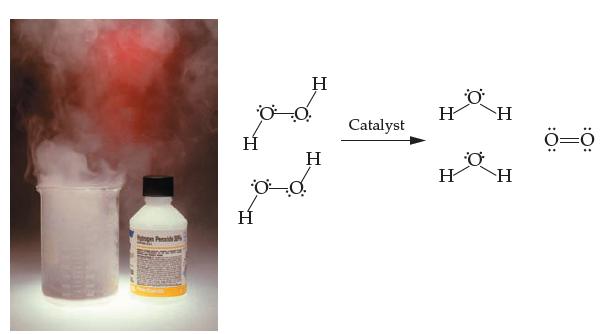
Hydrogen peroxide (H2O2) can be made to decompose into water and oxygen as shown below. (The hydrogen peroxide in the beaker is decomposing to give a cloud of water vapor. Oxygen gas is also being produced.) Is this a redox reaction? If so, prove it. ad Η Η στα Η Η Catalyst H Η Η Η
The reaction Cu2+ + I2 → Cu+ + 2I– is not possible as written. Assign an oxidation number to each atom and explain what is wrong with this reaction.
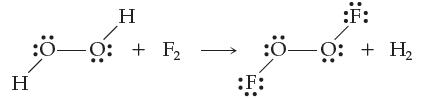
What conclusion would you come to regarding electron transfer for the reaction in Problem 10.134 if you had used octet rule electron bookkeeping instead of oxidation state electron bookkeeping? Explain.Data from Problem 10.134Consider the following hypothetical reaction:Is this an electron transfer
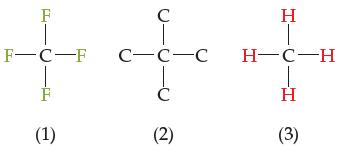
Consider the central carbon atom in each of the three molecules below.(a) One molecule contains a central carbon in its highest possible oxidation state. Which molecule is it, what is its oxidation state, and why is this the highest oxidation state you will ever find a carbon atom in?(b) One
A battery consists of a strip of titanium metal in a solution of Ti2+ ions connected to a strip of zinc metal in a solution of Zn2+ ions. Over time, the concentration of Zn2+ ions decreases and the concentration of Ti2+ ions increases.(a) Which metal is the anode?(b) Which metal is the cathode?(c)
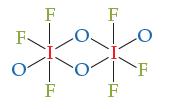
F6I2O4 is an interesting compound whose structure is shown below. Complete the dot diagram (add lone pairs) and then determine the oxidation state for every atom in the molecule not using the shortcut rules. Then use the shortcut rules and see if they give the same result. F F F F F F
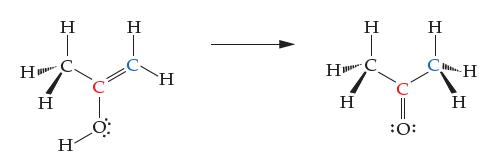
In the interconversion shown below, one carbon atom in the molecule can be thought of as being oxidized, while another carbon atom in the molecule can be thought of as being reduced. These two carbon atoms are highlighted in red and blue. Which gets oxidized and which gets reduced? Supply proof.
In a nickel–cadmium battery, the relevant redox reaction is:Does this agree with the EMF series? What are the oxidation states of nickel before and after the reaction? 2 NiO(OH)+Cd + 2 H₂O → 2 Ni(OH)2 + Cd(OH)2
Most combustible materials will burn in chlorine (Cl2) gas. For example, methane burns to yield CH3Cl, CH2Cl2, CHCl3, and CCl4. Why is the word “burn” used in this case?
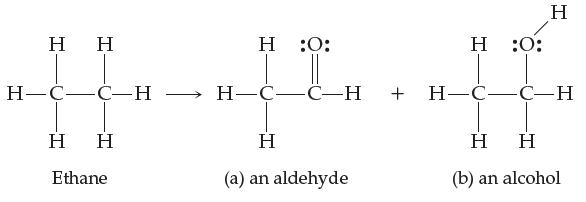
Ethane can be converted into an aldehyde and an alcohol (shown below):(a) Explain why this is an example of oxidation.(b) Which is the more oxidized form of ethane, the aldehyde or the alcohol? Η Η H=C=C-H Η Η Ethane Η :O: Η Η (a) an aldehyde Τ :O: Η H-C-C-H + H-C-C-H Η Η (b) an alcohol
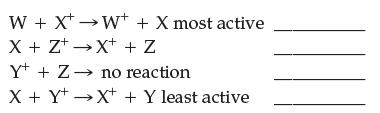
(a) Use the following results to arrange the four metals, W, X, Y, Z in the vertical column on the right from the most active (at the top) to least active (on the bottom).(b) Based on your series in part a, circle ALL the reactions below that you would expect to occur spontaneously as written.
Acids like HCl ionize completely when dissolved in water to produce H+(aq) and Cl–(aq) ions. Metals (M) react with acids (H+) as follows:M(s) + H+(aq) → M+n(aq) + H2(g)where n depends on the specific metal involved. Based on the activity series, which of the choices below would be the best for
Consider the perchlorate (ClO4–) ion.(a) Assign oxidation states to all of the atoms in perchlorate.(b) Explain why the chlorine atom in perchlorate does not follow the halide rule.(c) Do you think perchlorate would be a powerful oxidizing agent or a powerful reducing agent? Explain.(d) Would
Ozone (O3) is a strong oxidizing agent. Explain why this is so.
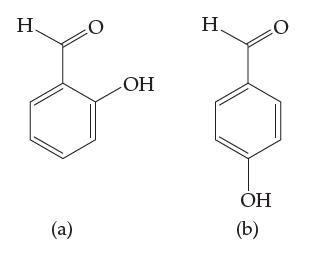
Shown below are the structures for two isomers of hydroxy-benzaldehyde. Structure (a) is 2-hydroxy-benzaldehyde and structure (b) is 4-hydroxy-benzaldehyde. The melting point for isomer (a), 2 °C, is significantly lower than the melting point of isomer (b), 118 °C.Based on your knowledge of
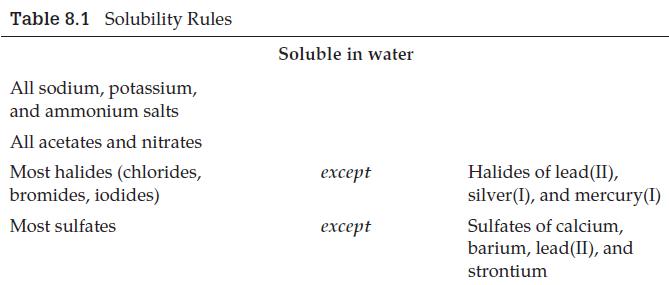
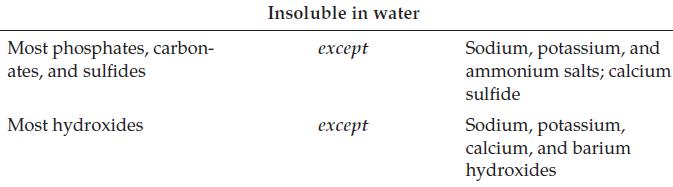
Lead is a very toxic metal; if drinking water is contaminated with Pb2+ ions, you should not drink it. Design an experiment to confirm the absence or presence of Pb2+ ions in your drinking water using the information from Table 8.1 (the solubility rules). Also discuss whether a positive test would
Come up with five common objects that, when you change the subscript in their “formula,” you can then show that what you have is no longer the same as what you started with. For example, the formula for a bicycle is frame1tires2. If you were to change the subscript to frame2tires2, would it
Which chemical equations represent chemical reactions?(a) H2O(l) → H2O(g)(b) CO2 + H2O → H2CO3(c) CO2 + O2 → O2 + CO2
Which one of the following is true about chemical reactions?(a) They accomplish only physical changes.(b) They are represented with a chemical equation.(c) Products are converted into reactants.(d) The arrow means “heat and stir.”
Imagine a collision between an oxygen, O2, molecule and a hydrogen, H2, molecule to give the product hydrogen peroxide, H2O2. Draw Lewis dot diagrams for all the molecules, and then indicate which bonds must be broken and which bonds must form.
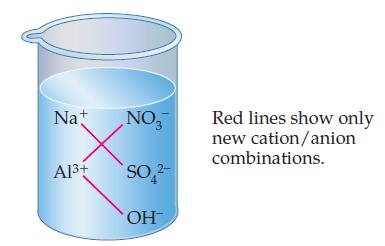
Write the molecular formulas for all potential precipitates in the beaker below.Check your formulas against those at the end of the chapter. Of the three precipitates possible, only Al(OH)3 is insoluble in water. Therefore, the net ionic equation for the precipitation reaction is:If you feel
Which one of the following is true about chemical bonds?(a) It takes energy to break a bond only for polar compounds.(b) Energy is released when breaking weak bonds.(c) It always takes energy to break chemical bonds.(d) They can survive molecular collisions of any amount of energy.
Consider three separate aqueous solutions of sodium nitrate, aluminum sulfate, and sodium hydroxide. Draw a beaker for each, and show which ions are present in each solution.
The energy required to yield a chemical change in a gas-phase reaction (a) Comes from high-energy electrons.(b) Comes from collisions between molecules.(c) Is supplied by the products.(d) Has nothing to do with the reactant molecules.
The reason we balance chemical equations is (a) Actually, chemical reactions do not have to be balanced.(b) To obey the law of conservation of energy.(c) To obey the law of balancing electrons.(d) To obey the law of conservation of matter.
A good hint for balancing chemical equations is (a) Save the elemental substances for last.(b) Balance the elemental substances first.(c) Divide all the balancing coefficients by a number that makes them all whole.(d) Take random guesses until you are right.
A combination reaction is a reaction in which (a) The chemical properties of the reactants are combined.(b) Decomposition occurs.(c) Atoms are exchanged between reactants.(d) Different reactant molecules are combined to yield products.
A precipitation reaction is (a) A single-replacement reaction.(b) A double-displacement reaction.(c) A combination reaction.(d) (b) and (c).
A precipitation reaction will occur when (a) The reactants and products are incompatible.(b) All of the reactants are soluble.(c) At least one of the possible products is insoluble.(d) All of the reactants are insoluble.
An acid is any substance that(a) Produces H+ (aq) ions when added to water.(b) Produces hydroxide OH–(aq) ions when added to water.(c) Contains hydrogen, H, atoms in its formula.(d) Forms a precipitate when added to a soluble compound.
Stoichiometry is the study of (a) The energetics of a reaction.(b) The quantitative aspects of a reaction.(c) How reactants turn into products.(d) Stoicheons (Greek for elements) involved in a chemical reaction.
The word mole comes from the Latin word moles, which means “heap” or “pile.” Like the word dozen, a mole has a numerical value (6.022 × 10²³) attached to it. Explain where this number comes from and how the ability to count individual atoms would help you to determine its value. Then, if
Consider the element gold, Au, a yellow metal. Suppose you obtained 393.934 g of it.(a) What is the molar mass of gold?(b) How many moles of gold do you have?(c) How many atoms of gold do you have?
Rework Practice Problem by the method of unit conversion. Write out each solution in full, making sure to show your conversion factor and which units cancel.You have plenty of eggs and cream cheese, but only 3 cups of sugar. How many cheesecakes can you make?
Conversion factors are(a) Never written in fractional form (something over something else).(b) Used to eliminate all units from a calculation.(c) Used to improve accuracy and precision of a calculated result.(d) Used to translate or convert from one unit to another unit.
Balanced chemical reactions can be thought of as recipes. Write a short paragraph that explains why. Then, in the next paragraph, write down why such recipes can be thought of as being written in a different language from the one we speak. Finally, explain what does the translating between
Suppose you are given 1 mole of methane, CH4.(a) How many moles of carbon atoms do you have?(b) How many moles of hydrogen atoms do you have?(c) How many atoms of carbon do you have?(d) How many atoms of hydrogen do you have?
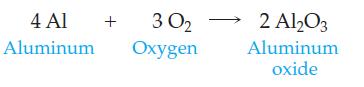
This concept is so important that you need to practice it now.(a) Express the balanced equationin words, using the word moles for every reactant and product.(b) Write every conversion factor you can think of from the balanced chemical equation.(c) Write all the conversion factors from the formula
Rework Practice Problem by the method of unit conversion. Write out each solution in full, making sure to show your conversion factor and which units cancel.If you use 3 cups of sugar in making your cakes, how many eggs will you need?
The mole is(a) The number of 126C atoms in exactly 12 g of 126C.(b) 6.022 × 10²³ of anything.(c) Also called Avogadro’s number.(d) All of the above are correct statements.
Rework Practice Problem by the method of unit conversion. Write out each solution in full, making sure to show your conversion factor and which units cancel.If you use 21 blocks of cream cheese, how many eggs will you need?
Using the four-step procedure, determine the mass in grams of I2 required to make 10.0 g of HI. Write out all your steps and cross out all units that cancel.
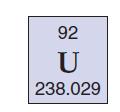
Suppose you have 0.10 mole of uranium, U, atoms.(a) How many uranium atoms do you have?(b) What is the mass in grams of this much uranium? 92 U 238.029
Suppose you have 0.5 mole of gold, Au, atoms.(a) How many gold atoms do you have?(b) What is the mass in grams of this much gold?
One mole of an element weighs(a) Its atomic mass divided by 6.022 × 10²³/mol.(b) Its atomic mass times 6.022 × 10²³/mol.(c) Its atomic mass listed on the periodic table in grams.(d) One-twelfth its atomic mass listed on the periodic table in grams.
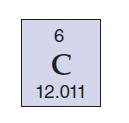
Suppose you have 120.11 g of carbon atoms.(a) How many moles of carbon atoms do you have?(b) How many carbon atoms do you have? 6 C 12.011
In grams, one mole of a molecule weighs (a) The sum of its constituent element atomic masses, each multiplied by its subscript in the formula.(b) Its molar mass in grams.(c) 6.022 × 10²³ times the mass of one single molecule in grams.(d) All of the above are correct.
A balanced chemical equation can always be read(a) In terms of individual molecules.(b) In terms of moles of molecules.(c) In terms (as a source) of conversion factors.(d) All of the above are correct.
If you have 1 mole of propane, C3H8, a gas used in outdoor grills and industrial torches:(a) How many propane molecules do you have?(b) How many hydrogen atoms do you have?(c) What is the mass in grams of 1 mole of propane?
A limiting reactant(a) Is always present in a reaction.(b) Makes it impossible to write a balanced chemical equation.(c) Ends up becoming an excess reactant.(d) Limits the yield of a reaction.
What is the mass in grams of 2 moles of propane?
To find if there is a limiting reactant requires(a) Removing the balancing coefficients from the chemical equation.(b) Dividing the moles of each reactant present by its balancing coefficient from the balanced chemical equation.(c) Multiplying the moles of each reactant present by its balancing
Showing 1600 - 1700
of 3073
First
10
11
12
13
14
15
16
17
18
19
20
21
22
23
24
Last
Step by Step Answers

 Get 50% OFF
Claim Now
Get 50% OFF
Claim Now