New Semester
Started
Get
50% OFF
Study Help!
--h --m --s
Claim Now
Question Answers
Textbooks
Find textbooks, questions and answers
Oops, something went wrong!
Change your search query and then try again
S
Books
FREE
Study Help
Expert Questions
Accounting
General Management
Mathematics
Finance
Organizational Behaviour
Law
Physics
Operating System
Management Leadership
Sociology
Programming
Marketing
Database
Computer Network
Economics
Textbooks Solutions
Accounting
Managerial Accounting
Management Leadership
Cost Accounting
Statistics
Business Law
Corporate Finance
Finance
Economics
Auditing
Tutors
Online Tutors
Find a Tutor
Hire a Tutor
Become a Tutor
AI Tutor
AI Study Planner
NEW
Sell Books
Search
Search
Sign In
Register
study help
sciences
introductory chemistry atoms first
Introductory Chemistry Atoms First 5th Edition Steve Russo And Michael Silver - Solutions
Aquatic life is often damaged when hot water is discharged from power stations into rivers and lakes. What might this have to do with gas solubility in water?
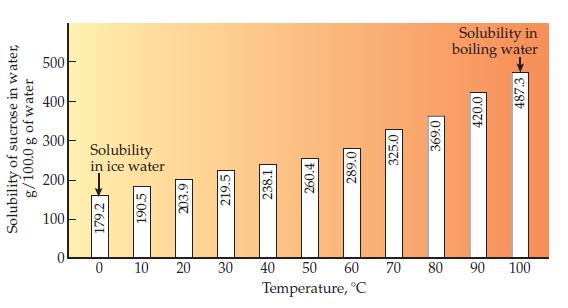
What is the mass in grams of sucrose necessary to saturate 100.0 lb of water at 90 °C? (Use the top graph on page 462; 1 lb = 453.6 g.)Top Graph from page 462 Solubility of sucrose in water, g/100.0 g of water 500 400 300 200 100 T Solubility in ice water 179.25 0 190.5 203.9 10
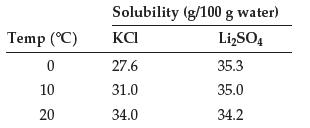
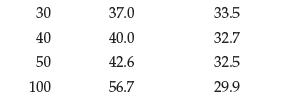
(a) Use these data to plot solubility as a function of temperature for KCl and Li2SO4:(b) Using the plot, estimate the solubility of both compounds in water at 70°C.(c) How much of each compound can be dissolved in a beaker containing 75 g of water at 70°C? Temp (°C) 0 10 20 Solubility (g/100 g
When a can of soda pop is opened, the pressure of carbon dioxide gas that is above the pop in the can drops from high pressure to 1 atm. What does this have to do with the pop going flat when the can is left open?
How many more grams of Li2SO4 can you dissolve in 250.0 g of water at 10.0 °C than at 50.0 °C? Data from Problem 12.94Use these data to plot solubility as a function of temperature for KCl and Li2SO4:Using the plot, estimate the solubility of both compounds in water at 70°C.How much of each
A saturated solution of KCl was prepared at 40.0°C using 5.00 lb of water. How many grams of KCl were required to prepare this solution?Data from Problem 12.94Use these data to plot solubility as a function of temperature for KCl and Li2SO4:Using the plot, estimate the solubility of both compounds
A saturated solution of KCl was prepared at 50.0°C using 2.00 L of water. How many grams of KCl were required to prepare this solution?Data from Problem 12.94Use these data to plot solubility as a function of temperature for KCl and Li2SO4:Using the plot, estimate the solubility of both compounds
Define molarity.
Give precise instructions to your laboratory assistant as to how to prepare 1.00 L of a 1.00 M aqueous solution of CaCl2. Remember that your assistant will be measuring out the CaCl2 in grams. She has available a 1-L volumetric flask.
Give precise instructions to your laboratory assistant as to how to prepare 1.00 L of a 1.00 M aqueous solution of sucrose, C12H22O11. Remember that she will be measuring out the sucrose in grams. She has available a 1-L volumetric flask.
Give precise instructions to your laboratory assistant as to how to prepare 1.00 L of a 0.250 M aqueous solution of sucrose, C12H22O11. Remember that she will be measuring out the sucrose in grams. She has available a 1-L volumetric flask.
Give precise instructions to your laboratory assistant as to how to prepare 0.500 L of a 1.50 M aqueous solution of sucrose, C12H22O11. Remember that she will be measuring out the sucrose in grams. She has available a 0.50-L volumetric flask.
Your assistant tells you she measured out 2.50 moles of NaCl and then added enough water to get 500.0 mL of solution to prepare a 5.00 M solution of NaCl.(a) What was the mass of the NaCl in grams?(b) Did she successfully prepare a 2.5 M solution? Prove your answer.
Your assistant tells you he measured out 116.886 g of NaCl and then added exactly 1.00 L of water to it to prepare a 2.00 M solution of NaCl. Do you fire him or give him a promotion? Explain.
You have 2500.0 mL of a 0.250 M solution of NaCl.(a) How many moles of NaCl are present in this solution?(b) How many moles of ions are present in this solution?(c) How many grams of NaCl would you recover if you evaporated all of the water off of this solution?
You have 45.0 mL of a 0.250 M solution of sucrose, C12H22O11.(a) How many moles of C12H22O11 are present in this solution?(b) How many grams of sucrose would you recover if you evaporated all of the water off of this solution?(c) A student says that if you did part (b) and recovered all of the
How many milliliters of a 1.00 M solution of NaCl are required to obtain 5.00 g of NaCl?
How many milliliters of a 0.250 M solution of glucose, C6H12O6, are required to obtain 100.0 g of glucose?
There is a bottle of 0.500 M sucrose stock solution in the laboratory. Give precise instructions to your assistant on how to use the stock solution to prepare 250.0 mL of a 0.348 M sucrose solution.
There is a bottle of 4.50 M NaCl solution in the laboratory. Give precise instructions to your assistant on how to use the stock solution to prepare 100.0 mL of a 4.00 M NaCl solution.
A student plans to divide the molarity of his solution by its volume to determine the number of moles of solvent in it. He is making two mistakes here. Identify the mistakes and correct both of them.
Consider the three types of percent composition of a solution.(a) What are the names of these three types of percent compositions?(b) Which term is missing from all three types of percent compositions: solvent, solute, or solution?(c) Give the mathematical definition of each type of percent
In Practice Problem 12.3, you learned that “proof” for an alcoholic drink equals twice the percentage of alcohol in the drink. The complete definition of proof is that it is twice the percentage by volume of alcohol. Knowing this, exactly what does it mean to have a 90-proof drink?Data from
A solution of ethanol is prepared by combining 22.5 g of ethanol with 49.6 g of water. What is the percent composition by mass of alcohol in this solution?
A solution of a particular solid solute in water has a concentration of 25.0 mass %.(a) Given 100.0 g of this solution, how many grams of solute do you have?(b) Given 48.0 g of this solution, how many grams of solute do you have?(c) How many grams of this solution do you need to obtain 56.5 g of
How would you prepare 2.00 kg of an NaCl solution that is 30.0 mass % NaCl?
You want 1.00 L of an alcohol–water solution that is 5.00 vol % alcohol.(a) How would you prepare this solution?(b) Suppose the alcohol is ethanol, C2H6O, which has a density of 0.789 g/mL and an MM = 46.07 g/mol. What would be the molarity of the solution?
An alcohol–water solution is 35.00 vol % alcohol. How much solution is required to obtain 200.0 mL of alcohol?
An aqueous solution is 25.0 mass % NaCl. The density of the solution is 1.05 g/mL. What is the molarity of the solution?
What is a solvent cage?
What do we mean when we say that solute particles diffuse through a solution?
You have two solutions, one 1.50 M sodium sulfide and the other 1.00 M Pb(NO3)2.(a) Write a net ionic equation for the precipitation reaction that occurs when these solutions are combined.(b) How many milliliters of the two solutions must be combined to prepare 10.00 g of precipitate?(c) Suppose
You have two solutions, one 0.755 M barium nitrate and the other 1.250 M calcium hydroxide.(a) Write a net ionic equation for the precipitation reaction that occurs when these solutions are combined.(b) How many milliliters of the two solutions must be combined to prepare 5.00 g of precipitate?(c)
You have two solutions, one 0.650 M iron(III)nitrate and the other 1.500 M ammonium carbonate.(a) Write a net ionic equation for the precipitation reaction that occurs when these solutions are combined.(b) If you pour 200.0 mL of each solution into the same flask, what is the theoretical yield of
You have two solutions, one 0.800 M sodium phosphate and the other 0.800 M lead(II) acetate.(a) Write a net ionic equation for the precipitation reaction that occurs when these solutions are combined.(b) If you pour 100.0 mL of the sodium phosphate solution and 50.0 mL of the lead(II) acetate
A 25.00 mL sample of aqueous hydrobromic acid of unknown concentration is neutralized by 43.28 mL of 0.1001 M NaOH(aq).(a) Write a net ionic equation for this acid–base neutralization reaction.(b) How many moles of NaOH did it take for the neutralization?(c) How many moles of hydrobromic acid
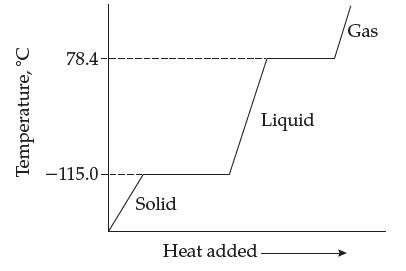
A substance has the following heating curve:(a) What is the melting point of the substance?(b) What is its freezing point?(c) What is its boiling point?(d) At what temperature does the vapor condense?(e) Why isn’t the temperature increasing as the substance is being heated at the horizontal
A 25.00 mL sample of aqueous sulfuric acid of unknown concentration is neutralized by 27.55 mL of 1.0002 M NaOH(aq).(a) Write a net ionic equation for this acid–base neutralization reaction.(b) How many moles of NaOH did it take for the neutralization?(c) How many moles of sulfuric acid were
Propionic acid has one acidic proton per molecule. A solution is prepared by dissolving 0.273 g of propionic acid in enough water to yield 100.0 mL of solution. This solution is neutralized by 36.82 mL of 0.1001 M NaOH(aq).(a) What is the molar concentration of the propionic acid?(b) What is the
When it is warmed, a piece of plastic changes from a solid phase in which its molecules are positioned in an ordered arrangement to a solid phase in which its molecules are arranged randomly. How could you determine the temperature at which this phase change occurs?
When water boils, its temperature does not increase even though it is being heated. If the heat energy isn’t being used to increase the temperature of the water, what is it being used for?
If liquid water is introduced into an evacuated (zero pressure) flask, the pressure will begin to rise.(a) Eventually, the pressure will stop rising and reach a constant value. Why does it stop rising?(b) What do we call this pressure?(c) What will happen to this pressure if we increase the
Define vapor pressure and include the word equilibrium in your definition.
Hexane, which is a liquid at room temperature, is more volatile than water.(a) What does this mean?(b) Which liquid has the higher vapor pressure at a given temperature?(c) Which liquid most likely has the higher boiling point?(d) Why is hexane more volatile than water?
How could you make water boil at 20°C (approximately room temperature)?
Use the dueling-arrows model to explain what heating does to a liquid that eventually causes the liquid to boil.
What is the vapor pressure of benzene at 80.1°C?
What does the word colligative mean when referring to colligative properties of a substance? Also, give three examples of colligative properties.
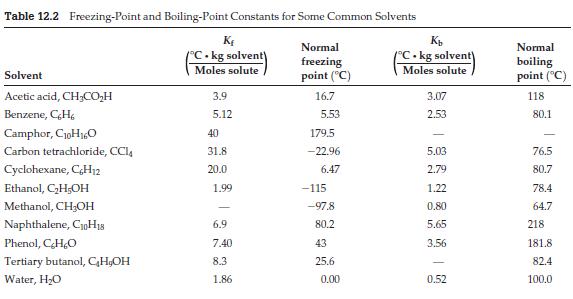
A student dissolves 28.7 g of NaCl(s) in 2.00 kg of water. How many grams of sucrose, C12H22O11, would she have to dissolve in 2.00 kg of water to make the sucrose solution have the same freezing point as the NaCl solution?
A student dissolves 36.9 g of calcium nitrate in 500.0 g of water. How many grams of glucose, C6H12O6, would he have to dissolve in 500.0 g of water to make the glucose solution have the same boiling point as the calcium nitrate solution?
A student dissolves 45.6 g of sodium sulfate in 550.0 g of water at a given temperature. How many grams of sodium chloride would she have to dissolve in 550.0 g of water at the same temperature to make the chloride solution have the same vapor pressure as the sulfate solution?
What are (a) The boiling point(b) The freezing point of a solution made by dissolving 38.60 g of sodium phosphate in 200.0 mL of water? (The density of water is 1.000 g/mL.)
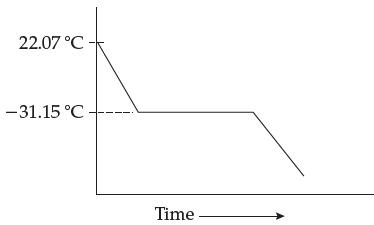
A solution is prepared by dissolving 5.00 g of caffeine in 100.0 g of carbon tetrachloride. The solution is cooled and the temperature plotted over time:(a) What is the molar mass of caffeine?(b) Combustion analysis reveals that the empirical formula of caffeine is C4H5N2O. What is the molecular
What are (a) The boiling point (b) The freezing point of a solution made by dissolving 5.75 g of solid cetyl alcohol, C16H34O, in 100.0 mL of benzene? (The density of benzene is 0.874 g/mL.)
When 1.56 g of cholesterol is dissolved in 50.0 mL of cyclohexane, the resulting solution freezes at 4.40 °C. What is the molar mass of cholesterol? (The density of cyclohexane is 0.779 g/mL.)
Soap molecules have two portions with very different properties, called hydrophobic and hydrophilic.(a) Draw a typical soap molecule.(b) State how a typical soap molecule is related to fat (animal fat) molecules.(c) Discuss the properties of the two portions of a soap molecule.
When soap molecules are dissolved in water in a pool, the soap molecules migrate to the surface of the water and actually coat the surface, with the polar heads being dissolved in the water and the non-polar tails sticking out into the air above the surface of the water.(a) Draw the scenario just
Micelles are spherical, although they are usually drawn as a flat cross section. Why wouldn’t micelles exist in water as flat, two-dimensional structures?
Soap molecules have a hydrophobic portion and yet they dissolve in water. Explain how they accomplish this.
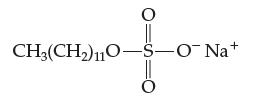
A common molecule used in detergents is sodium lauryl sulfate:Identify the hydrophobic and hydrophilic portions of this molecule. O CH3(CH₂)11O-S-ONa+ O
Explain how soaps allow water to wash oily, nonpolar dirt off clothes and skin.
Which would you expect to release the most hydration energy when dissolved in water: KCl(s), Mg(OH)2(s), or CO2(g)? Which would you expect to release the least hydration energy? Explain your answers.
Which would you expect to release the most hydration energy when dissolved in water: CH3CH2OH(l), CH3Cl(l), or C8H18(l)? Which would you expect to release the least hydration energy? Explain your answers.
The ionic lattice in which compound requires the most energy to break: KCl, Mg(OH)2, or NaNO3? Explain your answer.
Which one of the following steps in the dissolving process must have a negative value for ΔE? Explain your answer.(a) The physical separation of solute particles(b) The formation of solvent–solute interactions(c) The physical separation of solvent particles(d) None of the above
Which one of the following statements is true?(a) Gases are more soluble in liquids when the pressure is decreased.(b) Pressure has no effect on how soluble a gas is in a liquid.(c) Gases are more soluble in liquids when the pressure is increased.(d) Gases are less soluble in liquids when the
How many moles of potassium permanganate, KMnO4, are there in 28.86 mL of a 5.20 × 10⁻³ M solution of KMnO4?
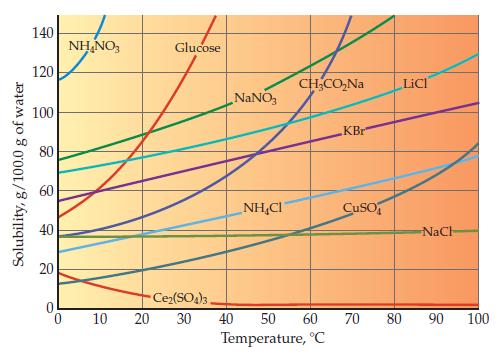
Use the bottom graph on page 462 to determine what mass of water is required to dissolve 50.0 g of NaNO3 at 40.0 °C.Graph from Page 462 Solubility, g/100.0 g of water 140 120 100 80 60 40 20 0 NH₂NO3 10 Glucose Ce₂(SO4)3. 20 30 NaNO3 NHẠC CH₂CO₂Na 40 50 60 Temperature,
(a) How many grams of NaOH are needed to prepare 500.0 mL of a 0.300 M NaOH solution?(b) Describe how you would make this solution, including the equipment needed.
How would you prepare 250.0 mL of a 0.350 M NaOH solution from a 6.00 M NaOH stock solution?
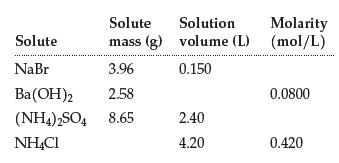
Complete the table: Solute Solute mass (g) NaBr 3.96 Ba(OH)2 2.58 (NH4)2SO4 8.65 NH4Cl Solution Molarity volume (L) (mol/L) 0.150 2.40 4.20 0.0800 0.420
Calculate the number of moles of each ion present in 2.00 × 102 cm3 of (a) 0.200 M NaCl,(b) 0.350 M K3PO4, (c) 1.44 M Al(NO3)3.
4.70 g of CuSO4 is added to enough water to make 150.0 cm3 of solution.(a) What is the molarity of the solution?(b) How many moles of CuSO4 are there in 1.00 mL of this solution?(c) What is the percent by mass of CuSO4 of this solution? (The density of the solution is 1.01 g/mL).
Calculate the freezing point and boiling point of each solution:(a) 18.4 g of glucose, C6H12O6, in 95.5 g of water(b) 15.00 g of urea, N2H4CO, in 75.0 g of water
Combustion analysis reveals vitamin C to be 40.9% by mass C and 4.58% by mass H. The only other element present is oxygen. A solution of 19.40 g of vitamin C in 100.0 g of water freezes at 22.05 °C. What is the molecular formula of vitamin C?
The freezing point of a solution prepared by dissolving 0.200 mole of HF(g) in 2.00 kg of water is –0.19°C. Is HF primarily intact in solution, existing as HF(aq), or has it dissociated to H+(aq) and F– (aq) ions? Does this mean HF is a weak or a strong acid?
How many gallons of 24-proof wine would you have to drink to consume 0.100 gallon of alcohol?
Draw pictures illustrating the solute–solvent interactions and the solvent–solvent interactions for methanol, CH3OH, in water. Is this a case of like dissolves like? Explain.
After 125.0 mL of water is added to 50.0 mL of a 0.250 M solution of ammonium phosphate, (a) what is the molar concentration of ammonium phosphate in the diluted solution? Once in solution, the ammonium phosphate exists not as intact ammonium phosphate but rather as ammonium ions and phosphate
After 50.0 mL of a 0.250 M solution of calcium nitrate is combined with 100.0 mL of a 0.835 M solution of calcium nitrate, (a) What is the molar concentration of Ca(NO3)2(aq) in the combined solution? Once in solution, the calcium nitrate exists not as intact calcium nitrate but rather as calcium
Suppose 250.0 mL of a 0.600 M solution of barium nitrate is combined with enough 0.500 M sodium sulfate solution to precipitate the maximum amount of barium sulfate. What volume of the sodium sulfate solution is required?
A bottle contains 1.00 L of a stock solution of Fe(NO3)3 of unknown concentration. A lab technician dilutes 5.00 mL of the stock solution to 100.0 mL with water. He then determines the Fe(NO3)3 concentration of this solution to be 0.0478 M. What is the Fe(NO3)3 concentration of the stock solution?
What volume of a 0.245 M solution of NaI would you need to add to 100.0 mL of a 0.300 M solution of lead acetate to precipitate out all the lead? Which ions are spectators?
Citric acid can produce 3 H+(aq) ions per molecule. A solution of citric acid is prepared by dissolving 0.177 g of solid citric acid in enough water to yield 100.0 mL of solution. When this solution is titrated with 0.1001 M NaOH(aq), the indicator turns color after 27.55 mL of NaOH(aq) has been
A 25.00-mL sample of a hydrochloric acid solution of unknown concentration is titrated with 0.1004 M NaOH. However, before the acid is titrated, 27.65 mL of water is added to it. The phenolphthalein indicator turns red after 28.70 mL of NaOH has been added. What is the concentration of the 25.00-mL
Identify the solvent and the solute in each solution:(a) Brass, which is 60 to 80% Cu, and 18 to 40% Zn.(b) Household ammonia cleaner, which is 1% by mass ammonia gas in water.(c) 2.59 g of sucrose in 1.00 g of water at 50°C
Carbon dioxide, CO2, is a compound of carbon and oxygen. Does this mean that a sample of pure carbon dioxide can be considered to be a solution of carbon dissolved in oxygen? Explain your answer.
Describe at the molecular level what is happening when solid iodine, I2(s), dissolves in carbon tetrachloride liquid, CCl4(l).
Would you expect solid iodine, I2(s), to be more or less soluble in CCl4(l) than in H2O(l)? Explain your answer in terms of energy.
What is the difference between hydration and solvation? Does one process always release more energy than the other? Explain.
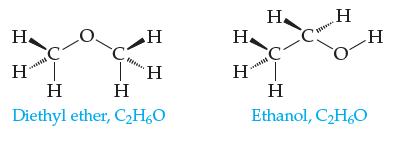
Consider dissolving these two molecules in water:Even though the solute-separation step for ethanol requires more energy than does the solute-separation step for diethyl ether, ethanol is more soluble in water. Explain why. H. H H H H H Diethyl ether, C₂H₂O Н. H H H O- H H Ethanol, C₂H6O
How would you explain the fact that Na3PO4 is quite soluble in water but AlPO4 is essentially insoluble?
Fill in the blank.Whether or not a solute dissolves in a solvent is decided not only by changes in energy but also by changes in ____________________.
Correct the two errors in this statement: A solute can dissolve even when the energy absorbed by the solute–solvent interactions is less than the energy absorbed by the solute–solute and solvent–solvent interactions because the entropy of the system decreases.
If the dissolution of a particular solute in water is endothermic, what must be true about(a) ΔEtotal (b) The change in entropy for the system as a result of the dissolution?
Henry’s law tells us that the solubility s of a gas in a liquid increases as the pressure P of the gas increases. Which of the following mathematical expressions of Henry’s law is correct? Explain your choice and explain why the other two expressions are incorrect.(a) s = kP(b) s = k/P(c) s =
Could 32 g of NaCl be dissolved in 75 g of water at 20.0°C?
Could 75 g of sodium nitrate be dissolved in 90.0 g of water at 60.0°C?
What is the mass in grams of glucose dissolved in 60.0 g of water at 20.0°C if the solution is saturated?
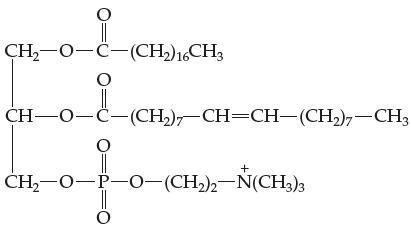
Phospholipids are naturally occurring soap like molecules present in the membranes of living cells. A typical phospholipid structure is:Identify the hydrophobic and hydrophilic portion(s) of this molecule. CH₂-O-C-(CH2) 16CH3 O CH–O-C–(CH,),
Showing 1500 - 1600
of 3073
First
9
10
11
12
13
14
15
16
17
18
19
20
21
22
23
Last
Step by Step Answers

 Get 50% OFF
Claim Now
Get 50% OFF
Claim Now