New Semester
Started
Get
50% OFF
Study Help!
--h --m --s
Claim Now
Question Answers
Textbooks
Find textbooks, questions and answers
Oops, something went wrong!
Change your search query and then try again
S
Books
FREE
Study Help
Expert Questions
Accounting
General Management
Mathematics
Finance
Organizational Behaviour
Law
Physics
Operating System
Management Leadership
Sociology
Programming
Marketing
Database
Computer Network
Economics
Textbooks Solutions
Accounting
Managerial Accounting
Management Leadership
Cost Accounting
Statistics
Business Law
Corporate Finance
Finance
Economics
Auditing
Tutors
Online Tutors
Find a Tutor
Hire a Tutor
Become a Tutor
AI Tutor
AI Study Planner
NEW
Sell Books
Search
Search
Sign In
Register
study help
sciences
introductory chemistry atoms first
Introductory Chemistry Atoms First 5th Edition Steve Russo And Michael Silver - Solutions
In which period and which group is the element that has the ground-state electron configuration [Xe]6s1? Which element is this?
The alkali metals all react with water by giving up an electron to it. Based on their relative positions in the periodic table, which do you think would be more reactive with water, lithium or sodium?
Arrange the atoms Mg, Sr, S, O, and Rb from smallest to largest.
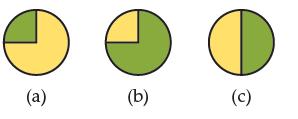
In the pie-chart graphs, the percent natural abundance for Cl-35 (atomic mass 34.969 amu) is represented as green, and the percent natural abundance for Cl-37 (atomic mass 36.966 amu) is represented as yellow. Given that the atomic mass listed for Cl in the periodic table 35.353 amu, and without
Give the full symbol for the atom or ion that has 26 protons and 30 neutrons in its nucleus, and 23 electrons outside its nucleus. Also give the number of the group this element is in.
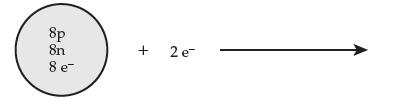
Consider the following process (e– represents an electron):(a) Give the full symbol for the starting atom.(b) Give the full symbol for the resulting ion.(c) Is the product a cation or an anion? Explain. 8p 8n 8 e + 2 e
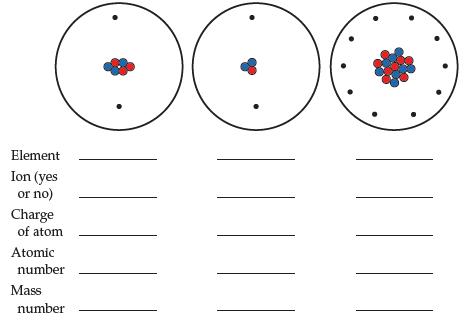
Fill in the blanks for each of the atoms below (protons are red, neutrons are blue, and electrons are black): Element Ion (yes or no) Charge of atom Atomic number Mass number ||| |||| ||
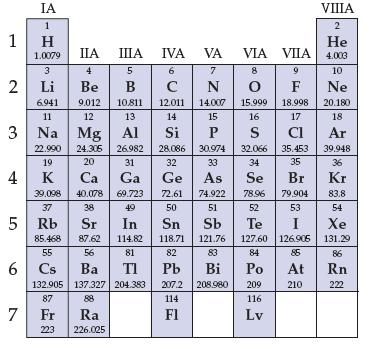
The following is a periodic table consisting only of the representative elements. Indicate where the transition metals get inserted. How many groups are in the smaller section of representative elements after the transition metals are inserted?A periodic table showing only the representative
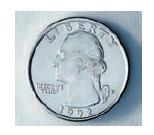
The U.S. quarter, pictured below, has a diameter of 24.25 mm. If the nucleus inside an atom had the diameter of a U.S. quarter, then what would be the diameter of the atom in miles? RE
Although not discussed until the next chapter, what process do you think chemists mean by an atom’s second ionization energy?
Regarding problem 3.137, do you think an atom’s second ionization energy would be smaller, the same, or larger than its first ionization energy? Do you think the second ionization energy for an atom would ever be less than the first? Explain.Data from Problem 3.137Although not discussed until the
Postulate a reason why the first ionization energy increases as we progress from left to right across a period.
Atom A has 35 protons and 44 neutrons in its nucleus. Atom B has 35 protons and 46 neutrons in its nucleus. Should we expect similar or different chemical properties for these atoms? Explain.
The first ionization energy is the minimum energy required to remove an electron from a neutral atom. Upon escape from the atom, how would the now free electron differ if you had used more energy than the minimum first ionization energy as compared to using the exact first ionization energy?
Suppose 12.0 g of silicon (Si) reacts with 70.0 g of oxygen (O2) to give 25.6 g of the compound silicon dioxide (SiO2). In the process, all the silicon gets used up, but some oxygen is left over.(a) For the law of conservation of matter to be obeyed, how much oxygen is unused?(b) What is the
In a mass spectrometer, atoms are ionized and then accelerated through the instrument by a nearby metal plate with a hole in it and an electrical charge on it. Suppose during the ionization process, atoms are turned into cations. What charge, positive or negative, must be put onto the metal plate
An electromagnet bends the path of the fast moving ions in a mass spectrometer so they can reach the detector. The strength of an electromagnets magnetic field depends on the how much voltage is being fed to the magnet. How does a mass spectrometer measure the mass of a single atom?
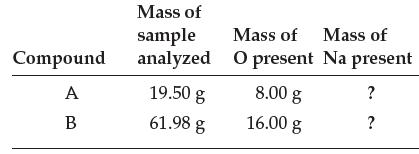
Two different compounds, both consisting of sodium (Na) and oxygen (O), were analyzed. The data are given below:(a) Fill in the last column of the table.(b) Calculate the %Na and %O for both compounds. Compound A B Mass of sample analyzed 19.50 g 61.98 g Mass of Mass of O present Na
Bromine (Br) has two abundant isotopes, one with 44 neutrons and the other with 46 neutrons. Give the full atomic symbols for both isotopes.
The difference between a cation and an anion is (a) A cation has more electrons than an anion.(b) An anion has more electrons than a cation.(c) A cation is negative whereas an anion is positive.(d) They have the same mass number but different atomic numbers.
Life on our planet is based on the element carbon, but science fiction writers often like to conjure up silicon-based life-forms. Why have these writers picked on the element Si to create alien life?
Name the three subatomic particles found in an atom and give their relative masses and charges.
How many electrons does a neutral atom of each isotope in Practice Problem 3.8 have?Practice Problem 3.8Bromine (Br) has two abundant isotopes, one with 44 neutrons and the other with 46 neutrons. Give the full atomic symbols for both isotopes.
Creating a cation from a neutral atom (a) Always takes energy, called the ionization energy.(b) Always requires the removal of an electron from the atom.(c) Never requires the addition of an electron to the atom.(d) Requires all of the above.
Given that the mass of an electron is 5.486 × 10⁻⁴ amu, and the mass of a proton is 1.007 amu, calculate how many times heavier a proton is than an electron.
The following is true regarding metals and nonmetals:(a) The majority of elements in the periodic table are metals.(b) Metals like to lose electrons, whereas nonmetals like to gain electrons.(c) Only nonmetallic elements exist as gases at 25°C and 1 atm.(d) All of the above are true.
In Rutherford’s alpha-particle scattering experiment:(a) How did he interpret the observation that only a very few of the a particles were scattered by the gold foil and most of them went straight through?(b) What was wrong with his model of the atom as far as the physics of the day was concerned?
Iron (Fe) and silicon (Si) are common elements in Earth’s crust. How much more massive is iron than silicon?
Suppose all the alpha particles in Rutherford’s experiment went straight through the gold foil with absolutely no deflections. What would this imply about the structure of the atom?
What is the mass in grams of a billion billion (1018) atoms of 24Mg? The atomic mass of 24Mg is 23.9850 amu.
What else besides an atom’s mass number would you need to determine its elemental identity? Explain how you would use it along with the mass number
Chlorine exists as two isotopes in nature, 3517Cl (atomic mass 34.969 amu, abundance 75.77%) and 3717Cl (atomic mass 36.966 amu).(a) What is the percent abundance of the 3717Cl isotope?(b) Calculate the weighted average of the atomic mass of naturally occurring chlorine.(c) How many times more
Does knowing how many electrons a neutral atom has tell you its elemental identity? Explain.
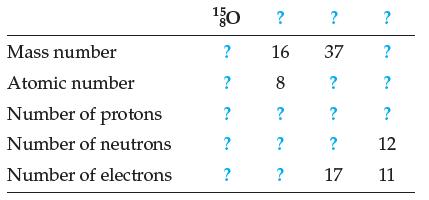
Fill in the following table for four neutral atoms: Mass number Atomic number Number of protons Number of neutrons Number of electrons 15 ? ? ? ? ? ? 16 8 ? ? ? ? 37 ? ? ? 17 ? ? ? ? 12 11
How many groups constitute the representative (main-group) elements?
Physicists are fond of saying that an atom is mostly empty space. What justifies this statement?
What do the elements in a group of the periodic table have in common with one another?
Uranium exists mainly as two isotopes in nature, possessing mass numbers 235 and 238. Write the full atomic symbols for both isotopes.
What are the period number and group number of the element that has atomic number 15?
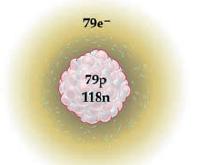
Give the full atomic symbol for this atom: 79e- 79p 118n
Consider the symbol 147C.(a) What is wrong with this symbol?(b) Adjust the atomic number so that the symbol is correct.(c) Adjust the symbol letter so that the symbol is correct.
Which elements with atomic numbers greater than 40 can be expected to have chemical properties similar to those of the element bromine (Br)? What is the periodicity of these two elements?
Write the full atomic symbol for the only atom that has its mass number equal to its atomic number.
What would the periodicity be if the transition metals, lanthanides, and actinides were removed from the periodic table?
Suppose you wanted to turn atoms of lead into atoms of gold. What would you have to do to the nucleus of the lead atoms?
The alkali metals all react with water by giving up an electron to it. Based on their relative positions in the periodic table, which do you think would be more reactive with water—lithium or sodium?
What is the difference between an atom’s atomic mass and its mass number?
Arrange the atoms I, Zr, Ag, and Rb from smallest to largest first ionization energy. What does this say about metals versus nonmetals?
Why is the atomic mass scale also called the relative atomic mass scale?
Give the full symbol for the atom or ion that has 26 protons and 30 neutrons in its nucleus and 23 electrons outside its nucleus. Also give the number of the group this element is in.
What is so special about the mass number and atomic mass of 126C?
Give the full symbol for the atom or ion that has eight protons and eight neutrons in its nucleus and ten electrons outside its nucleus. Also give the name of the group this element is in.
How much more massive is an “average” oxygen atom than a 126C atom? (Use the periodic table for the atomic mass of oxygen.)
How much more massive is an “average” titanium (Ti) atom than a 126C atom? (Use the periodic table for the atomic mass of titanium.)
Why is the atomic mass of carbon not listed as 12 on the periodic table if the universal standard is that 126C has an atomic mass of exactly 12 amu?
Suppose we wanted to use one of the more massive atoms, like 23592U, as the standard reference for the atomic mass scale.(a) What would be the universally agreed-upon atomic mass of the 23592U isotope?(b) Why don’t we use 23592U instead of 126C?
Bromine exists as only two isotopes in nature, 7935Br (atomic mass 78.918 336 amu, % natural abundance = 50.69%) and 8135Br (atomic mass 80.916 289 amu).(a) What is the percent natural abundance for 8135Br?(b) Calculate the atomic mass of the naturally occurring mixture of isotopes.
Naturally occurring hydrogen on Earth has an atomic mass of 1.0079 amu. Suppose you were on another planet and found the atomic mass of hydrogen to be 1.2000 amu. How would you explain this? (The atomic mass of 11H is 1.007 825 2 amu; the atomic mass of 21H is 2.104 102 2 amu.)
While an atom’s mass number and its atomic mass are not the same, they are often quite close to one another. Consider the following: Uranium-235 has an atomic mass of 235.043 93 amu and a percent abundance of 0.73%. Uranium-238 has an atomic mass of 238.0508 amu and a percent abundance of 99.27%.
(a) In what unique way did Mendeleev order the elements to make his discovery?(b) What was his discovery?(c) How does his ordering differ from the modern ordering?
How did Mendeleev’s discovery aid in discovering additional elements?
Define chemical periodicity with respect to chemical properties.
If one considers just the representative elements, how many groups would the periodic table have?
Considering just the representative elements, what percentage of them are metals, nonmetals, and metalloids? How do your results compare to the same percentages derived using the entire periodic table?
Give the names associated with groups IA (1), IIA (2), VIA (16), VIIA (17), and VIIIA (18).
What element seems poorly placed in group IA (1), the alkali metals? Why?
How does a group differ from a period in the periodic table?
Suppose you added one electron and one proton to an atom somewhere in the middle of a period. Which way would this move you on the periodic table and by how many places?
Magnesium (Mg) reacts with chlorine (Cl2) to form the compound MgCl2.(a) Predict the formulas for the compounds formed when all the other alkaline earth metals react with chlorine.(b) Predict the formulas for the compounds formed when all the alkaline earth metals react with bromine.(c) Explain
State two things that are unique about the noble gases.
Name and give symbols for five of the transition metals.
How many elements are in each transition metal period of the periodic table? How many are in each lanthanide (rare earth)/actinide period?
Which elements are responsible for changing the chemical periodicity in the periodic table from 8 to 18? From 18 to 32?
Metals are excellent conductors of electricity. Nonmetals are poor conductors of electricity and are called insulators. Some elements have the ability to conduct electricity roughly between that of metals and nonmetals. Give some examples of these elements, and name the class they belong to.
It always takes energy to remove an electron from a neutral atom. Explain why, and name the minimum amount of energy it takes to do this.
A student claims that the way to convert a neutral atom of Cl into a Cl– anion is to decrease its atomic number by one while leaving the number of electrons unchanged.(a) Will this give the atom a -1 charge and convert it into an anion? Explain.(b) Will the atom still be an atom of the element
What would the charge on a ion be if, starting from the neutral atom: (a) You add three electrons.(b) You remove four electrons. (c) You add two neutrons to the nucleus.
Two students are studying using a plastic model of the atom to which they can easily add or remove electrons, protons, and neutrons. They build a model for the neutral 146C atom. Their next job is to make the +2 ion of this carbon isotope. Student X removes two electrons from the atom. Student Y
Something is wrong with the following statement. Fix it. “Adding an electron to a +1 cation yields a neutral atom, but adding an electron to a neutral atom yields a cation.”
A student says that it is possible for an atom’s second ionization energy to be zero because all the work was done creating a cation with the first ionization energy. Is this student right or wrong? Explain.
What is the trend in first ionization energy as you go down a given group in the periodic table? As you go across a period from left to right?
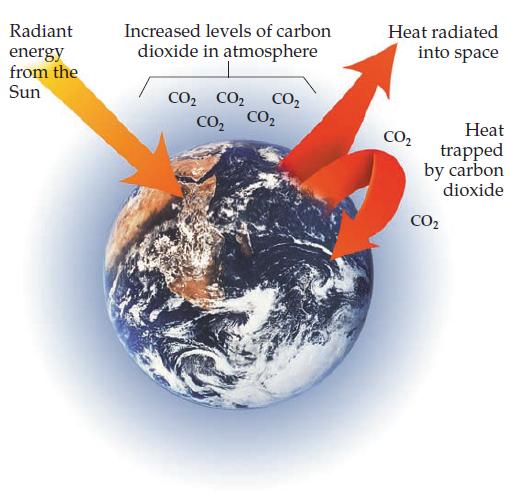
The trend is for first ionization energy to increase from left to right across a period. Describe any exceptions to this overall trend. Use the portion of the plot that is for the third period atoms to answer this question. Radiant energy from the Sun Increased levels of carbon dioxide in
Give the full symbol for the +2 alkaline earth cation that is in the fourth period and has a mass number 21 greater than its atomic number. Explain.
Of the atoms Na, Mg, and Al, which should be the most difficult to ionize? Which has the smallest first ionization energy?
Of the atoms Na, Mg, and K, which should be the most difficult to ionize? Which has the smallest first ionization energy?
Sodium, Na, a metal, rapidly reacts with chlorine, Cl2, a nonmetal.(a) What reason is given for this high reactivity in this chapter?(b) In what ways would you expect the reaction between lithium, Li, and bromine, Br2, to be similar to the reaction between sodium and chlorine?
In the reaction of lithium, Li, with nitrogen, N2, three lithium atoms react with one nitrogen atom to give the compound Li3N. Atoms of one of these elements lose one electron; atoms of the other element gain three electrons.(a) Which element gains the three electrons? Explain your choice.(b) Does
White light from an incandescent light bulb gives a continuous visible spectrum when the light is passed through a prism. What is meant by the word continuous in this context?
A heated gas made up of individual atoms gives off a line spectrum when the emitted light is passed through a prism. How does a line spectrum differ from a continuous spectrum?
A 34.01-g sample of pure hydrogen peroxide produced at a chemical company contains 32.00 g of oxygen. The rest of the mass is due to hydrogen.(a) What is the percent by mass of oxygen and hydrogen in this sample?(b) Another company also produces pure hydrogen peroxide. What is the percent by mass
Tin, Sn, and oxygen can combine to form two different compounds called oxides. Oxide A contains 78.77% by mass tin. Oxide B contains 88.12% by mass tin. What is the percent by mass of oxygen in each oxide?
When wood burns, it combines with oxygen from the atmosphere to produce carbon dioxide, water vapor, and ash. What would you have to do to prove that the law of conservation of matter is not disobeyed when wood burns?
What evidence exists to support the theory that an atom contains a massive nucleus that is very small relative to the size of the whole atom?
When 5 g of compound A reacts with an unlimited amount of compound B, 7 g of compound C is formed. How many grams of compound B must have reacted, and what law allows you to answer the question?
A student claims that isotopes of the same element have the same number of electrons and protons. Is she correct? Justify your answer.
A student claims that isotopes of the same element have the same number of neutrons but different numbers of protons. Is he correct? Justify your answer.
How do you convert a neutral sulfur atom to an anion carrying a charge of 2–?
A student says that the easiest way to convert a neutral sodium atom to a Na+ cation is to add a proton to its nucleus. She reasons that this is so because protons have a 1+ charge. What is wrong with her argument? What does a neutral Na atom become when a proton is added to its nucleus?
The mass number of a neutral atom is 19, and its atomic number is 9. The atom contains how many protons, electrons, and neutrons?
The mass number of a 2+ cation is 56, and its atomic number is 26. The ion contains how many protons, electrons, and neutrons?
Showing 2600 - 2700
of 3073
First
17
18
19
20
21
22
23
24
25
26
27
28
29
30
31
Step by Step Answers

 Get 50% OFF
Claim Now
Get 50% OFF
Claim Now