New Semester
Started
Get
50% OFF
Study Help!
--h --m --s
Claim Now
Question Answers
Textbooks
Find textbooks, questions and answers
Oops, something went wrong!
Change your search query and then try again
S
Books
FREE
Study Help
Expert Questions
Accounting
General Management
Mathematics
Finance
Organizational Behaviour
Law
Physics
Operating System
Management Leadership
Sociology
Programming
Marketing
Database
Computer Network
Economics
Textbooks Solutions
Accounting
Managerial Accounting
Management Leadership
Cost Accounting
Statistics
Business Law
Corporate Finance
Finance
Economics
Auditing
Tutors
Online Tutors
Find a Tutor
Hire a Tutor
Become a Tutor
AI Tutor
AI Study Planner
NEW
Sell Books
Search
Search
Sign In
Register
study help
sciences
introductory chemistry atoms first
Introductory Chemistry Atoms First 5th Edition Steve Russo And Michael Silver - Solutions
The atoms in the molecule HSCN are connected in the order given in the formula.(a) Draw the dot diagram.(b) Draw the molecule’s three-dimensional shape, and label the numeric value of all bond angles.(c) Draw in the individual bond dipole moments.(d) Is the molecule polar? If yes, draw the
Consider the molecule SO3.(a) Draw the dot diagram.(b) Draw the molecule’s three-dimensional shape, and label the numeric value of all bond angles.(c) What is the shape of this molecule?(d) Draw in the individual bond dipole moments.(e) Is the molecule polar? If yes, draw the molecular dipole
Consider the molecule AsF3.(a) Draw the dot diagram.(b) Draw the molecule’s three-dimensional shape, and label the numeric value of all bond angles.(c) What is the shape of this molecule?(d) Draw in the individual bond dipole moments.(e) Is the molecule polar? If yes, draw the molecular dipole
Consider the molecule SiCl4.(a) Draw the dot diagram.(b) Draw the molecule’s three-dimensional shape, and label the numeric value of all bond angles.(c) What is the shape of this molecule?(d) Draw in the individual bond dipole moments.(e) Is the molecule polar? If yes, draw the molecular dipole
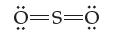
The dot diagramfor SO2 is incorrect.(a) Draw the correct dot diagram.(b) How do the correct and incorrect dot diagrams differ in their prediction of molecular shape and polarity? ö=s=o
Why is it important to always show the lone pairs in a Lewis dot diagram?
Consider all the hydrogen halide molecules HX, where X is a group VIIA atom.(a) Which is the most polar? Why?(b) Which is the least polar? Why?(c) Draw all these molecules, showing their relative bond dipole moments.
Which of each pair is most polar? Explain.(a) Chlorine and phosphorus trichloride (b) Carbon disulfide and sulfur difluoride (c) Nitrogen trifluoride and phosphorus trifluoride (d) Silicon tetrabromide and hydrogen cyanide (HCN)(e) Nitrogen trichloride and oxygen dichloride
Consider SO2 and CO2. Both have polar covalent bonds. One of these molecules is polar and the other is nonpolar. Which is which and why?
Which of these molecules is the least polar?(a) CH2O (b) F2 (c) CH3F (d) CH3Cl
Consider an individual bond dipole moment.(a) What does electronegativity have to do with an individual bond dipole moment?(b) Explain how an individual bond dipole moment is drawn.
Consider the two molecules CO and CO2. They are both made of the same elements, and yet only one is polar. Why is this so?
Consider the following molecules. For those that are polar, draw the molecular dipole moment.(a) CHBr3 (b) CH3Br (c) H2S (d) NOCl(e) C2Cl2 (connected Cl—C—C—Cl)
What is a dipole–dipole force? Give an example.
Are dipole–dipole forces between molecules as strong as the forces between oppositely charged ions? Explain.
What do we mean by intermolecular forces? What evidence is there that they exist?
Draw two HCl molecules and show how they would be attracted to each other. Show the partial charges and dipole moment vectors for both molecules, and orient the molecules properly with respect to each other.
Draw two ammonia molecules in their three-dimensional shape and show how they would be attracted to each other. Show the partial charges and individual bond dipole moment vectors for both molecules, and orient the molecules properly with respect to each other.
Consider the molecule HNF2 (N is the central atom in the molecule).(a) Draw the dot diagram.(b) Draw the molecule’s three-dimensional shape, and label the numeric value of all bond angles.(c) What is the shape of this molecule?(d) Draw in the individual bond dipole moments.(e) Is the molecule
Consider the molecule N2O (connected N—N—O).(a) Draw the dot diagram.(b) Draw the molecule’s three-dimensional shape, and label the numeric value of all bond angles.(c) What is the shape of this molecule?(d) Draw in the individual bond dipole moments.(e) Is the molecule polar? If yes, draw
Some molecules pose special challenges to the rules for obtaining the correct Lewis dot diagram. Consider the molecule NO2 (N is the central atom).(a) What challenge does it present?(b) Suppose you were allowed to violate the octet rule for the N atom. What would the dot diagram look like?(c) Based
Consider the phosphonium ion, PH4+ .(a) Draw the dot diagram.(b) Draw the ion’s three-dimensional shape, and label the numeric value of all bond angles.(c) What is the shape of this polyatomic ion?(d) Draw in the individual bond dipole moments.
Imagine that you could vary the magnitude of the molecular dipole moment of all molecules in a substance. What would happen to the strength of the intermolecular forces between a group of molecules as the dipole moment of each molecule is increased? Explain.
Consider the PX3 molecule, where X is either H or F.(a) For X = H, the entire molecule is nonpolar. Why is this so?(b) For X = F, the entire molecule is polar.Draw two molecules next to one another in proper orientation so as to yield a dipolar intermolecular attraction, and explain why the
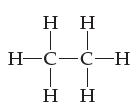
Using lines, solid wedges, and dashed wedges, draw the three dimensional shape of ethane, C2H6. Indicate the numeric value of all bond angles. Η Η H=C=C- -Η Η Η
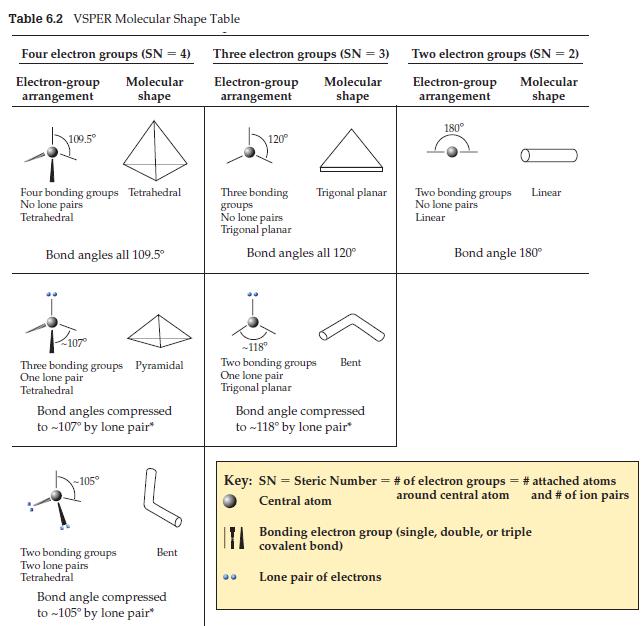
An atom has no lone pairs of electrons on it and four other atoms bound to it. Why is 109.5° the bond angle adopted by this molecule?
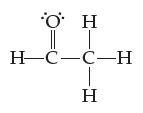
Using lines, solid wedges, and dashed wedges, draw the three-dimensional shape of acetaldehyde, C2H4O. Indicate the numeric value of all bond angles. O H || T H-C-C-H H
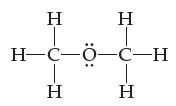
Using lines, solid wedges, and dashed wedges, draw the three-dimensional shape of diethyl ether, C2H6O. Indicate the numeric value of all bond angles. Η H¬C- Η Η -C-H Η
Using lines, solid wedges, and dashed wedges, draw the three-dimensional shape of the hydronium ion, H3O+. Indicate the numeric value of all bond angles. [H-Q-H]+ -C H
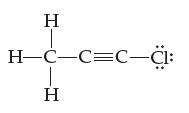
Using lines, solid wedges, and dashed wedges, draw the three-dimensional shape of chloromethylacetylene, C3H3Cl. Indicate the numeric value of all bond angles. HTCIH Η H-C-C=C-Cl: Η
Consider the molecules CH4, CH3Cl, CH2Cl2, CHCl3, and CCl4. Which are polar and which are nonpolar?
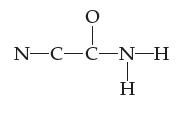
The connections in C2N2H2O are:(a) Put in the remaining valence electrons to complete the Lewis dot diagram.(b) Using lines, solid wedges, and dashed wedges, draw the three-dimensional shape of this molecule. Indicate the numeric value of all bond angles. O N-C-C-N-H N|H Η
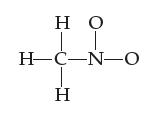
The connections in CH3NO2 are:(a) Put in the remaining valence electrons to complete the Lewis dot diagram.(b) Using lines, solid wedges, and dashed wedges, draw the three-dimensional shape of this molecule. Indicate the numeric value of all bond angles. Η Ο I-O-I H¬C-N-0 H
Up until now, you’ve been drawing first a Lewis dot diagram (two-dimensional, shows lone electron pairs) and then a separate diagram showing molecule shape (three-dimensional, no lone pairs shown). Now begin combining the two, drawing one structure showing both threedimensional shape and all lone
Draw a combined Lewis dot, molecular-shape diagram for each of the following species. Name each shape, and indicate whether the molecule or ion has an overall dipole moment. If so, draw the dipole moment vector.(a) Cl2O (b) NOF (c) PF3 (d) ICl2
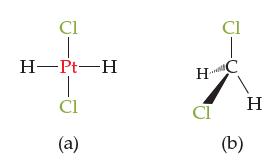
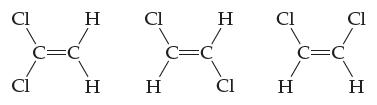
Which, if any, of these molecules are polar? For any molecule you classify as polar, show both the individual bond dipole moment vectors and the overall molecular dipole moment vector. Explain your answers. Cl Cl C=C H H CI H C=C H CI Cl H C=C Cl H
Draw a combined Lewis dot, molecular-shape diagram for each of the following species. Name each shape, and indicate whether the molecule or ion has a dipole moment. If so, draw the dipole moment vector.(a) CHBr3 (b) NF3 (c) ClO3–(d) CS2
Draw dot diagrams for the carbonate anion, CO32–, and for the sulfite anion, SO32–. What is the electron-group configuration around the central atom in each anion? What is the molecular shape of each anion? Is either ion polar? If so, which one? Explain your choice.
Which, if any, of these molecules do you expect to be polar: CO2, CS2, or CSO (carbon is the central atom in all three molecules)? Explain your answer.
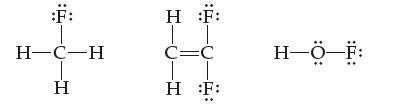
Draw the three-dimensional shape of each molecule shown below. Label the numeric value of all bond angles, and indicate whether the molecule is polar or nonpolar. If polar, draw the molecular dipole moment vector. :F: H-C-H H H :F: IT C=C IT H :F: H-Ö-F:
List the steps you take to decide (a) Whether or not a covalent bond is polar (b) Whether or not a molecule is polar.
Which should have the largest molecular dipole moment: H2, CO2, CH3F, or CH3I?
When asked the shape of NH2–, a student begins by drawing two dot diagrams:She then answers that the shape can be either bent or linear, depending on the arrangement of the hydrogen atoms. What is wrong with this answer? What is the correct shape? H-Z: H-N: Η [H_N_H]¯
What is the molecular shape of NCl3? What is the electron-group geometry around N? Is this a polar molecule?
What is the difference between intermolecular forces and intramolecular forces? Which are stronger?
Draw the three-dimensional shape of S2F2 (connected F—S—S—F) and N2F2 (connected F—N—N—F). Indicate the numeric value of all bond angles.
Although Lewis dot diagrams are useful in understanding how the valence electrons in a molecule are arranged, what important aspect of the molecule do they neglect to show?
Draw the three-dimensional shape of methanol, CH3OH. Indicate the numeric value of all bond angles. Is this molecule polar? If so, draw the molecular dipole moment vector.
A student forgets that the N in ammonia, NH3, has a lone pair as well as its three single bonds. After checking Table 6.2, he mistakenly draws the molecule—three bonding groups, no lone pairs— as having a trigonal planar shape. If the ammonia molecule really were trigonal planar, how would the
Explain the difference between electron-group geometry and molecular shape. How do you use electron-group geometry when deciding what shape a molecule has?
Hydrogen peroxonitrite has the formula HNO3, with the atoms connected O—N—O—O—H.(a) Draw the dot diagram for this molecule.(b) Draw the three-dimensional shape of the molecule, showing the numeric value of all bond angles.(c) Describe the electron-group geometry and molecular shape around
Under what conditions is the electron-group geometry for a molecule the same as the molecular shape?
What is the shape of the N3– anion? What is the numeric value of each bond angle in the anion?
Which should have the largest dipole moment: O3, H2O, or OF2?
Covalent molecules that contain an O—H, N—H, or F—H bond have very strong intermolecular forces. Explain why.
Draw the three-dimensional shape of H2O3. Label the numeric value of all bond angles. In this molecule, the three oxygen atoms form a chain with a hydrogen atom at each end.
Draw each ion or molecule showing its three dimensional shape and valence electrons. For each species, name the electron-group geometry around the central atom (or atoms) and the molecular shape. Indicate whether each species has a molecular dipole moment. If so, draw the dipole moment vector.(a)
White phosphorus, P4, consists of four phosphorus atoms, with each atom bonded to the other three. Draw the three-dimensional shape of this molecule, showing all valence electrons and bond angles.
Nature supplies examples that violate VSEPR. Consider the two molecules shown below. Their correct shapes are indicated.(a) What is the steric number for the central atom for both molecules?(b) Which molecule violates VSEPR?(c) Which molecule is polar and which is nonpolar? Explain why.
BH3 and PH3 each contain four atoms, with the three hydrogens surrounding the central atom. Do the two molecules have the same electron-group geometry? Do they have the same molecular shape? Name the geometry and the shape for both molecules. You know from Problem 6.59 that PH3 is nonpolar. What
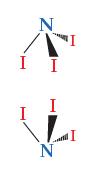
A student postulates that when two NI3 molecules approach one another, they do so with the preferential orientation shown below. Would you argue for or against his postulate? Explain why. I I N I I N I
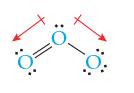
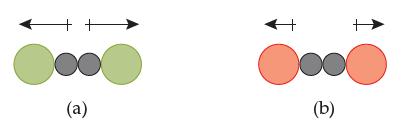
A student draws the following for ozone and claims it is a polar molecule. Is the student correct? Explain why.
One of the molecules below is C2Cl2 (linear, connectivity Cl—C—C—Cl) and the other is F2C2 (linear, connectivity F—C—C—F). The bond dipole moment vectors are shown:(a) Which molecule contains Cl and which contains F? Explain how you knew from the diagram.(b) Could you distinguish
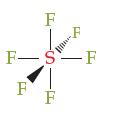
Some molecules have central atoms with steric numbers greater than 4. For example, the central sulfur atom in SF6 has a steric number of 6. Its actual geometry (called octahedral), is shown below (all the bond angles are 90° or 180°).(a) Are the bonds in SF6 polar, polar covalent, or ionic?
There are exceptions to the predictions of VSEPR. Consider CH3, known as a methyl radical.(a) Create a dot diagram for the methyl radical. How is it fundamentally different from other dot diagrams you have done?(b) Use VSEPR to predict the shape of the methyl radical and draw it with that shape
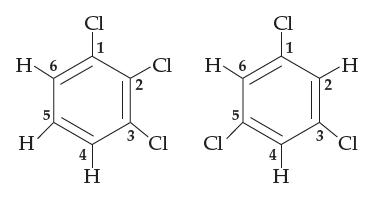
Consider 1,2,3-trichlorobenzene and 1,3,5-trichlorobenzene, both shown below (the carbon atoms are numbered as shown). Both are flat molecules with 120° bond angles, yet one of them is polar and the other nonpolar. Which is which, and why? For the polar one, indicate which part of the molecule is
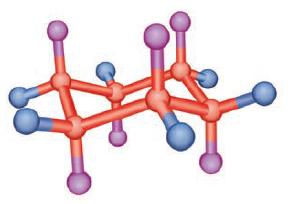
Cyclohexane, formula C6H12, is often drawn as a puckered (not flat) ring as shown below (the purple and blue atoms are the hydrogens). Explain how drawing it as a puckered ring makes it consistent with VSEPR, and explain why the purple atoms are called axial hydrogens and the blue atoms are called
Given the electronegativities of F and I, what would have to be true for IF2+ to be nonpolar? The fact that it is polar means what?
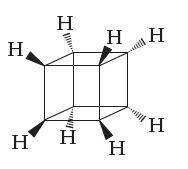
Cubane, C8H8, is an interesting molecule shown below. Comment on it relative to VSEPR. Then imagine you had dichloro cubane, C8H6C12. Draw all the unique molecules with this formula (you are drawing isomers, molecules with identical formulas but different structures). Indicate which of them are
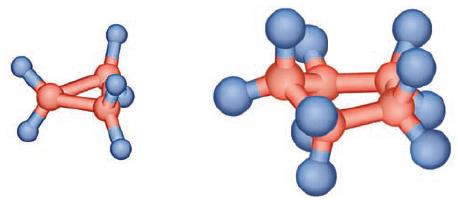
Using your knowledge of VSEPR theory and its preferred bond angles, suggest a reason for the fact that the cyclopropane molecule (pictured below) is not a very stable molecule and is highly reactive, while the cyclopentane molecule is not nearly as reactive or unstable.
What is it about the trigonal bipyramidal shape that distinguishes it from all the other molecular shapes that we have covered?
Consider the molecule BrCl3.(a) Draw a dot diagram for the molecule.(b) Predict the molecule’s electron group geometry.(c) Predict the molecule’s shape (name the shape and draw it using wedges, lines, and broken lines, and indicate the ideal value of the bond angles).(d) Predict if the molecule
One student claims XeF4 will be polar. Another claims it will be nonpolar. Which is right, and why?
Is ClF5 polar or nonpolar? Fully explain your answer.
Write the formula for ammonium phosphate.
SeF4 and SeF42– have very different shapes. Explain why, and also draw and name the shapes for both.
Write the formula for sodium carbonate.
Write the proper name for Ca(ClO)2.
Write the formula for magnesium bicarbonate.
Draw dot diagrams for the following simple ions:(a) I–(b) O2–(c) Cl–(d) H+
What do you call the attractive force that results when a negative ion comes into contact with a positive ion?
In terms of valence electrons, what must happen for an ionic bond to form between initially neutral atoms? What kind of atoms are likely to do what you describe? Give an example.
If potassium and oxygen were to bind, describe with words and dot diagrams what would happen to the valence electrons.
Predict the formulas of the ionic compounds that result from combining the following:(a) Mg (solid metal) with Br2 (liquid)(b) Be (solid metal) with O2 (gas)(c) Na (solid metal) with I2 (solid)
Predict the formula of the ionic compound formed by each of the following pairs of elements:(a) Ca, I (b) Ca, O (c) Al, S (d) Ca, Br
Predict the formula of the ionic compound that would result from the reaction between lithium and nitrogen.
Suppose you come across a solid substance and experiments show no long-range order among the particles that make up that solid. What type of solid do you have?
What insights does Coulomb’s Law give into ionic lattice energy?
Should the lattice energy for Al2O3 be greater or less than the lattice energy for Na2O? By how much? Justify your answers.
Explain the term lattice energy in terms of melting an ionic lattice.
A simple drop on the floor of an ionic substance may cause it to fracture along a perfectly straight line. Explain why.
Are all molecules also compounds? Explain.
Give a general definition of a molecule.
Suppose you could see into solid objects at the atomic level. Explain, based on what you see, why solid NaCl would not be called a molecular substance whereas solid H2O would.
What is it about molecules that makes them worth preparing? Give some examples.
What common diatomic molecules exist in our atmosphere? What triatomic molecules exist in our atmosphere? Give the formulas for all your answers.
Ethanol (C2H6O) is consumed in alcoholic beverages, but another alcohol, methanol (CH4O), is toxic. What explanation can you give for this?
Can a molecule also be an elemental substance? If so, give some examples.
The attractive force between atoms that results from the sharing of two valence electrons between those atoms has a special name. What is it?
Fill in the blanks.Chemists will often say that a covalent bond is two electrons shared between two atoms. Technically, this is not correct. They should really say “A covalent bond is _______________________ that results from ___________________________.”
Showing 2300 - 2400
of 3073
First
17
18
19
20
21
22
23
24
25
26
27
28
29
30
31
Step by Step Answers

 Get 50% OFF
Claim Now
Get 50% OFF
Claim Now


![[H-Q-H]+ -C H](https://dsd5zvtm8ll6.cloudfront.net/images/question_images/1701/4/1/9/0386569981e489161701419037757.jpg)
![H-Z: H-N: [H_N_H]](https://dsd5zvtm8ll6.cloudfront.net/images/question_images/1701/4/2/0/77265699ee4a53f81701420770333.jpg)