New Semester
Started
Get
50% OFF
Study Help!
--h --m --s
Claim Now
Question Answers
Textbooks
Find textbooks, questions and answers
Oops, something went wrong!
Change your search query and then try again
S
Books
FREE
Study Help
Expert Questions
Accounting
General Management
Mathematics
Finance
Organizational Behaviour
Law
Physics
Operating System
Management Leadership
Sociology
Programming
Marketing
Database
Computer Network
Economics
Textbooks Solutions
Accounting
Managerial Accounting
Management Leadership
Cost Accounting
Statistics
Business Law
Corporate Finance
Finance
Economics
Auditing
Tutors
Online Tutors
Find a Tutor
Hire a Tutor
Become a Tutor
AI Tutor
AI Study Planner
NEW
Sell Books
Search
Search
Sign In
Register
study help
physics
electricity and magnetism
Fundamentals of Ethics for Scientists and Engineers 1st Edition Edmund G. Seebauer, Robert L. Barry - Solutions
In a particular region of the earth's atmosphere, the electric field above the earth's surface has been measured to be 150 N/C downward at an altitude of 250 m and 170 N/C downward at an altitude of 400 m. Calculate the volume charge density of the atmosphere assuming it to be uniform between 250
A spherical shell of radius R1 carries a total charge q1 that is uniformly distributed on its surface. A second, larger spherical shell of radius R2 that is concentric with the first carries a charge q2 that is uniformly distributed on its surface.(a) Use Gauss's law to find the electric field in
A spherical shell of radius 6 cm carries a uniform surface charge density σ = 9 nC/m2.(a) What is the total charge on the shell? Find the electric field at(b) r = 2 cm,(c) r = 5.9 cm,(d) r = 6.1 cm, and(e) r = 10 cm.
A sphere of radius 6 cm carries a uniform volume charge density ρ = 450 nC/m3.(a) What is the total charge of the sphere? Find the electric field at(b) r = 2 cm,(c) r = 5.9 cm,(d) r = 6.1 cm, and(e) r = 10 cm. Compare your answers with Problem 31.
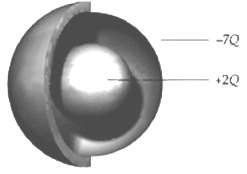
Consider two concentric conducting spheres (Figure). The outer sphere is hollow and initially has a charge ?7Q deposited on it. The inner sphere is solid and has a charge +2Q on it. (a) How is the charge distributed on the outer sphere? That is, how much charge is on the outer surface and ho much
A nonconducting sphere of radiuss R = 0.1 m carries a uniform volume charge of charge density ρ? = ?2.0 nC/m3. The magnitude of the electric field at r? = ?2R is 1883 N/C. Find the magnitude of the electric field at r? = ?0.5R.
A nonconducting sphere of radius R carries a volume charge density that is proportional to the distance from the center: ρ = Ar for r ≤ R, where A is a constant; ρ = 0 for r > R.(a) Find the total charge on the sphere by summing the charges on shells of thickness dr and volume 4πr2 dr.(b)
Repeat Problem 35 for a sphere with volume charge density ρ = B/r for r < R ; ρ = 0 for r > R.
Repeat Problem 35 for a sphere with volume charge density ρ = C/r2 for r < R; ρ = 0 for r > R.
The charge density in a region of space is spherically symmetric and is given by ρ(r) = Ce-r/a when r < R and ρ = 0 when r > R. Find the electric field as a function of r.
A thick, nonconducting spherical shell of inner radius a and outer radius b has a uniform volume charge density ρ. Find(a) The total charge and(b) The electric field everywhere.
A point charge of +5 nC is located at the origin. This charge is surrounded by a spherically symmetric negative charge distribution with volume density ρ(r) = Ce–r/a.(a) Find the constant C in terms of a if the total charge of the system is zero.(b) What is the electric field at r = a?
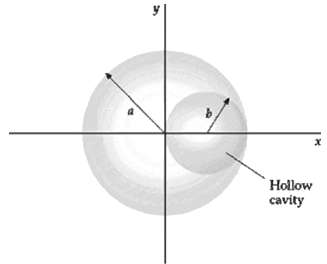
A nonconducting solid sphere of radius a with its center at the origin has a spherical cavity of radius b with its center at the point x = b, y = 0 as shown in Figure. The sphere has a uniform volume charge density ?. Show that the electric field in the cavity is uniform and is given by Ey = 0, Ex
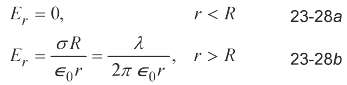
Show that the electric field due to an infinitely long, uniformly charged cylindrical shell of radius R carrying a surface charge density Ï?? is given by Where ? = 2?R? is the charge per unit length on the shell.
A cylindrical shell of length 200 m and radius 6 cm carries a uniform surface charge density of σ = 9 nC/m2.(a) What is the total charge on the shell? Find the electric field at(b) r = 2 cm,(c) r = 5.9 cm,(d) r = 6.1 cm, and(e) r = 10 cm. (Use the results of Problem 42.)
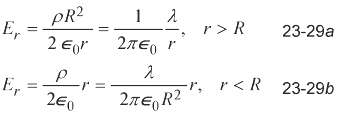
An infinitely long nonconducting cylinder of radius R?carries a uniform volume charge density of ?(r) = ?0. Show that the electric field is given by where ? = ??R2 is the charge per unit length.
A cylinder of length 200 m and radius 6 cm carries a uniform volume charge density of ρ = 300 nC/m3.(a) What is the total charge of the cylinder? Use the formulas given in Problem 44 to calculate the electric field at a point equidistant from the ends at(b) r = 2 cm,(c) r = 5.9
Consider two infinitely long, concentric cylindrical shells. The inner shell has a radius R1 and carries a uniform surface charge density of σ1, and the outer shell has a radius R2 and carries a uniform surface charge density of σ2.(a) Use Gauss's law to find the electric field in the
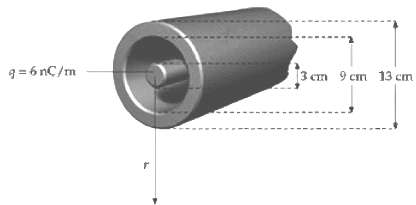
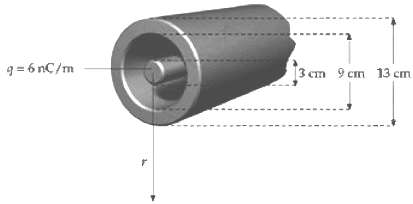
Figure shows a portion of an infinitely long, concentric cable in cross section. The inner conductor carries a charge of 6 nC/m; the outer conductor is uncharged. (a) Find the electric field for all values of r, where r is the distance from the axis of the cylindrical system. (b) What are the
Repeat Problem 44 for a cylinder with volume charge density(a) ρ(r) = ar and(b) ρ = Cr 2
Repeat Problem 44 with ρ = C/r.
An infinitely long, thick, nonconducting cylindrical shell of inner radius a and outer radius b has a uniform volume charge density ρ. Find the electric field everywhere.
Suppose that the inner cylinder of Figure is made of nonconducting material and carries a volume charge distribution given by ?(r) = C/r, where C = 200 nC/m2. The outer cylinder is metallic. (a) Find the charge per meter carried by the inner cylinder. (b) Calculate the electric field for all values
A penny is in an external electric field of magnitude 1.6 kN/C directed perpendicular to its faces.(a) Find the charge density on each face of the penny, assuming the faces are planes.(b) If the radius of the penny is 1 cm, find the total charge on one face.
A charge of 6 nC is placed uniformly on a square sheet of nonconducting material of side 20 cm in the yz plane.(a) What is the surface charge density σ?(b) What is the magnitude of the electric field just to the right and just to the left of the sheet?(c) The same charge is placed on a square
A spherical conducting shell with zero net charge has an inner radius a and an outer radius b. A point charge q is placed at the center of the shell.(a) Use Gauss's law and the properties of conductors in equilibrium to find the electric field in the regions r < a, a < r < b, and b <
The electric field just above the surface of the earth has been measured to be 150 N/C downward. What total charge on the earth is implied by this measurement?
A positive point charge of magnitude 2.5 μC is at the center of an uncharged spherical conducting shell of inner radius 60 cm and outer radius 90 cm.(a) Find the charge densities on the inner and outer surfaces of the shell and the total charge on each surface.(b) Find the electric field
A square conducting slab with 5-m sides carries a net charge of 80 μC.(a) Find the charge density on each face of the slab and the electric field just outside one face of the slab.(b) The slab is placed to the right of an infinite charged nonconducting plane with charge density 2.0 μC/m2 so that
Imagine that a small hole has been punched through the wall of a thin, uniformly charged spherical shell whose surface charge density is σ. Find the electric field near the center of the hole.
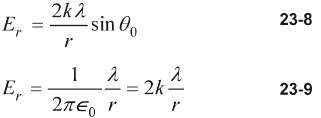
Equation 23-8 for the electric field on the perpendicular bisector of a finite line charge is different from Equation 23-9 for the electric field near an infinite line charge, yet Gauss's law would seem to give the same result for these two cases.Explain.
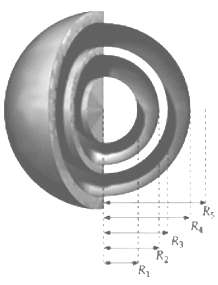
Consider the three concentric metal spheres shown in Figure. Sphere I is solid, with radius R1. Sphere II is hollow, with inner radius R2 and outer radius R3. Sphere III is hollow, with inner radius R4 and outer radius R5. Initially, all three spheres have zero excess charge. Then a negative charge
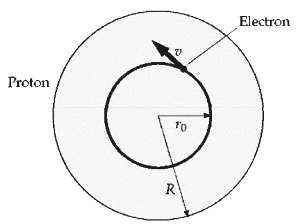
An early model of the hydrogen atom considered the atom to consist of a proton, which is a uniform charged sphere of radius R, with an electron in an orbit of radius r0 inside the proton as shown in Figure. (a) Use Gauss's law to obtain the magnitude of E (the field due to the proton) at the
A nonuniform surface charge lies in the yz plane. At the origin, the surface charge density is σ = 3.10 μC/m2. Other charged objects are present as well. Just to the right of the origin, the x component of the electric field is Ex = 4.65 × 10⁵ N/C. What is Ex just to the left of the origin?
An infinite line charge of uniform linear charge density λ = –1.5 μC/m lies parallel to the y axis at x = –2 m. A point charge of 1.3 μC is located at x = 1 m, y = 2 m. Find the electric field at x = 2 m, y = 1.5 m.
Two infinite planes of charge lie parallel to each other and to the yz plane. One is at x = –2 m and has a surface charge density of σ = –3.5 μC/m2. The other is at x = 2 m and has a surface charge density of σ = 6.0 μC/m2. Find the electric field for(a) x < –2 m,(b) –2 m < x <
An infinitely long cylindrical shell is coaxial with the y axis and has a radius of 15 cm. It carries a uniform surface charge density σ = 6 μC/m2. A spherical shell of radius 25 cm is centered on the x axis at x = 50 cm and carries a uniform surface charge density σ = –12 μC/m2. Calculate
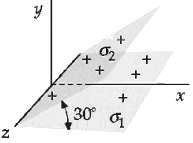
An infinite plane in the xz?plane carries a uniform surface charge density ?1 = 65 nC/m2. A second infinite plane carrying a uniform charge density ?2 = 45 nC/m2 intersects the xz?plane at the z?axis and makes an angle of 30o with the xz?plane as shown in Figure. Find the electric field in the
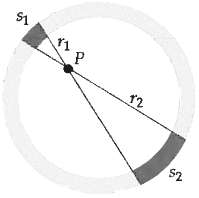
A ring of radius R carries a uniform, positive, linear charge density ?. Figure shows a point P in the plane of the ring but not at the center. Consider the two elements of the ring of lengths s1 and s2 shown in the figure at Figure Problem 78 distances r1 and r2, from point P. (a) What is the
A ring of radius R that lies in the horizontal (xy) plane carries a charge Q uniformly distributed over its length. A mass m carries a charge q whose sign is opposite that of Q.(a) What is the minimum value of |q|/m such that the mass will be in equilibrium under the action of gravity and the
A long, thin, nonconducting plastic rod is bent into a loop with radius R. Between the ends of the rod, a small gap of length l ( l << R) remains. A charge Q is equally distributed on the rod.(a) Indicate the direction of the electric field at the center of the loop.(b) Find the magnitude of
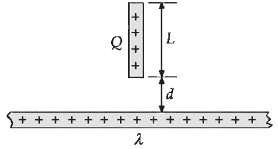
A rod of length L lies perpendicular to an infinitely long uniform line charge of charge density ? C/m (Figure). The near end of the rod is a distance d above the line charge. The rod carries a total charge Q uniformly distributed along its length. Find the force that the infinitely long line
A nonconducting sphere 1.2 m in diameter with its center on the x axis at x = 4 m carries a uniform volume charge of density ρ = 5 μC/m3. Surrounding the sphere is a spherical shell with a diameter of 2.4 m and a uniform surface charge density σ = –1.5 μC/m2. Calculate the magnitude and
An infinite plane of charge with surface charge density σ1 = 3 μC/m2 is parallel to the xz plane at y = –0.6 m. A second infinite plane of charge with surface charge density σ2 = –2 μC/m2 is parallel to the yz plane at x = 1 m. A sphere of radius 1 m with its center in the xy plane at the
An infinite plane lies parallel to the yz plane at x = 2 m and carries a uniform surface charge density σ = 2 μC/m2. An infinite line charge of uniform linear charge density λ = 4 μC/m passes through the origin at an angle of 45o with the x axis in the xy plane. A
A ring of radius R that lies in the yz plane carries a positive charge Q uniformly distributed over its length. A particle of mass m that carries a negative charge of magnitude q is at the center of the ring.(a) Show that if x << R, the electric field along the axis of the ring is
When the charges Q and q of Problem 86 are 5 μC and –5 μC, respectively, and the radius of the ring is 8.0 cm, the mass m oscillates about its equilibrium position with an angular frequency of 21 rad/s. Find the angular frequency of oscillation of the mass if the radius of the ring is doubled
A nonconducting cylinder of radius 1.2 m and length 2.0 m carries a charge of 50 μC uniformly distributed throughout the cylinder. Find the electric field on the cylinder axis at a distance of(a) 0.5 m,(b) 2.0 m, and(c) 20 m from the center of the cylinder
A uniform line charge of density λ lies on the x axis between x = 0 and x = L. Its total charge is Q = 8 nC. The electric field at x = 2L is 600 N/C i. Find the electric field at x = ?3L.
Find the linear charge density λ (in C/m) of the line charge of Problem 90.
A uniformly charged sphere of radius R is centered at the origin with a charge of Q. Find the force on a uniformly charged line oriented radially having a total charge q with its ends at r = R and r = R + d.
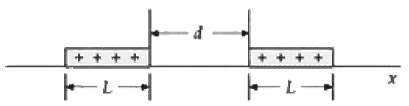
Two equal uniform line charges of length L lie on the x axis a distance d apart as shown in Figure. (a) What is the force that one line charge exerts on the other line charge? (b) Show that when d >> L, the force tends toward the expected result of k(?L)2/d 2.
A dipole p is located at a distance r from an infinitely long line charge with a uniform linear charge density λ. Assume that the dipole is aligned with the field due to the line charge. Determine the force that acts on the dipole.
Suppose that the charge on the rod in Problem 81 is given by λ(y) = ay2, where y is the distance from the midpoint of the rod, and that the total charge on the rod is Q.(a) Determine the constant a.(b) Find the force dF that acts on an element of charge λ(y) dy.(c) Integrate the force obtained in
Repeat Problem 95 with the charge on the rod being λ(y) = by, where y is measured from the midpoint of the rod with the positive y direction up.
(Multiple Choice) (1) True or false: (a) Gauss's law holds only for symmetric charge distributions. (b) The result that E = 0 inside a conductor can be derived from Gauss's law. (2) True or false: (a) If there is no charge in a region of space, the electric field on a surface surrounding the region
An infinite line charge λ is located along the z axis. A mass m that carries a charge q whose sign is opposite to that of λ is in a circular orbit in the xy plane about the line charge. Obtain an expression for the period of the orbit in terms of m, q, R, and λ, where R is the radius of the
A uniform electric field of 2 kN/C is in the x direction. A positive point charge Q = 3 μC is released from rest at the origin.(a) What is the potential difference V(4 m) – V(0)?(b) What is the change in the potential energy of the charge from x = 0 to x = 4 m?(c) What is the kinetic energy of
An infinite plane of surface charge density σ = +2.5 μC/m2 is in the yz plane.(a) What is the magnitude of the electric field in newtons per coulomb? In volts per meter? What is the direction of E for positive values of x?(b) What is the potential difference Vb – Va when point b is at x = 20 cm
Two large parallel conducting plates separated by 10 cm carry equal and opposite surface charge densities such that the electric field between them is uniform. The difference in potential between the plates is 500 V. An electron is released from rest at the negative plate.(a) What is the magnitude
Explain the distinction between electric potential and electrostatic potential energy.
A positive charge of magnitude 2 μC is at the origin.(a) What is the electric potential V at a point 4 m from the origin relative to V = 0 at infinity?(b) How much work must be done by an outside agent to bring a 3-μC charge from infinity to r = 4 m, assuming that the 2-μC charge is held fixed
The distance between the K+ and Cl– ions in KCl is 2.80 × 10⁻¹⁰ m. Calculate the energy required to separate the two ions to an infinite distance apart, assuming them to be point charges initially at rest. Express your answer in eV.
Two identical masses m that carry equal charges q are separated by a distance d. Show that if both are released simultaneously their speeds when they are separated a great distance are v/√2, where v is the speed that one mass would have at a great distance from the other if it were released and
Protons from a Van de Graaff accelerator are released from rest at a potential of 5 MV and travel through a vacuum to a region at zero potential.(a) Find the final speed of the 5-MeV protons.(b) Find the accelerating electric field if the same potential change occurred uniformly over a distance of
An electron gun fires electrons at the screen of a television tube. The electrons start from rest and are accelerated through a potential difference of 30,000 V. What is the energy of the electrons when they hit the screen?(a) In electron volts and(b) In joules?(c) What is the speed of impact of
(a) Derive an expression for the distance of closest approach of an a particle with kinetic energy E to a massive nucleus of charge Ze. Assume that the nucleus is fixed in space.(b) Find the distance of closest approach of a 5.0- and a 9.0-MeV a particle to a gold nucleus; the charge of the gold
Four 2-μC point charges are at the corners of a square of side 4 m. Find the potential at the center of the square (relative to zero potential at infinity) if(a) All the charges are positive,(b) Three of the charges are positive and one is negative, and(c) Two are positive and two are negative.
Three point charges are on the x axis: q1 is at the origin, q2 is at x = 3 m, and q3 is at x = 6 m. Find the potential at the point x = 0, y = 3 m if(a) q1 = q2 = q3 = 2 μC,(b) q1 = q2 = 2 μC and q3 = –2 μC, and(c) q1 = q3 = 2 μC and q2 = –2 μC.
Points A, B, and C are at the corners of an equilateral triangle of side 3 m. Equal positive charges of 2 μC are at A and B.(a) What is the potential at point C?(b) How much work is required to bring a positive charge of 5 μC from infinity to point C if the other charges are held
A sphere with radius 60 cm has its center at the origin. Equal charges of 3 μC are placed at 60o intervals along the equator of the sphere.(a) What is the electric potential at the origin?(b) What is the electric potential at the North Pole?
Two positive charges +q are on the x axis at x = +a and x = –a.(a) Find the potential V(x) as a function of x for points on the x axis.(b) Sketch V(x) versus x.(c) What is the significance of the minimum on your curve?
A point charge of +3e is at the origin and a second point charge of –2e is on the x axis at x = a.(a) Sketch the potential function V(x) versus x for all x.(b) At what point or points is V(x) zero?(c) How much work is needed to bring a third charge +e to the point x = ½ a on the x axis?
A uniform electric field is in the negative x direction. Points a and b are on the x axis, a at x = 2 m and b at x = 6 m.(a) Is the potential difference Vb – Va positive or negative?(b) If the magnitude of Vb – Va is 105 V, what is the magnitude E of the electric field?
A point charge q = 3.00 μC is at the origin.(a) Find the potential V on the x axis at x = 3.00 m and at x = 3.01 m.(b) Does the potential increase or decrease as x increases? Compute -ΔV/Δx, where ΔV is the change in potential from x = 3.00 m to x = 3.01 m and Δx = 0.01 m.(c) Find the electric
A charge of +3.00 μC is at the origin, and a charge of –3.00 μC is on the x axis at x = 6.00 m.(a) Find the potential on the x axis at x = 3.00 m.(b) Find the electric field on the x axis at x = 3.00 m.(c) Find the potential on the x axis at x = 3.01 m, and compute
A uniform electric field is in the positive y direction. Points a and b are on the y axis, a at y = 2 m and b at y = 6 m.(a) Is the potential difference Vb – Va positive or negative?(b) If the magnitude of Vb – Va is 2 × 10⁴ V, what is the magnitude E of the electric field?
In the following, V is in volts and x is in meters. Find Ex when(a) V(x) = 2000 + 3000x;(b) V(x) = 4000 + 3000x;(c) V(x) = 2000 – 3000x; and(d) V(x) = –2000, independent of x.
A charge q is at x = 0 and a charge –3q is at x = 1 m.(a) Find V(x) for a general point on the x axis.(b) Find the points on the x axis where the potential is zero.(c) What is the electric field at these points?(d) Sketch V(x) versus x.
An electric field is given by Ex = 2.0x3 kN/C. Find the potential difference between the points on the x axis at x = 1 m and x = 2 m.
Three equal charges lie in the xy plane. Two are on the y axis at y = –a and y = +a, and the third is on the x axis at x = a.(a) What is the potential V(x) due to these charges at a point on the x axis?(b) Find Ex along the x axis from the potential function V(x). Evaluate your answers to (a) and
The electric potential in a region of space is given by V = (2 V/m2)x2 + (1 V/m2)yz . Find the electric field at the point x = 2 m, y = 1 m, z = 2 m.
A potential is given by (a) Find the components Ex, Ey, and Ez of the electric field by differentiating this potential function. (b) What simple charge distribution might be responsible for thispotential?
In the calculation of V at a point x on the axis of a ring of charge, does it matter whether the charge Q is uniformly distributed around the ring? Would either V or Ex be different if it were not?
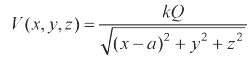
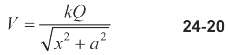
(a) Sketch V(x) versus x for the uniformly charged ring in the yz plane given by Equation 24-20. (b) At what point is V(x) a maximum? (c) What is Ex at this point?
A charge of q = +10–8 C is uniformly distributed on a spherical shell of radius 12 cm.(a) What is the magnitude of the electric field just outside and just inside the shell?(b) What is the magnitude of the electric potential just outside and just inside the shell?(c) What is the electric
A disk of radius 6.25 cm carries a uniform surface charge density σ = 7.5 nC/m2. Find the potential on the axis of the disk at a distance from the disk of(a) 0.5 cm,(b) 3.0 cm, and(c) 6.25 cm.
An infinite line charge of linear charge density λ = 1.5 μC/m lies on the z axis. Find the potential at distances from the line charge of(a) 2.0 m,(b) 4.0 m, and(c) 12 m, assuming that V = 0 at 2.5 m.
A rod of length L carries a charge Q uniformly distributed along its length. The rod lies along the y axis with its center at the origin.(a) Find the potential as a function of position along the x axis.(b) Show that the result obtained in (a) reduces to V = kQ/x for x >> L.
A disk of radius R carries a surface charge distribution of σ = σ0R/r.(a) Find the total charge on the disk.(b) Find the potential on the axis of the disk a distance x from its center.
Repeat Problem 42 if the surface charge density is σ = σ0r2/R2.
A rod of length L carries a charge Q uniformly distributed along its length. The rod lies along the y axis with one end at the origin. Find the potential as a function of position along the x axis.
A disk of radius R carries a charge density + σ0 for r < a and an equal but opposite charge density –σ0 for a < r < R. The total charge carried by the disk is zero.(a) Find the potential a distance x along the axis of the disk.(b) Obtain an approximate expression for V(x) when x
Use the result obtained in Problem 45(a) to calculate the electric field along the axis of the disk. Then calculate the electric field by direct integration using Coulomb's law.
A rod of length L has a charge Q uniformly distributed along its length. The rod lies along the x axis with its center at the origin.(a) What is the electric potential as a function of position along the x axis for x > L/2?(b) Show that for x >> L/2, your result reduces to that due to a
A conducting spherical shell of inner radius b and outer radius c is concentric with a small metal sphere of radius a < b. The metal sphere has a positive charge Q. The total charge on the conducting spherical shell is –Q.(a) What is the potential of the spherical shell?(b) What
Two very long, coaxial cylindrical shell conductors carry equal and opposite charges. The inner shell has radius a and charge +q; the other shell has radius b and charge –q. The length of each cylindrical shell is L. Find the potential difference between the shells.
A uniformly charged sphere has a potential on its surface of 450 V. At a radial distance of 20 cm from this surface, the potential is 150 V. What is the radius of the sphere, and what is the charge of the sphere?
Consider two infinite parallel planes of charge, one in the yz plane and the other at distance x = a.(a) Find the potential everywhere in space when V = 0 at x = 0 if the planes carry equal positive charge densities +σ .(b) Repeat the problem with charge densities equal
Show that for x >> R the potential on the axis of a disk charge approaches kQ/x, where Q = σπR2 is the total charge on the disk.
Showing 4300 - 4400
of 8940
First
37
38
39
40
41
42
43
44
45
46
47
48
49
50
51
Last
Step by Step Answers

 Get 50% OFF
Claim Now
Get 50% OFF
Claim Now