New Semester
Started
Get
50% OFF
Study Help!
--h --m --s
Claim Now
Question Answers
Textbooks
Find textbooks, questions and answers
Oops, something went wrong!
Change your search query and then try again
S
Books
FREE
Study Help
Expert Questions
Accounting
General Management
Mathematics
Finance
Organizational Behaviour
Law
Physics
Operating System
Management Leadership
Sociology
Programming
Marketing
Database
Computer Network
Economics
Textbooks Solutions
Accounting
Managerial Accounting
Management Leadership
Cost Accounting
Statistics
Business Law
Corporate Finance
Finance
Economics
Auditing
Tutors
Online Tutors
Find a Tutor
Hire a Tutor
Become a Tutor
AI Tutor
AI Study Planner
NEW
Sell Books
Search
Search
Sign In
Register
study help
business
business communication essentials
Business Communication And Character 11th Edition Amy Newman - Solutions
Apply the steps for team writing in a business situation.
Identify best practices for in-person and online business meetings.
Explain examples of nonverbal communication.
Describe ways to improve listening skills in business situations.
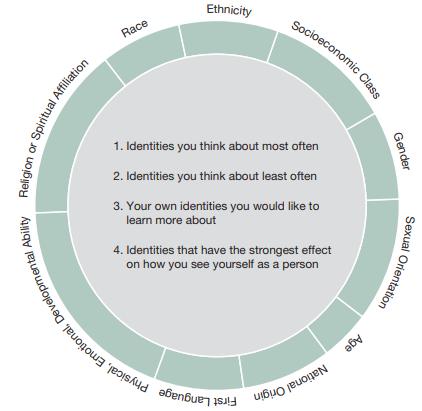
To develop self-awareness, complete the Social Identity Wheel in Figure 18. Write your identities in the open sections, and then respond to the statements in the middle. With a friend you trust and know well, share the Identity Wheel you created as a reflection activity. What do you feel most and
At Harvard’s Implicit Bias site (https://implicit.harvard.edu/implicit/takeatest.html), you’ll find tests about your perceptions on race, age, gender, sexual orientation, religion, weight, skin tone, and more. Take at least one of these tests. How did you do? Did the results surprise you? Why
If mindfulness isn’t part of your daily practice, try it for at least five minutes a day for a week. Consider one of Thich Nhat Hanh’s guided breathing meditations, or follow instructions from the Greater Good Science Center at the University of California, Berkeley. Thich Nhat Hanh and the
Think about a difficult conversation you initiated recently. What was the situation, and what led to your decision to address rather than ignore it? What did you risk? Which skills and steps discussed in this chapter did you use? What went well, and what would you do differently next time you
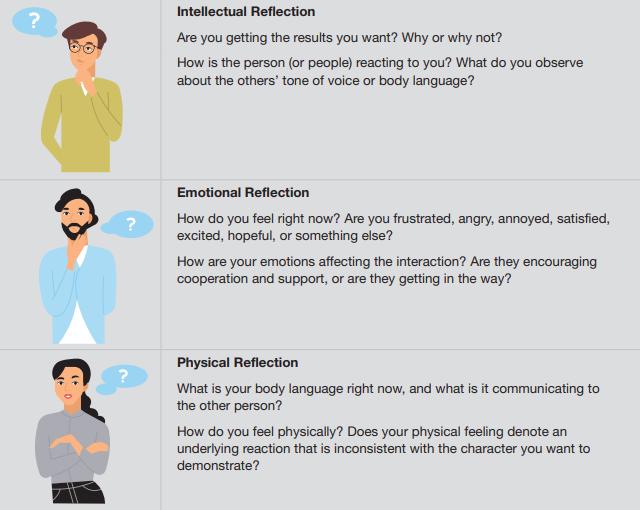
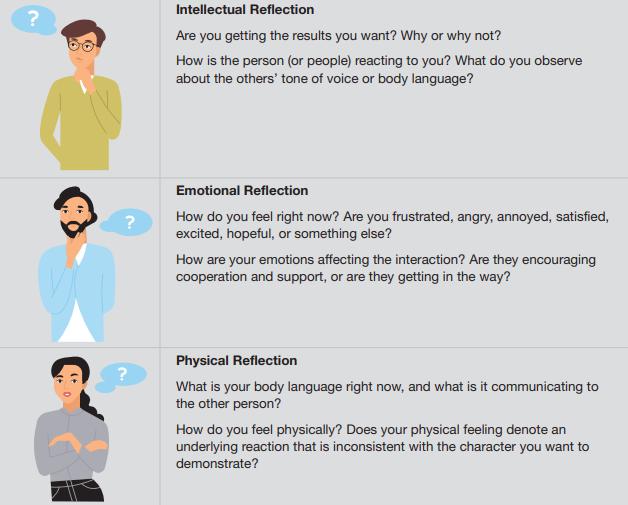
The next time you’re involved in a difficult conversation, check in with yourself by asking the questions in Figure 7. Try to reflect intellectually, emotionally, and physically. What does your assessment tell you about your experience? What adjustments can you make to improve the
Think about a time when you felt you belonged. What contributed to your feeling this way? In other words, what did you and others do? Think about a time when you didn’t feel you belonged. What happened? Did you try too hard to “fit in” or hide an aspect of yourself? What, if anything, could
Watch a segment of a movie, series, or TV show in which someone has a closed mindset. How is this person unfairly judging another? Write down examples that demonstrate failing humility and other factors. Next, write down how observing without judging, getting perspective, being curious, and getting
In small groups, look at a few pictures of people. Identify only what you see, for example, that someone is wearing a blue shirt, leaning forward, or looking sideways. Try not to include any interpretations, for example, what people may be thinking or feeling.
Identify parts of your resume that might lead to bias in the hiring process. Assume the worst: that someone is biased against your name, address, dates, hobbies, interests, volunteer work, and/or college. What are you willing to change—or not? Of course, you can present yourself just as you are.
You’re a candidate for a new job and ask to meet your prospective team. You’re glad you did because no one on the team is like you; you are the only ______________. (Fill in the blank.) What is this characteristic, and how important is it that you are different? Will you take the job?
As you watch movies or other shows this week, notice examples of conflicts. For each, identify the type of conflict—task, relationship, or values. How do people work through them? How do they tackle different types of conflicts differently? What do they do that is successful, and what could they
Think about a team conflict you had in the past. Or, if you’re working as part of a team now, discuss a conflict you had. Identify whether it was a task, relationship, or values conflict. How did you handle it? What was the outcome? How could you handle conflicts in the future?
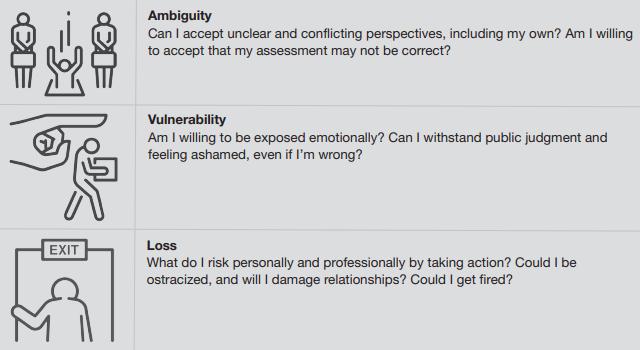
Talk with a partner in class about a conflict you’re currently experiencing. Walk through the questions in Figure 4 about ambiguity, vulnerability, and loss to decide whether to engage in the conflict. What do you decide and why?Figure 4 848 EXIT Ambiguity Can I accept unclear and conflicting
Imagine that one of your team members submitted her section of a report for a class project, but you suspect it’s not the student’s own work. In a footnote on the last page are someone else’s name, the same course number, and last year’s date. The student submitted the work online, and your
Using the scenario described in Exercise 8, have the student leading the discussion follow the steps for encouraging a dialogue. Start the conversation, listen actively and openly, share your perspective, problem-solve, and end the conversation. Review suggestions in the chapter for each step of
Use the process described in Exercises 8 and 9 to plan and role-play another situation. Imagine that a coworker’s behavior falls into the “obnoxious aggression” category of radical candor. Earlier in the day, you overheard your coworker tell a customer, “You need to be more careful with the
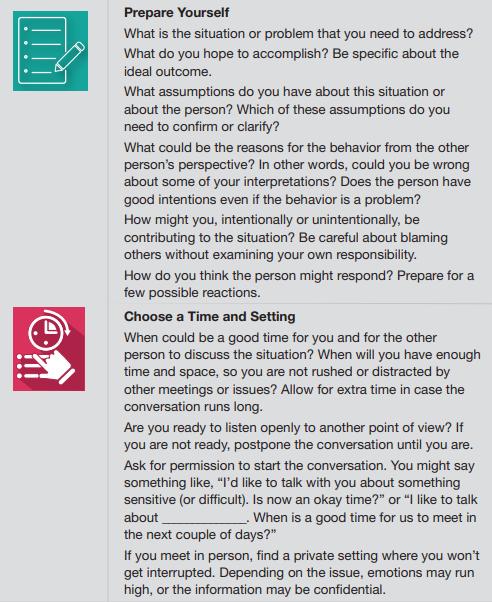
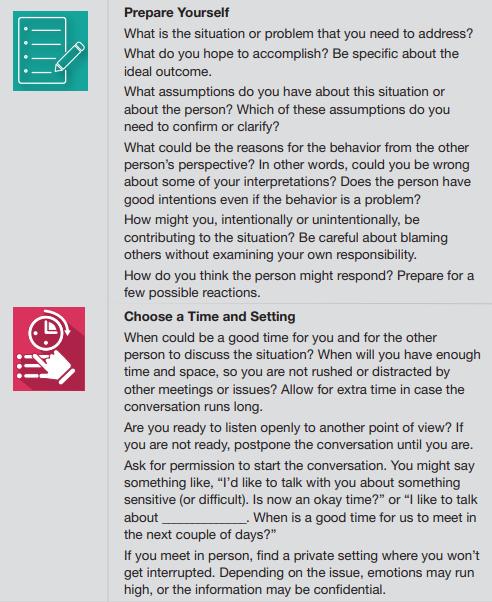
Think about a situation you may have been avoiding. Use the steps in Figure 5 to prepare yourself to have a difficult conversation. Before choosing a time and place, talk with a partner about your responses to the first set of questions. How do you feel about scheduling the conversation? What, if
Find and compare diversity, inclusion, and/or belonging statements from two or three of your favorite companies. Answer the following questions, and then share your responses with another student:● How easy was it to find the statement on the company website?● Which parts of the statement fit
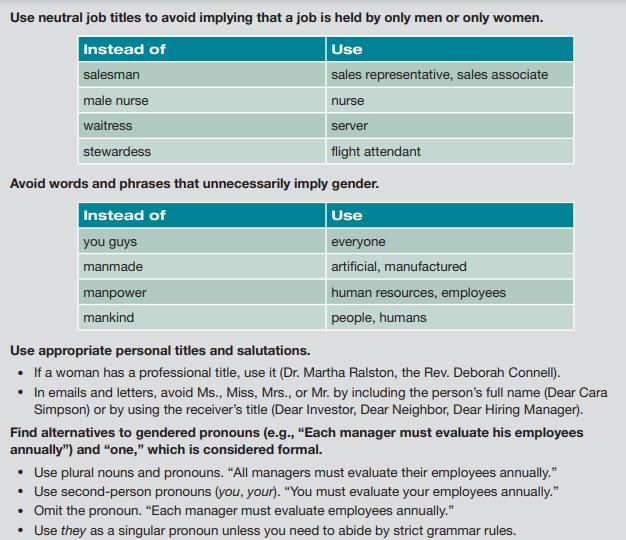
In small groups, discuss how you feel about using inclusive language, for example, the advice in Figure 12. Allow space for everyone to be honest and respectful of different points of view. For example, not everyone likes the idea of using they as a singular pronoun or being asked what pronouns
With a classmate, describe a time each of you were misjudged because of your affiliation or identity. Next, describe a time when you misjudged someone else. What are the similarities and differences among these four situations? What can you learn from talking them through?
Imagine that a colleague is traveling abroad and wants your advice. With a classmate, choose one country that neither of you knows well. Prepare a short email with suggestions about greetings, dining, meetings, and other relevant information.
Choose a large, global company and explore its website. Do you find multiple versions of the company’s site for different countries? In what ways does the company adapt its writing style, use of graphics, and other features to different cultures? Write a brief report on your findings and include
Choose two countries and compare their cultures at https://www.hofstede-insights.com/ product/compare-countries. What similarities and differences do you notice? What, if anything, surprises you?
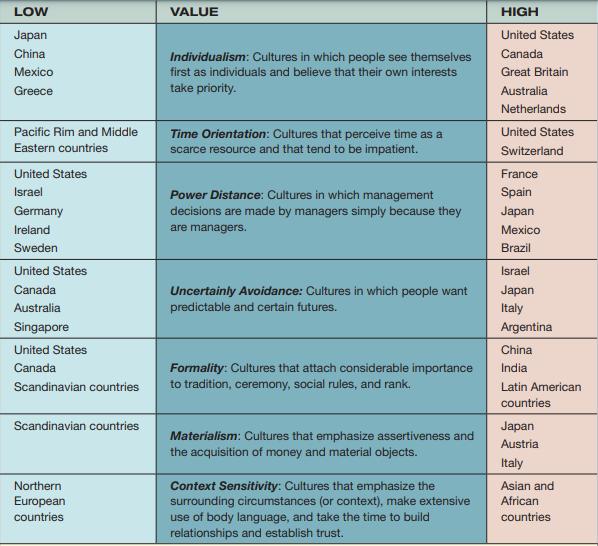
If your country of origin is different from where you’re studying, you may volunteer to describe the culture to the class. Or you may volunteer if you have traveled to another country. Answer the following questions:● How would you describe the culture based on the values in Figure 13?● What
Describe two approaches for shifting your mindset.
Define three types of conflict common in business environments and how to approach each.
Apply steps to engage in a difficult conversation in a business situation.
Identify ways to adapt language to audiences to honor differences.
Compare how people in high- and low-context countries communicate.
What has been your experience with writing? Think about a few pivotal projects or assignments throughout your life. What feedback have you received about your writing from family, friends, coworkers, classmates, and instructors? How have these experiences shaped your confidence level? What are
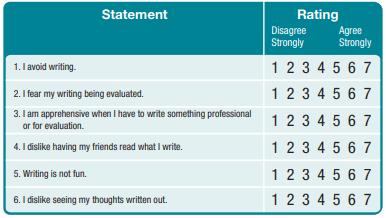
In Figure 20, rate how you feel about your writing. When you finish, consider how your responses affect your writing. How can you dispel negative messages and shift your thinking about yourself and your writing? What would a compassionate friend say to you? For example, “You have improved over
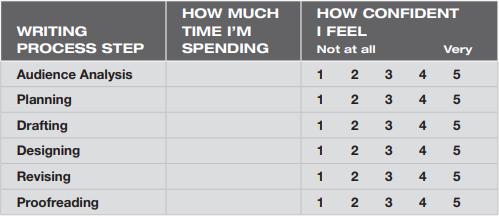
As you’re working through your next writing assignment, document how you spend time and how confident you feel at each step of the writing process. Use the chart in Figure 21.Figure 21You might have guessed that there are no right or wrong answers for how much time is appropriate at each step;
Consider why you experience writer’s block, if you do. What could be getting in your way of enjoying the writing process more?
Do you tend to rush through the process of analyzing your audience? Do you sometimes feel as though you know best what information to include and how to present it? If so, what could prevent you from getting an outside view? Consider suggestions from Chapter 3 about shifting your mindset. Try to
Spend 10 minutes freewriting—continuously, without judgment—about a current assignment. How do you feel about the assignment and your work so far? What issues are you facing? What are your plans for the next step in the process? Save a minute or so to write about how the freewriting affects
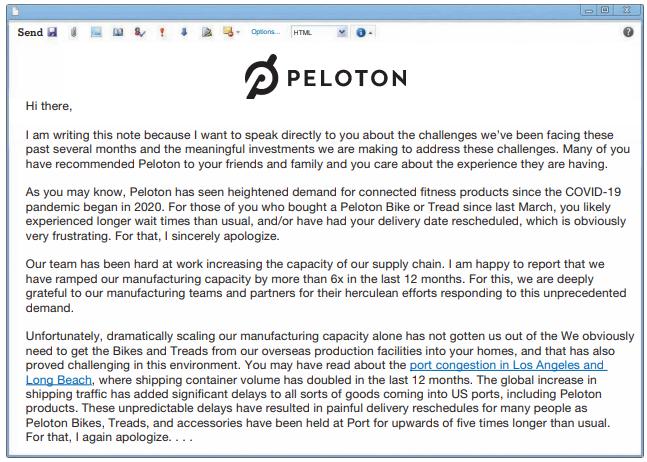
Review the Peloton situation and email in Figure 3. Imagine that you’re an executive coach for the CEO of Peloton. Describe the steps in the writing process that he should take to ensure that future messages are tailored to specific audiences. Explain how the writing process would avoid future
Find a company message you consider to be a failure. What steps in the writing process may have been missed? For example, is the purpose not specific; the audience not well defined; the organization unclear; or the message cluttered, unclear, or riddled with errors? On which step should the writer
Imagine that you work for a wealth management firm, which manages financial assets for individuals. You have a prospective new client, whose previous financial manager was her brother-in-law, who recently retired. Looking at her portfolio, you realize that she’s heavily invested in just one
Your college is merging with another local college. Identify the many audiences affected by this decision—both internal and external to the college. Who needs to know about the change? Once you have identified these groups, decide which audiences need to receive different messages. One way to
If you were a business communication instructor and received this email from a student, how would you react? Analyze your instructor as an audience for this student’s message and consider changes the student might make to achieve the purpose.
When a football team changed its name from the Washington Redskins, the leaders had many audiences to consider. Find articles to read more about the story, and then list the audiences who would have an opinion on the situation. Describe how each might have felt about the change.
Prepare for your next writing assignment by putting your ideas on coggle.it. Use one of their designs without paying. Practice writing freely, organizing your thoughts, and moving main and subpoints around. Share your experience with a classmate.
Read the following situations and write a general-purpose statement and a specific communication objective—the results you want—for each.● As the manager of a small retail clothing store, you write an email to let employees know they’re getting a $3 per hour wage increase.● As the
For the situations in Exercise 9, imagine what the audience reaction might be and write a sequential outline of your points. Explain why you chose the order you did.Exercise 9Read the following situations and write a general-purpose statement and a specific communication objective—the results you
Working in groups of three or four—without censoring your ideas—come up with as many new ice cream flavors as you can. Make a list of all the suggestions, and then share your list with the other groups in the class. How does your list compare to other groups’ lists?How big is the combined
Prepare to write a review of a product you used or purchased recently. Use the process outlined in this chapter:● Brainstorm ideas. What do you think is important to include in your review? Draw a mind map.● Create a hierarchy of ideas. How will you organize your main and supporting points?●
Now that you have your outline for Exercise 12, draft your product review. Practice freewriting for this activity to avoid moving to the revision stage too quickly. Don’t worry about formatting for this exercise; just practice moving from an outline to a written document.Exercise 12Prepare to
Using the principles discussed for effective email communication, write a draft email to members of an organization to which you belong. This can be real or imagined—a sports team, fraternity or sorority, hobby club, religious group, or nonprofit organization.Your purpose is to move some of your
Imagine that you work for your favorite company and have been asked to write a few entries on their blog. Write three short posts (about 50 words each). Write one post about an upcoming national holiday, one post to promote a product or service, and one post to link to a recent news story about the
With a small group, select a keyword that interests you. Search for the word in any search engine and analyze the results. When you follow pages that rank highly, note how they use the word, for example, in headings and content. What other features of the site mentioned in this chapter could
Look at one of your favorite websites. Evaluate whether the site meets accessibility guidelines outlined in this chapter. What criteria are met, and what, if anything, should the designers do to make the page more inclusive?
Look at the same website you evaluated in Exercise 19. Now consider the design. Which reading pattern seems to drive the design? Where are the most important elements, and how does the design draw your eye to them? Finally, consider the overall look and feel. Do you find it attractive and inviting?
Browse a few websites to find good examples of contrast, alignment, repetition, and proximity. With a small group, discuss how these principles improve the site design and your user experience.
Find a dense document that has little white space and few headings or graphics. You might look at a legal court filing, a company’s privacy statement, or an apartment lease. How could you redesign the document to include principles from this chapter? If you can, import the document into an
Revise your draft email to the student organization. What changes will you make to improve the message? Follow these steps for the revision process:a. Read the email once, revising for content. Make sure that all needed information—and no unnecessary information—is included for the audience.
Exchange draft emails (from Exercise 23) with other students in class (so that you’re not revising the paper of the person who is revising yours). Using the process described in Exercise 23, revise the other student’s message, and then return the draft to the writer with your
Bring in a one-page message (email, memo, or letter) you have written in the past. Exchange papers with other students (so that you’re not revising the paper of the person who is revising yours). Spend a few minutes asking the writer to give you background information about the message: purpose,
Proofread the following lines of a letter using the line numbers to indicate the position of each error. Proofread for content, typographical errors, and format. For each error, indicate by a “yes” or “no” whether the error would have been identified by a computer’s spelling checker. How
Review the following passage and see how many errors you can find. Look for spelling, formatting, and punctuation errors.
Describe steps in the business process.
Answer five questions to analyze a business audience.
Describe one approach to organizing your ideas for a message.
Identify differences between writing emails and writing for the web.
Explain four principles for designing documents and websites.
Apply steps to revise and proofread a business message.
Think about a topic you know well, for example, a stock or investment, a business, a video game, a sport or hobby, a political issue, or an academic area. Write an email to someone who is also an expert on the subject. Include at least six jargon terms you would typically use.Now assume that
How would you describe your typical writing style? Now that you learned guidelines for business writing, how willing are you to flex your style to meet the needs of your audience? In what ways is it easy and difficult for you to adapt to business writing?Another way to think of this question is to
Some students find learning business writing frustrating because they believe they can’t be creative. Do you feel this way? Business messages do follow some standard formats. Try to identify ways you can show your creativity and personality within these guidelines, even in formal documents like
Think about a time when someone felt hurt or offended by something you wrote. This could be a business, school, or personal situation. What did the person say about your writing? How would you describe your role in the situation? What, specifically, in your writing led to the bad feelings or
Find an email that you received recently from a company or organization. Analyze the writing style by looking carefully at the words, sentences, paragraphs, and tone. How do you describe the style? Do you find it appropriate for you as the audience? What would improve the style? Compare emails and
Read these paragraphs, which are from the retailer BJ’s website during the COVID-19 pandemic. What are the major style issues?We are here to serve you in these challenging times. BJ’s provides essential services in our communities, giving you access to food and other products you and your
Imagine that you’re trying to convince world leaders to develop initiatives to reduce food waste. You found this information: Roughly one third of the food produced in the world for human consumption every year—approximately 1.3 billion tons—gets lost or wasted. Those sound like big,
Rewrite to clarify these sentences:a. The actor was accosted after the play by a young man.b. To become a policy, the management team must agree unanimously.c. After attending the meeting, the minutes were prepared by the board secretary.d. The manager fired an employee because he was insane.e.
By how many words can you reduce this paragraph without changing the meaning? New York City is the most natural choice of a location for an innovative restaurant like Fellerton. It is no secret that New York City is a world capital in restaurant innovation. In fact, New York City residents and
Find any legal document, for example, one of the many privacy or user agreements you click through to use apps. Copy the original text, and then revise it for clarity and conciseness. By how many words (and what percentage of the text) can you reduce the document without changing the meaning?
Copy a few paragraphs from an article in a major online newspaper. In a new document, identify whether each sentence is simple, complex, or compound. Find the percentage of simple, complex, and compound sentences by dividing the total number of sentences by each type. Notice how the author varies
Place a number (from 1 to 7) next to each sentence to represent its position within the paragraph. The broadest statement will be the first sentence—the topic sentence.
Place a number (from 1 to 8) next to each sentence to represent its position within the paragraph. The broadest statement will be the first sentence—the topic sentence.
Revisit the Honda Accord paragraph in Exercise 18. Now that you have sentences in a logical order, add transitions to improve coherence.Exercise 18Place a number (from 1 to 7) next to each sentence to represent its position within the paragraph. The broadest statement will be the first
Hi Raj, I’m wondering whether you enjoyed our first shipment of organic vegetables that we dropped off last week. Did you receive them? How did they look and taste to you?If you would like to order more, let me know.Otherwise, I hope you have a great day!Jordine
In small groups, discuss text messages you received recently that caused misunderstandings. What was the situation and what went wrong? If you can, share the messages to gauge how your classmates might have reacted. What could cause these differences? What ideas does your group have for reducing
Revise this note to convey a better tone. This can be casual and fun but try to build a better relationship. To Apartment 4, You guys are so inconsiderate. You’re way too noisy and keep me up all night. Why do you have to stay up so late and blast music? At least you can invite me to your
Revisit BJ’s website in Exercise 2. You probably noticed that every sentence starts with “we.” Revise the text using “you” to focus on the customer instead.Exercise 2Read these paragraphs, which are from the retailer BJ’s website during the COVID-19 pandemic. What are the major style
Identify four principles of writing style.
Explain ways to choose the best words for a business message.
Write three types of sentences.
Describe components of a logical paragraph.
Compare examples of appropriate and inappropriate tone.
If you have business experience, either as an intern or a full-time employee for a company, do you relate to negative stereotypes about work? How did you contribute to the culture—either positively or negatively? In retrospect, could you have contributed more positively? What could you have done
Have you experienced anxiety on Sundays or another day of the week in anticipation of the next work or school day? What were the circumstances? What patterns did you observe when this happened, and what conclusions can you draw about the work, the people, the classes, or yourself?How can you use
Within how many minutes or hours, on average, do you respond to email? Does your answer vary for different contexts, for example, work, school, volunteer, or club/organization email? How would others describe your response time? Are you satisfied with your answers to these questions, or do you want
Think about someone who had a positive influence on your life—a former teacher, coach, pastor, friend, relative, etc. Write a thank-you note following the guidelines in this chapter. Reflect on the process. What drives you to write, and what makes you hesitate?
Think about a recent time when someone close to you suffered a tragedy. Did you write a sympathy note or offer compassion in a different way?Reflect on the experience. Did offering compassion come easy to you, or was it difficult? What factors affected your response?
In small groups, describe your ideal work environment. Try to be specific. Identify the people, the office or home space, and the work itself. If you had to prioritize, what would be most important?
With a partner, describe the best and worst manager you have had. If you haven’t had work experience, think about a coach, teacher, or someone else who inspired you to be your best—and another who didn’t support you or actively discouraged you.Another approach to this question is to think
Review the past 50 or so emails or texts you received. Place them in categories: neutral, positive, sales/persuasive, bad news, and others. What conclusions can you draw based on the types of messages that you receive? Now review the messages you sent to others. How do those categories compare?
Showing 5400 - 5500
of 5904
First
46
47
48
49
50
51
52
53
54
55
56
57
58
59
60
Step by Step Answers

 Get 50% OFF
Claim Now
Get 50% OFF
Claim Now