New Semester
Started
Get
50% OFF
Study Help!
--h --m --s
Claim Now
Question Answers
Textbooks
Find textbooks, questions and answers
Oops, something went wrong!
Change your search query and then try again
S
Books
FREE
Study Help
Expert Questions
Accounting
General Management
Mathematics
Finance
Organizational Behaviour
Law
Physics
Operating System
Management Leadership
Sociology
Programming
Marketing
Database
Computer Network
Economics
Textbooks Solutions
Accounting
Managerial Accounting
Management Leadership
Cost Accounting
Statistics
Business Law
Corporate Finance
Finance
Economics
Auditing
Tutors
Online Tutors
Find a Tutor
Hire a Tutor
Become a Tutor
AI Tutor
AI Study Planner
NEW
Sell Books
Search
Search
Sign In
Register
study help
business
business communication essentials
Business Communication And Character 11th Edition Amy Newman - Solutions
Identify questions to guide decisions about resume content.
Assess whether a LinkedIn profile meets given criteria.
Tailor a cover letter for a given position.
How have your interviews for jobs, clubs, or other organizations gone in the past? How would you describe your comfort level? What were your strengths, and in what ways did you fall short?Describe what you can do to improve your interview success—even if you did well in the past. Consider ways to
Think about an interview during which you didn’t do as well as you had hoped. Don’t spend too much time fretting about what went wrong. Instead, visualize a “do-over”: imagine watching a movie of yourself doing better. Try to recreate the original details, but this time, you do everything
Read a job description that interests you. Compare your qualifications for the position. Imagine that you’re someone else reviewing your resume and matching up skills and experience. What are your application strengths? What might be a weakness in your application? Practice answering a direct
In this chapter, you read that ghosting happens on both sides of the selection process. What is your experience—in your personal or your professional life—with being ghosted? How did you feel at the time? How do you feel now, reflecting on the experience?What is your experience ghosting others?
How did you feel reading the chapter section about negotiating offers? How comfortable have you been in the past asking for a higher salary? What might hold you back in the future? How might your identity, culture, upbringing, and other factors affect your comfort level? What information or
Assume that your favorite company has invited you to an interview. To prepare for the interview, research the company by reviewing its website, reading news stories, and exploring websites like Glassdoor. Concentrate on information most likely to help you during the interview. Now assume that
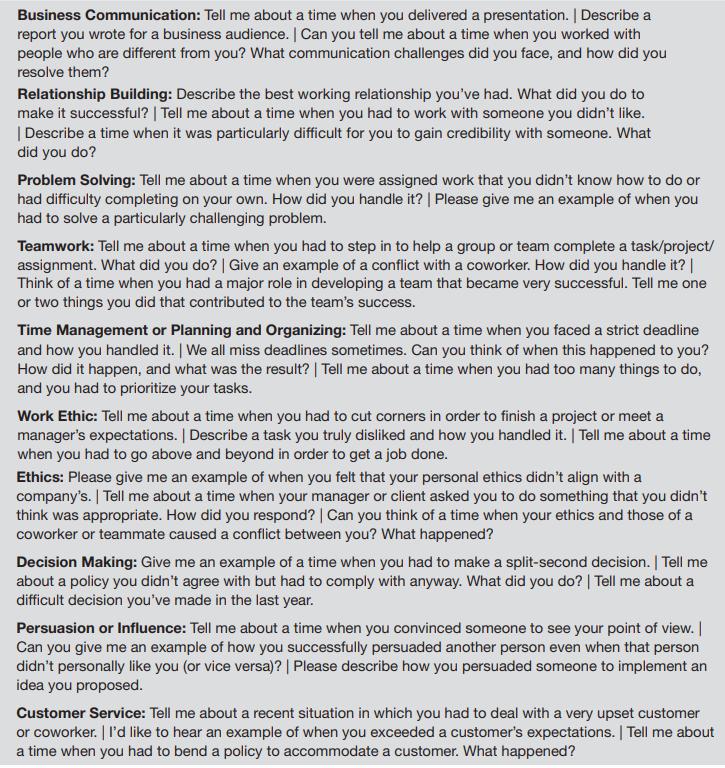
Find a job description that interests you. Based on the tasks and qualifications, list the job competencies and specialized skills the company seeks, for example, detail orientation, customer service, innovation, data analysis, financial modeling, and so on. Now write at least one behavioral
Based on the competencies you identified for Exercise 2—and for other competencies you may need for jobs that interest you—identify between 10 and 15 examples of stories from your experience, as described in this chapter. Write each out in the STAR (situation/task, action, result) format.
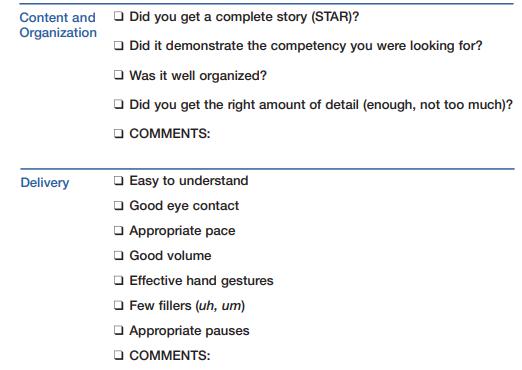
Working in groups of three, practice answering a behavioral interview question from Figure 3 and others you wrote for Exercise 2.Take turns, with one of you asking the question, another responding, and the third person observing and taking notes, using the feedback form in Figure 16 to evaluate the
For an upcoming interview (or from your research completed in Exercise 1), prepare a list of questions you might ask. You may not have the time to ask everything but prepare at least ten questions, just in case.Exercise 1Assume that your favorite company has invited you to an interview. To prepare
To prepare for your job search, conduct research and meet with people who can help you.First, target specific people within companies where you might like to work. You will need to send a few networking emails to ask for assistance. Your goal is to complete the following activities within one or
Find a sample interview by searching for “mock interview” on YouTube or another video site. Watch at least two questions and answers with a classmate. How did the candidate do?What improvements would you suggest about the candidate’s presentation and interaction?Would you like to have the
Ask someone to do a complete practice interview with you. Your school’s career management office might offer mock interviews, or you can reach out to a business professional you know or an alumnus of your school. You may do this in person or on video, whichever is the more likely way you’ll
Thinking about jobs that interest you, what could a hiring manager ask that would be difficult for you to answer? Consider questions about your experience, coursework, grades, and so on. Write a few possible questions and prepare to answer them. Find ways to convince the interviewer that you’re
Imagine that you are asked to interview through HireVue. Visit the website and review guidelines to ensure that your device is compatible. Next, answer a few of the practice questions. Say your answers a couple of times until you’re comfortable. As always, avoid memorizing your responses;
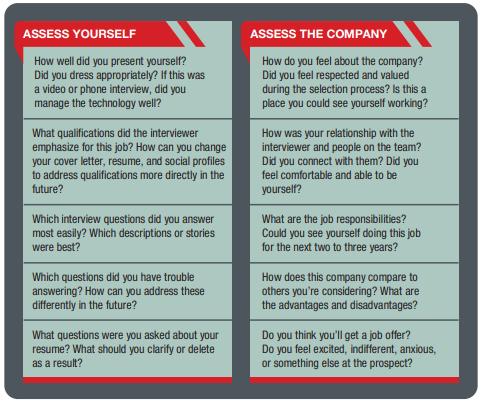
After an interview, answer the questions in Figure 8. Write your responses and submit them to your instructor. At the end, summarize your conclusions by answering one more question:under what, if any, conditions would you take the job if offered?Figure 8 ASSESS YOURSELF How well did you present
Find an email you sent in the past to thank someone for an interview. Exchange messages with a classmate and give each other feedback. Assess the tone, writing style, tailored content, and so on.
Imagine that you had a great interview for a job. Write a thank-you email to your interviewer to summarize your qualifications and reinforce your interest in the position. Invent whatever details you would like. Send the email to your instructor for feedback.
Have you been declined a job offer? Write an email to request feedback. It might be too late to send it, but this is good practice for next time. Exchange drafts with a classmate to make sure your request is easy to answer and your tone is appropriate.
Find two other students who have career interests similar to yours. Think about a job you would all like when you graduate. Then, separately, search online at Glassdoor, PayScale, Salary.com, and other sites to find a typical salary range for the position in a particular location. Compare results.
When you think about compensation and benefits for a future job, what is most important to you? Consider the salary, healthcare benefits, retirement plan, bonus, equity, location, relocation assistance, remote work option, tuition reimbursement, flexible time, vacation days, training opportunities,
Revisit the guidelines in this chapter for negotiating a job offer. Then, with the two classmates you worked with for Exercise 16, practice negotiating. Divide roles: the hiring manager, candidate, and observer. The hiring manager and observer should meet privately first to decide on an offer. At a
Imagine that you received an offer that you don’t accept. Instead, you accepted an offer for a higher starting salary in your hometown. Write an email declining the offer. Your goal is to express appreciation and keep the door open for future opportunities. In a short cover note to your
Just for fun, imagine that you received a great job offer from your favorite company, but alas, you have been cast as your favorite actor’s love interest in an upcoming movie. You cannot pass up the opportunity. Write an email to the company hiring manager to turn down the job. Invent whatever
Think about a recent job for which you applied but weren’t offered a position. If you received a generic or template rejection, write something more specific and personal. Even if you weren’t the best candidate for the job, what would you have liked to have received from the employer?
With two classmates, discuss the culture of an organization where you have worked or that you know well. How would you define professionalism at that location? Specifically, what type of behavior was valued and what was discouraged? What, if anything, surprised you about how people acted at work?
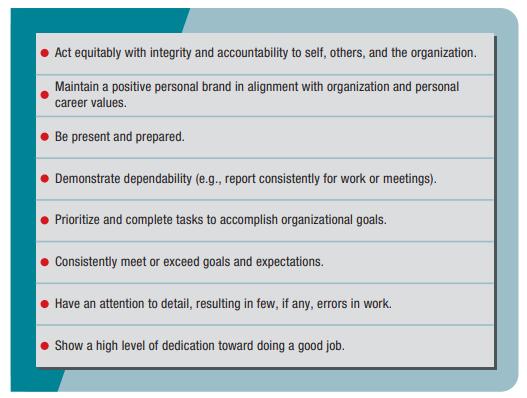
Consider your own professional behavior. Looking at the list of behaviors in Figure 15, which do you consider assets? Of which do you feel most proud? How can you emphasize these qualities throughout the job search? Which behaviors don’t describe you? What prevents you from demonstrating
In small groups, discuss your personal relationships at past jobs. How were friendships and romantic relationships perceived at the office? In what ways did you benefit from your relationships at work, and in what ways did they cause problems on the job? Consider any ramifications from social
Provide a response to a behavioral interview question in the “STAR” format.
Describe ways to make a good first impression during a job interview.
Write a thank-you email for a given job offer.
Write an email to decline a job offer.
List behaviors that describe professionalism.
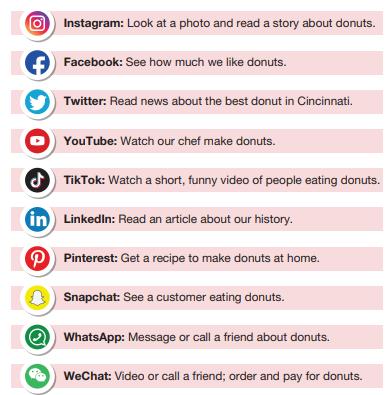
What’s your favorite company? Which of the platforms shown in Figure 10 does the company use and how? If you’re a customer, what other ways does the company communicate with you and for what purposes? Which do you consider most and least effective?Figure 10 Instagram: Look at a photo and read a
Use one of the scenarios in the previous exercise to practice facilitating and participating in a meeting. You may do this in person or online. Have each person assume the role of another participant. The dean or the sales associate will lead the meeting. Conduct a ten-minute meeting. Following the
To summarize the meeting for your colleagues in the previous scenario, write up the meeting minutes. Each of you in the group should prepare the minutes separately. Then, as a group, compare your minutes. Which are best and why?Scenarios:Scenario 1 Imagine that you are a dean at your college and
Find a company message or use one you found for a previous exercise. Write down the specific objective—what did the writer hope to accomplish? Do you believe the message achieved that objective? Why or why not? Next, analyze how the message is organized. Is the main point up front? Is the
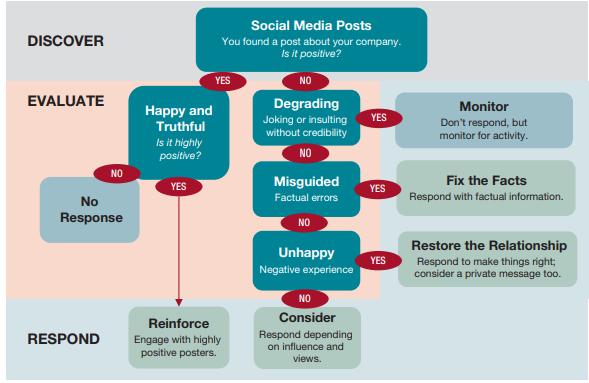
Find about ten mentions of your favorite brand on Twitter. Using the Social Media Response Guidelines in Figure 13, to which of the posts do you think the company should respond?Next, analyze which posts received a response and how the feedback was addressed. From these examples, how well is your
Give the review you completed in the previous exercise to another student in class. Imagine that you’re the business manager responsible for responding to online reviews. First, decide how you would respond to this post. Would you ignore it, write an online response, or try to call or email the
Imagine that you’re the corporate communications vice president for Harley-Davidson Motor Company. To promote motorcycle use in the United States, you’re planning a communication campaign focused on safety. Your objective is to overcome the public’s perception that motorcycles are
Research shows that, although we need to acknowledge our weaknesses, focusing more on our strengths—and finding ways to use them—has more positive outcomes for people and for those around them. What are your character strengths? Take a free online survey at www.viacharacter.org. You’ll be
Imagine that you’re winning an award from your company or from a community organization for your leadership. What would someone say about you, particularly about ways you were able to overcome obstacles to accomplish all that you did? Include future examples that illustrate your effect on
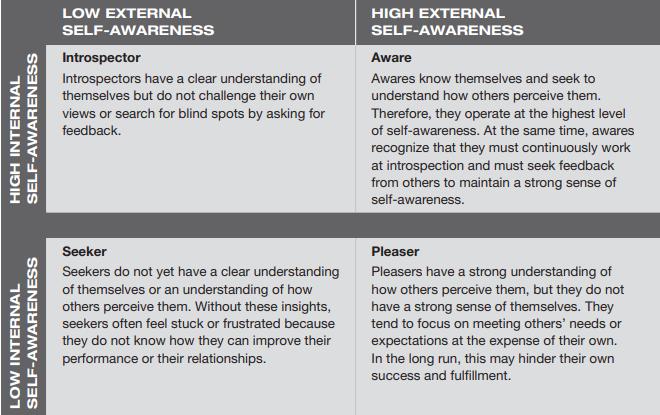
In her article “What Self-Awareness Really Is (and How to Cultivate It),” Tasha Eurich explains four “archetypes” to categorize current levels of internal and external self-awareness—knowing ourselves and knowing how others perceive us. Ideally, we should seek high external and internal
Imagine that an employer asks you the question, “Tell me about a time when you took action because a situation conflicted with your values.” Write a response that includes context or background about the situation, your action, and the result. Emphasize what you learned from the experience.
List a few times when you had trouble communicating with someone. Do you see a pattern? Consider language, cultural, attitudinal, emotional, and other barriers described in the chapter. Which barriers do you need to address, and what strategies will you use to prevent these barriers from
Do you default to using text and email when a phone call might be a better choice? Sometime in the next week, consider a situation that you can address by phone. What makes you uncomfortable about having a voice conversation, and how can you work through these feelings? If it’s easier, schedule a
Find a recent message that demonstrates or fails to demonstrate strong character. Use your own news sources, or go to amynewman.com. What in the leader’s message demonstrates character? What do the words convey, and what is not said? If you were an advisor to this leader, what changes would you
Do you know someone you would describe as having strong character? What examples from this person’s communication demonstrate character?
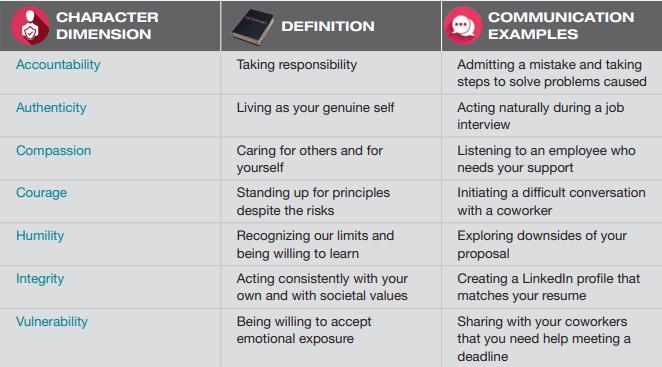
From a movie, series, or TV show, find at least five communication examples that illustrate the character dimensions defined in Figure 1. Briefly describe the scene and what the actor does or says to demonstrate each dimension.Figure 1 CHARACTER DIMENSION Accountability Authenticity Compassion
While watching a movie, series, TV show, or interview, analyze two people talking. Track how communication happens between the initial communicator and the audience. In particular, note how the audience receives the message and creates a new message. How do the two create new messages and meaning
Think about a message you need to send, and walk through the character, audience, message (CAM) communication model:What drives you to communicate? To what are you reacting, and what is your purpose? What impact do you want to have, and how do you want others to perceive you? How will you
At the end of a day, write down your answers to the following questions:a. What communication makes me feel most proud today? What did I do to contribute to the success? What did others do to contribute to the success?b. What communication didn’t go as well as I hoped? What happened to interfere?
Do you know someone you would describe as having high emotional intelligence? What examples from this person’s communication demonstrate self-awareness, self-management, social awareness, and relationship management?
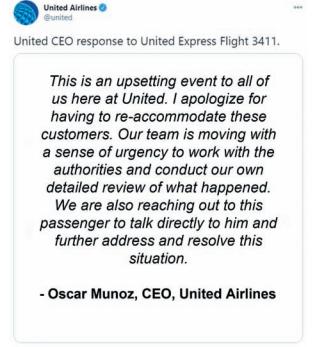
Given what you know about the United Airlines situation and business communication, rewrite the tweet shown in Figure 4. Try to do a better job of conveying character in this first message about the incident.Figure 4 United Airlines @united United CEO response to United Express Flight 3411. This
The U.S. Federal Trade Commission (FTC) sued Facebook for illegal monopolization. Read more about the case at www.ftc.gov/news-events/press-releases/2020/12/ftc-sues-facebook-illegal-monopolization. Research the role email plays in the suit, particularly CEO Mark Zuckerberg’s 2012 email about
If you’re working now and have access to it, share the organization’s policy with the class and describe how the policy is implemented. How do employees both abide by and skirt the policy? In what ways are situations handled that are consistent or inconsistent with the policy? If you were a
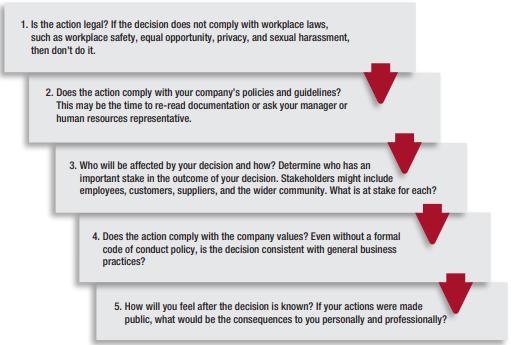
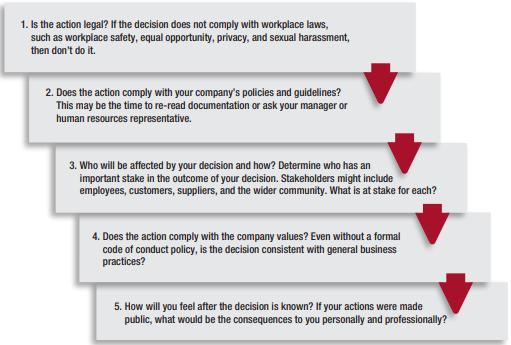
Imagine that you got a job offer and accepted it. You were happy about your decision until you got another offer—this time from your ideal company and in your ideal location. Write responses to each of the questions in the Framework for Ethical Decision Making (Figure 7). Adapt questions to the
Working in small groups, identify at least one ethical dilemma one of you has experienced in each of the following categories. Using the Framework for Ethical Decision Making (Figure 7), analyze how you handled the situation and what, if anything, you could have done differently.a. Copyright issues
Find a news story on businesswire.com or from your own sources about a CEO leaving a company. These communications are sensitive: leaders need to be respectful to the departing CEO and, at the same time, supportive and enthusiastic about an incoming executive. Research the situation and describe
Do you know someone you would describe as having organizational savvy? Perhaps someone is a good networker or knows just the right things to say in business or group situations. What examples from this person’s communication demonstrate organizational savvy?
Think of an organization where you worked recently. Create an organization chart for two or three levels of employees. Identify examples of upward, lateral, and downward messages you remember from your experience.
In the classic business movie Office Space, watch Scene 13, “Flair.” This communication does not go very well. Identify the communication barriers in this scene.
Some emails and texts seem to go on forever. At some point, a phone call might work better to resolve an issue. Talk with a partner about a recent experience and how you knew that the current medium was doing more harm than good. What were the consequences of either sticking with it or changing
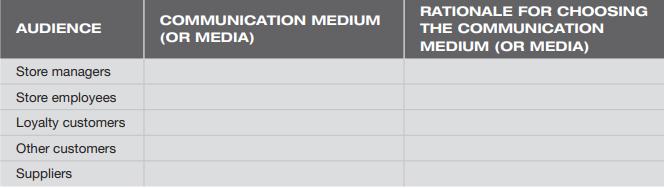
Imagine that you’re the owner of a retail store and decide to close three of your 14 locations. Working in groups, identify in the communication plan template in Figure 14 which medium you would use to communicate with each audience. You may have multiple communications for some audiences.
Image that you were offered a summer internship but decide not to accept it. With a partner, discuss the most appropriate communication medium to use for your message. Would you use a different medium if you received the offer by email or by phone?
Describe the relationship between communication and character.
Explain components of the character, audience, message (CAM) communication model.
Identify factors to consider during the character check step of the communication model.
Describe aspects of the audience to consider in business communication.
Choose the best medium for your message in a business situation.
Think about a negative experience you had as part of a team. What was your role in the team’s failure? Without wallowing in it too much, try to identify what you could have done differently. Get in touch with another member of the team to discuss what happened. Ask for feedback about your
When you’re part of a new team, introduce yourself by including some self-disclosure—nothing too personal but a few aspects of your life that will help your team members know you better and feel more comfortable with you. Next, practice communicating informally. Particularly if your
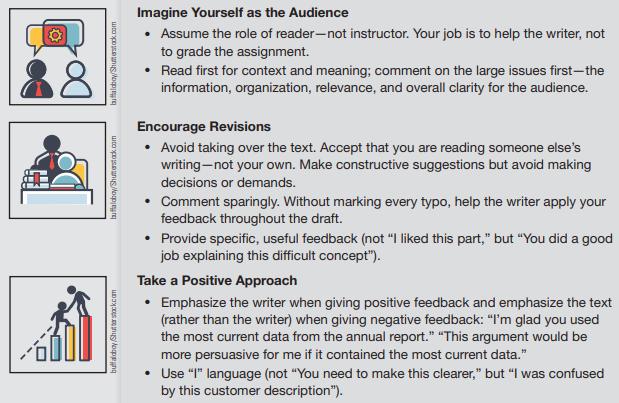
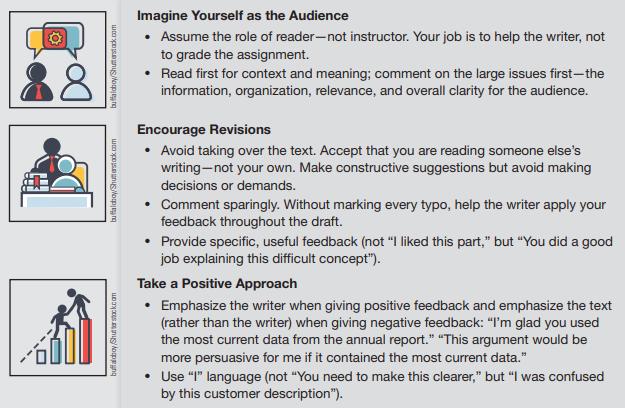
Exchange a few pages of writing with a friend or classmate. Following the guidelines in Figure 6, Commenting on Team Writing, provide written feedback, and then discuss your feedback by taking turns. How do you feel giving and receiving feedback on writing? You might try this exercise with one of
Next time you’re on a video meeting, record yourself speaking and listening. Watch yourself later to observe your nonverbal communication. Are your words aligned with your facial expressions, gestures, and movement? If you notice inconsistencies, what could be the cause? Remember how you felt
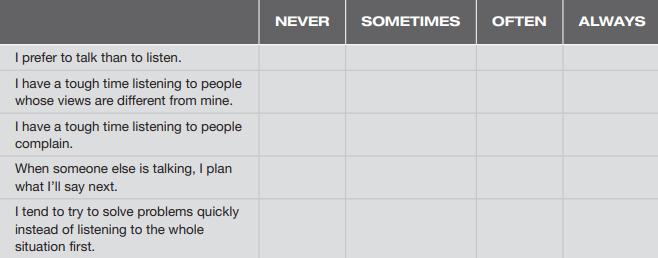
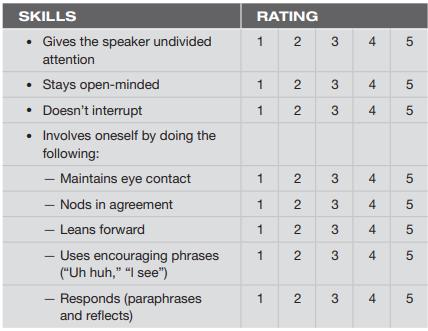
Reflect on your listening skills by rating the behaviors in Figuren20. For which of the items did you mark “often” or “always”? Next time someone is talking to you, observe these behaviors in yourself and try to listen more carefully.Figuren20 I prefer to talk than to listen. I have a tough
Watch a segment of a movie, series, or TV show in which a team is communicating. Search for “team movies” if you need ideas. Write down examples you observe of conflict, conformity, and consensus. Also identify any examples of groupthink. Talk with a classmate about your observations.
For a team project in class, agree on team norms. Answer the following questions:● What if team members miss a deliverable or team meeting? How should they notify the team? What will be the consequences?● What if two team members are having a conflict? How should it be addressed or resolved?●
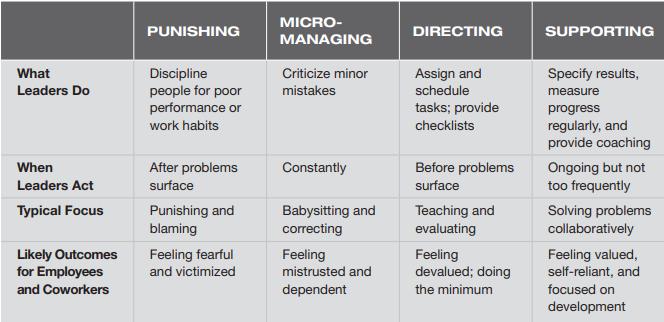
Think about a past or current job. Looking at Figure 2, External and Internal Accountability Measures, how would you describe leaders in the organization? Did you notice a difference between your immediate manager and others? How did your manager’s way of holding you accountable—punishing,
Imagine this situation: your manager calls you into her office and asks for product information for a customer. She seems annoyed that you haven’t already sent it to her, but this is the first you’re hearing about it. She says that one of your team members said you were working on this last
Review text or instant messages you exchanged with a coworker or classmate. What aspects of the messages are informal, for example, slang, abbreviations, emoticons, and so on? How does your communication compare to your coworker’s or classmate’s? Which is more effective given the situation?
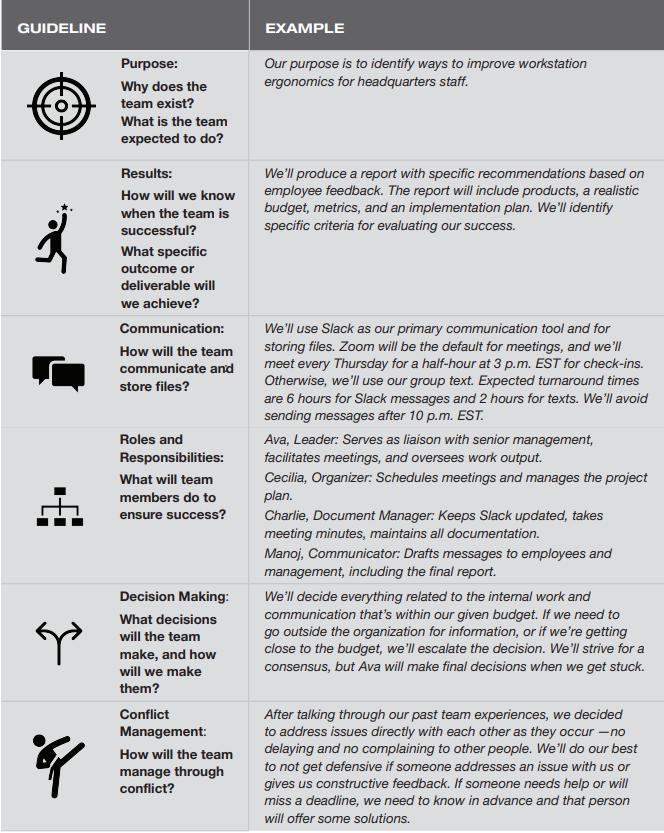
If you are part of a remote team, develop a charter to agree on how you’ll work together. Refer to Figure 3 for questions about your purpose, results, communication, roles and responsibilities, decision making, and conflict management.Figure 3 GUIDELINE De g of Purpose: Why does the team exist?
In a small group, research a few collaboration platforms. Also share your own experience about the advantages and disadvantages of each. Which platforms might be best for which type of work or team? If you had to choose one for your group, which would it be and why?
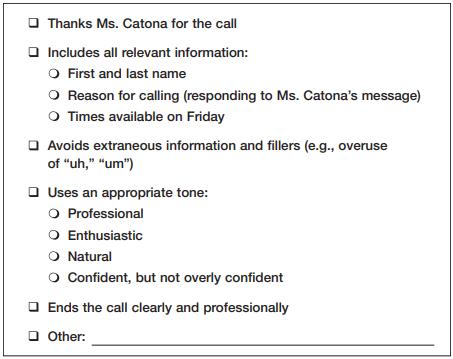
Imagine that you applied for a job and received the following voicemail message from the company’s HR manager: Hello. This is Marley Catona from Bank on Me. We received your cover letter and resume, and I’d like to schedule a phone interview with you. Will you please tell me what times you’re
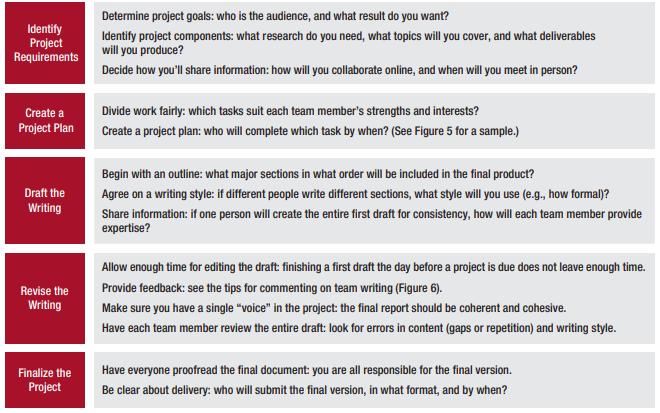
Working in groups of four or five, plan an upcoming event. You may choose something real in your lives—a club or social event—or invent something. Complete the first two steps for team writing described in Figure 4: identify project requirements and create a project plan. Include all the tasks
Working in groups of three, use the tips in Figure 6, Commenting on Team Writing, to provide feedback on other students’ writing. If you’re working as part of a team, use a writing sample for your project. Otherwise, choose a writing sample for another assignment. Spend about 10 minutes
In pairs, think about the best and worst meetings you ever attended. They could have been at work, at school, or with a community organization. List the factors that made each the best and worst. Compare them to the principles in this chapter.
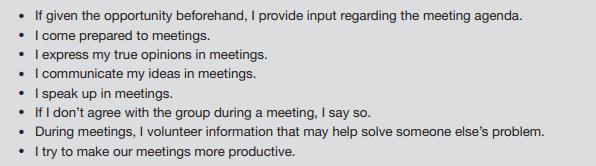
Prepare to participate during an upcoming meeting. Review the meeting citizenship behaviors listed in Figure 10. Try to demonstrate as many behaviors as possible and observe other participants to see how many they follow. After the meeting, reflect on your experience. Which behaviors did you
Working in groups of five, choose one of the following scenarios for the next three exercises. For the scenario you and your team members choose, prepare an email and detailed agenda to send to meeting participants. Plan ways to involve people in the meeting. Whether you’ll meet in person or
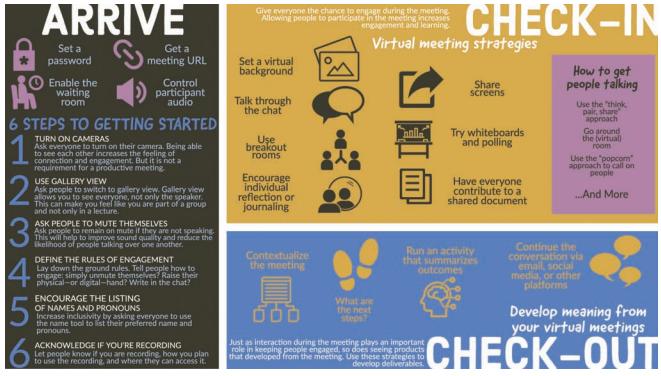
Next time you participate in an online meeting, evaluate which of the suggestions in Figure 9 the host follows. How well did the host arrive, check in, and check out of the meeting? Which of the platform features did you use? If you were asked for feedback, what would you suggest the host do
Throughout the day, keep a list of emotions you see on people’s faces. Try to be more precise than happy, sad, or angry. People might feel upset, delighted, anxious, determined, grateful, ambitious, confident, content, bored, disgusted, or a host of other emotions. Practicing identifying
With a friend or classmate, schedule time for a video meeting on Zoom or another platform. Practice different gazes to see which appears to be the most direct eye contact. Also take a few screenshots of yourself so you can see how you appear to others.
Use your voice tone to convey emotions.With a partner, practice conveying different emotions. If you go first, read the sentences in the left-side column, changing your tone to reflect each emotion. Also change the order of the sentences to see whether your partner can guess which emotion you’re
Working in pairs, have one person describe a time when someone didn’t listen well. This can be a situation with a family member, friend, doctor, or someone else. Have the listener identify (1) What the person did to demonstrate nonlistening(2) The effect this had on the speaker. From this
Working in groups of three, have one person talk about a difficult decision. As your classmate describes the situation, have a second person listen, using skills discussed in this chapter. The listener just needs to listen—not give advice or help the speaker solve the problem. The third person in
Find Brené Brown’s popular TED talk. Watch the video in groups or on your own. In small groups, discuss the video and how her concept of vulnerability relates to empathy. If you’re comfortable, take some risks and discuss your personal views of empathy: what do you find easy or difficult about
Describe ways to improve team communication.
Explain ways to build relationships when working remotely.
Showing 5300 - 5400
of 5904
First
46
47
48
49
50
51
52
53
54
55
56
57
58
59
60
Step by Step Answers

 Get 50% OFF
Claim Now
Get 50% OFF
Claim Now