New Semester
Started
Get
50% OFF
Study Help!
--h --m --s
Claim Now
Question Answers
Textbooks
Find textbooks, questions and answers
Oops, something went wrong!
Change your search query and then try again
S
Books
FREE
Study Help
Expert Questions
Accounting
General Management
Mathematics
Finance
Organizational Behaviour
Law
Physics
Operating System
Management Leadership
Sociology
Programming
Marketing
Database
Computer Network
Economics
Textbooks Solutions
Accounting
Managerial Accounting
Management Leadership
Cost Accounting
Statistics
Business Law
Corporate Finance
Finance
Economics
Auditing
Tutors
Online Tutors
Find a Tutor
Hire a Tutor
Become a Tutor
AI Tutor
AI Study Planner
NEW
Sell Books
Search
Search
Sign In
Register
study help
business
experiencing mis
Experiencing MIS 6th Edition David M Kroenke, Randall J Boyle - Solutions
Why should organizations be concerned with the legal consequences of a data breach? Explain why the payment card industry would want all merchants to be PCI DSS compliant.Why should merchants be concerned about the fines levied against Genesco? Define PCI DSS, FISMA, GLBA, HIPAA, and FERPA.
Define countermeasures, network intrusion detection system(NIDS), and data loss prevention system (DLP). List two ways the Target data breach could have been prevented. Explain why there’s nothing you can do to make data breaches impossible and how you can make them improbable. Describe what an
State the two characteristics that make international IS management challenging. Explain the difference between international systems development and international software development. Using the five-component framework, explain why international systems development is more difficult.Give an
Summarize the characteristics of large-scale information systems development projects. Explain why these characteristics make large-scale projects hard to manage. Give two examples of large-scale systems development projects.
Describe two meanings for the term scope. Describe how requirements affect cost and time. Describe the trade-offs that exist between requirements and time. Explain the trade-offs that exist between time and cost. Describe circumstances in which increasing cost reduces time. Explain circumstances in
Describe the difference between development processes such as the SDLC and project management. Summarize the activities of the PMI. Describe the contents of the PMBOK® Guide.Name the five process groups and the nine knowledge areas.Briefly explain the focus of each management area. Explain how you
State the key strategy for large-scale systems development.Explain why each task needs to produce one or more deliverables.Define work breakdown structure, and give an example.In Figure CE16-4, explain the numeric notation under task 1.3 Define Gantt chart, and describe its contents. Explain how
Name the biggest challenge for systems development planning.Explain why this is so. Describe how the logical-poetry nature of software development affects scheduling. Summarize the three approaches to the systems development scheduling challenge that organizations can take. Describe two ways of
Name four factors that create challenges for managing systems development. Give an example of each factor. Define configuration control...
State and describe the single most important task for users on a systems development project. Explain why, as Dodd put it, there are no IT projects. Summarize user responsibilities for managing requirements. Define requirements creep. Describe the action that should occur if requirements creep
WHY IS THE SDLC LOSING CREDIBILITY?
WHAT ARE THE PRINCIPLES OF AGILE DEVELOPMENT METHODOLOGIES?
WHAT IS THE SCRUM PROCESS?
HOW DO REQUIREMENTS DRIVE THE SCRUM PROCESS?
Describe the two reasons that the SDLC is falling out of favor.Explain why the U.S. Department of Defense believed that it was a workable process. Explain the nature of social systems development. Explain what happens when an incomplete SDLC project runs out of time or money.
Define agile development. In your own words, explain the benefits of each of the principles in Figure CE17-1. Explain why just-intime design is difficult for some developers to accept. Describe the projects for which agile development is appropriate.
In sports, what is a scrum? Explain the origin of the term as it pertains to teamwork. In your own words, explain the benefits of the principles in Figure CE17-2. Define scrum period and state the recommended length for such periods.Define stand-up and explain what happens in a stand-up.Define
Explain the format for stating requirements in scrum. Why is why needed? Give two examples of scrum-style requirements not in this text. Summarize the process for creating a task list for accomplishing a scrum requirement. Explain what scheduling activity developers do poorly and what scheduling
Read the criteria for team success in Chapter C Extension 1. Explain scrum characteristics that sup- port achieving team success.
Read the opening to Chapter 12 Explain how PRIDE Systems could use a scrum process for managing the Xbox prototype. Describe how doing so would reduce the risk of failure.
Suppose that you suggest that an information system be developed for your department using scrum. Further suppose that your management is dubious. Write a one-page memo to justify using scrum.
WHAT ARE THE STAGES OF BUSINESS PROCESS MANAGEMENT (BPM)?
HOW DO BUSINESS PROCESSES AND INFORMATION SYSTEMS RELATE?
WHICH COMES FIRST, BUSINESS PROCESSES OR INFORMATION SYSTEMS?
HOw !IS BPM PRACTICED IN THE REAL WORLD?
Define business process. Define activities, roles, actors, repositories, data flows, and sequence flows. Summarize three reasons that processes need to be changed and give an example of each.
Describe the need for BPM and explain why it is a cycle. Name the four stages of the BPM process and summarize the activities in each. Explain the role of COBIT.
Explain how information systems and business processes differ.Give an example, other than one in this text, of a business process that uses two or more information systems. Give an example, other than one in this text, of an information system that is part of two or more business processes. Explain
Explain the problems that occur if business processes are developed first, with IS as a component. Explain the problems that occur if information systems are developed first, with business processes as a component. Explain the differences between Figures CE18-6 and CE18-7. Summarize the issues that
Explain how the perpetual assessing of business processes is unrealistic. Name two factors that drive process change. Name and describe three factors that cause process problems. Define business analyst, describe the background of a business analyst, and differentiate business analysts from systems
Compare and contrast the initial AllRoad process, shown in Figure 2-1, with the version shown in Figure CE18-4. (Treat the parallelograms in Figure 2-1 as databases.)a. Summarize the problems that existed in the origi- nal process and explain how the adjusted process enables a solution to those
Suppose you are starting a business that is similar to AllRoad.a. Should you start with business processes first or information systems first? Defend your answer.b. Most likely, you will obtain off-the-shelf software and alter it for your applications. How does this fact influence whether you start
Suppose you are starting a venture similar to PRIDE Systems.a. Should you start with business processes first or information systems first? Defend your answer.b. All of your mobile applications will be custom- developed. How does this fact influence whether you start first with processes or IS?c.
WHAT ARE THE TWO KEY CHARACTERISTICS OF COLLABORATION?
WHAT ARE THREE CRITERIA FOR SUCCESSFUL COLLABORATION?
WHAT ARE THE FOUR PRIMARY PURPOSES OF COLLABORATION?
WHAT ARE THE COMPONENTS AND FUNCTIONS OF A COLLABORATION INFORMATION SYSTEM?
In your own words, explain the difference between cooperation and collaboration. Name the two key characteristics of collaboration and explain how they improve group work.Summarize important skills for collaborators and list what you believe are the best ways to give and receive critical feedback.
Name and describe three criteria for collaboration success.Summarize how these criteria differ between student and professional teams.
Name and describe four primary purposes of collaboration.Explain their relationship. Describe ways that collaboration systems can contribute to each purpose.
Name and describe the five components of a collaboration information system. Name and describe two key collaboration IS functions.
Using your experience working on past teams, give an example of an unhelpful statement for each of the guidelines in Figure CE1-2. Correct your examples to a more productive and helpful comment.
Using a past team project from your own experience, summarize how your team conducted the four phases listed in Figure CE1-5. Evaluate how your team conducted problem solving, decision making, and in- forming activities. Rate your past team on Hackman's criteria as discussed in Q2.
WHAT ARE THE IS REQUIREMENTS FOR STUDENT PROJECT COLLABORATIONS?
HOW CAN YOU USE COLLABORATION TOOLS TO IMPROVTEEAM COMMUNICATION?
HOW CAN YOU USE COLLABORATION TOOLS TO SHARE CONTENT?
HOW CAN YOU USE COLLABORATION TOOLS TO MANAGE TASKS?
WHICH COLLABORATION INFORMATION SYSTEM IS RIGHT FOR YOUR TEAM?
Summarize why you should learn about collaboration IS for today as well as later. Name the three categories of requirements discussed in this chapter extension. Name and describe the three required features. Summarize the other two sets of features.
Explain why communication is important to collaboration.Define synchronous and asynchronous communication and explain when each is used. Name two collaboration tools that can be used to help set up synchronous meetings. Describe collaboration tools that can be used for face-to-face meetings.
Summarize alternatives for processing Office documents on the desktop as well as over the Internet. Describe two ways that content is shared with no control and explain the problems that can occur. Explain the difference between version management and version control. Describe how user accounts,
Explain why managing tasks is important to team progress.Specify how a task should be described. List the minimal content of a task list. Summarize the advantages and disadvantages of using Google Docs and Microsoft SharePoint for managing tasks.
Describe the three collaboration tool sets and indicate how each meets the minimum requirements for collaboration.Explain the differences among them. Summarize the criteria for choosing the right set for your team. Explain the meaning of the power curve and discuss the power curve for each of the
Choose one of the three alternatives described in Q5 for use by your collaborative team. To do so, answer the following questions (if possible, answer these questions with your team):a. Using your and your teammates’ answers to question CE2-2, create your team’s list of requirements.b. Create a
WHAT ARE MOBILE SYSTEMS?
WHY ARE MOBILE SYSTEMS IMPORTANT?
How DO NATIVE AND WEB-BASED MOBILE APPLICATIONS COMPARE?
wuHat CHARACTERIZES QUALITY MOBILE USER EXPERIENCES?
WHAT ARE THE CHALLENGES OF PERSONAL MOBILE DEVICES AT WORK?
Define mobile systems. Name and describe the four elements of a mobile system.
Summarize the size of and opportunities in the mobile market.Explain why the mobile market will become stronger in the future. Explain why a problem for one organization is an opportunity for another. Using the five-component model, describe particular opportunities for each component. Define
In your own words, summarize the differences between native applications and Web applications. In high-level terms, explain the difference between native application languages and Web languages. Explain each cell of Figure CE3-3 . State which is better: native or Web applications.
Explain the difference between the terms UJ and UX. Describe how each of the following can affect the UX of a mobile application:user content, context-sensitive chrome, animation and lively behavior, scaling and sharing, the cloud. Define chrome, charms, roaming, push, and pull.
Summarize the advantages and disadvantages of employees’use of mobile systems at work. Define BYOD and BYOD policy.Name six possible policies and compare them in terms of functionality and organizational control. Summarize the advantage of each to employers.
Examine Figure CE3-2 and reflect on each component.a. Describe a job that you would like to have upon graduation.b. Describe how changes in mobile hardware will af- fect that job.c. Explain how you can use your knowledge of the differences between native and Web mobile application development to
Suppose that you are Drew at AllRoad. List five criteria you would use in helping AllRoad decide whether it should develop a native or a Web mobile application.
Choose a mobile application that you frequently use. It could be Facebook, Twitter, or some other more vertical application. Evaluate that application according to the principles in Figure CE3-7.
Explain how the following terms are related: spreadsheet, electronic spreadsheet, Microsoft Excel, worksheet, and workbook.Explain how spreadsheet cells are addressed. Where would you find cell Q54?
Describe the first task you should do when creating a spreadsheet.Open a new workbook and give it the name My_Sample_ WB. Explain the relationship of tabs and tools and selections.Which tab is the most likely one to have the tools and selections you need?
List three ways of entering data into Excel. Describe the advantage of using the F2 key to edit data. Explain two ways that Excel uses a pattern to enter data.
Open Excel and explain the purpose of each of the icons in the Font section of the Home tab of the ribbon. Explain the purpose of the Alignment and Number sections.
Write the expression you would need to add the content of cell B2 to the content of cell B7. Write the expression to multiply the content of cell C4 by 7.3. Write the expression to find the average of the values in cells D7, D8, and D9. Use a built-in formula to total the values in cells E2, E3,
Explain the purpose and use of Print Preview. Open Excel, go to the PAGE LAYOUT tab, and explain the purpose of the Margins, Orientation, and Print Area tools in the Page Setup section. Also, explain the function of the View and Print checkboxes in the Gridlines and Headings portion of the Sheet
Summarize the problem that the fund-raising manager must solve. Explain how a database can help solve this problem.Describe the missing information. In your own words, what data must be available to construct the missing information?
Name and briefly describe the components of a database application system. Explain the difference between a database application system and a database application program. Using Figure CE5-1 as a guide, describe the major steps in the process of developing a database application system. Explain
Define the terms entity, attributes, and relationship. Give an example of two entities (other than those in this book) that have a 1:N relationship. Give an example of two entities that have an N:M relationship. Explain the difference between maximum and minimum cardinality. Show two entities
Give an example of a data integrity problem. Describe, in general terms, the process of normalization. Explain how normalizing data prevents data integrity problems. Explain the disadvantage of normalized data. Using your examples from Q3, show how 1:N relationships are expressed in relational
Describe the major role for users in the development of a database application system. Explain what is required to change a 1:N relationship to an N:M relationship during the data modeling stage. Explain what is required to make that same change after the database application system has been
Examine Figure CE5-12. Describe the maximum and minimum cardinality for each relationship. Justify these cardinalities.Change the relationship between Prospect and Phone to N:M, and explain what this means. Change the relationship between Prospect and Work to 1:1, and explain what this means.
HOW DO YOU CREATE TABLES in Microsft?
HOW DO YOU CREATE QUERIES USING THE QUERY DESIGN TOOL?
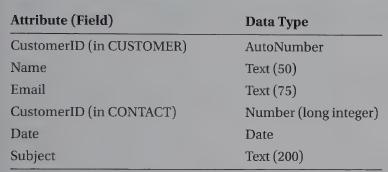
Open Access and create a new database having a name of your choosing. Create the CUSTOMER and CONTACT tables.Assume the foliowing data types:Add Description entries to the Field definitions that you think are appropriate. Attribute (Field) CustomerID (in CUSTOMER) Name Data Type AutoNumber Text
Open the Relationships window and create a relationship from CUSTOMER to CONTACT using the CustomerID attribute.Click all of the check boxes. Enter sample data. Add at least five rows to CUSTOMER and at least seven rows to CONTACT.Ensure that some CUSTOMER rows have no matching CONTACT rows.
Open the default data entry form for the CUSTOMER table.Click the CUSTOMER rows to display the related CONTACT data. Now use the Form tool to create a data entry form.Navigate through that form to see that the CONTACT rows are correctly connected to the CUSTOMER rows. Adjust spacing as you deem
Create a query that displays Name, Email, Date, and Subject.Sort the results of Name in alphabetical order.
Use the Report Wizard to create a report that has Name, Email, Date, and Subject. View that report. Add a group total for each CUSTOMER that counts the number of contacts for each customer.Follow the procedure shown, except instead of selecting Sum for Type choose Count Records instead.
Answer question CE5-2 at the end of Chapter Extension 5 (page 446). Use Access to implement your database design. Create the tables and add sample data. Create a data entry form that shows teams and the equipment they have checked out. Verify that the form correctly processes new checkouts, changes
WHAT IS IMPORT/EXPORT in Microsoft ?
HOWCAN YOU CREATE CHARTS WITH EXCEL?
Describe the chief strengths of both Excel and Access. Summarize the primary purposes of Excel and Access. Give an example of why you might want to process Access data in Excel and another example of why you might want to process Excel data in Access.
Define import/export. Explain how data can become out of date when using import/export and describe a solution to this problem. Explain the difference between comma-delimited and tab-delimited data. Go to the text’s Web site at www.pearsonhighered.com/kroenke and obtain the text file EMIS CE7
Follow the steps explained in Q3 to create the graphics shown in Figures CE7-6 and CE7-9. Enter data manually as described in Q3.
Explain the term day’s total of TotalDonations. Explain what the Group By function does. Go to the text’s Web site at www.pearsonhighered.com/kroenke and download the Access database file EMIS Volunteer_CE7. Follow the instructions in this question to duplicate the query shown in Figures
Follow the instructions in this section to use Excel to graph the results of the query you generated in your review for Q4. Your graph should look like that in Figure CE7-25. Explain how this exercise takes advantage of some of the relative strengths of these two products.
Explain why you might want to use Access to create reports on Excel data. Go to the text’s Web site at www.pearsonhighered.com/kroenke and download the Excel file EMIS CE7 FundRaisingExpenses.xslx. Follow the instructions in the discussion of this question to create a report like that in Figure
Open the database with the Event_Expenses query that you created in your review of Q6. Follow the procedures described in this section to create an Excel worksheet that looks like that shown in Figure CE7-39. Explain how some of this data made a roundtrip from Excel to Access and back to Excel.
WHY IS INTRODUCTION TO MIS THE MOST IMPORTANT CLASS IN THE BUSINESS SCHOOL?
WHAT IS MIS?
WHY IS THE DIFFERENCE BETWEEN INFORMATION TECHNOLOGY AND INFORMATION SYSTEMS IMPORTANT TO YOU?
WHAT IS YOUR ROLE IN IS SECURITY?
Showing 1300 - 1400
of 1598
First
2
3
4
5
6
7
8
9
10
11
12
13
14
15
16
Step by Step Answers

 Get 50% OFF
Claim Now
Get 50% OFF
Claim Now