New Semester
Started
Get
50% OFF
Study Help!
--h --m --s
Claim Now
Question Answers
Textbooks
Find textbooks, questions and answers
Oops, something went wrong!
Change your search query and then try again
S
Books
FREE
Study Help
Expert Questions
Accounting
General Management
Mathematics
Finance
Organizational Behaviour
Law
Physics
Operating System
Management Leadership
Sociology
Programming
Marketing
Database
Computer Network
Economics
Textbooks Solutions
Accounting
Managerial Accounting
Management Leadership
Cost Accounting
Statistics
Business Law
Corporate Finance
Finance
Economics
Auditing
Tutors
Online Tutors
Find a Tutor
Hire a Tutor
Become a Tutor
AI Tutor
AI Study Planner
NEW
Sell Books
Search
Search
Sign In
Register
study help
engineering
introduction to chemical engineering thermodynamics
Introduction To Chemical Engineering Thermodynamics 8th Edition J.M. Smith, Hendrick Van Ness, Michael Abbott, Mark Swihart - Solutions
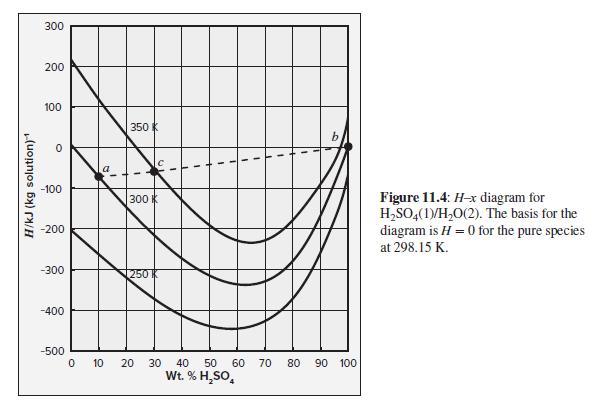
For a 35-wt-% aqueous solution of H2SO4 at 300 K, what is the heat of mixing ΔH in kJ·kg−1?
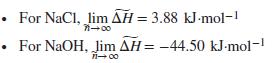
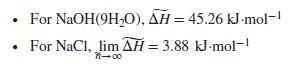
A large quantity of very dilute aqueous NaOH solution is neutralized by addition of the stoichiometric amount of a 10-mol-% aqueous HCl solution. Estimate the heat effect per mole of NaOH neutralized if the tank is maintained at 25°C and 1(atm) and the neutralization reaction goes to completion.
A large quantity of very dilute aqueous HCl solution is neutralized by the addition of the stoichiometric amount of a 10-mol-% aqueous NaOH solution. Estimate the heat effect per mole of HCl neutralized if the tank is maintained at 25°C and 1(atm) and the neutralization reaction goes to
Ten thousand (10,000) kg·h−1 of an 80-wt-% H2SO4 solution in water at 300 K is continuously diluted with chilled water at 280 K to yield a stream containing 50-wt-% H2SO4 at 330 K.(a) What is the mass flow rate of chilled water in kg·h−1?(b) What is the rate of heat transfer in kJ·h−1 for
Determine the heat of mixing ΔH of sulfuric acid in water and the partial specific enthalpies of H2SO4 and H2O for a solution containing 65-wt-% H2SO4 at 300 K.
It is proposed to cool a stream of 75-wt-% sulfuric acid solution at 330 K by diluting it with chilled water at 280 K. Determine the amount of water that must be added to 1 kg of 75-wt-% acid before cooling below 330 K actually occurs.
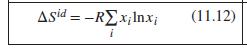
Develop Eq. (11.12) for ΔSid by appropriate application of Eqs. (5.36) and (5.37) to a mixing process.Eq. (11.12)Eq. (5.36)Eq. (5.37) Δsid-RΣ x; Inx (11.12) i
The following liquids, all at atmospheric pressure and 300 K, are mixed: 25 kg of pure water, 40 kg of pure sulfuric acid, and 75 kg of 25-wt-% sulfuric acid.(a) How much heat is liberated if mixing is isothermal at 300 K?(b) The mixing process is carried out in two steps: First, the pure sulfuric
A 90-wt-% aqueous H2SO4 solution at 25°C is added over a period of 6 hours to a tank containing 4000 kg of pure water also at 25°C. The final concentration of acid in the tank is 50-wt-%. The contents of the tank are cooled continuously to maintain a constant temperature of 25°C. Because the
Consider a closed vessel of fixed volume containing equal masses of water, ethanol, and toluene at 70°C. Three phases (two liquid and one vapor) are present.(a) How many variables, in addition to the mass of each component and the temperature, must be specified to fully determine the intensive
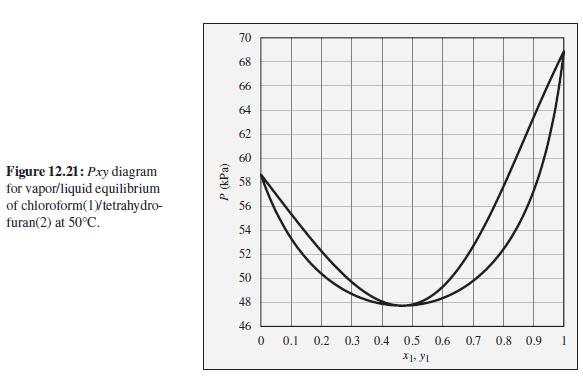
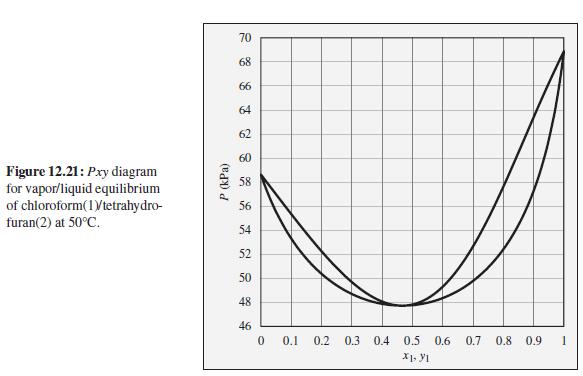
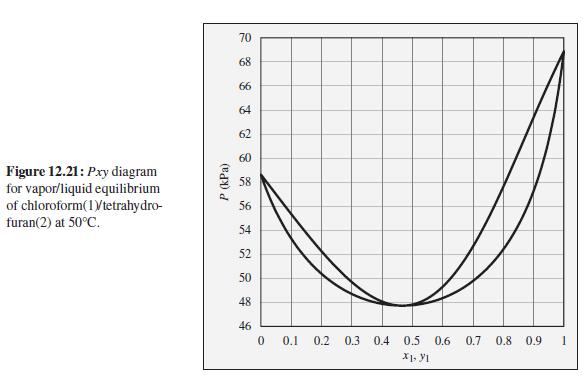
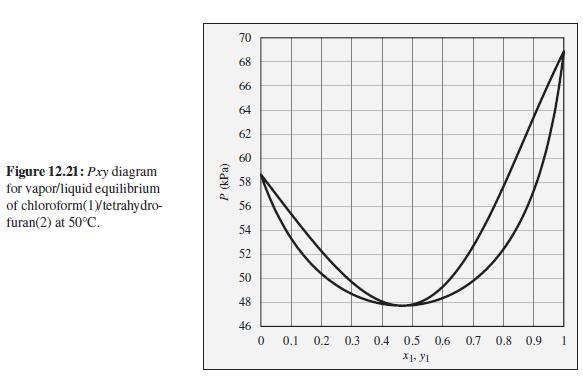
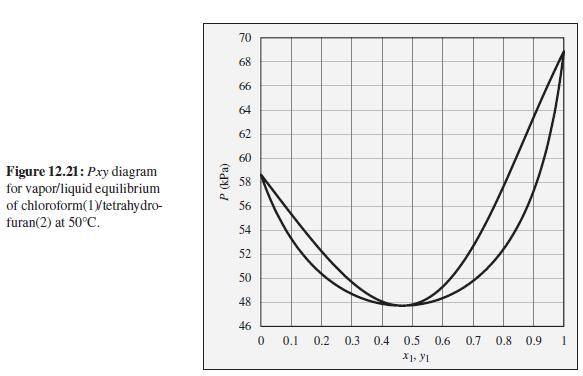
The pressure above a mixture of chloroform and tetrahydrofuran at 50°C is measured to be 62 kPa. What are the possible compositions of the liquid and vapor phases?To the Pxy diagram for chloroform(1)/tetrahydrofuran(2) at 50°C shown in Fig. 12.21. 70 68 66 64 62 60 Figure 12.21: Pxy diagram for
The pressure above a mixture of chloroform and tetrahydrofuran at 50°C is measured to be 52 kPa. What are the possible compositions of the liquid and vapor phases?To the Pxy diagram for chloroform(1)/tetrahydrofuran(2) at 50°C shown in Fig. 12.21. 70 68 66 64 62 60 Figure 12.21: Pxy diagram for
Consider a binary (two-species) system in vapor/liquid equilibrium. Enumerate all of the combinations of intensive variables that could be fixed to fully specify the intensive state of the system.
What is the composition of the azeotrope for the chloroform(1)/tetrahydrofuran (2) system? Would this be called a high boiling or low-boiling azeotrope?To the Pxy diagram for chloroform(1)/tetrahydrofuran(2) at 50°C shown in Fig. 12.21. 70 68 66 64 62 60 Figure 12.21: Pxy diagram for vapor/liquid
Consider a closed vessel initially containing 1 mol of pure ethyl acetate at 74°C and 100 kPa. Imagine that pure ethanol is slowly added at constant temperature and pressure until the vessel contains 1 mol ethyl acetate and 9 mol ethanol. Describe the evolution of phases and phase compositions
Consider a chloroform (1)/tetrahydrofuran(2) mixture with x1 = 0.80, initially at 50°C and 70 kPa. Describe the evolution of phases and phase compositions as the pressure is gradually reduced to 50 kPa.To the Pxy diagram for chloroform(1)/tetrahydrofuran(2) at 50°C shown in Fig. 12.21.
Consider an chloroform(1)/tetrahydrofuran(2) mixture with x1 = 0.90, initially at 50°C and 50 kPa. Describe the evolution of phases and phase compositions as the pressure is gradually increased to 70 kPa.To the Pxy diagram for chloroform(1)/tetrahydrofuran(2) at 50°C shown in Fig. 12.21.
Consider a closed vessel initially containing 1 mol of tetrahydrofuran at 50°C and 52 kPa. Imagine that pure chloroform is slowly added at constant temperature and pressure until the vessel contains 1 mol tetrahydrofuran and 9 mol chloroform. Describe the evolution of phases and phase compositions
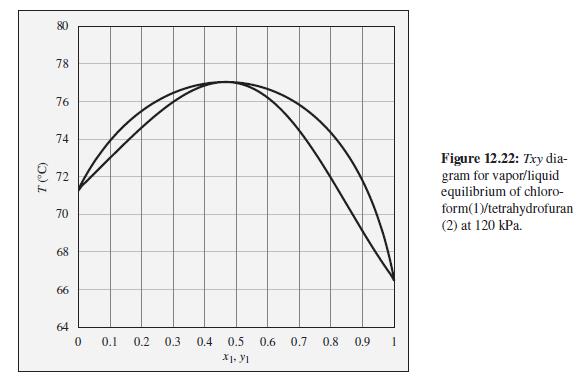
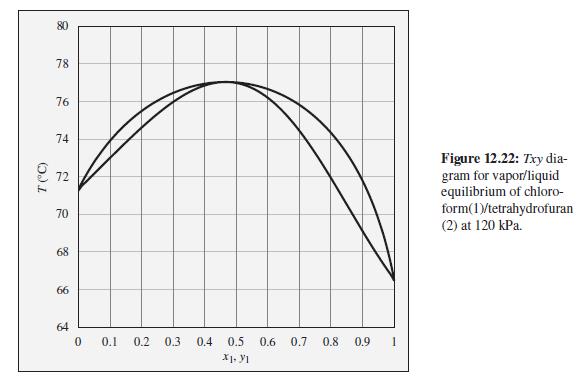
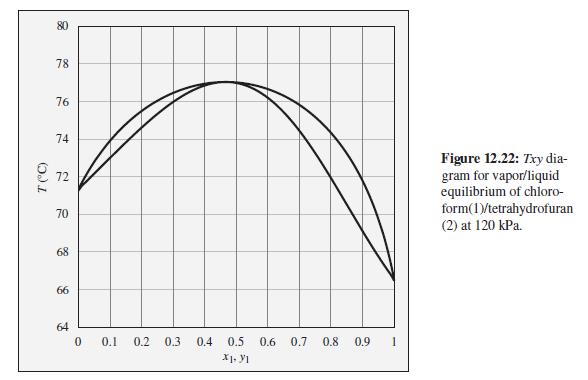
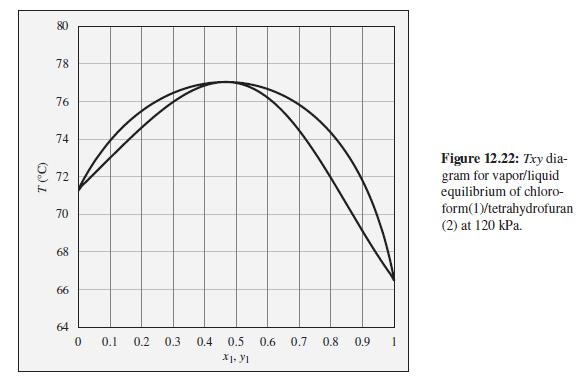
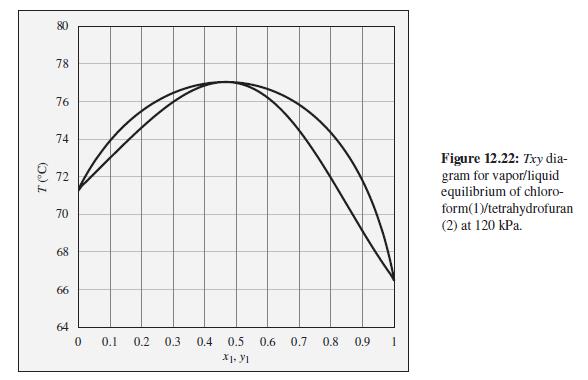
A mixture of chloroform and tetrahydrofuran is heated in a closed system at 120 kPa to a temperature of 75°C, and two phases are observed to be present. What are the possible compositions of the liquid and vapor phases?To the Txy diagram for chloroform(1)/tetrahydrofuran(2) at 120 kPa shown in
A chloroform and tetrahydrofuran mixture is heated in a closed system at 120 kPa to a temperature of 70°C, and two phases are observed to be present. What are the possible compositions of the liquid and vapor phases?To the Txy diagram for chloroform(1)/tetrahydrofuran(2) at 120 kPa shown in Fig.
Consider a chloroform(1)/tetrahydrofuran(2) mixture with x1 = 0.80, initially at 70°C and 120 kPa. Describe the evolution of phases and phase compositions as the temperature is gradually increased to 80°C.To the Txy diagram for chloroform(1)/tetrahydrofuran(2) at 120 kPa shown in Fig. 12.22.
Consider a chloroform(1)/tetrahydrofuran(2) mixture with x1 = 0.20, initially at 70°C and 120 kPa. Describe the evolution of phases and phase compositions as the temperature is gradually increased to 80°C.To the Txy diagram for chloroform(1)/tetrahydrofuran(2) at 120 kPa shown in Fig. 12.22.
Consider a chloroform(1)/tetrahydrofuran(2) mixture with x1 = 0.10, initially at 80°C and 120 kPa. Describe the evolution of phases and phase compositions as the temperature is gradually reduced to 70°C.To the Txy diagram for chloroform(1)/tetrahydrofuran(2) at 120 kPa shown in Fig. 12.22.
Consider a chloroform(1)/tetrahydrofuran(2) mixture with x1 = 0.90, initially at 76°C and 120 kPa. Describe the evolution of phases and phase compositions as the temperature is gradually reduced to 66°C.To the Txy diagram for chloroform(1)/tetrahydrofuran(2) at 120 kPa shown in Fig. 12.22.
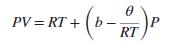
A certain gas is described by the equation of state:Here, b is a constant and θ is a function of T only. For this gas, determine expressions for the isothermal compressibility κ and the thermal pressure coefficient (∂P/∂T)V. These expressions should contain only T, P, θ, dθ/dT, and
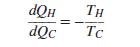
A Carnot engine operates between an infinite hot reservoir and a finite cold reservoir of total heat capacity CtC.(a) Determine an expression for the work obtained as a function of CtC, TH (= constant), TC, and the initial cold-reservoir temperature TC0.(b) What is the maximum work obtainable? This
A single gas stream enters a process at conditions T1, P1, and leaves at pressure P2. The process is adiabatic. Prove that the outlet temperature T2 for the actual (irreversible) adiabatic process is greater than that for a reversible adiabatic process. Assume the gas is ideal with constant heat
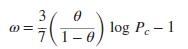
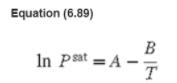
Assuming the validity of Eq. (6.89), derive Edmister’s formula for estimation of the acentric factor:where θ ≡ Tn / Tc , Tn is the normal boiling point, and Pc is in (atm). 3 log P. - 1 1-0
A vessel contains 1 kg of H2O as liquid and vapor in equilibrium at 1000 kPa. If the vapor occupies 70% of the volume of the vessel, determine H and S for the 1 kg of H2O.
Show that isobars and isochores have positive slopes in the single-phase regions of a TS diagram. Suppose that CP = a + bT, where a and b are positive constants. Show that the curvature of an isobar is also positive. For specified T and S, which is steeper: an isobar or an isochore? Why? Note that
Show that the Clapeyron equation for liquid/vapor equilibrium may be written in the reduced form: d In Psat lv ΔΗ lv AH where AH = RT. dT, TAZ
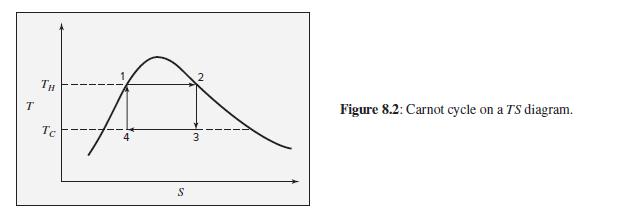
A Carnot engine with H2O as the working fluid operates on the cycle shown in Fig. 8.2. The H2O circulation rate is 1 kg⋅s−1. For TH = 475 K and TC = 300 K, determine:(a) The pressures at states 1, 2, 3, and 4.(b) The quality xv at states 3 and 4.(c) The rate of heat addition.(d) The rate of
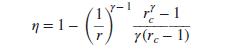
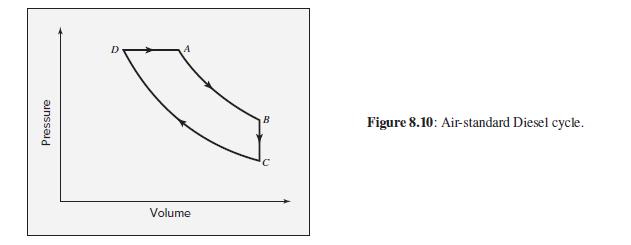
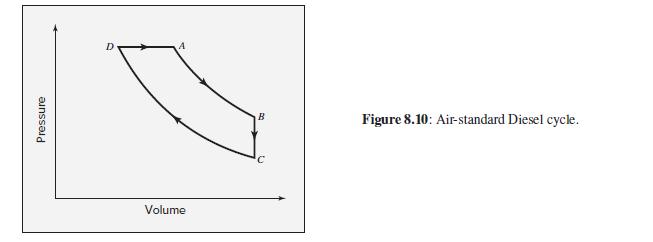
For comparison of Diesel- and Otto-engine cycles:(a) Show that the thermal efficiency of the air-standard Diesel cycle can be expressed aswhere r is the compression ratio and rc is the cutoff ratio, defined as rc = VA/VD. (See Fig. 8.10.)(b) Show that for the same compression ratio the thermal
An air-standard Diesel cycle absorbs 1500 J⋅mol−1 of heat (step DA of Fig. 8.10, which simulates combustion). The pressure and temperature at the beginning of the compression step are 1 bar and 20°C, and the pressure at the end of the compression step is 4 bar. Assuming air to be an ideal gas
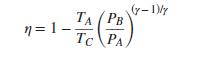
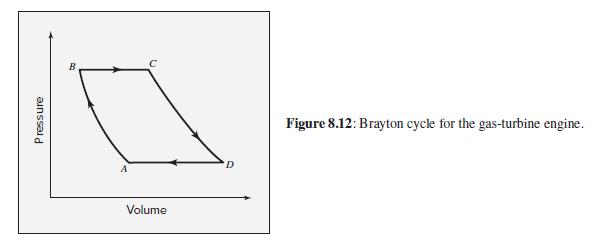
An air-standard gas-turbine cycle is modified by the installation of a regenerative heat exchanger to transfer energy from the air leaving the turbine to the air leaving the compressor. In an optimum countercurrent exchanger, the temperature of the air leaving the compressor is raised to that of
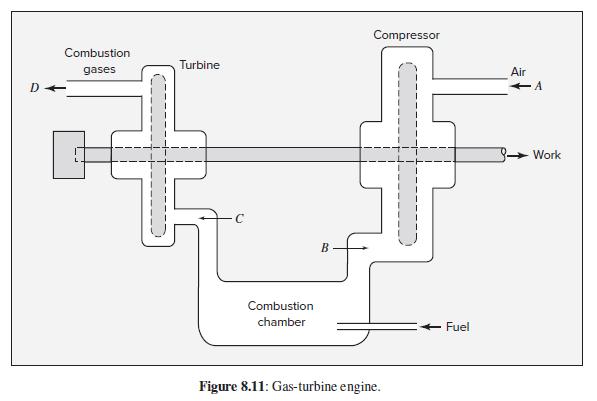
Air enters a gas-turbine engine (see Fig. 8.11) at 305 K and 1.05 bar and is compressed to 7.5 bar. The fuel is methane at 300 K and 7.5 bar; compressor and turbine efficiencies are each 80%. For one of the turbine inlet temperatures TC given below, determine: the molar fuel to-air ratio, the net
Air-standard power cycles are conventionally displayed on PV diagrams. An alternative is the PT diagram. Sketch air-standard cycles on PT diagrams for the following:(a) Carnot cycle(b) Otto cycle(c) Diesel cycle(d) Brayton cycleWhy would a PT diagram not be helpful for depicting power cycles
Devise a general scheme for analyzing four-step air-standard power cycles. Model each step of the cycle as a polytropic process described byPVδ = constantwhich implies thatTP(1 − δ) ⁄δ = constantwith a specified value of δ. Decide which states to fix, partially or completely, by values of T
An easy way to rationalize definitions of cycle performance is to think of them as:Thus, for an engine, thermal efficiency is η = |W|/|QH|; for a refrigerator, the coefficient of performance is ω = |QC|/|W|. Define a coefficient of performance ϕ for a heat pump. What is ϕ for a Carnot
In comparing the performance of a real cycle with that of a Carnot cycle, one has in principle a choice of temperatures to use for the Carnot calculation. Consider a vapor-compression refrigeration cycle in which the average fluid temperatures in the condenser and evaporator are TH and TC,
Rework the preceding problem for methane entering at 200 bar and precooled to 240 K by external refrigeration.
The condenser of a home refrigerator is commonly underneath the appliance; thus, the condensing refrigerant exchanges heat with household air, which has an average temperature of about 21°C. It is proposed to reconfigure a refrigerator so that the condenser is outside the home, where the average
A common misconception is that the coefficient of performance of a refrigerator must be less than unity. In fact, this is rarely the case. To see why, consider a real refrigerator for which ω = 0.6 ωCarnot. What condition must be satisfied in order for ω < 1? Assume that TH is fixed.
What is the partial molar temperature? What is the partial molar pressure? Express results in relation to the T and P of the mixture.
Show that:(a) The “partial molar mass” of a species in solution is equal to its molar mass.(b) A partial specific property of a species in solution is obtained by division of the partial molar property by the molar mass of the species.
For the system methane(1)/ethane(2)/propane(3) as a gas, estimate(a) Through application of Eq. (10.64).(b) Assuming that the mixture is an ideal solution.(a) Eq. (10.64)where the dummy indices i and j run over all species, andwith fi. f2, f3. d1, 42. and 3 at t= 100°C, P = 35 bar, yı = 0.21, and
Given below are values of GE /J·mol−1, HE /J·mol−1, and CEP / J · mol −1· K−1 for some equimolar binary liquid mixtures at 298.15 K. Estimate values of GE, HE, and SE at 328.15 K for one of the equimolar mixtures by two procedures: (I) Use all the data; (II) Assume CEP = 0. Compare
If the molar density of a binary mixture is given by the empirical expression:find the corresponding expressions for V̅1 and V̅2 p= ag + ajx1 +a2xf
For a ternary solution at constant T and P, the composition dependence of molar property M is given by:M = x1 M1 + x2 M2 + x3 M3 + x1 x2 x3Cwhere M1, M2, and M3 are the values of M for pure species 1, 2, and 3, and C is a parameter independent of composition. Determine expressions for M̅1,
For a particular binary liquid solution at constant T and P, the molar enthalpies of mixtures are represented by the equation H = x1
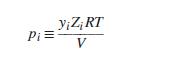
A pure-component pressure pi for species i in a gas mixture may be defined as the pressure that species i would exert if it alone occupied the mixture volume. Thus,where yi is the mole fraction of species i in the gas mixture, Zi is evaluated at pi and T, and V is the molar volume of the gas
If for a binary solution one starts with an expression for M (or MR or ME) as a function of x1 and applies Eqs. (10.15) and (10.16) to find M̅1 and M̅2 (or M̅R1and M̅R2 or M̅E1 and M̅E2) and then combines these expressions by Eq. (10.11), the initial expression for M is regenerated. On the
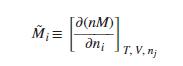
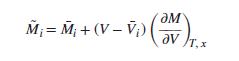
Analogous to the conventional partial property M̅i , one can define a constant-T, V partial property M̅i :Show that M̅i and M̅i are related by the equation:Demonstrate that the M̅i satisfy a summability relation, M = Σi xi M̅i. [a(nM)] T, V, nj
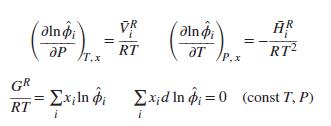
Justify the following equations: ( - VR aln ƏT P.x RT RT2 T.x GR Ex, In ộ Exd In ộ = 0 (const T, P) RT
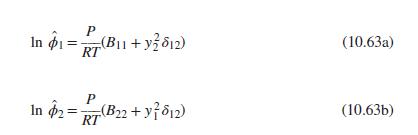
For the system ethylene(1)/propylene(2) as a gas, estimate(a) Through application of Eqs. (10.63).(b) Assuming that the mixture is an ideal solution.(a) Eqs. (10.63) fi. f2, ô1, and 2 at t = 150°C, P = 30 bar, and y1 = 0.35: %3D
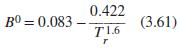
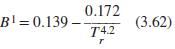
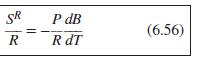
Make use of Eqs. (3.36), (3.61), (3.62), (6.54), (6.55), (6.56), (6.70), (6.71), (10.62), and (10.69)–(10.74), to estimate V, HR, SR, and GR for one of the following binary vapor mixtures:(a) Acetone(1)/1,3-butadiene(2) with mole fractions y1 = 0.28 and y2 = 0.72 at t = 60°C and P = 170 kPa.(b)
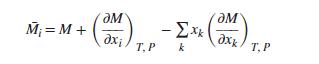
For a multicomponent mixture containing any number of species, prove thatwhere the summation is over all species. Show that for a binary mixture this result reduces to Eqs. (10.15) and (10.16).Eq. (10.15) & (10.16) ƏM M; = M + (), - Σx Т, Р k Т, Р
Rationalize the following expression, valid at sufficiently low pressures, for estimating the fugacity coefficient: ln ϕ ≈ Z − 1.
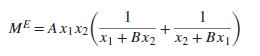
The following empirical two-parameter expression has been proposed for correlation of excess properties of symmetrical liquid mixtures:Here, quantities A and B are parameters that depend at most on T.(a) Determine from the given equation the implied expressions for M̅E1 and M̅E2 .(b) Show that
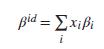
An engineer claims that the volume expansity of an ideal solution is given byIs this claim valid? If so, show why. If not, find a correct expression for βid. pid = Exißi %3D i
Laboratory A reports the following results for equimolar values of GE for liquid mixtures of benzene(1) with 1-hexanol(2):GE = 805 J·mol−1 at T = 298 K GE = 785 J·mol−1 at T = 323 KLaboratory B reports the following result for the equimolar value of HE for the same system:HE = 1060
The following expressions have been proposed for the partial molar properties of a particular binary mixture:M̅1 = M1 + Ax2 M̅2 = M2 + Ax1Here, parameter A is a constant. Can these expressions possibly be correct? Explain.
Two (2) kmol·hr−1 of liquid n-octane (species 1) are continuously mixed with 4 kmol·hr−1 of liquid iso-octane (species 2). The mixing process occurs at constant T and P; mechanical power requirements are negligible.(a) Use an energy balance to determine the rate of heat transfer.(b) Use an
Fifty (50) mol·s−1 of enriched air (50 mol-% N2, 50 mol-% O2) are produced by continuously combining air (79 mol-% N2, 21 mol-% O2) with a stream of pure oxygen.All streams are at the constant conditions T = 25°C and P = 1.2(atm). There are no moving parts.(a) Determine the rates of air and
A simple expression for ME of a symmetrical binary system is ME = Ax1x2. However, countless other empirical expressions can be proposed which exhibit symmetry. How suitable would the two following expressions be for general application?(a) ME = Ax21 x22 ;(b) ME = A sin (πx1)
Commonly, if ME for a binary system has a single sign, then the partial properties M̅E1 and M̅E2 have the same sign as ME over the entire composition range. There are occasions, however, where the M̅Ei may change sign even though ME has a single sign. In fact, it is the shape of the
At 25°C and atmospheric pressure the volume change of mixing of binary liquid mixtures of species 1 and 2 is given by the equationΔV = x1 x2 (45x1 + 25x2)where ΔV is in cm3·mol−1. At these conditions, V1 = 110 and V2 = 90 cm3·mol−1. Determine the partial molar volumes V̅1 and
Following are data for GE and HE (both in J·mol−1) for equimolar mixtures of the same organic liquids. Use all of the data to estimate values of GE, HE, and TSE for the equimolar mixture at 25°C.∙ At T = 10°C: GE = 544.0, HE = 932.1∙ At T = 30°C: GE = 513.2, HE = 893.4∙ At T = 50°C: GE
The volume change of mixing (cm3·mol−1) for the system ethanol(1)/methyl butyl ether(2) at 25°C is given by the equationΔV = x1 x2 [ − 1.026 + 0.0220 (x1− x2)]Given that V1 = 58.63 and V2 = 118.46 cm3·mol−1, what volume of mixture is formed when 750 cm3 of pure species 1 is mixed
Starting with Eq. (6.9), show that isobars in the vapor region of a Mollier (HS) diagram must have positive slope and positive curvature.Eq. (6.9) dH = T dS + V dP (6.9)
The PVT behavior of a certain gas is described by the equation of state:P (V−b) = RTwhere b is a constant. If in addition CV is constant, show that:(a) U is a function of T only.(b) γ = const.(c) For a mechanically reversible process, P ( V − b )γ = const.
A pure fluid is described by the canonical equation of state: G = Γ ( T ) + RT ln P, where Γ(T ) is a substance-specific function of temperature. Determine for such a fluid expressions for V, S, H, U, CP, and CV. These results are consistent with those for an important model of gas-phase
A pure fluid, described by the canonical equation of state: G = F(T) + KP, where F(T) is a substance-specific function of temperature and K is a substance-specific constant. Determine for such a fluid expressions for V, S, H, U, CP, and CV. These results are consistent with those for an important
Determine expressions for GR, HR, and SR implied by the three-term virial equation in volume, Eq. (3.38).Eq. (3.38) PV 1+ RT B C Z= (3.38) %3! V V2
Determine expressions for GR, HR, and SR implied by the van der Waals equation of state, Eq. (3.39).Eq. (3.39) RT a (3.39) %3D V - b
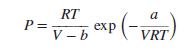
Determine expressions for GR, HR, and SR implied by the Dieterici equation:Here, parameters a and b are functions of composition only. RT а P = V - b exp - VRT
The state of 1(lbm) of steam is changed from saturated vapor at 20 (psia) to superheated vapor at 50 (psia) and 1000(°F). What are the enthalpy and entropy changes of the steam? What would the enthalpy and entropy changes be if steam were an ideal gas?
Propane gas at 100°C is compressed isothermally from an initial pressure of 1 bar to a final pressure of 10 bar. Estimate ΔH and ΔS.
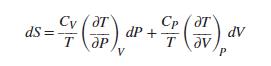
Prove thatFor an ideal gas with constant heat capacities, use this result to derive Eq. (3.23c).Eq. (3.23c) Cy ( aT Cp ( aT ds = dP + dV T av P V
A tank of 4 m3 capacity contains 1500 kg of liquid water at 250°C in equilibrium with its vapor, which fills the rest of the tank. A quantity of 1000 kg of water at 50°C is pumped into the tank. How much heat must be added during this process if the temperature in the tank is not to change?
A well-insulated tank of 50 m3 volume initially contains 16,000 kg of water distributed between liquid and vapor phases at 25°C. Saturated steam at 1500 kPa is admitted to the tank until the pressure reaches 800 kPa. What mass of steam is added?
Starting with Eq. (6.9), show that isotherms in the vapor region of a Mollier (HS) diagram have slopes and curvatures given by:Here, β is volume expansivity. If the vapor is described by the two-term virial equation in P, Eq. (3.36), what can be said about the signs of these derivatives? Assume
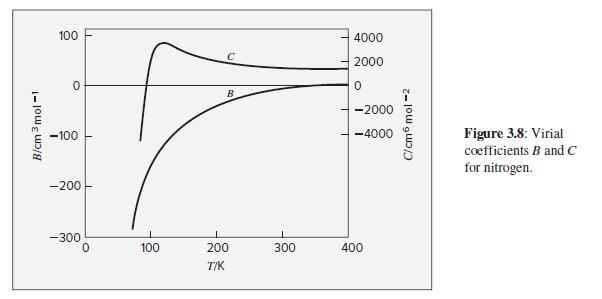
The temperature dependence of the second virial coefficient B is shown for nitrogen in Fig. 3.8. Qualitatively, the shape of B(T) is the same for all gases; quantitatively, the temperature for which B = 0 corresponds to a reduced temperature of about Tr = 2.7 for many gases. Use these observations
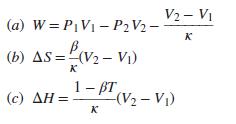
For the reversible isothermal compression of a liquid for which β and κ may be assumed independent of pressure, show that:Do not assume that V is constant at an average value, but use Eq. (3.6) for its P dependence (with V2 replaced by V). Apply these equations to the conditions stated in
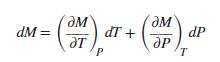
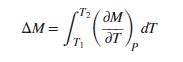
In general for an arbitrary thermodynamic property of a pure substance, M = M(T,P); whenceFor what two distinct conditions is the following equation true? ƏM dT + ƏT we, dM = dP dP T
The enthalpy of a pure ideal gas depends on temperature only. Hence, Hig is often said to be “independent of pressure,” and one writes (∂Hig / ∂P)T = 0 . Determine expressions for (∂Hig / ∂P)V and (∂Hig / ∂P)S . Why are these quantities not zero?
As noted in Ex. 6.6, Δ H lv is not independent of T; in fact, it becomes zero at the critical point. Nor may saturated vapors in general be considered ideal gases. Why is it then that Eq. (6.89) provides a reasonable approximation to vapor-pressure behavior over the entire liquid range?Exercises
The derivative (∂U / ∂V)T is sometimes called the internal pressure and the product T(∂P / ∂T)V the thermal pressure. Find equations for their evaluation for:(a) An ideal gas;(b) A van der Waals fluid;(c) A Redlich/Kwong fluid.
(a) A pure substance is described by an expression for G(T, P). Show how to determine Z, U, and CV, in relation to G, T, and P and/or derivatives of G with respect to T and P.(b) A pure substance is described by an expression for A(T, V). Show how to determine Z, H, and CP, in relation to A, T, and
Rationalize the following approximate expressions for solid/liquid saturation pressures:(a) Psatsl = A + BT ;(b) Psatsl = A + BlnT
Real-gas behavior for turbomachinery is sometimes empirically accommodated through the expression Ẇ = 〈Z〉 Ẇig , where Ẇig is the ideal-gas mechanical power and 〈Z〉 is some suitably defined average value of the compressibility factor.(a) Rationalize this expression.(b) Devise a turbine
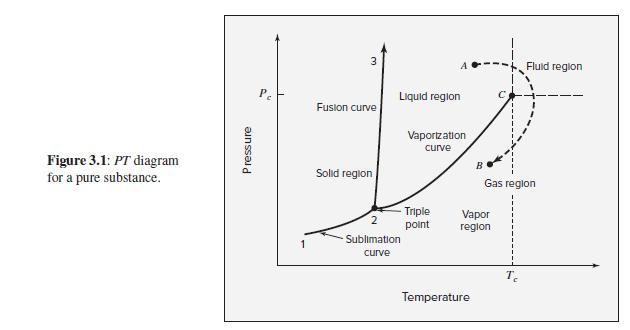
As suggested by Fig. 3.1, the slope of the sublimation curve at the triple point is generally greater than that of the vaporization curve at the same state. Rationalize this observation. Note that triple-point pressures are usually low; hence assume for this exercise that Δ Zsv ≈ Δ
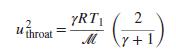
An ideal gas with constant heat capacities enters a converging/diverging nozzle with negligible velocity. If it expands isentropically within the nozzle, show that the throat velocity is given by:where T1 is the temperature of the gas entering the nozzle, ℳ is the molar mass, and R is the molar
A gas enters a converging nozzle at pressure P1 with negligible velocity, expands isentropically in the nozzle, and discharges into a chamber at pressure P2. Sketch graphs showing the velocity at the throat and the mass flow rate as functions of the pressure ratio P2 /P1.
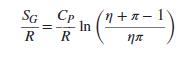
For an adiabatic gas compressor, the efficiency with respect to isentropic operation η is a measure of internal irreversibilities; so is the dimensionless rate of entropy generation SG /R ≡ ṠG /(ṅ R). Assuming that the gas is ideal with constant heat capacities, show that η and SG /R are
For isentropic expansion in a converging/diverging nozzle with negligible entrance velocity, sketch graphs of mass flow rate ṁ, velocity u, and area ratio A/A1 versus the pressure ratio P/P1. Here, A is the cross-sectional area of the nozzle at the point in the nozzle where the pressure is P, and
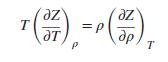
For a pressure-explicit equation of state, prove that the Joule/Thomson inversion curve is the locus of states for which:Apply this equation to (a) the van der Waals equation; (b) the Redlich/Kwong equation. Discuss the results. ze dp T ze T
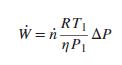
A fan is (in effect) a gas compressor which moves large volumes of air at low pressure across small (1 to 15 kPa) pressure differences. The usual design equation is:where subscript 1 denotes inlet conditions and η is the efficiency with respect to isentropic operation. Develop this equation. Show
Two nonconducting tanks of negligible heat capacity and of equal volume initially contain equal quantities of the same ideal gas at the same T and P. Tank A discharges to the atmosphere through a small turbine in which the gas expands isentropically; tank B discharges to the atmosphere through a
Turbines can be used to recover energy from high-pressure liquid streams. However, they are not used when the high-pressure stream is a saturated liquid. Why? Illustrate by determining the downstream state for isentropic expansion of saturated liquid water at 5 bar to a final pressure of 1 bar.
Showing 1900 - 2000
of 2105
First
8
9
10
11
12
13
14
15
16
17
18
19
20
21
22
Step by Step Answers

 Get 50% OFF
Claim Now
Get 50% OFF
Claim Now