New Semester
Started
Get
50% OFF
Study Help!
--h --m --s
Claim Now
Question Answers
Textbooks
Find textbooks, questions and answers
Oops, something went wrong!
Change your search query and then try again
S
Books
FREE
Study Help
Expert Questions
Accounting
General Management
Mathematics
Finance
Organizational Behaviour
Law
Physics
Operating System
Management Leadership
Sociology
Programming
Marketing
Database
Computer Network
Economics
Textbooks Solutions
Accounting
Managerial Accounting
Management Leadership
Cost Accounting
Statistics
Business Law
Corporate Finance
Finance
Economics
Auditing
Tutors
Online Tutors
Find a Tutor
Hire a Tutor
Become a Tutor
AI Tutor
AI Study Planner
NEW
Sell Books
Search
Search
Sign In
Register
study help
engineering
introduction to chemical engineering thermodynamics
Introduction To Chemical Engineering Thermodynamics 8th Edition J.M. Smith, Hendrick Van Ness, Michael Abbott, Mark Swihart - Solutions
A small adiabatic air compressor is used to pump air into a 20-m3 insulated tank. The tank initially contains air at 25°C and 101.33 kPa, exactly the conditions at which air enters the compressor. The pumping process continues until the pressure in the tank reaches 1000 kPa. If the process is
Show that the points on the Joule/Thomson inversion curve [for which μ = (∂T/∂P)H = 0] are also characterized by each of the following: ze = 0; G), (*), (a) (b) = 0; (c) (d) = 0; T P dP. (e) V av T +T = 0 V
Demonstrate that the power requirement for compressing a gas is smaller the more complex the gas. Assume fixed values of ṅ, η, T1, P1, and P2, and that the gas is ideal with constant heat capacities.
Air is compressed in a steady-flow compressor, entering at 1.2 bar and 300 K and leaving at 5 bar and 500 K. Operation is nonadiabatic, with heat transfer to the surroundings at 295 K. For the same change in state of the air, is the mechanical-power requirement per mole of air greater or less for
A boiler house produces a large excess of low-pressure [50(psig), 5(°F)-superheat] steam. An upgrade is proposed that would first run the low-pressure steam through an adiabatic steady-flow compressor, producing medium-pressure [150(psig)] steam A young engineer expresses concern that
Liquid benzene at 25°C and 1.2 bar is converted to vapor at 200°C and 5 bar in a twostep steady-flow process: compression by a pump to 5 bar, followed by vaporization in a counterflow heat exchanger. Determine the power requirement of the pump and the duty of the exchanger in kJ⋅mol−1. Assume
Operating data are taken on an air turbine. For a particular run, P1 = 8 bar, T1 = 600 K, and P2 = 1.2 bar. However, the recorded outlet temperature is only partially legible; it could be T2 = 318, 348, or 398 K. Which must it be? For the given conditions, assume air to be an ideal gas with
The infinite heat reservoir is an abstraction, often approximated in engineering applications by large bodies of air or water. Apply the closed-system form of the energy balance [Eq. (2.3)] to such a reservoir, treating it as a constant-volume system. How is it that heat transfer to or from the
Liquid benzene at 25°C and 1.2 bar is converted to vapor at 200°C and 5 bar in a two-step steady-flow process: vaporization in a counter flow heat exchanger at 1.2 bar, followed by compression as a gas to 5 bar. Determine the duty of the exchanger and the power requirement of
Of the processes proposed in Probs. 7.50 and 7.51, which would you recommend? Why?Problem 7.50Liquid benzene at 25°C and 1.2 bar is converted to vapor at 200°C and 5 bar in a twostep steady-flow process: compression by a pump to 5 bar, followed by vaporization in a counterflow heat exchanger.
Liquids (identified below) at 25°C are completely vaporized at 1(atm) in a countercurrent heat exchanger. Saturated steam is the heating medium, available at four pressures: 4.5, 9, 17, and 33 bar. Which variety of steam is most appropriate for each case? Assume a minimum approach ΔT of 10°C for
Show how the general rate form of the entropy balance, Eq. (5.16), reduces to Eq. (5.2) for the case of a closed system.Eq. (5.16)Eq. (5.2) d(mS)cv + A(Sm)fs- E = ŠG 2 0 To.j (5.16) dt
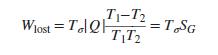
Consider the direct heat transfer from a heat reservoir at T1 to another heat reservoir at temperature T2, where T1 > T2 > Tσ. It is not obvious why the lost work of this process should depend on Tσ, the temperature of the surroundings, because the surroundings are not involved in the
Four different types of drivers for gas compressors are: electric motors, gas expanders, steam turbines, and internal-combustion engines. Suggest when each might be appropriate. How would you estimate operating costs for each of these drivers? Ignore such add-ons as maintenance, operating labor,
Consider the air conditioning of a house through use of solar energy. At a particular location, experiment has shown that solar radiation allows a large tank of pressurized water to be maintained at 175°C. During a particular time interval, heat in the amount of 1500 kJ must be extracted from the
Two schemes are proposed for the reduction in pressure of ethylene gas at 375 K and 18 bar to 1.2 bar in a steady-flow process:(a) Pass it through a throttle valve.(b) Send it through an adiabatic expander of 70% efficiency.For each proposal, determine the downstream temperature, and the rate of
An ideal gas at 2500 kPa is throttled adiabatically to 150 kPa at the rate of 20 mol·s–1. Determine ṠG and Ẇlost if Tσ = 300 K.
Consider the heating of a house by a furnace, which serves as a heat source reservoir at a high temperature TF. The house acts as a heat sink reservoir at temperature T, and heat |Q| must be added to the house during a particular time interval to maintain this temperature. Heat |Q| can of course be
Prove that the mean heat capacities ⟨CP⟩H and ⟨CP⟩S are inherently positive, whether T > T0 or T < T0. Explain why they are well defined for T = T0.
Reversible adiabatic processes are isentropic. Are isentropic processes necessarily reversible and adiabatic? If so, explain why; if not, give an illustrative example.
A mass m of liquid water at temperature T1 is mixed adiabatically and isobarically with an equal mass of liquid water at temperature T2. Assuming constant CP, showand prove that this is positive. What would be the result if the masses of the water were different, say, m1 and m2? (T1 + T2)/2 AS' =
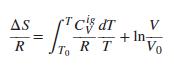
For an ideal gas prove that: AS c dT V + In, Vo R To R T
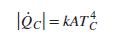
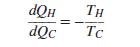
A heat engine operating in outer space may be assumed equivalent to a Carnot engine operating between reservoirs at temperatures TH and TC . The only way heat can be discarded from the engine is by radiation, the rate of which is given (approximately) by:where k is a constant and A is the area of
A Carnot engine operates between two finite heat reservoirs of total heat capacity C tH and CtC(a) Develop an expression relating TC to TH at any time.(b) Determine an expression for the work obtained as a function of C tH, CtC , TH , and the initial temperatures TH0 and TC0 .(c)
For an ideal gas with constant heat capacities, show that:(a) For a temperature change from T1 to T2, ΔS of the gas is greater when the change occurs at constant pressure than when it occurs at constant volume.(b) For a pressure change from P1 to P2, the sign of ΔS for an isothermal change
An ideal gas, CP = (7/2)R, is heated in a steady-flow heat exchanger from 70°C to 190°C by another stream of the same ideal gas which enters at 320°C. The flow rates of the two streams are the same, and heat losses from the exchanger are negligible.(a) Calculate the molar entropy changes of the
With respect to 1 kg of liquid water:(a) Initially at 0°C, it is heated to 100°C by contact with a heat reservoir at 100°C. What is the entropy change of the water? Of the heat reservoir? What is ΔStotal?(b) Initially at 0°C, it is first heated to 50°C by contact with a heat reservoir at
Which is the more effective way to increase the thermal efficiency of a Carnot engine: to increase TH with TC constant, or to decrease TC with TH constant? For a real engine, which would be the more practical way?
A natural-gas fuel contains 85 mol-% methane, 10 mol-% ethane, and 5 mol-% nitrogen.(a) What is the standard heat of combustion (kJ·mol−1) of the fuel at 25°C with H2O(g) as a product?(b) The fuel is supplied to a furnace with 50% excess air, both entering at 25°C. The products leave at
Saturated water vapor, i.e., steam, is commonly used as a heat source in heat-exchanger applications. Why saturated vapor? Why saturated water vapor? In a plant of any reasonable size, several varieties of saturated steam are commonly available; for example, saturated steam at 4.5, 9, 17, and
The first step in the metabolism of ethanol is dehydrogenation by reaction with nicotinamide-adenine dinucleotide (NAD):
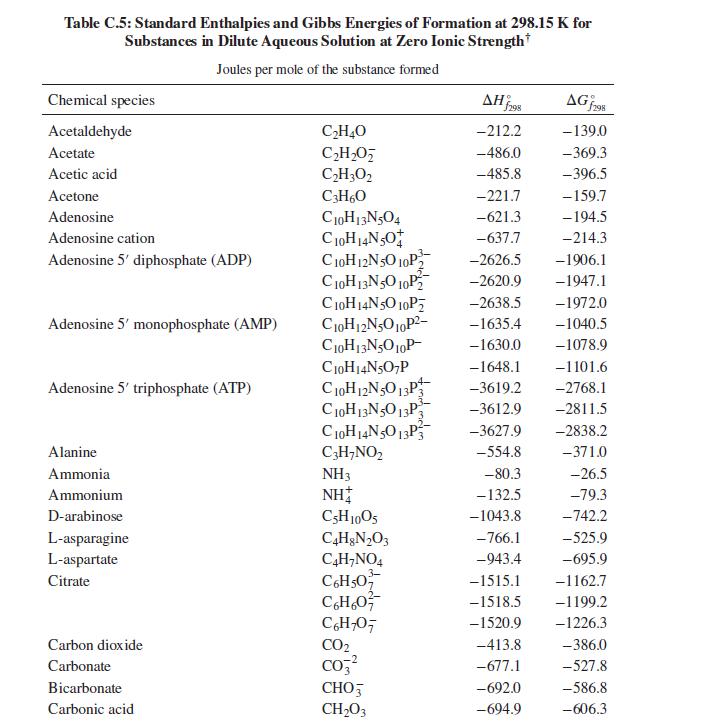
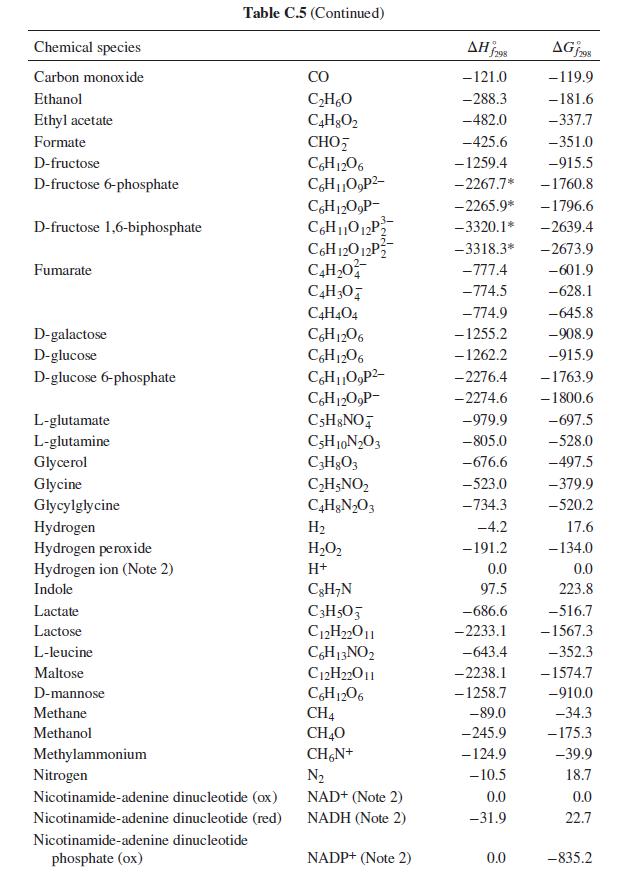
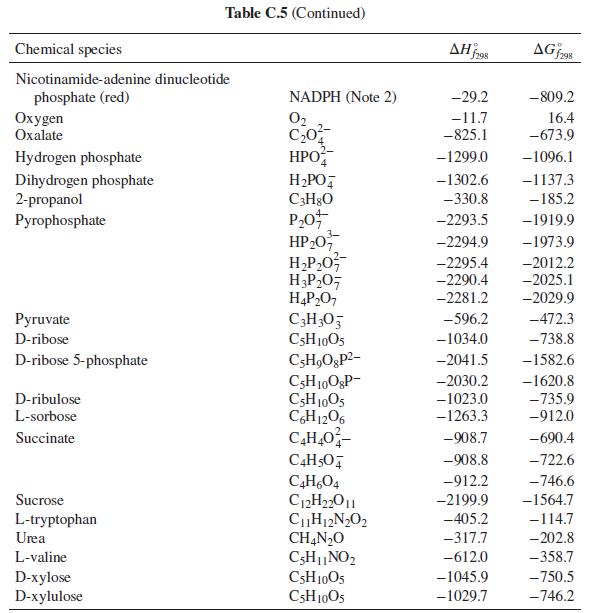
Compute the standard heat of reaction for each of the following reactions taking place at 298.15 K in dilute aqueous solution at zero ionic strength.(a) D-Glucose + ATP2− → D-Glucose 6-phosphate− + ADP−(b) D-Glucose 6-phosphate− → D-Fructose 6-phosphate−(c) D-Fructose 6-phosphate− +
Determine the standard heat for one of the reactions of Prob. 4.23: part (a) at 600°C, part (b) at 50°C, part (f) at 650°C, part (i) at 700°C, part (j) at 590(°F), part (l) at 770(°F), part (m) at 850 K, part (n) at 1300 K, part (o) at 800°C, part (r) at 450°C, part (t) at 860(°F), part
Determine the standard heat of each of the following reactions at 25°C:(a) N2(g) + 3H2(g) → 2NH3(g)(b) 4NH3(g) + 5O2(g) → 4NO(g) + 6H2O(g)(c) 3NO2(g) + H2O(l) → 2HNO3(l) + NO(g)(d) CaC2(s) + H2O(l) → C2H2(g) + CaO(s)(e) 2Na(s) + 2H2O(g) → 2NaOH(s) + H2(g)(f) 6NO2(g) + 8NH3(g) → 7N2(g)
What is the standard heat of combustion of each of the following gases at 25°C if the combustion products are H2O(l) and CO2(g)? Compute both the molar and specific heat of combustion in each case.(a) Methane(b) Ethane(c) Ethylene(d) Propane(e) Propylene(f) N-butane(g) 1-butene(h) Ethylene
For each of the following substances, compute the final temperature when heat in the amount of 60 kJ·mol−1 is added to the subcooled liquid at 25°C at atmospheric pressure.(a) Methanol(b) Ethanol(c) Benzene(d) Toluene(e) Water
A process stream is heated as a gas from 25°C to 250°C at constant P. A quick estimate of the energy requirement is obtained from Eq. (4.3), with CP taken as constant and equal to its value at 25°C. Is the estimate of Q likely to be low or high? Why?Eq. (4.3) Q = AH = CpdT (4.3)
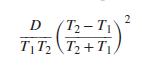
If the heat capacity of a substance is correctly represented by an equation of the form, CP = A + BT + DT−2 show that the error resulting when ⟨CP⟩H is assumed equal to CP evaluated at the arithmetic mean of the initial and final temperatures is: D (T2- T1 TT, (T2+T|
If the heat capacity of a substance is correctly represented by an equation of the form, CP = A + BT + CT2 show that the error resulting when ⟨CP⟩H is assumed equal to CP evaluated at the arithmetic mean of the initial and final temperatures is C(T2 − T1)2/12.
For a steady-flow heat exchanger with a feed temperature of 100°C, compute the outlet stream temperature when heat in the amount of 12 kJ·mol−1 is added to the following substances.(a) Methane(b) Ethane(c) Propane(d) N-butane(e) N-hexane(f) N-octane(g) Propylene(h) 1-pentene(i) 1-heptene(j)
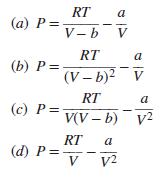
Given below are four proposed modifications of the van der Waals equation of state. Are any of these modifications reasonable? Explain carefully; statements such as, “It isn’t cubic in volume” do not qualify. RT (а) Р%3 a V- b V RT a (b) P = (V – b)? V RT a (c) P= V(V – b) v2 RT (d) P
With reference to Prob. 2.47, assume air to be an ideal gas, and develop an expression giving the household air temperature as a function of time.Problem 2.47The heating of a home to increase its temperature must be modeled as an open system because expansion of the household air at constant
A garden hose with the water valve shut and the nozzle closed sits in the sun, full of liquid water. Initially, the water is at 10°C and 6 bar. After some time the temperature of the water rises to 40°C. Owing to the increase in temperature and pressure and the elasticity of the hose, the
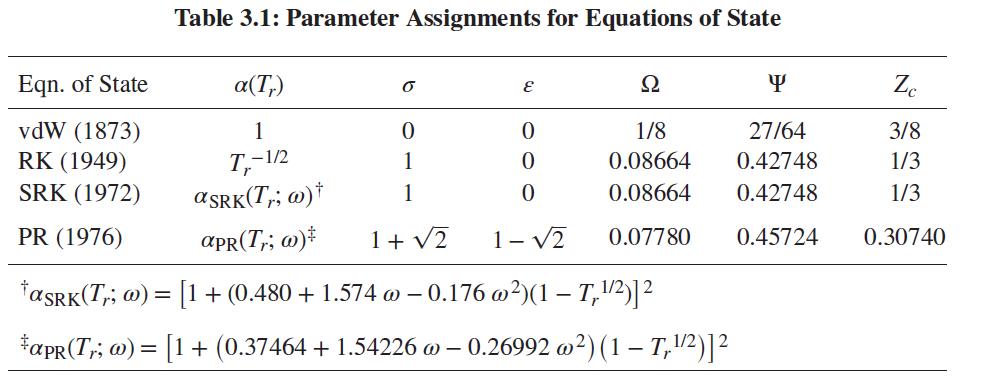
Derive the values of Ω, Ψ, and Zc given in Table 3.1 for:(a) The Redlich/Kwong equation of state.(b) The Soave/Redlich/Kwong equation of state.(c) The Peng/Robinson equation of state.Table 3.1 Table 3.1: Parameter Assignments for Equations of State Eqn. of State a(T,) Ω Ze vdW (1873) RK
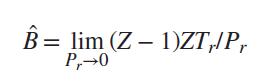
Suppose Z vs. Pr data are available at constant Tr . Show that the reduced density-series second virial coefficient can be derived from such data via the expression: B = lim (Z – 1)ZT,/P, В %D P,-0
Write the general form of an equation of state as: Z = 1 + Zrep (ρ) − Zattr (T, ρ)where Zrep(ρ) represents contributions from repulsions, and Zattr(T, ρ) represents
Show that the density-series second virial coefficients can be derived from isothermal volumetric data via the expression: B = lim(Z – 1)/p p-0 p(molar density)= 1/V -
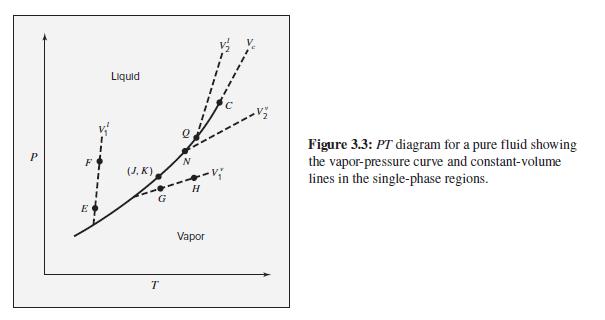
Figure 3.3 suggests that the isochores (paths of constant volume) are approximately straight lines on a P-T diagram. Show that the following models imply linear isochores.(a) Constant-β, κ equation for liquids(b) Ideal-gas equation(c) Van der Waals equationFigure 3.3 Liquid Figure 3.3: PT diagram
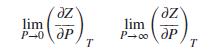
For a gas described by the Redlich/Kwong equation and for a temperature greater than Tc, develop expressions for the two limiting slopes,Note that in the limit as P → 0, V → ∞, and that in the limit as P → ∞, V → b. lim ze, lim P-0dP ӘР P-co dP T (2)
Recreational scuba diving using air is limited to depths of 40 m. Technical divers use different gas mixes at different depths, allowing them to go much deeper. Assuming a lung volume of 6 liters, estimate the mass of air in the lungs of:(a) A person at atmospheric conditions.(b) A recreational
For one of the substances in Prob. 3.62, estimate the mass of the substance contained in the size D cylinder at 20°C and 25 bar.Problems 3.62A size D compressed gas cylinder has an internal volume of 2.40 liters. Estimate the pressure in a size D cylinder if it contains 454g of one of the
A size D compressed gas cylinder has an internal volume of 2.40 liters. Estimate the pressure in a size D cylinder if it contains 454g of one of the following semiconductor process gases at 20°C:(a) Phosphine, PH3, for which Tc = 324.8 K, Pc = 65.4 bar, and ω = 0.045(b) Boron trifluoride, BF3,
Estimate:(a) The mass of ethane contained in a 0.15 m3 vessel at 60°C and 14,000 kPa.(b) The temperature at which 40 kg of ethane stored in a 0.15 m3 vessel exerts a pressure 20,000 kPa.
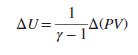
One mole of an ideal gas with constant heat capacities undergoes an arbitrary mechanically reversible process. Show that: AU=- 7-14(PV)
A substance for which κ is a constant undergoes an isothermal, mechanically reversible process from initial state (P1, V1) to final state (P2, V2), where V is molar volume.(a) Starting with the definition of κ, show that the path of the process is described by: V = A (T) exp (−κP)(b)
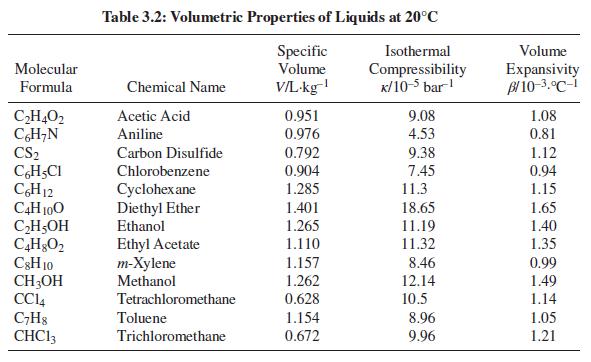
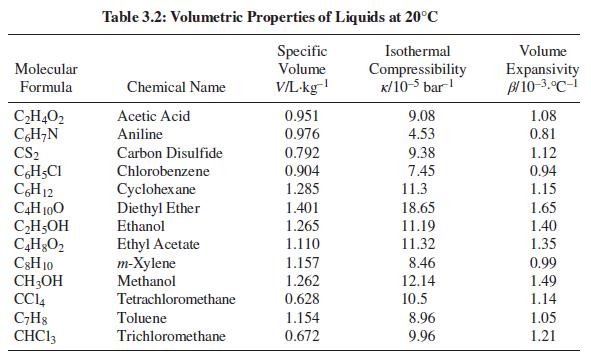
For one of the substances in Table 3.2, compute the final pressure when the substance is heated from 15°C and 1 bar to 25°C at constant volume.Table 3.2 Table 3.2: Volumetric Properties of Liquids at 20°C Specific Volume Isothermal Volume Molecular V/L-kg Compressibility K/10-5
How many phase rule variables must be specified to fix the thermodynamic state of each of the following systems?(a) A sealed flask containing a liquid ethanol-water mixture in equilibrium with its vapor.(b) A sealed flask containing a liquid ethanol-water mixture in equilibrium with its vapor and
A renowned laboratory reports quadruple-point coordinates of 10.2 Mbar and 24.1°C for four-phase equilibrium of allotropic solid forms of the exotic chemical β-miasmone. Evaluate the claim.
A closed, nonreactive system contains species 1 and 2 in vapor/liquid equilibrium. Species 2 is a very light gas, essentially insoluble in the liquid phase. The vapor phase contains both species 1 and 2. Some additional moles of species 2 are added to the system, which is then restored to its
For the system described in Prob. 3.4:(a) How many phase-rule variables in addition to T and P must be chosen so as to fix the compositions of both phases?(b) If the temperature and pressure are to remain the same, can the overall composition of the system be changed (by adding or removing
The Tait equation for liquids is written for an isotherm as:where V is molar or specific volume, V0 is the hypothetical molar or specific volume at zero pressure, and A and B are positive constants. Find an expression for the isothermal compressibility consistent with this equation. АР V = Vo В
Various species of hagfish, or slime eels, live on the ocean floor, where they burrow inside other fish, eating them from the inside out and secreting copious amounts of slime. Their skins are widely used to make eelskin wallets and accessories. Suppose a hagfish is caught in a trap at a depth of
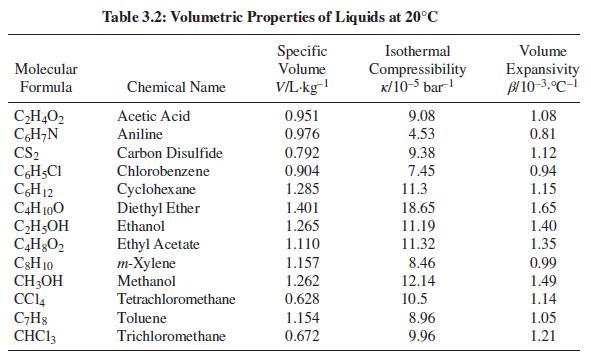
For one of the substances in Table 3.2, compute the change in volume and work done when one kilogram of the substance is heated from 15°C to 25°C at a constant pressure of 1 bar.Table 3.2 Table 3.2: Volumetric Properties of Liquids at
For one of the substances in Table 3.2, compute the change in volume and work done when one kilogram of the substance is compressed from 1 bar to 100 bar at a constant temperature of 20°C.Table 3.2 Table 3.2: Volumetric Properties of Liquids at
One mole of an ideal gas with CP = (7/2)R and CV = (5/2)R expands from P1 = 8 bar and T1 = 600 K to P2 = 1 bar by each of the following paths:(a) Constant volume;(b) Constant temperature;(c) Adiabatically.Assuming mechanical reversibility, calculate W, Q, ΔU, and ΔH for each process. Sketch
One mole of an ideal gas with CP = (5/2)R and CV = (3/2)R expands from P1 = 6 bar and T1 = 800 K to P2 = 1 bar by each of the following paths:(a) Constant volume(b) Constant temperature(c) AdiabaticallyAssuming mechanical reversibility, calculate W, Q, ΔU, and ΔH for each process. Sketch each
The state of an ideal gas with CP = (5/2)R is changed from P = 1 bar and V1t = 12 m3 to P2 = 12 bar and V2t = 1 m3 by the following mechanically reversible processes:(a) Isothermal compression.(b) Adiabatic compression followed by cooling at constant pressure.(c) Adiabatic
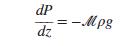
The environmental lapse rate dT/dz characterizes the local variation of temperature with elevation in the earth’s atmosphere. Atmospheric pressure varies with elevation according to the hydrostatic formula,where M is molar mass, ρ is molar density, and g is the local acceleration of gravity.
Gas at constant T and P is contained in a supply line connected through a valve to a closed tank containing the same gas at a lower pressure. The valve is opened to allow flow of gas into the tank, and then is shut again.(a) Develop a general equation relating n1 and n2, the moles (or mass) of gas
Develop equations that may be solved to give the final temperature of the gas remaining in a tank after the tank has been bled from an initial pressure P1 to a final pressure P2. Known quantities are initial temperature, tank volume, heat capacity of the gas, total heat capacity of the containing
One mole of an ideal gas in a closed system, initially at 25°C and 10 bar, is first expanded adiabatically, then heated isochorically to reach a final state of 25°C and= 1 bar. Assuming these processes are mechanically reversible, compute T and P after the adiabatic expansion, and compute Q, W,
One cubic meter of argon is taken from 1 bar and 25°C to 10 bar and 300°C by each of the following two-step paths. For each path, compute Q, W, ΔU, and ΔH for each step and for the overall process. Assume mechanical reversibility and treat argon as an ideal gas with CP = (5/2)R and CV =
A scheme for finding the internal volume VtB of a gas cylinder consists of the following steps. The cylinder is filled with a gas to a low pressure P1, and connected through a small line and valve to an evacuated reference tank of known volume VtA . The valve is opened, and gas flows through the
In addition to heat and work flows, energy can be transferred as light, as in a photovoltaic device (solar cell). The energy content of light depends on both its wavelength (color) and its intensity. When sunlight impinges on a solar cell, some is reflected, some is absorbed and converted to
Liquids that boil at relatively low temperatures are often stored as liquids under their vapor pressures, which at ambient temperature can be quite large. Thus, n-butane stored as a liquid/vapor system is at a pressure of 2.581 bar for a temperature of 300 K. Large-scale storage (>50 m3) of this
An incompressible fluid (ρ = constant) is contained in an insulated cylinder fitted with a frictionless piston. Can energy as work be transferred to the fluid? What is the change in internal energy of the fluid when the pressure is increased from P1 to P2?
Electric current is the fundamental SI electrical dimension, with the ampere (A) as its unit. Determine units for the following quantities as combinations of fundamental SI units.(a) Electric power(b) Electric charge(c) Electric potential difference(d) Electric resistance(e) Electric capacitance
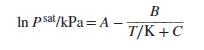
Liquid/vapor saturation pressure Psat is often represented as a function of temperature by the Antoine equation, which can be written in the form:Here, parameters a, b, and c are substance-specific constants. Suppose this equation is to be rewritten in the equivalent form:Show how the parameters in
The SI unit of luminous intensity is the candela (abbreviated cd), which is a primary unit. The derived SI unit of luminous flux is the lumen (abbreviated lm). These are based on the sensitivity of the human eye to light. Light sources are often evaluated based on their luminous efficacy, which is
An absolute pressure gauge is submerged 50 m (1979 inches) below the surface of the ocean and reads P = 6.064 bar. This is P = 2434(inches of H2O), according to the unit conversions built into a particular calculator. Explain the apparent discrepancy between the pressure measurement and the actual
In medical contexts, blood pressure is often given simply as numbers without units.(a) In taking blood pressure, what physical quantity is actually being measured?(b) What are the units in which blood pressure is typically reported?(c) Is the reported blood pressure an absolute pressure or a gauge
The annual average insolation (energy of sunlight per unit area) striking a fixed solar panel in Buffalo, New York, is 200 W ⋅ m−2, while in Phoenix, Arizona, it is 270 W ⋅ m−2. In each location, the solar panel converts 15% of the incident energy into electricity. Average annual
A wind turbine with a rotor diameter of 77m produces 1.5 MW of electrical power at a wind speed of 12 m ⋅ s−1. What fraction of the kinetic energy of the air passing through the turbine is converted to electrical power? You may assume a density of 1.25 kg ⋅ m−3 for air at the operating
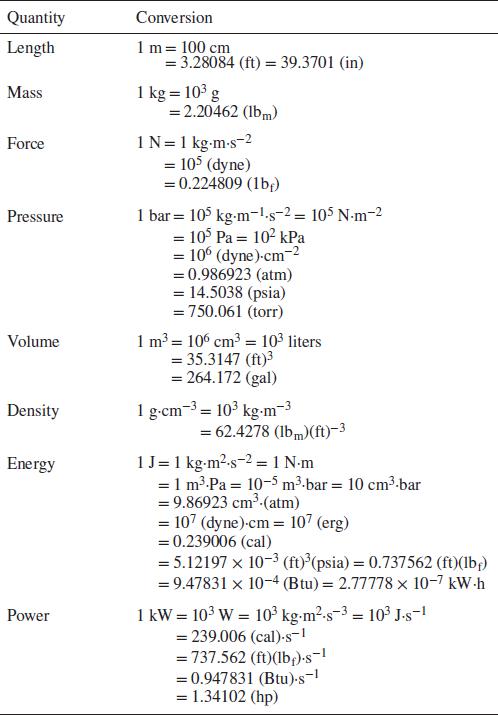
Following is a list of approximate conversion factors, useful for “back-of-the-envelope” estimates. None of them is exact, but most are accurate to within about ±10%. Use Table A.1 (App. A) to establish the exact conversions.∙ 1(atm) ≈ 1 bar∙ 1(Btu) ≈ 1 kJ∙ 1(hp) ≈ 0.75 kW∙
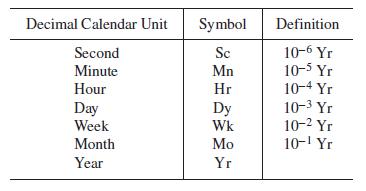
Consider the following proposal for a decimal calendar. The fundamental unit is the decimal year (Yr), equal to the number of conventional (SI) seconds required for the earth to complete a circuit of the sun. Other units are defined in the following table. Develop, where possible, factors for
Chemical-plant equipment costs rarely vary in proportion to size. In the simplest case, cost C varies with size S according to the allometric equationThe size exponent β is typically between 0 and 1. For a wide variety of equipment types it is approximately 0.6.(a) For 0 < β < 1, show that
An egg, initially at rest, is dropped onto a concrete surface and breaks. With the egg treated as the system,(a) What is the sign of W?(b) What is the sign of ΔEP?(c) What is ΔEK?(d) What is ΔUt?(e) What is the sign of Q?In modeling this process, assume the passage of sufficient time for the
An electric hand mixer draws 1.5 amperes at 110 volts. It is used to mix 1 kg of cookie dough for 5 minutes. After mixing, the temperature of the cookie dough is found to have increased by 5°C. If the heat capacity of the dough is 4.2 kJ ⋅ kg−1⋅K−1, what fraction of the electrical energy
Comment on the feasibility of cooling your kitchen in the summer by opening the door to the electrically powered refrigerator.
An electric motor runs “hot” under load, owing to internal irreversibilities. It has been suggested that the associated energy loss be minimized by thermally insulating the motor casing. Comment critically on this suggestion.
A wind turbine with a rotor diameter of 40 m produces 90 kW of electrical power when the wind speed is 8 m ⋅ s−1. The density of air impinging on the turbine is 1.2 kg ⋅ m−3. What fraction of the kinetic energy of the wind impinging on the turbine is converted to electrical energy?
The battery in a laptop computer supplies 11.1 V and has a capacity of 56 W⋅h. In ordinary use, it is discharged after 4 hours. What is the average current drawn by the laptop, and what is the average rate of heat dissipation from it? You may assume that the temperature of the computer remains
Suppose that the laptop of Prob. 2.16 is placed in an insulating briefcase with a fully charged battery, but it does not go into “sleep” mode, and the battery discharges as if the laptop were in use. If no heat leaves the briefcase, the heat capacity of the briefcase itself is negligible, and
A solid body at initial temperature T0 is immersed in a bath of water at initial temperature Tw0. Heat is transferred from the solid to the water at a rate Q̇ = K̇ (Tw – T) , where K is a constant and Tw and T are instantaneous values of the temperatures of the water and solid. Develop an
A list of common unit operations follows:(a) Single-pipe heat exchanger(b) Double-pipe heat exchanger(c) Pump(d) Gas compressor(e) Gas turbine(f) Throttle valve(g) NozzleDevelop a simplified form of the general steady-state energy balance appropriate for each operation. State carefully, and
The Reynolds number Re is a dimensionless group that characterizes the intensity of a flow. For large Re, a flow is turbulent; for small Re, it is laminar. For pipe flow, Re ≡ uρD/μ, where D is pipe diameter and μ is dynamic viscosity.(a) If D and μ are fixed, what is the effect of increasing
(a) Water flows through the nozzle of a garden hose. Find an expression for m˙ in terms of line pressure P1, ambient pressure P2, inside hose diameter D1, and nozzle outlet diameter D2. Assume steady flow, and isothermal, adiabatic operation. For liquid water modeled as an incompressible fluid, H2
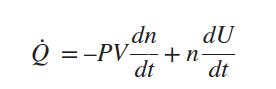
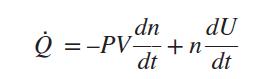
The heating of a home to increase its temperature must be modeled as an open system because expansion of the household air at constant pressure results in leakage of air to the outdoors. Assuming that the molar properties of air leaving the home are the same as those of the air in the home, show
(a) An incompressible fluid (ρ = constant) flows through a pipe of constant cross-sectional area. If the flow is steady, show that velocity u and volumetric flow rate q are constant.(b) A chemically reactive gas stream flows steadily through a pipe of constant cross-sectional area. Temperature and
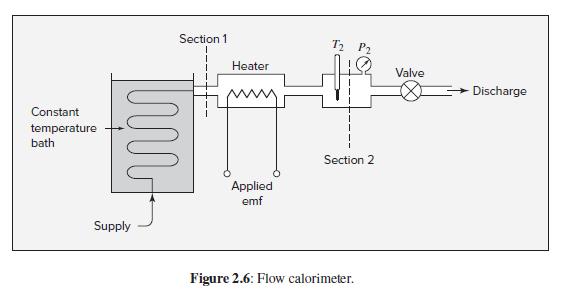
Like the flow calorimeter of Figure 2.6, a particular single-cup coffee maker uses an electric heating element to heat a steady flow of water from 22°C to 88°C. It heats 8 fluid ounces of water (with a mass of 237 g) in 60 s. Estimate the power requirement of the heater during this process. You
Showing 2000 - 2100
of 2105
First
8
9
10
11
12
13
14
15
16
17
18
19
20
21
22
Step by Step Answers

 Get 50% OFF
Claim Now
Get 50% OFF
Claim Now