New Semester
Started
Get
50% OFF
Study Help!
--h --m --s
Claim Now
Question Answers
Textbooks
Find textbooks, questions and answers
Oops, something went wrong!
Change your search query and then try again
S
Books
FREE
Study Help
Expert Questions
Accounting
General Management
Mathematics
Finance
Organizational Behaviour
Law
Physics
Operating System
Management Leadership
Sociology
Programming
Marketing
Database
Computer Network
Economics
Textbooks Solutions
Accounting
Managerial Accounting
Management Leadership
Cost Accounting
Statistics
Business Law
Corporate Finance
Finance
Economics
Auditing
Tutors
Online Tutors
Find a Tutor
Hire a Tutor
Become a Tutor
AI Tutor
AI Study Planner
NEW
Sell Books
Search
Search
Sign In
Register
study help
mathematics
first course differential equations
Differential Equations And Linear Algebra 4th Edition C. Edwards, David Penney, David Calvis - Solutions
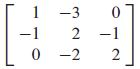
In Problems 9–22, use the method of Example 7 to find the inverse A-1 of each given matrix A. L 1 -1 -3 0 2 -1 2 bes 0-2
In Problems 15–18, find an equation of the central ellipse that passes through the three given points.(0,1), (1,0), and (10,10)
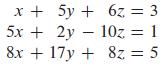
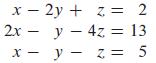
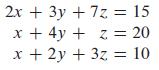
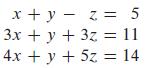
In each of Problems 1–22, use the method of elimination to determine whether the given linear system is consistent or inconsistent. For each consistent system, find the solution if it is unique; otherwise, describe the infinite solution set in terms of an arbitrary parameter t (as in Examples 5
In Problems 11–22, use elementary row operations to transform each augmented coefficient matrix to echelon form. Then solve the system by back substitution.3x1 - 6x2 + x3 + 13x4 = 153x1 - 6x2 + 3x3 + 21x4 = 212x1 - 4x2 + 5x3 + 26x4 = 23
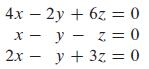
In Problems 17–22, first write each given homogeneous system in the matrix form Ax = 0. Then find the solution in vector form, as in Eq. (9).x1 - 3x2 + 6x4 = 0 x3 + 9x4 = 0 x = s(3, 4, 1,0) +(2, -3, 0, 1) = 8x₁ + 1x2. (9)
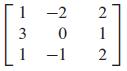
In Problems 9–22, use the method of Example 7 to find the inverse A-1 of each given matrix A. 1 3 1 -2 0 -1 212 1
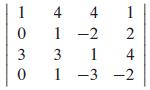
Use the method of elimination to evaluate the determinants in Problems 13–20. 1 0 3 0 C 4 4 1-2 ช 1 1 242 3 1 -3 -2
In each of Problems 1–22, use the method of elimination to determine whether the given linear system is consistent or inconsistent. For each consistent system, find the solution if it is unique; otherwise, describe the infinite solution set in terms of an arbitrary parameter t (as in Examples 5
In Problems 15–18, find an equation of the central ellipse that passes through the three given points.(0,4), (3,0), and (5,5)
In Problems 17–22, first write each given homogeneous system in the matrix form Ax = 0. Then find the solution in vector form, as in Eq. (9).x1 + 3x4 - x5 = 0 x2 - 2x4 + 6x5 =
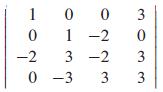
Use the method of elimination to evaluate the determinants in Problems 13–20. 100 3 0 1-2 -2 3-2 0-3 3 نرا لا لا لا 0 3 3
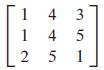
In Problems 9–22, use the method of Example 7 to find the inverse A-1 of each given matrix A. 1 4 4 1 L 2 5 35 1
In each of Problems 1–22, use the method of elimination to determine whether the given linear system is consistent or inconsistent. For each consistent system, find the solution if it is unique; otherwise, describe the infinite solution set in terms of an arbitrary parameter t (as in Examples 5
In Problems 17–22, first write each given homogeneous system in the matrix form Ax = 0. Then find the solution in vector form, as in Eq. (9).x1 - 3x2 + 7x5 = 0 x3 - 2x5 = 0
Find a curve of the form y = A + (B/x) that passes through the points (1,5) and (2,4).
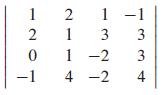
Use the method of elimination to evaluate the determinants in Problems 13–20. 1 2 0 -1 21 1-1 13 1-2 4-2 3 3 4
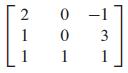
In Problems 9–22, use the method of Example 7 to find the inverse A-1 of each given matrix A. 2 1 1 0-1 0 3 1 1
Find a curve of the form y = Ax + (B/x) + (C/x2) that passes through the points (1, 2), (2, 20), and (4, 41).
Use Cramer’s rule to solve the systems in Problems 21–32.3x + 4y = 25x + 7y = 1
In Problems 17–22, first write each given homogeneous system in the matrix form Ax = 0. Then find the solution in vector form, as in Eq. (9).x1 - x3 + 2x4 + 7x5 = 0 x2 + 2x3 - 3x4 + 4x5 = 0 x = s(3, 4, 1,0) +(2, -3, 0, 1) = 8x₁ + 1x2. (9)
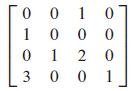
In Problems 9–22, use the method of Example 7 to find the inverse A-1 of each given matrix A. 0 0 1 0 1000 01 20 3001
In each of Problems 1–22, use the method of elimination to determine whether the given linear system is consistent or inconsistent. For each consistent system, find the solution if it is unique; otherwise, describe the infinite solution set in terms of an arbitrary parameter t (as in Examples 5
A sphere in space with center (h, k, l) and radius r has equationFour given points in space suffice to determine the values of h, k, l, and r. In Problems 21 and 22, find the center and radius of the sphere that passes through the four given points P, Q,R, and S.P(4, 6, 15), Q(13,5,7), R(5, 14, 6),
Use Cramer’s rule to solve the systems in Problems 21–32.5x + 8y = 38x + 13y = 5
In Problems 17–22, first write each given homogeneous system in the matrix form Ax = 0. Then find the solution in vector form, as in Eq. (9).x1 - x2 + 7x4 + 3x5 = 0 x3 - x4 - 2x5 = 0 x = s(3, 4,
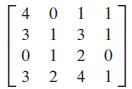
In Problems 9–22, use the method of Example 7 to find the inverse A-1 of each given matrix A. 4011 13 1 0120 3 2 4 1 3
In each of Problems 1–22, use the method of elimination to determine whether the given linear system is consistent or inconsistent. For each consistent system, find the solution if it is unique; otherwise, describe the infinite solution set in terms of an arbitrary parameter t (as in Examples 5
In Problems 23–27, determine for what values of k each system has (a) A unique solution; (b) No solution; (c) Infinitely many solutions.3x + 2y = 16x + 4y = k
In Problems 23–27, determine for what values of k each system has (a) A unique solution; (b) No solution; (c) Infinitely many solutions.3x + 2y = 06x + ky = 0
In Problems 23–27, determine for what values of k each system has (a) A unique solution; (b) No solution; (c) Infinitely many solutions.3x + 2y = 116x + ky = 21
In Problems 23–27, determine for what values of k each system has (a) A unique solution; (b) No solution; (c) Infinitely many solutions.3x + 2y = 17x + 5y = k
This problem deals with the reversibility of elementary row operations.(a) If the elementary row operation cRp changes the matrix A to the matrix B, show that (1/c) Rp changes B to A.(b) If SWAP(Rp,Rq) changes A to B, show that SWAP(Rp,Rq) also changes B to A.(c) If cRp + Rq changes A to B, show
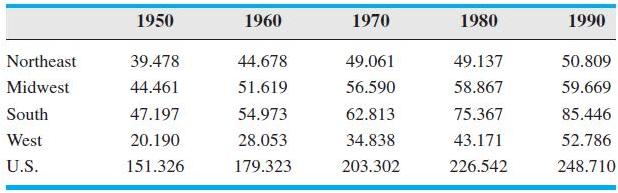
Problems 23–34 are intended as calculator or computer problems and are based on the U.S. census data in the table of Fig. 3.7.13, listed by national region in millions for the census years 1950–1990. See www.census.gov/population/ censusdata/table-16.pdf for further details.31–34. The
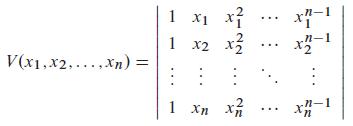
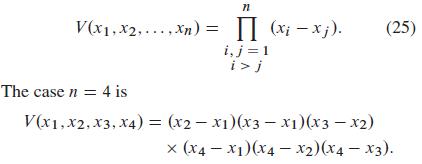
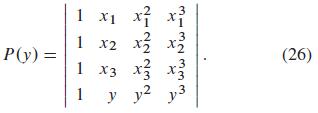
Problems 61–64 deal with the Vandermonde determinantthat will play an important role in Section 3.7.The formulas in Problem 61 are the cases n = 2 and n = 3 of the general formulaProve this as follows. Given x1, x2, and x3, define the cubic polynomial P(y) to beBecause P(x1) = P(x2) = P(x3) = 0
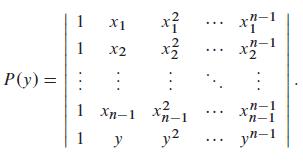
Problems 61–64 deal with the Vandermonde determinantthat will play an important role in Section 3.7. Generalize the argument in Problem 62 to prove the formula in (25) by induction on n. Begin with the (n - 1)st degree polynomial V(x1,X2,....Xn) = 1 X1 1 x2 기글 212 1 Xn ... 2 : .. -1 -1 -1
In Problems 1–4, determine whether the given vectors are mutually orthogonal.v1 = (2, 1, 2, 1), v2 = (3, -6, 1, -2), v3 = (3,-1,-5,5)
In Problems 1–8, determine whether the given vectors v1, v2, ....., vk are linearly independent or linearly dependent. Do this essentially by inspection—that is, without solving a linear system of equations.v1 = (4.-2,6,-4), v2 = (6,-3,9,-6)
In Problems 1–8, determine whether the given vectors v1, v2, ....., vk are linearly independent or linearly dependent. Do this essentially by inspection—that is, without solving a linear system of equations.v1 = (3,9,-3, 6), v2 = (2,6,-2,4)
In Problems 1–4, determine whether the given vectors are mutually orthogonal.v1 = (5, 2, -4, -1), v2 = (3, -5, 1, 1), v3 = (3, 0, 8, -17)
In Problems 23–27, determine for what values of k each system has (a) A unique solution; (b) No solution; (c) Infinitely many solutions.x + 2y + z = 32x - y - 3z = 54x + 3y - z = k
Consider the system, a1x + b1y + c1z = d1, a2x + b2y + c2z = d2 of two equations in three unknowns.(a) Use the fact that the graph of each such equation is a plane in xyz-space to explain why such a system always has either no solution or infinitely many solutions.(b) Explain why the system
In Problems 23–26, the vectors {vi} are known to be linearly independent. Apply the definition of linear independence to show that the vectors {ui} are also linearly independent.u1 = v2 + v3, u2 = v1 + v3, u3 = v1 + v2
In Problems 1–8, determine whether the given vectors v1, v2, ....., vk are linearly independent or linearly dependent. Do this essentially by inspection—that is, without solving a linear system of equations.v1 = (3,4), v2 = (6,-1), v3 = (7,5)
In Problems 1–4, determine whether the given vectors are mutually orthogonal.v1 = (1,2,3,-2, 1), v2 = (3, 2, 3, 6,-4), v3 = (6,2,-4, 1,4)
In Problems 1–8, determine whether the given vectors v1, v2, ....., vk are linearly independent or linearly dependent. Do this essentially by inspection—that is, without solving a linear system of equations.v1 = (4, -2, 2), v2 = (5, 4,-3), v3 = (4,6,5), v4 = (-7,9,3)
In Problems 1–8, determine whether the given vectors v1, v2, ....., vk are linearly independent or linearly dependent. Do this essentially by inspection—that is, without solving a linear system of equations.v1 = (1,0,0), v2 = (0, -2,0), v3 = (0,0,3)
In Problems 5–8, the three vertices A, B, and C of a triangle are given. Prove that each triangle is a right triangle by showing that its sides a, b, and c satisfy the Pythagorean relation a2 + b2 = c2.A(6, 6, 5, 8), B(6, 8, 6, 5), C(5, 7, 4, 6)
In Problems 1–8, determine whether the given vectors v1, v2, ....., vk are linearly independent or linearly dependent. Do this essentially by inspection—that is, without solving a linear system of equations.v1 = (1,0,0), v2 = (1,1,0), v3 = (1,1,1)
In Problems 5–8, the three vertices A, B, and C of a triangle are given. Prove that each triangle is a right triangle by showing that its sides a, b, and c satisfy the Pythagorean relation a2 + b2 = c2.A(3, 5, 1, 3), B(4, 2, 6, 4), C(1, 3, 4,2)
In Problems 1–8, determine whether the given vectors v1, v2, ....., vk are linearly independent or linearly dependent. Do this essentially by inspection—that is, without solving a linear system of equations.v1 = (2,1,0,0), v2 = (3,0,1,0), v3 = (4,0,0,1)
In Problems 5–8, the three vertices A, B, and C of a triangle are given. Prove that each triangle is a right triangle by showing that its sides a, b, and c satisfy the Pythagorean relation a2 + b2 = c2.A(4, 5, 3, 5, -1), B(3, 4,-1, 4, 4), C(1, 3, 1, 3, 1)
In Problems 5–8, the three vertices A, B, and C of a triangle are given. Prove that each triangle is a right triangle by showing that its sides a, b, and c satisfy the Pythagorean relation a2 + b2 = c2.A(2,8, -3,-1,2), B(-2, 5, 6, 2, 12), C(-5, 3, 2, -3,5)
In Problems 9–16, express the indicated vector w as a linear combination of the given vectors v1, v2, ....., vk if this is possible. If not, show that it is impossible.w = (4,-4, 3, 3); v1 = (7,3,-1,9), v2 = (-2,-2, 1,-3)
In Problems 1–8, determine whether the given vectors v1, v2, ....., vk are linearly independent or linearly dependent. Do this essentially by inspection—that is, without solving a linear system of equations.v1 = (1,0,3,0), v2 = (0,2,0,4), v3 = (1,2,3,4)
In Problems 13–22, the given vectors span a subspace V of the indicated Euclidean space. Find a basis for the orthogonal complement V⊥ of V.v1 = (1, -2, 3)
In Problems 9–16, express the indicated vector w as a linear combination of the given vectors v1, v2, ....., vk if this is possible. If not, show that it is impossible.w = (5,2,-2); v1 = (1,5,-3), v2 = (5,-3,4)
In Problems 9–16, express the indicated vector w as a linear combination of the given vectors v1, v2, ....., vk if this is possible. If not, show that it is impossible.w = (2,-3,2,-3); v1 = (1,0,0,3), v2 = (0, 1, -2,0), v3 = (0, -1, 1, 1)
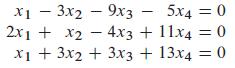
In Problems 15–26, find a basis for the solution space of the given homogeneous linear system. 9х3 x13x29x3 - 5x4 = 0 2x1 + x2 - 4x3 + 11x4 = 0 x1 + 3x2 + 3x3 + 13x4 = 0
In Problems 9–16, express the indicated vector w as a linear combination of the given vectors v1, v2, ....., vk if this is possible. If not, show that it is impossible.w = (4,5,6); v1 = (2,-1,4), v2 = (3,0,1), v3 = (1,2,-1)
In Problems 13–22, the given vectors span a subspace V of the indicated Euclidean space. Find a basis for the orthogonal complement V⊥ of V.v1 = (1, 5, -3)
In Problems 13–22, the given vectors span a subspace V of the indicated Euclidean space. Find a basis for the orthogonal complement V⊥ of V.v1 = (1, -2, -3, 5)
In Problems 17–22, three vectors v1, v2, and v3 are given. If they are linearly independent, show this; otherwise find a nontrivial linear combination of them that is equal to the zero vector.v1 = (1, 1,-1, 1), v2 = (2, 1, 1, 1), v3 = (3, 1, 4, 1)
In Problems 13–22, the given vectors span a subspace V of the indicated Euclidean space. Find a basis for the orthogonal complement V⊥ of V.v1 = (2, 5, 5, 4, 3), v2 = (3, 7, 8, 8, 8)
In Problems 25 and 26, use the method of Example 8 to find a basis for the 2-dimensional solution space of the given differential equation.y'' - 5y' = 0 Example 8 With a = 1, b = -2, and c = 0 in (16), we get the differential equation y" - 2y' = 0. (18)
In Problems 23–26, the vectors {vi} are known to be linearly independent. Apply the definition of linear independence to show that the vectors {ui} are also linearly independent.u1 = v1 + v2, u2 = 2v1 + 3v2
In Problems 17–22, three vectors v1, v2, and v3 are given. If they are linearly independent, show this; otherwise find a nontrivial linear combination of them that is equal to the zero vector.v1 = (3, 0, 1, 2), v2 = (1, -1, 0, 1), v3 = (1, 2, 1, 0)
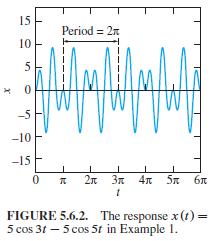
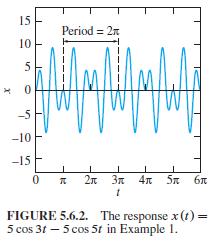
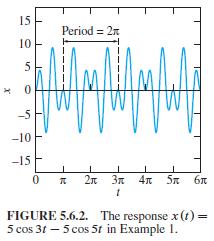
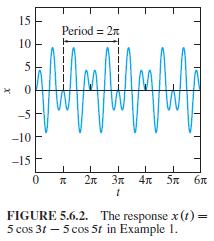
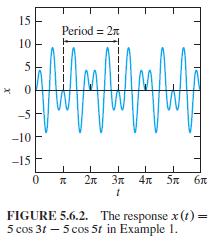
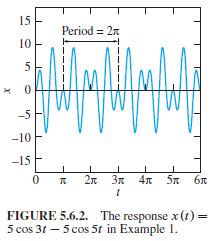
In Problems 1 through 6, express the solution of the given initial value problem as a sum of two oscillations as in Eq. (8). Throughout, primes denote derivatives with respect to time t. In Problems 1–4, graph the solution function x(t) in such a way that you can identify and label (as in Fig.
In Problems 23–26, the vectors {vi} are known to be linearly independent. Apply the definition of linear independence to show that the vectors {ui} are also linearly independent.u1 = v1, u2 = v1 + 2v2, u3 = v1 + 2v2 + 3v3
In Problems 25 and 26, use the method of Example 8 to find a basis for the 2-dimensional solution space of the given differential equation.y'' + 10y' = 0 Example 8 With a = 1, b = -2, and c = 0 in (16), we get the differential equation y" - 2y' = 0. (18)
In Problems 1 through 6, express the solution of the given initial value problem as a sum of two oscillations as in Eq. (8). Throughout, primes denote derivatives with respect to time t. In Problems 1–4, graph the solution function x(t) in such a way that you can identify and label (as in Fig.
Find the general solutions of the differential equations in Problems 1 through 20.y'' - 4y = 0
In Problems 1 through 6, express the solution of the given initial value problem as a sum of two oscillations as in Eq. (8). Throughout, primes denote derivatives with respect to time t. In Problems 1–4, graph the solution function x(t) in such a way that you can identify and label (as in Fig.
Find the general solutions of the differential equations in Problems 1 through 20.2y'' - 3y' = 0
In Problems 1 through 16, a homogeneous second-order linear differential equation, two functions y1 and y2, and a pair of initial conditions are given. First verify that y1 and y2 are solutions of the differential equation. Then find a particular solution of the form y = c1y1 + c2y2 that satisfies
Determine the period and frequency of the simple harmonic motion of a body of mass 0.75 kg on the end of a spring with spring constant 48 N/m.
Problems 1 through 6, show directly that the given functions are linearly dependent on the real line. That is, find a nontrivial linear combination of the given functions that vanishes identically.f(x) = 5 , g(x) = 2 - 3x2 , h(x) = 10 + 15x2
In Problems 1 through 20, find a particular solution yp of the given equation. In all these problems, primes denote derivatives with respect to x.y" - y' - 2y = 3x + 4
Find the general solutions of the differential equations in Problems 1 through 20.y'' + 3y' - 10y = 0
In Problems 1 through 6, express the solution of the given initial value problem as a sum of two oscillations as in Eq. (8). Throughout, primes denote derivatives with respect to time t. In Problems 1–4, graph the solution function x(t) in such a way that you can identify and label (as in Fig.
In Problems 1 through 16, a homogeneous second-order linear differential equation, two functions y1 and y2, and a pair of initial conditions are given. First verify that y1 and y2 are solutions of the differential equation. Then find a particular solution of the form y = c1y1 + c2y2 that satisfies
Problems 1 through 6, show directly that the given functions are linearly dependent on the real line. That is, find a nontrivial linear combination of the given functions that vanishes identically.f(x) = 0, g(x) = sinx , h(x) = ex
A mass of 3 kg is attached to the end of a spring that is stretched 20 cm by a force of 15 N. It is set in motion with initial position x0 = 0 and initial velocity v0 = -10 m/s. Find the amplitude, period, and frequency of the resulting motion.
In Problems 1 through 20, find a particular solution yp of the given equation. In all these problems, primes denote derivatives with respect to x.y" - y' - 6y = 2 sin 3x
Find the general solutions of the differential equations in Problems 1 through 20.2y'' - 7y' + 3y = 0
In Problems 1 through 6, express the solution of the given initial value problem as a sum of two oscillations as in Eq. (8). Throughout, primes denote derivatives with respect to time t. In Problems 1–4, graph the solution function x(t) in such a way that you can identify and label (as in Fig.
In Problems 1 through 16, a homogeneous second-order linear differential equation, two functions y1 and y2, and a pair of initial conditions are given. First verify that y1 and y2 are solutions of the differential equation. Then find a particular solution of the form y = c1y1 + c2y2 that satisfies
A body with mass 250 g is attached to the end of a spring that is stretched 25 cm by a force of 9 N. At time t = 0 the body is pulled 1 m to the right, stretching the spring, and set in motion with an initial velocity of 5 m/s to the left.(a) Find x(t) in the form C cos(ω0t - α) (b) Find the
Problems 1 through 6, show directly that the given functions are linearly dependent on the real line. That is, find a nontrivial linear combination of the given functions that vanishes identically.f(x) = 17, g(x) = 2 sin2x , h(x) = 3 cos2x
In Problems 1 through 6, express the solution of the given initial value problem as a sum of two oscillations as in Eq. (8). Throughout, primes denote derivatives with respect to time t. In Problems 1–4, graph the solution function x(t) in such a way that you can identify and label (as in Fig.
In Problems 1 through 20, find a particular solution yp of the given equation. In all these problems, primes denote derivatives with respect to x.4y" + 4y' + y = 3xex
Find the general solutions of the differential equations in Problems 1 through 20.y'' + 6y' + 9y = 0
In Problems 1 through 16, a homogeneous second-order linear differential equation, two functions y1 and y2, and a pair of initial conditions are given. First verify that y1 and y2 are solutions of the differential equation. Then find a particular solution of the form y = c1y1 + c2y2 that satisfies
Problems 1 through 6, show directly that the given functions are linearly dependent on the real line. That is, find a nontrivial linear combination of the given functions that vanishes identically.f(x) = 17, g(x) = cos2x , h(x) = cos 2x
In Problems 1 through 20, find a particular solution yp of the given equation. In all these problems, primes denote derivatives with respect to x.y" + y' + y = sin2x
Find the general solutions of the differential equations in Problems 1 through 20.y'' + 5y' + 5y = 0
In Problems 1 through 16, a homogeneous second-order linear differential equation, two functions y1 and y2, and a pair of initial conditions are given. First verify that y1 and y2 are solutions of the differential equation. Then find a particular solution of the form y = c1y1 + c2y2 that satisfies
Problems 1 through 6, show directly that the given functions are linearly dependent on the real line. That is, find a nontrivial linear combination of the given functions that vanishes identically.f(x) = ex , g(x) = cosh x , h(x) = sinh x
In Problems 1 through 20, find a particular solution yp of the given equation. In all these problems, primes denote derivatives with respect to x.2y" + 4y' + 7y = x2
In each of Problems 7 through 10, find the steady periodic solution xsp(t) = C cos(ωt - α) of the given equation mx" + cx' + kx = F(t) with periodic forcing function F(t) of frequency ω. Then graph xsp(t) together with (for comparison) the adjusted forcing function F1(t) = F(t)/mω.x" + 4x' + 4x
Find the general solutions of the differential equations in Problems 1 through 20.4y'' - 12y' + 9y = 0
Showing 600 - 700
of 2513
1
2
3
4
5
6
7
8
9
10
11
12
13
14
15
Last
Step by Step Answers

 Get 50% OFF
Claim Now
Get 50% OFF
Claim Now