New Semester
Started
Get
50% OFF
Study Help!
--h --m --s
Claim Now
Question Answers
Textbooks
Find textbooks, questions and answers
Oops, something went wrong!
Change your search query and then try again
S
Books
FREE
Study Help
Expert Questions
Accounting
General Management
Mathematics
Finance
Organizational Behaviour
Law
Physics
Operating System
Management Leadership
Sociology
Programming
Marketing
Database
Computer Network
Economics
Textbooks Solutions
Accounting
Managerial Accounting
Management Leadership
Cost Accounting
Statistics
Business Law
Corporate Finance
Finance
Economics
Auditing
Tutors
Online Tutors
Find a Tutor
Hire a Tutor
Become a Tutor
AI Tutor
AI Study Planner
NEW
Sell Books
Search
Search
Sign In
Register
study help
mathematics
first course differential equations
Differential Equations And Linear Algebra 4th Edition C. Edwards, David Penney, David Calvis - Solutions
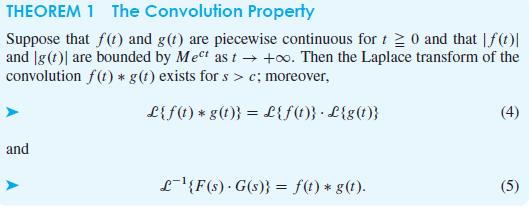
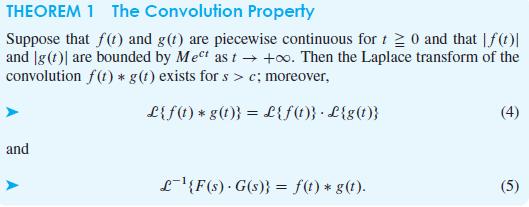
Find the convolution f(t) * g(t) in Problems 1 through 6.f(t) = g(t) = eat
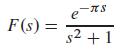
Find the inverse Laplace transform f (t) of each function given in Problems 1 through 10. Then sketch the graph of f. F(s) = -πS e s²+1 2
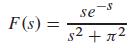
Find the inverse Laplace transform f (t) of each function given in Problems 1 through 10. Then sketch the graph of f. F(s) = -$ se s²+7² 2
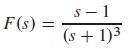
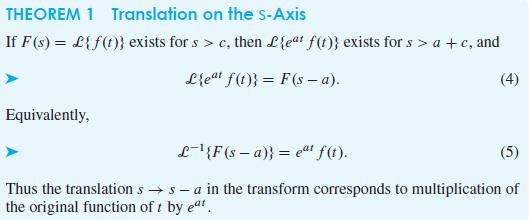
Apply the translation theorem to find the inverse Laplace transforms of the functions in Problems 5 through 10. F(s) = s-1 (s + 1)³
Apply the definition in (1) to find directly the Laplace transforms of the functions described (by formula or graph) in Problems 1 through 10.f(t) = sin2 t
Find the convolution f(t) * g(t) in Problems 1 through 6.f(t) = eat, g(t) = ebt (a ≠ b)
Use Laplace transforms to solve the initial value problems in Problems 1 through 16.x'' + 4x = cos t; x(0) = 0 = x' (0)
Use Laplace transforms to solve the initial value problems in Problems 1 through 16.x" + x = cos 3t; x (0) = 1, x'(0) = 0
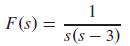
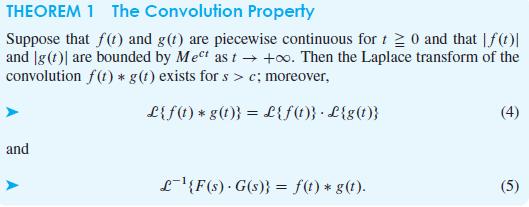
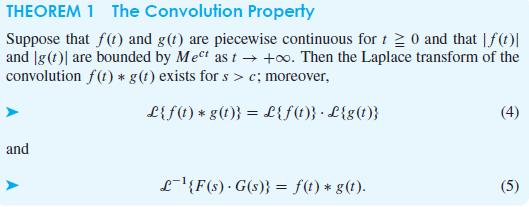
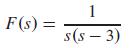
Apply the convolution theorem to find the inverse Laplace transforms of the functions in Problems 7 through 14. F(s) = 1 s(s - 3)
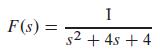
Apply the translation theorem to find the inverse Laplace transforms of the functions in Problems 5 through 10. F(s) = I s² + 4s + 4 2
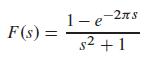
Find the inverse Laplace transform f (t) of each function given in Problems 1 through 10. Then sketch the graph of f. F(s) = 1-e-2лs s²+1
Use Laplace transforms to solve the initial value problems in Problems 1 through 16.x' = 2x + y, y' = 6x + 3y; x(0) = 1, y(0) = -2
Find the Laplace transforms of the functions given in Problems 11 through 22. f(t) = 2 if 0 ≤ t < 3; f(t) = 0 ift ≥ 3
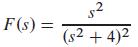
Apply the convolution theorem to find the inverse Laplace transforms of the functions in Problems 7 through 14. F(s) = 5² (s² + 4)² 2
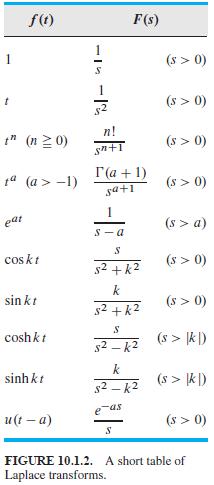
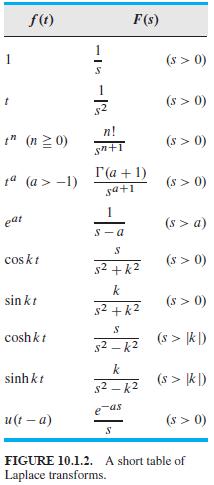
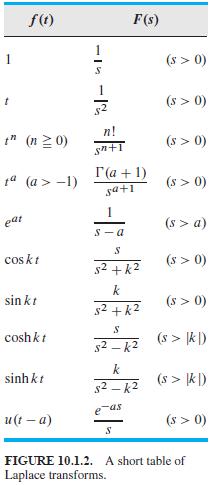
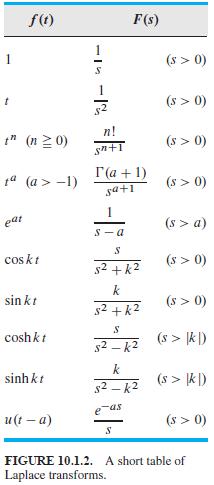
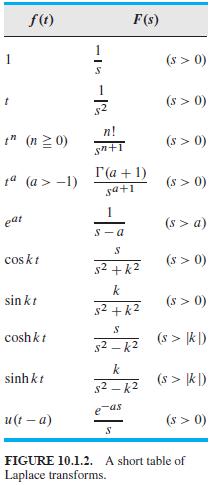
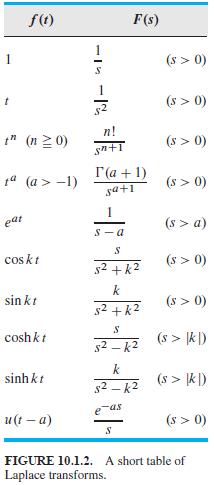
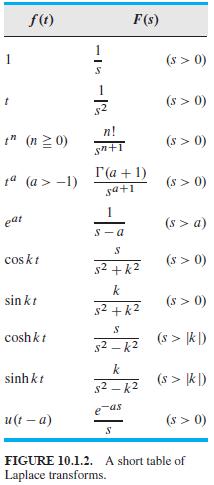
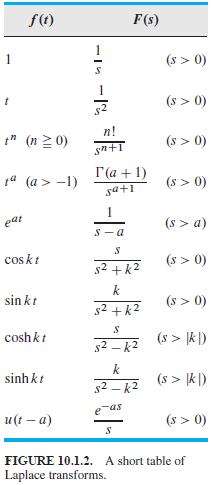
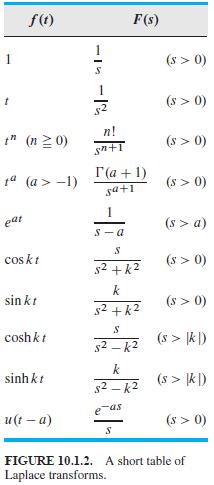
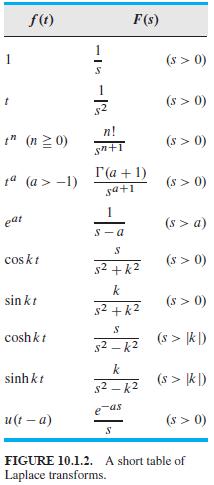
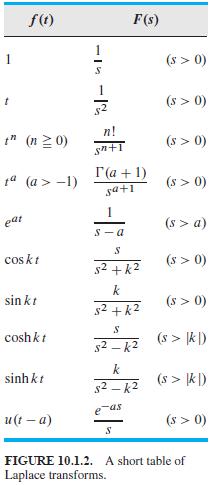
Use the transforms in Fig. 10.1.2 to find the Laplace transforms of the functions in Problems 11 through 22. A preliminary integration by parts may be necessary. f (t) = √t + 3t t f(t) t" (n ≥0) g@ (a>−1) eat cos kt sin kt cosh kt sinhkt u(t - a) 13 S n! gn+T F(s) Γ(α +
Use Laplace transforms to solve the initial value problems in Problems 1 through 16.x' = x + 2y, y' = x + e-t; x(0) = y(0) = 0
Use the transforms in Fig. 10.1.2 to find the Laplace transforms of the functions in Problems 11 through 22. A preliminary integration by parts may be necessary. f (t) = 3t5/2 - 4t3 t f(t) t" (n ≥0) g@ (a>−1) eat cos kt sin kt cosh kt sinhkt u(t - a) 13 S n! gn+T F(s) Γ(α +
Find the Laplace transforms of the functions given in Problems 11 through 22. f(t) = 1 if 1 ≤ t ≤ 4; f(t) = 0 ift < 1 or if t > 4
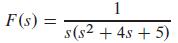
Apply the convolution theorem to find the inverse Laplace transforms of the functions in Problems 7 through 14. F(s) = 1 s(s² + 4s + 5)
Use Laplace transforms to solve the initial value problems in Problems 1 through 16.x' + 2y' + x = 0, x' - y' + y = 0; x (0) = 0, y(0) = 1
Find the Laplace transforms of the functions given in Problems 11 through 22. f(t) = sint if 0 ≤ t ≤ 2n; f(t) = 0 ift > 2n
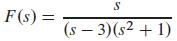
Apply the convolution theorem to find the inverse Laplace transforms of the functions in Problems 7 through 14. F(s) = S (s - 3)(s² + 1)
Use the transforms in Fig. 10.1.2 to find the Laplace transforms of the functions in Problems 11 through 22. A preliminary integration by parts may be necessary. f (t) = t - 2e3t t f(t) t" (n ≥0) g@ (a>−1) eat cos kt sin kt cosh kt sinhkt u(t - a) 13 S n! gn+T F(s) Γ(α +
Use Laplace transforms to solve the initial value problems in Problems 1 through 16.x" + 2x + 4y = 0, y" + x + 2y = 0; x (0) = y(0) = 0, x' (0) = y'(0) = -1
Find the Laplace transforms of the functions given in Problems 11 through 22. f(t) = cos лt if 0 ≤ t ≤2; f(t) = 0 ift > 2
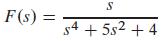
Apply the convolution theorem to find the inverse Laplace transforms of the functions in Problems 7 through 14. F(s) = S S4 + 5s² + 4
Use the transforms in Fig. 10.1.2 to find the Laplace transforms of the functions in Problems 11 through 22. A preliminary integration by parts may be necessary. f (t) = t3/2 - e-10t t f(t) t" (n ≥0) g@ (a>−1) eat cos kt sin kt cosh kt sinhkt u(t - a) 13 S n! gn+T F(s) Γ(α +
In Problems 13 through 20, a third-order homogeneous linear equation and three linearly independent solutions are given. Find a particular solution satisfying the given initial conditions. (3) +2y" -y'-2y = 0; y(0) = 1, y' (0) = 2, y" (0) = 0; y₁ = ex, y₂ = ex, y3 = e-2x
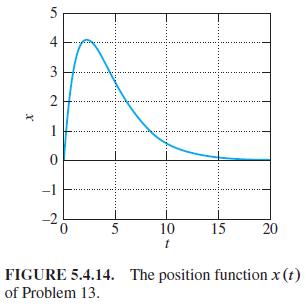
Suppose that the mass in a mass–spring–dashpot system with m = 10, c = 9, and k = 2 is set in motion with x(0) = 0 and x'(0) = 5.(a) Find the position function x(t) and show that its graph looks as indicated in Fig. 5.4.14.(b) Find how far the mass moves to the right before starting back toward
In Problems 1 through 16, a homogeneous second-order linear differential equation, two functions y1 and y2, and a pair of initial conditions are given. First verify that y1 and y2 are solutions of the differential equation. Then find a particular solution of the form y = c1y1 + c2y2 that satisfies
In Problems 1 through 20, find a particular solution yp of the given equation. In all these problems, primes denote derivatives with respect to x.y" + 2y' + 5y = ex sinx
In each of Problems 11 through 14, find and plot both the steady periodic solution xsp(t) = C cos(ωt - α) of the given differential equation and the actual solution x(t) = xsp(t) + Xtr(t) that satisfies the given initial conditions.x" + 8x' + 25x = 200 cost + 520 sint ; x(0) = -30, x' (0) = -10
Find the general solutions of the differential equations in Problems 1 through 20.y(4) + 3y" - 4y = 0
In Problems 13 through 20, a third-order homogeneous linear equation and three linearly independent solutions are given. Find a particular solution satisfying the given initial conditions. y(3)-6y" +11y'-6y=0; y(0) = 0, y'(0) = 0, y" (0) = 3; y1 = ex, y2 = e2x, y3 = = e³x
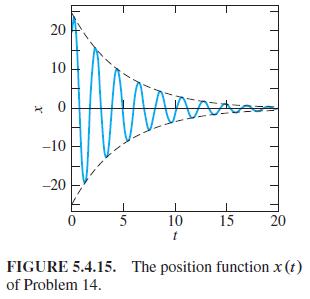
Suppose that the mass in a mass–spring–dashpot system with m = 25, c = 10, and k = 226 is set in motion with x(0) = 20 and x'(0) = 41.(a) Find the position function x(t) and show that its graph looks as indicated in Fig. 5.4.15.(b) Find the pseudoperiod of the oscillations and the equations of
In Problems 1 through 16, a homogeneous second-order linear differential equation, two functions y1 and y2, and a pair of initial conditions are given. First verify that y1 and y2 are solutions of the differential equation. Then find a particular solution of the form y = c1y1 + c2y2 that satisfies
In Problems 1 through 20, find a particular solution yp of the given equation. In all these problems, primes denote derivatives with respect to x.y(4) - 2y" + y = xex
Each of Problems 15 through 18 gives the parameters for a forced mass-spring-dashpot system with equation mx" + cx' + kx = F0 cos ωt. Investigate the possibility of practical resonance of this system. In particular, find the amplitude C(ω) of steady periodic forced oscillations with frequency ω.
Find the general solutions of the differential equations in Problems 1 through 20.y(4) - 8y" + 16y = 0
In Problems 13 through 20, a third-order homogeneous linear equation and three linearly independent solutions are given. Find a particular solution satisfying the given initial conditions. y (3)-3y" + 3y'-y = 0; y(0) = 2, y'(0) = 0, y" (0) = 0; y1 = ex, y2 = xex, y3 = x²ex
Find the Laplace transforms of the functions given in Problems 11 through 22. f(t) = sin лt if 2 ≤ t ≤ 3; f(t) = 0 if t < 2 or if t > 3
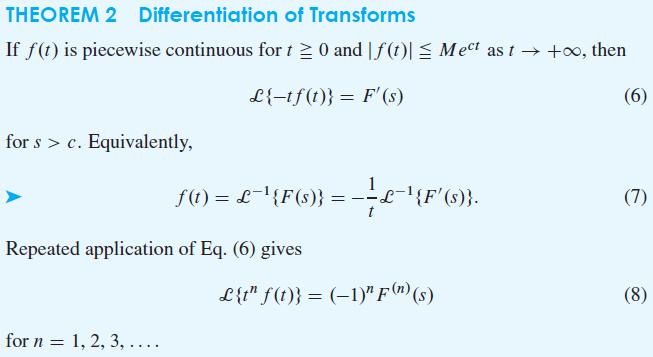
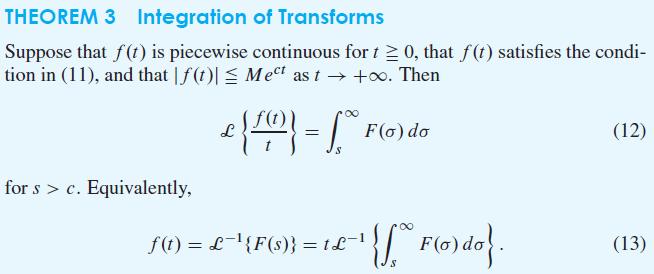
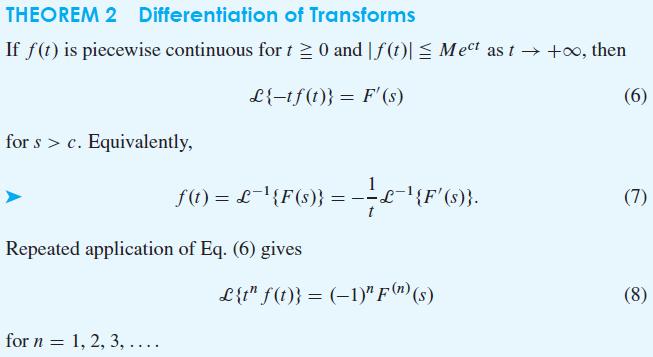
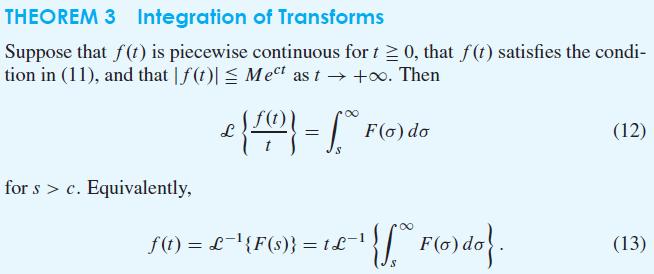
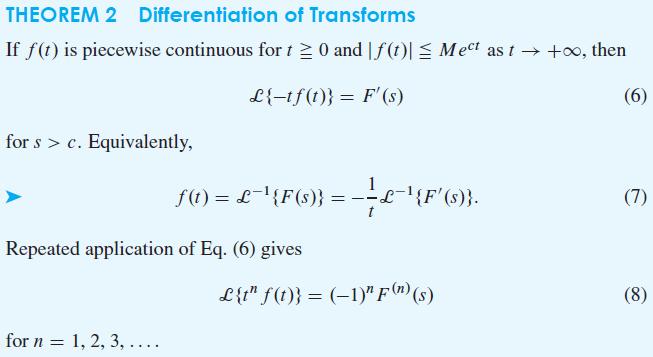
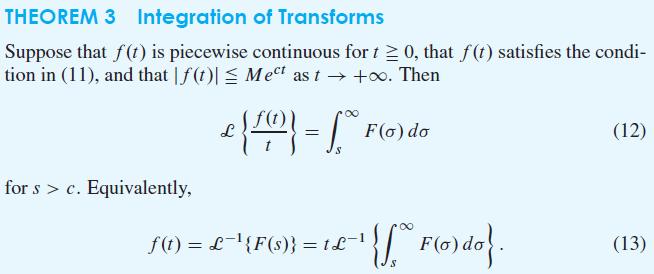
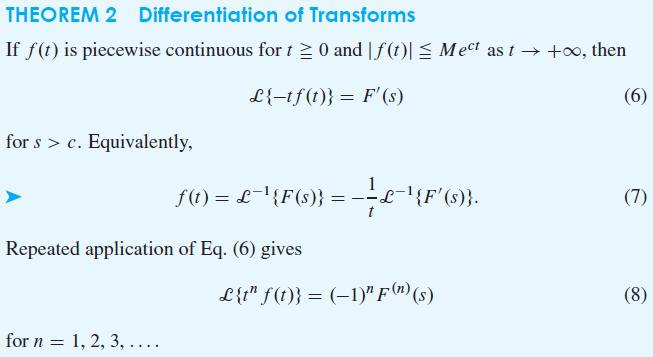
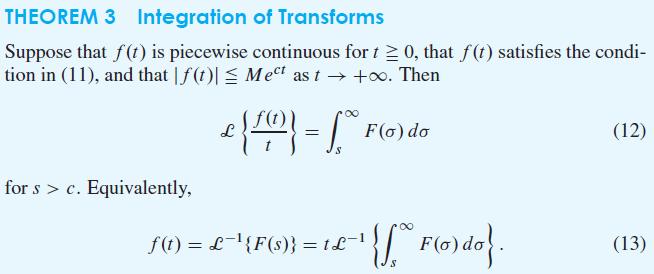
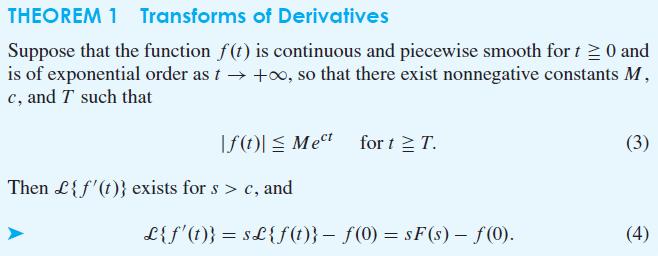
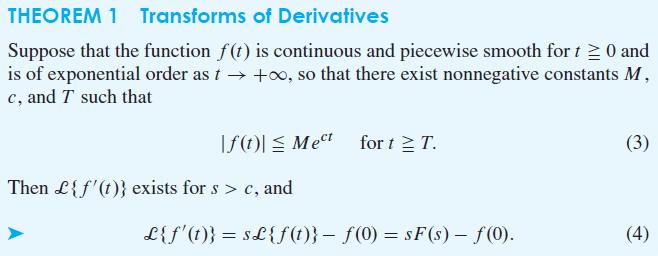
In Problems 15 through 22, apply either Theorem 2 or Theorem 3 to find the Laplace transform of f (t).f (t) = te2t cos 3t THEOREM 2 Differentiation of Transforms If f(t) is piecewise continuous for t≥ 0 and f(t)| ≤ Mect as t→ +∞o, then L{-tf(t)} = F' (s) for sc. Equivalently, f(1) =
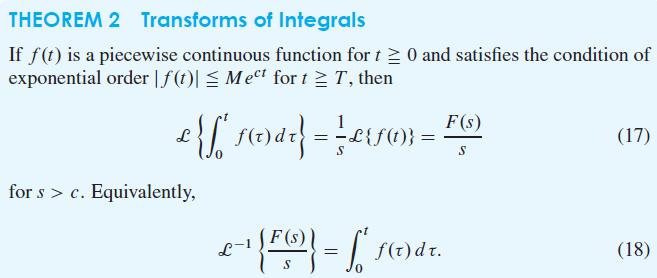
Apply Theorem 2 to find the inverse Laplace transforms of the functions in Problems 17 through 24. F(s) = 1 s(s - 3)
Use the transforms in Fig. 10.1.2 to find the Laplace transforms of the functions in Problems 11 through 22. A preliminary integration by parts may be necessary. f (t) = cos2 2t t f(t) t" (n ≥0) g@ (a>−1) eat cos kt sin kt cosh kt sinhkt u(t - a) 13 S n! gn+T F(s) Γ(α +
In Problems 15 through 22, apply either Theorem 2 or Theorem 3 to find the Laplace transform of f (t).f (t) = te-t sin2 t THEOREM 2 Differentiation of Transforms If f(t) is piecewise continuous for t≥ 0 and f(t)| ≤ Mect as t→ +∞o, then L{-tf(t)} = F' (s) for sc. Equivalently, f(1) =
Find the Laplace transforms of the functions given in Problems 11 through 22. f(t) = cost if 3 ≤ t ≤ 5; f(t) = 0 ift < 3 or if t > 5
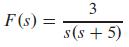
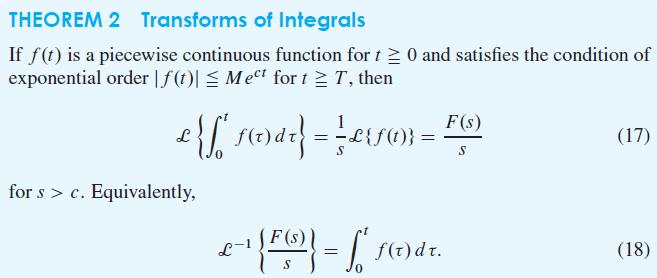
Apply Theorem 2 to find the inverse Laplace transforms of the functions in Problems 17 through 24. F(s) = = 3 s(s+ 5)
Use the transforms in Fig. 10.1.2 to find the Laplace transforms of the functions in Problems 11 through 22. A preliminary integration by parts may be necessary. f (t) = sin 3t cos 3t t f(t) t" (n ≥0) g@ (a>−1) eat cos kt sin kt cosh kt sinhkt u(t - a) 13 S n! gn+T F(s) Γ(α +
Find the Laplace transforms of the functions given in Problems 11 through 22. f(t) = 0 ift < 1; f(t) = t ift ≥ 1
Use Laplace transforms to solve the initial value problems in Problems 1 through 16.x' = x + z, y' = x + y, z' = -2x - z; x (0) = 1, y (0) = 0, z (0) = 0
Use the transforms in Fig. 10.1.2 to find the Laplace transforms of the functions in Problems 11 through 22. A preliminary integration by parts may be necessary. f (t) = sin 2t + cos 2t t f(t) t" (n ≥0) g@ (a>−1) eat cos kt sin kt cosh kt sinhkt u(t - a) 13 S n! gn+T F(s) Γ(α +
In Problems 15 through 22, apply either Theorem 2 or Theorem 3 to find the Laplace transform of f (t).f (t) = t2 cos 2t THEOREM 2 Differentiation of Transforms If f(t) is piecewise continuous for t≥ 0 and f(t)| ≤ Mect as t→ +∞o, then L{-tf(t)} = F' (s) for sc. Equivalently, f(1) =
Find the Laplace transforms of the functions given in Problems 11 through 22. f(t) = sin 2t if ≤t ≤2n; f(t)= 0 ift < or if t > 2π
Use the transforms in Fig. 10.1.2 to find the Laplace transforms of the functions in Problems 11 through 22. A preliminary integration by parts may be necessary. f (t) = 1 + cosh 5t t f(t) t" (n ≥0) g@ (a>−1) eat cos kt sin kt cosh kt sinhkt u(t - a) 13 S n! gn+T F(s) Γ(α +
In Problems 15 through 22, apply either Theorem 2 or Theorem 3 to find the Laplace transform of f (t).f (t) = t sin 3t THEOREM 2 Differentiation of Transforms If f(t) is piecewise continuous for t≥ 0 and f(t)| ≤ Mect as t→ +∞o, then L{-tf(t)} = F' (s) for sc. Equivalently, f(1) =
Find the Laplace transforms of the functions given in Problems 11 through 22. f(t) = sint if 0 ≤ t ≤ 3n; f(t) = 0 ift > 3r
Use Laplace transforms to solve the initial value problems in Problems 1 through 16.x" + x' + y' + 2x - y = 0, y" + x' + y' + 4x - 2y = 0; x (0) = y(0) = 1, x'(0) = y'(0) = 0
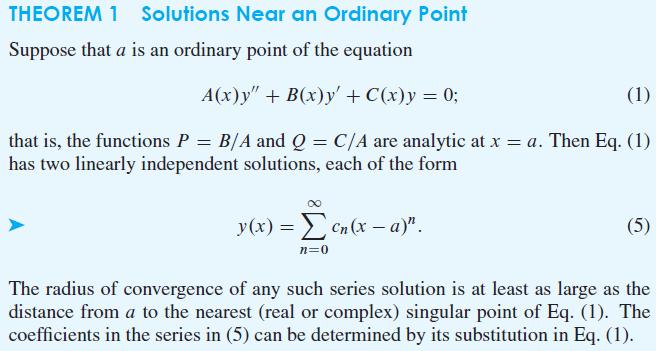
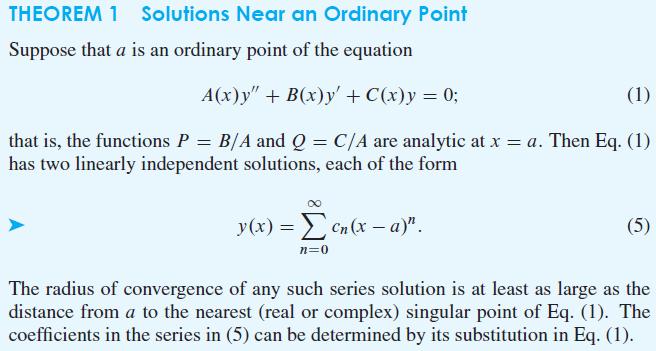
Solve the initial value problems in Problems 18 through 22. First make a substitution of the form t = x - a, then find a solution Σcntn of the transformed differential equation. State the interval of values of x for which Theorem 1 of this section guarantees convergence.(x2 - 6x +10) y" - 4(x -
In Problems 19 through 30, express the general solution of the given differential equation in terms of Bessel functions.xy" + 3y' + xy = 0
Find two linearly independent Frobenius series solutions (for x > 0) of each of the differential equations in Problems 17 through 26.3xy'' + 2y' + 2y = 0
Solve the initial value problems in Problems 18 through 22. First make a substitution of the form t = x - a, then find a solution Σcntn of the transformed differential equation. State the interval of values of x for which Theorem 1 of this section guarantees convergence.(4x2 + 16x + 17) y" = 8y;
In Problems 19 through 22, first derive a recurrence relation giving cn for n ≧ 2 in terms of c0 or c1 (or both). Then apply the given initial conditions to find the values of c0 and c1. Next determine cn (in terms of n, as in the text) and, finally, identify the particular solution in terms of
In Problems 19 through 30, express the general solution of the given differential equation in terms of Bessel functions.xy" - y' + 36x3 y = 0
Find two linearly independent Frobenius series solutions (for x > 0) of each of the differential equations in Problems 17 through 26.2x2y'' + xy' - (1 + 2x2) y = 0
In Problems 19 through 22, first derive a recurrence relation giving cn for n ≧ 2 in terms of c0 or c1 (or both). Then apply the given initial conditions to find the values of c0 and c1. Next determine cn (in terms of n, as in the text) and, finally, identify the particular solution in terms of
Solve the initial value problems in Problems 18 through 22. First make a substitution of the form t = x - a, then find a solution Σcntn of the transformed differential equation. State the interval of values of x for which Theorem 1 of this section guarantees convergence.(x2 + 6x)y" + (3x + 9)y' -
In Problems 19 through 30, express the general solution of the given differential equation in terms of Bessel functions.x2y" - 5xy' + (8 + x) y = 0
Find two linearly independent Frobenius series solutions (for x > 0) of each of the differential equations in Problems 17 through 26.2x2y" + xy' - (3 - 2x2) y = 0
In Problems 19 through 22, first derive a recurrence relation giving cn for n ≧ 2 in terms of c0 or c1 (or both). Then apply the given initial conditions to find the values of c0 and c1. Next determine cn (in terms of n, as in the text) and, finally, identify the particular solution in terms of
In Problems 19 through 30, express the general solution of the given differential equation in terms of Bessel functions.36x2y" + 60xy' + (9x3 - 5) y = 0
Find two linearly independent Frobenius series solutions (for x > 0) of each of the differential equations in Problems 17 through 26.6x2y" + 7xy' - (x2 + 2)y = 0
In Problems 23 through 26, find a three-term recurrence relation for solutions of the form y = Σ cnxn. Then find the first three nonzero terms in each of two linearly independent solutions.y'' + (1 + x)y = 0
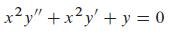
Show that the equationhas no power series solution of the form y = Σ cnxn. 2 x²y" + x²y + y = 0
In Problems 19 through 30, express the general solution of the given differential equation in terms of Bessel functions.16x2y" + 24xy' + (1 + 144x3) y = 0
Find two linearly independent Frobenius series solutions (for x > 0) of each of the differential equations in Problems 17 through 26.3x2y" + 2xy' + x2y = 0
In Problems 23 through 26, find a three-term recurrence relation for solutions of the form y = Σ cnxn. Then find the first three nonzero terms in each of two linearly independent solutions.(x2 - 1) y'' + 2xy' + 2xy = 0
Establish the binomial series in (12) by means of the following steps.(a) Show that y = (1 + x)α satisfies the initial value problem (1 + x)y' = αy, y(0) = 1.(b) Show that the power series method gives the binomial series in (12) as the solution of the initial value problem in part (a), and that
In Problems 19 through 30, express the general solution of the given differential equation in terms of Bessel functions.x2y" + 3xy' + (1 + x2)y = 0
Find two linearly independent Frobenius series solutions (for x > 0) of each of the differential equations in Problems 17 through 26.2xy" + (1 + x)y' + y = 0
In Problems 23 through 26, find a three-term recurrence relation for solutions of the form y = Σ cnxn. Then find the first three nonzero terms in each of two linearly independent solutions.y'' + x2y' + x2y = 0
In Problems 19 through 30, express the general solution of the given differential equation in terms of Bessel functions.4x2y" - 12xy' + (15 + 16x) y = 0
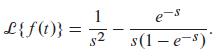
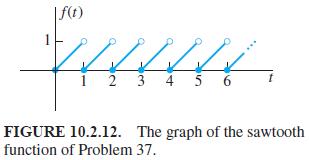
Apply the extension of Theorem 1 in Eq. (22) to derive the Laplace transforms given in Problems 32 through 37.If f(t) is the sawtooth function whose graph is shown in Fig. 10.2.12, then L{f(t)}= = -1/²2 -5 (1-0-²³) е s(1-es)
Find two linearly independent Frobenius series solutions (for x > 0) of each of the differential equations in Problems 17 through 26.2xy" + (1 - 2x2)y' - 4xy = 0
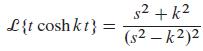
Apply Theorem 1 as in Example 5 to derive the Laplace transforms in Problems 28 through 30. L{t cosh kt} = s²+k² (s²-k²)² ($2
Use Laplace transforms to solve the initial value problems in Problems 27 through 38.x" + 4x' + 8x = e-t; x(0) = x'(0) = 0
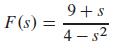
Use the transforms in Fig. 10.1.2 to find the inverse Laplace transforms of the functions in Problems 23 through 32. F(s) = 9+s 4-52
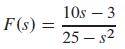
Use the transforms in Fig. 10.1.2 to find the inverse Laplace transforms of the functions in Problems 23 through 32. F(s) = 10s - 3 25-$2
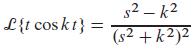
Apply the results in Example 5 and Problem 28 to show thatProblem 28 - 1 (s²+k²) ² 1 38 2k-3 (sinkt - kt coskt).
In Problems 31 through 35, the values of mass m, spring constant k, dashpot resistance c, and force f (t) are given for a mass–spring–dashpot system with external forcing function. Solve the initial value problemand construct the graph of the position function x(t). mx" + cx' + kx = f(t); x(0)
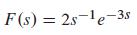
Use the transforms in Fig. 10.1.2 to find the inverse Laplace transforms of the functions in Problems 23 through 32. F(s) = 25-1e-3s
In Problems 31 through 35, the values of mass m, spring constant k, dashpot resistance c, and force f (t) are given for a mass–spring–dashpot system with external forcing function. Solve the initial value problemand construct the graph of the position function x(t). mx" + cx' + kx = f(t); x(0)
Use Laplace transforms to solve the initial value problems in Problems 27 through 38.x(3) + x" - 6x' = 0; x (0) = 0, x'(0) = x" (0) = 1
Apply the extension of Theorem 1 in Eq. (22) to derive the Laplace transforms given in Problems 32 through 37. L{u(ta)} = s-le-as for a > 0.
In Problems 29 through 34, transform the given differential equation to find a nontrivial solution such that x(0) = 0.tx" + 2(t - 1)x' - 2x = 0
Use Laplace transforms to solve the initial value problems in Problems 27 through 38.x(4) - x = 0; x (0) = 1, x'(0) = x"(0) = x(3) (0) = 0
Derive the transform of f (t) = sin k t by the method used in the text to derive the formula in (16).
In Problems 31 through 35, the values of mass m, spring constant k, dashpot resistance c, and force f (t) are given for a mass–spring–dashpot system with external forcing function. Solve the initial value problemand construct the graph of the position function x(t). mx" + cx' + kx = f(t); x(0)
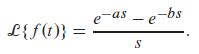
Apply the extension of Theorem 1 in Eq. (22) to derive the Laplace transforms given in Problems 32 through 37.If f(t) = 1 on the interval [a, b] (where 0 < a < b) and f(t) = 0 otherwise, then L{f(t)} = -as - e-bs S
In Problems 29 through 34, transform the given differential equation to find a nontrivial solution such that x(0) = 0.tx" - 2x' + tx = 0
Use Laplace transforms to solve the initial value problems in Problems 27 through 38.x(4) + x = 0; x (0) = x'(0) = x" (0) = 0, x(3) (0) = 1
Showing 800 - 900
of 2513
First
2
3
4
5
6
7
8
9
10
11
12
13
14
15
16
Last
Step by Step Answers

 Get 50% OFF
Claim Now
Get 50% OFF
Claim Now