New Semester
Started
Get
50% OFF
Study Help!
--h --m --s
Claim Now
Question Answers
Textbooks
Find textbooks, questions and answers
Oops, something went wrong!
Change your search query and then try again
S
Books
FREE
Study Help
Expert Questions
Accounting
General Management
Mathematics
Finance
Organizational Behaviour
Law
Physics
Operating System
Management Leadership
Sociology
Programming
Marketing
Database
Computer Network
Economics
Textbooks Solutions
Accounting
Managerial Accounting
Management Leadership
Cost Accounting
Statistics
Business Law
Corporate Finance
Finance
Economics
Auditing
Tutors
Online Tutors
Find a Tutor
Hire a Tutor
Become a Tutor
AI Tutor
AI Study Planner
NEW
Sell Books
Search
Search
Sign In
Register
study help
mathematics
first course differential equations
Differential Equations And Linear Algebra 4th Edition C. Edwards, David Penney, David Calvis - Solutions
In Problems 1 through 16, a homogeneous second-order linear differential equation, two functions y1 and y2, and a pair of initial conditions are given. First verify that y1 and y2 are solutions of the differential equation. Then find a particular solution of the form y = c1y1 + c2y2 that satisfies
In Problems 7 through 12, use the Wronskian to prove that the given functions are linearly independent on the indicated interval.f(x) = 1 , g(x) = x , h(x) = x2 ; the real line
In Problems 1 through 20, find a particular solution yp of the given equation. In all these problems, primes denote derivatives with respect to x.y'' - 4y = sinh x
The remaining problems in this section deal with free damped motion. In Problems 15 through 21, a mass m is attached to both a spring (with given spring constant k) and a dashpot (with given damping constant c). The mass is set in motion with initial position x0 and initial velocity v0. Find the
Find the general solutions of the differential equations in Problems 1 through 20.y'' - 6y' + 13y = 0
In Problems 1 through 16, a homogeneous second-order linear differential equation, two functions y1 and y2, and a pair of initial conditions are given. First verify that y1 and y2 are solutions of the differential equation. Then find a particular solution of the form y = c1y1 + c2y2 that satisfies
Each of Problems 15 through 18 gives the parameters for a forced mass-spring-dashpot system with equation mx" + cx' + kx = F0 cos ωt. Investigate the possibility of practical resonance of this system. In particular, find the amplitude C(ω) of steady periodic forced oscillations with frequency ω.
In Problems 1 through 20, find a particular solution yp of the given equation. In all these problems, primes denote derivatives with respect to x.y(5) + 5y(4) - y = 17
Find the general solutions of the differential equations in Problems 1 through 20.y(4) + 18y" + 81y = 0
In Problems 13 through 20, a third-order homogeneous linear equation and three linearly independent solutions are given. Find a particular solution satisfying the given initial conditions. y(3) -5y" +8y'-4y = 0; y(0) = 1, y' (0) = 4, y'" (0) = 0; y₁ = ex, y2 = e²x, y3 = 2x
The remaining problems in this section deal with free damped motion. In Problems 15 through 21, a mass m is attached to both a spring (with given spring constant k) and a dashpot (with given damping constant c). The mass is set in motion with initial position x0 and initial velocity v0. Find the
In Problems 1 through 20, find a particular solution yp of the given equation. In all these problems, primes denote derivatives with respect to x.y" + 9y = 2x2e3x + 5
Each of Problems 15 through 18 gives the parameters for a forced mass-spring-dashpot system with equation mx" + cx' + kx = F0 cos ωt. Investigate the possibility of practical resonance of this system. In particular, find the amplitude C(ω) of steady periodic forced oscillations with frequency ω.
In Problems 13 through 20, a third-order homogeneous linear equation and three linearly independent solutions are given. Find a particular solution satisfying the given initial conditions. y(3) +9y' = 0; y(0) = 3, y' (0) = -1, y" (0) = 2; y₁ = 1, = cos 3x, y3 = sin 3x y2
Find the general solutions of the differential equations in Problems 1 through 20.6y(4) + 11y" + 4y = 0
The remaining problems in this section deal with free damped motion. In Problems 15 through 21, a mass m is attached to both a spring (with given spring constant k) and a dashpot (with given damping constant c). The mass is set in motion with initial position x0 and initial velocity v0. Find the
In Problems 1 through 20, find a particular solution yp of the given equation. In all these problems, primes denote derivatives with respect to x.y" + y = sinx + x cos x
Each of Problems 15 through 18 gives the parameters for a forced mass-spring-dashpot system with equation mx" + cx' + kx = F0 cos ωt. Investigate the possibility of practical resonance of this system. In particular, find the amplitude C(ω) of steady periodic forced oscillations with frequency ω.
The following three problems illustrate the fact that the superposition principle does not generally hold for nonlinear equations.Show that y = 1/x is a solution of y' + y2 = 0, but that if c ≠ 0 and c ≠ 1, then y = c/x is not a solution.
In Problems 13 through 20, a third-order homogeneous linear equation and three linearly independent solutions are given. Find a particular solution satisfying the given initial conditions. y(3)-3y" +4y'-2y = 0; y(0) = 1, y'(0) = 0, y" (0) = 0; y1 = ex, y2 = ex cosx, y3 = ex sin.x.
The remaining problems in this section deal with free damped motion. In Problems 15 through 21, a mass m is attached to both a spring (with given spring constant k) and a dashpot (with given damping constant c). The mass is set in motion with initial position x0 and initial velocity v0. Find the
Find the general solutions of the differential equations in Problems 1 through 20.y(4) = 16y
In Problems 1 through 20, find a particular solution yp of the given equation. In all these problems, primes denote derivatives with respect to x.y(4) - 5y'' + 4y = ex - xe2x
Find the general solutions of the differential equations in Problems 1 through 20.y(3) + y'' - y' - y = 0
The following three problems illustrate the fact that the superposition principle does not generally hold for nonlinear equations.Show that y = x3 is a solution of yy'' = 6x4, but that if c2 ≠ 1, then y = cx3 is not a solution.
The remaining problems in this section deal with free damped motion. In Problems 15 through 21, a mass m is attached to both a spring (with given spring constant k) and a dashpot (with given damping constant c). The mass is set in motion with initial position x0 and initial velocity v0. Find the
A mass weighing 100 lb (mass m = 3.125 slugs in fps units) is attached to the end of a spring that is stretched 1 in. by a force of 100 lb. A force F0 cos ωt acts on the mass. At what frequency (in hertz) will resonance oscillations occur? Neglect damping.
In Problems 1 through 20, find a particular solution yp of the given equation. In all these problems, primes denote derivatives with respect to x.y(5) + 2y(3) + 2y" = 3x2 - 1
The following three problems illustrate the fact that the superposition principle does not generally hold for nonlinear equations.Show that y1 ≡ and y2 = √x are solutions of yy'' + (y')2 = 0, but that their sum y = y1 + y2 is not a solution.
Find the general solutions of the differential equations in Problems 1 through 20.y(4) + 2y(3) + 3y" + 2y' + y = 0
In Problems 13 through 20, a third-order homogeneous linear equation and three linearly independent solutions are given. Find a particular solution satisfying the given initial conditions. x³y (3) + 6x2y" + 4xy' - 4y = 0; y(1) = 1, y'(1) = 5, y" (1) = -11; y₁ = x, y2 = x-2, y3 = x=2 ln x
A front-loading washing machine is mounted on a thick rubber pad that acts like a spring; the weight W = mg (with g = 9.8 m/s2) of the machine depresses the pad exactly 0.5 cm. When its rotor spins at ω radians per second, the rotor exerts a vertical force F0 cos ωt newtons on the machine. At
The remaining problems in this section deal with free damped motion. In Problems 15 through 21, a mass m is attached to both a spring (with given spring constant k) and a dashpot (with given damping constant c). The mass is set in motion with initial position x0 and initial velocity v0. Find the
In Problems 1 through 20, find a particular solution yp of the given equation. In all these problems, primes denote derivatives with respect to x.y(3) - y = ex + 7
In Problems 21 through 30, set up the appropriate form of a particular solution yp, but do not determine the values of the coefficients.y'' - 2y' + 2y = ex sin x
Determine whether the pairs of functions in Problems 20 through 26 are linearly independent or linearly dependent on the real line.f(x) = π, g(x) = cos2x + sin2x
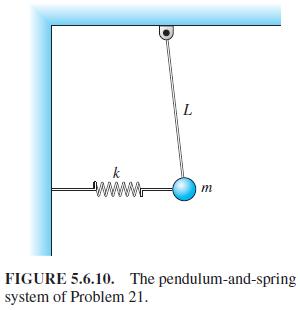
Figure 5.6.10 shows a mass m on the end of a pendulum (of length L) also attached to a horizontal spring (with constant k). Assume small oscillations of m so that the spring remains essentially horizontal and neglect damping. Find the natural circular frequency ω0 of motion of the mass in terms of
In Problems 21 through 24, a nonhomogeneous differential equation, a complementary solution yc , and a particular solution yp are given. Find a solution satisfying the given initial conditions. y" + y = 3x; y(0) = 2, y'(0) = -2; yc = c1 cos x + c2 sin x; yp = 3x
The remaining problems in this section deal with free damped motion. In Problems 15 through 21, a mass m is attached to both a spring (with given spring constant k) and a dashpot (with given damping constant c). The mass is set in motion with initial position x0 and initial velocity v0. Find the
Solve the initial value problems given in Problems 21 through 26.y" - 4y' + 3y = 0; y(0) = 7, y' (0) = 11
In Problems 21 through 30, set up the appropriate form of a particular solution yp, but do not determine the values of the coefficients.y(5) - y(3) = ex + 2x2 - 5
Determine whether the pairs of functions in Problems 20 through 26 are linearly independent or linearly dependent on the real line.f(x) = x3, g(x) = x2|x|
Solve the initial value problems given in Problems 21 through 26.9y" + 6y' + 4y = 0; y(0) = 3, y' (0) = 4
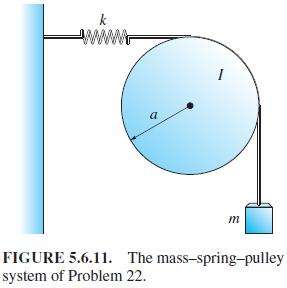
A mass m hangs on the end of a cord around a pulley of radius a and moment of inertia I, as shown in Fig. 5.6.11. The rim of the pulley is attached to a spring (with constant k). Assume small oscillations so that the spring remains essentially horizontal and neglect friction. Find the natural
In Problems 21 through 24, a nonhomogeneous differential equation, a complementary solution yc , and a particular solution yp are given. Find a solution satisfying the given initial conditions.y" - 4y = 12; y(0) = 0, y'(0) = 10; yc = c1e2x + c2e-2x ; yp = -3
In Problems 21 through 30, set up the appropriate form of a particular solution yp, but do not determine the values of the coefficients.y" + 4y = 3x cos 2x
Determine whether the pairs of functions in Problems 20 through 26 are linearly independent or linearly dependent on the real line.f(x) = 1 + x, g(x) = 1 + |x|
In Problems 21 through 24, a nonhomogeneous differential equation, a complementary solution yc , and a particular solution yp are given. Find a solution satisfying the given initial conditions.y" - 2y' - 3y = 6; y(0) = 3, y'(0) = 11; yc = c1e-x + c2e3x ; yp = -2
A building consists of two floors. The first floor is attached rigidly to the ground, and the second floor is of mass m = 1000 slugs (fps units) and weighs 16 tons (32,000 lb). The elastic frame of the building behaves as a spring that resists horizontal displacements of the second floor; it
Determine whether the pairs of functions in Problems 20 through 26 are linearly independent or linearly dependent on the real line.f(x) = xex, g(x) = |x|ex
In Problems 21 through 30, set up the appropriate form of a particular solution yp, but do not determine the values of the coefficients.y(3) - y" - 12y' = x - 2xe-3x
Find the acute angles (in degrees) of each of the right triangles of Problems 5–8, respectively.In Problems 5–8, the three vertices A, B, and C of a triangle are given. Prove that each triangle is a right triangle by showing that its sides a, b, and c satisfy the Pythagorean relation a2 + b2 =
In Problems 9–16, express the indicated vector w as a linear combination of the given vectors v1, v2, ....., vk if this is possible. If not, show that it is impossible.w = (1, 0, 0,-1); v1 = (7,-6, 4, 5), v2 = (3,-3,2,3)
In Problems 9–16, express the indicated vector w as a linear combination of the given vectors v1, v2, ....., vk if this is possible. If not, show that it is impossible.w = (3,-1,-2); v1 = (-3, 1, -2), v2 = (6, -2,3)
In Problems 9–16, express the indicated vector w as a linear combination of the given vectors v1, v2, ....., vk if this is possible. If not, show that it is impossible.w = (1,0,-7); v1 = (5,3,4), v2 = (3,2,5)
Use Laplace transforms to solve the initial value problems in Problems 1 through 16.x'' + 4x = 0; x(0) = 5, x' (0) = 0
Use Laplace transforms to solve the initial value problems in Problems 1 through 16.x" + 9x = 0; x (0) = 3, x' (0) = 4
Find the convolution f(t) * g(t) in Problems 1 through 6.f(t) = t, g(t) = eat
Apply the definition in (1) to find directly the Laplace transforms of the functions described (by formula or graph) in Problems 1 through 10.f(t) = t2
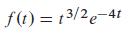
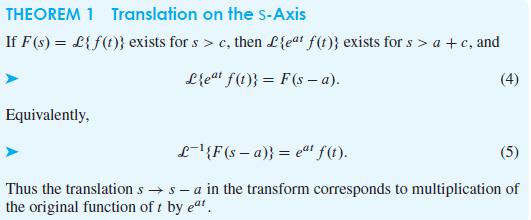
Apply the translation theorem to find the Laplace transforms of the functions in Problems 1 through 4. f(t) = 13/2e-4t
Use Laplace transforms to solve the initial value problems in Problems 1 through 16.x" - x' - 2x = 0; x (0) = 0, x' (0) = 2
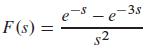
Find the inverse Laplace transform f (t) of each function given in Problems 1 through 10. Then sketch the graph of f. F(s) = e -S -38 e $2
Find the convolution f(t) * g(t) in Problems 1 through 6.f(t) = g(t) = sin t
Apply the definition in (1) to find directly the Laplace transforms of the functions described (by formula or graph) in Problems 1 through 10.f(t) = e3t + 1
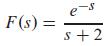
Find the inverse Laplace transform f (t) of each function given in Problems 1 through 10. Then sketch the graph of f. F(s) = -S s+2
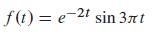
Apply the translation theorem to find the Laplace transforms of the functions in Problems 1 through 4. f(t) = e-2¹ sin 3πt
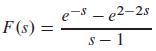
Find the inverse Laplace transform f (t) of each function given in Problems 1 through 10. Then sketch the graph of f. F(s) = e-se2-2s s-1
Apply the definition in (1) to find directly the Laplace transforms of the functions described (by formula or graph) in Problems 1 through 10.f(t) = cost
Find the convolution f(t) * g(t) in Problems 1 through 6.f(t) = t2, g(t) = cost
Use Laplace transforms to solve the initial value problems in Problems 1 through 16.x" + 8x' + 15x = 0; x (0) = 2, x'(0) = -3
Use Laplace transforms to solve the initial value problems in Problems 1 through 16.x" + x = sin 2t; x (0) = 0 = x' (0)
In Problems 1 through 16, a homogeneous second-order linear differential equation, two functions y1 and y2, and a pair of initial conditions are given. First verify that y1 and y2 are solutions of the differential equation. Then find a particular solution of the form y = c1y1 + c2y2 that satisfies
In Problems 7 through 12, use the Wronskian to prove that the given functions are linearly independent on the indicated interval.f(x) = ex , g(x) = e2x , h(x) = e3x ; the real line
In Problems 5 through 8, assume that the differential equation of a simple pendulum of length L is Lθ'' + gθ = 0, where g = GM/R2 is the gravitational acceleration at the location of the pendulum (at distance R from the center of the earth; M denotes the mass of the earth).Most grandfather clocks
In Problems 1 through 16, a homogeneous second-order linear differential equation, two functions y1 and y2, and a pair of initial conditions are given. First verify that y1 and y2 are solutions of the differential equation. Then find a particular solution of the form y = c1y1 + c2y2 that satisfies
Find the general solutions of the differential equations in Problems 1 through 20.y'' + 8y' + 25y = 0
In each of Problems 7 through 10, find the steady periodic solution xsp(t) = C cos(ωt - α) of the given equation mx" + cx' + kx = F(t) with periodic forcing function F(t) of frequency ω. Then graph xsp(t) together with (for comparison) the adjusted forcing function F1(t) = F(t)/mω.2x" + 2x' + x
In Problems 1 through 16, a homogeneous second-order linear differential equation, two functions y1 and y2, and a pair of initial conditions are given. First verify that y1 and y2 are solutions of the differential equation. Then find a particular solution of the form y = c1y1 + c2y2 that satisfies
In each of Problems 7 through 10, find the steady periodic solution xsp(t) = C cos(ωt - α) of the given equation mx" + cx' + kx = F(t) with periodic forcing function F(t) of frequency ω. Then graph xsp(t) together with (for comparison) the adjusted forcing function F1(t) = F(t)/mω.x" + 3x' + 3x
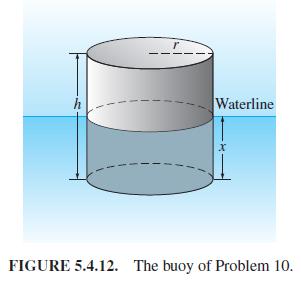
Consider a floating cylindrical buoy with radius r, height h, and uniform density ρ ≦ 0.5 (recall that the density of water is 1 g/cm3). The buoy is initially suspended at rest with its bottom at the top surface of the water and is released at time t = 0. Thereafter it is acted on by two forces:
Find the general solutions of the differential equations in Problems 1 through 20.5y(4) + 3y(3) = 0
In Problems 7 through 12, use the Wronskian to prove that the given functions are linearly independent on the indicated interval.f(x) = ex , g(x) = x-2, h(x) = x-2 In x ; x > 0
In Problems 1 through 20, find a particular solution yp of the given equation. In all these problems, primes denote derivatives with respect to x.y" + 9y = 2 cos 3x + 3 sin 3x
In each of Problems 11 through 14, find and plot both the steady periodic solution xsp(t) = C cos(ωt - α) of the given differential equation and the actual solution x(t) = xsp(t) + Xtr(t) that satisfies the given initial conditions.x" + 4x' + 5x = 10 cos 3t ; x (0) = x'(0) = 0
Find the general solutions of the differential equations in Problems 1 through 20.y(4) - 8y(3) + 16y" = 0
In Problems 7 through 12, use the Wronskian to prove that the given functions are linearly independent on the indicated interval.f(x) = x , g(x) = xex , h(x) = x2ex ; the real line
In Problems 1 through 16, a homogeneous second-order linear differential equation, two functions y1 and y2, and a pair of initial conditions are given. First verify that y1 and y2 are solutions of the differential equation. Then find a particular solution of the form y = c1y1 + c2y2 that satisfies
In Problems 1 through 20, find a particular solution yp of the given equation. In all these problems, primes denote derivatives with respect to x.y(3) + 4y' = 3x - 1
In each of Problems 11 through 14, find and plot both the steady periodic solution xsp(t) = C cos(ωt - α) of the given differential equation and the actual solution x(t) = xsp(t) + Xtr(t) that satisfies the given initial conditions.x" + 6x' + 13x = 10 sin 5t ; x (0) = x'(0) = 0
Find the general solutions of the differential equations in Problems 1 through 20.y(4) - 3y(3) + 3y" - y' = 0
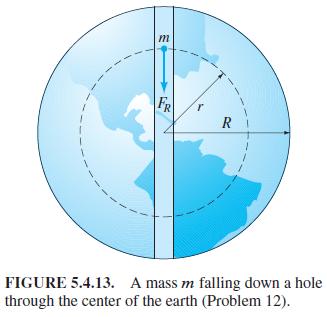
Assume that the earth is a solid sphere of uniform density, with mass M and radius R = 3960 (mi). For a particle of mass m within the earth at distance r from the center of the earth, the gravitational force attracting m toward the center is Fr = -GMrm/r2, where Mr is the mass of the part of the
In Problems 7 through 12, use the Wronskian to prove that the given functions are linearly independent on the indicated interval.f(x) = x , g(x) = cos(lnx) , h(x) = sin(In x) ; x > 0
In Problems 1 through 16, a homogeneous second-order linear differential equation, two functions y1 and y2, and a pair of initial conditions are given. First verify that y1 and y2 are solutions of the differential equation. Then find a particular solution of the form y = c1y1 + c2y2 that satisfies
In Problems 1 through 20, find a particular solution yp of the given equation. In all these problems, primes denote derivatives with respect to x.y(3) + y' = 2 - sin x
In each of Problems 11 through 14, find and plot both the steady periodic solution xsp(t) = C cos(ωt - α) of the given differential equation and the actual solution x(t) = xsp(t) + Xtr(t) that satisfies the given initial conditions.x" + 2x' + 26x = 600 cos 10t ; x (0) = 10, x'(0) = 0
Find the general solutions of the differential equations in Problems 1 through 20.9y(3) + 12y" + 4y' = 0
In each of Problems 7 through 10, find the steady periodic solution xsp(t) = C cos(ωt - α) of the given equation mx" + cx' + kx = F(t) with periodic forcing function F(t) of frequency ω. Then graph xsp(t) together with (for comparison) the adjusted forcing function F1(t) = F(t)/mω.x" + 3x' + 5x
In Problems 1 through 20, find a particular solution yp of the given equation. In all these problems, primes denote derivatives with respect to x.y" - 4y = cosh 2x
In Problems 1 through 20, find a particular solution yp of the given equation. In all these problems, primes denote derivatives with respect to x.y" + 2y' - 3y = 1 + xex
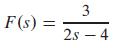
Apply the translation theorem to find the inverse Laplace transforms of the functions in Problems 5 through 10. F(s) = 3 2S-4
Showing 700 - 800
of 2513
1
2
3
4
5
6
7
8
9
10
11
12
13
14
15
Last
Step by Step Answers

 Get 50% OFF
Claim Now
Get 50% OFF
Claim Now