New Semester
Started
Get
50% OFF
Study Help!
--h --m --s
Claim Now
Question Answers
Textbooks
Find textbooks, questions and answers
Oops, something went wrong!
Change your search query and then try again
S
Books
FREE
Study Help
Expert Questions
Accounting
General Management
Mathematics
Finance
Organizational Behaviour
Law
Physics
Operating System
Management Leadership
Sociology
Programming
Marketing
Database
Computer Network
Economics
Textbooks Solutions
Accounting
Managerial Accounting
Management Leadership
Cost Accounting
Statistics
Business Law
Corporate Finance
Finance
Economics
Auditing
Tutors
Online Tutors
Find a Tutor
Hire a Tutor
Become a Tutor
AI Tutor
AI Study Planner
NEW
Sell Books
Search
Search
Sign In
Register
study help
physics
particle physics
Principles And Practice Of Physics 2nd Edition Eric Mazur - Solutions
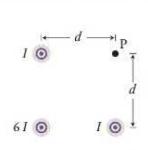
Two of the three wires in Figure P28.8 carry current \(I\), and the third wire carries current 6I. The location labeled \(\mathrm{P}\) is a distance \(d\) from cach of the wires carrying current \(I\). What is the direction of the magnetic field at \(\mathrm{P}\) ?Data from Figure P28.8 P 10 d
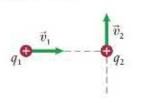
Two positively charged particles 1 and 2 are moving in the same plane, with the velocity of particle 1 perpendicular to the velocity of particle 2. At the instant shown in Figure P28.9, particle 2 is on the line that defines the velocity of Figure P28.9 particle 1. (Take their speeds to be much
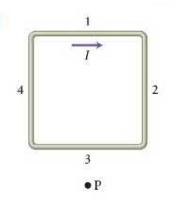
In Figure P28.10, (a) specify the direction of the magnetic field at the location labeled \(\mathrm{P}\) due to each of the four sides 1-4 of the current loop. (b) Which side produces the strongest magnetic field at P? (c) What additional information is needed to determine the direction of the
Where do you expect the magnitude of the magnetic field due to a circular current loop to be greatest?
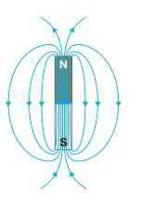
Could Figure P28.12 represent the magnetic field due to a bar magnet that has a rectangular cross section rather than a circular cross section?Data from Figure P28.12 N S
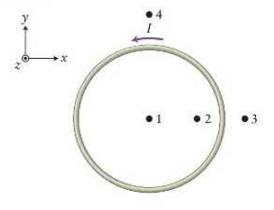
A loop of wire carries a current \(l\) as shown in Figure P28.13. Determine the direction of the magnetic field at the points labeled.Data from Figure P28.13 L x 2 3
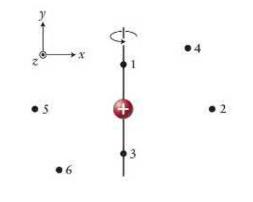
Figure P28.14 shows a positively charged spherical object that is spinning. For each of the labeled points, state the direction of the magnetic field. Assume all points lie in the \(x y\) plane.Data from Figure P28.14 05 6 3 A 2
For a given current loop, a rectangular geometry can make calculations more convenient than a circular geometry. How would the magnetic field from a small square current loop compare with that from a small circular current loop?
A circular current-carrying wire loop produces a magnetic field. A spinning disk of uniformly distributed charge produces a similar magnetic field. How would you expect the field due to a spinning disk to compare to the field due to a current-carrying wire loop?
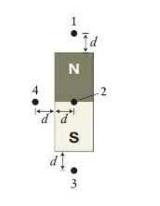
For the bar magnet in Figure P28.18, which of the four locations labeled 1,2,3,4 has the greatest density of magnetic field lines?Data from Figure P28.18 N d 2 P.P. d S 3
A negatively charged particle located at the origin of an \(x y z\) coordinate system is spinning clockwise about the \(x\) axis (that is, clockwise when you look at the particle while standing somewhere on the positive \(x\) axis). What is the direction of its magnetic field at all positions along
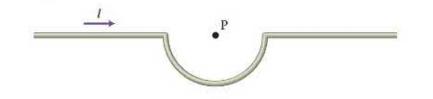
Figure P28.20 shows a wire segment bent into a halfcircle, with the center of curvature labeled \(P\). If the wire of which this segment is a part is extremely long and carries a current \(I\), what is the direction of the magnetic field at P?Data from Figure P28.20 P
In the Bohr model of the hydrogen atom, an electron orbits a nucleus consisting of one proton. Given that the electron and proton are both spinning, describe the types of magnetic interactions you expect to be associated with the hydrogen atom.
In the space surrounding Earth, the main component of the planet's magnetic field is the field due to a magnetic dipole. In what direction is Earth's magnetic dipole moment?
Earth's magnetic field is thought to be generated by currents in the planet's core. In what direction (clockwise or counterclockwise, when viewed along the rotation axis from north to south) does this current circulate?
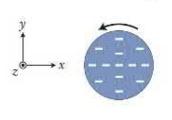
The disk shown in Figure P28.24 is charged with electrons and spins counterclockwise when viewed from above. From this perspective, what is the direction of the magnetic dipole moment of the disk?Data from Figure P28.24
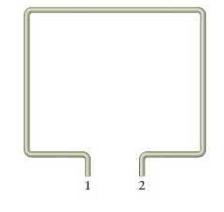
In the open wire loop of Figure P28.25, end 1 is held at a higher electric potential than end 2. (a) In which direction do electrons move through the loop? (b) What is the direction of the current? (c) What is the direction of the loop's magnetic dipole moment?Data from Figure P28.25 1 2
Figure P28.26 shows part of the rotation of an electric motor, during which the magnetic dipole moment of the loop points to the left or has some component to the left. If the entire rotation were shown, during what fraction of the rotation would the magnetic dipole moment have some component
A current loop lying in the \(x y\) plane of an \(x y z\) coordinate system experiences a torque that is clockwise about the \(y\) axis when viewed looking down from the positive \(y\) axis toward the origin. This torque is due to a uniform external magnetic field that points in the positive \(x\)
A current loop lies in the \(x y\) plane of an \(x y z\) coordinate system, with the current circulating counterclockwise when viewed looking down the positive \(z\) axis toward the origin. The loop experiences a torque about the \(x\) axis that is counterclockwise when viewed looking down the
Determine the direction of the magnetic dipole moment in each current loop or charge distribution in Figure P28.29. In (c), the higher potential end of the loop is marked + , and in (d), the disk has a uniform negative charge.
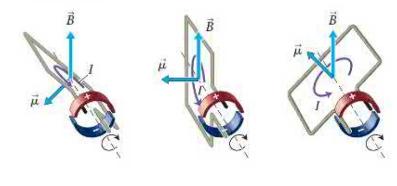
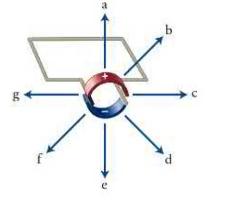
(a) As the electric motor shown schematically in Figure P28.30 operates, which of the arrows shown could represent the magnetic dipole moment at various instants? (b) If there are any arrows that are not possible magnetic dipole moment vectors, state why they are not allowed.Data from Figure
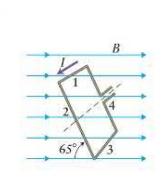
Figure P28.31 shows a rectangular loop of current in an external magnetic field. Initially the plane of the loop makes a \(65^{\circ}\) angle with the magnetic field. (a) Determine the direction of the magnetic force exerted on each side of the loop. Treat side 4 as though it were one unbroken
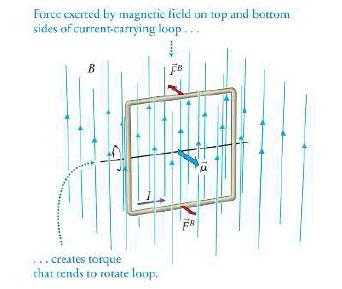
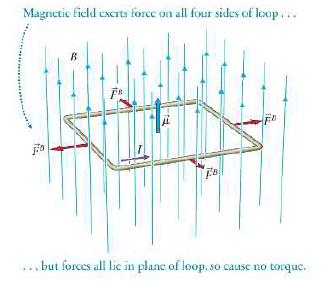
Figure 28. 10 shows a current loop in an external magnetic field and the forces exerted on the different lengths of the wire. Assume that the loop is attached to a pivot that allows it to spin (as between Figures 28. 10 and 28. 11).(a) Determine the directions of all the forces on the loop if the
A negatively charged particle is held in position and then released in a region where a uniform magnetic field points in the positive \(x\) direction and a uniform electric field points in the positive \(y\) direction. The particle is spinning about an axis parallel to the \(z\) axis, and the spin
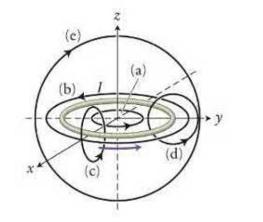
The current loop in Figure P28.34 lies in the \(x y\) plane. For each of the Amperrian paths (a)-(e), is the line integral of the magnetic field positive, negative, or zero?Data from Figure P28.34 () 20 (c) (a) (b) (d)
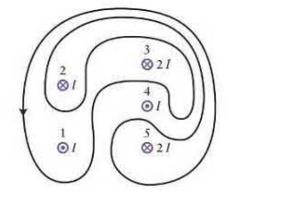
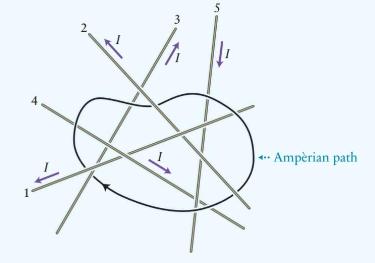
Wires 1 to 5 in Figure P28.35 carry current either into or out of the page. What is the magnitude of the current enclosed by the Ampèrian path indicated? Is the line integral of the magnetic field around this path, in the direction indicated, positive, negative, or zero?Data from Figure P28.35 2
Is the line integral of the magnetic field along the closed path in Figure P28.36 positive, negative, or zero? The direction of integration is shown with arrows on the path.Data from Figure P28.36 21 02/
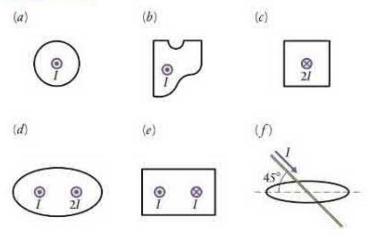
Figure P28.37 shows a series of current-carrying wires, and in each case an Ampèrian path is shown (but without direction). Rank the six cases according to the magnitude of the line integral of the magnetic field calculated along the Ampèrian path shown in each case, smallest value of \(|\oint
The line integral of the magnetic field around a certain closed path is initially \(L\). The current that penetrates this path is then doubled. What can you say about the current through the path if the new integral of the magnetic field around the closed path is (a) L and(b) 2 L ?
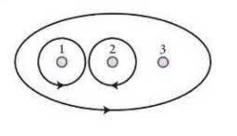
Each of the wires 1 to 3 in Figure P28.39 carries a current perpendicular to the page. The line integrals of the magnetic field around the three Ampèrian paths shown all have the same positive value. How do the magnitudes and directions of the three currents compare?Data from Figure P28.39
A positively charged particle located at the origin of an \(x y z\) coordinate system spins about the \(z\) axis, and the spin is counterclockwise when viewed looking down from the positive \(z\) axis toward the origin. Is the line integral of the magnetic field positive, negative, or zero for an
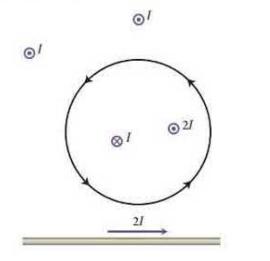
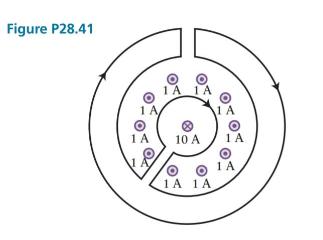
Eleven wires and one Ampèrian path are shown in Figure P28.41, with current values and directions as indicated. Is the line integral of the magnetic field along the Ampèrian path shown greater than, smaller than, or equal to zero?Data from Figure P28.41 Figure P28.41 1A A 1 A 1 A 1 A 10 A 1 A 1
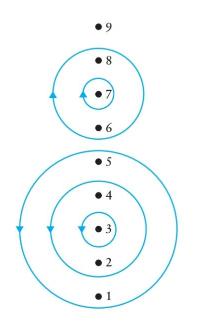
Figure P28.42 shows magnetic field lines in a certain region. Are there any locations where there must be a current directed into or out of the plane of the diagram? (Consider locations near the numbers on the vertical axis.) At which of the locations 1-9 does a current exist? What is the current
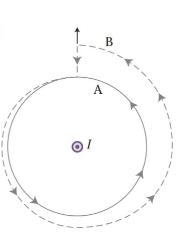
Figure \(\mathrm{P} 28. 43\) shows two paths (A and B) around a wire that carries current \(I\). (a) Along which path is the line integral of the magnetic field greater? (b) Along which path is the average magnetic field greater? (c) Explain how your answers to parts \(a\) and \(b\) are
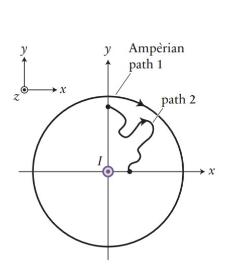
Figure P28.44 shows a very long wire that carries a current \(I\) in the \(z\) direction and is centered in the \(x y\) plane at the position \((0,0)\). The line integral of the magnetic field along Ampèrian path 1 is \(-5.50 \mathrm{~T} \cdot \mathrm{m}\). Determine the line integral of the
At a location \(25 \mathrm{~mm}\) away from a long, straight currentcarrying wire, the magnitude of the magnetic field due to the wire is \(2.0 \times 10^{-5} \mathrm{~T}\). Calculate the magnitude of the current in the wire.
A long, straight wire carrying \(1.5 \mathrm{~A}\) of current to the left is placed above a large, flat sheet through which the current per unit width is \(3.0 \mathrm{~A} / \mathrm{m}\) to the left. What are the magnitude and direction of the magnetic force exerted on each \(1.0-\mathrm{m}\)
The magnetic field magnitude is \(4.0 \mathrm{mT}\) at a position \(6.2 \mathrm{~mm}\) radially away from a long current-carrying wire. Calculate \((a)\) the current in the wire and \((b)\) the magnetic field magnitude at a position \(77 \mathrm{~mm}\) radially away from the wire.
Two straight wires separated by a very small distance run parallel to each other, one carrying a current of \(3.0 \mathrm{~A}\) to the right and the other carrying a current of 4. 0 A to the left. Give the approximate value for the magnitude of the magnetic field a large distance \(r\) from both
A moving particle carrying charge \(e\) traveling to the right at \(2.5 \times 10^{7} \mathrm{~m} / \mathrm{s}\) initially feels no magnetic force. When a long current-carrying wire is placed parallel to the line of motion of the particle at a location \(3.0 \mu \mathrm{m}\) away from the particle,
An electric current is uniformly distributed throughout a long, straight wire that has a diameter of \(50 \mathrm{~mm}\). If the current through the wire is \(6.0 \mathrm{~A}\), calculate the magnitude of the magnetic field (a) \(20 \mathrm{~mm}\) radially away from the wire center and \((b) 50
Two large, flat current-carrying sheets are placed parallel to each other, one sheet above the other. The upper sheet carries a current density of \(2.0 \mathrm{~A} / \mathrm{m}\) to the left, and the lower sheet carries a current density of \(5.0 \mathrm{~A} / \mathrm{m}\) to the right. Calculate
An electron travels to the right at \(3.0 \times 10^{6} \mathrm{~m} / \mathrm{s}\) between two large, flat sheets that are parallel to each other and to the electron's line of motion. If currents per unit width of \(8.0 \mathrm{~A} / \mathrm{m}\) to the right through the top sheet and \(8.0
A certain wire has a circular cross section of radius \(R\) and carries a current \(I\). Suppose that the charge carriers all move along the cylindrical surface of the wire, not through its cross-sectional area. (a) Derive an expression for the magnetic field magnitude \(B(r)\) as a function of
Point \(\mathrm{P}\) is a distance \(d_{1}=4.0 \mathrm{~mm}\) above a large sheet of metal that carries a current of \(40 \mathrm{~A}\) in the positive \(x\) direction and a distance \(d_{2}=3.0 \mathrm{~mm}\) below a very long wire that carries a current of \(0.35 \mathrm{~A}\) in the positive
Two large, parallel, current-carrying plates are oriented horizontally and the vertical distance between them is \(5.0 \mathrm{~mm}\). The current per unit width in each plate is \(100 \mathrm{~A} / \mathrm{m}\), and both currents are in the positive \(x\) direction. Determine the magnitude and
A particle of mass \(9.1 \times 10^{-31} \mathrm{~kg}\) and carrying an unknown quantity of charge is shot at a velocity of \(2.0 \times 10^{4} \mathrm{~m} / \mathrm{s}\) to the right and enters the magnetic field generated by a large, flat current-carrying sheet. The current in the sheet is
A long solenoid with 300 windings per meter of length carries a current of \(1.0 \mathrm{~A}\). Calculate the magnitude of the magnetic field inside the solenoid.
You need to use a long solenoid to produce a magnetic field of magnitude \(0.070 \mathrm{~T}\). If the maximum current you are able to run through the windings is \(20 \mathrm{~A}\), what is the minimum number of windings per meter the solenoid must have?
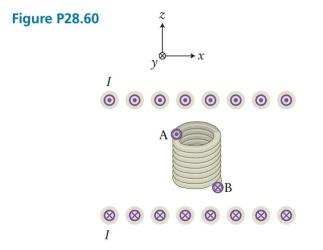
A small solenoid is inserted into a larger solenoid (Figure P28.60). The current in the small solenoid is from A to B. (a) Determine the initial direction of the magnetic dipole moment of the small solenoid. (b) Assuming the large solenoid is fixed in place and the small solenoid is free to rotate,
A long, straight wire carrying a current of \(2.5 \mathrm{~A}\) to the left is placed directly below and parallel to the central axis of a solenoid that has 1000 windings per meter of length and a current of \(45 \mathrm{~mA}\). Calculate the magnitude and direction of the magnetic field at the
Calculate the magnitude of the magnetic force exerted on a wire that is \(20 \mathrm{~mm}\) long and carries a current of \(4.0 \mathrm{~A}\) when it is suspended inside a solenoid at an angle of \(45^{\circ}\) to the magnetic field. The solenoid has 700 turns per meter of length and carries a
A toroid has 250 square windings carrying a current of \(3.0 \mathrm{~mA}\). Each side of each square winding is \(50 \mathrm{~mm}\) long, and the distance from the toroid center to the inner surface of the windings is \(120 \mathrm{~mm}\). What is the magnitude of the magnetic field \((a)\) at the
At what radial distance \(r\) from the center of a toroid of 200 windings does the magnitude of the magnetic field equal that found inside a solenoid that has 500 turns per meter of length? Assume that the current is the same through both devices.
A toroid carries a current \(I\) and has \(n\) circular windings per unit length measured along the inside edge of the windings. The radius of each circular winding is \(R_{\text {winding }}\), and the inner radius of the toroid is \(R_{\text {toroid. }}\). Derive an expression for the magnetic
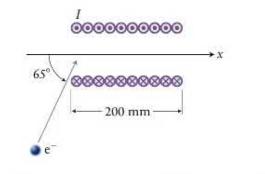
An electron is fired into one end of the solenoid in Figure P28.66. Viewed along the positive \(x\) axis from a negative \(x\) coordinate, the electron enters from below at a \(65^{\circ}\) angle to the horizontal, just inside the bottom edge of the solenoid. From this viewpoint the solenoid
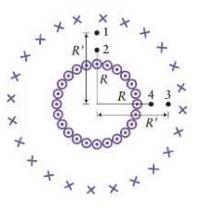
You are calibrating magnetic coils for a particle detector. One step involves checking the magnetic field at different positions inside a toroid, and you are asked to measure the field at the positions labeled 1,2,3, 4 in Figure P28.67. Your partner, knowing that the magnetic field inside a
Calculate the magnitude of the magnetic field at the center of a circular arc of radius \(25 \mathrm{~mm}\) spanning an angle of \(\pi / 2\) and carrying a current of \(3.0 \mathrm{~A}\).
Wire \(1,5.0 \mathrm{~m}\) long and carrying a current of \(3.0 \mathrm{~A}\), experiences a magnetic force of magnitude \(4.0 \times 10^{-7} \mathrm{~N}\) when placed \(90 \mathrm{~mm}\) away from wire 2 running parallel to wire 1 . What must the magnitude of the current in wire 2 be?
Use the Biot-Savart law to determine the magnetic field \(70 \mathrm{~mm}\) above the center of a loop of wire that has a radius of \(0.22 \mathrm{~m}\) and carries \(3.0 \mathrm{~A}\) of current.
Wire \(1,3.0 \mathrm{~m}\) long and of linear mass density \(0.010 \mathrm{~kg} / \mathrm{m}\), is initially held in place and carries \(10 \mathrm{~A}\) of current to the right. Very long wire 2 is placed parallel to and \(5.0 \mathrm{~mm}\) directly above wire 1 . When wire 1 is released, it
Suppose that we can use wire of \(1.0-\mathrm{mm}\) diameter to make either a single loop of wire or a solenoid, and we wish to compare, for a given current, the magnetic fields at the center of each. (a) Use the Biot-Savart law to derive an expression for the magnetic field magnitude at the center
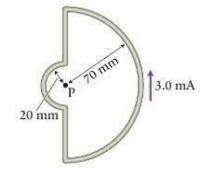
In Figure P28.73, point P is the common center of two circular arcs of wire, the larger of radius \(70 \mathrm{~mm}\) and the smaller of radius \(20 \mathrm{~mm}\). What are the magnitude and direction of the magnetic field at \(\mathrm{P}\) if the current through the wire is \(3.0 \mathrm{~mA}\)
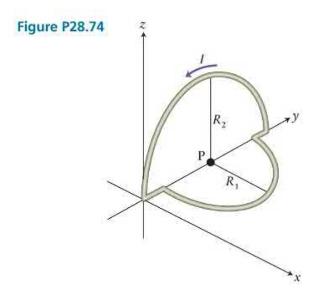
A current-carrying wire has been bent into the form shown in Figure P28.74, with a half-circle of radius \(R_{1}\) lying in the \(x y\) plane connected via two straight segments to a half-circle of radius \(R_{2}\) lying in the \(y z\) plane. The current direction is as indicated. If \(R_{2}=1.5
A wire carrying a \(3.0-\mathrm{A}\) current lies along the \(x\) axis of an \(x y\) coordinate system, extending from \(x=0\) to \(x=10 \mathrm{~m}\). What is the magnitude of the magnetic field at point \(\mathrm{P}\) located at \(x=0, y=2.0 \mathrm{~m}\) ?
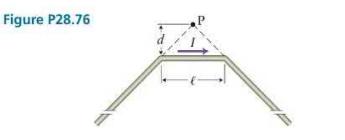
The horizontal portion of the wire in Figure P28.76 has a length \(\ell=0.100 \mathrm{~m}\), and position \(\mathrm{P}\) is a perpendicular distance \(d=30.0 \mathrm{~mm}\) above the center of the horizontal portion. The wire carries a \(45.0-\mathrm{A}\) current, and the two slanted portions of
An electron moves in a straight line at a speed of \(6.0 \times 10^{7} \mathrm{~m} / \mathrm{s}\). Calculate the magnitude and direction of the magnetic field at a position \(5.0 \mathrm{~mm}\) behind the electron and \(15 \mathrm{~mm}\) below its line of motion.
A proton moves in the positive \(x\) direction at \(4.00 \times 10^{4} \mathrm{~m} / \mathrm{s}\). Calculate the magnitude of the magnetic field at the point \((x, y)=(+2.00 \mathrm{~mm},+1.00 \mathrm{~mm})\) as the proton passes through the origin.
Express the magnetic field due to a uniformly moving charged particle in terms of the electric field of the particle and its velocity.
Two electrons 1 and 2 move along antiparallel paths separated by a distance of \(10 \mathrm{~nm}\), traveling at speeds \(v_{1}=\) \(4.0 \times 10^{7} \mathrm{~m} / \mathrm{s}\) and \(v_{2}=7.0 \times 10^{6} \mathrm{~m} / \mathrm{s}\). What is the magnitude of the magnetic force exerted by electron
Proton 1 , traveling in the negative \(x\) direction at speed \(v_{1}\), is directly below proton 2 , which is traveling at speed \(v_{2}\) at an angle of \(45^{\circ}\) above the positive \(x\) axis. If the protons are separated by a distance \(r\), calculate the magnitude of the magnetic force
A charged particle is traveling through a uniform magnetic field, with its velocity perpendicular to the field direction. You learned that such a particle experiences a magnetic force that causes it to move in a circular path. Also, because it is moving, the charged particle creates its own
Electron 1 , initially traveling to the right at \(1.5 \times 10^{6} \mathrm{~m} / \mathrm{s}\), is accelerated upward at \(900 \mathrm{~m} / \mathrm{s}^{2}\) by the electromagnetic force exerted by electron 2, which is directly beneath electron 1 and traveling to the left at \(4.0 \times 10^{6}
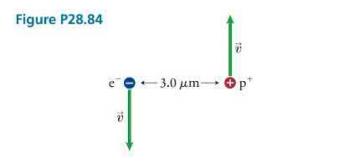
An electron and a proton are fired in opposite directions, and at the instant they are nearest each other, their separation distance is \(3.0 \mu \mathrm{m}\) (Figure P28.84). At that instant, the two particles are both moving at \(3.0 \times 10^{4} \mathrm{~m} / \mathrm{s}\) but in opposite
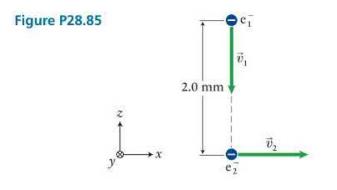
Two electrons move near each other and at the instant shown in Figure P28.85 are \(2.0 \mathrm{~mm}\) apart. The speed of electron 1 is \(v_{1}=300 \mathrm{~m} / \mathrm{s}\), that of electron 2 is \(v_{2}=\) \(500 \mathrm{~m} / \mathrm{s}\), and the directions of motion are as shown in Figure
At \(t=0\), electron 1 is shot out of an accelerator at a speed of \(2.0 \times 10^{3} \mathrm{~m} / \mathrm{s}\). At \(t=1.0 \mu \mathrm{s}\), electron 2 is shot out of the accelerator and travels on a path that is parallel to and \(10 \mathrm{~mm}\) below the path of electron 1 . The speed of
A current loop lies in the \(x y\) plane, with the current circulating counterclockwise when viewed from the positive \(z\) axis. Is there a torque on the loop, and if so, in what direction, if a uniform magnetic field is applied along the positive \((a) x\) axis, \((b) y\) axis, and \((c) z\) axis?
A solenoid that is \(200 \mathrm{~mm}\) long has 200 turns. What current \(I\) in the solenoid is required to produce a magnetic field of magnitude \(1.0 \mathrm{~T}\) inside the solenoid?
Wire 1 is \(2.3 \mathrm{~m}\) long and carries a current of \(2.2 \mathrm{~A}\) to the right. Wire 2 is also \(2.3 \mathrm{~m}\) long, and it carries a current of 3. 0 A to the left. The wires are parallel to each other and separated by a distance of \(0.25 \mathrm{~m}\). Determine the direction
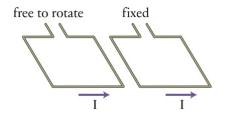
Figure P28.90 shows two square loops of wire. The loop on the right is fixed in place, and the one on the left is free to pivot in any direction. Both loops carry a current that is counterclockwise when viewed from above.(a) What is the direction of the magnetic field created by the right loop at
Wire 1, with mass \(0.010 \mathrm{~kg}\) and length \(1.0 \mathrm{~m}\), has a square cross section and is initially at rest on a table. It is connected by flexible leads to a battery and carries a steady current of \(1.5 \mathrm{~A}\). When wire 2 is placed parallel to wire 1 a distance \(2.0
Two of your friends separately calculated a magnetic field line integral around a long, straight current-carrying wire in a homework problem, but they arrived at different answers. Now they want your help, so they send you a copy of their work. Andy chose a square path for his line integral, a path
Your design team is working on an air-core toroid that is to have the greatest feasible magnetic field per ampere of current but in which the greatest magnetic field magnitude must be exactly four times the smallest magnetic field magnitude. Because of space and cost restrictions, the maximum
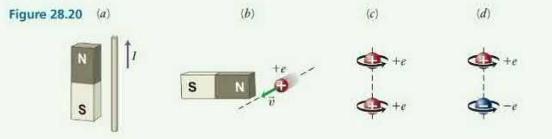
Determine the direction of the magnetic force exerted at the center of the wire or on the particles in Figure 28. 20.Data from Figure 28. 20 Figure 28.20 (a) (b) N S S N +8 te
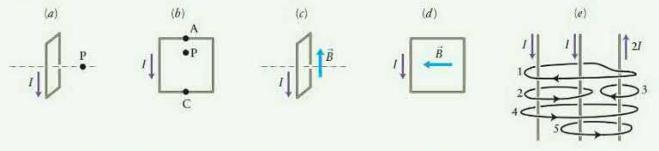
Determine the direction of the magnetic field at \(\mathrm{P}\) due to \((a)\) the current loop in Figure 28. 21a and (b) segments A and C of the current loop in Figure 28. 21b.Data from Figure 28. 21 (a) ! 21 (e) (d) (2)
Determine in which direction the current loop rotates \((a)\) in Figure \(28.21 c\) and \((b)\) in Figure 28. 21d.Data from Figure 28. 21 (a) ! 21 (e) (d) (2)
(a) Determine the currents encircled by the five Ampèrian paths in Figure 28. 21e. (b) Rank the paths according to the magnitudes of the line integral of the magnetic field along each path, greatest first.Data from Figure 28. 21 (a) ! 21 (e) (d) (2)
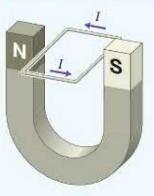
When placed between the poles of a horseshoe magnet as shown in Figure 28.12, does a rectangular current loop experience a torque? If so, in which direction does the loop rotate?Data from Figure 28.12 N S
Consider the Ampèrian path going through the collection of current-carrying wires in Figure 28.19. If the magnitude of the current is the same in all the wires, is the line integral of the magnetic field along the Ampèrian path positive, negative, or zero?Data from Figure 28.19 5 3 Amprian path
A long straight wire carries a current of magnitude \(I\), and this current creates a magnetic field \(\vec{B}\). Derive an expression for the magnitude of the magnetic field a radial distance \(r\) from the wire.
A large flat metal sheet carries a current. The magnitude of the current per unit of sheet width is \(K\). What is the magnitude of the magnetic field a distance \(d\) above the sheet?
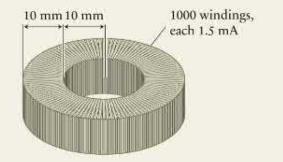
The toroid in Figure 28.31 has 1000 windings carrying a current of \(1.5 \mathrm{~mA}\). Each winding is a square of side length \(10 \mathrm{~mm}\), and the toroid's inner radius is \(10 \mathrm{~mm}\). What is the magnitude of the magnetic field at the center of the winding squares?Data from
A long straight wire carries a current of magnitude \(I\). Use the Biot-Savart law to derive an expression for the mag. netic field \(\vec{B}\) produced at point \(\mathrm{P}\) a radial distance \(r\) from the wire.
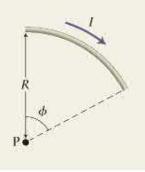
A wire bent into a circular arc of radius \(R\) subtending an angle \(\phi\) carries a current of magnitude \(I\) (Figure 28.35). Use the Biot-Savart law to derive an expression for the magnitude of the magnetic field \(\vec{B}\) produced at point \(\mathrm{P}\), located at the center of the
An electron carrying a charge \(-e=-1.60 \times 10^{-19} \mathrm{C}\) moves in a straight line at a speed \(v=3.0 \times 10^{7} \mathrm{~m} / \mathrm{s}\). What are the magnitude and direction of the magnetic field caused by the electron at a point \(\mathrm{P} 10 \mathrm{~mm}\) ahead of the
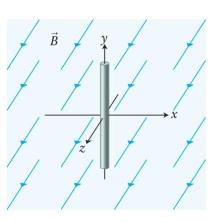
What happens if the conducting rod in Figure P29.1 moves \((a)\) in either direction along the \(z\) axis and \((b)\) in either direction along the \(y\) axis?Data from Figure P29.1 B
The Air Force Thunderbirds aerial demonstration team is performing at an air show located on Earth's magnetic equator. In what directions can the airplanes fly so that there is no charge separation on their metal surfaces?
How should any one of the airplanes described in Problem 2 fly in order to produce the maximum charge separation between its wing tips? (Consider both the direction of motion and the orientation of the wings.)Data from Problem 2The Air Force Thunderbirds aerial demonstration team is performing at
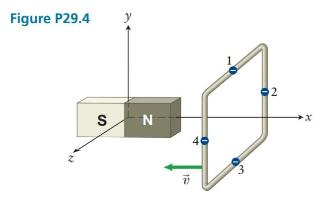
Figure P29.4 shows a square conducting loop centered on the \(x\) axis, with its sides parallel to the \(y\) and \(z\) axes. The loop moves with constant velocity in the negative \(x\) direction toward a small bar magnet that is centered on the origin and has its polar axis aligned along the \(x\)
Showing 1500 - 1600
of 4962
First
9
10
11
12
13
14
15
16
17
18
19
20
21
22
23
Last
Step by Step Answers

 Get 50% OFF
Claim Now
Get 50% OFF
Claim Now