New Semester
Started
Get
50% OFF
Study Help!
--h --m --s
Claim Now
Question Answers
Textbooks
Find textbooks, questions and answers
Oops, something went wrong!
Change your search query and then try again
S
Books
FREE
Study Help
Expert Questions
Accounting
General Management
Mathematics
Finance
Organizational Behaviour
Law
Physics
Operating System
Management Leadership
Sociology
Programming
Marketing
Database
Computer Network
Economics
Textbooks Solutions
Accounting
Managerial Accounting
Management Leadership
Cost Accounting
Statistics
Business Law
Corporate Finance
Finance
Economics
Auditing
Tutors
Online Tutors
Find a Tutor
Hire a Tutor
Become a Tutor
AI Tutor
AI Study Planner
NEW
Sell Books
Search
Search
Sign In
Register
study help
physics
particle physics
Principles And Practice Of Physics 2nd Edition Eric Mazur - Solutions
The reactions in a lead-acid battery are Positive terminal: \(\mathrm{PbO}_{2}+\mathrm{HSO}_{4}^{-}+3 \mathrm{H}^{+}+2 \mathrm{e}^{-} \rightarrow\)\[\mathrm{PbSO}_{4}+2 \mathrm{H}_{2} \mathrm{O}\]Negative terminal: \(\quad \mathrm{HSO}_{4}^{-}+\mathrm{Pb} \rightarrow
One electrode in an alkaline battery is zinc, and the other is manganese dioxide. Fill in the blank for the chemical reaction \((a)\) at the zinc electrode: \(\mathrm{Zn}+2 \mathrm{OH}^{-} \rightarrow\) \(\mathrm{ZnO}+\ldots+2 \mathrm{e}^{-}\)and \((b)\) at the manganese electrode: \(2
Suppose that the metal electrodes in a battery are shaped like large parallel plates and are \(1.00 \mathrm{~mm}\) apart, so that they are essentially a parallel-plate capacitor. If the battery supplies a potential difference of \(4.5 \mathrm{~V}\) between the electrodes, what is the surface charge
A parallel-plate capacitor initially has capacitance \(C\). The distance between the plates is then doubled, with a \(9.0-\mathrm{V}\) battery connected. The battery is then disconnected, and the plate area is doubled. Finally, a \(20-\mathrm{V}\) battery is connected across the plates. What is the
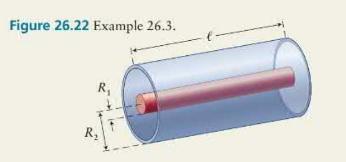
A capacitor consisting of two concentric spheres and one consisting of two coaxial cylinders both have an inner radius of \(10.0 \mathrm{~mm}\) and an outer radius of \(30.0 \mathrm{~mm}\). If the two capacitors have the same capacitance, what is the length of the cylinders?
A parallel-plate capacitor initially has capacitance \(C\). What is the capacitance after each of the following single changes is made:(a) plate separation distance doubled,(b) dielectric material inserted,(c) potential difference across plates doubled, \((d)\) plate area halved, \((e)\) applied
A coaxial capacitor consisting of an inner wire and an outer cylindrical shell has a length of \(80.0 \mathrm{~mm}\) and an outer diameter of \(10.0 \mathrm{~mm}\). When connected to an \(18.0-\mathrm{V}\) battery, this capacitor can hold \(1.1 \mathrm{nC}\) of charge on the wire. What is the wire
Consider a parallel-plate capacitor with charge \(+q\) on the top plate and \(-q\) on the other, and a plate area that is large relative to the separation distance. Contrast this with a spherical capacitor consisting of two concentric spherical shells, one smaller than the other, with a charge of
One way to double the capacitance of a parallel-plate capacitor is to reduce the plate separation distance by a factor of 2. Doubling the capacitance of a spherical capacitor is a bit more complex, though. (a) If you had a spherical capacitor consisting of two concentric spherical shells of radii
A spherical capacitor consists of two concentric conducting spherical shells of radii \(R\) and \(2 R\). (a) How long would a coaxial cylindrical capacitor made of two concentric cylindrical conductors of radii \(R\) and \(2 R\) have to be in order to have the same capacitance as the spherical
Two small, irregularly shaped conducting objects, one carrying charge \(+q\) and one carrying charge \(-q\), are placed on an \(x\) axis at \(x=-4.0 \mathrm{~m}\) and \(x=+4.0 \mathrm{~m}\), respectively. Between the objects, the electric field on the \(x\) axis is given by \(E(x)=a
The expression for the capacitance of a parallel-plate capacitor that has plates of area \(A\) separated by a distance \(d\) is given in Example 26. 2.(a) Show that the expression for a spherical capacitor, given in Example 26. 4, reduces to the expression for a parallel-plate capacitor in the
A parallel-plate capacitor with air between its plates carries a charge of \(6.60 \mu \mathrm{C}\) when a \(9.00-\mathrm{V}\) battery is connected to it. How much energy is stored in the capacitor?
Suppose a certain battery has an internal emf of \(9.00 \mathrm{~V}\) but the potential difference across its terminals is only \(85.0 \%\) of that value. If that battery is connected to a \(56.0-\mu \mathrm{F}\) capacitor, how much energy is stored when the capacitor is fully charged?
A parallel-plate capacitor connected to a battery maintaining a potential difference \(V\) across the capacitor initially stores electric potential energy \(U_{1}^{E}\). If the plate area is doubled and the battery is replaced with one that maintains a potential difference of \(2 \mathrm{~V}\)
Two parallel-plate capacitors 1 and 2 are identical except that capacitor 1 has charge \(+q\) on one plate and \(-q\) on the other, and capacitor 2 has charge \(+2 q\) on one plate and \(-2 q\) on the other. Compare the two capacitors based on their \((a)\) capacitance, \((b)\) potential difference
Three parallel-plate capacitors are separately connected to identical batteries. Capacitor 1 has a plate area \(A\) and a plate separation \(d\). Capacitor 2 has a plate area \(2 A\) and a plate separation \(d\). Capacitor 3 has a plate area \(A\) and a plate separation \(2 d\). Rank the three
Three parallel-plate capacitors each store the same amount of charge. Capacitor 1 has a plate area \(A\) and a plate separation \(d\). Capacitor 2 has a plate area \(2 A\) and a plate separation \(d\). Capacitor 3 has a plate area \(A\) and a plate separation \(2 d\). Rank the three capacitors,
(a) A spherical capacitor consists of two concentric conducting spheres of radii \(R\) and \(2 R\). If the two spheres carry charges of \(+q\) and \(-q\), what is the average energy density inside the capacitor in terms of \(R\) and \(q\) ? (b) \(\mathrm{A}\) cylindrical capacitor of length
A parallel-plate capacitor has plates of area \(A\). The plates are initially separated by a distance \(d\), but this distance can be varied. If the capacitor is connected to a battery, what should the plate separation be if you want to quadruple \((a)\) the capacitance, \((b)\) the charge stored,
A parallel-plate capacitor has plates of area \(A\). The plates are initially separated by a distance \(d\), but this distance can be varied. If the capacitor is charged by a battery and the battery is then removed so that the capacitor is isolated, what should the plate separation be if you want
A parallel-plate capacitor has an initial charge \(q\) and a plate separation distance \(d\). How much work must you do, in terms of \(q, d\), and plate area \(A\), to increase the separation distance to \(3 d\) if \((a)\) the capacitor is isolated and (b) the capacitor is connected to a
(a) Does it make sense to talk about a dielectric constant for a conductor? If so, what value does the constant have? (b) What is the breakdown threshold for a conductor?
The potential difference across the plates of a parallel-plate capacitor is gradually increased. (a) What happens when the breakdown threshold is exceeded? (b) If you want to increase the potential difference before breakdown occurs, what capacitor variables might you change?
(a) Make a list of ways to increase the capacitance of a parallel-plate capacitor.(b) Does Increase quantity of charge stored or Decrease potential difference belong on the list?
When you remove a dielectric slab from between the plates of a charged isolated capacitor, what happens to the energy stored in the capacitor? Why does this happen to the stored energy?
Two parallel-plate capacitors are identical except that capacitor 1 has vacuum between the plates and capacitor 2 has a dielectric slab of dielectric constant \(\kappa\) filling the space between the plates. The capacitors are connected to identical batteries. Compare the two based on (a)
Two parallel-plate capacitors are identical except that capacitor 1 has vacuum between the plates and capacitor 2 has a dielectric slab of dielectric constant \(\kappa\) filling the space between the plates. Each capacitor is isolated (that is, not connected to a battery), and they store equal
When a dielectric slab completely fills the space between the plates of a parallel-plate capacitor, the magnitude of the bound charge is one-fourth the magnitude of the free charge.(a) What is the dielectric constant of the material of which the slab is made? \((b)\) If the slab does not fill the
If you want to maintain a potential difference of \(6000 \mathrm{~V}\) between the plates of a parallel-plate capacitor, what is the minimum value of the plate separation if the space between the plates is completely filled by \((a)\) a slab of mica and \((b)\) a slab of barium titanate? (c) What
A parallel-plate capacitor with a plate area of \(50 \mathrm{~mm}^{2}\) and air between the plates can hold \(5.5 \mathrm{pC}\) of charge per volt of potential difference across its plates. When a barium titanate dielectric slab completely fills the space between the plates and the capacitor is
You are working on charge-storage devices for a research center. Your goal is to store as much charge on a given device as possible. The facilities allow you to generate almost any potential difference \(V\) you need, but you are restricted to using a single parallel-plate capacitor. The area and
A spherical capacitor has an inner radius of \(8.00 \mathrm{~mm}\) and an outer radius of \(8.50 \mathrm{~mm}\). With air between the spheres, the capacitor is connected to a battery and allowed to charge fully. With the battery still connected, oil is poured in, filling the volume between the
A dielectric slab completely fills the space between the plates of a parallel-plate capacitor. The magnitude of the bound charge on each side of the slab is \(75 \%\) of the magnitude of the free charge on each plate. The capacitance is \(480 \epsilon_{0} \ell\), where \(\ell\) is a constant with
Two very long wires each carry a linear charge density \(\lambda\). They initially repel each other with a force \(F\). If the wires are immersed in distilled water, with what force do they repel each other?
A solid conducting sphere of radius \(R\) and carrying charge \(+q\) is embedded in an electrically neutral nonconducting spherical shell of inner radius \(R\) and outer radius \(2 R\). The material of which the shell is made has a dielectric constant of 3. 0. (a) Relative to a potential of zero at
A solid conducting sphere of radius \(R\) is embedded in an electrically neutral nonconducting spherical shell that has inner radius \(R\), has outer radius \(2 R\), and is made of a material having dielectric constant \(\kappa\). Inside the shell the electric field magnitude is \(E=3 Q /\left(4
A conducting sphere has a radius of \(2.25 \mathrm{~m}\) and carries a positive surplus charge of \(35.0 \mathrm{mC}\). A protective layer of barium titanate is applied to the surface of the sphere to make it safe for laboratory workers nearby. Safety considerations dictate that the potential
(a) Explain how treating the electric field lines between two oppositely charged objects as elastic bands can help you to understand what happens to the electric potential energy of the system when you increase the separation distance between the objects. (b) Can you think of any limitations to
Why would two objects made of nonconducting material make a poorer capacitor than two objects of the same shape made of material that is an electrical conductor?
Two parallel-plate capacitors have the same plate separation. The plate area of capacitor 1 is twice that of capacitor 2. (a) How do the potential differences across the two capacitors compare if the quantity of charge you place on capacitor \(1\left(q_{1}\right)\) is twice the quantity you place
During a lightning strike, on the order of \(10 \mathrm{C}\) of charge is typically transferred to the ground over a potential difference of \(3 \times 10^{8} \mathrm{~V}\). (a) What is the capacitance of the cloudground system? (b) How much energy is stored in the system just before the strike?
Given that charge separation increases the electric potential energy of a system, what can you conclude about the criteria for keeping a system of positively and negatively charged particles in static equilibrium, in the presence of electrostatic interactions only?
A parallel-plate capacitor in which the plates are extendable is connected to a battery and charged until there is a charge \(+q\) on one plate and a charge \(-q\) on the other plate. (a) With the battery still connected, the area of each plate is doubled by sliding the extension out. How much
A parallel-plate capacitor carries a charge \(+q\) on one plate and a charge \(-q\) on the other plate. Each plate has an area \(A\). How much force, in terms of \(q\) and \(A\), does one plate exert on the other?
A \(30.5-\mu F\) parallel-plate capacitor initially has air between its plates and is connected to a \(24.0-\mathrm{V}\) battery. The capacitor is then submerged in distilled water. What is the charge on the plates \((a)\) if the capacitor is submerged with the battery connected and \((b)\) if the
Your firm uses a large parallel-plate capacitor to store energy, and you measure the electric field strength between the plates to determine the amount of energy stored. During a test run with a new renewable energy source, you realize that the electric field magnitudes being produced are too small
You are working for a car-battery manufacturer, and your boss complains that to be more competitive, the company needs to produce batteries that will last longer while minimizing the amount of metal or metal oxide used. She is not concerned about the amount of electrolyte used, but the battery must
In the endless endeavor to make electronic devices as small as possible, you have been hired to make a capacitor that has the greatest capacitance possible in a cubic volume of \((10 \mathrm{~mm}) \times(10 \mathrm{~mm}) \times(10 \mathrm{~mm})\). You are allowed to use any capacitor geometry you
Which way does the north pole of a compass needle point in the Southern Hemisphere?
Which type of magnetic pole is located near Earth's geographic South Pole?
How are the elementary magnets aligned in the magnet in Figure P27.3?Data from Figure P27.3
Can a magnet have more than two magnetic poles, one north and one south?
You are given three bars of metal. Two of them are magnets, and the third is made of a magnetic material but is not magnetized. Describe how, using only the three bars, you could determine which of them is not a magnet.
You are given two metal rods. One is a magnet, and the other is made of magnetic material but does not have the elementary magnets aligned. Using no other objects, how can you determine which is the magnet?
Sketch and describe the magnetic poles of a spherical piece of uniformly magnetized material.
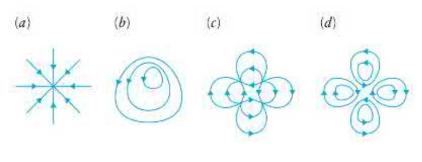
Which field line patterns in Figure P27.8 can represent a magnetic field?Data from Figure P27.8 (a) (b) (c) (d)
A bar magnet is enclosed by a spherical surface. (a) What is the magnetic flux through the entire surface? (b) If the magnetic flux through the hemisphere closest to the magnet's north pole is positive, is the flux through the hemisphere closest to the magnet's south pole positive, negative, or
Is the field line pattern created by a magnetic dipole the same as the field line pattern created by an electric dipole? Draw both field line patterns.
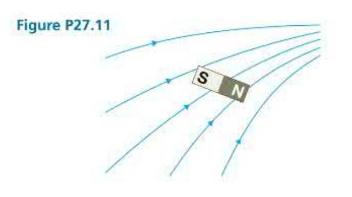
Describe what happens to a bar magnet placed in the nonuniform external magnetic field shown in Figure P27.11.Data from Figure P27.11 Figure P27.11 SN
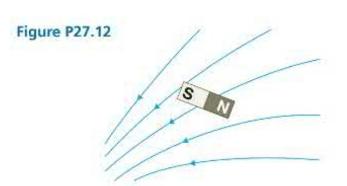
Describe what happens to a bar magnet placed in the nonuniform external magnetic field shown in Figure P27.12.Data from Figure P27.12 Figure P27.12 SN
Is there a field line pattern that could everywhere represent either the magnetic field due to a magnet or the electric field due to a system of fixed charged particles?
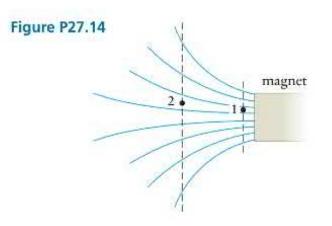
Estimate the magnitude of the magnetic field at location 2 in Figure P27.14 if the magnetic field magnitude at location 1 is \(0.27 \mathrm{~T}\). Note that real magnetic field lines spread out in three dimensions. The spreading is shown in only two dimensions here, but you must imagine that the
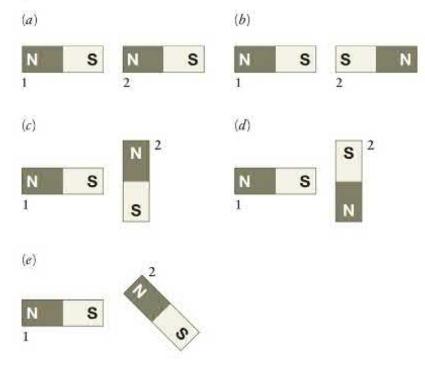
Rank the magnet pairs in Figure P27.15 in order of the magnitude of torque on magnet 2 , smallest torque first. Assume all the magnets are equal in strength and the spacing between magnets is comparable in all pairs.Data from Figure P27.15 (a) (b) N S N S N S S 1 2 1 2 (c) 2 N N S 1 (e) N S 1 S 2 N
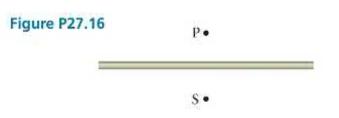
The long, straight current-carrying wire of Figure P27.16 lies in the plane of the page, and the magnetic field it produces at position \(\mathrm{P}\) points out of the page. (a) In what direction does the magnetic field point at position S? (b) What is the current direction in the wire?Data from
Figure \(\mathrm{P} 27. 17\) shows a long, straight current-carrying wire running perpendicular to the plane of the page. The current produces a magnetic field that points to the right at position P. (a) In what direction does the magnetic field point at position \(S\) ? (b) What is the current
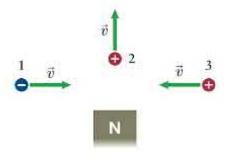
Figure P27.18 shows three particles passing near the north end of a bar magnet. Particle 1 is an electron, and particles 2 and 3 are protons. All three particles move at the same speed. (a) Determine the direction of the magnetic force exerted on each particle as it passes over the magnet. (b) What
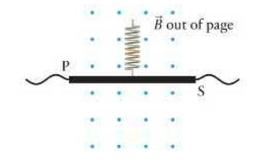
Figure P27.19 shows a conducting rod suspended from a spring in a region where a uniform magnetic field points horizontally out of the page. The rod can be supplied with current by two thin wires connecting its ends to the terminals of a battery (not shown). (a) Does the tension in the spring
A wire is coiled in the shape of a helical spring with closely spaced turns. (a) When current is passed through it, does the coil tend to lengthen, shorten, or stay the same length? (b) Does your answer depend on the current direction?
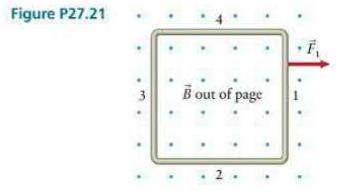
The square loop of wire in Figure P27.21 carries a current, and an external magnetic field is directed out of the page everywhere. If the magnetic force exerted on side 1 is to the right, determine \((a)\) the direction of the current in the loop and \((b)\) the directions of the magnetic forces
The two metal rods in Figure P27.22 are perpendicular to each other. Describe the magnetic force each rod exerts on the other, and then describe the torque caused by each force.Data from Figure P27.22
If two charged particles \(M\) and \(S\) are at rest relative to each other, there is no magnetic force between them. Suppose instead that particle \(M\) is moving relative to particle \(S\) while \(S\) is at rest in the Earth reference frame. Is a magnetic force exerted on S?
A positively charged particle is at rest on the positive \(z\) axis in reference frame \(S\). Reference frame \(S^{\prime}\) is moving along the positive \(x\) axis of \(\mathrm{S}\), reference frame \(\mathrm{S}^{\prime \prime}\) is moving along the negative \(x\) axis, and reference frame
Write expressions for the magnitudes and directions of the electric fields measured in Problem 24.Data from Problem 24A positively charged particle is at rest on the positive \(z\) axis in reference frame \(S\). Reference frame \(S^{\prime}\) is moving along the positive \(x\) axis of
Compare the magnitudes and directions of the magnetic fields measure in Problem 24.Data from Problem 24A positively charged particle is at rest on the positive \(z\) axis in reference frame \(S\). Reference frame \(S^{\prime}\) is moving along the positive \(x\) axis of \(\mathrm{S}\), reference
A wire \(0.70 \mathrm{~m}\) long carries a current of \(1.4 \mathrm{~A}\). The wire is at an angle of \(53^{\circ}\) to a uniform external magnetic field. If the magnitude of the force the field exerts on the wire is \(0.20 \mathrm{~N}\), what is the magnitude of the magnetic field?
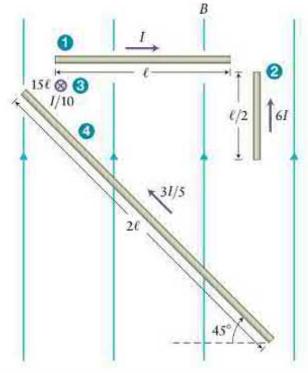
In Figure P27.28, an external magnetic field is directed upward throughout a region that contains four currentcarrying wires having the lengths and currents shown.Rank the wires according to the magnitude of the magnetic force exerted on them by the external field, smallest force first. Ignore any
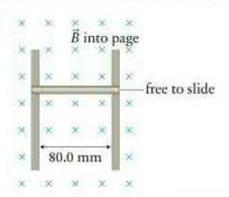
Two vertical parallel rails made of material that is an electrical conductor are \(80.0 \mathrm{~mm}\) apart (Figure P27.29). A wire \(80.0 \mathrm{~mm}\) long is free to slide along the rails, which allow a current to be maintained through the wire as it slides. An external magnetic field of
A current-carrying wire is bent into a circular loop of radius \(R\) and lies in an \(x y\) plane. A uniform external magnetic field in the \(+z\) direction exists throughout the plane of the loop. What is the magnetic force exerted by the external field on the loop?
Draw an \(x y z\) coordinate system with the \(x\) axis pointing horizontally to the right, the \(y\) axis pointing up the page, and the \(z\) axis pointing out of the page. Show a current-carrying wire lying on the \(x\) axis, and a 2. 5-A current through the wire directed in the positive \(x\)
A wire \(70.0 \mathrm{~mm}\) long is bent in a right angle such that the wire starts at the origin and goes in a straight line to \(x=30.0 \mathrm{~mm}, y=0\), and then in another straight line from \(x=30.0 \mathrm{~mm}, y=0\) to \(x=30.0 \mathrm{~mm}, y=\) \(40.0 \mathrm{~mm}\). The wire is in an
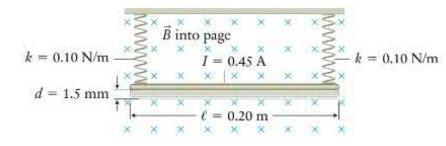
Figure \(\mathrm{P} 27. 33\) shows the arrangement we looked at in Example 27. 2: a metal bar \(0.20 \mathrm{~m}\) long suspended from two springs, cach having a spring constant \(k=0.10 \mathrm{~N} / \mathrm{m}\). Initially there is no current through the bar, and it is suspended at rest below the
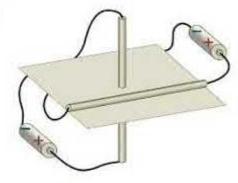
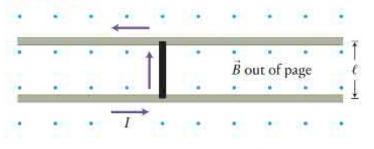
Two horizontal parallel conducting rods are connected such that a conducting crossbar free to slide along them has a constant current \(I\) running through it (Figure P27.34). The rods are separated by a distance \(\ell\) and are in an external uniform magnetic field of magnitude \(B\) directed out
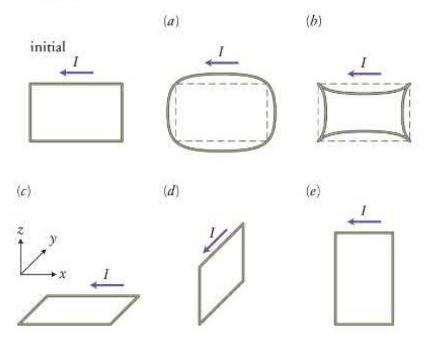
The top left portion of Figure P27.35 shows a currentcarrying wire shaped into a rectangular loop that is very flexible. The loop is mounted on a base (not shown) that allows it to spin in any direction, and in this way any forces that cause the loop to move, spin, or distort can be detected. If
An arbitrary-shaped tangle of wire is connected such that it carries a current \(I_{0}\) from position \(\vec{r}_{1}\) to position \(\vec{r}_{2}\) in a region where there is an external uniform magnetic field \(\vec{B}_{0}\). Show that the magnetic force exerted by the external field on the wire is
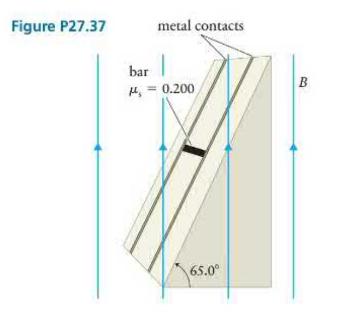
A \(1.00-\mathrm{m}\) metal bar that has a mass of \(0.900 \mathrm{~kg}\) is initially pinned in place on an incline \(65.0^{\circ}\) above the horizontal (Figure P27.37). There is a \(0.850-\mathrm{T}\) magnetic field directed upward in the region around the bar, and metal contacts along the
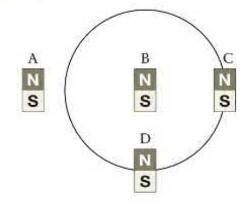
Figure P27.38 shows a bar magnet placed at four positions on and near a spherical shell. Rank the positions according to the amount of magnetic flux through the shell, smallest flux first.Data from Figure P27.38 A N S BNS DNS C N S
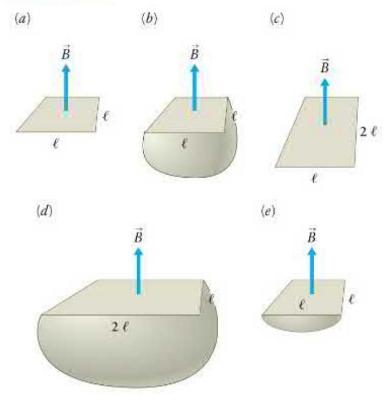
Figure \(\mathrm{P} 27. 39\) shows five objects, all placed in the same uniform, upward-directed external magnetic field. Rank the objects according to the amount of magnetic flux through them, smallest flux first.Data from Figure P27.39 (a) B (d) (b) B (c) 100 100 B (e) B 28 28
A square loop of side length \(100 \mathrm{~mm}\) is placed on a wooden table in a uniform magnetic field of magnitude \(0.25 \mathrm{~T}\). The greatest magnetic flux through the loop is measured when the loop is flat on the table. What is the flux through the loop when it is tilted such that the
A circular loop of radius \(100 \mathrm{~mm}\) is placed in a magnetic field of magnitude \(0.030 \mathrm{~T}\). If the magnetic flux through the loop is \(3.00 \times 10^{-4} \mathrm{~T} \cdot \mathrm{m}^{2}\), what is the angle between the plane of the loop and the field?
A square loop of wire has a perimeter of \(4.00 \mathrm{~m}\) and is oriented such that two of its parallel sides form a \(25.0^{\circ}\) angle with the horizontal. A uniform horizontal magnetic field of magnitude \(0.100 \mathrm{~T}\) passes though the loop. (a) Calculate the magnetic flux through
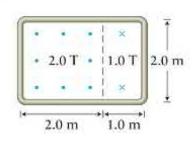
The loop of Figure P27.43 is partially in a region where there is a \(2.0-\mathrm{T}\) magnetic field pointing out of the page and partially in a region where there is a \(1.0-\mathrm{T}\) magnetic field pointing into the page. Calculate the magnetic flux through the loop.Data from Figure P27.43 x
A hemispherical bowl of radius \(R\) is placed in a uniform magnetic field that has magnitude \(B_{0}\) and is in the positive \(z\) direction. The open top of the bowl is in the \(x y\) plane. Obtain an expression for the magnetic flux through the hemispherical surface of the bowl.
A proton moves at \(6.67 \times 10^{5} \mathrm{~m} / \mathrm{s}\) undeflected in the \(+x\) direction through a velocity selector, a device containing crossed electric and magnetic fields. You measure the electric field to be \(2.0 \times 10^{5} \mathrm{~N} / \mathrm{C}\) in the positive \(z\)
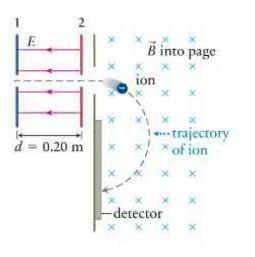
Figure P27.46 shows the semicircular path through which charged particles travel in the magnetic field of a mass spectrometer. If the particles are oxygen ions carrying a charge of \(-2 e\) and the magnetic field magnitude is \(0.20 \mathrm{~T}\), how long does it take each ion to travel the
An alpha particle \(\left(m=6.64 \times 10^{-27} \mathrm{~kg}\right)\), which has twice the charge and approximately four times the mass of a proton, is moving in a circle of radius \(0.75 \mathrm{~m}\) perpendicular to a uniform magnetic field of magnitude 0. 75 T. Calculate the alpha particle's
A proton moves in a circular orbit \(150 \mathrm{~mm}\) in radius that is perpendicular to a uniform \(0.25-\mathrm{T}\) magnetic field. Determine the proton's \((a)\) angular frequency and period of motion, \((b)\) speed, and \((c)\) kinetic energy.
An electron that has a kinetic energy of \(7.5 \times 10^{-17} \mathrm{~J}\) moves in a circular orbit perpendicular to a uniform magnetic field of magnitude 0. 35 T. For this electron, determine \((a)\) the radius of its orbit, \((b)\) its angular frequency and period of motion, and \((c)\) its
A deuteron is a charged particle that has the same charge as a proton but approximately twice the mass. An alpha particle has twice the charge and approximately four times the mass of a proton. For this problem, assume the mass ratios are exactly 2 and 4 . If a proton, a deuteron, and an alpha
The isotopes magnesium-24 (mass \(3.983 \times 10^{-26} \mathrm{~kg}\) ) and magnesium-26 (mass \(4.315 \times 10^{-26} \mathrm{~kg}\) ) are to be separated using a mass spectrometer in which the magnetic field magnitude is \(0.577 \mathrm{~T}\). The ions used are the ones that have lost one
Showing 1700 - 1800
of 4962
First
11
12
13
14
15
16
17
18
19
20
21
22
23
24
25
Last
Step by Step Answers

 Get 50% OFF
Claim Now
Get 50% OFF
Claim Now