New Semester
Started
Get
50% OFF
Study Help!
--h --m --s
Claim Now
Question Answers
Textbooks
Find textbooks, questions and answers
Oops, something went wrong!
Change your search query and then try again
S
Books
FREE
Study Help
Expert Questions
Accounting
General Management
Mathematics
Finance
Organizational Behaviour
Law
Physics
Operating System
Management Leadership
Sociology
Programming
Marketing
Database
Computer Network
Economics
Textbooks Solutions
Accounting
Managerial Accounting
Management Leadership
Cost Accounting
Statistics
Business Law
Corporate Finance
Finance
Economics
Auditing
Tutors
Online Tutors
Find a Tutor
Hire a Tutor
Become a Tutor
AI Tutor
AI Study Planner
NEW
Sell Books
Search
Search
Sign In
Register
study help
physics
particle physics
Principles And Practice Of Physics 2nd Edition Eric Mazur - Solutions
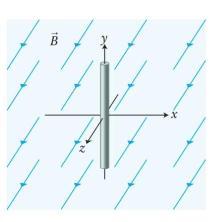
What happens if the conducting rod in Figure P29.1 rotates(a) clockwise about the \(z\) axis as viewed looking down the positive \(z\) axis toward the origin, \((b)\) clockwise about the \(x\) axis as viewed looking down the positive \(x\) axis toward the origin, and(c) clockwise about the \(y\)
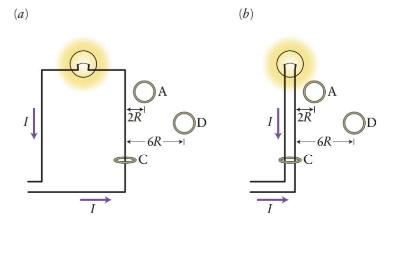
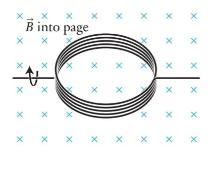
The large loop of wire in Figure P29.6a carries into and out of a lamp an electric current whose direction alternates back and forth with time. A circular ring of wire of radius \(R\) is at one of the three positions labeled \(A, C\), and D.(a) At which position is the induced current in the ring
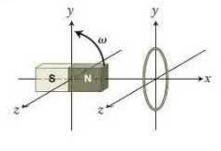
The bar magnet in Figure P29.7 is rotated about an axis that runs perpendicular to the page and passes through the center of the magnet. The magnet rotates with rotational speed \(\omega\). A loop of wire is placed alongside the magnet as shown. The loop is positioned so that the axis that runs
A large region of space contains a uniform magnetic field that is increasing with time. You have a piece of wire of length \(\ell\) and want to form a coil from it. What shape should you use for your windings and how many windings should you have to generate the maximum induced current in the coil
A \(1.00-\mathrm{m}\) length of wire is shaped into a rectangle, and another \(1.00-\mathrm{m}\) length of identical wire is shaped into a circle. Both wires then move at the same speed into and then out of a region of uniform magnetic field. Is the induced current in the rectangle greater than,
You observe a small charge separation between the ends of a conducting rod that is lying on the table in front of you. This is puzzling because the rod is not connected to a battery or other power source; it is at rest on the nonconducting table, pointed toward a nearby window. You call your
A flat conducting plate is centered in the \(x y\) plane of an \(x y z\) coordinate system in which the \(x y\) plane is horizontal. A bar magnet is lowered vertically toward the plate. If the magnet is oriented so that its north pole faces the origin as the magnet moves toward the plate, what do
A metal pipe is held vertically, and a bar magnet is dropped into it. What do the electric field lines in the pipe look like as the magnet falls through it?
You have a bar magnet and a circular conducting loop, and you wish to induce a current in the loop that changes direction regularly: clockwise, counterclockwise, clockwise, and so on. Explain how to do this while the loop remains at rest on a wooden table.
You have a bar magnet and a loop of wire. The loop lies in the plane of this page, and we define a positive current as one for which the current direction is clockwise around the loop as viewed from above. How can you move the magnet so as to induce a positive current in the loop? (There are
If you drop a magnet through a length \(\ell\) of copper pipe, the time interval needed for the magnet to travel through the pipe (even if the magnet never touches the sides of the pipe) is much greater than the time interval the magnet takes to drop the same distance \(\ell\) in air. Why?
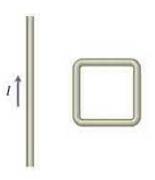
The long straight wire in Figure P29.17 carries a current \(I\) that varies in time as \(I=I_{0} \sin (\omega t)\), and a loop of wire is held stationary near the straight wire. When is the induced current in the loop clockwise? When is it zero? When is it counterclockwise?Data from Figure P29.17
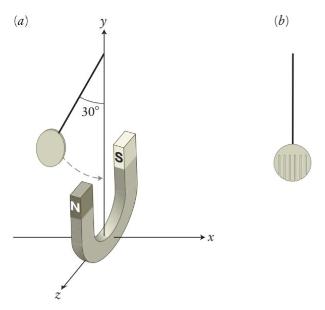
A pendulum consists of a rod with an aluminum disk attached, suspended from a pivot. First the pendulum is held at a \(30^{\circ}\) angle to the vertical and released so that it begins to swing. The disk passes between the poles of a powerful magnet on each swing (Figure P29.18a). Next a series of
The magnetic flux through a conducting loop increases at a rate of \(3.0 \mathrm{~T} \cdot \mathrm{m}^{2} / \mathrm{s}\). What is the magnitude of the induced emf in the loop?
Initially there is no magnetic flux through a conducting loop. A magnetic field near the loop is then suddenly turned on, and \(5.0 \mathrm{~s}\) later the magnetic flux through the loop is \(1.0 \mathrm{~T} \cdot \mathrm{m}^{2}\). What is the average magnitude of the induced emf in the loop during
A rectangular loop of length \(\ell=80 \mathrm{~mm}\), width \(w=\) \(60 \mathrm{~mm}\), and resistance \(R=20 \mathrm{~V} / \mathrm{A}\) is located in a uniform magnetic field of magnitude \(B=0.50 \mathrm{~T}\). The area vector of the loop makes a \(45^{\circ}\) angle with the magnetic field
You are building an instrument to measure the orientation of Earth's magnetic field. Your device consists of a single conducting coil that encloses an area \(A=400 \mathrm{~mm}^{2}\) and rotates at a speed of 10,000 rotations \(/ \mathrm{min}\). What peak induced emf should you expect if the
A circular coil of radius \(R=50 \mathrm{~mm}\) rotates about an axis that is perpendicular to a uniform magnetic field of magnitude \(B=0.50 \mathrm{~T}\) (Figure P29.23). If the coil completes 60 rotations each second, how many windings must the coil have in order to power an appliance that
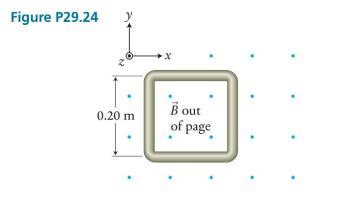
The square conducting loop in Figure P29.24 lies in the \(x y\) plane of an \(x y z\) coordinate system. The loop is in a uniform magnetic field that points in the positive \(z\) direction and is decreasing at a rate of \(0.070 \mathrm{~T} / \mathrm{s}\). What are (a) the magnitude of the induced
An increasing number of products, such as passports and credit cards, contain an embedded radio-frequency identification chip that both stores and transmits information. The chips do not have their own power sources. Instead, they receive their power through induction from the device used to read
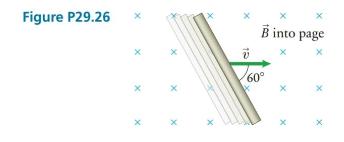
A \(100-\mathrm{mm}\)-long metal rod is placed in a uniform magnetic field with the rod length perpendicular to the field direction (Figure P29.26). The rod moves at \(0.20 \mathrm{~m} / \mathrm{s}\), and its velocity vector makes an angle of \(60^{\circ}\) with the rod length. If the magnitude of
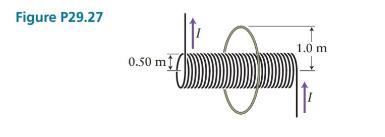
The very long cylindrical solenoid of Figure P29.27 has a radius of \(0.50 \mathrm{~m}\) and 1000 windings per meter along its length. A circular conducting loop of radius \(1.0 \mathrm{~m}\) encircles the solenoid, with the long central axis of the solenoid passing through the center of the loop,
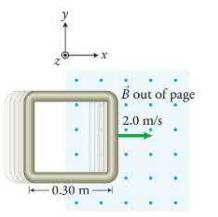
The space to the right of the \(y\) axis in Figure P29.28 contains a uniform magnetic field of unknown magnitude that points in the positive \(z\) direction. As a conducting square loop placed in the \(x y\) plane (oriented with its horizontal and vertical sides parallel to the \(x\) and \(y\)
A region of space contains a changing magnetic field given by \(\vec{B}(t)=B_{0} e^{-t / \tau} \hat{k}\), and a circular conducting loop of radius \(R\) lies in this region in the \(x y\) plane. (a) Calculate the upward magnetic flux through the loop as a function of time. Is the flux increasing
The coil in a generator has 100 windings and a crosssectional area of \(0.0100 \mathrm{~m}^{2}\). (a) If the coil turns at a constant rotational speed and the magnetic field in the generator is that of Earth \(\left(B=0.500 \times 10^{-4} \mathrm{~T}\right)\), how many \(360^{\circ}\) rotations
You have two cylindrical solenoids, one inside the other, with the two cylinders concentric. The outer solenoid has length \(\ell_{\text {ourer }}=400 \mathrm{~mm}\), radius \(R_{\text {outer }}=50 \mathrm{~mm}\), and \(N_{\text {outer }}=1000\) windings. The inner solenoid has length \(\ell_{\text
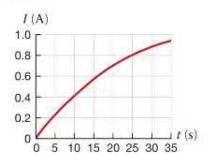
A rectangular wire loop enclosing an area \(A=0.40 \mathrm{~m}^{2}\) is inside a long cylindrical solenoid with two windings per \(\mathrm{mm}\). The area vector of the loop is aligned with the axis of the solenoid, and the current in the solenoid varies according to the graph shown in Figure
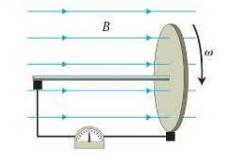
A circular metal disk with a shaft through its center rotates about a central axis as shown in Figure P29.33. The unit is placed in a uniform magnetic field of magnitude \(1.5 \mathrm{~T}\), directed parallel to the shaft. Two small sliding contacts are placed against the unit, one touching the
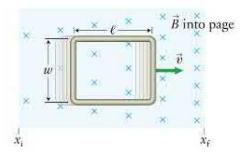
The dimensions of the rectangular loop of wire in Figure P29.34 are \(\ell=50 \mathrm{~mm}\) and \(w=40 \mathrm{~mm}\). The loop moves at speed \(v=30 \mathrm{~mm} / \mathrm{s}\) through the magnetic field shown. The field magnitude increases linearly from
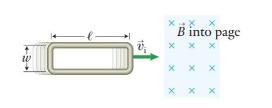
The dimensions of the rectangular loop of wire in Figure P29.35 are \(\ell=400 \mathrm{~mm}\) and \(w=120 \mathrm{~mm}\). The mass of the loop is \(10 \mathrm{~g}\), its resistance is \(5.0 \mathrm{~V} / \mathrm{A}\), and before entering the magnetic field shown the loop is moving at a constant
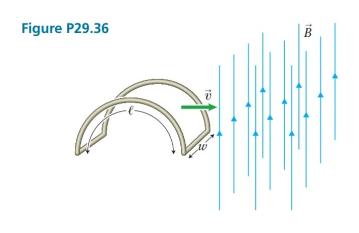
(a) A rectangular loop of wire is \(\ell=800 \mathrm{~mm}\) long and \(w=500 \mathrm{~mm}\) wide. You bend the \(\ell\) sides into a semicircle while keeping the \(w\) sides straight, as shown in Figure P29.36, and then move the curved loop at speed \(v=0.800 \mathrm{~m} / \mathrm{s}\) into a
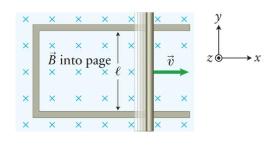
A bar is sliding along a set of connected conducting rails as shown in Figure P29.37. The bar is given an initial velocity \(\vec{v}_{\mathrm{i}}\) to the right and then allowed to move freely. The bar has mass \(m\), and the distance between the rails (which is also the bar length) is \(\ell\).
The area vector of a rectangular loop that is initially \(\ell_{\mathrm{i}}=300 \mathrm{~mm}\) long and \(w_{\mathrm{i}}=200 \mathrm{~mm}\) wide is aligned with the direction of a uniform magnetic field that has initial magnitude \(B_{\mathrm{i}}=500 \mathrm{mT}\). You want to increase the field
A uniform magnetic field exists in a circular area. A particle carrying charge \(q=5.0 \mathrm{mC}\) is placed in the field a distance \(r_{\mathrm{p}}=20 \mathrm{~mm}\) from the center of the circular area. If the particle experiences a force that has magnitude \(F=4.00 \mu \mathrm{N}\) and is
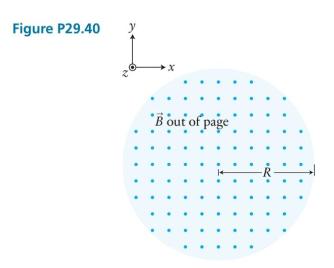
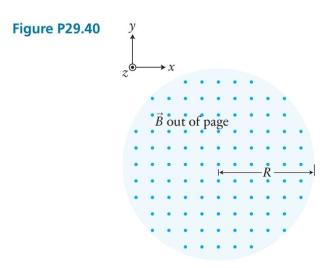
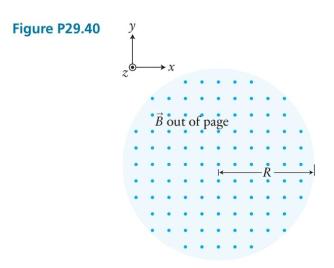
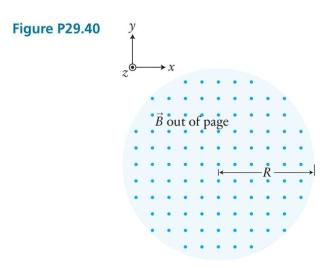
In Figure P29.40, \(R=0.12 \mathrm{~m}\) and a changing magnetic field creates an electric field that has magnitude \(E=10 \mathrm{~V} / \mathrm{m}\) at a radial distance \(r=0.060 \mathrm{~m}\) from the center of the magnetic field. What is the instantaneous magnitude of the time rate of change of
If in Figure P29.40 \(R=0.25 \mathrm{~m}\) and the magnetic field magnitude is decreasing at a rate of \(0.30 \mathrm{~T} / \mathrm{s}\), what is the magnitude of the electric field created by this changing magnetic field \((a)\) at radial distance \(r=0.20 \mathrm{~m}\) from the magnetic field
If the magnitude of the magnetic field in Figure P29.40 changes with time as \(B=B_{\max } \sin (\omega t)\), calculate the magnitude of the electric field that accompanies this changing magnetic field as a function of time \(t\) and radial distance \(r\) from the center of the magnetic field for
The magnitude of the magnetic field in Figure P29.40 changes with time, and the magnitude of the accompanying electric field inside the magnetic field is given by \(E(r, t)=3 C r t^{2}\), where \(C\) is a positive constant and \(r\) is the radial distance from the center of the magnetic field. For
A uniform magnetic field fills a cylindrical volume of radius \(R\), and the field magnitude changes with time at an unknown rate. At a certain instant, the electric field magnitude at a radial distance \(r_{1}
It takes an electric field magnitude of about \(10^{6} \mathrm{~V} / \mathrm{m}\) to ionize atoms in the air and produce a spark. Is it possible to increase the magnetic field inside a long solenoid quickly enough to generate a spark inside? Take the solenoid radius to be \(30 \mathrm{~mm}\).
A \(2.0-\mathrm{H}\) inductor carries a current that is increasing at a rate of \(0.40 \mathrm{~A} / \mathrm{s}\). What is the magnitude of the \(\mathrm{emf}\) induced in the inductor? Does this induced emf aid or oppose the flow of the charge carriers?
When the current through an inductor is decreasing at a rate of \(2.0 \mathrm{~A} / \mathrm{s}\), the magnitude of the induced emf is \(6.0 \mathrm{~V}\). What is the inductance of the inductor?
The radius of a toroid is \(R_{\mathrm{t}}=0.10 \mathrm{~m}\), and the windings have a circular cross section. The radius of each winding is \(R_{\mathrm{w}}=10 \mathrm{~mm}\), and the number of windings is \(N=400\). Calculate the inductance of the toroid.
The current through an inductor of inductance \(L\) is given by \(I(t)=I_{\max } \sin (\omega t)\). (a) Derive an expression for the induced emf in the inductor as a function of time. (b) At \(t=0\), is the current through the inductor increasing or decreasing? (c) At \(t=0\), is the induced emf
The induced emf in an inductor of inductance \(L\) varies with time according to \(\mathscr{E}_{\text {ind }}(t)=-2 C t\), where \(C\) is a positive constant. (a) If there is no current through the inductor at \(t=0\), calculate the current as a function of time for \(t>0\). (b) Is the current
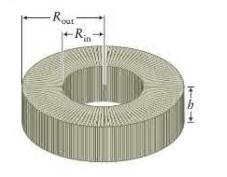
The toroid in Figure P29.52 has 200 rectangular windings, and the toroid radii are \(R_{\text {in }}=160 \mathrm{~mm}\) and \(R_{\text {out }}=\) \(240 \mathrm{~mm}\). The height of each winding is \(b=20 \mathrm{~mm}\), such that the rectangular cross section of each winding is \(\left(R_{\text
Calculate the amount of magnetic potential energy stored in a \(0.60-\mathrm{H}\) inductor when the current in the inductor is \(6.0 \mathrm{~A}\).
If \(10 \mathrm{~J}\) of magnetic potential energy is stored in a \(5.0-\mathrm{H}\) inductor, what is the current in the inductor?
A cylindrical volume of space contains a uniform magnetic field of magnitude \(0.12 \mathrm{~T}\) but unknown direction. If the dimensions of the cylindrical volume are length \(\ell=0.060 \mathrm{~m}\) and radius \(R=0.040 \mathrm{~m}\), how much \(\mathrm{mag}\) netic potential energy is stored
When you unplug a coffee maker that plugs into the utility outlet of your car, you notice a spark. Worried that the coffee maker might be broken, you take it apart and find that the heating element is a tungsten wire that, according to the label, is wound 600 times around what appears to be a
The magnitude of the magnetic field in a magnetic resonance imaging (MRI) machine can be as great as \(B=3.0 \mathrm{~T}\). Under normal circumstances, this field cannot be shut off by just flipping a switch. Instead the magnitude needs to be carefully decreased to zero. In an emergency, however,
What is the magnetic potential energy stored in a cylindrical volume of height \(b_{\text {cylin }}=50 \mathrm{~mm}\) and radius \(R_{\text {cylin }}=24 \mathrm{~mm}\) that symmetrically surrounds an infinitely long wire that has radius \(R_{\text {wire }}=2.1 \mathrm{~mm}\) and carries current
Calculate the inductance of a 2000 -winding cylindrical solenoid that is \(0.20 \mathrm{~m}\) long if the radius of each winding is \(0.030 \mathrm{~m}\).
The current in a cylindrical solenoid is increased smoothly from \(I_{\mathrm{i}}=0.40 \mathrm{~A}\) at \(t_{\mathrm{i}}=3.0 \mathrm{~s}\) to \(I_{\mathrm{f}}=1.20 \mathrm{~A}\) at \(t_{\mathrm{f}}=5.0 \mathrm{~s}\). What is the induced emf during this time interval if the solenoid length is
A uniform magnetic field exists in a cubic volume of space with a \(50-\mathrm{mm}\) side length. If the magnetic energy stored in this volume is \(12 \mathrm{~J}\), what is the magnetic field magnitude?
In a large laboratory electromagnet, the poles have a circular cross section with a diameter of \(100 \mathrm{~mm}\) and are \(25 \mathrm{~mm}\) apart. If there is a uniform 1. 3-T magnetic field between the poles, how much magnetic potential energy is stored in the magnetic field?
The rate at which the magnetic flux inside a wire loop decays is given by \(\Phi_{B}(t)=\Phi_{B, i} e^{-\beta t}\), where \(\beta=0.50 / \mathrm{s}\) and \(\Phi_{B, i}=4.0 \mathrm{~Wb}\). What is the magnitude of the induced current at \(t=10 \mathrm{~s}\) if the resistance of the wire is \(R=2.0
You build a solenoid containing 400 windings over a \(0.20-\mathrm{m}\) length, with a loop radius of \(0.025 \mathrm{~m}\) for each winding. If the current in the unit is \(3.0 \mathrm{~A}\), what are (a) the magnitude of the magnetic field produced and (b) the inductance of the solenoid? (c) Use
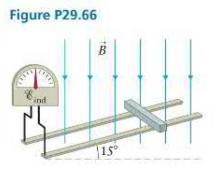
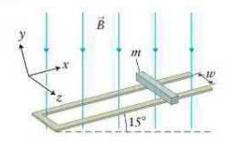
A conducting bar that is \(\ell=40 \mathrm{~mm}\) long can slide with negligible friction on two parallel conducting rails positioned at an incline of \(\theta=15^{\circ}\) (Figure P29.66). Initially, the bar is at rest in a magnetic field of magnitude \(B=0.60 \mathrm{~T}\). What is the emf
You have a circular wire loop of radius \(a=0.50 \mathrm{~m}\). It carries a current that increases linearly from 0 to \(4.5 \mathrm{~A}\) in \(0.30 \mathrm{~s}\). At the center of this loop is a wire loop of radius \(b=0.0020 \mathrm{~m}\) and resistance \(R=0.80 \mathrm{~V} / \mathrm{A}\). The
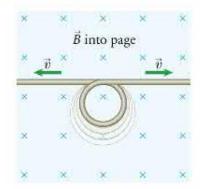
You shape a flexible wire into a loop of initial radius \(r_{\mathrm{i}}=30 \mathrm{~mm}\). You then place the loop in a uniform magnetic field and pull the two ends of the wire in opposite directions at \(v=6.0 \mathrm{~mm} / \mathrm{s}\) so that the loop starts closing up (Figure P29.68). If the
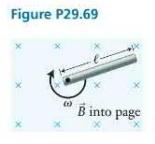
A rod of length \(\ell\) rotates about one end at a constant rotational speed \(\omega\). The rod is in a uniform magnetic field \(\vec{B}\), and the axis of rotation is parallel to \(\vec{B}\) (Figure P29.69). (a) In terms of \(\ell, B\), and \(\omega\), what potential difference develops between
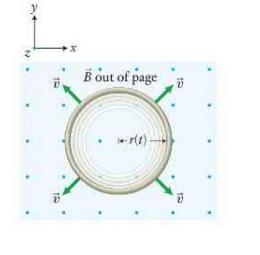
A uniform magnetic field of magnitude \(B\) fills all space and points in the positive \(z\) direction (Figure P29.70). A circular conducting loop in the \(x y\) plane is growing larger, with its radius as a function of time given by \(r(t)=v t\), where \(v\) is a positive constant. (a) Derive an
A conducting bar of width \(w=0.12 \mathrm{~m}\) and mass \(m=\) \(8.0 \mathrm{~g}\) can slide freely on two parallel conducting rails positioned at an incline of \(\theta=15^{\circ}\) (Figure P29.71). The rails are connected at their base by a piece of conducting material. The distance between the
For the system described in Problem 71, you measure a constant speed of \(1.0 \mathrm{~m} / \mathrm{s}\). Because this is not the value you calculated when you ignored friction in the system, you conclude that the friction in the rails is too great to be ignored. What value for the coefficient of
A square loop of wire of side length \(a\) and resistance \(R\) lies a distance \(x\) to the right of a long, straight wire that carries a current \(I\). The straight wire lies in the plane defined by the loop, parallel to one side of the square, and the current direction in the wire is upward. The
You are working for a company that is interested in mapping geological formations in Earth's crust by examining variations in the magnitude of the magnetic field at Earth's surface. Your assignment is to design a device that can detect small variations in this magnetic field at ground level.
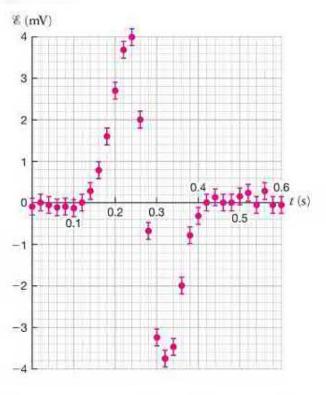
On the fifth floor of the physics building, you are in a laboratory class studying induction. You are using a computer to measure emf values from a solenoid when suddenly a thunderstorm breaks out. You see a large blip on the computer screen and \(2.0 \mathrm{~s}\) later hear a loud thunderclap.
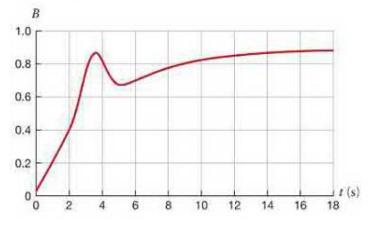
An electromagnet in a physics laboratory is damaging electronic apparatus in its vicinity. You suspect that the damage is due to unusually large induced currents created each time the electromagnet power supply is turned on, so you decide to monitor the magnet's magnetic field. Figure P29.76 shows
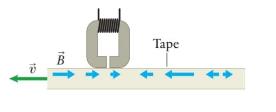
Analog tape players read sound recorded on magnetic tape. The sound is recorded by magnetizing the tape longitudinally (magnetization parallel to the tape's length) with varying magnetic field magnitudes in either direction. The tape is usually divided into longitudinal tracks so that different
When a charge-separating process or device is used to charge a pair of objects, how are their charges related?
Positive work is done on a system containing positively and negatively charged particles. All work goes into changing the electric potential energy of the system. What can be said about the electric field between positively and negatively charged particles? What can be said about the electric field
You are designing a Van de Graaff generator, and you want it to hold as many electrons as possible. Should you make the radius of the sphere very large or very small?
Draw energy diagrams for the processes of separating charge carriers by (a) rubbing, (b) increasing the separation distance between a positively charged object and a negatively charged object, and (c) increasing the separation distance between two positively charged objects.
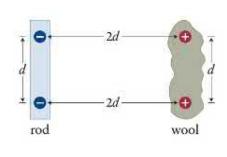
A plastic rod is rubbed with wool, producing a distribution of positive and negative surplus charge that is concentrated in two locations on the rod and two on the wool. This distribution can be approximated as two pairs of small balls of charge as shown in Figure P26.5. The distance \(d\) is
A piece of wool is used to charge two plastic spheres. When the spheres are held \(200 \mathrm{~mm}\) apart, they repel each other with \(7.00 \mathrm{~N}\) of force. If the wool ends up with a surplus positive charge of \(23.5 \mu \mathrm{C}\), what is the charge on each of the two spheres?
Two \(0.0450-\mathrm{kg}\) spheres are identical (including the charge they carry) and are initially pinned in place \(200 \mathrm{~mm}\) apart. You unpin them and push on each sphere with a force of \(0.15 \mathrm{~N}\). After their separation increases to \(400 \mathrm{~mm}\), each sphere has a
A fellow scientist heard that a Van de Graaff generator built 70 years ago could collect \(5.0 \mathrm{C}\) of charge on its dome, which had a radius of \(1.1 \mathrm{~m}\), and has challenged you to do the same. The belt you plan to use is \(100 \mathrm{~mm}\) wide and \(10.0 \mathrm{~m}\) long
The plates of a capacitor are charged using a battery, and they produce an electric field across the separation distance \(d\) between them. The two plates are now to be pushed together to a separation of \(d / 2\). The pushing together can be done either with the battery connected or with it
Two parallel-plate capacitors have the same plate area. Capacitor 1 has a plate separation twice that of capacitor 2 , and the quantity of charge you place on capacitor 1 is twice the quantity you place on capacitor 2 . How do the potential differences across each of the two capacitors compare to
Two parallel-plate capacitors have the same plate area. Capacitor 1 has a plate separation twice that of capacitor 2 , and the potential difference you impose across the plates of capacitor 1 is twice the potential difference you impose across capacitor 2. How do the quantities of charge stored on
Suppose a capacitor is fully charged by a battery and then disconnected from the battery. The positive plate has a charge \(+q\) and the negative plate has a charge \(-q\). The plate area is doubled, and the plate separation is reduced to half its initial separation. What is the new charge on the
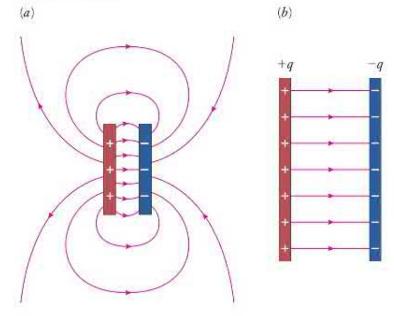
Explain why there must always be some nonzero electric field outside the plates of a parallel-plate capacitor (Figure P26.13a), which means that the idealization shown in Figure P26.13b, with all the field lines confined to the region between the plates, can never be exact. (Consider the potential
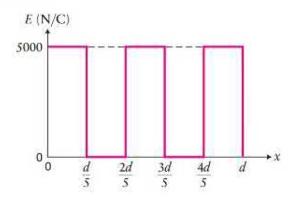
Figure P26.14 is a graph of the electric field between two capacitor plates as a function of distance from the left plate. The distance between the plates is \(d\), the direction of the field is to the right, and a battery is connected to the plates. (a) Which plate carries a positive charge? (b)
When two parallel plates separated by a distance \(d\) are connected to a battery that maintains a potential difference of magnitude \(V\) between the plates, a charge of magnitude \(q\) accumulates on each plate. If the plate separation is increased to \(2 d\) and the battery is replaced with one
Suppose two capacitor plates have an arca of \(0.0100 \mathrm{~m}^{2}\) and are initially separated by \(1.00 \mathrm{~mm}\). Each plate holds \(3.30 \mu \mathrm{C}\) of charge. How much energy is required to increase the plate separation to \(2.00 \mathrm{~mm}\) ?
A certain capacitor is fully charged by a battery, such that the positive plate holds a charge \(+q\) and the negative plate holds a charge \(-q\). The plates of the capacitor are then pulled apart to twice their initial separation. Determine the new charge on the positive plate if \((a)\) the
You need to insert a metal slab between the two plates of a parallel-plate capacitor. The plates are a distance \(d\) apart, and a battery maintains a constant potential difference \(V_{\text {batt }}\) between them. In order to avoid dielectric breakdown, the electric field in any region cannot
Either a dielectric or a conductor could be inserted between the plates of a capacitor. (a) State at least two similarities between the effects of inserting a dielectric and inserting a conducting slab. (b) State at least two differences between the effects of inserting a dielectric and inserting a
A fully charged capacitor initially has an air gap and is disconnected from the battery. A dielectric material is inserted between the plates. What happens to \((a)\) the free charge at the surface of the capacitor plates and \((b)\) the total charge (free and bound) at the surface of the capacitor
Two parallel-plate capacitors have the same dimensions, but the space between the plates is filled with air in capacitor 1 and with plastic in capacitor 2 . The magnitude of the charge on the plates is the same in both capacitors. Compare \((a)\) the magnitudes of the electric fields \(E_{1}\) and
Two parallel-plate capacitors have the same dimensions, but the space between the plates is filled with air in capacitor 1 and with plastic in capacitor 2 . The potential difference between the plates is the same in both capacitors. Compare (a) the magnitudes of the electric fields \(E_{1}\) and
A capacitor connected to a battery initially holds a charge of \(+q\) on its positive plate and \(-q\) on its negative plate. The electric field between the plates is initially \(\vec{E}\). A dielectric material is then inserted that polarizes in such a way as to produce an electric field of
A parallel-plate capacitor with air between the plates and plate separation distance \(d\) is connected to a battery that maintains a potential difference \(V_{\text {batt }}\) between the plates. Sketch a graph of \(V\) as a function of \(x\) when \(x\) is defined as position between the plates,
A capacitor initially has a charge of magnitude \(q\) on each plate. When a dielectric is inserted between the plates, the bound surface charge on the two dielectric surfaces facing the plates has a magnitude \(q / 3\). What is the ratio of the electric field magnitude in the empty capacitor to the
A capacitor has a plate area of \(0.0045 \mathrm{~m}^{2}\) and a charge of magnitude \(q\) on each plate. The space between plates has been filled with a dielectric that has a bound surface charge of magnitude \(3 q / 4\) on either side. When the dielectric material is removed, the electrical
The night before an exam, your study partner asks what you can do to a parallel-plate capacitor to avoid the problem of the electrical breakdown of air. You answer that a nonconducting dielectric material can be inserted. Your friend is confused as to why other things wouldn't work. Why wouldn't it
The term emf is an acronym for electromotive force. Why is this a misnomer?
As a battery is used to charge a capacitor, does the overall charge inside the battery get smaller, get greater, or stay the same?
What limits the lifetime of a battery?
Showing 1600 - 1700
of 4962
First
10
11
12
13
14
15
16
17
18
19
20
21
22
23
24
Last
Step by Step Answers

 Get 50% OFF
Claim Now
Get 50% OFF
Claim Now