New Semester
Started
Get
50% OFF
Study Help!
--h --m --s
Claim Now
Question Answers
Textbooks
Find textbooks, questions and answers
Oops, something went wrong!
Change your search query and then try again
S
Books
FREE
Study Help
Expert Questions
Accounting
General Management
Mathematics
Finance
Organizational Behaviour
Law
Physics
Operating System
Management Leadership
Sociology
Programming
Marketing
Database
Computer Network
Economics
Textbooks Solutions
Accounting
Managerial Accounting
Management Leadership
Cost Accounting
Statistics
Business Law
Corporate Finance
Finance
Economics
Auditing
Tutors
Online Tutors
Find a Tutor
Hire a Tutor
Become a Tutor
AI Tutor
AI Study Planner
NEW
Sell Books
Search
Search
Sign In
Register
study help
physics
particle physics
Principles And Practice Of Physics 2nd Edition Eric Mazur - Solutions
What is the approximate thermal energy of a molecule that has three degrees of translational freedom, two degrees of rotational freedom, and two degrees of vibrational freedom? The molecule is in a gas at temperature \(T\).
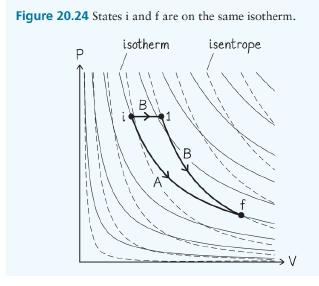
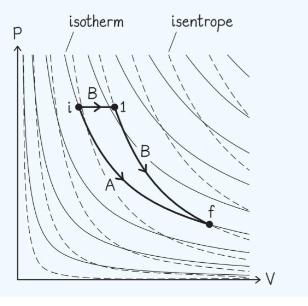
Which types of processes are represented in Figure 20. 24? For each process, determine whether the following quantities are positive, negative, or zero: \(\Delta T, \Delta V, \Delta P\).Data from Figure 20. 24 Figure 20.24 States i and f are on the same isotherm. P isotherm B 00 isentrope V
When the bulb of an ideal gas thermometer is immersed in water at the triple point, the height of the mercury column above the reference mark is \(760 \mathrm{~mm}\). The same thermometer is then immersed in a sample of unknown temperature, and the height of the mercury column moves to \(1167
Derive an expression for converting a temperature (a) from the Celsius scale to the Fahrenheit scale, (b) from the Kelvin scale to the Fahrenheit scale, and (c) from the Fahrenheit scale to the Kelvin scale.
At room temperature, do collisions between nitrogen molecules have enough energy to set a nitrogen molecule rotating? Enough to set it vibrating? The quantum of energy associated with rotation is \(E_{\text {rot }}=4.0 \times 10^{-23} \mathrm{~J}\) and the quantum of energy associated with
In quasistatic process A of Figure 20.24, an ideal gas is brought from an initial to a final state while its temperature is held fixed. In quasistatic process B, an identical gas is brought in two steps from the same initial state as in process A to the same final state. In the first step, the gas
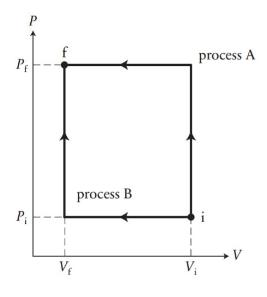
In Figure 20.28, an ideal gas is brought from an initial state \(\mathrm{i}\) to a final state \(\mathrm{f}\) by two processes. The initial volume and pressure are \(0.50 \mathrm{~m}^{3}\) and \(100 \mathrm{kPa}\), and the final values for these variables are \(0.10 \mathrm{~m}^{3}\) and \(500
A sample of hydrogen gas that contains \(1.00 \mathrm{~mol}\) of \(\mathrm{H}_{2}\) molecules at a temperature of \(300 \mathrm{~K}\) and a pressure of \(60.0 \mathrm{kPa}\) undergoes an isochoric process. The final pressure is \(80.0 \mathrm{kPa}\). How much energy is transferred thermally to the
Experimentally one obtains \(C_{P}=4.844 \times 10^{-23} \mathrm{~J} / \mathrm{K}\) for nitrogen gas at room temperature. (a) Calculate the heat capacity ratio \(\gamma\) for a gas of nitrogen molecules, \(\mathrm{N}_{2}\), at room temperature. (b) Which degrees of freedom of the \(\mathrm{N}_{2}\)
An ideal gas sample is compressed quasistatically at constant temperature. The initial pressure and volume are \(P_{\mathrm{i}}=1.01 \times 10^{5} \mathrm{~Pa}\) and \(V_{\mathrm{i}}=3.00 \times 10^{-2} \mathrm{~m}^{3}\), and the final volume is \(V_{\mathrm{f}}=2.00 \times 10^{-2}
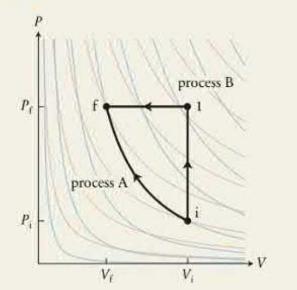
Figure 20.38 shows two quasistatic processes that take a sample of an ideal gas containing \(N\) particles from an initial state \(\left(P_{i}, V_{i}\right)\) to a final state \(\left(P_{f}, V_{f}\right)\). Process A is a one-step isentropic compression. Process \(B\) has two steps: an isochoric
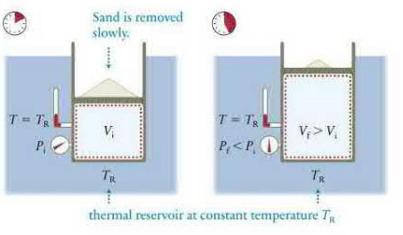
Figure P21.1 shows a gas confined to a cylinder fitted with a movable piston. The cylinder is immersed in a tank of water that acts as a thermal reservoir, so that the temperature of the gas never changes. (a) With the system defined as the gas, draw an energy input-output diagram for the system as
Draw an energy input-output diagram for a steady device that partially converts thermal energy to work, drawing your input and output arrows such that their relative sizes indicate the relative amounts of the quantities being represented. Label changes in the energy and entropy of the device.
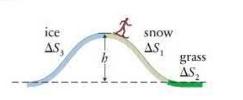
The snowboarder in Figure P21.3 starts at the top of a snow-covered hill and boards down the hill, which produces a change in entropy \(\Delta S_{1}\). At the bottom, she slides over a patch of grass, which quickly slows her down and produces a change in entropy \(\Delta S_{2}\). She then climbs
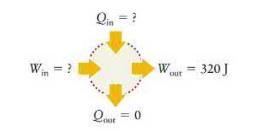
For the steady device shown in Figure P21.4, determine the values of \(W_{\text {in }}\) and \(Q_{\text {in }}\).Data from Figure P21.4 W = ? Qin = ? W out=320J
A source adds \(150 \mathrm{~J}\) of thermal energy to a steady device while \(275 \mathrm{~J}\) of work is done on the device. The device is in contact with its environment. Without specifying anything about the way the entropy of the device, source, or environment responds to changes in energy,
A \(5.3-\mathrm{kg}\) ball is dropped from a height of \(2.0 \mathrm{~m}\) into a vat of water. The impact produces \(0.80 \mathrm{~J}\) of sound energy, the ball gains \(4.50 \mathrm{~J}\) of thermal energy from the impact, and \(21 \mathrm{~J}\) of thermal energy escapes from the vat after the
A steady device operates on the 600 -W output of a motor. The device runs at \(20 \mathrm{~Hz}\) and can convert \(68 \%\) of its input to usable power to pump water. (a) How much thermal energy does the device output per cycle? (b) How much thermal energy does the device output in \(8.0
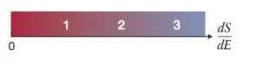
Three reservoirs of heated water are represented on the entropy diagram in Figure P21.8. All three reservoirs contain equal amounts of energy, so that \(E_{1}=E_{2}=E_{3}\). (a) For which reservoir would you be least concerned about burning yourself if you dunked your hand into the water? (b) Which
The entropy of material 1 varies as \(S_{1}=2 \gamma E^{2}\), where \(\gamma\) is a constant, and the entropy of material 2 varies as \(S_{2}=\gamma E^{3} / 9\). With \(E=4\) units of energy, which material is better suited to converting lower-quality thermal energy to useful higher-quality
A reversible steady device operates between two thermal reservoirs, one at \(390 \mathrm{~K}\) and one at \(250 \mathrm{~K}\). If no work is done on the device, what is the maximum value for the percentage of thermal energy input \(Q_{\text {in }}\) converted to mechanical energy \(W_{\text {out
A thermal reservoir has entropy gradient \(d S / d E=b E^{3}\), where \(b=2.00 \mathrm{~J}^{-4}\). At \(E=3.00 \mathrm{MJ}\), what is the temperature of the reservoir?
Consider two reservoirs at unknown temperatures. The entropy of reservoir 1 is defined by the function \(S_{1}=a E^{2}\), where \(a=1.00 \mathrm{~J}^{-2}\), and that of reservoir 2 is defined by the function \(S_{2}=b E e^{-c E}\), where \(b=3.00 \mathrm{~J}^{-1}\) and \(c=\) \(1.00
Draw an entropy diagram for a reversible steady device that takes seawater at \(29^{\circ} \mathrm{C}\) and upgrades as much energy as possible to a reservoir filled with water at \(100^{\circ} \mathrm{C}\) and on the verge of boiling. The rest of the energy is deposited at \(14^{\circ}
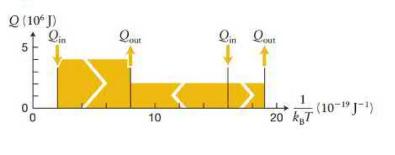
A composite of several processes that take place in a steady device is represented by the entropy diagram in Figure P21.14. What is \(\Delta S\) for the composite?Data from Figure P21.14 Q(10J) Lin 5 Qout Lin Lout 10 KT 20 kgT (10-19 J-)
A reversible steady device puts out \(W_{\text {out }}=750 \mathrm{~J}\) of mechanical energy. The only input energy is the quantity \(Q_{\text {in }}\) transferred thermally from a thermal reservoir at \(355 \mathrm{~K}\). If the temperature of the environment (which serves as a low-temperature
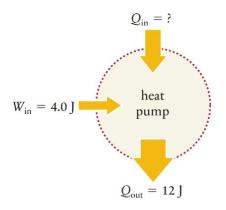
The energy input-output diagram for a heat pump is shown in Figure P21.16. What are (a) the value of \(Q_{\text {in }}\), (b) the coefficient of performance of heating, and (c) the coefficient of performance of cooling?Data from Figure P21.16 Win = 4.0 J Qin = ? heat pump Qout = 12 J
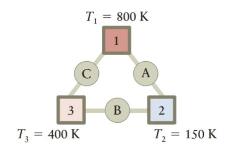
Three identical steady devices, A, B, and C, operate between three thermal reservoirs, 1,2 , and 3 , as shown in Figure P21.17. Each device takes thermal energy from the warmer of its two reservoirs, and each upgrades to mechanical energy as much of that thermal energy as possible without lowering
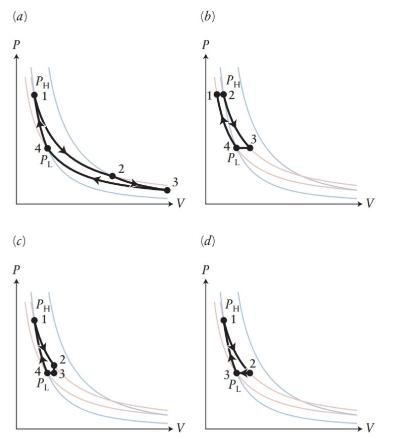
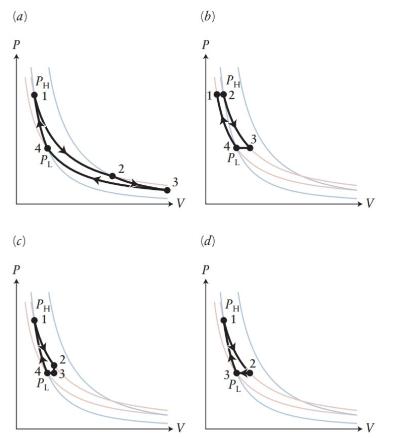
Figure P21.18 shows PV diagrams for four thermodynamic cycles. In each case, the cycle consists of three or four processes carried out on identical working substances, and each process is isothermal, isobaric, isochoric, or isentropic. The pressures \(P_{\mathrm{H}}\) and \(P_{\mathrm{L}}\) have
Which of the four thermodynamic cycles illustrated in Figure P21.18 has the greatest efficiency? Data from Figure P21.18 (a) P (b) P PH (c) P 1 41 PL 23 2 3 V 2 (d) P +V V 1 3. PL V
Two thermodynamic processes, each involving the same type and amount of monatomic gas as a working substance and each working as a heat engine, begin and end their cycles from a common state: \(P_{1}=1.00 \times 10^{5} \mathrm{~Pa}\), \(V_{1}=2.50 \times 10^{-2} \mathrm{~m}^{3}\), and \(T_{1}=300
The working substance in a steady device is a gas that undergoes expansion followed by compression. The work done by the gas during expansion is \(6.4 \mathrm{~J}\), and the work done on it during compression is \(8.2 \mathrm{~J}\). What is the work done on the gas during the cycle?
What is the entropy change in the environment when 5. 0 MJ of energy is transferred thermally from a reservoir at \(1000 \mathrm{~K}\) to one at \(500 \mathrm{~K}\) ?
In one cycle, a steady device transfers \(1.55 \times 10^{6} \mathrm{~J}\) of thermal energy from a reservoir at \(450 \mathrm{~K}\) to a reservoir at \(300 \mathrm{~K}\). Calculate the entropy change for the device and for the environment.
Draw an entropy diagram for a steady device that in each cycle converts \(135 \mathrm{~J}\) of work to thermal energy that is released into a reservoir at \(340 \mathrm{~K}\). Calculate numerical values for the length and height of the entropy bar and for the change in entropy that results from
An ideal gas is held at \(70 \mathrm{~K}\) in a cylinder fitted with a movable piston. When a \(5.0-\mathrm{kg}\) cube is placed on the piston, the piston slides down a distance of \(200 \mathrm{~mm}\). What is the entropy change in the environment that results from the change in the gas volume?
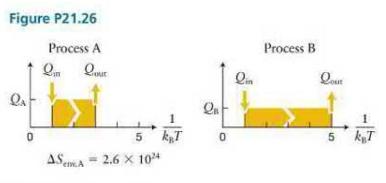
Processes A and B in Figure P21.26 each transfer energy thermally. If the energies transferred thermally by the two processes are related by \(Q_{A}=\sqrt{2} \times Q_{B}\), and process A causes \(\Delta S_{\text {env }}=2.6 \times 10^{24}\), what is \(\Delta S_{\text {env }}\) for process B?Data
What is the maximum efficiency of a reversible heat engine that transfers energy from a \(373 \mathrm{~K}\) reservoir to a \(273 \mathrm{~K}\) reservoir?
A heat engine takes in \(6.45 \times 10^{3} \mathrm{~J}\) of thermal energy from a reservoir at \(500 \mathrm{~K}\) and returns some of this energy to a reservoir at \(T_{1}
A reversible heat pump takes in thermal energy from a reservoir at \(273 \mathrm{~K}\) and expels thermal energy to a reservoir at \(320 \mathrm{~K}\). How much energy does the pump expel for every \(16.0 \mathrm{MJ}\) of energy taken in?
A heat pump used to heat a house has a coefficient of performance of heating of 5. 4 . Over \(24 \mathrm{~h}\), the house needs to receive \(2.4 \mathrm{GJ}\) of thermal energy from the pump to keep the occupants comfortable. How many kilowatts of power is required to drive the heat pump?
A heat engine does \(85 \mathrm{~J}\) of work per cycle while expelling \(110 \mathrm{~J}\) of waste thermal energy. How much energy is transferred thermally to this engine each cycle, and what is the efficiency of the engine?
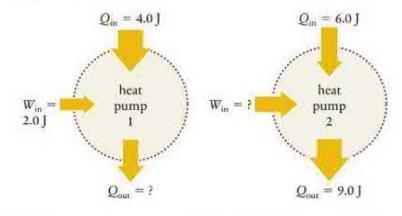
Energy input-output diagrams for two heat pumps are shown in Figure P21.32. What are (a) \(Q_{\text {out }}\) for pump 1 and (b) \(W_{\text {in }}\) for pump 2?Data from Figure P21.32 Q = 4.0J Qin -6.0J heat heat Win pump Win? pump 2 2.0J 1 Lou=? Lout = 9,0]
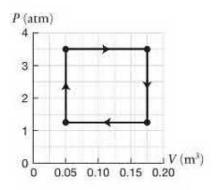
The heat engine represented by the \(P V\) diagram in Figure P21.33 exhausts \(43.5 \mathrm{~kJ}\) of thermal energy per cycle. What is the engine's efficiency?Data from Figure P21.33 P (atm) 3 2 0 V (m) 0 0.05 0.10 0.15 0.20
During each cycle, a heat engine ejects \(75 \mathrm{~J}\) of thermal energy for every \(115 \mathrm{~J}\) of input thermal energy. This engine is used to lift a \(375-\mathrm{kg}\) load a vertical distance of \(27.0 \mathrm{~m}\) at a steady rate of \(52.5 \mathrm{~mm} / \mathrm{s}\). How many
In winter, you like to keep your house interior at \(21.0^{\circ} \mathrm{C}\). Your geothermal heating system, which was advertised as being reversible, draws thermal energy from an underground reservoir at \(347 \mathrm{~K}\). In a cold winter, with the average outdoor temperature being
An engine has a rated maximum efficiency of 0. 22 when burning a certain fuel, but the manufacturer claims that burning a new type of fuel will increase the maximum efficiency. In testing this claim, you determine that, with an identical energy input, the ratio of the work done on the environment
For a heat pump that operates on a Carnot cycle, calculate (a) the coefficient of performance of cooling when the pump is used to cool a house to \(72{ }^{\circ} \mathrm{F}\) on a day when the outside air is at \(105^{\circ} \mathrm{F}\) and \((b)\) the coefficient of performance of heating when
Reversible heat engines 1 and 2 are connected to each other in such a way that the output temperature of engine 1 is the input temperature of engine \(2, T_{\text {lout }}=T_{2 \text { in }}\), and the quantity of energy transferred thermally out of engine 1 is the quantity transferred into engine
On a day when the outdoor temperature is \(35^{\circ} \mathrm{C}\), a walkin freezer in a butcher shop where there is no airconditioning must remove \(3000 \mathrm{~J}\) of thermal energy from its interior each second to maintain an interior temperature of \(-4^{\circ} \mathrm{C}\). (a) What is the
The internal temperature of a freezer is \(269 \mathrm{~K}\), and the temperature of the cooling coils on the back of the freezer is \(325 \mathrm{~K}\).(a) What is the maximum coefficient of performance of cooling of the freezer? \((b)\) You measure the time interval it takes to freeze a sample
How much work is done by a Carnot cycle that doubles the volume of \(1.00 \mathrm{~mol}\) of a monatomic ideal gas during isothermal expansion and triples the initial temperature of \(0.0^{\circ} \mathrm{C}\) during isentropic compression?
An automobile manufacturer determines that, on a summer day when the ambient temperature is \(311 \mathrm{~K}\), the temperature inside their new, ready-to-deliver cars reaches \(339 \mathrm{~K}\) when parked with the windows rolled up, a temperature that causes minor damage to the interiors. An
A heat engine that operates on a Carnot cycle has an efficiency of 0. 480 when its low-temperature reservoir is at \(10^{\circ} \mathrm{C}\). By how many degrees Celsius must you increase the temperature of the high-temperature reservoir to increase the efficiency to 0. 600 if you continue to use
A heat engine operates on a Carnot cycle that runs clockwise between a reservoir at \(340 \mathrm{~K}\) and a reservoir at \(280 \mathrm{~K}\). One cycle moves enough energy from the hightemperature reservoir to raise the temperature of \(1.0 \mathrm{~kg}\) of water by \(1.0 \mathrm{~K}\). How much
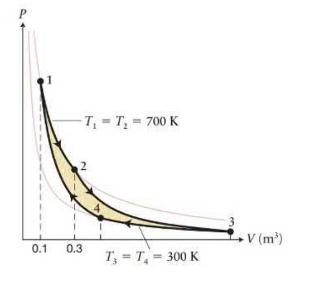
The Carnot cycle shown in Figure P21.45 uses \(1.00 \mathrm{~mol}\) of a monatomic ideal gas as its working substance. From the information given in the graph, determine the values of \(P_{1}, P_{2}, P_{3}, P_{4}, V_{3}\), and \(V_{4}\).Data from Figure P21.45 P 2 T = T = 700 K V (m) 0.1 0.3
Carnot cycles A and B run on the same amount of the same working substance and draw their thermal energy from the same high-temperature reservoir. The two cycles start with their working substances occupying different volumes. During the isothermal expansion, cycle A doubles its volume and cycle B
Heat engines 1 and 2 operate on Carnot cycles, and the two have the same efficiency. Engine 1 takes in boiling water at \(373 \mathrm{~K}\) and outputs water that is twice as hot as the output water from engine 2. What is the temperature of the input water for engine 2 ?
A heat pump that operates on a Carnot cycle cools a house in a very hot climate. During the hottest part of the day, the outside temperature is \(45^{\circ} \mathrm{C}\), and you want to keep the inside temperature at \(20^{\circ} \mathrm{C}\). The heat pump operates on electricity. (a) What is the
A heat pump that operates on a Carnot cycle uses \(\mathrm{N}_{2}\) gas and operates on electricity. (a) At what rate is it using electrical energy when it adds thermal energy at a rate of \(1.35 \mathrm{~kW}\) to a room that is at \(22^{\circ} \mathrm{C}\) when the outside temperature is
To meet energy regulations, the coefficient of performance of cooling of a refrigerator that operates on a Carnot cycle must be 4. 00 . At what rate is this refrigerator expelling thermal energy into the kitchen if it consumes electrical energy at a rate of \(225 \mathrm{~W}\) ?
A heat engine that operates on a Carnot cycle uses a lowtemperature reservoir at \(25^{\circ} \mathrm{C}\) and runs at an efficiency of 0. 350 . The working substance is nitrogen gas, and the gas chamber contains \(7.50 \times 10^{23} \mathrm{~N}_{2}\) molecules. What is the change in the thermal
An electric heat pump used as a heater operates on a Carnot cycle. The low-temperature reservoir consists of a pipe driven \(10 \mathrm{~m}\) into the ground to a region where the temperature is always \(10^{\circ} \mathrm{C}\). The high-temperature reservoir is the interior of a house, kept at
The temperature of Earth's oceans at a depth of \(2500 \mathrm{~m}\) is about \(4{ }^{\circ} \mathrm{C}\). Suppose you want to use this water as the low-temperature thermal reservoir for an electric heat pump to heat the cabin of a boat to \(20^{\circ} \mathrm{C}\). If the pump operates on a Carnot
An experimental six-cylinder engine that operates on a Carnot cycle has been proposed for a car. Each cylinder is fitted with a movable piston that allows the cylinder to fill with \(1.00 \mathrm{~mol}\) of a monatomic ideal gas. During isothermal expansion at \(700 \mathrm{~K}\), the length of
A freezer that operates on a Carnot cycle maintains an interior temperature of \(-18{ }^{\circ} \mathrm{C}\) and exhausts thermal energy into a kitchen at \(22^{\circ} \mathrm{C}\). You place a tray containing \(0.500 \mathrm{~kg}\) of water at \(0^{\circ} \mathrm{C}\) in the freezer and observe
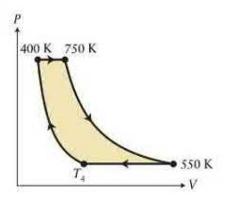
Determine \(T_{4}\) for the Brayton cycle represented in Figure P21.56.Data from Figure P21.56 P 400 K 750 K T 5.50 K V
An engine that operates on a Brayton cycle uses oxygen gas (diatomic molecules, \(\mathrm{O}_{2}\) ) as the working substance. During the isobaric cooling, the temperature decreases by \(85^{\circ} \mathrm{C}\). During the isobaric heating, the temperature increases by \(100^{\circ} \mathrm{C}\).
A gas engine that operates on a Brayton cycle has an efficiency of 0. 22 . On a cold day, the temperature of the air drawn into the engine is \(267 \mathrm{~K}\). What is the temperature of the air exhausted from the engine?
An experimental car engine operates on a Brayton cycle and uses a monatomic ideal gas as the working substance. If the pressure in front of the moving car is \(103,500 \mathrm{~Pa}\) and the pressure behind the moving car is \(99,700 \mathrm{~Pa}\), what is the maximum efficiency possible for the
An engine that operates on a Brayton cycle uses air as its working substance, compressing ambient air initially at a pressure of \(1.0 \mathrm{~atm}\) to \(6.0 \mathrm{~atm}\). (a) What is the engine's pressure ratio? (b) If the heat capacity ratio \(\gamma=C_{P} / C_{V}\) is 1. 40 for air, what is
A heat engine that operates on a Brayton cycle has a pressure ratio of 5 and uses as its working substance a gas for which the heat capacity ratio \(C_{P} / C_{V}\) is 1. 333 . You wish to replace this engine with one that operates on a Carnot cycle and has the same efficiency as the Brayton
You need to replace a heat engine that operates on a Carnot cycle with one that has the same efficiency but operates on a Brayton cycle. The Carnot engine low and high temperatures are \(-10{ }^{\circ} \mathrm{C}\) and \(225^{\circ} \mathrm{C}\). If the working substance in your replacement engine
A heat engine that operates on a Brayton cycle uses \(\mathrm{N}_{2}\) gas and has a pressure ratio of 10 . It is being used to lift a \(535-\mathrm{kg}\) pallet of bricks vertically at a steady rate of \(100 \mathrm{~mm} / \mathrm{s}\). At what rate must thermal energy be supplied to this engine
You need to design a heat engine that operates on a Brayton cycle and, during each cycle, does \(175 \mathrm{~J}\) of work while exhausting \(65 \mathrm{~J}\) of energy. (a) If the working substance is helium gas, what should the pressure ratio be? (b) If the working substance is carbon dioxide
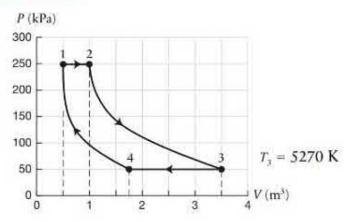
If the Brayton cycle represented in Figure P21.65 operates on \(4.0 \mathrm{~mol}\) of an ideal gas, how many degrees of freedom do the particles of the gas have?Data from Figure P21.65 P (kPa) 300 250 200 150 100 50 0 0 1 2 3. T, = 5270 K V (m)
You are designing a gas engine that operates on a Brayton cycle and uses air \((\gamma=1.4)\) as its working substance. By making the engine larger and larger, you can have the pressure ratio be \(16,17,18,19\), or 20 . At the higher pressure ratios, however, the efficiency is a smaller fraction of
A thermal reservoir is held at \(265 \mathrm{~K}\). If \(4180 \mathrm{~J}\) of energy is transferred thermally to it, what is the change in entropy of the reservoir?
The entropy of a system is increased by \(3.8 \times 10^{21}\) for every \(10 \mathrm{~J}\) of energy added to it. What is the temperature of this system?
In the past 40 years, the average power a refrigerator requires to provide a given amount of cooling has dropped from \(160 \mathrm{~W}\) to \(40 \mathrm{~W}\). By what factor has the COP of cooling for refrigerators changed during this time interval?
A \(1000-\mathrm{kg}\) iceberg at \(0^{\circ} \mathrm{C}\) falls into the ocean at a location where the water temperature is \(2^{\circ} \mathrm{C}\), and all the ice melts by absorbing thermal energy from the water. What is the entropy change for the system comprising the water and the iceberg?
The low-temperature reservoir for a heat engine that operates on a Carnot cycle is at \(-5^{\circ} \mathrm{C}\). Using only \(1.00 \mathrm{MJ}\) of thermal energy, this engine needs to pull a \(1200-\mathrm{kg}\) boulder at a steady rate \(65.0 \mathrm{~m}\) up a ramp inclined at \(35.0^{\circ}\)
An electric heat pump that operates on a Carnot cycle is used to cool a house interior to \(20^{\circ} \mathrm{C}\) on a day when the outside temperature is \(38^{\circ} \mathrm{C}\). (a) For every \(1.0 \mathrm{~J}\) of electrical energy used, what quantity of thermal energy is removed from the
A Carnot heat engine in a factory operates at an efficiency of 0. 33 when it takes in thermal energy from a reservoir of heated water and releases thermal energy into the \(28^{\circ} \mathrm{C}\) surface water of an outdoor pool. By how much could the efficiency be improved if the thermal energy
A heat engine that operates on a Carnot cycle is used to pump water out of a well that is \(45.0 \mathrm{~m}\) deep. The hightemperature reservoir for the heat engine is at \(215^{\circ} \mathrm{C}\), and the low-temperature reservoir is at \(-10^{\circ} \mathrm{C}\). The engine must move water
An electric heat pump that operates on a Carnot cycle is used to keep the air in a laboratory chamber at a constant \(35^{\circ} \mathrm{C}\) by extracting energy from outside air that is at \(5^{\circ} \mathrm{C}\). Due to conduction and small leaks, the chamber loses thermal energy at a rate of
A heat pump that operates on a Carnot cycle must deliver thermal energy to your house at a rate of \(12.5 \mathrm{~kW}\) to keep the rooms at \(22^{\circ} \mathrm{C}\). The pump uses outside air at \(-10^{\circ} \mathrm{C}\) as its low-temperature reservoir and runs on electricity that costs \(2.69
The thermal gradient of Earth's crust is approximately \(25 \mathrm{~K} / \mathrm{km}\) at locations away from tectonic plate boundaries. Suppose you want to use this thermal gradient to run a heat engine that operates on a Carnot cycle at a location where the base of the crust is \(30
The average daytime temperature at the surface of the Moon is \(380 \mathrm{~K}\), and the temperature of the lunar core is estimated at \(1000 \mathrm{~K}\). Suppose you want to run a heat engine that operates on a Carnot cycle to use this temperature difference to run a \(2.50-\mathrm{MW}\) power
A heat engine that operates on a Carnot cycle has efficiency \(\eta\). When the engine is run in reverse as a heat pump, what are, in terms of \(\eta\) (a) the coefficient of performance of cooling when the pump is used for cooling and (b) the coefficient of performance of heating when the pump
A heat engine that operates on a Carnot cycle is used to pump crude oil at a rate of 25,000 barrels/day from a well that is \(1.70 \mathrm{~km}\) deep. The mass density of the oil is \(850 \mathrm{~kg} / \mathrm{m}^{3}\), the oil is under minimal pressure and so has no initial speed, and it has
A heat engine that operates on a Carnot cycle between \(150{ }^{\circ} \mathrm{C}\) and \(10^{\circ} \mathrm{C}\) is used to accelerate a flywheel from rest to a rotational speed of \(8.50 \mathrm{~s}^{-1}\). The \(1500-\mathrm{kg}\) flywheel is a solid uniform cylinder that rotates about its long
A \(950-\mathrm{kg}\) car uses an engine that operates on a Brayton cycle for which the pressure ratio is 8 and the working substance is helium (He) gas. During each cycle, \(25 \%\) of the work done by the engine is used to overcome friction. If the engine must accelerate the car from rest to \(30
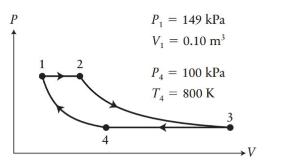
The Brayton cycle represented in Figure P21.83 operates with \(2.00 \mathrm{~mol}\) of working substance. How many degrees of freedom does each particle of the working substance have? Data from Figure P21.83 P 2 P = 149 kPa V = 0.10 m + PA = 100 kPa T = 800 K 3 V
You have taken a job as a patent examiner, and your first assignment is to evaluate a "zero-point energy perpetual motion machine." You are skeptical, but after the applicant gives it an initial energy of \(1000 \mathrm{~J}\), the machine starts operating and does not immediately run down. Hours
Working for an automotive journal, you are reviewing two proposed new models that have identical frame shapes and identical masses. Car 1 runs on a Brayton cycle that does enough work to accelerate the car from 0 to \(100 \mathrm{~km} / \mathrm{h}\) in \(11.5 \mathrm{~s}\) when internal friction,
You work for a toy company that wants to produce a bathtub toy boat that operates on a Carnot cycle and slowly putts around the bathtub. It is assumed that the temperature of the bathwater will be about \(100^{\circ} \mathrm{F}\) and the air temperature will be about \(70{ }^{\circ} \mathrm{F}\).
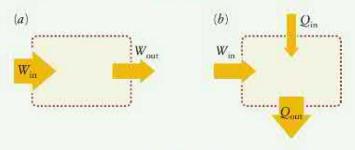
Describe the energy transfers in Figure 21. 34. What is implied about the energy of the system?Data from Figure 21. 34 (a) W W (b) W Qu Lin
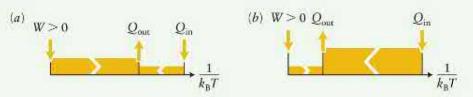
Describe the energy conversions in Figure 21.35. Which are possible?Data from Figure 21. 35 (a) (b) W>0 Q Lin W 0 Lout
Write the ratios for the efficiency of a heat engine, the coefficients of performance of cooling for a refrigerator, and the coefficients of performance of heating a room using a heat pump in terms of \(W, Q_{\text {in }}\), and \(Q_{\text {our }}\). Make a generalization about the quantity on the
Showing 2600 - 2700
of 4962
First
20
21
22
23
24
25
26
27
28
29
30
31
32
33
34
Last
Step by Step Answers

 Get 50% OFF
Claim Now
Get 50% OFF
Claim Now