New Semester
Started
Get
50% OFF
Study Help!
--h --m --s
Claim Now
Question Answers
Textbooks
Find textbooks, questions and answers
Oops, something went wrong!
Change your search query and then try again
S
Books
FREE
Study Help
Expert Questions
Accounting
General Management
Mathematics
Finance
Organizational Behaviour
Law
Physics
Operating System
Management Leadership
Sociology
Programming
Marketing
Database
Computer Network
Economics
Textbooks Solutions
Accounting
Managerial Accounting
Management Leadership
Cost Accounting
Statistics
Business Law
Corporate Finance
Finance
Economics
Auditing
Tutors
Online Tutors
Find a Tutor
Hire a Tutor
Become a Tutor
AI Tutor
AI Study Planner
NEW
Sell Books
Search
Search
Sign In
Register
study help
physics
particle physics
Principles And Practice Of Physics 2nd Edition Eric Mazur - Solutions
When is \(W\) in Eq. 10.40 positive, and when is it negative? Is your answer consistent with the definition of positive and negative work given in Section 9.2?Equation 10.40 W = mgh, (10.40)
(a) A brick slides more easily on ice than on wood. For which combination (brick on ice or brick on wood) is \(\mu_{s}\) larger? (b) For rubber on dry asphalt, \(\mu_{s}\) is about 1 . Ignoring any limits due to the runner's skill and condition, what maximum acceleration without slipping can a
(a) To what angle \(\theta_{\max }\) does a coefficient of static friction of 1 correspond? (b) Put, in turn, a coin, a paper clip, a cell phone, and a comb on the cover of this book and tilt the book to obtain the angle at which each object begins to slide. In each case, how close do you get to
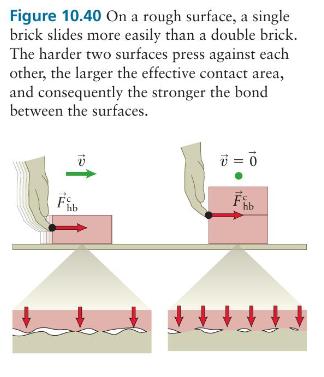
Imagine putting a single and a double brick on a flat board, as in Figure 10.40, and then slowly raising one end of the board. (a) Does the single brick begin to slide before, after, or at the same time as the double brick? (b) Once the bricks start sliding, is the acceleration of the double brick
As you are standing on the platform, a boy in a train moving to the right extends his hand outside the window and releases a ball. In what direction is the ball moving according to(a) you(b) the boy? Ignore air resistance.
You are watching a race while sitting on a bench. An athlete speeds up from 0 to \(7 \mathrm{~m} / \mathrm{s}\) to the right. Describe his motion from the point of view of another athlete going at (a) \(5 \mathrm{~m} / \mathrm{s}\) to the right, (b) \(5 \mathrm{~m} / \mathrm{s}\) to the left, and
Does a man standing in an elevator that is moving upward at a constant speed of \(10 \mathrm{~m} / \mathrm{s}\) feel heavier or lighter? What if the elevator is moving downward at the same speed? If the elevator slows down to a stop?
A horizontal escalator connecting airport terminals is \(1 \mathrm{~km}\) long. Two kids start from opposite ends and run toward each other at \(3 \mathrm{~m} / \mathrm{s}\) and meet \(600 \mathrm{~m}\) from the start of the escalator. What is the speed of the escalator? How long do they take to
Two identical particles of inertia \(m\) collide elastically on a low-friction table. Calculate the kinetic energy of the system before and after the collision in the zero-momentum frames.
Two objects A and B having inertias \(m_{a}=m\) and \(m_{b}=3 m\) are moving with velocities \(v_{a}=v\) and \(v_{b}=3 v\). Find the velocities of the two objects in the zero-momentum frame of reference.
In the Earth reference frame, box 1 is approaching box 2 , which is initially at rest on a low-friction floor, with velocity \(v\). Box 1 has five times the inertia of box 2 . They collide elastically. Calculate the velocities before and after collision in (a) the Earth reference frame(b) the
You run at \(4 \mathrm{~m} / \mathrm{s}\) in the same direction as a river flowing at \(2 \mathrm{~m} / \mathrm{s}\). This speed is enough to keep you chatting with your friend who is steering a slow boat on the river. How fast is your friend going? How fast should your friend go, and in what
Jupiter, with an inertia 317.83 times that of Earth, is at an average distance of \(7.784 \times 10^{11} \mathrm{~m}\) from the Sun. At what distance from the centre of the Sun is the center of mass of the Sun-Jupiter system if the Sun's inertia is 333,000 times that of Earth, and its mean
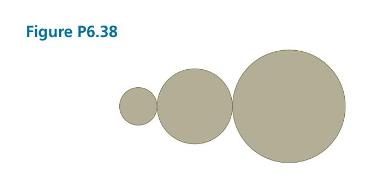
Figure P6.38 shows three solid spheres of radii a, 2a, and 3a made of materials with densities \(ho, 2 ho\), and \(3 ho\). Find the position of the center of mass of the system. Figure P6.38
A bullet of speed \(v\) and inertia \(m\) strikes and gets embedded in a wooden block of inertia \(M\), initially at rest on a low-friction floor. Plot \(k_{f} / k_{i}\) as a function of \(M / m\) from \(M / m=0\) to \(M / m=10\), and discuss your result.
An 800-kg car moving at \(108 \mathrm{~km} / \mathrm{hr}\) hits and gets entangled with a large truck of inertia \(10,000 \mathrm{~kg}\) initially at rest. What is the kinetic energy of the wreckage? How much energy is lost from the system?
A \(15-\mathrm{kg}\) box is pushed at \(5 \mathrm{~m} / \mathrm{s}\) across a low-friction floor and is caught by a \(60-\mathrm{kg}\) man on low-friction skates, initially at rest. What is the resulting kinetic energy of the man? How much energy is convertible?
A 72-kg woman is walking at \(1.5 \mathrm{~m} / \mathrm{s}\). An \(8-\mathrm{kg}\) dog is running at six times that speed in the same direction. At what speed and in what direction relative to the woman would you have to be jogging in order for the dog to have the same momentum as the woman in your
Assume that the asteroids in Problem 74 collide totally inelastically. Answer the same questions posed in that problem for this situation.Data from Problem 74Asteroid A1, \(m_{\mathrm{A} 1}=3.60 \times 10^{6} \mathrm{~kg}\), and asteroid \(\mathrm{A} 2\), \(m_{\mathrm{A} 2}=1.20 \times 10^{6}
(a) Imagine holding a ball a certain height above the ground. If you let the ball go, it accelerates downward. An interaction between the ball and what other object causes this acceleration? Is this interaction attractive or repulsive? (b) Once the ball hits the ground, its direction of travel
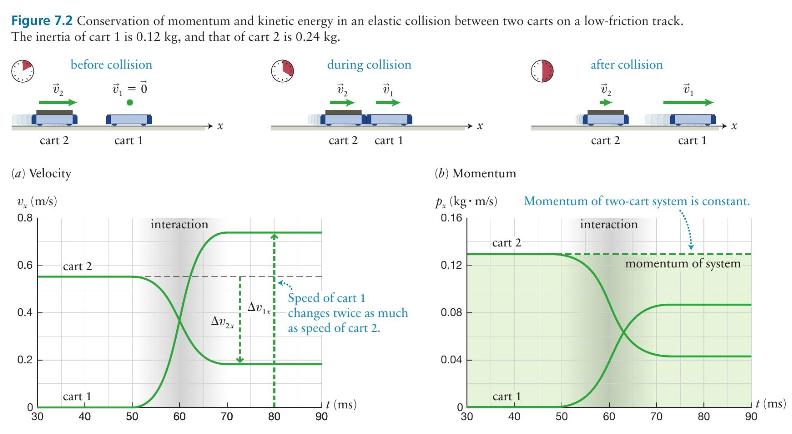
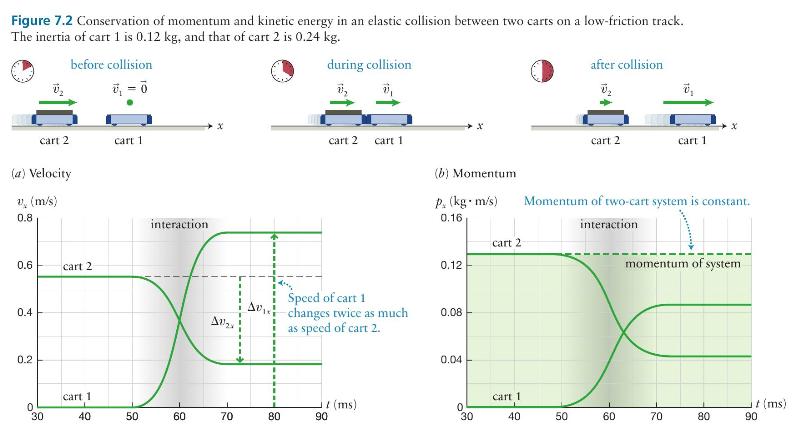
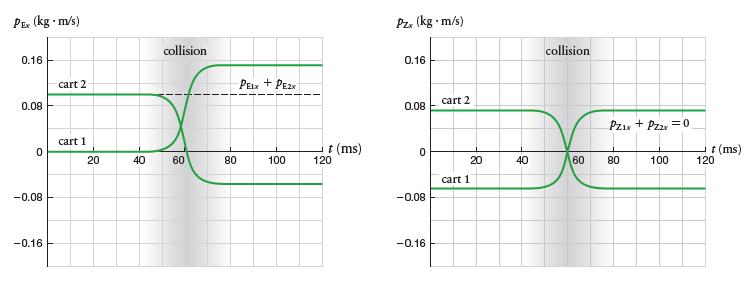
(a) Use Figure \(7.2 a\) to calculate the \(x\) components of the momenta of the two carts at \(t=30,60\), and \(90 \mathrm{~ms}\).(b) What is the \(x\) component of the momentum of the system at each of these three instants? Figure 7.2 Conservation of momentum and kinetic energy in an elastic
(a) Use Figure \(7.2 a\) to calculate the kinetic energies of the two carts at \(t=30,60\), and \(90 \mathrm{~ms}\).(b) What is the kinetic energy of the system at each instant? Figure 7.2 Conservation of momentum and kinetic energy in an elastic collision between two carts on a low-friction track.
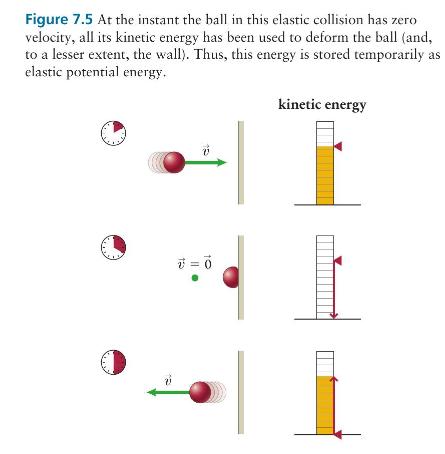
(a) In Figure 7.5, what is the momentum of the ball during the collision?(b) Is the momentum of the ball constant before, during, and after the collision? If so, why? If not, why not, and for what system is the momentum constant? Figure 7.5 At the instant the ball in this elastic collision has zero
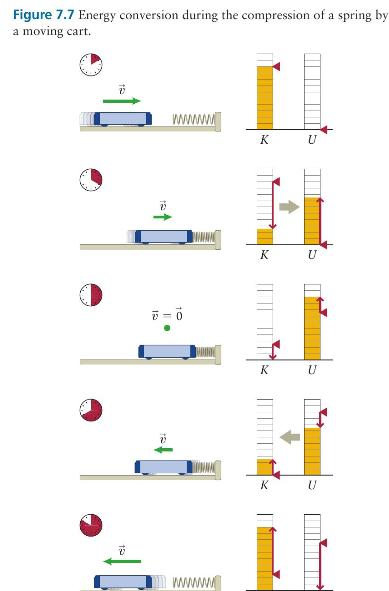
In Figure 7.7, consider the cart's initial speed to be \(v_{\mathrm{i}}\). Assuming no potential energy is initially stored in the spring, how much potential energy is stored in the spring at the instant depicted in the middle drawing and at the instant depicted in the bottom drawing? Give your
Because of friction, a \(0.10-\mathrm{kg}\) hockey puck initially sliding over ice at \(8.0 \mathrm{~m} / \mathrm{s}\) slows down at a constant rate of \(1.0 \mathrm{~m} / \mathrm{s}^{2}\) until it comes to a halt. (a) On separate graphs, sketch the puck's speed and its kinetic energy as functions
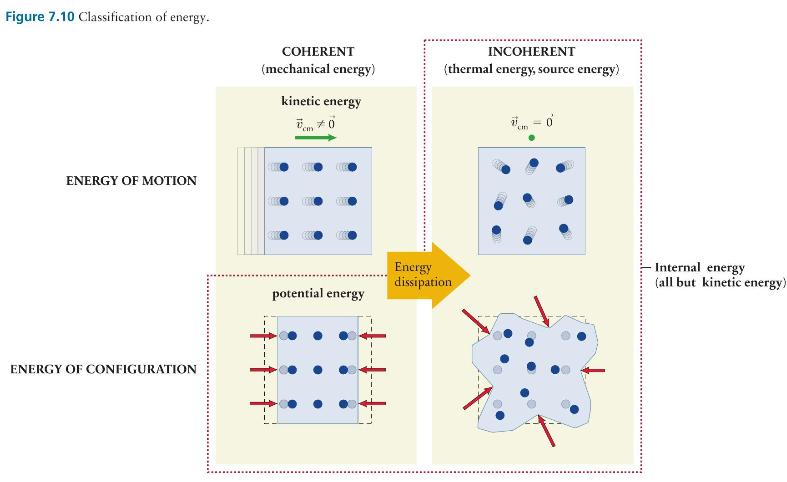
How should chemical energy be classified in Figure 7.10? Figure 7.10 Classification of energy. COHERENT (mechanical energy) kinetic energy 7cm 70 INCOHERENT (thermal energy, source energy) ENERGY OF MOTION ENERGY OF CONFIGURATION Energy dissipation potential energy -Internal energy (all but kinetic
Whenever you leave your room, you diligently turn off the lights to "conserve energy." Your friend tells you that energy is conserved regardless of whether or not your lights are off. Which of you is right?
For each of the following processes, determine what energy conversion takes place and classify the interaction as dissipative or nondissipative.(a) The launching of a ball by the expanding of a compressed spring,(b) the fall of a ball released a certain height above the ground,(c) the slowing down
As an example of an interaction mediated by a "particle," imagine tossing a ball back and forth with a friend. You are both standing on an icy surface so slippery that friction is negligible.(a) Describe the effect the throwing and catching have on your momentum and your friend's momentum. (b) Is
A 1000-kg compact car and a \(2000-\mathrm{kg}\) van, each traveling at \(25 \mathrm{~m} / \mathrm{s}\), collide head-on and remain locked together after the collision, which lasts 0.20 s.(a) According to Eq. 7.6, their accelerations during the collision are unequal. How can this be if both
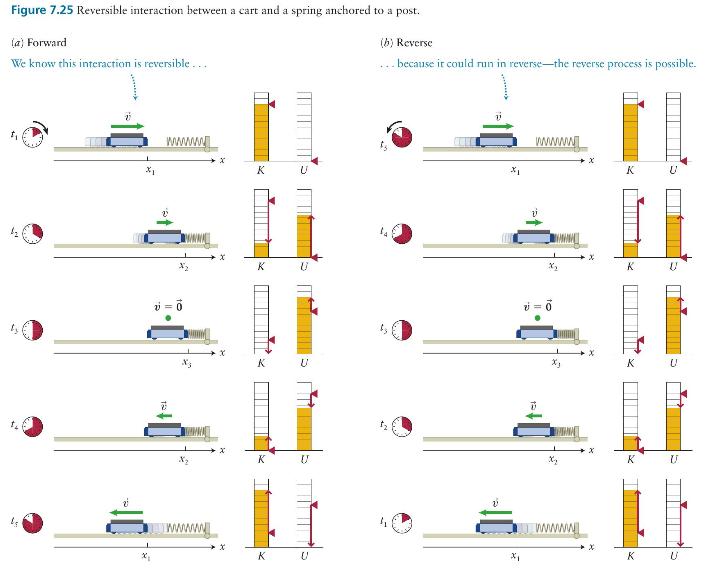
Use the conservation laws to show that, when the spring in Figure 7.25 expands, the change in the kinetic energy of Earth is negligible and we are therefore justified in using Eq. 7.11.Equation 7.11 Figure 7.25 Reversible interaction between a cart and a spring anchored to a post. (a) Forward We
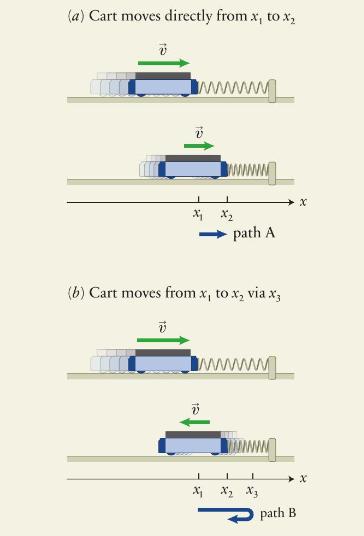
Show that, in Figure 7.26, the change in potential energy along a round trip from position \(x_{1}\) to position \(x_{2}\) and then back to \(x_{1}\) is zero.Figure 7.26 (a) Cart moves directly from x, to x, v x1 x2 path A (b) Cart moves from x, to x, via x3 v L XX2 X3 path B x
Consider a ball launched upward. Verify that its acceleration points in the direction that lowers the gravitational potential energy of the Earth-ball system.
Suppose you raise this book (inertia \(m=3.4 \mathrm{~kg}\) ) from the floor to your desk, \(1.0 \mathrm{~m}\) above the floor. (a) Does the gravitational potential energy of the Earth-book system increase or decrease? (b) By how much? (c) Conservation of energy requires that this change in
Suppose that instead of choosing Earth and the ball as our system in the discussion leading up to Eq. 7.21, we had chosen to consider just the ball. Does it make sense to speak about the gravitational potential energy of the ball (the way we speak of its kinetic energy)? UG(x) = mgx (near Earth's
How much energy is dissipated in the collision of Checkpoint 7.11?Data from Checkpoint 7.11A 1000-kg compact car and a \(2000-\mathrm{kg}\) van, each traveling at \(25 \mathrm{~m} / \mathrm{s}\), collide head-on and remain locked together after the collision, which lasts 0.20 s.According to Eq.
Sketch curves to scale of momentum for the collision of object A initially moving with velocity \(v\) and object B initially at rest, for the following cases: (a) \(m_{A}=m_{B}\),(b) \(m_{A}=2 m_{B}\),(c) \(m_{A} \gg m_{B}\).
A \(1-\mathrm{kg}\) block is used to compress a spring with spring constant \(k=10.0 \mathrm{~N} / \mathrm{m}\) by \(5 \mathrm{~cm}\), and then released. Draw energy diagrams for the spring-mass system when the spring is(a) fully compressed(b) fully relaxed.
Imagine that you take a metal spring, compress it to its most compact length, and tie some string around it to keep it compressed. There is now potential energy stored in the compressed spring. You then place the tied-up spring into a container of strong acid, and, after some time, the compressed
Choose an appropriate closed system and draw a bar diagram representing the energy conversions and transfers that occur during each process of Checkpoint 7.9:(a) a ball launching as the compressed spring it sits on expands, (b) a ball released from some height and falling to the ground,(c) a
A \(2000-\mathrm{kg}\) car burns gasoline with \(25 \%\) efficiency. Accelerating from rest, how fast would this car go upon burning \(0.040 \mathrm{~L}\) of gasoline if \(1.0 \mathrm{~L}\) of gasoline contains approximately \(3.2 \times 10^{7} \mathrm{~J}\) of energy? \(\bullet\)
Give three examples to support the statement "longrange interaction forms the underlying basis for most life processes and technology.”
Explain why tension (in ropes, etc.) and the contact forces between surfaces are not fundamental forces.
A \(5-\mathrm{kg}\) object is subject to an interaction that has a potential energy \(U(x)=\frac{1}{2} k x^{2}-b x\), where \(k=2.0 \mathrm{~J} / \mathrm{m}^{2}\) and \(b=1.5 \mathrm{~J} / \mathrm{m}\). At \(x=1.0 \mathrm{~m}\), the object is found to be moving to the left at \(4 \mathrm{~m} /
A rock climber accidentally drops a \(4.5-\mathrm{kg}\) backpack, and it falls \(160 \mathrm{~m}\) to the ground below. What is the change in the gravitational potential energy of the system comprising the backpack and the Earth?
The fastest baseball pitchers can throw the \(0.145-\mathrm{kg}\) ball at speeds of about \(45 \mathrm{~m} / \mathrm{s}\). Ignoring air resistance, what height must the ball be dropped from to hit the ground at this speed?
A 100-g apple is dropped from a height of \(12 \mathrm{~m}\) and 1 second later is struck by a 100-g arrow flying upward at \(15 \mathrm{~m} / \mathrm{s}\).(a) What is the speed of the apple and the arrow just after collision?(b) How much energy is lost in the collision?(c) How long does it take
While you are standing on your balcony \(8 \mathrm{~m}\) above the ground, your friend tosses a \(0.4-\mathrm{kg}\) book at you from the ground at \(14 \mathrm{~m} / \mathrm{s}\). The book barely makes it to your hand. How much energy was dissipated by air resistance?
In a simple throwball game on ice, a \(90-\mathrm{kg}\) athlete throws a \(1.0-\mathrm{kg}\) ball at \(15 \mathrm{~m} / \mathrm{s}\). The ball is caught by his \(80-\mathrm{kg}\) teammate. If \(20 \%\) of the source energy is lost in the initial throw, then what are the recoil speeds of the
A 60-g Mars bar will supply you with \(1095 \mathrm{~kJ}\) of energy. How many of them would you need to get enough energy to climb the first \(800 \mathrm{~m}\) of the highest structure in the world? The next \(800 \mathrm{~m}\) ? Assume your inertia to be \(80 \mathrm{~kg}\).
A 1-kg cart and a 2-kg cart are held together with a coupler that contains a small charge. The charge is exploded and sends the \(1-\mathrm{kg}\) cart rolling away at \(+4.0 \mathrm{~m} / \mathrm{s}\). What is the speed of the \(2-\mathrm{kg}\) cart? How much energy does the explosion create if
Imagine pushing a crate in a straight line along a surface at a steady speed of \(1 \mathrm{~m} / \mathrm{s}\). What is the time rate of change in the momentum of the crate?
Imagine pushing on a crate initially at rest so that it begins to move along a floor.(a) While you are setting the crate in motion, increasing its speed in the desired direction of travel, what is the direction of the vector sum of the forces exerted on it?(b) Suppose you suddenly stop pushing and
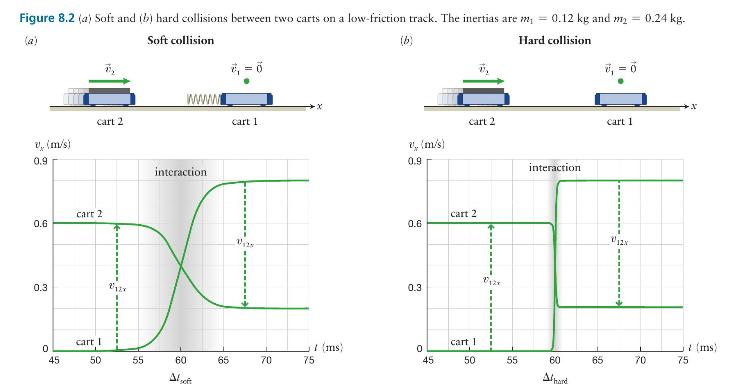
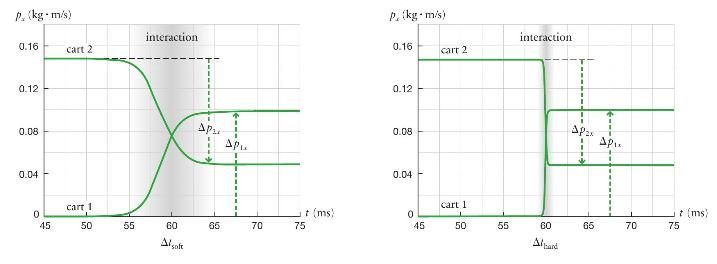
(a) Verify that for both collisions in Figure 8.2 the momentum of the two-cart system remains constant.(b) Verify that both collisions are elastic. Figure 8.2 (a) Soft and (b) hard collisions between two carts on a low-friction track. The inertias are m =0.12 kg and my = Soft collision (a) b Hard
Does the conclusion just stated apply to inelastic collisions?
If you drop a book from a certain height, it falls (accelerating all the while) because of the gravitational force exerted by Earth on it. Because forces always come in interaction pairs, the book must exert a force on Earth. (a) How does the magnitude of \(F_{\text {by book on Earth }}\) compare
In Example 8.1, the mosquito has an inertia of \(0.1 \mathrm{~g}\) and is initially at rest, while the bus, with an inertia of \(10,000 \mathrm{~kg}\), has an initial speed of \(25 \mathrm{~m} / \mathrm{s}\). The collision lasts \(5 \mathrm{~ms}\).(a) Calculate the final speeds of the mosquito and
A magnet lies on a table. You place a second magnet near the first one so that the two repel each other. Identify all the forces exerted on the first magnet.
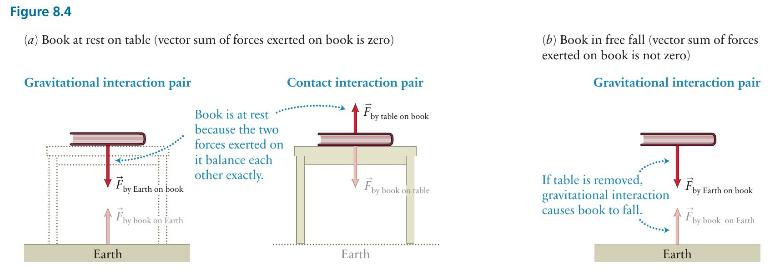
In Figure 8.4, are the contact force exerted by the table on the book and the gravitational force exerted by Earth on the book an interaction pair? Figure 8.4 (a) Book at rest on table (vector sum of forces exerted on book is zero) Gravitational interaction pair Contact interaction pair Book is at
If Exercise 8.3 had asked about a book in free fall rather than one on the floor, what would the free-body diagram look like?Data from Exercise 8.3Draw a free-body diagram for a book lying motionless on the floor.
Draw a free-body diagram for the person in Exercise 8.4.Data from Exercises 8.4Consider a person hanging motionless from a ring suspended from a cable, with the person's feet not touching the floor. Draw a free-body diagram for the ring.
You throw a ball straight up. Draw a free-body diagram for the ball (a) while it is still touching your hand and is accelerating upward, (b) at its highest point, (c) on the way back down.
In Figure \(8.10 a\), how does the magnitude of the downward force exerted by the spring on the ceiling compare with the magnitudes of the downward gravitational forces exerted by Earth on the spring and on the brick?
In Example 8.6, suppose both people pull on the same end of the rope, each exerting a force \(F\), while the other end is still tied to the tree. Is the tension in the rope larger than, equal to, or smaller than the tension when the two people pull on opposite ends?
(a) You exert a constant force of 200 N on a friend on roller skates. If she starts from rest, estimate how far she moves in 2.0s.(b) When a person jumps off a wall, what is the magnitude of his acceleration?(c) Estimate the magnitude of the force exerted by Earth on the person during the jump in
If forces always come in interaction pairs and the forces in such a pair are equal in magnitude and opposite in direction (Eq. 8.15), how can the vector sum of the forces exerted on an object ever be nonzero?Equation 8.15 F12 = -21. (8.15)
The magnitude of the gravitational force exerted by Earth on an object of inertia \(m_{1}\) is \(m_{1} g\).(a) What is the magnitude of the force exerted by the object on Earth (inertia \(m_{\mathrm{E}}\) )?(b) What is the acceleration of Earth due to its gravitational interaction with the object?
Suppose you are in an elevator that is accelerating upward at \(1 \mathrm{~m} / \mathrm{s}^{2}\). (a) Draw a free-body diagram for your body. (b) Determine the magnitude of the force exerted by the elevator floor on you.
(a) Is a spring that has a large spring constant \(k\) stiffer or softer than a spring that has a small spring constant? (b) Which has a larger spring constant: steel or foam rubber?
(a) A feather and a brick are falling freely in an evacuated tube. Is the magnitude of the gravitational force exerted by Earth on the feather larger than, smaller than, or equal to that exerted by Earth on the brick?(b) Suppose equal forces of \(10 \mathrm{~N}\) are exerted on both objects for \(2
(a) Show that Eqs. 8.47 reduce to Eqs. 8.46 when you consider a system of just one object.(b) Follow the procedure used to get from Eq. 8.21 to Eq. 8.24 for a system of many interacting objects.Equations 19 (8.21)
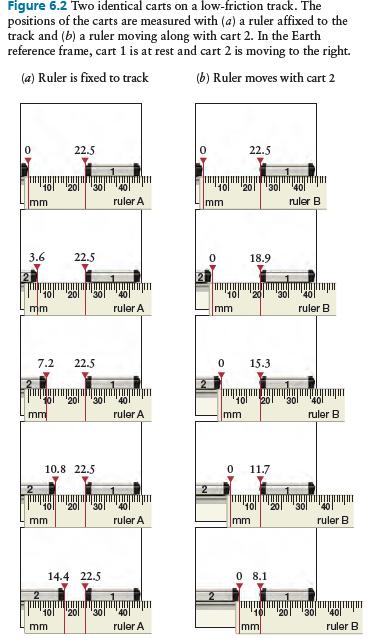
What is the velocity of each cart in Figure 6.2 measured by an observer moving at \(-3.0 \mathrm{~mm} /\) frame in the Earth reference frame? Figure 6.2 Two identical carts on a low-friction track. The positions of the carts are measured with (a) a ruler affixed to the track and (b) a ruler moving
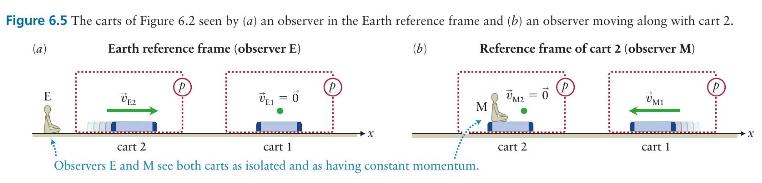
From the point of view of each observer in Figure \(6.5,\) (a) is the energy of each cart constant? (b) Is the isolated system containing cart 1 closed?(c) Is the isolated system containing cart 2 closed? Figure 6.5 The carts of Figure 6.2 seen by (a) an observer in the Earth reference frame and
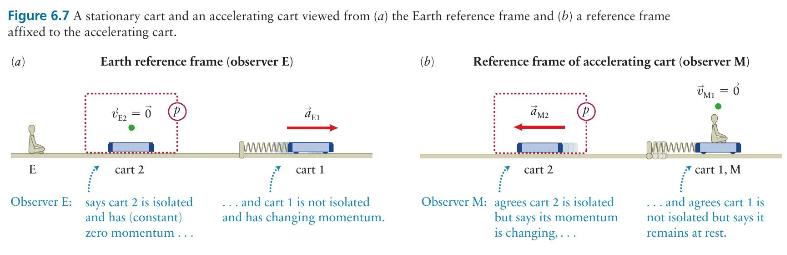
From the point of view of each observer in Figure 6.7,(a) is the energy of each cart constant? (b) Is the isolated system containing cart 1 closed?(c) Is the isolated system containing cart 2 closed?(d) Do the observations made by each observer agree with the conservation of energy law? Figure 6.7
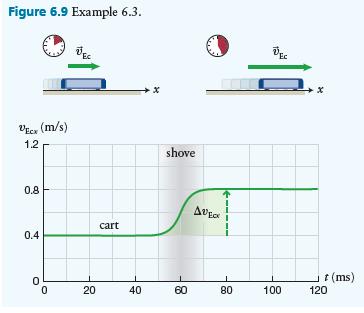
In Example 6.3, what is the change in the cart's kinetic energy due to the shove(a) in the Earth reference frame,(b) in a reference frame moving in the same direction as the cart at \(0.60 \mathrm{~m} / \mathrm{s}\) relative to Earth, and(c) in a reference frame moving in the same direction as the
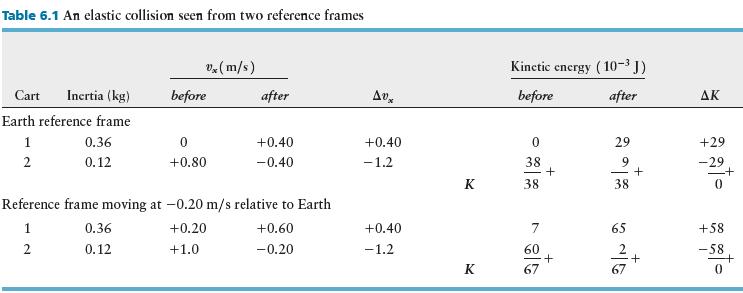
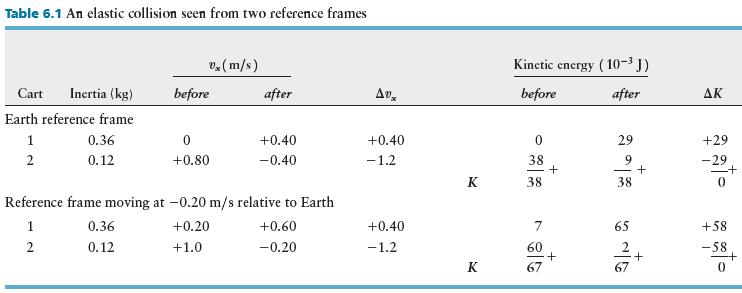
Repeat Example 6.4 but let the collision be totally inelastic.Data from Example 6.4Consider a collision between the two carts of Table 6.1, starting from the same initial velocities, but with \(v_{\mathrm{E} 1 x, \mathrm{f}}=+0.30 \mathrm{~m} / \mathrm{s}\). Make a table like Table 6.1 for this
Is the coefficient of restitution \(e\) different in two inertial reference frames, which are moving at constant velocity relative to each other? (See Eq. 5.18 if you have forgotten the definition of \(e\).)Equation 5.8 - m(V1x,i V1x, f) (V1x,i + V1x,f) = m2 (V2x, f - V2x,i) (V2x,i + V2x,f), (5.8)
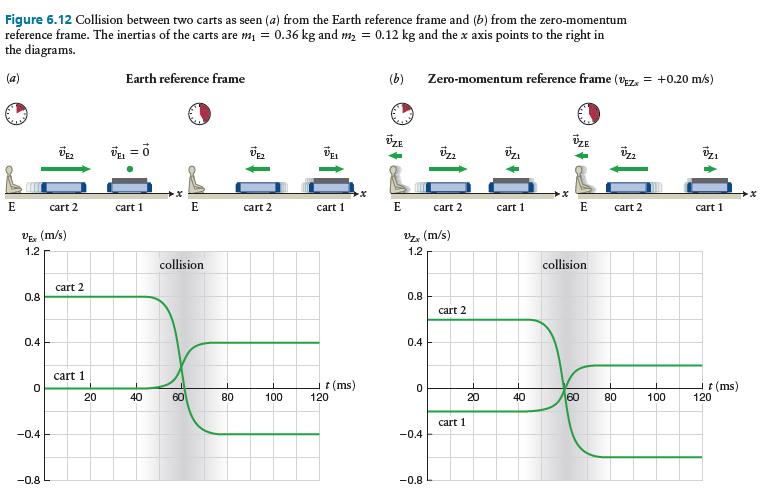
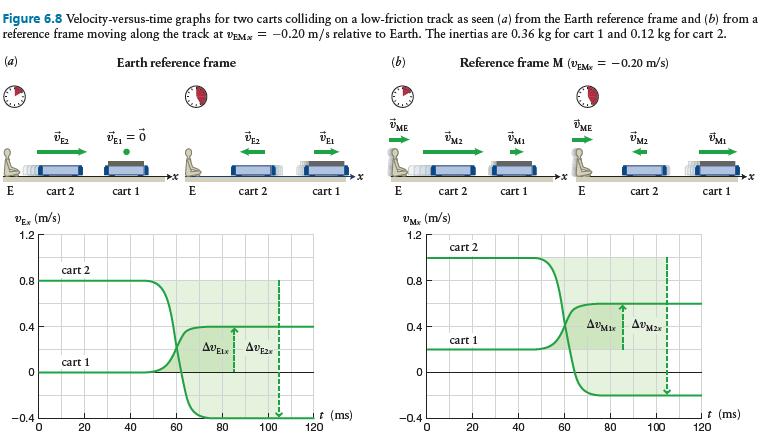
Is the kinetic energy of the two-cart system in Figure 6.12 in the zero-momentum reference frame less than, equal to, or greater than the system's kinetic energy in the Earth reference frame? Figure 6.12 Collision between two carts as seen (a) from the Earth reference frame and (b) from the
A jogger runs in place on a treadmill whose belt moves at \(v_{\mathrm{EB} x}=+2.0 \mathrm{~m} / \mathrm{s}\) relative to Earth. Let the origins of the Earth reference frame and the reference frame B moving along with the top surface of the belt coincide at \(t=0\).(a) What is the jogger's position
In a train moving due north at \(3.1 \mathrm{~m} / \mathrm{s}\) relative to Earth, a passenger carrying a suitcase walks due north down the aisle at \(1.2 \mathrm{~m} / \mathrm{s}\) relative to the train. A spider crawls along the bottom of the suitcase at \(0.5 \mathrm{~m} / \mathrm{s}\) due south
In Example 6.7, let \(m_{1}=3 m_{2}\).(a) Where on axis A is the center of mass of the two-cart system?(b) Where on axis A would you need to place a third cart of inertia \(m_{3}=m_{1}\) so that the center of mass of the three-cart system is at the position of cart 2 ?Data from Example 6.7 The
(a) Determine the center-of-mass velocity of the two carts in Figure 6.8 (a) before and after the collision, and verify that it is equal to the velocity of the carts at the point where the two \(v_{x}(t)\) curves intersect. (b) Is the velocity of the carts at the point where the two \(v_{x}(t)\)
Verify that Eq. 6.38 is valid by substituting Eq. 6.26 for \(v_{\mathrm{cm}}\) into Eq. 6.37 and working through the algebra.Equations dcm d7cm dt m + mv+... m+... m (6.26)
A moving object that has inertia \(m\) strikes a stationary object that has inertia \(0.5 \mathrm{~m}\). (a) What fraction of the initial kinetic energy of the system is convertible? (b) Why can't the rest be converted?
Objects \(1\left(m_{1}=1.0 \mathrm{~kg}\right)\) and \(2\left(m_{2}=3.0 \mathrm{~kg}\right)\) collide inelastically. The velocities are \(v_{1 x, \mathrm{i}}=+4.0 \mathrm{~m} / \mathrm{s}, \quad v_{2 x, \mathrm{i}}=0, \quad v_{1 x, \mathrm{f}}=-0.50 \mathrm{~m} / \mathrm{s}\), and \(v_{2 x,
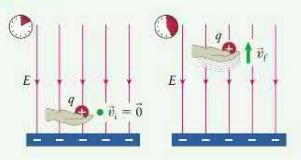
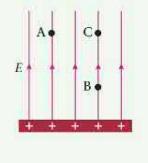
Consider the situation illustrated in Figure 25. 11. A positively charged particle is lifted against the uniform electric field of a negatively charged plate. Ignoring any gravitational interactions, draw energy diagrams for the following choices of systems: (a) particle and plate,
A positively charged particle is moved from point A to point B in the electric field of the massive, stationary, positively charged object in Figure 25. 12. (a) Is the electrostatic work done on the particle positive, negative, or zero? (b) How is the electrostatic work done on the particle along
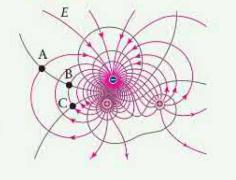
Figure 25. 13 shows both the electric field lines and the equipotentials associated with the given charge distribution.(a) Is the potential at point A higher than, lower than, or the same as the potential at point B?(b) Is the potential at point C higher than, lower than, or the same as that at
Two metallic spheres A and B are placed on nonconducting stands. Sphere A carries a positive charge, and sphere B is electrically neutral. The two spheres are connected to each other via a wire, and the charge carriers reach a new electrostatic equilibrium. (a) Is the electric potential energy of
Two small pith balls, initially separated by a large distance, are each given a positive charge of \(5.0 \mathrm{nC}\). By how much does the electric potential energy of the two-ball system change if the balls are brought together to a separation distance of \(2.0 \mathrm{~mm}\) ?
The negative terminal of a \(9-\mathrm{V}\) battery is connected to ground via a wire. (a) What is the potential of the negative terminal? (b) What is the potential of the positive terminal? (c) What is the potential of the negative terminal if the positive terminal is connected to ground?
A (simplistic) model of the hydrogen atom treats the electron as a particle carrying a charge \(-e\) orbiting a proton (a particle carrying a charge \(+e\) ) in a circle of radius \(r_{\mathrm{H}}=0.53 \times 10^{-10} \mathrm{~m} .(\) a) How much energy is required to completely separate the
Consider a uniform electric field of magnitude \(E\) between two parallel charged plates separated by a distance \(d\).(a) What is the potential difference between the positive plate and the negative plate? \((b)\) What is the value of the potential at a point \(\mathrm{P}\) that lies between the
A thin rod of length \(\ell\) carries a uniformly distributed charge \(q\). What is the potential \(V_{\mathrm{p}}\) at point \(\mathrm{P}\) a distance \(d\) from the rod along a line that runs perpendicular to the long axis of the rod and passes through one end of the rod?
A thin disk of radius \(R\) carries a uniformly distributed charge. The surface charge density on the disk is \(\sigma\). What is the electrostatic potential due to the disk at point \(\mathrm{P}\) that lies a distance \(z\) from the plane of the disk along an axis that runs through the disk center
A permanent dipole consists of a particle carrying a charge \(+q_{\mathrm{p}}\) at \(x=0, y=+\frac{1}{2} d\) and another particle carrying a charge \(-q_{\mathrm{p}}\) at \(x=0, y=-\frac{1}{2} d\). Use the electrostatic potential at a point \(\mathrm{P}\) on the axis of the dipole to determine the
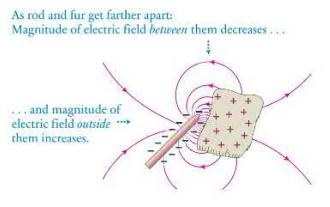
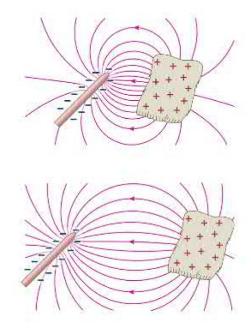
Consider again Figure 26. 2 and imagine moving one more electron from the fur to the rod. (a) Is the work that must be done on the rod-fur system to accomplish this transfer positive, negative, or zero? (b) Is the electrostatic work positive, negative, or zero? (c) Does the electric potential
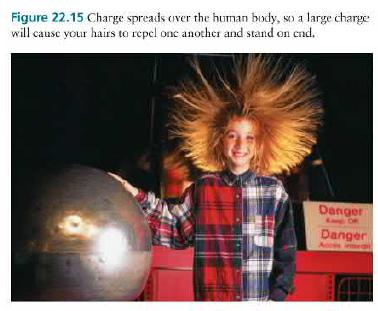
Figure 22. 15 (page 773) shows a person's hair standing out from her head because of "electrostatic charge." Look back at the discussion of Van de Graaff generators and discuss how this can happen when a person touches the globe of the generator but is insulated from the ground.Data from Figure
A parallel-plate capacitor is connected to a battery. If the distance between the plates is decreased, do the magnitudes of the following quantities increase, decrease, or stay the same: (i) the potential difference between the negative plate and the positive plate, (ii) the electric field
When a dielectric is inserted between the plates of an isolated charged capacitor, do the magnitudes of the following quantities increase, decrease, or stay the same: (i) the charge on the plates, (ii) the electric field between the plates, and (iii) the potential difference between the negative
Showing 1900 - 2000
of 4962
First
13
14
15
16
17
18
19
20
21
22
23
24
25
26
27
Last
Step by Step Answers

 Get 50% OFF
Claim Now
Get 50% OFF
Claim Now