New Semester
Started
Get
50% OFF
Study Help!
--h --m --s
Claim Now
Question Answers
Textbooks
Find textbooks, questions and answers
Oops, something went wrong!
Change your search query and then try again
S
Books
FREE
Study Help
Expert Questions
Accounting
General Management
Mathematics
Finance
Organizational Behaviour
Law
Physics
Operating System
Management Leadership
Sociology
Programming
Marketing
Database
Computer Network
Economics
Textbooks Solutions
Accounting
Managerial Accounting
Management Leadership
Cost Accounting
Statistics
Business Law
Corporate Finance
Finance
Economics
Auditing
Tutors
Online Tutors
Find a Tutor
Hire a Tutor
Become a Tutor
AI Tutor
AI Study Planner
NEW
Sell Books
Search
Search
Sign In
Register
study help
physics
particle physics
Principles And Practice Of Physics 2nd Global Edition Eric Mazur - Solutions
Two \(1.00-\mathrm{kg}\) spheres carry identical charges and are placed a distance \(d\) from each other.(a) How large should the charge on each sphere be so that the repulsive electric force between them balances the attractive gravitational force between them? \((b)\) What is the smallest mass
A charged oil drop that has a mass of \(5.00 \times 10^{-12} \mathrm{~kg}\) and carries 10 elementary charges is centered \(50 \mathrm{~mm}\) below the center of an oppositely charged nonconducting sphere that has a radius of \(5.0 \mathrm{~mm}\). What uniformly distributed charge should the sphere
In the Bohr model, a hydrogen atom consists of an electron orbiting a one-proton nucleus. (a) Derive an algebraic expression for the relationship between the electron's speed \(v\) and the radius \(R_{\text {orbit }}\) of its orbit. (b) Review the derivation of Kepler's third law in Chapter 13
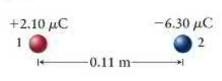
(a) Draw and label the electric force exerted on each of the charged spheres in Figure P22.42 and compute their magnitudes. The centers of the spheres are separated by \(0.11 \mathrm{~m}\). (b) Repeat part \(a\), drawing to the same scale, if the charge on the left sphere is \(-6.30 \mu
You have two marbles, one carrying a uniformly distributed charge \(q_{\mathrm{p}}=+1.0 \mu \mathrm{C}\) and the other carrying a uniformly distributed charge \(q_{\mathrm{n}}=-0.50 \mu \mathrm{C}\). (a) What is the magnitude of the electric force between them when they are held \(100
Two charged particles \(3.0 \mathrm{~m}\) apart exert on each other an attractive electric force of magnitude \(8.0 \times 10^{-3} \mathrm{~N}\). If the charge on the two particles sums to \(6.0 \mu \mathrm{C}\), what is the charge on each particle?
Determine the magnitude and direction of the electric force exerted by a \(25-n C\) charged particle located at the origin of a Cartesian coordinate system on a \(20-\mathrm{nC}\) charged particle located at \((2.0 \mathrm{~m}, 2. 0 \mathrm{~m})\). Draw a diagram illustrating the various quantities
The electric force between two identical positively charged ions is \(3.7 \times 10^{-9} \mathrm{~N}\) when they are \(0.50 \mathrm{~nm}\) apart. How many electrons are missing from each of the original atoms?
Two particles 1 and 2, each carrying \(71 \mathrm{pC}\) of charge, are released from rest on a nonconducting, low-friction track. Particle 1 accelerates initially at \(7.0 \mathrm{~m} / \mathrm{s}^{2}\). Particle 2 , which has a mass of \(0.49 \mathrm{mg}\), accelerates initially at \(9.0
Two identical lightweight conducting balls are suspended by thin strings of identical length from a common point. One ball is given a charge \(q\), and both are constrained in their motion by only the tension in the strings, gravity, and air resistance. Determine \(q\) in terms of \(m\), the mass
Suppose you want to use a repulsive electric force to launch a rocket. (a) How much charge do you need to create enough repulsion to bring a \(100,000-\mathrm{kg}\) rocket to escape speed \((11,200 \mathrm{~m} / \mathrm{s})\) while the rocket travels \(100 \mathrm{~mm}\) ? Assume that two identical
Two metal spheres each carry a charge and exert an electric force on each other. Sphere A carries \(2 n\) more surplus electrons than sphere \(\mathrm{B}\), where \(n\) is a positive integer. The two spheres are brought into electrical contact and then returned to their initial separation. Is the
(a) Prove that the repulsive electric force between two charged particles is a maximum when each particle carries charge \(q / 2\), where \(q\) is the sum of the charges carried by the two particles. (b) Explain why this is not true for the attractive electric force between charged particles.
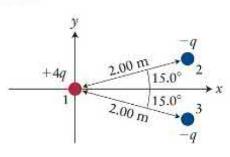
Particle 1 carrying charge \(+4 q\) is fixed at the origin of a rectangular coordinate system, particle 2 carrying charge \(-q\) is fixed \(15.0^{\circ}\) above the positive horizontal axis, and particle 3 carrying charge \(-q\) is fixed \(15.0^{\circ}\) below the positive horizontal axis (Figure
Particle 1 carrying \(-4.0 \mu \mathrm{C}\) of charge is fixed at the origin of an \(x y\) coordinate system, particle 2 carrying \(+6.0 \mu \mathrm{C}\) of charge is located on the \(x\) axis at \(x=3.0 \mathrm{~m}\), and particle 3 , identical to particle 2 , is located on the \(x\) axis at
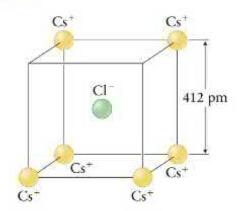
Cesium chloride \((\mathrm{CsCl})\) is a crystalline salt that forms in a cubic lattice structure, which you can imagine as a cube with \(\mathrm{Cs}^{+}\)ions at the eight corners and \(\mathrm{Cl}^{-}\)ion at the center. The edge length of the cube is \(412 \mathrm{pm}\). Suppose that at the edge
An \(x y z\) coordinate system contains three charged particles: particle \(1, q_{1}=-5.0 \mu \mathrm{C}\), at \((4.0 \mathrm{~m},-2.0 \mathrm{~m}, 0)\); particle \(2, q_{2}=12 \mu \mathrm{C}\), at \((1.0 \mathrm{~m}, 2. 0 \mathrm{~m}, 0)\); and an electron at \((-1.0 \mathrm{~m}, 0,0)\). (a) Draw
Particle 1 carrying charge \(q\) is at the origin of an \(x y\) coordinate system, particle 2 carrying charge \(-2 q\) is at \((1,0)\), and particle 3 carrying charge \(3 q\) is at \((0,1)\). What is the angle with respect to the \(x\) axis of the electric force exerted on a particle 4 carrying
Charged particles 1,2 , and \(3\left(q_{1}=10.0 \mu \mathrm{C}, q_{2}=-5.00 \mu \mathrm{C}\right.\), and \(\left.q_{3}=-3.00 \mu \mathrm{C}\right)\) are arranged in an equilateral triangle in an \(x y\) coordinate system. Particle 1 is at \((0,0)\), particle 2 at \((1.0 \mathrm{~m}, 0)\), and
Four negatively charged particles each carry a charge \(q_{\mathrm{n}}\) and form a square of side length \(d\). A positively charged particle carrying a charge \(q_{\mathrm{p}}\) is at the square's center. If the arrangement is in equilibrium (the vector sum of the electric forces on each particle
Particle 1 carrying \(2.0 \mu \mathrm{C}\) of charge is fixed at the origin of a rectangular coordinate system, particle 2 carrying \(-1.0 \mu \mathrm{C}\) is fixed \(45^{\circ}\) above the positive horizontal axis \(2.0 \mathrm{~mm}\) from the origin, and particle 3 carrying \(-1.0 \mu
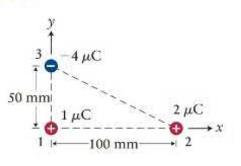
For the charge distribution in Figure P22.61, what is the ratio of the magnitude of the electric force exerted by particle 2 on particle 1 to the magnitude of the electric force exerted by particle 3 on particle 1 ?Data from Figure P22.61 -4C 50 mm 1 C 2 + x -100 mm- 2
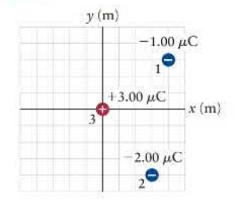
For the charge configuration shown in Figure P22.62, what is the vector sum of the electric forces exerted on particle 3 ?Data from Figure P22.62 y (m) -1.00 1 + 3.00 -x (m) 3 - 2.00 2 30
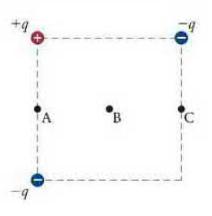
Two particles, each carrying charge \(-q\), are fixed at opposite corners of a square, and a third particle, carrying charge \(+q\), is fixed at a third corner (Figure P22.63). (a) Draw an arrow representing the vector sum of the forces exerted on a particle carrying charge \(+q\) as it is placed
Two particles are located on the \(x\) axis of a Cartesian coordinate system. Particle 1 carries a charge of \(+2.0 \mathrm{nC}\) and is at \(x=-30 \mathrm{~mm}\), and particle 2 carries a charge of \(-2.0 \mathrm{nC}\) and is at \(x=30 \mathrm{~mm}\). What are the magnitude and direction of the
Particle 1 carrying charge \(4 q\) is fixed at the origin of an \(x y\) coordinate system, and particle 2 carrying charge \(q\) is fixed at \((0,0.12 \mathrm{~m})\). Particle 3 carrying \(2.0 \mu \mathrm{C}\) of charge can move along the \(y\) axis. This particle experiences zero electric force
Conducting spheres 1,2 , and 3 are placed at three corners of a square. Spheres 1 and 2 at opposing corners are very small and oppositely charged, and the magnitude of the charge on negatively charged sphere 1 is twice the magnitude of the charge on positively charged sphere 2 . Sphere 3 is much
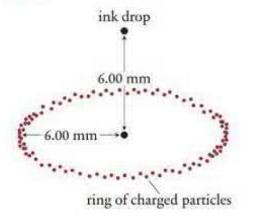
You are working as an engineer designing ink-jet printers. Your boss has come across a printer design that involves a charged drop of ink experiencing a force exerted by 100 small, fixed charged particles. As shown in Figure P22.67, the particles are arranged in a ring of radius \(6.00
A \(0.160-\mathrm{kg}\) hockey puck modified to hold \(+50 \mu \mathrm{C}\) of charge is placed at one end of an ice hockey rink that is \(61 \mathrm{~m}\) long. At the other end of the rink is a device capable of generating a charge of \(-0.10 \mathrm{C}\), but only for a short time interval. The
Two particles 1 and 2 , each carrying \(6.0 \mathrm{nC}\) of charge, are located along an \(x\) axis, one particle at \(x=-30 \mathrm{~mm}\) and the other at \(x=30 \mathrm{~mm}\). Where along the \(y\) axis is a particle 3 carrying a charge of \(+2.0 \mathrm{nC}\) if it experiences an electric
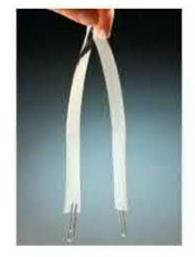
Figure \(\mathrm{P} 22. 70\) shows strips of transparent tape repelling each other. Use information given on the packaging of a roll of transparent tape to estimate what fraction of the atoms in either strip lose an electron in order to produce the repulsive effect. (Assume that the material of the
If electrons move easily in electrical conductors, why aren't pieces of metal usually negatively charged on the bottom and positively charged on top, due to gravitational settling of the electrons?
Metals are often good thermal conductors as well as good electrical conductors. In fact, usually the better a metal is as a thermal conductor, the better it is as an electrical conductor. Give a physical explanation for this.
Suppose a glass rod is rubbed on wool. When held \(35.0 \mathrm{~mm}\) above a \(0.20 \mathrm{~g}\) scrap of paper, the rod lifts the paper with an initial acceleration of \(0.14 \mathrm{~m} / \mathrm{s}^{2}\). Calculate the magnitude and direction of the electric force exerted by the rod on the
Three identical conducting spheres, A, B, and C, are given different initial charges. Sphere A, which initially carries 12 units of negative charge, is brought in contact with sphere \(B\), which initially has 4 units of negative charge. Then sphere B is brought into contact with sphere C, which is
Particle A carrying a \(4.0-\mu \mathrm{C}\) charge is located at \(y=3.0 \mathrm{~m}\) on the \(y\) axis of an \(x y\) coordinate system, and particle B carrying a \(6.0-\mu \mathrm{C}\) charge is located at the origin. What are the magnitude and direction of the electric force exerted \((a)\) on
Protons and neutrons are made up of particles called quarks. The particles known as up quarks carry a charge of \(2 e / 3\), and those known as down quarks carry a charge of \(-e / 3\). How could you assemble a proton from up and down quarks to account for its charge? How could you assemble a
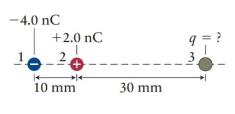
Three charged particles are arranged along a line as in Figure P22.77. If particle 2 experiences zero electric force, what is the charge on particle 3 ?Data from Figure P22.77 -4.0 nC +2.0 nC 10 mm 30 mm
Four identical charged particles are constrained along an \(x\) axis. Identify one possible configuration of the particles that would leave one of them at rest at the origin when the others are fixed in place. No two charged particles can be at the same location.
(a) A particle carrying charge \(+q\) is located at the center of a square with sides of length \(\ell\). Given four particles, two carrying charge \(+q\) and two carrying charge \(-q\), how should you place them at the four corners of the square, with one particle at each corner, such that the
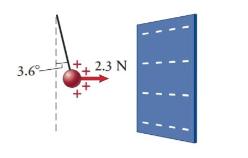
A small charged sphere hanging from a thin string next to an oppositely charged plate experiences a \(2.3-\mathrm{N}\) attractive electric force (Figure P22.80). If the string makes an angle of \(3.6^{\circ}\) with the vertical, what is the mass of the sphere?Data from Figure P22.80 3.6 ++2.3 N
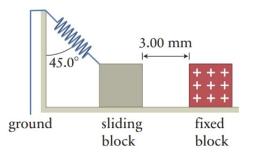
The accelerometer in a certain video game controller is constructed as shown in Figure P22.81. A block made of material that is an electrical conductor is grounded by a small stretched spring and is constrained to sliding along a rail. The net force on this block is zero. A nonconducting,
An anti-hydrogen atom, A, is composed of one positron orbiting one antiproton just as a regular hydrogen atom is composed of one electron orbiting one proton. The difference is that each antiparticle has the usual mass but an opposite charge of its regular counterpart. Atom A is placed in a closed
All life on Earth is based on one of many two-polymer systems, each made up of a protein and a nucleic acid. In a cell, these polymers are, for the most part, charge-balanced, with the nucleic acid in any pair carrying a negative charge and the protein carrying an equal amount of positive charge.
In a simplistic model of the hydrogen atom, the electron orbits the proton in a circle of radius \(53 \mathrm{pm}\). What is the orbital period of the electron, in seconds, if the force responsible for the proton-electron attraction is \((a)\) gravitational and \((b)\) electric?
(a) About how many electrons are there in a copper penny, which has a mass of about \(0.003 \mathrm{~kg}\) ? (b) If you could isolate these electrons, how much charge would you have? (c) Estimate the magnitude of the electric force it would require to bring one more electron to within \(1.0
Earth exerts an electric force on small charged objects located near its surface. The effect can be modeled by assuming Earth is a particle at the center of Earth carrying a charge of \(-6.76 \times 10^{5} \mathrm{C}\). (a) What is the magnitude of the electric force exerted by Earth on an electron
Four particles, each carrying a charge of \(|3.0| \mathrm{nC}\), are located at the corners of a square that has a side length of \(50 \mathrm{~mm}\). The charge on the particle at the lower left corner is positive, and the other three particles are negatively charged. (a) Draw a free-body diagram
A small sphere 1 carrying charge \(q\) is fixed a few meters above the Moon's surface next to a spaceship. An astronaut holds a charged sphere 2 a couple of meters above sphere 1, almost but not quite directly over sphere 1 . Sketch the trajectory for sphere 2 when the astronaut drops it if the
Someone has challenged you in a friendly bet that, given a set of six charged spheres with three carrying positive charge and three carrying negative charge, you can't place any three of them in a line (a board with a groove in it serves the purpose) and have them be in translational equilibrium.
While assembling part of an electric generator, you realize that two pieces were not properly labeled. One piece is a nonconducting block, and the other is a conducting block, but without labels you don't know which is which. Because you had counted on the parts being properly labeled, you do not
Working on a system to collect solar energy, you are trying to move some charged particles through the open interior of a uniformly charged ring. A colleague vaguely remembers Newton's and Priestley's argument that no electrostatic force is exerted on a charged particle inside a uniformly charged
Suppose someone discovers that blue and yellow objects attract each other, that two blue objects repel each other, and that two yellow objects repel each other. The strength of this "chromatic interaction" is found to depend on color depth: The deeper the color, the greater the magnitude of the
(a) Does an electrically neutral particle that has mass interact with an electric field?(b) Does a charged particle interact with a gravitational field?
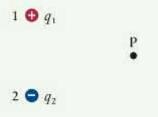
The two particles in Figure 23. 19 have the same mass, carry charges of the same magnitude ( \(\left.q_{1}=-q_{2}>0\right)\), and are equidistant from point \(P\). (a) What is the electric field direction at \(\mathrm{P}\) ? (b) At \(\mathrm{P}\), what is the direction of the gravitational field
Can electric and gravitational fields exist in the same place at the same time?
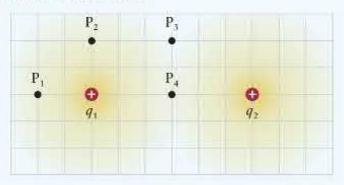
Consider two identical particles 1 and 2 carrying charges \(q_{1}=q_{2}>0\) (Figure 23.10). What is the direction of the combined electric field at points \(\mathrm{P}_{1}\) through \(\mathrm{P}_{4}\) ?Data from Figure 23.10 P P P + 9 PA 92
Four charged particles are fired with a horizontal initial velocity \(\vec{v}_{i}\) into a uniform electric field that is directed vertically downward. The effect of gravity is negligible. The particles have the following charges and masses: particle 1 \((+q, m) ; 2(+q, 2 m) ; 3(+2 q, 2 m) ; 4(-q,
A thin rod of length \(\ell\) carries a uniformly distributed charge \(q\). What is the electric field at a point \(\mathrm{P}\) along a line that is perpendicular to the long axis of the rod and passes through the rod's midpoint?
A thin ring of radius \(R\) carries a uniformly distributed charge \(q\). What is the electric field at point \(\mathrm{P}\) along an axis that is perpendicular to the plane of the ring and passes through its center?
A thin disk of radius \(R\) carries a uniformly distributed charge. The surface charge density on the disk is \(\sigma\). What is the electric field at a point \(\mathrm{P}\) along the perpendicular axis through the disk center?
A solid sphere of radius \(R\) carries a fixed, uniformly distributed charge \(q\). Exploiting the analogy between Newton's law of gravity and Coulomb's law, use the result obtained in Section 13.8 to obtain an expression for the magnitude of the electric field created by the sphere at a point
In a discussion of the technological capabilities of ancient civilizations, a friend offers this hypothesis: "Some ancient civilizations built sophisticated instruments based on a mysterious type of radiation, but all of them have been lost." Which part of his statement is most likely to keep the
Suppose you have a disk of cardboard with two perpendicular diameters dividing the disk into four quadrants. The first and third quadrants taken clockwise from the topmost point of the disk are red, whereas the other two are white. How many axes of reflection does the disk have? Restrict your
Light takes approximately 500 seconds to travel from the Sun to the Earth.(a) What is this distance in kilometers?(b) How many Suns could fit side by side in this distance? Take the radius of the Sun to be \(696,000 \mathrm{~km}\).
How many water molecules are there in an Olympic swimming pool that is \(50 \mathrm{~m}\) long, \(25 \mathrm{~m}\) wide and \(3.0 \mathrm{~m}\) deep?
A human heart beats 72 times every minute. How many times, on average, does a heart beat during a healthy 70 -year lifespan?
The world record for the \(100 \mathrm{~m}\) dash was set at 9.58 seconds a few years ago. What is this speed in kilometers per hour? In miles per hour?
A weather balloon can rise to an altitude of \(80,000 \mathrm{ft}\) above sea level. What is this distance in miles? In meters?
Take the speed of sound in air at standard temperature and pressure to be \(343 \mathrm{~m} / \mathrm{s}\). Convert this speed to kilometers per hour, inches per nanoseconds, and miles per second.
The Dubai World Cup horserace is 2000 meters long. Express this distance in miles.
You measure a quantity \(T\) that can be represented as \(=2 \pi \sqrt{\frac{l}{g}}\). If \(T\) and \(l\) have the units of seconds and meters, respectively, then what should the units of \(g\) be for the expression to be correct?
Express the distance of the Dubai World Cup horserace in kilometers to the same number of significant digits needed to answer problem 42.Data from Problem 42The Dubai World Cup horserace is 2000 meters long. Express this distance in miles.
You have \(2.28 \mathrm{~kg}\) of rice and wish to divide it evenly among five people. If you calculate how much rice each person receives, how many significant digits does your answer have?
You are recording your car's petrol consumption. Your odometer measures to the tenth of a kilometer. The gas-station pump displays liters of gasoline dispensed to the thousandth of a liter. Given these levels of precision, is there any difference in the precision of your calculation when you drive
At present, the tallest man-made structure is the Burj Khalifa in Dubai. Express the height of this building in nanometers. How many atoms would need to be stacked to get to the same height?
A water tank is filled to its \(10 \times 10^{4}\)-L capacity. (a) What is the tank's volume in cubic meters? (b) What is the mass of the water in micrograms? (c) If your household consumed ten 500-cc bottles of water a day, how long would the water in the tank last? \(\cdot\)॰
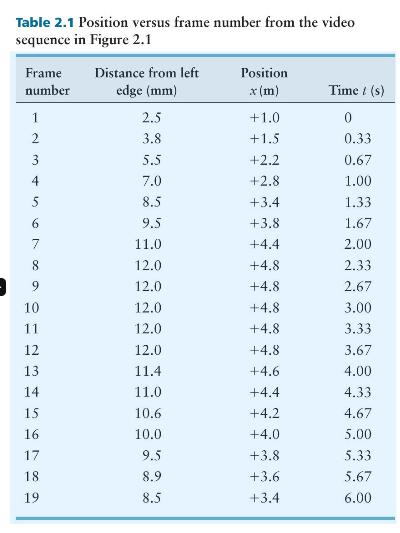
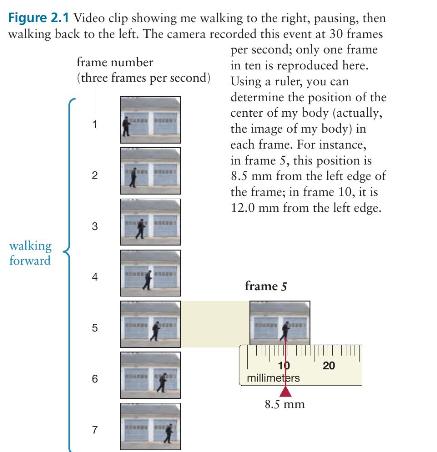
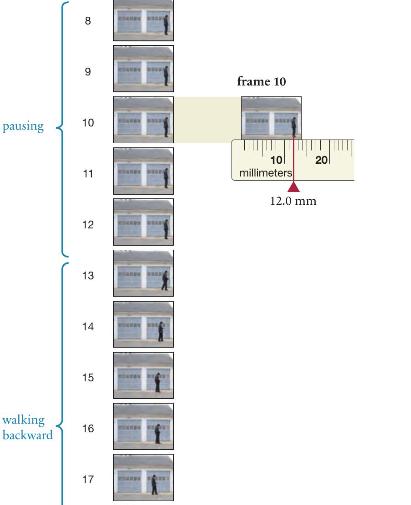
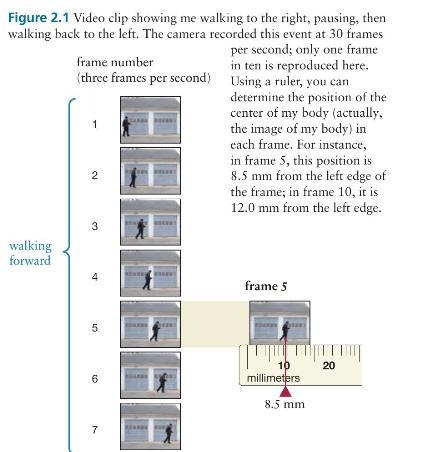
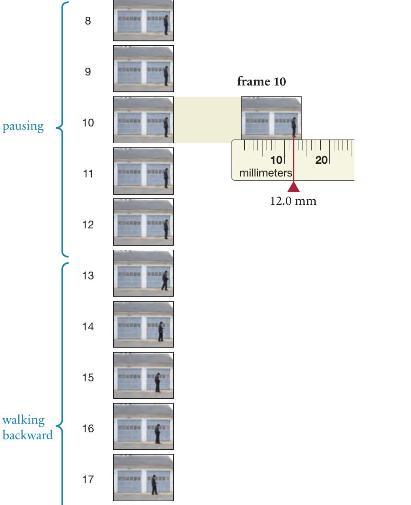
(a) Consider my motion between frames 6 and 17 in Figure 2.1. Use the values in Table 2.1 to determine the answers to these questions: What is my average speed over this time interval? What is the \(x\) component of my average velocity? What is the average velocity?(b) Repeat for the motion between
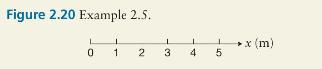
(a) Write each displacement in Example 2.5 in terms of the unit vector \(\hat{\imath}\) shown in Figure 2.18.(b) What is the magnitude of each displacement vector in part \(a\) ?(c) Write my final position in Figure 2.26 in terms of the unit vector.Data from Example 25On the reference axis shown in
A car is initially parked \(3.5 \mathrm{~m}\) to the left of a fire hydrant. It drives \(15.5 \mathrm{~m}\) past the hydrant before turning back for \(6.0 \mathrm{~m}\) and stopping. What is the car's displacement?
You run three times around a \(100-\mathrm{m}-\mathrm{by}-50-\mathrm{m}\) rectangular soccer field and continue for one more length. What is \((a)\) the magnitude of your displacement\((b)\) the total distance traveled?
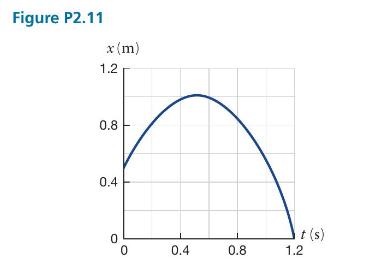
Figure P2.11 shows the position measured in meters plotted against time measured in seconds for an object moving in one dimension. For motion between \(t=0\) and \(t=1.2 \mathrm{~s},\) (a) Describe the motion of this object.(b) What is the distance traveled by this object?(c) What is the
An ant walks along a tight thread that is oriented north to south and can be taken to coincide with the \(y\) axis. The ant walks \(7 \mathrm{~cm}\) south, then turns and walks \(2 \mathrm{~cm}\) north. It continues another \(10 \mathrm{~cm}\) north, then \(3 \mathrm{~cm}\) south, then \(12
A remotely controlled helicopter is heading vertically upward when you attempt to land it. Its height is represented by \(y(t)=p+q t-r t^{2}\), where \(p=20.0 \mathrm{~m}\), \(q=5.0 \mathrm{~m} / \mathrm{s}\), and \(r=5.0 \mathrm{~m} / \mathrm{s}^{2}\). (a) Draw a graph of the motion from \(t=0\)
A taxi driver leaves the airport to drop a passenger at his hotel, making the following trips: she drives \(7.2 \mathrm{~km}\) in \(10 \mathrm{~min}\), stops and waits for the passenger at a convenience store for \(7 \mathrm{~min}\), drives another \(5 \mathrm{~km}\) to the hotel in \(10
Consider three vectors along the \(x\) axis, \(\vec{A}, \vec{B}\), and \(\vec{C}\). Let the \(x\) components of the three vectors be \(-2 \mathrm{~m},+3 \mathrm{~m}\), and \(-5 \mathrm{~m}\). What are (a) D = A + B and (b) E = - ?
After driving due north at \(72 \mathrm{~km} / \mathrm{hr}\) for 2 hours, you stop for \(20 \mathrm{~min}\) and then head back south at \(108 \mathrm{~km} / \mathrm{hr}\) to reach your starting position. What is your \((a)\) average velocity \((b)\) average speed at the end of the trip?
A freight train leaves city \(\mathrm{A}\) and heads for city \(\mathrm{B}\), which is \(44 \mathrm{~km}\) away, at \(12 \mathrm{~km} / \mathrm{hr}\). At the same time, a passenger train leaves city \(\mathrm{B}\) and heads for \(\mathrm{A}\). The two trains barely avoid a collision at a station
A policeman starts giving chase 60 seconds after a stolen car zooms by at \(108 \mathrm{~km} / \mathrm{hr}\). At what minimum speed should they drive if they have to catch up with the driver before they manage to get onto an expressway \(60 \mathrm{~km}\) away?
An object's position as a function of time is given by \(x(t)=-2.0 t^{2}+1.0 t^{3}\). Calculate \((a)\) the object's position and velocity at \(t=2 \mathrm{~s}\).(b) The average velocity between \(t=0\) and \(t=2 \mathrm{~s}\).
An object's position is represented by \(x(t)=2.0 t^{\frac{3}{2}}\). Compare the instantaneous velocity of the object at \(t=4 \mathrm{~s}\) to its average velocity between \(t=0\) and \(t=4 \mathrm{~s}\).
Two friends are running a \(1000-\mathrm{m}\) race. Jim gets a head start on Jack by starting earlier. How much earlier should Jim start to win the race if he can only run at \(6.8 \mathrm{~m} / \mathrm{s}\) while Jack can easily run at \(7 \mathrm{~m} / \mathrm{s}\) ?
The \(x\) component of a car's velocity increases from 0 to \(+5.0 \mathrm{~m} / \mathrm{s}\) in \(1.0 \mathrm{~s}\), and then from \(+5.0 \mathrm{~m} / \mathrm{s}\) to \(+10 \mathrm{~m} / \mathrm{s}\) in the next \(2.0 \mathrm{~s}\). What is the \(x\) component of its average acceleration\((a)\)
Take the first and second time derivatives of \(x_{\mathrm{f}}\) in Eq. 3.11. What do you notice?Equation x(t) = x + vxjt+axt (constant acceleration). (3.11)
A bus is travelling in the northeast direction. What are the directions of its acceleration and velocity \((a)\) if it is speeding up \((b)\) if it is slowing down?
You are travelling by a bullet train from a point to a distance at \(500 \mathrm{~km}\). If the bullet train operates at a uniform speed of \(200 \mathrm{~km} / \mathrm{h}\), describe your acceleration and inertia at different stages during this trip.
A tennis ball was dropped from rest from the window of a multistoried building. Calculate the distance travelled by the ball during one second considering the acceleration due to gravity \((g)=9.8 \mathrm{~m} / \mathrm{s}^{2}\).
You toss a ball to your brother leaning out of a window \(h \mathrm{~m}\) above you, throwing just hard enough for it to reach him. At the same instant, he drops a chocolate bar to you. Prove that the chocolate bar and the ball pass each other \(h / 4 \mathrm{~m}\) above the ground.
A grenade launcher shoots a grenade vertically upward at an initial speed of \(120 \mathrm{~m} / \mathrm{s}\). What are the vertical distances covered by it after (a) 6.0 s,(b) 12.0 s?
Two identical balls have the same inertia. One was dropped from a building \(20 \mathrm{~m}\) high, and another was thrown up from the ground at an initial speed of \(26 \mathrm{~m} / \mathrm{s}\). After how long will both the balls meet each other in air? \(\cdot\)
Showing 2400 - 2500
of 4962
First
18
19
20
21
22
23
24
25
26
27
28
29
30
31
32
Last
Step by Step Answers

 Get 50% OFF
Claim Now
Get 50% OFF
Claim Now