New Semester
Started
Get
50% OFF
Study Help!
--h --m --s
Claim Now
Question Answers
Textbooks
Find textbooks, questions and answers
Oops, something went wrong!
Change your search query and then try again
S
Books
FREE
Study Help
Expert Questions
Accounting
General Management
Mathematics
Finance
Organizational Behaviour
Law
Physics
Operating System
Management Leadership
Sociology
Programming
Marketing
Database
Computer Network
Economics
Textbooks Solutions
Accounting
Managerial Accounting
Management Leadership
Cost Accounting
Statistics
Business Law
Corporate Finance
Finance
Economics
Auditing
Tutors
Online Tutors
Find a Tutor
Hire a Tutor
Become a Tutor
AI Tutor
AI Study Planner
NEW
Sell Books
Search
Search
Sign In
Register
study help
physics
particle physics
Principles And Practice Of Physics 2nd Edition Eric Mazur - Solutions
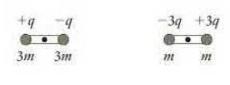
Each dipole in Figure P23.20 is free to rotate about an axis that is perpendicular to the plane of the page (represented by the dot in the center of each dipole). The dipoles are initially held fixed in a horizontal line as shown but are then released and begin rotating. What is their most likely
Suppose two plates lie in parallel horizontal planes, one plate in the \(x y\) plane at \(z=0\) and the other plate in the plane that is parallel to the \(x y\) plane at \(z=10 \mathrm{~mm}\). Between the plates is a constant electric field directed vertically upward (that is, in the positive \(z\)
Two uniformly charged pellets A and B are held some distance from each other, and then the charge on \(\mathrm{A}\) is doubled. Which of the following statements is most correct? (a) The magnitude of the electric force exerted on \(\mathrm{A}\) is doubled because the electric field at the position
What is the magnitude of the electric field \(200 \mathrm{~mm}\) away from a particle carrying \(3.0 \mu \mathrm{C}\) of charge?
A small, charged, spherical object at the origin of a Cartesian coordinate system contains \(3.30 \times 10^{4}\) more electrons than protons. What are the magnitude and direction of the electric field at the position \((2.00 \mathrm{~mm}, 1. 00 \mathrm{~mm})\) ?
Two protons A and B are separated by a distance \(d=9.00 \mu \mathrm{m}\). What are the magnitude and direction of the electric field along the line connecting the protons (a) halfway between them and (b) a distance \(d / 4\) away from \(\mathrm{A}\) and \(3 d / 4\) away from \(\mathrm{B}\) ?
A positively charged particle initially at rest on the ground accelerates upward to \(100 \mathrm{~m} / \mathrm{s}\) in \(2.00 \mathrm{~s}\). If the particle has a charge-to-mass ratio of \(0.100 \mathrm{C} / \mathrm{kg}\) and the electric field in this region is constant and uniform, what are the
A proton is located in the \(x y\) plane at \((4.00 \mathrm{~mm}, 3. 00\) \(\mathrm{mm}\) ) and experiences an electric force exerted by a particle at the origin carrying a positive charge of \(6.95 \mu \mathrm{C}\). (a) Determine the magnitude and direction of the electric force exerted on the
A particle at the origin of a Cartesian coordinate system carries a charge of \(3.89 \times 10^{-9} \mathrm{C}\). What are the magnitude and direction of the electric field at \((a)(4.00 \mathrm{~mm}, 0)\),(b) \((0,4.00 \mathrm{~mm})\), and(c) \((-2.829 \mathrm{~mm}, 2. 829 \mathrm{~mm})\) ?
(a) Plot the value of the radial component of the electric field due to a positively charged pellet as a function of distance from the pellet center. (b) Repeat for a negatively charged pellet. Take each pellet to be a uniformly charged nonconducting sphere having a radius of \(18.5 \mathrm{~mm}\)
An electron initially placed \(0.10 \mathrm{~m}\) to the right of a small charged sphere moves to the right with an inirial acceleration of \(4.0 \times 10^{7} \mathrm{~m} / \mathrm{s}^{2}\). What is the magnitude of the charge on the sphere? (Ignore gravity.)
A small sphere carrying \(6.0 \mathrm{nC}\) of charge is placed \(100 \mathrm{~mm}\) from a small sphere carrying \(3.0 \mathrm{nC}\) of charge. Assume the spheres are tiny relative to the \(100-\mathrm{mm}\) separation distance. At what position on the line joining the spheres is the electric
Two beads, one carrying charge \(+q\) and the other carrying charge \(+4 q\), are separated by a distance \(d\) that is much greater than the radius of each bead. (a) Is there any location along the line between them where the electric field magnitude is zero? If so, what is that location in terms
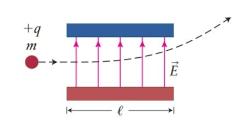
In an inkjet printer, tiny drops of ink of inertia \(m\) are given a charge \(q\) and then fired toward the paper at speed \(v\). They first pass between two charged plates of length \(\ell\) that create a uniform electric field of magnitude \(E\) between them (Figure P23.33). The field direction
(a) What electric field magnitude is needed to balance the gravitational force exerted by Earth on an electron near Earth's surface? \((b)\) Relative to the electron's position, where would you have to place a proton in order to create an equivalent electric force on the electron?
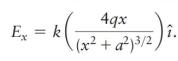
Consider a rectangle with diagonal length \(2 a\) in the \(y z\) plane with the origin at the center of the rectangle. Four beads, each carrying charge \(q\), are placed on the rectangle perimeter, one bead at each corner. Show that the electric field along the \(x\) axis is given by Ex=k 4qx (x +
A particle carrying a charge of \(6.0 \mu \mathrm{C}\) is located at the origin of a rectangular coordinate system, and a particle carrying a charge of \(4.0 \mu \mathrm{C}\) is located at \((0,5.0 \mathrm{~m})\). What are the magnitude and direction of the electric field at the positions (a) (5.0
Five charged particles are located around a semicircular arc of radius \(100 \mathrm{~mm}\), with one particle at each end of the semicircle and the remaining three spaced equally between the two ends. The semicircle lies in the region \(x
A positively charged particle 1 is at the origin of a Cartesian coordinate system, and there are no other charged objects nearby. You need the electric field magnitude at the position \((3.00 \mathrm{~nm}, 4. 00 \mathrm{~nm})\) to be zero, so that no electric force is exerted on any charged object
Three particles carrying equal positive charge \(q\) are located at the corners of an equilateral triangle with side length \(a\). What are the magnitude and direction of the electric field \((a)\) at the center of the triangle, \((b)\) at the midpoint of any side of the triangle, and \((c)\) a
Two nonconducting spheres 1 and 2 carry the same charge, and the magnitude of the electric force exerted by each sphere on the other is \(0.10 \mathrm{~N}\) when they are \(50 \mathrm{~mm}\) apart. (a) What is the magnitude of the charge on each sphere, assuming each has a diameter much smaller
A particle carrying a charge of \(-5.0 \mu \mathrm{C}\) is located at the origin of a rectangular coordinate system, and a particle carrying a charge of \(12.0 \mu \mathrm{C}\) is located at \((1.0 \mathrm{~m}, 0. 50 \mathrm{~m})\). Determine the coordinates of the position at which E=0 .
In table salt-sodium chloride, \(\mathrm{NaCl}-\) the \(\mathrm{Na}^{+}\)and \(\mathrm{Cl}^{-}\) ions are arranged in a cubic crystal structure. You can observe in this structure a cube made up of eight ions: four \(\mathrm{Na}^{+}\)and four \(\mathrm{Cl}^{-}\)in alternating corners. Each
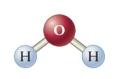
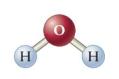
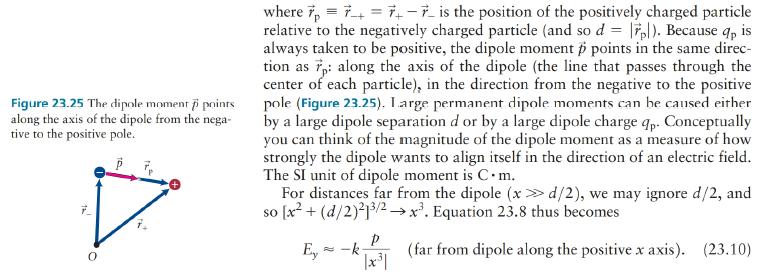
A water molecule (Figure P23.43) has a dipole moment of \(6.19 \times 10^{-30} \mathrm{C} \cdot \mathrm{m}\). If the \(\mathrm{O}-\mathrm{H}\) bonds were ionic bonds (in reality they are polar covalent bonds), the electrons from the two hydrogen atoms would be completely transferred to the oxygen
Two plastic bowling balls, 1 and 2 , are rubbed with cloth until they each carry a uniformly distributed charge of magnitude \(0.10 \mathrm{nC}\). Ball 1 is negatively charged, and ball 2 is positively charged. If the balls are held apart by a \(600-\mathrm{mm}\) stick stuck through the holes so
As Figure P23.43 shows, the water molecule is bent, and the angle formed by the three atoms is \(104.5^{\circ}\). Given that the permanent dipole moment of the molecule is \(6.186 \times 10^{-30} \mathrm{C} \cdot \mathrm{m}\), determine the dipole moment of each \(\mathrm{O}-\mathrm{H}\) bond.Data
A proton located several proton diameters away from a small charged object carrying charge \(q\) is subject to an electric field of magnitude \(E\). As the proton moves a distance \(d\) along the \(x\) axis away from the object, the electric field magnitude drops to \(E / 4\). If the charged object
A dipole consisting of a proton and an electron held a distance \(d\) apart is aligned along a \(z\) axis. A second proton is then placed at the midpoint of the line joining the electron and proton of the dipole. What is the ratio of the electric field magnitude at \((0,0,10 d)\) to the electric
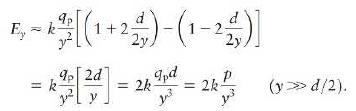
Equation 23. 12,\[E_{y}=k \frac{q_{\mathrm{p}}}{y^{2}}\left[\left(1-\frac{d}{2 y}\right)^{-2}-\left(1+\frac{d}{2 y}\right)^{-2}\right]\]was derived for the case \(y>d / 2\). Fxplain why this equation holds for the case \(y
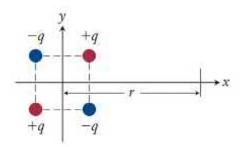
An electric quadrupole can be constructed by placing four charged objects at the corners of a square (Figure P23.49). The objects are identical except for the charge they carry: The two objects in one diagonally opposed pair each carry charge \(+q\), and the other two objects carry charge \(-q\).
A dipole is centered at the origin of a coordinate system, and a small charged sphere is some distance away along the perpendicular bisector of the dipole. The particle carries a uniformly distributed charge of \(-3.0 \mathrm{nC}\), and experiences a \(200 \mathrm{nN}\) electric force in the
Two thin plastic rods, each of length \(\ell\), are joined end to end. One rod is positively charged with a uniform linear charge density \(\lambda\), and the other carries a negative charge density \(-\lambda\). What is the effective dipole moment of the rod?
An electric dipole that has dipole separation \(d\) is aligned along the \(y\) axis of an \(x y\) coordinate system, pointed in the positive \(y\) direction. (a) Show that for \(x\) and \(y\) much greater than \(d\), the \(x\) and \(y\) components of the electric field of the dipole are given
You've been given the task of charging a spherical weather balloon made of a conducting material, and you want to put as much charge on it as possible. An experienced colleague advises you that the air surrounding the balloon becomes conducting when the electric field at the balloon surface reaches
A positively charged particle is released from rest along the axis of symmetry of a fixed ring carrying a uniformly distributed negative charge. Describe the motion of the particle.
A uniformly charged rod lies along the \(z\) axis of an \(x y z\) coordinate system, from \(z=-100 \mathrm{~mm}\) to \(z=+100 \mathrm{~mm}\). The linear charge density on the rod is \(100 \mathrm{nC} / \mathrm{m}\). What is the vector expression for the electric field at \((40 \mathrm{~mm}, 30
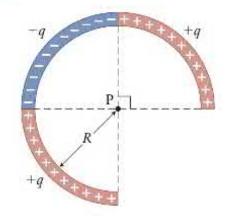
In the uniform charge distribution shown in Figure P23.56, each of the three arcs forms one-fourth of the circumference of a ring. The upper right and lower left arcs each carry a positive charge \(q\), while the upper left arc carries a charge \(-q\). Determine the electric field at
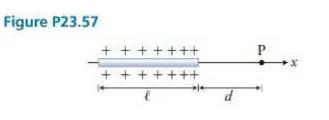
The thin glass rod of length \(\ell\) in Figure P23.57 has a linear charge density that starts out as zero at the left end of the rod and increases linearly from left to right. The positive charge on the rod is \(q_{\text {rod }}\).(a) What is the electric field along the rod's axis at position P,
You have two disks, 1 and 2 , both of radius \(R=25.0 \mathrm{~mm}\) and both made of the same nonconducting material. Disk 1 carries a uniformly distributed charge \(q_{1}=1.50 \mu \mathrm{C}\), and the uniformly distributed charge \(q_{2}\) on disk 2 is unknown. You place disk 1 at \(z_{1}=0\)
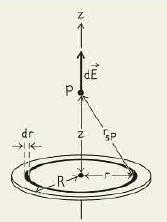
What percentage error in the electric field magnitude do you introduce by approximating the charged disk of Figure 23. 29 as an infinite charged sheet with the same surface charge density for (a) z=0.1 R,(b) z=0.5 R, and(c) z=R ?Data from Figure P23.29 dr. K N < P R- dE
You wish to determine the electric field magnitude along the perpendicular bisector of a \(250-\mathrm{mm}\) line along which \(30 \mathrm{nC}\) of charge is distributed uniformly. You want to get by with a minimal amount of work, so you need to know when it is sufficient to approximate the line of
For a uniformly charged disk of radius \(90 \mathrm{~mm}\), you wish to determine the electric field magnitude along the axis that runs through the disk center and perpendicular to the disk face. You want to get by with a minimal amount of work, so you need to know when you can get by with
Three narrow concentric rings of radii \(50 \mathrm{~mm}, 70 \mathrm{~mm}\), and \(90 \mathrm{~mm}\) are centered about the origin, with the axis of symmetry of each ring oriented along the \(y\) axis. The charge on the inner ring is \(1.0 \mu \mathrm{C}\), that on the middle ring is \(-2.0 \mu
Two large oppositely and uniformly charged parallel plates are separated by \(10 \mathrm{~mm}\). An electron is projected halfway between the plates and parallel to them with an initial speed of \(4.0 \times 10^{6} \mathrm{~m} / \mathrm{s}\). The electron hits the top plate a horizontal distance of
A particle of inertia \(m\) that carries charge \(q\) is held above an infinite sheet on which the surface charge density is \(\sigma\). The charge on the sheet is of the same type as the charge on the particle. The particle is then released from rest. (a) Describe its motion. (b) What is its
A uniformly charged thin rod lies along the \(x\) axis from \(x=0\) to \(x=+\infty\). (a) Derive an expression for the component \(E_{y}\) of the electric field in the positive \(y\) direction, and (b) show that the electric field at all positions on this axis makes an angle of \(135^{\circ}\) with
One half of a charged thin ring of radius \(R\) carries a charge \(q_{1}\) uniformly distributed over it, and the other half of the ring carries a charge \(q_{2}\) uniformly distributed over it. For any position along the axis of symmetry of the ring, derive an expression for (a) the component of
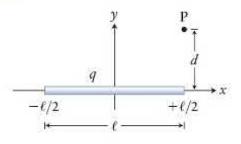
In Figure P23.67, determine the \(x\) and \(y\) components of the electric field at position \(\mathrm{P}\), which is a distance \(d\) above onc end of a rod of length \(\ell\) carrying uniformly distributed charge \(q\).Data from Figure P23.67 -8/2 9 d +1/2 x +
A thin rod of length \(2 \ell\) has a linear charge density that is \(\lambda_{0}\) at the left end but decreases linearly with distance going from left to right in such a way that the charge on the entire rod is zero. (a) What is the magnitude of the electric field along the rod's axis at a
You place \(2.2 \mu \mathrm{C}\) of charge along a long nonconducting rod. The rod extends from \(x=0\) farther than you can see along the positive \(x\) axis. The charge distribution has the form of a decreasing exponential: \(q(x)=q_{0} e^{-x / \ell}\), where \(\ell=28.6 \mathrm{~mm}\). Calculate
The water molecule is a permanent dipole with a dipole moment of \(6.186 \times 10^{30} \mathrm{C} \cdot \mathrm{m}\). If a single water molecule were oriented such that its dipole moment is along the \(z\) axis, what torque is caused on it by the electric force due to an \(8500-\mathrm{N} /
A microwave oven, which fills the oven chamber with oscillating electric fields, works well at heating food that has a high water content. However, it does not work well with frozen food or with food that has a high oil content but low water content. Can you think of a reason for this? (Water
The electric force due to a uniform external electric field causes a torque of magnitude \(10.0 \times 10^{-9} \mathrm{~N} \cdot \mathrm{m}\) on an electric dipole oriented at \(30^{\circ}\) from the direction of the external field. The dipole moment of the dipole is \(8.0 \times 10^{-12}
A dipole is to be released in a region where there is a uniform electric field and no dissipative forces. Describe the motion of the dipole if it is released from rest in an orientation \((a)\) parallel to the electric field and \((b)\) almost perpendicular to the electric field.
A small object with dipole moment \(p\) is released near its equilibrium orientation in a uniform electric field of magnitude \(E\). The rotational inertia of the dipole is \(I\). (a) What is the effective torsional constant \(\kappa\) of this simple harmonic system? (b) Calculate the angular
A dipole that is free to move is placed near a fixed dipole, with the midpoint of the free dipole on the perpendicular bisector of the fixed dipole. The distance from the free dipole to the fixed one is much greater than the dipole separation \(d\) of the fixed dipole. Draw a diagram to illustrate
In a particular region of space, an electric field has a constant direction but its magnitude increases smoothly along that direction. A dipole is placed in this field, its dipole moment is oriented perpendicular to the field, and it is released from rest. If no dissipative forces are present,
A particle carrying \(5.0 \times 10^{-7} \mathrm{C}\) of charge is located on the perpendicular bisector of a small dipole, \(300 \mathrm{~mm}\) from the center of the line joining the two poles of the dipole. The magnitude of the electric force exerted on the particle is \(10.0 \times 10^{-6}
There are two possible alignments of a dipole in an external electric field where the dipole is in equilibrium. (a) Draw a field diagram for a uniform electric field and show these two alignments. (b) Are both alignments stable? (Consider what would happen in each case if you gave the dipole a
In very rare cases, the polarizability of a molecule may be negative. (a) Draw a picture showing the resultant charge distribution when such a molecule is placed in the electric field surrounding a positively charged particle. (b) Describe the motion of the molecule that would result.
Two identical particles, each carrying charge \(q\), are a distance \(r\) apart. A dipole for which the dipole moment magnitude is \(p\) and the dipole separation is \(d
An electrically neutral molecule is collinear with (and located between) two charged particles, one carrying a charge of \(+3.56 \mu \mathrm{C}\) and the other carrying a charge of \(-1.05 \mu \mathrm{C}\). The center of the molecule is \(2.57 \mu \mathrm{m}\) from each particle. If the vector sum
Express the SI unit of electric field in terms of joules and other SI base units.
Four particles are located at the corners of a square that is \(50 \mathrm{~mm}\) on a side. All four particles carry a charge of magnitude \(3.0 \mathrm{nC}\), with positive charge at the lower left corner and negative charge at the other corners. Draw the electric field vectors at the center of
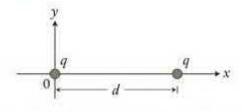
Each of the two particles in Figure P23.85 carries a charge of magnitude \(q\). Determine a position, if one exists, where the electric field magnitude is zero if the charge \((a)\) is of the same type on the two particles and (b) is positive on one particle and negative on the other.Data from
An electron is launched into a region of constant electric field, \(\vec{E}=2 \times 10^{4} \mathrm{~N} / \mathrm{C}\) directed along the positive \(y\) axis of a rectangular coordinate system, with an initial velocity of \(2.1 \times 10^{7} \mathrm{~m} / \mathrm{s}\) in the positive \(x\)
An electrically neutral, linear, polar molecule has positive charge equivalent to the charge on one proton centered \(0.30 \mathrm{~nm}\) from its center of mass and an equal quantity of negative charge centered \(0.10 \mathrm{~nm}\) from its center of mass (opposite the positive charge). The two
You have a pair of objects that interact with each other electrically. The objects initially are separated by a distance \(r\) and exert a force of magnitude \(F^{F}\) on each other. If the separation is increased to \(2 r\), calculate the new force magnitude between the objects if they are (a)
A particle carrying a charge of \(+32.0 \mathrm{nC}\) is located at \((10.0 \mathrm{~nm}, 95. 0 \mathrm{~nm})\), and a particle carrying a charge of \(+98.0 \mathrm{nC}\) is located at \((45.0 \mathrm{~nm}, 56. 0 \mathrm{~nm})\). Calculate the electric force exerted on a charged particle placed at
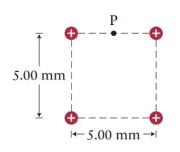
Figure P23.90 shows four charged particles, each having a charge equal to \(+3.00 \mu \mathrm{C}\), arranged in a square. What are the magnitude and direction of the electric field at \(\mathrm{P}\), located midway between the top two particles?Data from Figure P23.90 + P 5.00 mm + + -5.00 mm
A uniformly charged rod extends from \(y=-150 \mathrm{~mm}\) to \(y=+150 \mathrm{~mm}\) along the \(y\) axis of an \(x y\) coordinate system. The charge on the rod is \(30 \mathrm{nC}\). (a) With the goal of eventually calculating the electric field magnitude along the rod's perpendicular bisector,
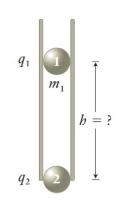
A small sphere 1 carrying charge \(q_{1}\) and having inertia \(m_{1}\) is constrained to moving inside a narrow vertical tube (Figure P23.92). Fixed at the bottom of the tube is a small sphere 2 carrying charge \(q_{2}\). (a) Determine the equilibrium height \(b\) for sphere 1 (ignore
Your boss is designing a new data storage system that will have a lot of dipoles very close to one another. They will point in the \(z\) direction and be closely spaced in the \(x\) and \(y\) directions. The data reader will detect \(E_{z}\) as it passes some small distance above the sheet of
You are designing a new guidance mechanism for an inkjet printer. You believe that a circular arc of charge, mounted in the \(x y\) plane, is needed in order to deflect the ink droplets most efficiently from their original path along the \(z\) axis. You want to use a uniformly charged arc of arc
A rod of length \(\pi R\) is composed of three nonconducting segments of equal length. The middle segment is electrically neutral, and each end segment carries a uniformly distributed negative charge \(-q\). The rod is bent into a semicircle of radius \(R\). Determine the magnitude of the electric
Draw a field line diagram for an infinite plate that carries a uniform positive charge distribution inside the plate.
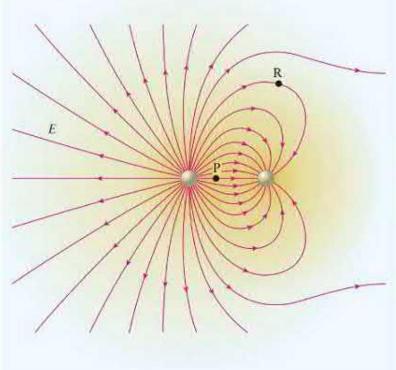
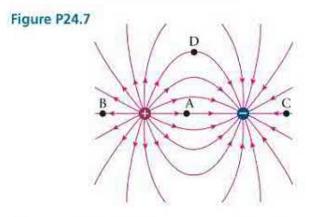
Consider the field line diagram shown in Figure 24.7. (a) What are the signs of the charges on the two small spherical objects? (b) What are the relative magnitudes of these charges? (c) What is the ratio of the magnitudes of the electric fields at points \(\mathrm{P}\) and \(\mathrm{R}\) ? (d) Is
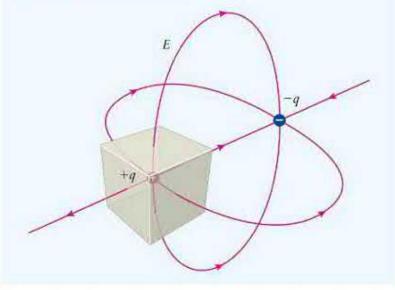
Consider the three-dimensional dipole field line diagram shown in Figure 24.10. Six field lines emanate from the positively charged end, and six terminate on the negatively charged end.(a) What is the field line flux through the surface of the cube that encloses the positively charged end shown in
An electrically neutral, conducting sphere contains an irregularly shaped cavity. Inside the cavity is a particle carrying a positive charge \(+q\). What are the sign and magnitude of the charge on the sphere's outer surface?
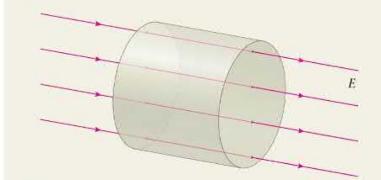
Consider a cylindrical Gaussian surface of radius \(r\) and length \(\ell\) in a uniform electric field \(\vec{E}\), with the length axis of the cylinder parallel to the electric field (Figure 24.24). What is the electric flux \(\Phi_{E}\) through this Gaussian surface?Data from Figure 24.24 E
Consider a charged sphere of radius \(R\) carrying a positive charge \(q\) that is uniformly distributed over the volume of the sphere. What is the magnitude of the electric field a radial distance \(r
What is the electric field magnitude a radial distance \(r\) from the central length axis of an infinitely long thin rod carrying a positive charge per unit length \(\lambda\) ?
What is the electric field a distance \(d\) from a thin, infinite nonconducting sheet with a uniform positive surface charge density \(\sigma\) ?
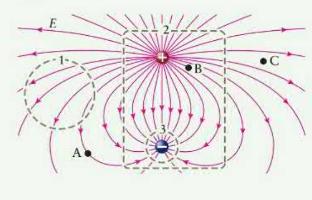
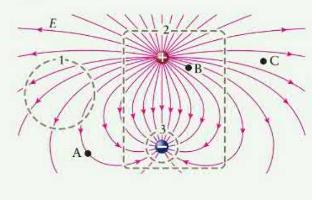
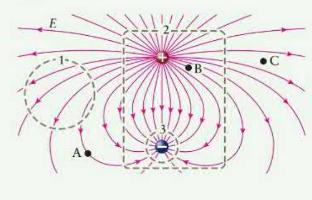
In Figure 24. 19, which of the two charged spheres carries a charge of greater magnitude?Data from Figure 24. 19 E A B C
Consider Gaussian surfaces 1-3 in Figure 24. 19. Determine the field line flux through each surface (considering just the two dimensions shown).Data from Figure 24. 19 E A B C
In Figure 24. 19 , is the field line density greater at point A or point B? At which of these locations is the magnitude of the electric field greater? Is the field line density at point C zero or nonzero?Data from Figure 24. 19 E A B C
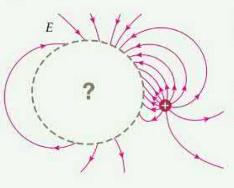
The electric field lines in Figure 24. 20 tell you there must be one or more charged particles inside the Gaussian surface defined by the dashed line. Could the electric field shown be due to a single particle inside the Gaussian surface? What must the signs and relative magnitudes of the charged
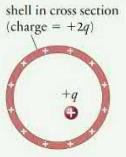
Figure 24. 21 shows a small ball that carries a charge of \(+q\) inside a conducting metal shell that carries a charge of \(+2 q\).(a) What are the sign and magnitude of the charge on the inner surface of the shell? \((b)\) What are the sign and magnitude of the charge on the outer surface of the
Suppose a charged particle is located at the origin. What is the direction of the electric field at the point \((0.6,1.2)\) if the particle is \((a)\) positively charged and \((b)\) negatively charged?
Because of the presence of positively charged ions in Earth's atmosphere, on a calm day free electrons (that is, electrons not bound to atoms) just above Earth's surface generally experience a small upward electric force. Sketch the electric field lines near Earth's surface.
Can you draw an electric field line through a location in space where the electric field magnitude is zero?
You and a friend are asked to draw the two-dimensional electric field line partern for two charged objects located near each other. The charge on the first object is \(+2 q\) (with \(q\) positive), and the charge on the second object is \(-q\). You show 32 field lines emanating from the first
A positively charged test particle is released from rest in a uniform electric field. The only force experienced by the particle is the clectric force in that ficld. (a) Describe the trajectory the particle follows. (b) How does the trajectory change, if at all, if the particle is given an initial
A certain field line diagram illustrates the electric field due to three particles that carry charges \(5.0 \mu \mathrm{C},-3.0 \mu \mathrm{C}\), and \(-2.0 \mu \mathrm{C}\). If 20 field lines emanate from the positively charged particle, how many field lines terminate on each of the negatively
Figure \(\mathrm{P} 24. 7\) shows the electric field produced by an electric dipole. How would a positively charged test particle begin to move when released from rest \((a)\) at point \(A\), (b) at point \(\mathrm{B},(c)\) at point \(\mathrm{C}\), and \((d)\) at point D? Assume that no other
Two particles of charge \(+q\) are located at opposite ends of one diagonal of a square, and two particles of charge \(-q\) are located at opposite ends of the square's other diagonal. Sketch the pattern of electric field lines created, showing eight lines per particle in the plane that contains
Assume that a test particle is released from rest in an electric field and experiences no forces other than the electric force exerted by that electric field. Does an electric field line passing through the particle's initial position represent the particle's trajectory over time? If not,
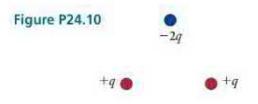
Draw several field lines surrounding the three charged particles shown in Figure P24.10.Data from Figure P24.10 Figure P24.10 +q -29 +q
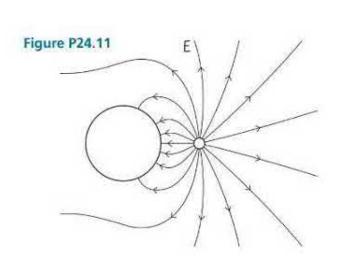
Two classmates sitting next to you have made an electric field diagram. You are looking at it (not during a test) to see if they did it correctly, but part of the diagram is covered by a quarter, as shown in Figure P24.11. If your classmates made the diagram correctly, what can you say about the
Outline an algorithm for a computer program that traces out the electric field lines surrounding a charged object. Assume that functions have already been provided to draw the charged object itself and to draw line segments between pairs of points that your program chooses.
Showing 2100 - 2200
of 4962
First
15
16
17
18
19
20
21
22
23
24
25
26
27
28
29
Last
Step by Step Answers

 Get 50% OFF
Claim Now
Get 50% OFF
Claim Now