New Semester
Started
Get
50% OFF
Study Help!
--h --m --s
Claim Now
Question Answers
Textbooks
Find textbooks, questions and answers
Oops, something went wrong!
Change your search query and then try again
S
Books
FREE
Study Help
Expert Questions
Accounting
General Management
Mathematics
Finance
Organizational Behaviour
Law
Physics
Operating System
Management Leadership
Sociology
Programming
Marketing
Database
Computer Network
Economics
Textbooks Solutions
Accounting
Managerial Accounting
Management Leadership
Cost Accounting
Statistics
Business Law
Corporate Finance
Finance
Economics
Auditing
Tutors
Online Tutors
Find a Tutor
Hire a Tutor
Become a Tutor
AI Tutor
AI Study Planner
NEW
Sell Books
Search
Search
Sign In
Register
study help
physics
particle physics
Principles And Practice Of Physics 2nd Edition Eric Mazur - Solutions
A ball is shot straight up near the Earth's surface.(a) Can its velocity be zero while its acceleration is nonzero? \((b)\) Is the velocity of the ball the same at any two points, one of which is on the upward trajectory, and one of which is on the downward one?(c) Is the speed of the ball the
A sports car goes from zero to \(108 \mathrm{~km} / \mathrm{hr}\) in 3 seconds. (a) What is the acceleration of the car, assuming it is constant? (b) How far does it travel during this time period? \(\cdot\)
An electron is decelerated from \(4 \times 10^{6} \mathrm{~m} / \mathrm{s}\) to zero in \(6 \times 10^{-8}\) s.(a) Calculate the distance travelled by the electron in this interval.(b) Calculate the average acceleration.
Compare the acceleration of a car that goes from 0 to \(100 \mathrm{~km} / \mathrm{hr}\) in 3 seconds to that of a boulder falling freely near the surface of the Earth.
A driver starts a car starts from rest and accelerates to \(72 \mathrm{~km} / \mathrm{hr}\) in 10 seconds. He drives at this speed for another \(20 \mathrm{~s}\), and then slows to a stop over a distance of \(500 \mathrm{~m}\). (a) What is the acceleration of the car during the first and last legs
A ball was dropped from the top of the Eiffel Tower, \(300 \mathrm{~m}\) high.(a) Calculate the time taken by the ball to reach the ground \((b)\) What is the final speed of the ball when it hits the ground?
An object takes \(3 \mathrm{~s}\) to fall from the top of the building to the ground. Calculate what time will be required by the object to fall from the same height on Moon's surface \(\left(g_{\text {moon }}=1.625 \mathrm{~m} / \mathrm{s}^{2}\right)\) \(\cdot\)
A ball is thrown vertically up with a speed \(10 \mathrm{~m} / \mathrm{s}\), caught by a boy leaning out of a window in 4 seconds.(a) Calculate the height of the window from the ground \((b)\) What is the final speed of the ball before it is caught?
In a children's park, a boy uses a slide with inclination \(50^{\circ}\) with respect to the ground. Ignoring friction, calculate the magnitude of the acceleration of the boy.
A box slides from rest down a \(2-\mathrm{m}\) long \(20^{\circ}\) incline. How long does it take the box to reach the bottom of the incline? \(\cdot\)
The equation of motion of a particle on \(x y\) plane as a function of time is given byCompute the particle's acceleration as a function time at \(3 \mathrm{~s}\). Here, \(b=4.5 \mathrm{~m} / \mathrm{s}^{3}\). x=4bt+48t+20
The acceleration of a particle can be represented by the equation \(a(t)=t^{2}\). The particle begins accelerating from rest at \(t=0\).(a) What is its acceleration at \(t=2 \mathrm{~s}\) ?(b) What is the velocity at \(t=2 \mathrm{~s}\) ?(c) What is the average acceleration between \(t=0\) and
The equation of motion of a particle travelling along the \(x\)-axis is given aswhere \(b=0.4 \mathrm{~m} / \mathrm{s}^{3}, c=0.5 \mathrm{~m} / \mathrm{s}^{2}\) and \(d=50 \mathrm{~m} / \mathrm{s}\).(a) Calculate the particle's acceleration \(t=20 \mathrm{~s}\).(b) What is the distance travelled at
A bullet is fired directly upward and reaches a height of \(45 \mathrm{~m}\). (a) What is the muzzle speed of the gun? (b) How much time does it take the bullet to reach its maximum height? \(\cdot\)\(\cdot\)
A scout wants to determine the depth of a dark well. She drops a pebble and hears a splash 5 seconds later. If the speed of sound in air is \(343 \mathrm{~m} / \mathrm{s},\) (a) how long does it take the pebble to reach the water?(b) How deep is the well?
A rocket is fired vertically up at an average acceleration of \(2 \mathrm{~m} / \mathrm{s}^{2}\). Taking \(t=0\) at lift-off, \(\) (a) what is the velocity of the rocket at \(t=1 \mathrm{~min}\) ?(b) What is its velocity at \(t=2\) \(\min\) ?(c) What is the altitude after 30 seconds?
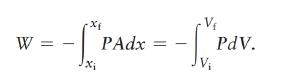
When the volume of a gas increases, is the work done by the gas on its surroundings positive, negative, or zero?
A thermally insulated chamber fitted with a piston as its bottom surface contains an ideal gas. The piston slowly moves upward and compresses the gas into a smaller volume. Draw an energy diagram for this process, taking the gas as your system.
State whether each process is quasistatic, adiabatic, both, or neither for the defined system: (a) Water boils in a pot. System: water, (b) A balloon filled with air is slowly compressed and cooled. System: balloon and air. (c) An initially sealed vial of air is opened in an air-filled room that is
A sample that contains \(5.60 \times 10^{21}\) particles of a monatomic ideal gas expands adiabatically and quasistatically from \(1.00 \mathrm{~L}\) to \(2.00 \mathrm{~L}\). If the initial gas pressure is \(30.5 \mathrm{kPa}\), what is the final temperature of the gas?
You are designing an engine that contains several pistons that each move \(150 \mathrm{~mm}\) per stroke. You believe the engine may consume less energy than a traditional engine if many of the processes in the engine are reversible. The gas is a mixture of several substances, but the particles
While converting a list of Kelvin temperatures to degrees Fahrenheit and degrees Celsius, you notice that one temperature on the Kelvin scale has the same numerical value on both the Fahrenheit and Celsius scales. What is this Kelvin temperature?
Express the difference between the boiling and freezing points of water in \((a)\) kelvins, \((b)\) degrees Celsius, and (c) degrees Fahrenheit.
Liquid nitrogen at atmospheric pressure boils at \(-196^{\circ} \mathrm{C}\). What is this temperature on the Kelvin scale?
Describe how an ideal gas thermometer is constructed and how it measures temperature.
When a certain ideal gas thermometer is placed in water at the triple point, the mercury level in the right arm is \(986 \mathrm{~mm}\) above the reference mark. How far is the mercury level above the reference mark when this thermometer is placed in boiling water at a location where the
When a certain ideal gas thermometer is dipped in water boiling at atmospheric pressure, the mercury level in the right \(\mathrm{arm}\) is \(1279 \mathrm{~mm}\) above the reference mark. When the thermometer is removed from the water and allowed to reach room temperature, the mercury level drops
When a certain ideal gas thermometer is immersed in a water-ice mixture at \(273.15 \mathrm{~K}\), the mercury level in the right arm is \(102 \mathrm{~mm}\) above the reference mark. When this thermometer is then immersed in a liquid of unknown temperature, the mercury level is \(29 \mathrm{~mm}\)
An engineer planning a weld from manufacturer specifications realizes that the units for temperature have been accidentally omitted. The specifications say, "The temperature of the weld should be no lower than \(95 \%\) of 1960 but can be safely welded at a much higher temperature." The engineer is
For an environmental study, you need to collect temperature data for a year in a North American desert, where the temperature ranges from \(255 \mathrm{~K}\) in winter to \(320 \mathrm{~K}\) in summer. You have a single thermal sensor that can be calibrated in degrees Celsius or degrees Fahrenheit,
How much energy is required to heat \(100 \mathrm{~L}\) of water from \(20^{\circ} \mathrm{C}\) to \(55^{\circ} \mathrm{C}\) ?
To make yourself some coffee, you put one cup of water \((236 \mathrm{~g})\) in a small pot on the stove. What quantity of energy must be transferred thermally to the water to raise its temperature from \(20^{\circ} \mathrm{C}\) to \(100^{\circ} \mathrm{C}\) ? (Ignore the mass of the pot.)
According to the Can Manufacturers Institute, the energy used to make an aluminum can from recycled aluminum is \(5 \%\) of the energy used to make an aluminum can from virgin ore. In a typical year, 1. 7 billion pounds of aluminum cans are recycled. How much energy is thermally transferred to get
Three diatomic molecules from different gas samplesone at \(3 \mathrm{~K}\), one at \(298 \mathrm{~K}\), and one at \(1000 \mathrm{~K}\)-are in thermal equilibrium with their respective surroundings. (a) Rank the molecules according to heat capacity per molecule at constant volume, highest first.
A swimming pool has a length of \(50.0 \mathrm{~m}\), a width of \(35.0 \mathrm{~m}\), and an average depth of \(2.00 \mathrm{~m}\).(a) How much energy is required to raise the temperature of the water in this pool by \(1.00^{\circ} \mathrm{C}\) ? \((b)\) If this energy were used to lift a truck,
A \(3.50-\mathrm{kg}\) block of iron initially at \(8.00 \times 10^{2} \mathrm{~K}\) is placed on top of a \(6.25 \mathrm{~kg}\) block of copper initially at \(4.00 \times 10^{2} \mathrm{~K}\). How much energy is transferred thermally from the iron to the copper as the two blocks come to thermal
Devil's Throat, the longest drop in Iguazu Falls on the Brazil-Argentina border, has a height of \(82 \mathrm{~m}\). If all the kinetic energy a given volume of water acquires in dropping through Devil's Throat could go into heating the water, how much would the water temperature rise?
You pour \(5.0 \mathrm{~L}\) of water at \(20^{\circ} \mathrm{C}\) into a large pot to make spaghetti. If the heating element on your stove is rated at \(1250 \mathrm{~W}\), how many minutes does it take for the water to start boiling? Ignore any energy thermally transferred to the environment.
A helium atom is in a nanowire (a wire with a diameter on the scale of molecules) in thermal equilibrium at \(77 \mathrm{~K}\). (a) The atom is constrained in the nanowire and so can move in only one dimension, along the wire length. What is the atom's thermal energy? (b) The atom is boiled off the
A diatomic molecule in thermal cquilibrium at \(120 \mathrm{~K}\) is constrained to move freely only on a two-dimensional surface. (a) What is the molecule's thermal energy? (b) The molecule is boiled off the surface and allowed to float freely in a gas at thermal equilibrium at \(298
A cryogenic substance is found to have a specific heat capacity \(c\) that varies with temperature according to \(c=\beta T^{2}\), where \(\beta\) is an empirically derived constant with units \(\mathrm{J} / \mathrm{K}^{3} \cdot \mathrm{kg}\). If \(231 \mathrm{~J}\) of energy must be transferred
An ideal gas expands adiabatically and quasistatically in a chamber fitted with a piston. Is this process isothermal, isentropic, isobaric, isochoric, or none of these?
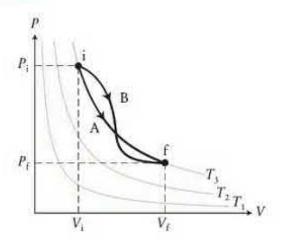
Figure P20.27 shows two processes, A and B, carried out on an ideal gas. In which process was the amount of work done by the gas greater?Data from Figure P20.27 P B T, TTV
Figure \(P 20. 28\) is the \(P V\) diagram for a process carried out on \(10 \mathrm{~mol}\) of an ideal gas in thermal equilibrium that begins and ends on the same state (the initial state \(i\) and the final state \(\mathrm{f}\) for the gas are at 1). (a) Characterize each leg of the process \(-1
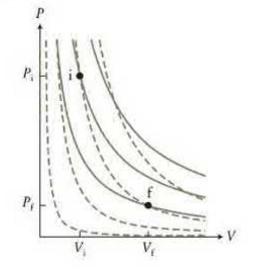
The curves in Figure P20.29 are isochors, isobars, isotherms, or isentropes. If a system is taken from initial state i to final state \(\mathrm{f}\), with \(V_{\mathrm{i}}=0.15 \mathrm{~m}^{3}\) and \(P_{\mathrm{f}}=1.00 \mathrm{~atm}\), what is the change in the entropy of the system?Data from
A \(0.300-\mathrm{kg}\) sample of nitrogen gas (diatomic molecules, \(m_{\mathrm{N}_{2}}=4.652 \times 10^{-26} \mathrm{~kg}\) ) in a chamber fitted with a piston undergoes an isothermal expansion from \(0.0500 \mathrm{~m}^{3}\) to \(0.150 \mathrm{~m}^{3}\). If the final pressure is \(150
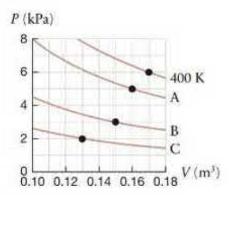
Figure \(P 20. 31\) shows four isotherms on the \(P V\) diagram for an ideal gas. What are the temperatures of isotherms \(\mathrm{A}, \mathrm{B}\), and \(\mathrm{C}\) ?Data from Figure P20.31 P (kPa) 8 9 4 400 K A B 2 C 0 V (m) 0.10 0.12 0.14 0.16 0.18"
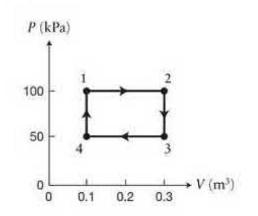
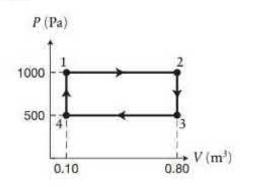
An ideal gas undergoes the process represented in Figure \(\mathrm{P} 20. 32\), where the gas is in state 1 when the process begins and again in state 1 at the finish. (a) Determine the work done by the gas during each of the four legs\(1 \rightarrow 2,2 \rightarrow 3,3 \rightarrow 4,4 \rightarrow
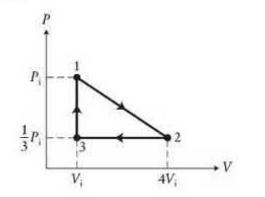
An ideal gas undergoes the process represented by the \(P V\) diagram of Figure P20.33, where the gas is in state 1 when the process begins and again in state 1 at the end of the process. Calculate the work done on the gas as a function of the initial pressure and volume.Data from Figure P20.33 P P
If \(1.00 \mathrm{~mol}\) of an ideal monatomic gas initially at \(72 \mathrm{~K}\) absorbs \(100 \mathrm{~J}\) of thermal energy, what is the final temperature? Assume the volume does not change.
An ideal gas is inside a cylinder fitted with a piston of cross-sectional area \(0.10 \mathrm{~m}^{2}\), and initially the gas pressure is \(5.0 \times 10^{4} \mathrm{~Pa}\). A quantity \(Q=5.0 \mathrm{~kJ}\) of thermal energy is transferred slowly to the gas while the piston moves \(0.10
What is the thermal energy associated with \(5.6 \times 10^{18}\) nitrogen molecules, \(\mathrm{N}_{2}\), at \(100^{\circ} \mathrm{F}\) ? Assume the nitrogen can be treated as an ideal gas.
In a cylindrical chamber fitted with a piston, the piston compresses \(10.0 \mathrm{~mol}\) of ideal gas from \(1.00 \mathrm{~m}^{3}\) to \(0.100 \mathrm{~m}^{3}\) at a constant temperature of \(300 \mathrm{~K}\). Suppose this compression was done by placing a \(100-\mathrm{kg}\) block on top of
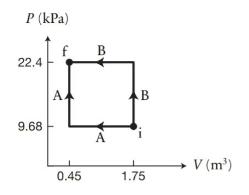
Figure P20.38 shows two processes, A and B, for moving \(3.45 \times 10^{22}\) particles of a monatomic ideal gas from state \(\mathrm{i}\) to state \(\mathrm{f}\). (a) Which process requires less work done on the gas? (b) Which process requires a smaller quantity \(Q\) of energy transferred
A \(1.00-\mathrm{mol}\) sample of an ideal diatomic gas in which the gas particles both translate and rotate is initially at \(600 \mathrm{~K}\). Energy is then added thermally to the sample until its temperature is \(1000 \mathrm{~K}\). At this temperature, the particles also vibrate. The sample
You have a sample that contains \(9.70 \times 10^{21}\) particles of an unknown gas in a chamber that has a volume of \(0.0100 \mathrm{~m}^{3}\). The initial pressure in the chamber is \(1.84 \times 10^{4} \mathrm{~Pa}\), and you determine that \(378 \mathrm{~J}\) of energy must be added to the
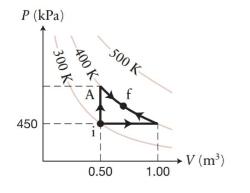
The \(P V\) diagram in Figure P20.41 shows two processes for taking an ideal gas from an initial state i to a final state \(\mathrm{f}\). How much work is done on the gas in the isochoric leg labeled A?Data from Figure P20.41 P (kPa) 500 K 300 K 400 K 450 V (m) 0.50 1.00
You park your car in the sun with the windows rolled up, and the interior temperature rises from \(35^{\circ} \mathrm{C}\) at \(100 \mathrm{kPa}\) to \(48^{\circ} \mathrm{C}\). The interior volume of your car is roughly \(1.5 \mathrm{~m} \times 2. 0 \mathrm{~m} \times 1. 0 \mathrm{~m}\). (a) What
Your one-story house has a floor area of \(2.0 \times 10^{2} \mathrm{~m}^{2}\) and 3. 0-m-high ceilings.(a) On a hot day, you leave home with all the windows closed and the air-conditioning on. A power failure causes the air-conditioning to stop, and by the time you return home, the quantity of
Steam at \(120^{\circ} \mathrm{C}\) and \(101.3 \mathrm{kPa}\) is added to a hollow steel can that is then sealed and allowed to cool. (a) What is the pressure inside the can at \(101^{\circ} \mathrm{C}\) ? \((b)\) The can is \(0.20 \mathrm{~m}\) tall and \(0.10 \mathrm{~m}\) in diameter. What is
A sample of helium gas is allowed to expand in a process that is adiabatic and quasistatic. As the gas cools from \(105^{\circ} \mathrm{C}\) to \(101^{\circ} \mathrm{C}\), it does \(9.05 \mathrm{~J}\) of work on a piston. How many helium atoms are there in the sample?
A 2. 00-L sample of an ideal gas initially at 1. 00 atm and \(273 \mathrm{~K}\) undergoes an isobaric process that cools the sample to \(265 \mathrm{~K}\). (a) What is the final pressure in the gas? (b) What is the final volume of the gas?
A cylinder fitted with a piston contains \(1.00 \mathrm{~mol}\) of air at room temperature, \(20.0^{\circ} \mathrm{C}\). The air is slowly compressed by the piston while the temperature is kept constant. What is the work done on the air if the final volume is one-third the initial volume?
A chamber fitted with a piston can be controlled to keep the pressure in the chamber constant as the piston moves up and down to increase or decrease the chamber volume. If the chamber contains an ideal gas at \(296 \mathrm{~K}\) and \(1.00 \mathrm{~atm}\), what is the work done on the gas as the
Your lab mate is measuring the heat capacity ratio of an unknown diatomic gas at room temperature and standard atmospheric pressure. She obtains values for \(C_{P}\) and \(C_{V}\) and tells you the ratio is \(6 / 9\). Give the reason you need to check your lab mate's work.
A spherical air bubble in a lake expands as it rises slowly to the surface. At the point it starts to rise, the pressure is \(2.00 \mathrm{~atm}\), the temperature of the water is \(10.0^{\circ} \mathrm{C}\), and the radius of the bubble is \(5.00 \times 10^{-3} \mathrm{~m}\). At the surface, the
A chamber fitted with a piston contains \(1.00 \mathrm{~mol}\) of an ideal gas. (a) The piston is slowly moved to decrease the chamber volume while the gas temperature is held constant at \(296 \mathrm{~K}\). How much work is done by the gas if the final chamber volume is one-third the initial
To change the volume of a gas isothermally by a factor \(f_{1}\) of its initial value, it is necessary to do work \(W_{1}\) on the gas. What work \(W_{2}\) is needed to change the volume by a factor \(f_{2}\) of the initial gas volume at the same temperature? Express your answer in terms of
An ideal gas initially at volume \(V_{1}\), pressure \(P_{1}\), and temperature \(T_{1}\) undergoes an isobaric process that changes its temperature to \(T_{2}\). The gas immediately undergoes an isothermal process that changes its volume to \(V_{3}\). What is the final pressure in the gas in terms
At temperature \(T\), a balloon is partly inflated with an ideal gas to a volume of \(1.0 \mathrm{~L}\). The balloon is then put in a low-pressure container at the same temperature \(T\) and its volume is increased to \(2.0 \mathrm{~L}\). If \(26 \mathrm{~J}\) of work was done by the gas to
A 1. 00-mol sample of an ideal gas expands such that its entropy doubles to \(1.345 \times 10^{24}\). The temperature is held constant at \(100 \mathrm{~K}\) during the expansion. (a) How much work is done by the gas on its surroundings? (b) What quantity \(Q\) of energy is transferred thermally to
A \(0.320-\mathrm{kg}\) piston seals a chamber that contains \(7.55 \times 10^{24}\) helium atoms initially at \(2.00^{\circ} \mathrm{C}\). The piston is free to move vertically, but it is originally held fixed in place with the chamber volume at \(0.250 \mathrm{~m}^{3}\). When the piston is
The ideal gas law is valid for a gas when, among other things, any interactions between particles are ignored. A more realistic model was proposed by Johannes Diderik van der Waals in 1873 , for which he received a Nobel Prize in 1910. The van der Waals equation of state is\[\left(P+\frac{a
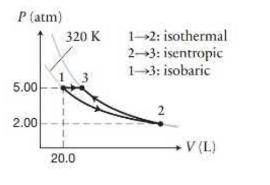
A sample of diatomic ideal gas \((\gamma=1.4)\) initially has a volume of \(20.0 \mathrm{~L}\) and is at \(5.00 \mathrm{~atm}\) and \(320 \mathrm{~K}\). The gas undergoes the process shown in Figure P20.58. First it expands isothermally \((1 \rightarrow 2)\) until the pressure is \(2.00
A sample of nitrogen gas \((\gamma=1.4)\) initially has a volume of \(0.61 \mathrm{~m}^{3}\) and a pressure of \(1.00 \mathrm{~atm}\). If the sample expands isentropically to a volume of \(1.00 \mathrm{~m}^{3}\), what is the final pressure?
A sample of an ideal gas for which \(\gamma=\frac{7}{5}\) initially has a volume of \(1.00 \mathrm{~L}\) and a pressure of \(100 \mathrm{~Pa}\). If the gas expands isentropically to \(1.20 \mathrm{~L}\), what is the final pressure?
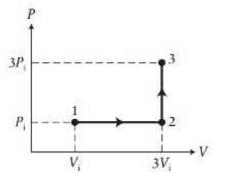
Figure \(P 20. 61\) shows the \(P V\) diagram for a monatomic ideal gas undergoing an isobaric expansion \(1 \rightarrow 2\) followed by an isochoric pressure increase \(2 \rightarrow 3\). If the sample contains \(N\) gas particles, what is the net change in entropy?Data from Figure P20.61 3P P P
An ideal gas for which \(\gamma=1.4\) initially has a volume of \(1.5 \mathrm{~m}^{3}\) and a pressure of \(15 \mathrm{MPa}\). The gas is then slowly compressed isentropically to a volume of \(0.50 \mathrm{~m}^{3}\). (a) What is the final pressure in the gas? (b) By how much did the entropy of the
A \(\frac{1}{3}\)-mol sample of an ideal gas is sealed in a container and heated from \(273 \mathrm{~K}\) to \(500 \mathrm{~K}\). For this gas, what is the value of \(C_{P}\) in units of \(k_{B}\) if the temperature increase causes an entropy change of \(1.8215 \times 10^{23}\) ?
Two identical thermally insulated spherical tanks, A and B, are connected by a valve. Initially tank A contains \(10 \mathrm{~mol}\) of an ideal diatomic gas, tank B is evacuated, and the valve is closed. If the valve is opened and the gas expands isothermally from \(\mathrm{A}\) to \(\mathrm{B}\),
As part of a physics experiment, air under high pressure is allowed to expand isentropically out of a metal can and into an empty plastic bag. When the expansion is complete, the bag and contents are at atmospheric pressure. The air inside the can is initially at \(5.0 \mathrm{~atm}\) and
A gas is inside a cylinder fitted with a piston. The gas and its surroundings are both at \(20^{\circ} \mathrm{C}\), and the gas is compressed as the piston moves and decreases the cylinder volume. The compression takes place slowly enough to allow the gas temperature to stay at \(20^{\circ}
An ideal gas that initially has a volume of \(1.00 \mathrm{~mL}\) and is at \(1.00 \mathrm{~atm}\) expands isentropically to \(10.0 \mathrm{~mL}\) and \(0.0215 \mathrm{~atm}\). (a) How many degrees of freedom do the gas particles have? (b) What does this tell you about the structure of the
A chamber fitted with a piston contains \(1.00 \mathrm{~mol}\) of a monatomic ideal gas that is taken from an initial state i to a final state \(f\) via states 1 and 2 . The chamber volume is initially \(V_{i}=0.100 \mathrm{~m}^{3}\), and the temperature is \(T_{i}=273{ }^{\circ} \mathrm{C}\). To
An ideal monatomic gas expands isentropically from an initial pressure \(P_{\mathrm{i}}\) and initial volume \(V_{\mathrm{i}}\) to a final pressure \(P_{\mathrm{t}}=P_{\mathrm{i}} / 20\) and final volume \(V_{\mathrm{t}}=6 V_{\mathrm{i}}\). What is the work done by the gas, expressed in terms of
A thermodynamic process raises the temperature of \(1.00 \mathrm{~mol}\) of water from \(59.0^{\circ} \mathrm{C}\) to \(61.0^{\circ} \mathrm{C}\). What is the change in thermal energy of the water?
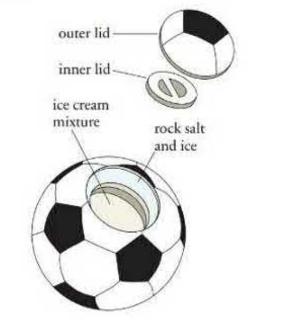
An ice cream maker is in the form of a soccer ball (Figure P20.71). You fill the inner container with a mixture of cream and sugar at \(32.0^{\circ} \mathrm{C}\) and add rock salt and ice to the sleeve encircling the inner container. You then put both lids on and kick the ice cream maker around
\(2.00 \times 10^{4} \mathrm{~J}\) of energy is transferred thermally into a huge tank filled with liquid water. The water temperature remains constant at \(10.0^{\circ} \mathrm{C}\) during the process. By how much does the entropy of the water change?
An iceberg initially at \(273 \mathrm{~K}\) is stopped in its motion by a small island. During the first few seconds of contact, \(10 \mathrm{~kJ}\) of energy is transferred thermally from the island to the iceberg without the temperature of either object changing significantly. If the island
The average normal temperature of the human body is \(98.6^{\circ} \mathrm{F}\). What is this temperature on the Celsius scale?
Which are the most likely units for a measured temperature with a numerical value of \((a)-322\) and (b) 0 ?
An ideal gas undergoes an isentropic process that changes its pressure from \(P_{i}\) to \(P_{f}\) and its volume from \(V_{\mathrm{i}}\) to \(V_{t}\). What is the work done on the gas?
A 22.7-g sample of diatomic oxygen gas molecules is in a sealed rigid container that has a volume of \(0.0240 \mathrm{~m}^{3}\). If the gas is initially at \(-1.50^{\circ} \mathrm{C}\), by how much does the pressure in the container change when the gas is cooled to \(-23.00^{\circ} \mathrm{C}\) ?
It is somerimes said, erroneously, that biological organisms violate the second law of thermodynamics because the biochemical reactions they carry out reduce their entropy by converting incoherent raw materials to coherent substances. To show that this is not so, consider your body at
Two identical samples of a monatomic ideal gas start out at the triple point of water. Sample A is heated isochorically to five times its original temperature. Sample B is compressed isentropically and quasistatically to one-fifth of its original volume. In which process is the quantity of energy
You are working in a factory that uses water in its cooling systems and consequently has a lot of steam reservoirs. Due to carclessness, a \(70.0-\mathrm{kg}\) metal plate has been left on top of the only steam vent for a certain steam reservoir, and as a result the pressure in the reservoir builds
You are the founder of a start-up company that extracts electrical energy from ocean waves, a process called WaveGen. Your basic technology is a tube anchored vertically to the ocean floor. The unit is installed close to shore so that the bottom is anchored to the seabed and the top is above the
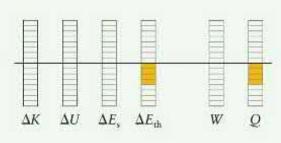
Figure 20. 26 shows the energy changes for a certain system over a short time interval. Describe what is happening to the system. From the diagram, what can you conclude about the temperature of the environment at the beginning of the time interval?Data from Figure 20. 26 AK AU , W Q
On a really hot day, which temperature scale \(\left({ }^{\circ} \mathrm{F}\right.\) or \(\left.{ }^{\circ} \mathrm{C}\right)\) registers the greater number? On a really cold day, which temperature scale registers the smaller number? At what temperature do the two scales register the same number?
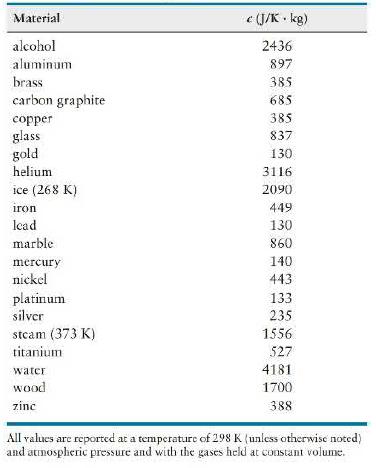
Which material in Table 20. 2 has the greatest specific heat capacity? The smallest? Imagine that objects made of these materials are placed on your hand. The objects have the same mass and are initially at the same temperature. Each object equilibrates thermally with your hand, which is at a
Showing 2500 - 2600
of 4962
First
19
20
21
22
23
24
25
26
27
28
29
30
31
32
33
Last
Step by Step Answers

 Get 50% OFF
Claim Now
Get 50% OFF
Claim Now