New Semester
Started
Get
50% OFF
Study Help!
--h --m --s
Claim Now
Question Answers
Textbooks
Find textbooks, questions and answers
Oops, something went wrong!
Change your search query and then try again
S
Books
FREE
Study Help
Expert Questions
Accounting
General Management
Mathematics
Finance
Organizational Behaviour
Law
Physics
Operating System
Management Leadership
Sociology
Programming
Marketing
Database
Computer Network
Economics
Textbooks Solutions
Accounting
Managerial Accounting
Management Leadership
Cost Accounting
Statistics
Business Law
Corporate Finance
Finance
Economics
Auditing
Tutors
Online Tutors
Find a Tutor
Hire a Tutor
Become a Tutor
AI Tutor
AI Study Planner
NEW
Sell Books
Search
Search
Sign In
Register
study help
physics
particle physics
Principles And Practice Of Physics 2nd Global Edition Eric Mazur - Solutions
There are many parallels between gravitational phenomena and electrical phenomena: One can think of a test object with mass in a gravitational field as analogous to a test object with positive charge in an electric field. (a) Draw the gravitational field line pattern for the EarthMoon system,
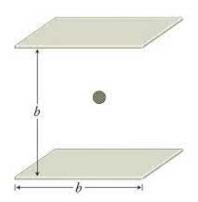
A small charged ball is suspended at the center of a spherical balloon that is nestled snugly inside a cubical cardboard box. On one side, the balloon touches the wall of the box. (a) At this point of contact, is the electric field magnitude on the balloon surface equal to the electric field
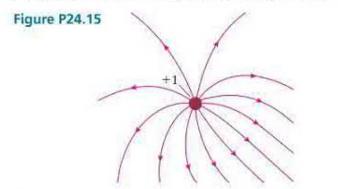
Where in Figure P24.15 other than around the point charge is the electric field greatest in magnitude?Data from Figure P24.15 Figure P24.15
Suppose a certain planar surface has 2000 field lines passing through each square meter, normal to the surface. How many field lines pass through each square meter if the surface is tilted by \(60^{\circ}\) ?
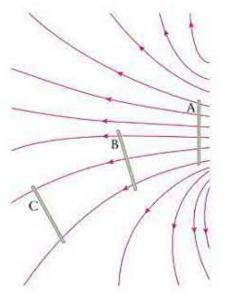
Consider the pattern of five field lines shown in Figure P24.17. Rank positions A, B, and C according to the magnitude of their electric fields, from greatest to smallest.Data from Figure P24.17 A B. C
Make a geometric argument, based on how the field lines spread out into space, that the magnitude of the electric field surrounding a long, straight, charged wire is proportional to \(1 / r\), where \(r\) is the radial distance from the long axis of the wire.
Make a geometric argument, based on the pattern of electric field lines, that the magnitude of the electric field surrounding a large, flat, charged metal plate is constant and independent of the distance \(d\) from the plate as long as \(d\) is small relative to the area of the plate.
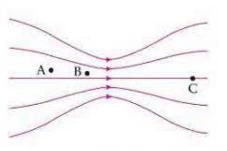
Figure P24.20 shows electric field lines due to a distribution of charge (not shown). The labeled regions of space are all equal in size. In which of the labeled regions, A, \(B\), and \(C\), is \((a)\) the electric field greatest and \((b)\) the electric field smallest?(c) How much greater is
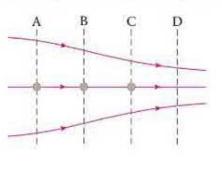
Identical charged pellets are released from rest from equidistant starting lines A, B, and C in Figure P24.21, in a region of nonuniform electric field. (a) Rank the pellets according to the time interval it takes the pellet on line \(\mathrm{A}\) to cross line B, the pellet on B to cross C, and
You decide to make an electric field line diagram in two dimensions, with 16 lines per coulomb of charge. (a) How many lines should you draw surrounding a particle that carries +1.5 C of charge? Should the lines enter or leave that particle? (b) Answer the same questions for a particle that carries
Two flat surfaces are near two different charged objects, and the surfaces are identical in size. Surface A has \(N\) field lines passing perpendicularly through it. Surface B has only \(N / 2\) field lines passing through it, and they pass through at an angle \(72^{\circ}\) from normal. Is the
Imagine a system that consists of only a single positively charged object. Is it possible to have in this system a closed surface that has a negative field line flux through it? (The charged object need not lie inside the surface.)
Closed surface \(A\) is a sphere of radius \(R\), closed surface \(B\) is a sphere of radius \(2 R\), and closed surface \(C\) is a cube with side length \(R\). At the geometric center of each closed surface is a small ball that is completely enclosed by the surface and carries electrical charge
Three charged pellets are arranged along a line. Three hypothetical closed surfaces are drawn around this set of three pellets. The three surfaces have identical cylindrical walls but different top caps (Figure P24.26). Rank the closed surfaces from smallest to greatest in terms of the electric
In Figure P24.27, assume that a Gaussian surface drawn to surround only sphere 1 would have an electric field line flux of +4 . Sketch Gaussian surfaces that contain sphere 1 plus one or more additional spheres and have field line fluxes of \((a)+24,(b)-4\), and \((c)+8\).Data from Figure P24.27 +q
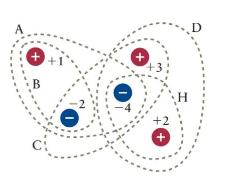
In the electric field line diagram for the charge arrangement shown in Figure P24.28, 12 field lines emanate from the object of charge \(+1 \mathrm{C}\). What is the field line flux through closed surfaces (a) A, (b) B, (c) C, (d) D, and (e) H?Data from Figure P24.28 A + + B -4 C D
In a certain field line diagram, a single electron is drawn that has four field lines terminating on it. If a closed surface in another part of this diagram is shown to have 16 field lines coming out of it, what can be said about the number of charge carriers inside the surface and the type of
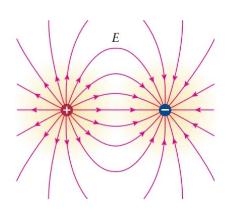
For the dipole in Figure P24.30, can you draw a twodimensional closed surface through which the field line flux is \((a)\) zero, \((b)+16,(c)-16\), and \((d)+3\) ?Data from Figure P24.30 E
Make an argument based on Gauss's law that a charged object cannot be held in stable translational equilibrium by electric fields alone. For a start, assume there is no other charged object in the region of interest even though the external electric field can be due to charged objects outside this
The chapter explains that the charge inside a closed surface is proportional to the flux through that surface. To illustrate why the surface must be closed, draw an example of a charge distribution and a surface for which the flux through the surface would be considerably altered if the surface had
(a) Can you draw a Gaussian surface that offers a simple way to compute the electric field surrounding a charged dipole? (b) If not, does this mean that the relationship between field line flux and enclosed charge and the relationship between field line density and magnitude of the electric field
An isolated system consists of one object carrying charge \(+q\) and one object carrying charge \(-q\). Are all the electric field lines for the system contained inside some boundary?
For a charged particle placed at the center of a spherical Gaussian surface, the field line flux through the surface is \(+\Phi\). Suppose that the spherical Gaussian surface is replaced by a cubical Gaussian surface composed of six square plates. Square plates are positioned above and below the
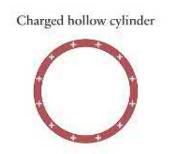
Figure P24.36 shows a cross section through an infinitely long, uniformly charged hollow cylinder. How does the magnitude of the electric field vary with the radial distance \(r\) from the cylinder's long central axis \((a)\) inside the hole in the cylinder and \((b)\) outside the cylinder?Data
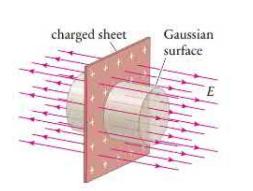
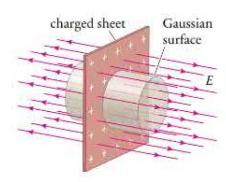
Figure P24.37 shows a cylindrical Gaussian surface straddling a charged sheet. Are there any other shapes that would be convenient for the Gaussian surface in this situation?Data from Figure P24.37 charged sheet Gaussian surface E
Suppose you want to determine the amount of charge on a spherical shell. You start out by surrounding the shell with a cylindrical Gaussian surface. Is it possible to use the flux everywhere on the surface of the cylinder to determine the charge on the spherical shell? Why isn't this recommended?
The magnitude of the electric field a distance \(R\) away from a particle carrying charge \(q\) is \(E_{0}\). Now consider this same quantity of charge \(q\) distributed uniformly throughout the volume of a nonconducting solid sphere of radius \(R\). What is the electric field magnitude, in terms
You are given a uniformly charged spherical shell that has a radius \(R\) and carries a positive charge \(q\). In order to measure the electric field magnitude inside, you drill a small hole that removes \(0.01 \%\) of the shell's material and insert a probe into the shell. What are the direction
You and your friend are working in a lab and wish to measure the surface charge density on a slab of metal. The slab is very long and very wide, but flat. You begin adding up the field line flux through a cylindrical Gaussian surface that passes through the slab as in Figure P24.37. Your friend
You have a hollow spherical shell of radius \(R\) that carries a positive charge. The shell is very thin. You make many Gaussian surfaces concentric with the shell to determine the electric field line density at various distances from the center. Qualitatively plot the electric field line density
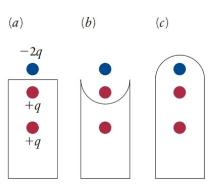
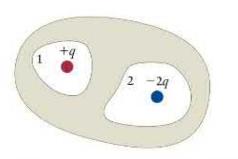
The two-cavity metal object in Figure P24.43 is electrically neutral, but each cavity contains a charged particle as shown. What are (a) the charge on the surface of each cavity and \((b)\) the charge on the outer surface of the object?Data from Figure P24.43 +9 1 2-29
Some charged particles are suspended inside a hollow metal object by supports made of a material that is an electrical insulator. The metal object has charge \(+q\) distributed over its outer surface and charge \(-2 q\) distributed over its inner surface.(a) How much charge is suspended in the
Delicate electronic devices are sometimes enclosed inside metal boxes to protect them from external electric fields. Explain what physical phenomena might cause this protection.
A coronal discharge occurs when the electric field magnitude just above the surface of a conductor exceeds approximately \(3 \times 10^{6} \mathrm{~N} / \mathrm{C}\), a magnitude strong enough to ionize atoms in the air by ripping electrons from them. Coronal discharge is most likely to occur near
Two concentric spherical metal shells are insulated from each other and from the surroundings. The inner shell carries a charge \(+2 q\), and the outer shell carries a charge \(-q\). In electrostatic equilibrium, what is the charge on(a) the outer surface of the inner shell,(b) the inner surface of
A small ball carrying a charge \(-2 q\) is placed at the center of a spherical metal shell that carries a charge \(+q\). What are the sign and magnitude of the charge \((a)\) on the inner surface of the shell and \((b)\) on the outer surface of the shell?(c) Do your answers change if the ball is
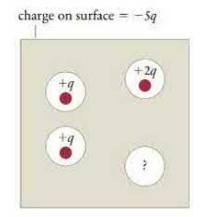
Figure P24.49 shows a neutral conducting block with four hollow chambers inside. A charge of \(-5 q\) has collected on the outer surface of the block. Inside three of the chambers are particles that carry charges \(+q,+q\), and \(+2 q\). Determine the charge inside the fourth chamber in terms of q
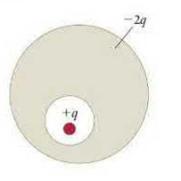
A pellet carrying charge \(+q\) is centered inside a spherical cavity that has been cut off-center in a solid metal sphere that carries charge \(-2 q\) (Figure P24.50). (a) How much charge resides on the inner surface of the cavity? Is this charge distributed uniformly or nonuniformly? (b) How much
A particle carries a charge of \(2 q\) and is located at the origin. The particle is surrounded by a conducting shell of inner radius \(R\) and thickness \(t\). The shell carries a charge of \(-3 q\). Determine \((a)\) the charge on the inner surface of the shell and \((b)\) the charge on the
Imagine a cubical Gaussian surface snugly surrounding a volleyball that is charged uniformly over its surface. The electric flux through one side of the cube is \(5.2 \times 10^{2} \mathrm{~N} \cdot \mathrm{m}^{2} / \mathrm{C}\). What is the charge on the volleyball?
A flat sheet that has an area of \(3.0 \mathrm{~m}^{2}\) is placed in a uniform electric field of magnitude \(10 \mathrm{~N} / \mathrm{C}\). While keeping the shect flat, can you orient it so that the electric flux through it is \(6 \mathrm{~N} \cdot \mathrm{m}^{2} / \mathrm{C}\) ? So that the flux
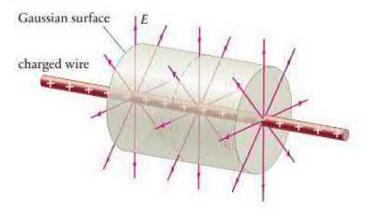
Figure P24.54 shows a cylindrical Gaussian surface enclosing a segment of a long charged wire. Consider using a spherical Gaussian surface to enclose the same segment of the wire. (a) Which surface, cylindrical or spherical, has the greater electric flux through it? (b) Which surface is more
A particle carries a charge of \(6.0 \mu \mathrm{C}\). Calculate the electric flux through a spherical Gaussian surface that is centered on the particle and has a radius of (a) 0. 04 m and(b) 0.08 m.
Use a symmetry argument to determine the electric flux through a Gaussian surface that encloses both charged particles that form an electric dipole. Does the value calculated for the flux depend on the shape of the surface?
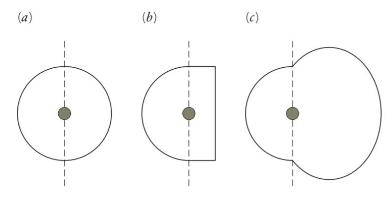
Figure P24.57 shows a charged particle surrounded by three different closed surfaces, \((a),(b)\), and \((c)\). In each case, the charge on the particle and the geometry of the left side (left of the dashed line) of the surface are identical. The closed surfaces have different geometries to the
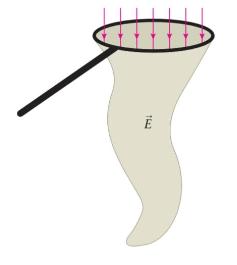
A butterfly net hangs from a circular loop of diameter \(400 \mathrm{~mm}\). You hold the loop horizontally in a region where the electric field is \(150 \mathrm{~N} / \mathrm{C}\) downward, as shown in Figure P24.58. (a) What is the electric flux through the net? (b) Does the flux through the net
A particle that carries an unknown amount of charge is placed at the center of a hollow metal sphere of inner radius \(R_{\mathrm{i}}\) and outer radius \(R_{0}\). The magnitude of the electric field outside the sphere at any radial distance \(r\) from the center is \(3 k q / r^{2}\) (with \(q>0\)
A small conducting ball that carries a charge of \(30.0 \mathrm{nC}\) is located at the center of an electrically neutral hollow conducting sphere of inner radius \(100 \mathrm{~mm}\) and outer radius \(150 \mathrm{~mm}\). What is the surface charge density \((a)\) on the sphere's inner surface and
A solid conducting sphere \(60 \mathrm{~mm}\) in radius carries a charge of \(5.0 \mathrm{nC}\). A thick conducting spherical shell of inner radius \(100 \mathrm{~mm}\) and outer radius \(120 \mathrm{~mm}\) carries a charge of \(-4.0 \mathrm{nC}\) and is concentric with the sphere. (a) Draw the
Three particles each carrying charge \(+q\) are located at the corners of an equilateral triangle of side length \(a\), and the triangle is centered on the origin of a Cartesian coordinate system. What is the electric flux through a spherical Gaussian surface centered at the origin if the radius of
A particular closed surface has four sides. The electric flux is \(+5.0 \mathrm{~N} \cdot \mathrm{m}^{2} / \mathrm{C}\) through side \(1,+8.0 \mathrm{~N} \cdot \mathrm{m}^{2} / \mathrm{C}\) through side 2 , and \(-9.0 \mathrm{~N} \cdot \mathrm{m}^{2} / \mathrm{C}\) through side 3. (a) If there is
A particular cylindrical Gaussian surface encloses no charge. If 20 electric field lines pass into the cylinder through one of the flat ends of the cylinder and 16 of these lines emerge from the other flat end, what can you conclude about the other 4 electric field lines?
Consider a rod of length \(\ell\) that carries a uniform charge distribution. Is Gauss's law practical for calculating the electric field at a radial distance \(r\) from the midpoint of the rod's length (a) when \(r \ll \ell,(b)\) when \(r=\ell\), and (c) when \(r \gg \ell\) ? For each case in
Any collection of \(N\) charged particles can be divided into \(N\) collections each containing one of the particles. Use the superposition property of electric fields to show that the electric flux through any Gaussian surface due to a collection of \(N\) charged particles is the sum of the fluxes
A horizontal rectangular sheet of length \(\ell\) and width \(w\) is positioned with its center a vertical distance \(w / 2\) below an infinitely long positively charged rod that has a uniform linear charge density \(\lambda\). (a) If the sides of length \(\ell\) are parallel to the rod's axis,
A cubical shell with edges of length \(a\) is positioned so that two adjacent sides of one face are coincident with the \(+x\) and \(+y\) axes of a rectangular coordinate system and the corner formed by these two sides is at the origin. (a) Sketch the electric field vectors in the region of the
A cubical Gaussian surface \(30 \mathrm{~mm}\) on each side is centered on a particle that carries a charge of \(+3.0 \mu \mathrm{C}\). (a) If you draw a field line diagram with four field lines per microcoulomb, how many lines pass through the Gaussian surface? In which direction are these lines?
There is a Gauss's law for gravity analogous to Gauss's law for electricity.(a) If the electric flux through a closed surface is proportional to the enclosed charge, what is the gravitational flux proportional to?\((b)\) Write an equation for Gauss's law for gravity.
A dipole that carries charges \(\pm q\) is aligned along the \(y\) axis of an \(x y z\) rectangular coordinate system, with the midpoint of the dipole at the origin. (a) Use Gauss's law to calculate the electric flux through the \(x z\) plane, which bisects the dipole and is perpendicular to the
A positively charged hollow sphere of radius \(+100 \mathrm{~mm}\) has a uniform surface charge density of \(10 \mathrm{nC} / \mathrm{m}^{2}\). Determine the electric field(a) 20 mm(b) 90 mm, and(c) 110 mm from the center of the sphere.
A positively charged solid sphere of radius \(100 \mathrm{~mm}\) has a uniform volume charge density of \(250 \mathrm{nC} / \mathrm{m}^{3}\). Determine the electric field(a) 20 mm,(b) 90 mm, and(c) 110 mm from the center of the sphere.
A positively charged thin cylindrical shell of length \(10 \mathrm{~m}\) and radius \(50 \mathrm{~mm}\) has no end caps and a uniform surface charge density of \(9 \times 10^{-9} \mathrm{C} / \mathrm{m}^{2}\).(a) What is the charge on the shell? Determine the electric field magnitude far from
An infinitely long positively charged cylindrical shell of radius \(a\) has a uniform linear charge density \(\lambda_{a}\). An infinitely long cylindrical shell of radius \(b>a\) is concentric with the first and has a uniform linear charge density \(\lambda_{b}\). (a) Determine \(\vec{E}\) in all
Two parallel vertical sheets of infinite extent carry surplus charge and are \(50 \mathrm{~mm}\) apart. Determine the magnitude and direction of the electric field in all regions of space (a) when each sheet has a uniform surface charge density \(\sigma=+3.0 \mathrm{nC} / \mathrm{m}^{2}\) (b)
A long, thin, positively charged wire runs along the long central axis of a hollow conducting cylinder of length \(10 \mathrm{~m}\), inner radius \(50 \mathrm{~mm}\), and outer radius \(70 \mathrm{~mm}\). The wire has a uniform linear charge density of \(+1.5 \mu \mathrm{C} / \mathrm{m}\), and the
A positively charged nonconducting hollow sphere of outer radius \(R\) and inner radius \(R / 2\) has a uniform volume charge density \(ho\). Determine the magnitude and direction of the electric field as a function of \(r\), the radial distance from the sphere center.
A positively charged nonconducting sphere of radius \(a\) has a uniform volume charge density \(ho_{0}\). It is snugly surrounded by a positively charged thick, nonconducting spherical shell of inner radius \(a\) and outer radius \(b\). This thick shell has a volume charge density \(ho_{0} r / a\)
An infinitely long nonconducting solid cylinder of radius \(R\) has a nonuniform but cylindrically symmetrical charge distribution. The volume charge density is given by \(ho(r)=c / r\), where \(c\) is a positive constant having units \(\mathrm{C} / \mathrm{m}^{2}\) and \(r\) is the radial distance
An infinitely long positively charged wire with a uniform linear charge density \(+\lambda\) is parallel to the \(y\) axis of a Cartesian coordinate system and passes through the \(x\) axis at \(x=-d\). At the origin, the electric field due to this charged wire has magnitude \(E_{0}\) and is
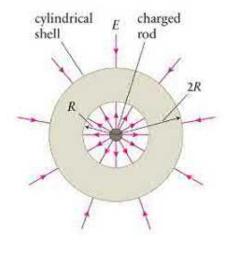
Figure P24.82 shows a cross section through a system that consists of an infinitely long charged rod centered in a thick cylindrical shell of inner radius \(R\) and outer radius \(2 R\). The shell is made of a conducting material; the rod is made of a nonconducting material and has a uniform linear
A positively charged solid nonconducting cylinder of length \(\ell=10 \mathrm{~m}\) and radius \(R=50 \mathrm{~mm}\) has uniform volume charge density \(+9.0 \times 10^{-9} \mathrm{C} / \mathrm{m}^{3}\).(a) What is the charge inside the cylinder? Avoiding the regions near the ends, determine the
Three nonconducting infinite sheets are parallel to the \(y z\) plane of an \(x y z\) coordinate system. Each sheet has a uniform surface charge density. Sheet 1 , negatively charged with surface charge density \(-\sigma\), passes through the \(x\) axis at \(x=1.0 \mathrm{~m}\). Sheet 2 has an
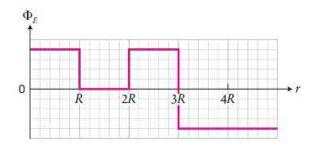
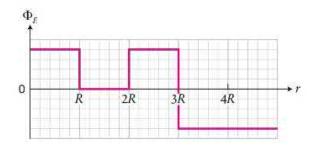
A particle that carries positive charge \(+q\) is located at the center of one or more concentric, thick or thin spherical shells. The shells are either made of a conducting material but are electrically neutral or made of a nonconducting material and have uniform surface charge densities. Figure
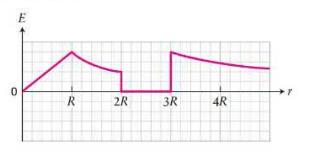
Can the graph in Figure P24.85 be produced by a system that consists of only charged particles? If not, explain why not. If so, describe the system that contains the minimum number of charged particles.Data from Figure P24.85 0 R 22 2R 3R 4R
At what minimal radius along the perpendicular bisector of a wire of length \(0.25 \mathrm{~m}\) carrying \(30 \mathrm{nC}\) of charge does the assumption of cylindrical symmetry in applying Gauss's law give an answer whose error exceeds \(5 \%\) ?
An infinitely long positively charged wire that carries a uniform linear charge density \(\lambda\) passes through the origin of an \(x y\) coordinate system and lies on the \(y\) axis. At the position \(x=d\) on the \(x\) axis, the electric field created by this wire has magnitude \(E\) and is
The origin of an \(x\) axis is placed at the center of a nonconducting solid sphere of radius \(R\) that carries a charge \(q_{\text {sphere }}\) distributed uniformly throughout its volume. A particle that carries an unknown charge \(q_{\text {part }}\) is located on the \(x\) axis at \(x=+2 R\).
A particle that carries charge \(+4 q\) is located at the origin of an \(x\) axis, and a uniformly charged nonconducting solid sphere of radius \(R\) and carrying charge \(+q\) is centered at \(x=+6 R\) on the \(x\) axis.(a) At what locations on the \(x\) axis is the electric field zero? \((b)\)
A positively charged nonconducting solid sphere of radius \(R\) has a nonuniform volume charge density given by \(ho_{0}\) for \(r \leq R / 2\) and given by \(2 ho_{0}(1-r / R)\) for \(R / 2 \leq r \leq R\), where \(r\) is the radial distance from the sphere center. (a) Determine the charge \(q\)
Can an electric field line have a kink in it?
Three particles each carrying charge \(+q\) are located at the corners of an equilateral triangle whose side length is \(a\). The triangle is centered on the origin of a Cartesian coordinate system. (a) Draw the electric field line diagram for this configuration of charge. What is the electric flux
A particle of charge \(q\) and mass \(m\) is placed above an infinite charged sheet for which the surface charge density is \(\sigma\). The sheet carries the same type of charge as the particle. What is the acceleration of the particle as a function of its distance \(d\) above the sheet?
Infinite positively charged sheet 1 has uniform surface charge density \(\sigma_{1}=+4.0 \mathrm{nC} / \mathrm{m}^{2}\) and is located in the \(y z\) plane of a Cartesian coordinate system. Infinite negatively charged sheet 2 is parallel to sheet 1 and has uniform surface charge density
A conducting, thick spherical shell of inner radius \(100 \mathrm{~mm}\) and outer radius \(120 \mathrm{~mm}\) has no net charge. A particle carrying a \(3.0-\mathrm{nC}\) charge is placed at its center. (a) Draw the electric field line diagram for the situation, marking the location of all charge
A system is composed of two infinitely long concentric cylinders, an outer cylinder \(\mathrm{O}\) and an inner cylinder I. Each is either conducting or nonconducting, and both have a uniform surface or volume charge density. Cylinder \(\mathrm{O}\) is a shell, and cylinder \(\mathrm{I}\) is either
Near Earth's surface, the electric field has a magnitude of \(150 \mathrm{~N} / \mathrm{C}\) and points downward. Treating Earth's surface as a conducting sphere, calculate the surface charge density necessary to produce this electric field.
An electron initially \(3.00 \mathrm{~m}\) from a nonconducting infinite sheet of uniformly distributed charge is fired toward the sheet. The electron has an initial speed of \(400 \mathrm{~m} / \mathrm{s}\) and travels along a line perpendicular to the sheet. When the electron has traveled \(2.00
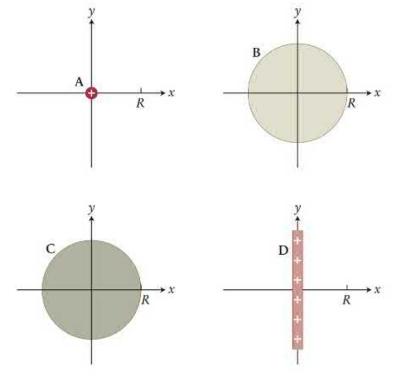
Figure P24.101 shows four charge distributions in an \(x y z\) coordinate system. A is a charged particle at the origin, \(\mathrm{B}\) is a charged conducting solid sphere of radius \(R\) centered at the origin, \(\mathrm{C}\) is a uniformly charged nonconducting solid sphere of radius \(R\)
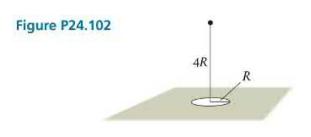
A positively charged nonconducting infinite sheet that has a uniform surface charge density \(\sigma\) lies in an \(x y\) plane. As shown in Figure P24.102, a circular region of radius \(R\) has been cut out of the sheet.(a) What is the electric field magnitude at the center of the circle? \((b)\)
A nonconducting positively charged slab 1 of thickness \(2 a\) has a nonuniform but symmetrical volume charge density \(ho_{0} x / a\). The sheet is centered, at \(x=0\), on the \(y z\) plane of a Cartesian coordinate system. (a) Determine the magnitude and direction of the electric field in all
A quantity of positive charge is distributed throughout the volume of a long nonconducting rod, which lies on the \(z\) axis and is centered at \(z=0\). The rod's radius \(R\) is much smaller than its length \(\ell\). For positions \(r \ll \ell\) and \(|z| \ll \ell\), calculate the electric fields
You are a crewmember on a space station orbiting Earth. To investigate some physics you remember from college, you drill a small hole all the way through a large solid nonconducting sphere of radius \(R\) that has a negative charge \(q_{s}\) evenly distributed throughout its volume, making sure the
You need to create a uniform electric field in a small region of space, and all you have to work with is one large styrofoam ball that carries a uniform volume charge distribution \(ho\). You cut the ball into two sections and scoop a hemispherical hole out of each section so that putting the
Electrical power lines are often not insulated, and the magnitude of the electric field of the surrounding air is about \(3 \times 10^{6} \mathrm{~N} / \mathrm{C}\). At greater electric field magnitudes, the air dissociates into charged particles, causing a breakdown and a big spark. You've been
An infinitely large positively charged nonconducting sheet 1 has uniform surface charge density \(\sigma_{1}=\) \(+130.0 \mathrm{nC} / \mathrm{m}^{2}\) and is located in the \(x z\) plane of a Cartesian coordinate system. An infinitely large positively charged nonconducting sheet 2 has uniform
A point \(\mathrm{P}\) is located at \(x_{\mathrm{p}}=2.0 \mathrm{~m}, y_{\mathrm{P}}=3.0 \mathrm{~m}\). What are the magnitude and direction of the electric field at \(\mathrm{P}\) due to a particle 1 carrying charge \(q_{1}=+10 \mu \mathrm{C}\) and located at \(x_{1}=1.0 \mathrm{~m}, y_{1}=0\)
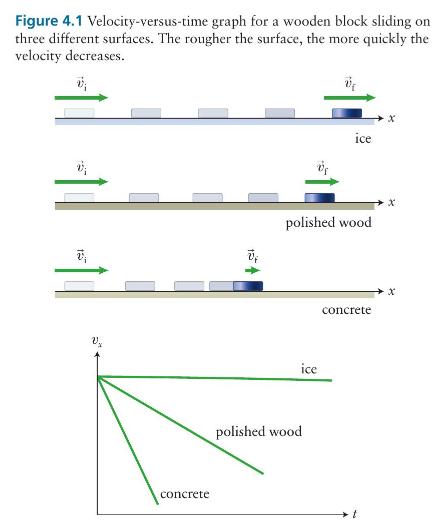
(a) Are the accelerations of the motions shown in Figure 4.1 constant?(b) For which surface is the acceleration largest in magnitude? Figure 4.1 Velocity-versus-time graph for a wooden block sliding on three different surfaces. The rougher the surface, the more quickly the velocity decreases. ;
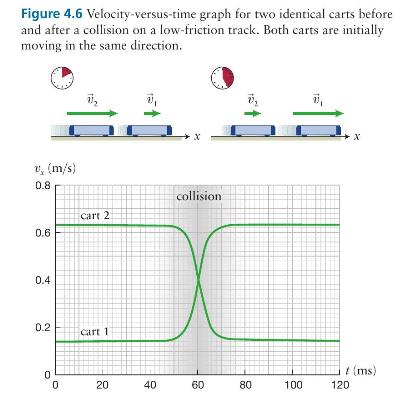
What is the change in velocity of \((a)\) cart 1 (b) cart 2 in Figure 4.6?(c) What do you notice about your two answers? Figure 4.6 Velocity-versus-time graph for two identical carts before and after a collision on a low-friction track. Both carts are initially moving in the same direction. v,
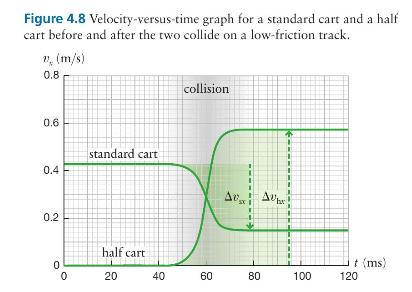
The \(x\) component of the final velocity of the standard cart in Figure 4.8 is positive. Can you make it negative by adjusting this cart's initial speed while still keeping the half cart initially at rest? Figure 4.8 Velocity-versus-time graph for a standard cart and a half cart before and after
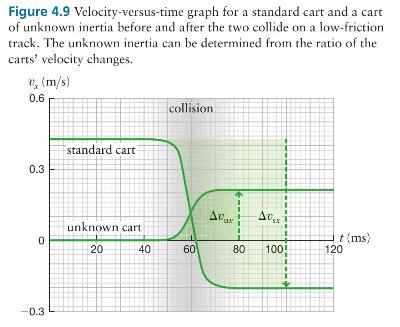
Verify that \(\left|\Delta v_{\mathrm{u} x}\right| /\left|\Delta v_{\mathrm{s} x}\right| \approx 1 / 3\) for the two carts in Figure 4.9. Figure 4.9 Velocity-versus-time graph for a standard cart and a cart of unknown inertia before and after the two collide on a low-friction track. The unknown
Showing 2200 - 2300
of 4962
First
16
17
18
19
20
21
22
23
24
25
26
27
28
29
30
Last
Step by Step Answers

 Get 50% OFF
Claim Now
Get 50% OFF
Claim Now