New Semester
Started
Get
50% OFF
Study Help!
--h --m --s
Claim Now
Question Answers
Textbooks
Find textbooks, questions and answers
Oops, something went wrong!
Change your search query and then try again
S
Books
FREE
Study Help
Expert Questions
Accounting
General Management
Mathematics
Finance
Organizational Behaviour
Law
Physics
Operating System
Management Leadership
Sociology
Programming
Marketing
Database
Computer Network
Economics
Textbooks Solutions
Accounting
Managerial Accounting
Management Leadership
Cost Accounting
Statistics
Business Law
Corporate Finance
Finance
Economics
Auditing
Tutors
Online Tutors
Find a Tutor
Hire a Tutor
Become a Tutor
AI Tutor
AI Study Planner
NEW
Sell Books
Search
Search
Sign In
Register
study help
physics
particle physics
Principles And Practice Of Physics 2nd Edition Eric Mazur - Solutions
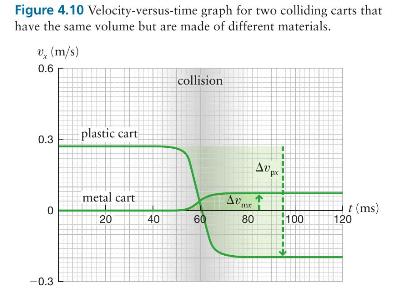
What is the ratio of the \(x\) components of the change in velocity for the plastic and metal carts, \(\Delta v_{\mathrm{p} x} / \Delta v_{\mathrm{m} x}\), in Figure 4.10? Figure 4.10 Velocity-versus-time graph for two colliding carts that have the same volume but are made of different materials.
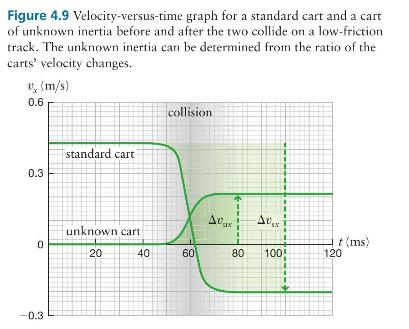
Is the inertia of the cart of unknown inertia in Figure 4.9 greater or less than that of the standard cart? Figure 4.9 Velocity-versus-time graph for a standard cart and a cart of unknown inertia before and after the two collide on a low-friction track. The unknown inertia can be determined from
Are the following quantities extensive or intensive: \((a)\) inertia, \((b)\) velocity, \((c)\) the product of inertia and velocity?
Which of these quantities is extensive?(a) money,(b) temperature,(c) humidity, \((d)\) volume.
In part \(a\) of Example 4.6, what are the directions of the changes in momentum, \(\Delta \vec{p}_{\mathrm{s}}\) and \(\Delta \vec{p}_{\mathrm{r}}\), of the two carts?Data from Example 4.6(a) A red cart with an initial speed of \(0.35 \mathrm{~m} / \mathrm{s}\) collides with a stationary standard
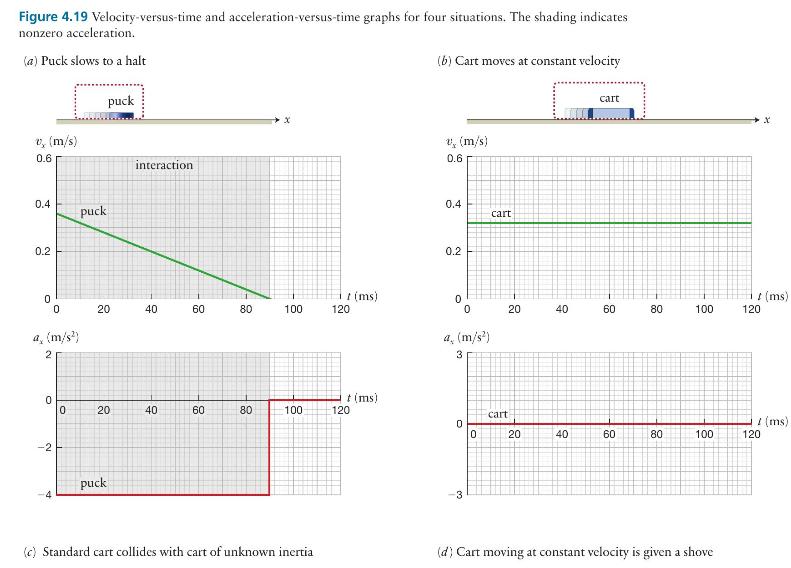
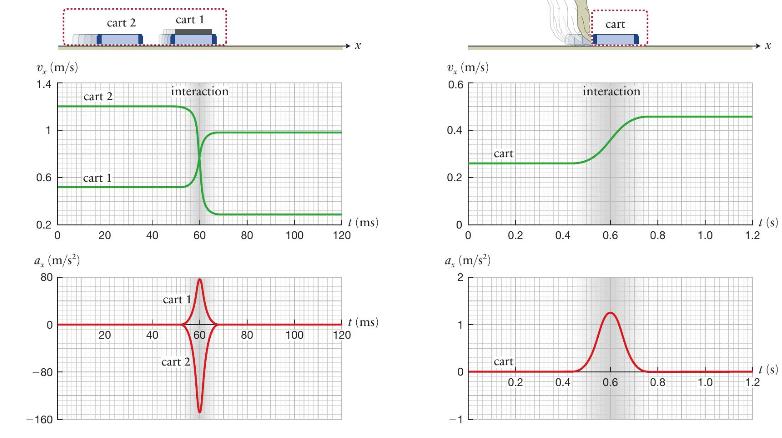
Is the change in the momentum \(\Delta \vec{p}\) zero or nonzero for the following choices of system over the 120-ms time interval in Figure 4.19:(a) puck in Figure 4.19a,(b) cart in Figure 4.19b,(c) cart 1 in Figure 4.19c,(d) both carts in Figure 4.19c,(e) cart in Figure 4.19d? Figure 4.19
Imagine sitting on a sled on the slippery surface of a frozen lake. To reposition yourself closer to the back of the sled, you push with your legs against the front end. (a) Do you constitute an isolated system? (b) How about you and the sled? Ignore the interaction between sled and ice.
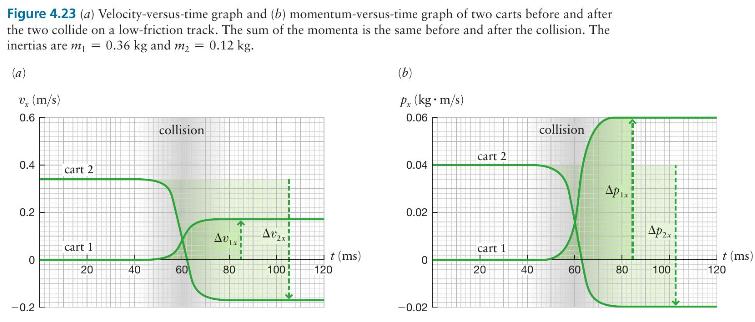
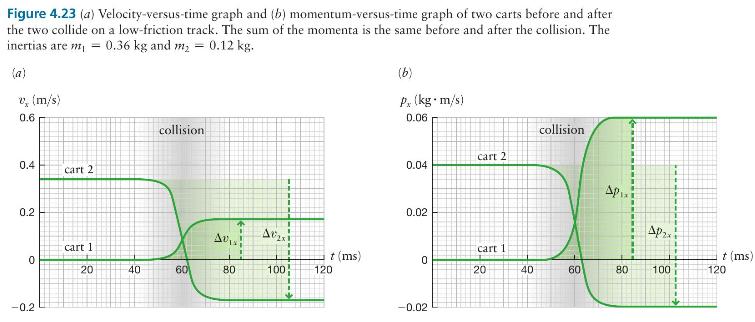
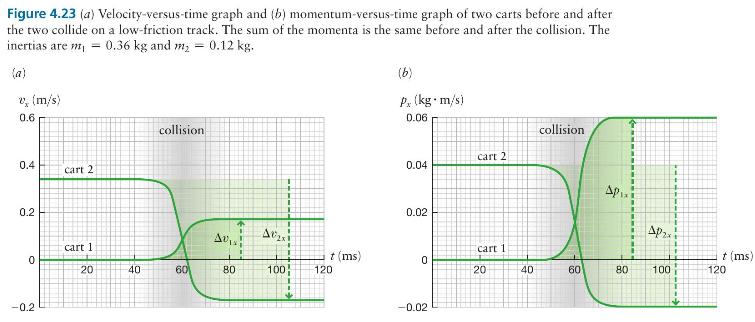
(a) How much momentum is transferred in the collisions in Figure 4.23?(b) Is this momentum transferred from cart 1 to cart 2 , or in the opposite direction? Figure 4.23 (a) Velocity-versus-time graph and (b) momentum-versus-time graph of two carts before and after the two collide on a low-friction
(a) What is the magnitude of the impulse delivered to cart 1 in Figure 4.23?(b) Write the impulse delivered to cart 1 in vector form.(c) Does the fact that the change in the momentum of cart 1 is nonzero mean that momentum is not conserved? Figure 4.23 (a) Velocity-versus-time graph and (b)
(a) Are the changes in velocity in Figure 4.23 a equal in magnitude? Why or why not?(b) Determine the velocity changes of the carts and verify that \(m_{1} / m_{2}=-\Delta v_{2 x} / \Delta v_{1 x}\) in Figure 4.23a.(c) Determine the initial and final momenta of the two carts.(d) What is the
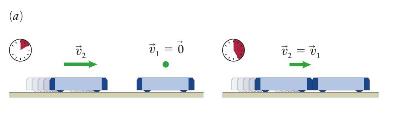
(a) Do the two carts in Figure 4.24 still constitute an isolated system like the carts in Figure 4.23?(b) What does your answer to part a imply about the momentum of the system comprising the two carts after the collision?Figure 4.24 (a)
A railroad car moves at speed \(v_{\mathrm{i}}\) on a track toward three other railroad cars at rest on the track. All the cars are identical, and each stationary car is some distance from the others. The moving car hits the first stationary car and locks onto it. Then the two hit the second
Two identical boxes A and B slide over the same rough floor. Box B stops over a distance twice as long as that needed for box A. Assuming a constant frictional force \(F\) acting in both cases, compare the initial velocities of the two boxes.
There are two 3-L bottles, one filled with water and the other filled with milk. Which one will have higher inertia?
A goldsmith used a \(500 \mathrm{~g}\) bar of gold and melted it and molded into a small statue of a Roman god. Comment on the change in the inertia of the gold before and after being molded.
During a flood-relief operation, two boxes having same inertia, one filled with polythene tent material and the other one filled with rice packets, are dropped from a helicopter. Which one will reach the ground fast?
The engine of a moving spaceship suddenly stopped working. What will happen to the motion of the space ship?
The boiling point of water on top of a mountain reduced to \(80^{\circ} \mathrm{C}\) compared to \(100^{\circ} \mathrm{C}\) at the sea level. Is the boiling point of water intensive or extensive?
A \(1.0-\mathrm{kg}\) cart is initially at rest on a low-friction track. It is hit by a \(3-\mathrm{kg}\) cart moving at \(0.2 \mathrm{~m} / \mathrm{s}\) to the left. After the collision, the \(3-\mathrm{kg}\) cart continues to move to the left at \(0.1 \mathrm{~m} / \mathrm{s}\). What is the
At what speed should a \(0.02-\mathrm{kg}\) bullet be shot to have the same momentum as a \(0.45-\mathrm{kg}\) soccer ball kicked at \(80 \mathrm{~km} / \mathrm{hr}\) by a professional player?
A \(2000-\mathrm{kg}\) car is moving at the same speed as a \(6000-\mathrm{kg}\) bus, as they go on adjacent lanes along the same level road. Both drivers apply their brakes, stopping over the same distance to avoid a red light. Which vehicle will have a bigger change in its momentum?
A 1-kg box is accidentally dropped from a third-floor window \(7.5 \mathrm{~m}\) above the ground. What is the change in its momentum as it strikes the muddy ground, coming to a complete stop?
A rifle fires a \(15-\mathrm{g}\) bullet at \(500 \mathrm{~m} / \mathrm{s}\) and recoils with a speed of \(2.5 \mathrm{~m} / \mathrm{s}\). What is the inertia of the rifle?
Robert Brown first discovered the random motion of pollen immersed in water through a microscope. When seen with naked eyes, everything seemed to be still, but, upon viewing through a microscope, the random motion of pollen grains was detected. Can you calculate the net momentum of the pollen
For our solar system, the planets with their moons revolve around the sun with different orbital periods. Even the sun is not static, and it revolves around a spot in the Milky Way galaxy in approximately 250 million years. In that scenario, do you consider our solar system to be an isolated system
A car moves with constant velocity on a regular road. Can you say the car is an example of an isolated system?
Two carts collide on a track. The initial momentum of cart 1 is \(+5 \mathrm{~kg} \cdot \mathrm{m} / \mathrm{s} \hat{\imath}\) and its final momentum is \(-3 \mathrm{~kg} \cdot \mathrm{m} / \mathrm{s} \hat{\imath}\). The initial momentum of cart 2 is \(-4 \mathrm{~kg} \cdot \mathrm{m} / \mathrm{s}
On an icy day, a driver swerves into the opposite lane and gets into a head-on collision with another car whose inertia is twice that of his. Both cars have the same speed when they hit and lock together. What fraction of their original speed do they have when moving together?
A \(1500-\mathrm{kg}\) car is being driven with the top open at \(30 \mathrm{~m} / \mathrm{s} \hat{\imath}\) when a 50 -g golf ball moving at \(-10 \mathrm{~m} / \mathrm{s} \hat{\imath}\) hits the cushioned seat and stops immediately. What is \((a)\) the car's momentum \((b)\) the ball's momentum
A \(20-\mathrm{kg}\) mail cart rolls on a smooth floor at \(5 \mathrm{~m} / \mathrm{s}\) when a \(2-\mathrm{kg}\) package drops from a shelf directly above and comes to rest in the cart. What is the change in the cart's speed?
The momentum ratio of a cannon grapeshot and rifle bullet is 3:100. If the mass of the grapeshot is \(5 \mathrm{~kg}\) and the mass of the bullet is \(0.05 \mathrm{~kg}\), find the relation between their velocities.
When a truck and a car both moving with same velocities collide head on, the car gets the maximum damage. Justify.
Two cars are moving along a highway with neither one accelerating. Is their relative speed equal to the difference between their speeds? Why or why not?
(a) An outfielder catches a baseball. Is the collision between ball and glove elastic, inelastic, or totally inelastic? (b) When a moving steel ball 1 collides head-on with a steel ball 2 at rest, ball 1 comes to rest and ball 2 moves away at the initial speed of ball 1 . Which type of collision is
Is kinetic energy an extensive quantity?
A moving cart collides with an identical cart initially at rest on a low-friction track, and the two lock together. What fraction of the initial kinetic energy of the system remains in this totally inelastic collision?
A piece of dough is thrown at a wall and sticks to it. Does the internal energy of the dough-wall system increase, decrease, or stay the same?
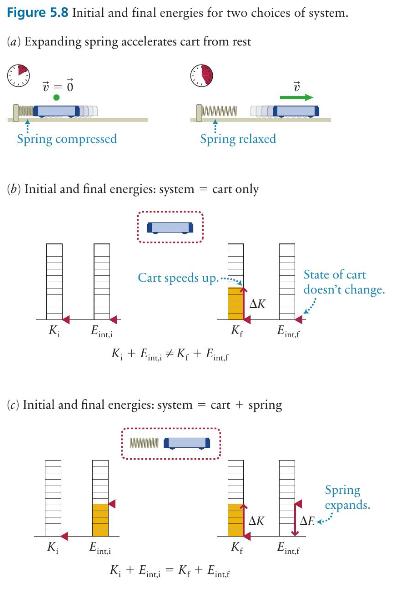
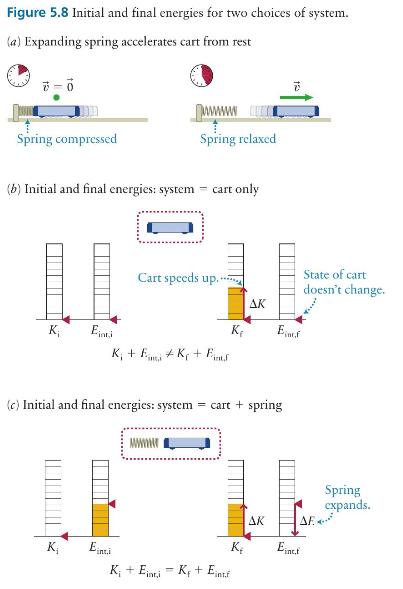
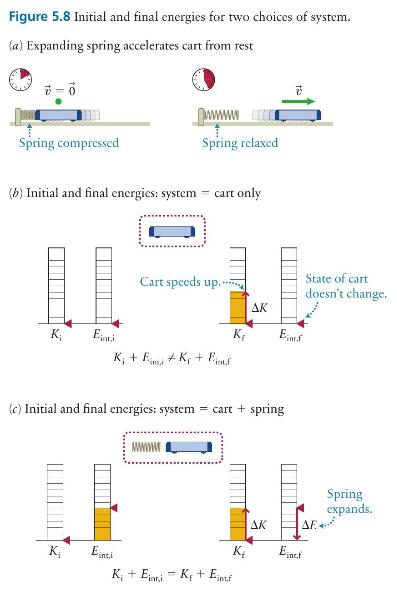
Think of a few other ways to put the cart of Figure 5.8 in motion. In each case, can you account for the increase in the cart's kinetic energy by either a change in state or a change in motion of another object? Figure 5.8 Initial and final energies for two choices of system. (a) Expanding spring
(a) Is the momentum of the cart-spring system in Figure 5.8 constant? (b) Is the system isolated? Figure 5.8 Initial and final energies for two choices of system. (a) Expanding spring accelerates cart from rest www Spring relaxed Spring compressed (b) Initial and final energies: system cart only K
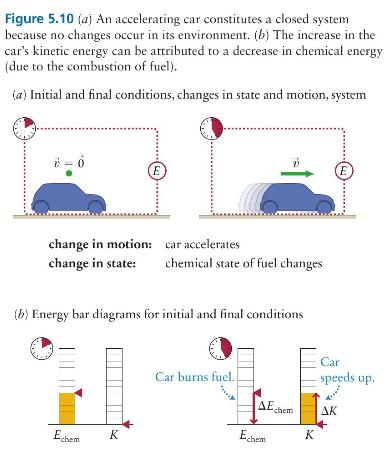
In describing what's going on in Figure 5.10, I ignored the change in temperature of the engine that accompanies the combustion of the fuel. Make a bar diagram that includes this change in temperature. Figure 5.10 (a) An accelerating car constitutes a closed system because no changes occur in its
(a) Can the magnitude of the momentum of an object change without a change in the object's kinetic energy? (b) Without a change in the object's energy? (c) What are your answers to parts \(a\) and \(b\) for a system consisting of more than one object?
Conservation of momentum tells us that \(m v_{x}\) doesn't change for an isolated system. Now we see that in an elastic collision \(m v_{x}^{2}\) also doesn't change. Does this mean that \(m v_{x}^{3}\) remains unchanged, too?
In a totally inelastic collision between two objects in an isolated system with one of the objects initially at rest, is it possible to lose all of the system's initial kinetic energy?
A gallon of gasoline contains approximately \(1.2 \times 10^{8} \mathrm{~J}\) of energy. If all of this energy were converted to kinetic energy in a \(1200-\mathrm{kg}\) car, how fast would the car go?
Does each cart in Example 5.9 get half of the spring's energy? Why or why not?Data from Example 5.9 A \(0.25-\mathrm{kg}\) cart is held at rest against a compressed spring as in Figure \(5.8 a\) and then released. The cart's speed after it separates from the spring is \(2.5 \mathrm{~m} /
In a billiard game, two balls collide having inertia \(0.25 \mathrm{~kg}\) each. Initially, ball 1 with velocity \(8 \mathrm{~m} / \mathrm{s}\) hits the ball 2 at rest. After collision, ball 1 moves with velocity \(5 \mathrm{~m} / \mathrm{s}\) and ball 2 moves with velocity \(3 \mathrm{~m} /
When you drop a tennis ball on the floor from a height, it will bounce back. (a) Do you expect the ball to return to the same height? (b) Is this collision elastic or inelastic? Justify your answer.
The ratio of kinetic energies of two moving objects \(A\) and \(B\) is \(1: 5\). Calculate the ratio of their momenta if the inertia of \(\mathrm{A}\) is 5 times the inertia of \(\mathrm{B}\).
The ratio of momenta of two objects \(A\) and \(B\) is \(1: 4\). The ratio of the kinetic energies of \(A\) and \(B\) is 1:2. Find the ratio of their velocities.
What is the interaction type in each of the following cases:(a) two colliding marbles, (b) two cars in a collision in which they move together, (c) a bullet fired into and passing through a wooden block, (d) a bullet fired into a wooden block that gets embedded in it, (e) one cart hitting
What physical phenomenon is at work in the launching of a rocket? Is the performance of the rocket engine better on earth or in space?
Light a matchstick by striking at the edge of the match box. If the event takes place in a room that can be considered a closed system, what are the consequences? If the same event occurs inside an isolated system, will there be any change?
Why are most of the massive meteoroids not able to hit the Earth's surface? Explain your answer in terms of energy.
Car A is at rest when an identical car, B, rear-ends it and they move together. What fraction of the kinetic energy of car B is lost?
Block A of inertia \(2 \mathrm{~kg}\) moving at \(5 \mathrm{~m} / \mathrm{s}\) collides elastically with a stationary block, B, of unknown inertia. After the collision, A is moving in the same direction at \(3 \mathrm{~m} / \mathrm{s}\). What is the inertia of block B? What is its velocity after
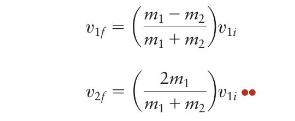
An object of inertia \(m_{1}\) moving at \(v_{1 i}\) collides elastically with an object of inertia \(m_{2}\) initially at rest. Show that the following solution for the final velocities of the two objects after the collision conserves momentum and kinetic energy: Vif V2f 'm-m m + m 2m m m
Use the solutions in Problem 29 to explain the outcome of each of the following collisions:(a) A moving truck colliding with a bike initially at rest.(b) A bike colliding with a stationary truck.(c) A bike colliding with an identical stationary bike.Data from Problem 29An object of inertia
A Labrador retriever dog with inertia \(25 \mathrm{~kg}\) and velocity \(6 \mathrm{~m} / \mathrm{s}\) jumps into a trolley at rest and after that both move in the same direction with a velocity \(3 \mathrm{~m} / \mathrm{s}\). Is the collision elastic, inelastic, or totally inelastic? Calculate the
You push a wooden block and friction causes it to stop eventually. If the acceleration during the process is constant, calculate the fraction of its kinetic energy lost as a function of the distance it was pushed through. Check your answer at the middle and end of its path.
A \(2-\mathrm{kg}\) block moving at \(4 \mathrm{~m} / \mathrm{s}\) hits a slower \(1-\mathrm{kg}\) block moving at \(2 \mathrm{~m} / \mathrm{s}\). If the \(2-\mathrm{kg}\) block continues in the same direction at \(3 \mathrm{~m} / \mathrm{s},(a)\) what is the speed of the slower block? (b) Is the
A mysterious explosion in an unmanned \(6000-\mathrm{kg}\) spaceship coasting at \(5000 \mathrm{~m} / \mathrm{s}\) breaks the ship into two unequal parts, one twice as massive as the other. The smaller piece recoils in the direction opposite to the original path at \(3000 \mathrm{~m} /
A stationary \(5.0-\mathrm{kg}\) ball explodes into two pieces due to a firecracker inside. One piece with inertia \(2.0 \mathrm{~kg}\) travels to the left at \(10 \mathrm{~m} / \mathrm{s}\).(a) What is the speed of the second fragment?(b) How much energy was released in the explosion?
Which has more kinetic energy: A 163-g cricket ball travelling at \(150 \mathrm{~km} / \mathrm{h}\) or a 58 -g tennis ball travelling at \(230 \mathrm{~km} / \mathrm{h}\) ?
In javelin throw, an athlete usually runs a certain distance before the throw. Why does the athlete not throw their javelin from a stand-still position?
A piece of tape is pulled from a spool and lowered toward a \(100-\mathrm{mg}\) scrap of paper. Only when the tape comes within \(8.0 \mathrm{~mm}\) is the electric force magnitude great enough to overcome the gravitational force exerted by Earth on the scrap and lift it. Determine the magnitude
A baseball bat is placed on a table such that the narrow end of the bat hangs over the edge. Two freshly pulled strips of tape are hung from opposite sides of the overhanging end of the bat. The strips repel each other so that they hang in the air in an inverted \(\mathrm{V}\) shape, with an angle
A plastic spring with spring constant \(k=450 \mathrm{~N} / \mathrm{m}\) has a relaxed length of \(0.100 \mathrm{~m}\). The spring is positioned vertically on a table, and a charged plastic \(1.00-\mathrm{kg}\) sphere is placed on the top end of the spring. Another charged object is suspended above
Two small objects carry the same amount of charge, and the magnitude of the electric force exerted by one object on the other is \(0.10 \mathrm{~N}\) when they are held \(30 \mathrm{~mm}\) apart. If the force magnitude increases when the objects are released and free to move, are the objects of the
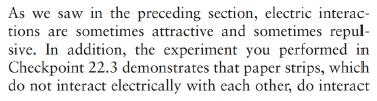
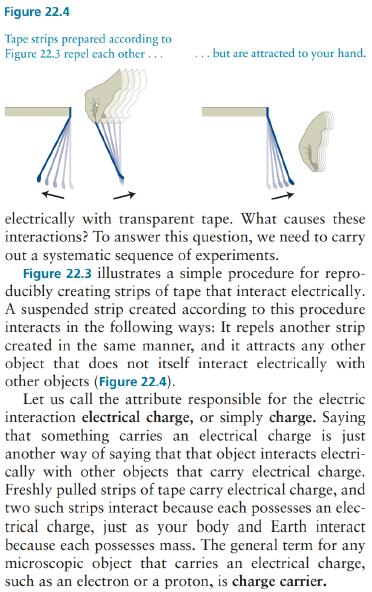
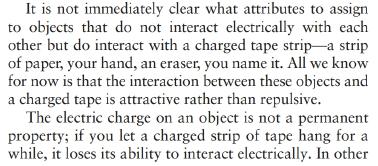
How might the results from electrostatic experiments with tape strips described in Section 22. 2 differ from those actually observed if there were three types of electrical charges in the universe?Data from Section 22. 2 As we saw in the preceding section, electric interac- tions are sometimes
If you must do positive work to bring a charged balloon toward a negatively charged sphere, is the charge on the balloon positive or negative?
Suppose you have three identical, electrically neutral pieces of tape, A, B, and C. (a) Describe how you could make two of them repel each other. (b) Is it possible for all three to repel one another?
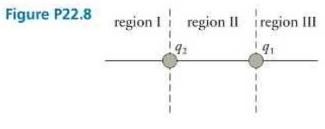
Suppose that in Figure P22.8, \(\left|q_{2}\right|>\left|q_{1}\right|>0\) but these particles may carry charges of the same or opposite type. A third particle carrying charge \(q_{3}\) is to be placed in this system along the axis such that the vector sum of electric forces on the third
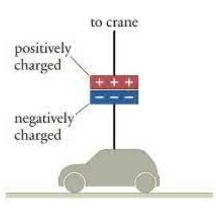
A salvage yard operator wants to make an electric force linkage for his wrecker crane as a safety device, so that when a vehicle being lifted is too massive, it will break the linkage before the force exerted by the vehicle topples the crane. His plan is to attach two metal plates to the crane
Which of the following phenomena are due to the electric interaction:(a) dissolution of salt in water, \((b)\) surface tension in water,(c) the elliptical orbit of comets,(d) the binding of protons in an atomic nucleus,(e) "traction" between tires and pavement.
Technicians who repair electronic devices know that a spark can damage electronic chips. They therefore wear a wriststrap connected by a metal wire to the metal leg of a worktable that is electrically "grounded" to Earth. How does wearing such a strap help prevent damage?
You have two rods A and B, both made of a nonconducting material. Initially, neither rod is charged. A sphere carrying 100 units of surplus positive charge is placed close to the left end of \(\operatorname{rod} \mathrm{A}\). One end of \(\operatorname{rod} \mathrm{B}\) is touched to the right end
Some survivors of lightning strikes have reported feeling their hair standing on end shortly before the strike. What causes the hair to behave in this way?
A closed system consists of a neutron and a positron. The neutron eventually decays. After decay, what are the most likely particles in the system, and what is the charge in the system? (Use the principle of conservation of charge.)
Two identical \(500-\mathrm{mg}\) paper clips, 1 and 2 , dangle from two strings, the top ends of which are tied to the same nail. The clips are charged in such a way that the two strings hang with an angle of \(32.0^{\circ}\) between them. (a) Draw a free-body diagram for clip 1, which is to the
A pith ball is suspended from a string, and when a rubber rod is brought close to the ball at \(t=0\), the ball is not noticeably affected by the rod. At \(t=5.00 \mathrm{~s}\) the rod is turned around such that the opposite end is nearest the ball. Now the ball is attracted to the rod. At \(t=10.0
At separation distance \(r_{1}\), charged Ping-Pong balls \(A\) and \(B\) repel each other with an electric force of magnitude 0. 40 N. At separation distance \(r_{2}\), charged Ping-Pong balls \(\mathrm{A}\) and \(\mathrm{C}\) repel each other with a force of magnitude 1. 4 N. Maintaining the
A metal sphere is grounded via a single wire. One end of a plastic rod is given a positive charge and held near the sphere. (a) If the ground wire is removed while the rod and sphere are near each other but have not touched, is there an electric force between the two? Why or why not? (b) If the rod
A rubber rod exerts no electric force on a small scrap of paper. After it is rubbed on cat fur for several seconds, the rod exerts an attractive force on the scrap. Is the force exerted by the fur on the same scrap attractive or repulsive?
Three small pieces of electrically neutral paper are placed far apart from one another on a table. One piece is given a negative electric charge, one is given a positive charge, and one is left neutral. They all look identical, and in order to tell which is which, a student runs a comb through her
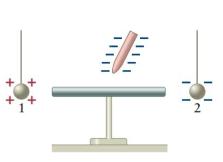
The electrically neutral metal rod in Figure P22.21 stands between two charged pith balls, and then a negatively charged rubber rod is scraped along the center of the metal rod. Draw the free-body diagram for each ball after the rubber rod is taken away.Data from Figure P22.21 2
A charged sphere with \(1 \times 10^{8}\) units of negative charge is brought near a neutral metal rod. The half of the rod closer to the sphere has a surplus charge of \(1 \times 10^{4}\) units. What is the magnitude of the charge on the half of the rod farther from the sphere? Is this charge
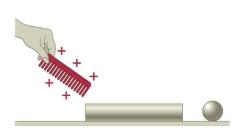
Near one end of an electrically neutral aluminum rod lying on a table made of nonconducting material, you hold a comb that is also made of a nonconducting material but carries a positive charge (Figure P22.23). Does a small steel sphere located near the other end of the rod roll toward the rod,
Two metal rods A and B are initially lying end to end on a wooden table and are touching each other. A sphere carrying surplus positive charge is brought close to the middle of \(\operatorname{rod} \mathrm{A}\). While the sphere is still in place, the rods are pulled apart by someone wearing gloves
You have three pairs of spheres. Pair A consists of two conducting spheres, pair B of two nonconducting spheres, and pair \(\mathrm{C}\) of one nonconducting sphere and one conducting sphere. If the same charge \(q\) is added to all spheres uniformly and in each pair the two spheres are separated
Metal sphere \(\mathrm{A}\) is hung from the ceiling by a long, thin string and given a positive charge. An identical sphere B is suspended nearby with an identical string and given a negative charge that has the same magnitude as the charge on \(\mathrm{A}\). The two spheres are \(50
You are an astrophysicist working on a problem involving Saturn's rings and trying to figure out why the smaller ice chunks in the rings stick to larger chunks. You hypothesize that as the chunks come out of the shadow of Saturn into the sunlight, the outside of the larger chunks heats up sooner
Suppose you have three identical metal spheres, A, B, and C. Initially sphere A carries a charge \(q\) and the others are uncharged. Sphere A is brought in contact with sphere B, and then the two are separated. Spheres C and B are then brought in contact and separated. Finally spheres \(A\) and
Two electrons are separated by \(1.50 \mathrm{~nm}\). What is the magnitude of the electric force each electron exerts on the other? Is this force attractive or repulsive?
A particle carrying a \(-4.0-\mu \mathrm{C}\) charge is located at the origin of an \(x y\) coordinate system. What are the components of the electric force exerted on a particle carrying a \(+1.0-\mu \mathrm{C}\) charge if that particle is located \((a)\) at \(x=10 \mathrm{~m}, y=0\) and \((b)\)
(a) By what distance do two objects carrying \(1.0 \mathrm{C}\) of charge each have to be separated beforc the electric force exerted on each object is \(1.0 \mathrm{~N}\) ? (b) How much charge should be placed on each of two small objects separated by \(1.0 \mathrm{~m}\) so that the electric force
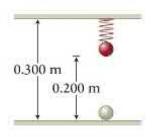
In a chamber \(0.300 \mathrm{~m}\) high, sphere 1 carrying charge \(q_{1}=1.00 \mu \mathrm{C}\) is suspended by a spring above a sphere 2 that carries charge \(q_{2}\) and sits on the floor of the chamber (Figure P22.33). The relaxed length of the suspended spring is \(70.0 \mathrm{~mm}\), its
Two identical 9. 60-g metal spheres (small enough to be treated as particles) are hung from separate \(300-\mathrm{mm}\) strings attached to the same nail in a ceiling. Surplus electrons are added to each sphere, and then the spheres are brought in contact with each other and released. Their
Suppose two particles carry a positive charge of \(1.00 \mathrm{C}\) for every kilogram of their mass. Compare the gravitational force and the electric force they exert on each other at a given separation.
Two metal spheres, one carrying a \(6.0-\mu \mathrm{C}\) charge and the other carrying a \(-24-\mu \mathrm{C}\) charge, are initially \(100 \mathrm{~mm}\) apart. They are brought in contact with each other and then moved back to their original positions. What is the numerical value of the ratio
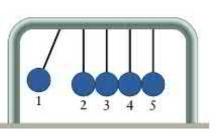
The device in Figure P22.37 is a so-called Newton's cradle. When you raise steel sphere 1 and then release it, its momentum is transferred to the other four steel spheres, and this momentum transfer causes sphere 5 to rise. When it falls, momentum is again transferred through the row of spheres,
Showing 2300 - 2400
of 4962
First
17
18
19
20
21
22
23
24
25
26
27
28
29
30
31
Last
Step by Step Answers

 Get 50% OFF
Claim Now
Get 50% OFF
Claim Now