New Semester
Started
Get
50% OFF
Study Help!
--h --m --s
Claim Now
Question Answers
Textbooks
Find textbooks, questions and answers
Oops, something went wrong!
Change your search query and then try again
S
Books
FREE
Study Help
Expert Questions
Accounting
General Management
Mathematics
Finance
Organizational Behaviour
Law
Physics
Operating System
Management Leadership
Sociology
Programming
Marketing
Database
Computer Network
Economics
Textbooks Solutions
Accounting
Managerial Accounting
Management Leadership
Cost Accounting
Statistics
Business Law
Corporate Finance
Finance
Economics
Auditing
Tutors
Online Tutors
Find a Tutor
Hire a Tutor
Become a Tutor
AI Tutor
AI Study Planner
NEW
Sell Books
Search
Search
Sign In
Register
study help
physics
particle physics
Principles And Practice Of Physics 2nd Edition Eric Mazur - Solutions
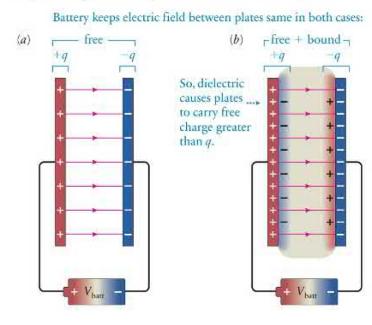
Draw an energy diagram for the process of charging a capacitor with a dielectric as shown in Figure \(26.15 b\) for the following systems: \((a)\) battery, capacitor, and dielectric; \((b)\) dielectric only;(c) battery and capacitor. Ignore any dissipation of energy.Data from Figure 26.15 (a)
Suppose the capacitor in Figure 26.9 has a plate separation distance \(d\) and the plates carry charges \(+q\) and \(-q\) when the capacitor is connected to a battery that maintains a potential difference \(V_{\text {batt }}\) between its terminals. If a metal slab of thickness \(d / 2\) is
What is the capacitance of a parallel-plate capacitor that has a plate area \(A\) and a plate separation distance \(d\) ?
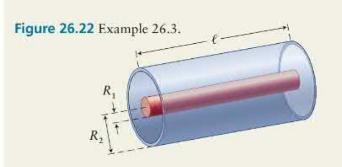
Figure \(\mathbf{2 6 . 2 2}\) shows a coaxial capacitor consisting of two concentric metal cylinders 1 and 2, of radii \(R_{1}\) and \(R_{2}>R_{1}\),Data from Figure 26.22 Figure 26.22 Example 26.3. R
What is the capacitance of a spherical capacitor consisting of two concentric conducting spherical shells of radii \(R_{1}\) and \(R_{2}>R_{1}\) ?
The radius of the dome on one very large Van de Graaff generator is about \(2.5 \mathrm{~m}\), and air breaks down when the field magnitude is about \(3.0 \times 10^{6} \mathrm{~V} / \mathrm{m}\). How much electric potential energy is stored in the electric field surrounding the dome just before
A parallel-plate capacitor consists of two conducting plates with a surface area of \(1.0 \mathrm{~m}^{2}\) and a plate separation distance of \(50 \mu \mathrm{m}\). (a) Determine the capacitance and the energy stored in the capacitor when it is charged by connecting it to a \(9.0-\mathrm{V}\)
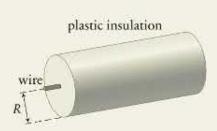
A thin, long, straight wire is surrounded by plastic insulation of radius \(R\) and dielectric constant \(\kappa\) (Figure 26.32). The wire carries a uniform distribution of charge with a positive linear charge density \(\lambda\). If the wire has a diameter \(d\), what is the potential difference
What orientation of an electric dipole in a uniform electric field has the greatest electric potential energy? What orientation has the least? (Let the system comprise both the electric dipole and the sources of the uniform electric field.)
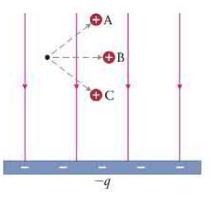
Identical positively charged objects \(A, B\), and \(C\) are launched with the same initial speed from the same position above a negatively charged sheet that produces a uniform electric field. The directions of the initial velocities are shown in Figure P25.2. Assuming the objects do not interact
You release three balls simultaneously from the same height above the floor. The balls all carry the same quantity of surplus positive charge, but they have different masses: \(1 \mathrm{~kg}, 2 \mathrm{~kg}\), and \(3 \mathrm{~kg}\). In addition to the gravitational field due to Earth, there is a
A proton, a deuteron (a hydrogen nucleus containing one proton and one neutron), and an alpha particle (a helium nucleus consisting of two protons and two neutrons) initially at rest are all accelerated through the same distance in the uniform electric field created by a very large charged plate.
A proton, a deuteron (a hydrogen nucleus containing one proton and one neutron), and an alpha particle (a helium nucleus consisting of two protons and two neutrons) initially at rest are all accelerated for the same time interval in the uniform electric field created by a very large charged plate.
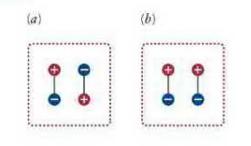
Consider an isolated system of two identical electric dipoles as in Figure P25.6. For which orientation is the electric potential energy smaller?Data from Figure P25.6 (a) (b)
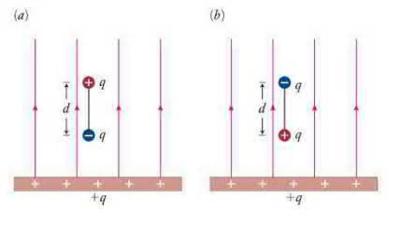
A dipole carrying charges \(+q\) and \(-q\) separated by a distance \(d\) is rotated \(180^{\circ}\) in a uniform electric field (Figure P25.7). What is the change in electric potential energy associated with this rotation? (Consider a system comprising both the dipole and the sources of the
In an electrostatic field, path 1 between points \(A\) and \(B\) is twice as long as path 2 . If the electrostatic work done on a negatively charged particle that moves from \(A\) to \(B\) along path 1 is \(W_{1}\), how much work is done on this particle if it later goes from A to B along path 2?
The electrostatic work done on a particle carrying charge \(q\) as the particle travels from point \(A\) to point \(B\) in an electric field is \(W\). How much electrostatic work is done on a particle carrying charge \(-2 q\) that travels from \(\mathrm{B}\) to \(\mathrm{A}\) in the field?
Electrostatic work \(W\) is done on a charged particle as it travels \(10 \mathrm{~mm}\) along a straight path from point A to point \(B\) in an electric field. If you return the particle to point \(A\) and then exert a force on it to move it from \(A\) to \(\mathrm{B}\) along a curved path that is
Points \(A\) and \(B\) are on the same electric field line. If the potential difference between \(A\) and \(B\) is positive, is the field directed from \(A\) to \(B\) or from \(B\) to \(A\) ?
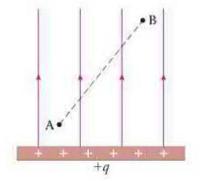
In three separate experiments, an object is moved from point \(A\) to point \(B\) in the uniform electric field of a large charged plate (Figure P25.12). The object is at rest in both the initial and final positions. Object 1 carries charge \(+q\) and has mass \(m\); object 2 carries charge \(+q\)
Electrostatic work \(W\) is done on a charged particle as the particle travels from point \(A\) to point \(B\) in an electric field. You then apply a force to move the particle back to A, increasing its kinetic energy by an amount equal to \(2 \mathrm{~W}\). How much work did you do?
Points A, B, and C form the vertices of a triangle in a nonuniform electrostatic field. The electrostatic work done on a particle of charge \(q\) as the particle travels from \(A\) to \(B\) is \(W_{A B}\), and that done on the particle as it travels from \(A\) to \(C\) is \(W_{A C}=-W_{A B} / 2\).
In the presence of an electrostatic field, you find that you must do positive work on an electron to move it from point \(A\) to point \(B\) without changing its kinetic energy. (a) Considering just the electron as our system, has the system's electric potential energy increased, decreased, or
In the presence of an electrostatic field, you find that you must do positive work on a proton to move it from point A to point \(\mathrm{B}\) without changing its kinetic energy. (a) Considering just the proton as your system, have you increased, decreased, or left unchanged its electric potential
An electron moves from point \(A\) to point \(B\) under the influence of an electrostatic field in which the potential difference between A and B is negative. (a) If your system includes both the electron and the particles generating the electrostatic field, does the system's electric potential
A proton moves from point \(A\) to point \(B\) under the influence of an electrostatic field in which the potential difference between A and B is negative. (a) If your system includes both the proton and the particles generating the electrostatic field, does the system's electric potential energy
Four objects are moved in various ways in the electrostatic field of Figure P25.19. Rank the following motions in order of the amount of electrostatic work done on the object, smallest amount first: (a) an object carrying charge \(+q\) is moved from A to \(\mathrm{B},(b)\) an object carrying charge
Points A, B, C, and D are at the corners of a square area in an electric field, with \(\mathrm{B}\) adjacent to \(\mathrm{A}\) and \(\mathrm{C}\) diagonally across from \(A\). The potential difference between \(A\) and \(C\) is the negative of that between \(A\) and \(B\) and twice that between B
Can equipotential lines ever cross?
Can you draw an equipotential surface through a position where the electric field vanishes?
Describe the equipotential surfaces associated with an infinitely long charged wire that has a uniform linear charge density.
Sketch some equipotential lines for the electric field line pattern of an electric dipole.
Sketch some electric field lines and equipotential lines associated with two identical charged particles spaced horizontally.
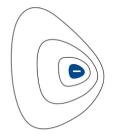
Some equipotential lines surrounding a negatively charged object are shown in Figure P25.26, where the potential difference between any two adjacent lines is the same. (a) In which region is the electric field magnitude greatest? (b) What is the direction of the electric field in that region? (c)
You determine that it takes no (net) electrostatic work to move a charged object from point A to point B along a particular path. (a) Can you conclude that A and B are on the same equipotential surface? (b) Can you say that the path is part of an equipotential surface that includes \(A\) and B?
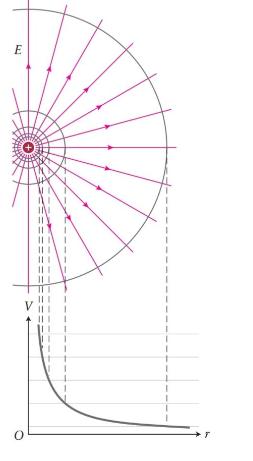
Figure P25.28 shows that the spacing between equipotential surfaces surrounding a charged particle increases with radial distance \(r\) away from the particle. (a) How would the potential have to depend on \(r\) in order to make the spacing between equipotential surfaces uniform? (b) How would the
Particle A carrying a charge of \(3.0 \mathrm{nC}\) is at the origin of a Cartesian coordinate system.(a) What is the electrostatic potential (relative to zero potential at infinity) at a position \(r=4.0 \mathrm{~m}\) from the origin? \((b)\) With particle A held in place at the origin, how much
A particle carrying a charge of \(6.0 \mathrm{nC}\) is released from rest in a uniform electric field of magnitude \(2.0 \times 10^{3} \mathrm{~N} / \mathrm{C}\). What are \((a)\) the electrostatic work done on the particle after it has moved \(4.0 \mathrm{~m}\) and \((b)\) the particle's kinetic
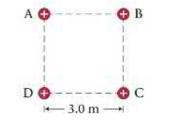
Particles A, B, C, and D in Figure P25.31 each carry a charge of magnitude \(3.0 \mathrm{nC}\). Calculate the electric potential energy for the charge distribution in this \(3.0-\mathrm{m}\) square \((a)\) if all the charges are positive; \((b)\) if \(\mathrm{B}, \mathrm{C}\), and \(\mathrm{D}\)
Particles A and B, each carrying a charge of \(2.0 \mathrm{nC}\), are at the base corners of an equilateral triangle \(2.0 \mathrm{~m}\) on a side. (a) What is the potential (relative to zero at infinity) at the apex of the triangle? (b) How much work is required to bring a positively charged
Six particles, each carrying a charge of \(3.0 \mathrm{nC}\), are equally spaced along the equator of a sphere that has a radius of \(0.60 \mathrm{~m}\) and has its center at the origin of a rectangular coordinate system. What is the electrostatic potential (relative to zero at infinity) (a) at
An electron and a proton are held on an \(x\) axis, with the electron at \(x=+1.000 \mathrm{~m}\) and the proton at \(x=\) \(-1.000 \mathrm{~m}\).(a) How much work is required to bring an additional electron from infinity to the origin? \((b)\) If, instead of the second electron coming in from
Four objects, each carrying a charge of magnitude \(q\), are placed at the corners of a square measuring \(d\) on each side. Two of the objects are positively charged, and two are negatively charged, with like-charged objects placed at opposite corners of the square. (a) Is the electric potential
Show that the units of electric field, newtons per coulomb, are equivalent to the units volts per meter.
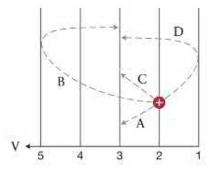
Four possible paths for a positively charged object traveling from a \(2-\mathrm{V}\) equipotential to a \(3-\mathrm{V}\) equipotential are shown in Figure P25.37. Rank the paths in order of the electrostatic work done on the object along each path, greatest value first.Data from Figure P25.37 B C
Four particles, cach carrying a charge of magnitude \(3.0 \mathrm{nC}\), are at the corners of a square that has a side length of \(3.0 \mathrm{~m}\). For zero potential set at infinity, calculate the potential at the center of the square \((a)\) if all particles are positively charged, \((b)\) if
A particle carrying charge \(+9.00 \mathrm{nC}\) is at the origin of a rectangular coordinate system. Taking the electrostatic potential to be zero at infinity, locate the equipotential surfaces at \(20.0-\mathrm{V}\) intervals from \(20.0 \mathrm{~V}\) to \(100 \mathrm{~V}\), and sketch them to
A particle carrying charge \(+q\) is located on the \(x\) axis at \(x=+d\). A particle carrying charge \(-3 q\) is located on the \(x\) axis at \(x=-7 d\). (a) With zero potential at infinity, at what locations on the \(x\) axis is the electrostatic potential zero? (b) At what locations on the
In a rectangular coordinate system, a positively charged infinite sheet on which the surface charge density is \(+2.5 \mu \mathrm{C} / \mathrm{m}^{2}\) lies in the \(y z\) plane that intersects the \(x\) axis at \(x=0.10 \mathrm{~m}\). What are(a) \(\vec{E}\) for \(x>0.10 \mathrm{~m}\) and(b) the
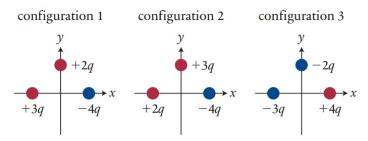
Figure P25.44 shows three configurations of charged particles. All the particles are the same distance from the origin. Rank the configurations in terms of \((a)\) the electrostatic potentials at the origin, greatest first, and \((b)\) the electric potential energies of the three-particle system,
Two parallel conducting plates carry equal and opposite charges. The plates are large relative to their separation distance, so we can assume the electric field between them is uniform. The potential difference between them is \(0.25 \mathrm{~V}\), and the magnitude of the electric field between
Particle 1 carrying charge \(+q_{1}\) is placed on the \(x\) axis at \(x=-d\). Particle 2 carrying some unknown charge \(q_{2}\) is placed somewhere on the \(x\) axis. The potential energy associated with the charges is \(+q_{1}^{2} /\left(2 \pi \epsilon_{0} d\right)\), and the electrostatic
Two charged particles are placed near the origin of an \(x y z\) coordinate system. Particle 1 carries charge \(+q\) and is on the \(x\) axis at \(x=+d\). Particle 2 carries an unknown charge and is at an unknown location. The magnitude of the electric field at the origin is \(q /\left(2 \pi
A thin disk of radius \(R=62.5 \mathrm{~mm}\) has uniform surface charge density \(\sigma=7.5 \mathrm{nC} / \mathrm{m}^{2}\). Calculate the potential on the axis of the disk at distances(a) 5.0 mm(b) 30 mm, and (c) 62. 5 mm from the disk.
Charge \(q=+10 \mathrm{nC}\) is uniformly distributed on a spherical shell that has a radius of \(120 \mathrm{~mm}\). (a) What are the magnitude and direction of the electric field just outside and just inside the shell? (b) What is the electrostatic potential just outside and just inside the
A very long positively charged wire on which the linear charge density \(\lambda\) is \(150 \mathrm{nC} / \mathrm{m}\) lies on the \(z\) axis of a rectangular coordinate system. Calculate the electrostatic potential(a) 2.0 m(b) 4. 0 m, and(c) 12 m from the wire, assuming that V=0 at 2.5 m.
A particle carrying charge \(+q\) is placed at the center of a thick-walled conducting shell that has inner radius \(R\) and outer radius \(2 R\) and carries charge \(-4 q\). A thinwalled conducting shell of radius \(3 R\) carries charge \(+4 q\) and is concentric with the thick-walled shell.
Four uniformly charged nonconducting rods, each of length \(\ell\) and carrying charge \(+q\), are arranged into a square of side length \(\ell\). At the center of the square, what are \((a)\) the magnitude of the electric field and \((b)\) the electrostatic potential?
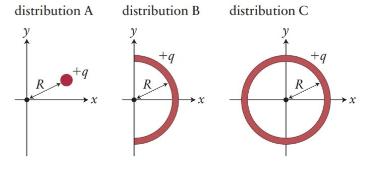
Figure P25.54 shows three charge distributions. In A, a particle carrying a charge \(+q\) is located a distance \(R\) from the origin. In B, \(+q\) charge is spread uniformly over a semicircle of radius \(R\) centered at the origin. In \(\mathrm{C},+q\) charge is spread uniformly over a circle of
A particle carrying charge \(q_{\mathrm{p}}=+10 \mathrm{nC}\) is located at \(y_{\mathrm{p}}=0.030 \mathrm{~m}\) on the \(y\) axis of an \(x y\) coordinate system. A nonconducting rod of length \(\ell=0.10 \mathrm{~m}\) carrying charge \(q_{\mathrm{r}}=-10 \mathrm{nC}\) lies on the \(x\) axis,
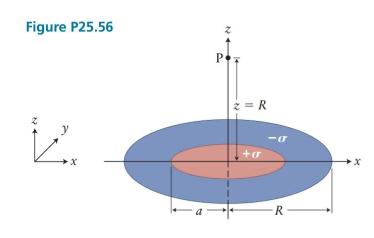
A disk of radius \(R\) has positive charge uniformly distributed over an inner circular region of radius \(a\) and negative charge uniformly distributed over the outer annular (ring-shaped) region (Figure P25.56). The surface charge density on the inner region is \(+\sigma\), and that on the
The surface charge density on a nonconducting disk of radius \(R\) varies with the radius as \(\sigma(r)=c r\), where \(c\) is a positive constant \((c>0)\). Derive an expression for the electrostatic potential as a function of position \(x\) along an \(x\) axis that runs through the disk center
A very long, solid, positively charged cylinder has a radius \(R\) and is made of a nonconducting material. The nonuniform volume charge density is given by \(ho=+a r\), where \(r\) is the radial distance away from the long central axis of the cylinder. Calculate the difference in electrostatic
The electrostatic potential in some region of space is given by \(V(x)=A+B x\), where \(V\) is in volts, \(x\) is in meters, and \(A\) and \(B\) are positive constants. Determine the magnitude of the electric field in this region. In what direction is the field?
The electrostatic potential in a particular \(x y\) coordinate system is given by \(V(x, y)=3 x y-5 y^{2}\). Obtain the expression for the electric field.
A particle carrying \(+3.00 \mathrm{nC}\) of positive charge is at the origin of an \(x y\) coordinate system. Take \(V(\infty)\) to be zero for these calculations. (a) Calculate the potential \(V\) on the \(x\) axis at \(x=3.0000 \mathrm{~m}\) and at \(x=3.0100 \mathrm{~m}\). (b) Does the
Two particles, each carrying positive charge \(q\), are on the \(y\) axis, one at \(y=+a\) and the other at \(y=-a\). (a) Calculate the potential for any point on the \(x\) axis. (b) Use your result in part \(a\) to determine the electric field at any point on the \(x\) axis.
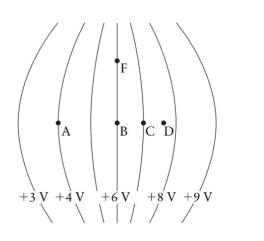
Figure P25.63 shows a two-dimensional slice through a set of equipotential surfaces.(a) At which of the locations marked A, B, C, and D is the magnitude of the electric field greatest? \((b)\) Is the magnitude of the electric field greater at B or at F?(c) Sketch some electric field lines in
A particle carrying \(3.00 \mathrm{nC}\) of positive charge is at the origin of a rectangular coordinate system, and a particle carrying \(3.00 \mathrm{nC}\) of negative charge is on the \(x\) axis at \(x=6.00 \mathrm{~m}\). (a) Calculate the potential on the \(x\) axis at \(x=3.00 \mathrm{~m}\),
A ring of radius \(a\) carrying a uniformly distributed positive charge \(q\) is located in the \(y z\) plane of a rectangular coordinate system, with the center of the ring at the origin. (a) Sketch a graph of the electrostatic potential \(V(x)\) as a function of distance along the \(x\) axis. (b)
Consider a spherically symmetrical distribution of charged particles. The magnitude of charge for the distribution is \(q\), and the radius of the distribution is \(R\). The electrostatic potential varies with radial distance \(r\) away from the center of the distribution. For \(r>2 R, V(r)=-q
An electron travels from point \(A\) to point \(B\) in an electrostatic field and gains kinetic energy. (a) Is the electrostatic work done on the electron positive, negative, or zero? (b) Is the potential at A higher than, lower than, or the same as the potential at B?
A proton travels from point \(A\) to point \(B\) in an electrostatic field and gains kinetic energy. (a) Is the electrostatic work done on the proton positive, negative, or zero? (b) Is the potential at A higher than, lower than, or the same as the potential at B?
Calculate \(E_{x}\) for each potential: (a) \(V(x)=a+b x\), \(a=4000 \mathrm{~V}, b=6000 \mathrm{~V} / \mathrm{m}\). (b) \(V(x)=a x+b / x\), \(a=1500 \mathrm{~V} / \mathrm{m}, b=2000 \mathrm{~V} \cdot \mathrm{m}\). (c) \(V(x)=a x-b x^{2}\), \(a=2000 \mathrm{~V} / \mathrm{m}, b=3000 \mathrm{~V} /
Consider an isolated, uniformly charged spherical shell of radius \(R\) carrying positive charge \(q\). Point \(\mathrm{A}\) is on the shell, point \(B\) is a distance \(2 R\) from the center, point \(C\) is a distance \(R / 2\) from the center, and point \(\mathrm{D}\) is at the center. Is the
You are sketching equipotentials for a positively charged particle, having defined \(V=0\) at infinity. If you draw the \(5.0-\mathrm{V}\) equipotential as a circle with a radius of \(50 \mathrm{~mm}\), what is the radius of \((a)\) the \(10-\mathrm{V}\) equipotential and (b) the 2. 0-V
A uniformly charged rod of length \(\ell\) and charge \(+q\) lies on the \(x\) axis of a Cartesian coordinate system, extending from the origin to \(x=-\ell\). What is the electric potential due to this rod at a position on the positive \(x\) axis that is a distance \(d\) from the origin?
A solid sphere of radius \(R\) is concentric with a spherical shell that carries charge \(+q_{\text {shell }}\) and has an inner radius of \(2 R\) and outer radius of \(3 R\). If the electrostatic potential at the common center of the sphere and shell is the same as the potential at infinity, what
You really like your new job at the atomic physics lab. Your boss casually mentions that the electron in a helium ion \(\left(\mathrm{He}^{+}\right)\)emits energy in the form of radiation as it jumps from an orbit that has a radius of \(0.42 \mathrm{~nm}\) to an orbit that has a radius of \(0.24
You have always wondered exactly how strong is the interaction called the strong nuclear interaction, and you suspect that an element like uranium could make a good test case. You begin to wonder if the electric potential energy discussed in this chapter might provide a path to an answer. As you
Two charged objects 1 and 2 are held a distance \(r\) apart. Object 1 has mass \(m\) and charge \(+2 q\), and object 2 has mass \(2 m\) and charge \(+q\). The objects are released from rest. Assume that the only force exerted on either object is the electric force exerted by the other object.(a)
What is the magnitude of the gravitational field that Earth feels due to the Sun?
Determine the magnitude of Earth's gravitational field for \((a)\) a 70. 0-kg person standing at Earth's surface, \((b)\) a \(700.0-\mathrm{kg}\) satellite in orbit \(150 \mathrm{~km}\) above Earth's surface, and \((c)\) the Moon (use \(3.844 \times 10^{8} \mathrm{~m}\) for the center-tocenter
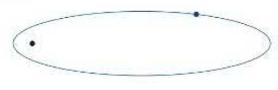
Sketch the gravitational field at 15 positions uniformly distributed along the comet orbit in Figure P23.3.Data from Figure P23.3
Suppose there is an electric field pointing horizontally toward the east at some location near Earth's surface. Does it make sense to add the gravitational and electric fields to determine the behavior of a proton at that location?
The units of the gravitational field are those of acceleration. Is that true of the electric field as well? If not, why not?
Two electrons initially repel each other with an electric force of magnitude \(2.5 \times 10^{-20} \mathrm{~N}\). What is the magnitude of the electric field at one electron due to the other?
The dwarf planet Pluto and its moon Charon have very similar masses. Suppose the masses are equal, and draw a gravitational field diagram for this system of two source objects.
Draw two vector field diagrams, one for a particle carrying charge \(+q\) and located at the origin of a rectangular coordinate system and one for a particle carrying charge \(-2 q\) and located at the origin. Describe the principal differences between the two diagrams.
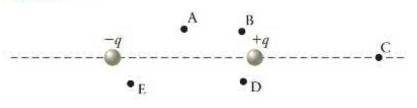
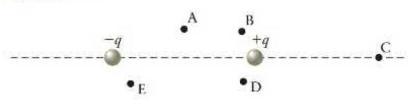
The two Ping-Pong balls in Figure P23.9 carry charges that have the same magnitude but opposite signs. Sketch the vectors that represent the electric fields the balls produce at locations A, B, C, D, and E, which all lie in a common plane that includes the line joining the centers of the balls. Use
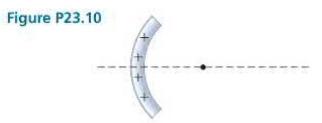
Positive charge is distributed uniformly on a plastic rod bent to form a quarter-circular arc (Figure P23.10). What is the direction of the electric field at the center of the circle?Data from Figure P23.10 Figure P23.10
Repeat Problem 9 for the case where the positive charge in Figure P23.9 remains \(+q\) but the negative charge is changed to \(-2 q\).Data from Problem 9The two Ping-Pong balls in Figure P23.9 carry charges that have the same magnitude but opposite signs. Sketch the vectors that represent the
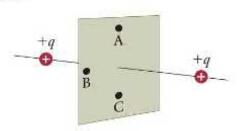
The two particles in Figure P23.12 carry identical charges. Sketch the vectors that represent the electric fields the particles produce at locations A, B, and C, which all lie in the plane that is midway between the two particles and perpendicular to the line connecting them.Data from Figure P23.12
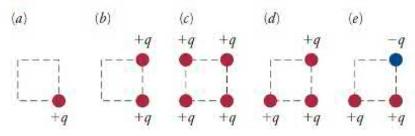
Charged beads are placed at the corners of a square in the various configurations shown in Figure P23.13. Each red bead carries a charge \(+q\), and the blue bead carries a charge \(-q\). Rank the configurations according to the magnitude of the electric field at the center of the square, smallest
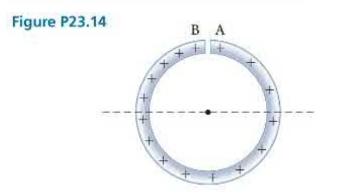
The charge on a nonconducting rod increases linearly from end \(\mathrm{A}\) to end \(\mathrm{B}\). The rod is bent in a circle so that ends A and B almost meet very near the top of the circle (Figure P23.14). What is the direction of the electric field at the center of the circle? (Consider
Qualitatively, how uniform is the gravitational field inside the room in which you are sitting?
A positively charged test particle is placed midway between two fixed, identical positively charged source particles. (a) Is the test particle in a stable or unstable equilibrium at that location? (b) If the test particle is replaced by a negatively charged test particle, is it in a stable or
A box full of charged plastic balls sits on a table. The electric force exerted on a ball near one upper corner of the box has components \(1.2 \times 10^{-3} \mathrm{~N}\) directed north, \(5.7 \times 10^{-4} \mathrm{~N}\) directed east, and \(2.2 \times 10^{-4} \mathrm{~N}\) directed vertically
An electron traveling horizontally east passes between two horizontal, oppositely charged plates and is deflected downward. Passing through the same space between the plates, in which direction (if any) would each of the following be deflected: \((a)\) a proton traveling horizontally east,(b) an
A \(30,0-\mathrm{mg}\) oil drop carrying a charge of \(+3.5 \mu \mathrm{C}\) passes undeflected through a region in which there is a uniform, constant electric field. What are the magnitude and direction of the electric field?
Showing 2000 - 2100
of 4962
First
14
15
16
17
18
19
20
21
22
23
24
25
26
27
28
Last
Step by Step Answers

 Get 50% OFF
Claim Now
Get 50% OFF
Claim Now