New Semester
Started
Get
50% OFF
Study Help!
--h --m --s
Claim Now
Question Answers
Textbooks
Find textbooks, questions and answers
Oops, something went wrong!
Change your search query and then try again
S
Books
FREE
Study Help
Expert Questions
Accounting
General Management
Mathematics
Finance
Organizational Behaviour
Law
Physics
Operating System
Management Leadership
Sociology
Programming
Marketing
Database
Computer Network
Economics
Textbooks Solutions
Accounting
Managerial Accounting
Management Leadership
Cost Accounting
Statistics
Business Law
Corporate Finance
Finance
Economics
Auditing
Tutors
Online Tutors
Find a Tutor
Hire a Tutor
Become a Tutor
AI Tutor
AI Study Planner
NEW
Sell Books
Search
Search
Sign In
Register
study help
physics
particle physics
Principles And Practice Of Physics 2nd Edition Eric Mazur - Solutions
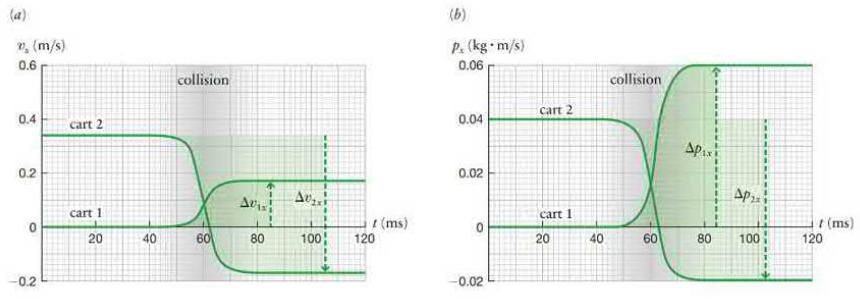
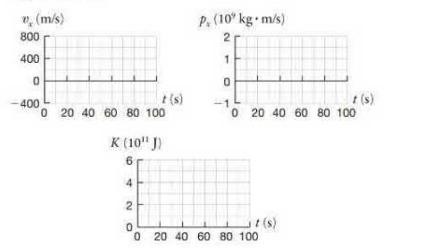
(a) Is the collision in Figure 4.23 elastic, inelastic, or totally inelastic? How can you tell? (b) Verify your answer by comparing the initial kinetic energy of the two-cart system with the final kinetic energy.Data from Figure 4.23 (a) v, (m/s) 0.6 0.4 cart 2 22 0.2 0 cart 1 -0.2 20 40 40
A \(0.2-\mathrm{kg}\) cart 1 initially at rest is struck by an identical cart 2 traveling at \(v_{2 x, i}=+0.5 \mathrm{~m} / \mathrm{s}\) along a low-friction track. After the collision, the velocity of cart 2 is reduced to \(v_{2 x, f}=+0.2 \mathrm{~m} / \mathrm{s}\). (a) Is the collision elastic,
Choose an appropriate closed system and make a bar diagram representing the energy conversions and transfers that occur when (a) a pan of water is heated on a propane burner, (b) a cyclist accelerates from rest, and (c) a spring-loaded gun fires a ball of putty.
Two carts, one of inertia \(m_{1}=0.25 \mathrm{~kg}\) and the other of inertia \(m_{2}=0.40 \mathrm{~kg}\), travel along a straight horizontal track with velocities \(v_{1 x, \mathrm{i}}=+0.20 \mathrm{~m} / \mathrm{s}\) and \(v_{2 x, i}=-0.050 \mathrm{~m} / \mathrm{s}\). What are the carts'
A rubber ball of inertia \(m_{\mathrm{b}}=0.050 \mathrm{~kg}\) is fired along a track toward a stationary cart of inertia \(m_{\mathrm{c}}=0.25 \mathrm{~kg}\). The kinetic energy of the system after the two collide elastically is \(2.5 \mathrm{~J}\). (a) What is the initial velocity of the ball?
A white car of inertia \(1200 \mathrm{~kg}\) that is moving at a speed of \(7.2 \mathrm{~m} / \mathrm{s}\) rear-ends a blue car of inertia \(1000 \mathrm{~kg}\) that is initially at rest. Immediately after the collision, the white car has a speed of \(3.6 \mathrm{~m} / \mathrm{s}\). What is the
A \(0.20-\mathrm{kg}\) steel ball is dropped into a ball of dough, striking the dough at a speed of \(2.3 \mathrm{~m} / \mathrm{s}\) and coming to rest inside the dough. If it were possible to turn all of the energy converted in this totally inelastic collision into light, how long could you light
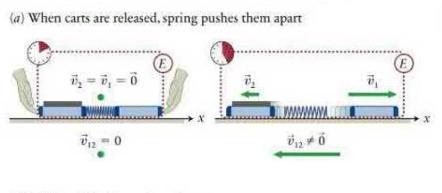
A \(0.25-\mathrm{kg}\) cart is held at rest against a compressed spring as in Figure \(5.8 a\) and then released. The cart's speed after it separates from the spring is \(2.5 \mathrm{~m} / \mathrm{s}\). The spring is then compressed by the same amount between a \(0.25-\mathrm{kg}\) cart and a
Consider an isolated object at rest in space. The object contains internal energy in some form or another. Is it-in principle-possible to convert the internal energy to kinetic energy so that the object starts to move?
Imagine squeezing a piece of foam with your hands. Choose an appropriate closed system and make a bar diagram representing the energy conversions and transfers that occur during the squeezing.
When you heat a pot of water on a gas stove, the water temperature increases until the water begins to boil. This change in thermal state from cool water to hot water is due to chemical energy from the burning gas being converted to thermal energy of the water. Once boiling starts, the water
An electric fan turns electrical energy into wind energy (a form of kinetic energy because it involves moving air). Suppose a blowing fan is suddenly unplugged. Even though the fan no longer receives electrical energy, it continues to blow air while the blades slowly come to a stop. What type of
Moving sidewalks are commonplace at large airports, but you must use caution getting on and off them. What should you do to make the transition easy when stepping onto one of these sidewalks? When stepping off?
A flying bug hits the helmet of a coasting bicyclist. (What kind of collision do you expect this to be?) Draw the momentum vectors for the bug and the bicyclist before and after the collision \((a)\) in the reference frame in which the bug is initially at rest and \((b)\) in the reference frame in
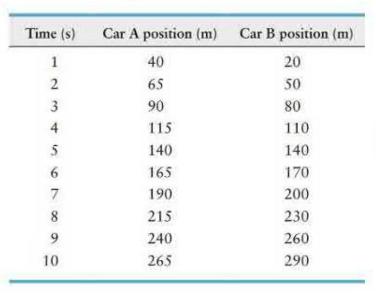
The data in the table were recorded for two race cars, A and \(B\), driving down a straight stretch of track. Determine the average velocity of car B as measured by an observer in car A. Time (s) Car A position (m) Car B position (m) 123 1 40 20 2 65 50 90 80 4 115 110 5 140 140 6 165 170 7 190 200
An observer in the Earth reference frame observes cart A and cart B moving toward each other with the same speed until they collide and come to rest. Consider this event as seen by observer A moving along with cart A. Assume that this observer matches cart A's initial velocity but does not collide
You are sitting, facing rearward, in the bed of a pickup truck and hop off while the truck is moving forward. When you land, do you move toward or away from the truck \((a)\) from the point of view of a person standing alongside the road and \((b)\) from the point of view of a person who remains in
Two objects, A and B, of equal inertia approach each other with relative velocity \(\vec{v}_{\mathrm{AB}}\) and collide elastically. For each object, draw a velocity-versus-time graph for the interval starting a few seconds before the collision and ending a few seconds after the collision \((a)\)
A woman standing beside a road sees a car accelerate from rest to \(30 \mathrm{~m} / \mathrm{s}\). Describe the car's motion as seen by the driver of a truck traveling in the same direction as the car at a constant \(30 \mathrm{~m} / \mathrm{s}\). What if the truck is moving in the opposite
On a long bus ride, you walk from your seat to the back of the bus to use the restroom. If the bus is driving at \(100 \mathrm{~km} / \mathrm{h}\), and you walk at \(2.0 \mathrm{~m} / \mathrm{s}\) from your seat to the restroom, how quickly are you moving relative to the ground?
A pickup truck has several empty soda cans loose in the bed. Why do the cans roll forward in the bed when the truck slows down?
You drop your keys in a high-speed elevator going up at a constant speed. Do the keys accelerate faster toward the elevator floor than they would \((a)\) if the elevator were not moving?(b) if the elevator were accelerating downward?
Train A, \(m_{\mathrm{A}}=150,000 \mathrm{~kg}\), is traveling west at \(60 \mathrm{~km} / \mathrm{h}\). Train B, \(m_{\mathrm{B}}=100,000 \mathrm{~kg}\), behind train A on the same track, is traveling west at \(88 \mathrm{~km} / \mathrm{h}\) and so is gaining on train A. Because the engineer
A \(1000-\mathrm{kg}\) car traveling east at \(50 \mathrm{~km} / \mathrm{h}\) passes over the top of a hill and hits a \(3000-\mathrm{kg}\) truck stalled in the middle of the lane. The impact causes the truck to roll eastward at \(15 \mathrm{~km} / \mathrm{h}\). (a) What is the coefficient of
You are riding a \(450-\mathrm{kg}\) horse at \(14.4 \mathrm{~km} / \mathrm{h}\) cast along a desert road. You have inertia equal to \(60.0 \mathrm{~kg}\). A police officer driving past (whom you know and who knows your inertia and the horse's inertia) measures your speed relative to the police car
Two cars collide head-on on a busy street. An observer standing on the street witnesses the accident and calculates how much of the cars' initial kinetic energy went into deforming the cars upon collision, \(E_{\text {def }}\). A police officer was driving next to one of the cars at a matching
At an airport, two business partners both walk at \(1.5 \mathrm{~m} / \mathrm{s}\) from the gate to the main terminal, one on a moving sidewalk and the other on the floor next to it. The partner on the moving sidewalk gets to the end in \(60 \mathrm{~s}\), and the partner on the floor reaches the
Do the laws of the universe change if the clocks in two inertial reference frames, \(A\) and \(B\), are not synchronized (in other words, if \(t_{\mathrm{A}}=t_{\mathrm{B}}+\Delta \tau\), where \(\Delta \tau\) is some constant time interval)?
You place a \(0.10-\mathrm{kg}\) sonic ranger on a low-friction track in front of a \(0.50-\mathrm{kg}\) cart to measure the cart's velocity in the Earth reference frame, which turns out to be \(+(1.0 \mathrm{~m} / \mathrm{s}) \hat{\imath}\). You are distracted, the cart hits the ranger in a
At the roller rink, two \(20-\mathrm{kg}\) girls accelerate toward each other until they are each moving at \(2.0 \mathrm{~m} / \mathrm{s}\) in the Earth reference frame. They then collide stomach-to-stomach, grab on to each other, and fall to the floor. Calculate the momentum of each girl before
Carts \(A\) and \(B\) are identical and are moving toward each other on a track. The speed of cart A is \(v\), while the speed of cart B is \(2 v\). In the Earth reference frame, the system of the two carts has kinetic energy \(K\). Is there any other reference frame in which the two-cart system
Two identical cars approach each other head-on while traveling at the same speed. What does an observer in the Earth reference frame measure for the speed of the zeromomentum reference frame of this two-car system? Suppose the same cars are traveling in the same direction. Now what does an observer
Is the kinetic energy of a system zero when measured from the zero-momentum reference frame for the system?
Two identical particles, A and B, collide elastically. In the zero-momentum reference frame, what can you say about the ratios of the final and initial speeds, \(v_{\mathrm{A}, \mathrm{f}} / v_{\mathrm{A}, \mathrm{i}}\) and \(v_{\mathrm{B}, \mathrm{f}} / v_{\mathrm{B}, \mathrm{i}}\) ?
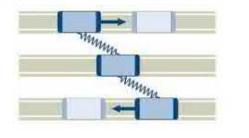
Figure P6.23 shows three identical carts placed on rails (so that they can slide easily left and right) and connected to one another by springs. There are two simple, symmetrical ways for this system to vibrate in the zeromomentum reference frame. One way is the sweeping- \(\mathrm{X}\) pattern
Consider two objects, A and B, of inertias \(m_{\mathrm{A}}\) and \(m_{\mathrm{B}} \gg m_{\mathrm{A}}\). If the two are moving at constant velocities with \(\vec{v}_{\mathrm{A}} eq \vec{v}_{\mathrm{B}}\), is the velocity of the zero-momentum reference frame closer to \(\vec{v}_{\mathrm{A}}\) or to
A \(4000-\mathrm{kg}\) dump truck is parked on a hill. The parking brake fails, and the truck rolls down the hill. It then coasts briefly along a horizontal stretch of road at \(36 \mathrm{~km} / \mathrm{h}\) before hitting a stationary \(1000-\mathrm{kg}\) car. The car sticks to the grill of the
Object A has ten times the inertia of object B. They approach each other with relative velocity \(\vec{v}_{A B}\) and collide elastically. For each object, draw a velocity-versustime graph for the interval starting a few seconds before the collision and ending a few seconds after the collision (a)
In an elastic collision between a lightweight object and a heavy object, which one carries away more of the kinetic energy? Does the answer depend on the initial speeds? (Begin with the zero-momentum reference frame for clarity.)
When two identical objects traveling at the same speed collide head-on, an observer standing in the Earth reference frame sees both objects changing direction. Do observers in every inertial reference frame that is moving relative to the Earth reference frame also see both objects changing
You toss a ball into the air and note the time interval between the ball leaving your hand and reaching its greatest height above you. While you are doing this, a construction worker being lifted on a hydraulic platform at constant speed also notes the time interval needed for the ball to reach its
A student runs an experiment with two carts on a low-friction track. As measured in the Earth reference frame, cart 1 ( \(m=0.36 \mathrm{~kg}\) ) moves from left to right at \(1.0 \mathrm{~m} / \mathrm{s}\) as the student walks along next to it at the same velocity. (a) What velocity
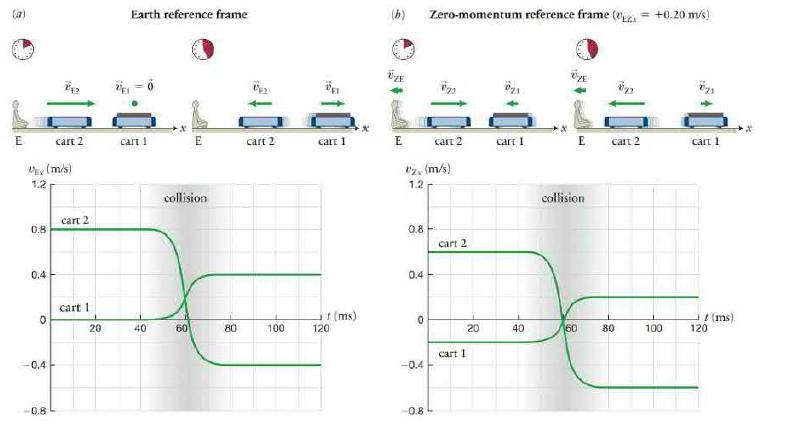
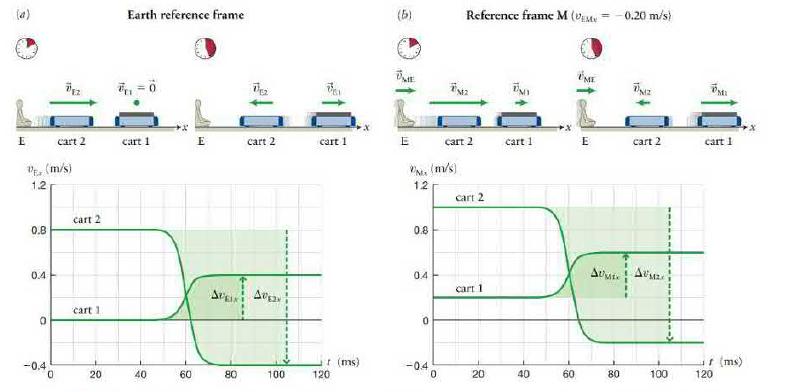
Notice that in Figure 6.12 the time intervals of the interaction are all the same, regardless of the reference frame shown. Is this true in all reference frames? Why or why not?Data from Figure 6.12 Earth reference frame (b) Zero-momentum reference frame (+0.20 m/s) E cart 2 cart 1 E cart 2 cart 1
In a three-car crash, car A bumps into the back end of car \(B\), which then goes forward and bumps into the back end of car C. Is the distance that car B moves between the collisions the same in all inertial reference frames?
Riding up an escalator while staying on the same step for the whole ride takes \(30 \mathrm{~s}\). Walking up the same escalator takes \(20 \mathrm{~s}\). How long does it take to walk down the up escalator?
A woman is on a train leaving the station at \(4.0 \mathrm{~m} / \mathrm{s}\), while a friend waving goodbye runs alongside the car she's in. (a) If the friend is running at \(6.0 \mathrm{~m} / \mathrm{s}\) and moving in the same direction as the train, how fast must the woman walk, and in which
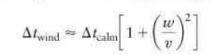
Airline pilots who fly round trips know that their round-trip travel time increases if there is any wind. To see this, suppose that an airliner cruises at speed \(v\) relative to the air. (a) For a flight whose one-way distance is \(d\), write an expression for the interval \(\Delta
The inertia of an object is \(m\) measured when the object is at rest in the Earth reference frame. According to Galilean relativity, what is its inertia measured by an observer moving past the object with a constant velocity \(\vec{v}\) in the positive \(x\) direction? What is the object's
At what distance from the center of Earth is the center of mass of the Earth-Moon system?
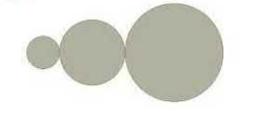
(a) Determine the location of the center of mass of the system shown in Figure P6.38. All three disks are made of sheet metal of the same material, and the diameters are \(1.0 \mathrm{~m}, 2. 0 \mathrm{~m}\), and \(3.0 \mathrm{~m}\). (b) Repeat the calculation for three solid spheres all made of
A boy and a girl are resting on separate rafts \(10 \mathrm{~m}\) apart in calm water when the girl notices a small beach toy floating midway between the rafts. The girl and her raft have twice the inertia of the boy and his raft. The rafts are connected by a rope \(12 \mathrm{~m}\) long, so she
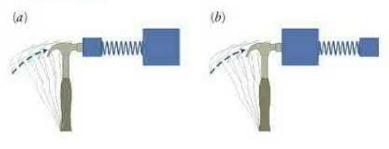
The two cubes in Figure P6.40 have different inertias. The cubes are connected to each other by a spring, and a hammer strikes them in the two ways, \((a)\) and \((b)\), shown in the figure. Assuming that the same impulse is transferred from the hammer, does the center-of-mass motion after the
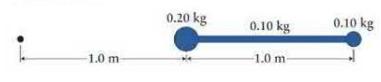
Determine the position of the center of mass of the baton shown in Figure P6.41, taking the origin of your coordinate axis to be \((a)\) the center of the larger ball, \((b)\) the center of the smaller ball, and \((c)\) a point \(1.0 \mathrm{~m}\) to the left of the larger ball. How much
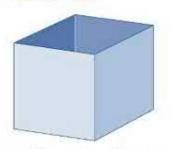
The empty cubical box shown in Figure \(\mathrm{P} 6. 42\) has no top face; that is, the box is made up of only five square faces. If all five faces have the same inertia, at what height above the bottom of the box is the center of mass?Data from Figure P6.42
How can you tell from the motion of the center of mass of an isolated system whether the reference frame from which the motion is measured is inertial?
Determine the center of mass of a pool cue whose diameter decreases smoothly from \(40 \mathrm{~mm}\) to \(10 \mathrm{~mm}\) over its \(1.40-\mathrm{m}\) length (Figure P6.44). Assume that the cue is made from solid wood, with no hidden weights inside, (Hint: See Appendix D for the center-of-mass
An object of inertia \(m_{1}\) collides totally inelastically with a stationary object of inertia \(m_{2}\). Plot the fraction of the kinetic energy lost as a function of \(m_{2} / m_{1}\) in the range \(m_{2} / m_{1}=0\) to \(m_{2} / m_{1}=4\), and discuss what happens as \(m_{2} / m_{1}\)
A 3. 0-g particle is moving toward a stationary 7. 0-g particle at \(3.0 \mathrm{~m} / \mathrm{s}\). What percentage of the original kinetic energy is convertible to internal energy?
Think of a system of two objects of different inertias \(m_{1}
(a) Is there a reference frame in which the kinetic energy of a system is a minimum? If so, what is this reference frame? (b) Is there a reference frame in which the kinetic energy of a system is a maximum? If so, what is this reference frame?
You hit a pitched baseball with a bat. In which reference frame is the translational (nonconvertible) kinetic energy greater: the reference frame in which the bat is at rest immediately before the collision or the reference frame in which the ball is at rest immediately before the collision?
What is the ratio \(K_{1} / K_{2}\) when \(K_{1}\) is the kinetic energy converted to internal energy when two cars each initially traveling ar \(88 \mathrm{~km} / \mathrm{h}\) collide head-on and \(K_{2}\) is the kinetic energy converted to internal energy when a car moving at \(88 \mathrm{~km} /
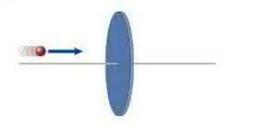
A \(0.075-\mathrm{kg}\) disk initially at rest in the Earth reference frame is free to move parallel to a horizontal bar through a hole at the disk's center. The disk is struck face-on by a \(0.050-\mathrm{kg}\) paintball traveling at \(11 \mathrm{~m} / \mathrm{s}\), as illustrated in Figure P6.51.
Take the common case where a moving object of inertia \(m_{\text {moving }}\) collides with a stationary object of inertia \(m_{\text {rest }}\). (a) Show that the fraction of kinetic energy not convertible in the collision is \(m_{\text {moving }} /\left(m_{\text {moving }}+m_{\text {rest
Ball 1 is moving toward you at \(10 \mathrm{~m} / \mathrm{s}\), and you decide to throw ball 2 at it to make it reverse its velocity. The balls collide head-on, and the coefficient of restitution for the collision is 0. 90 . (a) If ball 1 has an inertia of \(0.500 \mathrm{~kg}\) and ball 2 has an
Ball 1 from Problem 53 is moving away from you at \(5.0 \mathrm{~m} / \mathrm{s}\), and you decide to throw ball 2 at it to make it go faster. Onee again the balls collide head-on, and the coefficient of restitution for the collision is 0. 90 .(a) Given the inertias in Problem 53, how fast must
If the relative velocities are the same in both cases, which has more convertible kinetic energy: a collision between two objects each of inertia \(m\) or a collision between an object of inertia \(m_{1}\) and an object of inertia \(m_{2}
After coming down a slope, a 60-kg skier is coasting northward on a level, snowy surface at a constant \(15 \mathrm{~m} / \mathrm{s}\). Her \(5.0-\mathrm{kg}\) cat, initially running southward at \(3.8 \mathrm{~m} / \mathrm{s}\), leaps into her arms, and she catches it. (a) Determine the amount of
You toss a \(0.40-\mathrm{kg}\) ball at \(9.0 \mathrm{~m} / \mathrm{s}\) to a \(14-\mathrm{kg}\) dog standing on an iced-over pond. The dog catches the ball and begins to slide on the ice. (a) Measured from the Earth reference frame, what is the velocity of the dog immediately after he catches the
Instead of defining a reduced inertia \(\mu\) to characterize the convertible kinetic energy of a system, we could define a reduced velocity \(v_{\text {red }}\) as follows: For a system of two particles, one of inertia \(m_{1}\) and velocity \(v_{1}\) and the other of inertia \(m_{2}\) and
You learned about the zero-momentum reference frame. You may be curious whether there is such a thing as a zero-energy reference frame. Does a zero-kinetic energy reference frame always exist, never exist, or sometimes exist?
After a totally inelastic collision, the kinetic energy of an isolated system composed of two objects is zero. What was the momentum of the system in the same reference frame before the collision?
A mother penguin and her chick are on a flat, icy surface. The mother is lying at rest \(0.50 \mathrm{~m}\) from the edge of the water. The chick, which has one-fourth of its mother's inertia, is sliding, collides with her inelastically, and bounces back at one-eighth of its original speed. The
A \(50-\mathrm{kg}\) ice skater moves across the ice at a constant speed of \(2.0 \mathrm{~m} / \mathrm{s}\). She is caught by her \(70-\mathrm{kg}\) partner, and then the pair continues to glide together. He is at rest when he catches her, and immediately afterward they both coast. (a) What is
In an inertial reference frame F, an orange of inertia \(m_{\text {orange }}\) and velocity \(\vec{v}_{\text {orange }}\) collides totally inelastically with an apple of inertia \(m_{\text {apple }}\) initially at rest. (a) When this collision is viewed from an inertial reference frame \(G\), the
A \(50-\mathrm{kg}\) meteorite moving at \(1000 \mathrm{~m} / \mathrm{s}\) strikes Earth. Assume the velocity is along the line joining Earth's center of mass and the meteor's center of mass. (a) Calculate the amount of kinetic energy converted to internal energy measured from the Earth reference
A \(0.20-\mathrm{kg}\) softball is traveling at a velocity of \(20 \mathrm{~m} / \mathrm{s}\) to the east relative to Earth. It collides head-on with a 0. 40 \(\mathrm{kg}\) rubber ball traveling at a velocity of \(10 \mathrm{~m} / \mathrm{s}\) to the west. (a) If the system's kinetic energy, as
Derive an expression showing that when an elastic collision between two objects is viewed from the zero momentum reference frame, the direction of the momentum of each object is reversed and the magnitude of the change in momentum of each object is twice the magnitude of that object's initial
Just as a car passes a school crossing guard, a child throws a toy from the back seat of the car toward his sister in the front seat. The toy is thrown at a speed of \(2.0 \mathrm{~m} / \mathrm{s}\) relative to the car, and the car is traveling at \(10 \mathrm{~m} / \mathrm{s}\) relative to Earth.
A \(20-\mathrm{kg}\) child is sliding on an icy surface toward her mother at \(3.0 \mathrm{~m} / \mathrm{s}\). Her \(68-\mathrm{kg}\) mother starts toward her at \(2.0 \mathrm{~m} / \mathrm{s}\), intending to catch her. What percentage of the original kinetic energy is convertible?
An \(80-\mathrm{kg}\) man is walking ar \(2.0 \mathrm{~m} / \mathrm{s}\). A \(10-\mathrm{kg}\) dog is running at five times that speed in the same direction. At what speed and in what direction relative to the man would you have to be jogging in order for the dog to have the same momentum as the
One rider is in a descending clevator that is accelerating to a stop. Another is in an elevator that is accelerating upward from rest. With their eyes closed, can the riders tell which of the two elevators they are in?
You are in a noninertial reference frame observing two isolated objects of inertias \(m_{1}\) and \(m_{2}\) that move at constant speed relative to each other. What can you say about each object's \((a)\) apparent acceleration and(b) apparent change in momentum?
A bug of inertia \(m_{\mathrm{B}}\) collides with the windshield of a Mack truck of inertia \(m_{\mathrm{T}} \gg m_{\mathrm{B}}\) at an instant when the relative speed of the two is \(v_{\mathrm{BT}}\). (a) Express the system momentum in the truck's reference frame, then transform that expression
A \(0.045-\mathrm{kg}\) golf ball moving at \(50 \mathrm{~m} / \mathrm{s}\) (measured in the Earth reference frame) collides inelastically with a 1. 8 \(\mathrm{kg}\), heavy-duty plastic flowerpot sitting on a windowsill. The coefficient of restitution for the collision is 0. 50 . Calculate the
Asteroid \(\mathrm{A} 1, m_{\mathrm{A} 1}=3.60 \times 10^{6} \mathrm{~kg}\), and asteroid \(\mathrm{A} 2\), \(m_{\text {A2 }}=1.20 \times 10^{6} \mathrm{~kg}\), collide head-on in space. Approximate (rather poorly) the collision as being elastic. Observers watch the event from two space platforms.
A \(1500-\mathrm{kg}\) van is coasting to a stoplight at \(15 \mathrm{~m} / \mathrm{s}\). A \(1000-\mathrm{kg}\) car behind the van is doing the same thing at \(25 \mathrm{~m} / \mathrm{s}\) and crashes into the rear of the van. The bumpers collide with a coefficient of restitution of 0. 70 .(a)
A \(0.30-\mathrm{kg}\) cart traveling along a low-friction track at \(2.0 \mathrm{~m} / \mathrm{s}\) relative to Earth collides with a \(0.50-\mathrm{kg}\) cart traveling in the same direction at \(1.0 \mathrm{~m} / \mathrm{s}\) relative to Earth. If the system's kinetic energy measured in the
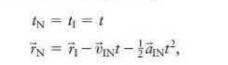
The transformation between position and time measurements in an inertial reference frame I and position and time measurements in a constantly accelerating (noninertial) reference frame \(\mathrm{N}\) is given bywhere \(\vec{v}_{\mathrm{IN}}\) is the velocity of the noninertial reference frame at
The medallion shown in Figure P6.79 has been made by cutting a small circular piece out of a larger circular disk. The diameter of the original disk is twice the diameter of the hole, and the thickness of the disk is uniform. You begin to wonder about the location of the center of mass of this
As an avid biker, you've come to realize that your top speed is really an air speed, not a ground speed, because air resistance is very noticeable when you ride fast. You like to ride at top speed for exactly an hour every day, and you know that on a calm day, you can ride \(20 \mathrm{~km}\)
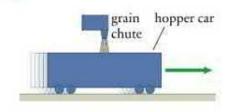
An uncoupled \(20,000-\mathrm{kg}\) railroad hopper car coasts along a track at \(2.0 \mathrm{~m} / \mathrm{s}\). As it passes a grain chute, the chute opens (Figure P6.81), grain fills the car at a rate of \(4000 \mathrm{~kg} / \mathrm{s}\) for \(5.0 \mathrm{~s}\), and the chute closes. (a) How
A skateboarder coasting at \(5.0 \mathrm{~m} / \mathrm{s}\) decides to coast into a friend going \(4.0 \mathrm{~m} / \mathrm{s}\) on rollerblades in the same direction. Unfortunately, the rollerblader stops right before the collision, too quickly for the skateboarder to react. The rollerblader
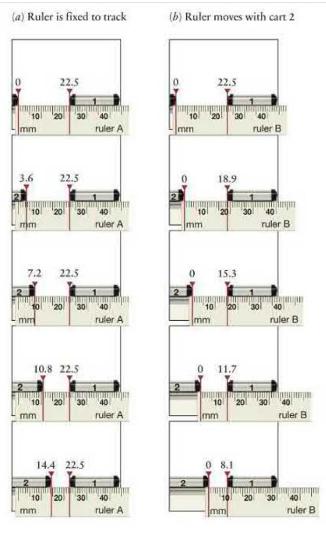
Suppose that in the situation shown in Figure 6.2, a third ruler is affixed to some device (not shown) that moves to the right along the track at a speed of \(2.0 \mathrm{~mm} /\) frame. If in the Earth reference frame cart 2 again moves at \(+3.6 \mathrm{~mm} /\) frame and cart 1 is again at rest,
Which of these reference frames are inertial: one affixed to (a) a merry-go-round, (b) the space shuttle orbiting Earth, (c) an airplane taking off, (d) a train moving at constant speed along a straight track?
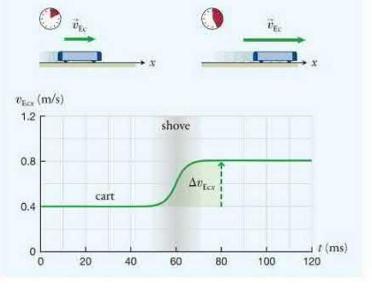
A \(0.12-\mathrm{kg}\) cart moving on a straight, low-friction track gets a shove so that its speed changes. Its initial and final speeds measured in the Earth reference frame are \(0.40 \mathrm{~m} / \mathrm{s}\) and \(0.80 \mathrm{~m} / \mathrm{s}\) (Figure 6.9). Determine the change in the
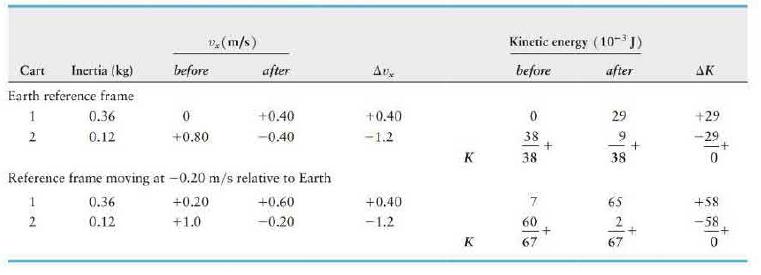
Consider a collision between the two carts of Table 6.1, starting from the same initial velocities, but with \(v_{\mathrm{EI} x, \mathrm{f}}=+0.30 \mathrm{~m} / \mathrm{s}\). Make a table like Table 6.1 for this situation, and compare the amount of kinetic energy converted to internal energy in the
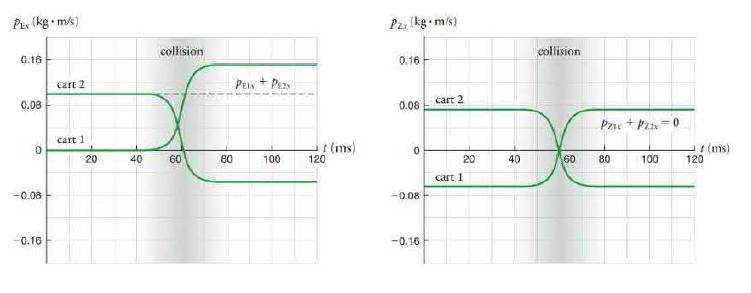
For the colliding carts in Figure 6.8,(a) determine the velocity of the zero-momentum reference frame relative to Earth and \((b)\) show that the system momentum measured in the zero-momentum reference frame is zero both before and after the collision.Data from Figure 6.8 (a) Earth reference frame
You are driving at \(25 \mathrm{~m} / \mathrm{s}\) on a straight, horizontal road when a truck going \(30 \mathrm{~m} / \mathrm{s}\) in the same direction overtakes you. Let the positive \(x\) direction point in the direction of travel, and let the origins of the reference frames affixed to your
The positions of two identical carts at rest on a low-friction track are measured relative to two axes oriented in the same direction along the track. On axis \(\mathrm{A}\), cart 1 is at \(x_{\mathrm{A}}\) and cart 2 is at \(x_{\mathrm{A} 2}\). On axis B, cart 1 is at the origin and cart 2 is at
Showing 4300 - 4400
of 4962
First
36
37
38
39
40
41
42
43
44
45
46
47
48
49
50
Step by Step Answers

 Get 50% OFF
Claim Now
Get 50% OFF
Claim Now