New Semester
Started
Get
50% OFF
Study Help!
--h --m --s
Claim Now
Question Answers
Textbooks
Find textbooks, questions and answers
Oops, something went wrong!
Change your search query and then try again
S
Books
FREE
Study Help
Expert Questions
Accounting
General Management
Mathematics
Finance
Organizational Behaviour
Law
Physics
Operating System
Management Leadership
Sociology
Programming
Marketing
Database
Computer Network
Economics
Textbooks Solutions
Accounting
Managerial Accounting
Management Leadership
Cost Accounting
Statistics
Business Law
Corporate Finance
Finance
Economics
Auditing
Tutors
Online Tutors
Find a Tutor
Hire a Tutor
Become a Tutor
AI Tutor
AI Study Planner
NEW
Sell Books
Search
Search
Sign In
Register
study help
physics
particle physics
Particle Physics 4th Edition Brian R. Martin, Graham Shaw - Solutions
If pp̅ annihilation at rest proceeds via S-states, explain why the reaction pp̅ → π0π0 is forbidden as a strong or electromagnetic interaction.
The reaction e+e− → τ+τ− is studied using a collider with equal beam energies of 5 GeV and with the collision point at the centre of the detector. The latter is of cylindrical construction and at increasing radii from the beam line there is a drift chamber, an electromagnetic calorimeter, a
Estimate the mean distance travelled by a resonance produced in a reaction like (3.26a) with γ = E/m ≈ 10, before it decays by a process like (3.26b). Compare this with the shortest distance that can be resolved experimentally (of order 1 mm) and with the range of the strong interactions. Why is
Show that for any electromagnetic potentials (ɸ,A) there are many possible choices of gauge-transformed potentialssuch that the Lorentz condition (D.11) is satisfied. af φ=φ+ Ət A = Á – Vf, дФ + V·A = 0. дt (D.11)
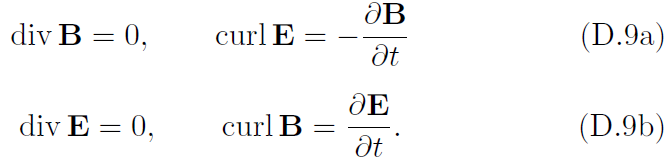
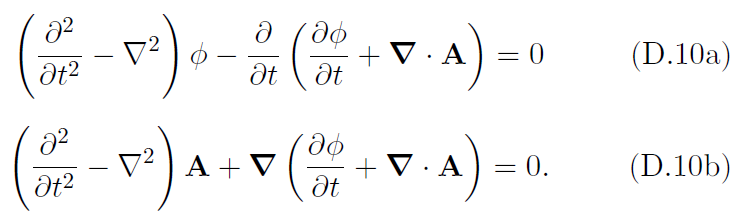
Show that Maxwell€™s equations in free space (D.9) reduce to (D.10) when expressed in terms of the potentials (D.4). ДА E = -Vø – дt (D.4) В - VхА. ▼ × B ƏB div B = 0, curl E (D.9a) дt ƏE div E = 0, curl B (D.9b) дt
Verify that the Dirac equation in the presence of an electromagnetic field (D.18) is gauge invariant, as stated in the text. д + iqo ) V = -ia · (V – iqA) V + ßm¥, (D.18) дt
Verify (8.21b) by explicitly evaluating the integral (8.21a).
Elastic lepton scattering (8.1) can be regarded as a special case of inelastic scattering (8.26) in which the final hadronic state X is a single proton. Find the corresponding value of the scaling variable (8.29). Hence show that in the rest frame of the proton, the initial (E) and final (E')
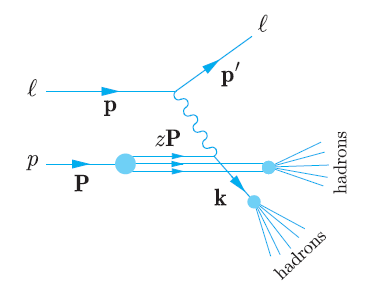
According to (8.33), the fraction z of the proton momentum carried by the struck parton in Figure 8.4 is equal to the scaling variable x if certain approximations are made. These are: the proton momentum P is much larger than its mass, that is |P| >> M; the masses and transverse momenta of
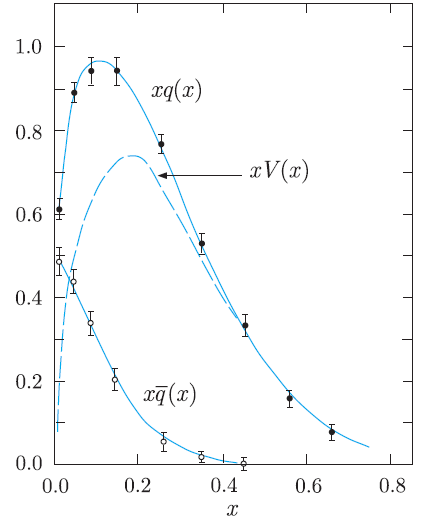
Use the quark distributions of Figure 8.7 to make a rough estimate of the fraction of the proton momentum in a high-momentum frame that is carried by its quark and antiquark constituents. To what would you ascribe the €˜missing momentum?Figure 8.7 1.0 xq(x) 0.8 -xV(x) 0.6 0.4 0.2 rą(x)
Derive the Gottfried sum rule,where the quark distributions refer to the proton. | [F} (2) – F (x)] dr 3+5, (a(z) – d(x)] dæ, 0.
Show that: (a) The difference between two rapidities y1 and y2 is invariant under a Lorentz transformation along the beam direction; (b) The rapidity reduces to the pseudorapidity if the mass of the jet or particle referred to can be neglected compared to its energy.
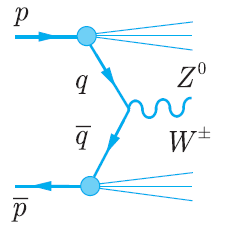
Generalise the Drell€“Yan production formula (8.62) to apply to the reaction Ï€ˆ’p †’ μ+μˆ’X. Then show that, under reasonable assumptions, the ratioas M2 †’ s, where C is a carbon-12 nucleus and M is the
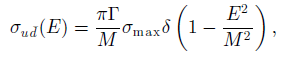
(a) The cross-section σ(udÌ… †’ W+) near the mass of the W+is given by a Breit€“Wigner formula (3.34b). For σ(udÌ… †’ W+) this may be written aswhere (M,Γ) are the mass and total width of the W+,
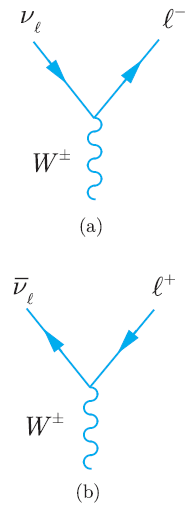
Show that the vertices of Figure 9.4 are the only possible abW vertices allowed by charge and lepton number conservation, where a and b can be any lepton or antilepton.Figure 9.4 (a) ,ק W+ (b)
The mechanisms of muon decay (9.4) and the semileptonic decay of the charmed quark (9.21a) are essentially the same. Use this to estimate the rate for the charmed quark decay, assuming that its mass is 1.5 ± 0.1GeV/c2 and the masses of final state particles may be neglected in both decays.
The charmed particle decays,D+(1869) → e+ + anything, D0(1869) → e+ + anything, Λ+c (2285) → e+ + anything,are usually assumed to result from the charmed quark decay c → s + e+ + νe discussed in the previous problem. Assuming that the effects due to quark binding can be neglected, use the
Classify the following semileptonic decays of the D+(1869) = cd̅ meson as Cabibbo-allowed, Cabibbo-suppressed or forbidden in lowest-order weak interactions, by finding selection rules for the changes in strangeness, charm and electric charge in such decays:(a) D+ → K− + π+ + e+ +
Draw quark diagrams for the decays (a) D0 → K− + π+ and (b) D0 → K+ + π−. Estimate the ratio of their decay rates and compare this to the measured values.
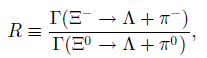
Hadronic strangeness-changing weak decays approximately obey the ΔI = 1/2 rule, that is the total isospin changes by 1/2 in the decay. By adding a fictitious strangeness zero I = 1/2 boson S in the initial state, find the prediction of this rule for the ratioassuming that the state
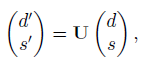
Show that an arbitrary n × n unitary matrix has n2real parameters, and hence thatis the most general form of a 2 × 2 unitary matrix. The most general form of (d, s) mixing iswhere U is an arbitrary 2 × 2 unitary matrix, UU = 1. Show that this can be reduced to
Show that if (9.17) were exact, then (9.43) would follow exactly, since the CKM matrix Vαβ is a unitary matrix.
Use the method of dimensions to show thatif W-exchange is approximated by a zero-range interaction and the masses of all final-state particles are neglected. If quark mass corrections are taken into account, this result is modified toWheref(x) = 1 ˆ’ 8x2 ˆ’ 24x4 ln(x) + 8x6
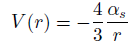
If the top quark were stable, the low-lying states of toponium ttÌ… could be approximated by non-relativistic motion in a Coulomb potential (cf. Equation (7.2a))with αs ‰ˆ 0.1. Use the simple Bohr model to calculate the radius of the ground state and the time
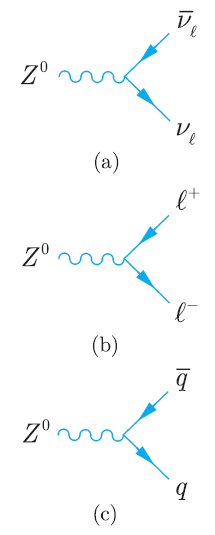
Show that the vertices of Figure 10.3 are the only possible vertices abZ0 allowed by charge and lepton number conservation, where a and b can be any lepton or anti lepton.
Which of the following processes are allowed in electromagnetic interactions and which are allowed in weak interactions via the exchange of a single W± or Z0?(a) K+ → π0 + e+ + νe, (b) K+ → π+ + e+ + e−, (c) Σ0 → Λ0 + e+ + e−, (d) Σ0 → n + νe + ν̅e.
The reaction (10.6b) is forbidden to occur via lowest-order weak interactions like Figure 10.5(b). However, it can proceed by higher order diagrams involving the exchange of two or more bosons. Draw examples of such diagrams. Make a simple dimensional estimate of the ratio of decay rates (10.7).
Draw the dominant Feynman diagrams for the reaction e+ + e− → νe + ν̅e. Estimate the order of magnitude and energy dependence of the corresponding contributions to the total cross-section for centreof- mass beam energies me << E << MW, MZ.
If small corrections of order (mf/MZ)2are neglected, the partial width for Z0†’ ffÌ… arising from the lowest-order diagrams of Figure 10.12 are given bywhere qf is the electric charge of the fermion in units of e, θw is the weak mixing angle and where the plus
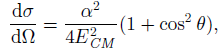
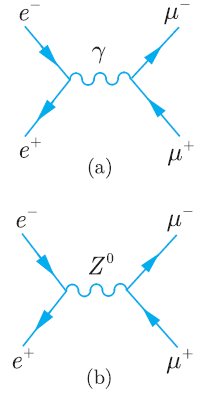
The centre-of-mass differential cross-section for the reaction e+eˆ’†’ μ+μˆ’due to the one-photon exchange diagram in Figure 10.2(a) is given in Equation (7.15),where s = E2CM, θ is the scattering angle and we have, as usual,
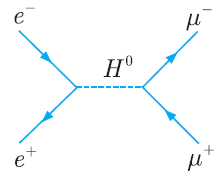
In our discussion of the reaction e++ eˆ’†’ μ++ μˆ’, we completely neglected the Higgs exchange diagram of Figure 10.30, compared with the dominant diagrams of Figures 10.2(a) and (b). Since the Higgs contribution is obviously largest at
Suppose that the reaction e+e− → Z0H0 was to be studied at a centre-of-mass energy of 500 GeV in a collider operating for 107s per year. Given that the cross-section at this energy is approximately 65 fb, what instantaneous luminosity (in units of cm−2s−1) would be needed to collect 2000
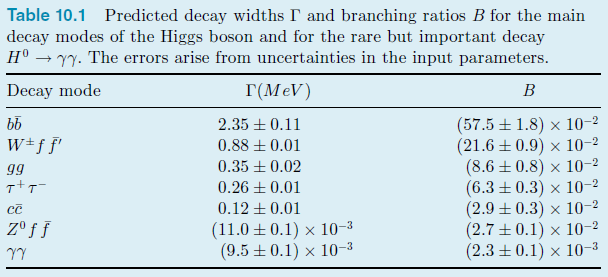
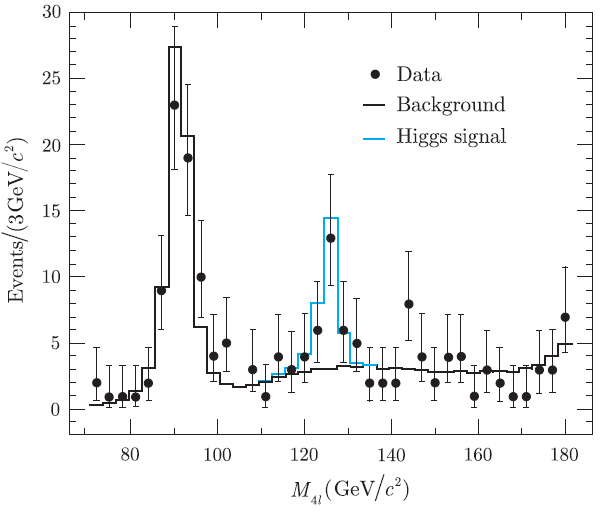
Estimate the branching ratios for the four-lepton decays (10.58) and (10.60) of the Higgs boson by relating them to the branching ratios for other reactions listed in Table 10.1. Use your answers to estimate the average total number of Higgs decays (10.58) for an LHC energy of 7€“8 TeV,
Draw the dominant lowest-order diagrams for the double Higgs boson production reaction e+e− → H0H0Z0 at a total centre-of mass energy of 500 GeV.
Show that the existence of the decays K+ → π+π0 and K+ → π+π+π− implies that parity is violated if the kaon is assumed to have spin 0.
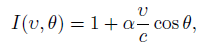
The intensity of the electrons emitted in the decay (11.1) of polarized cobalt-60 nuclei is found to be consistent with the formwhere υ is the magnitude of the electron velocity v and θ is the angle between its direction and the direction of the 60Co spin. Deduce the value
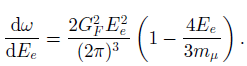
Neglecting the electron mass, the energy spectrum for the electrons emitted in muon decay is given by What is the most probable energy for the electron? Draw a diagram showing the orientation of the momenta of the three outgoing particles and their helicities for the case when Ee ‰ˆ
Show that the total decay rates for the reactions K0 → π−e+ν̅e and K̅0 → π−e− ν̅e are equal if CP is conserved.
By decomposing the π0π0state into components of definite isospin I, using the methods given in Appendix C, it can be shown thatwhere the phase factors are due to the strong interaction between the final-state pions and the superscripts (0, 2) refer to the isospin of the
At Super KEKB it is planned to collide 4 GeV positrons with 7 GeV electrons to form Υ(4S) particles. If the latter decay to B± particles with equal energies, how far will they travel on average before decaying? (The B± particles have masses of 5.28 GeV/c2 and lifetimes of 1.64 × 10⁻¹² s.)
Four mesons each of mass 5280MeV/c2 are produced in a B factory and observed to decay to(a) D̅0 π− μ+νμ, (b) ρ + K−, (c) ρ + π−, (d) D− D+ s, where ρ+ is the resonance discussed in Section 6.2.1. Is it possible to distinguish between a B0 and a B̅0 in each
Derive the formulas (11.77a) and (11.77b) for CP violation in mixing.
Compare the expansions (11.61a) and (11.61b) for mesons Ma and Mb with expansions of the form (11.33a) and (11.33b) for K0S and K0L, respectively, and show that in the case of no violation in mixing, (11.63c) implies ε = i tan β.
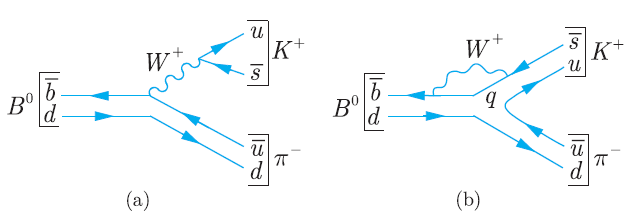
Estimate the relative importance of the contributions of Figures 11.15(a) and (b) to the amplitude for the decay B0†’ K+Ï€ˆ’.Figure 11.15 (a) and (b) и K+ K+ и Bº Bº и (a) (b)
Explain why you might expect significant direct CP violation in B̅0 → π+π− decays and discuss its possible importance in B̅0 → D+D− decays.
List the independent, continuously variable parameters of the standard model, whose values must be determined from experiment. How many are there in total?
What would be the energy of a positron if it were emitted from the decay p → π0 + e+ of a proton at rest? If such an event were observed in the Super Kamiok and e detector, what would be the emission angle of the resulting C̆erenkov radiation, given that the refractive index of water is
Consider a star moving with velocity υ in a circular orbit of radius R about the centre of a spiral galaxy. Calculate the dependence of υ on R for the following extreme cases.(a) The total mass of the galaxy, like the luminous mass, is concentrated almost entirely at the centre of the galaxy.(b)
Consider a collision between a cosmic ray proton and a photon in the cosmic microwave background whose energy corresponds to the ambient temperature of 2.7 K. Estimate the minimum proton energy required to produce (a) An e+e− pair, (b) A proton–anti proton pair.
In the text, it is stated that if dark matter consisted entirely of WIMPs of mass 60 GeV/c2, the number of WIMPs passing through each square centimetre of the Earth’s surface would be of order 105, with velocities of order 2 × 10³m/s. Use these assumptions to deduce the approximate value of the
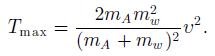
A WIMP of mass mwand velocity Ï… << c scatters elastically from a stationary nucleus of mass mA. Show that the maximum kinetic energy imparted to the nucleus is For a given mw, what value of mA leads to the maximum value of Tmax and what is its value if mw = 60GeV/c2 and
Show that the electric field E is odd under parity but even under time reversal, as stated in the discussion of electric dipole moments in Section 12.4.3. How does the magnetic field B behave under P and T?
Following the supernova explosion 1987A at a distance d = 1.5 × 10²¹ m, a burst of ν̅e interactions was observed in a terrestrial detector. The interactions occurred over a time interval of 7 seconds and the anti neutrinos had a range of energies between 7 MeV and 11 MeV. Use this to estimate an
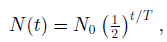
Show that the half-life T ‰¡ T1/2is related to the mean life Ï„ by T = Ï„ ln 2 and that the exponential decay law can be written in the form
Derive an expression for the muon energy in the decay π+ → μ+ + νμ in terms of the pion, muon and neutrino masses for the case of pions at rest.
A particle of mass m decays in flight to give two photons of energies E1 and E2. Show that the opening angle θ between the photon directions is given bycos θ = 1− m2c4/2E1E2(Several short-lived particles – for example π0(140), η0(547) – can decay in this way, and since they have different
Calculate the lowest energy at which Λ(1116) baryons can be produced in the strong interaction of negative pions with protons at rest.
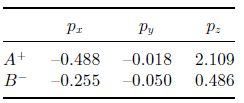
A neutral particle X0decays to two charged particles A+and Bˆ’. The momentum components of the decay products in GeV/c are measured to be:Is the decay K0S(498) †’ Ï€+Ï€ˆ’ or Λ(1116) †’ pÏ€ˆ’? Pr Py P: A+
(a) Find the maximum values of velocity υ and γ if the non-relativistic approximation for energy, E ≈ mc2 + p2/2m, is to be used with an error less than εp2/2m. Hence show that for an error of 1%, the momentum satisfies p ≈ 0.2mc.(b) Find the minimum values of velocity υ and γ if the
Three particles, labelled 1, 2, 3, are produced in a given experiment at a fixed centre-of-mass energy. Ifshow that the sum of the squared invariant masses is m,с3 (Е, + E,)* - (р. + Рә)°е, т; 3 m,c+ m, ' + mj1ed-EGMΣmξd. + mž c ΕOM +Σπ'. i=1
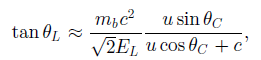
When high-energy particles decay, the decay products emerge predominantly at very small angles θLto the initial beam direction. Verify this by showing that for decays of the formb(EL, pL) †’ P(E, q) + · · ·the decay angle θL defined bypL
A liquid hydrogen target of volume 10−4 m3 and density 71 kg/m3 is exposed to a wide uniform mono energetic beam of negative pions of flux 107 particles/(m2 s) and the reaction π−p → K0Λ is observed. If the cross-section for this reaction is 0.4 mb, what is the rate of production of Λ
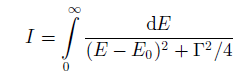
(a) Verify by explicit integration that the integralis left unchanged by the substitution (B.47a) in the limit that Γ/E0 †’ 0 at fixed E0.(b) Show that (B.47a) and (B47b) are compatible close to the resonance if Γ << E0. I (E – Eo)² +T² /4
Use the relations (C.1) and (C.3) to verify the commutation relations (C.2). [,. 3.]= iJ, [J. J.] = iJ., [J1] = id, (C.1) [J,3-] = 2.3, [3, JA] = +J4, (C.2)
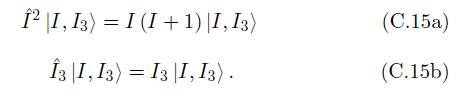
Use the relations (C.16) and (C.17) to show that the 2I + 1 members of an isomultiplet {I, I3} all have the same energy if isospin is conserved. Î4 |I, I3) = C+(I, I3) |I, I3 ± 1) , (C.16a) C+ (I, I3) = +[(I+ I3)(I ± I3 + 1)]'/². (C.16b)
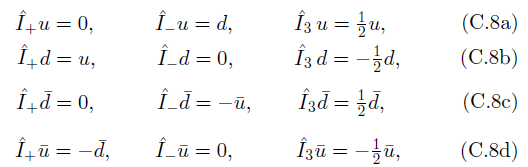
Use the definitions (C.8) to verify that (C.15) and (C.16) are satisfied for the quark and anti quark assignments (C.19). (C.8a) Î_u = d, Î_d = 0, Îz u = žu, Îz d = -d, Îzd = }d, Î4u = 0, Î̟d = u, Î4d = 0, (C.8b) (C.8c) Î_d = -ū, (C.8d) Î_ū = 0, Îzū = -jū, ÎĻū = -d, Î̟r =
A resonance X0(1520) decays via the strong interaction to the final states nπ0 and pπ− with branching ratios of approximately 18% and 36%, respectively. What is its isospin?
The Λ(1405) resonance decays by the strong interaction to Σπ final states with a branching ratio of 42%. What are the individual branching ratios for the charged modes Σ+π−,Σ0π0 andΣ−π+ if the Λ(1405) is an isosinglet state?
Show that Hamilton€™s equations of motionlead to the equations of motion (D.5) for a charged particle in an electromagnetic field if the Hamiltonian is of the form (D.3), where r = (x1, x2, x3) ‰¡ (x, y, z). не (і %3D1, 2, 3) Ән pi = дх, др: (р-ДА)? + qф, 2m Н-
Show that the gauge transformation (D.8) used in our discussion of QED can be written as two successive electroweak gauge transformations of the form (D.58) and (D.66).
Our treatment of the electroweak interactions of massless leptons may be extended to massless quarks by invoking lepton€“quark symmetry between the doublets (νe, eˆ’) and (u, d) where we neglect quark mixing.(a) What are the appropriate weak isospin and hyper
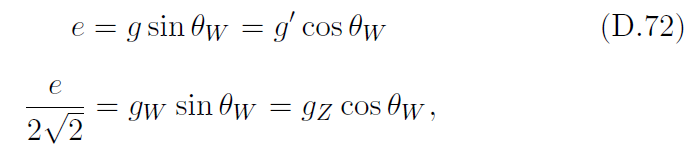
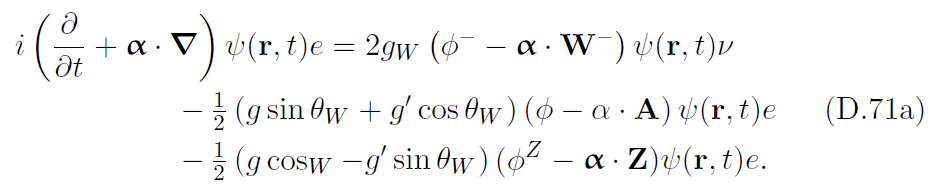
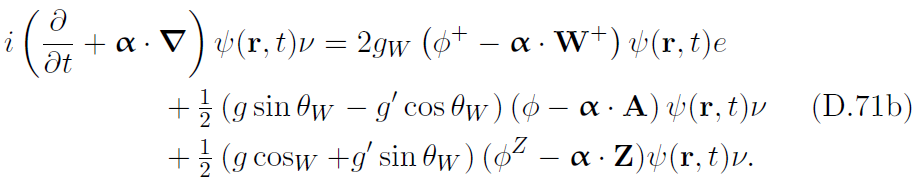
How would you modify your answer to Problem D.6 to take account of mixing between the quark doublets (u, d) and (c, s)? In particular, obtain the equations analogous to (D.71a) and (D.71b) for left handed d and s quarks, instead of electrons. Hence confirm that the charged current couplings are
Derive (4.24b) from (4.24a).Equation 4.24aEquation 4.24bhÌ…wp= [Ï(g/cm3){Z/A}]1/2 × 28.81 eV, -(47Ner?)!/2m,&². %3D ħwp
A charged particle moving with speed υ through a medium of refractive index n emits C̆erenkov radiation at an angle θ to the direction of the particles.(a) What is the maximum angle of emission and to what limit does it correspond?(b) If the momentum p of the
Use the model for electromagnetic showers of Section 4.4.6 to show that (a) the energy spectrum of all the secondaries contained in the shower falls approximately like E−2 for E0 >> E > EC and (b) the sum of the track lengths of all charged secondaries is approximately proportional
The reaction e++ eˆ’†’ μ++ μˆ’is studied using a collider with equal beam energies of 3 GeV. The differential cross-section in natural units is given bywhere ECM is the total centre-of-mass energy and θ is the angle between the
Use the standard commutation relations for angular momentum operators to show that L and S remain good quantum numbers if the spin-dependent forces arise from a simple spin–orbit interaction, that is if H = H0 + αL̂ · Ŝ,Where[H0, L̂] = [H0, Ŝ] = 0and α is a constant.
Show that parity invariance (5.31) leads to parity conservation, that is [H, P̂] = 0, where P̂ Ψ(r1 , r2, . . . , t) = P1P2 · · · Ψ(−r1,−r2, . . . , t).Equation 531H(r'1, r'2, . . .) = H(−r1,−r2, . . .) = H (r1, r2, . . .).
The deuteron is a bound state of a proton and a neutron with spin 1 and positive parity. Show that it may only exist in the 3S1 and 3D1 states of the np system.
Assuming that exotic states exist in the su̅sd̅ system, express in spectroscopic notation the lowest states that would be expected and give their corresponding JP values.
Why is the reaction π− + d → n + n + π0 effectively forbidden for a π− at rest, but proceeds at a normal rate for a strong reaction at higher energies?
The η(549) meson has spin-0 and is observed to decay to three-pion final states by the electromagnetic processes (5.57b) and (5.57c). Use this information to deduce the parity of the η, and hence explain why the decays η → π + π− and η → π0π0 have never been observed. Equation
List the JPC values of all possible qq̅ states with (a) L = 0 and (b) L = 1.
A neutral spin-2 meson M0 can decay via the strong interaction to a π+π− final state. Use this to deduce its parity and charge conjugation quantum numbers.
Suppose that an intrinsic C-parity factor Ca is introduced into (5.50b), which then becomes Ĉ |α, Ψ} = Ca |α̅, Ψ} and analogously Ĉ |α̅, Ψ} = Cα̅ |α, Ψ}. Show that the eigenvalue corresponding to any eigenstate of Ĉ is independent of Cα, so that Cα cannot
Use the conservation of angular momentum and parity to determine possible angular momentum states in the reaction p + p̅ → π+ + π− and express the allowed transitions in spectroscopic notation for initial states in which the orbital angular momentum is L = 0, 1 or 2. Does taking account of C
Consider a hydrogen-like atom composed of a negative muon and a positron. What would be its ground-state energy, ignoring fine structure? What would be the splitting between the corresponding 3S1 and 3S0 states when fine structure is taken into account?
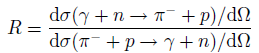
What is the value of the ratioIf the centre-of-mass momentum of the pion is q = 200MeV/c? (Despite having spin 1, the photon has only two distinct spin states, corresponding to the two polarisation states of electromagnetic waves.) do (y +n → T do (T¯ + p → y + n)/dN +p)/dN R =
What is the behavior of the electric and magnetic fields E(r, t) and B(r, t) under the operation of time reversal?
Show that the two definitions (6.5) and (6.7) of the third component of isospin are equivalent.
The hadron Σ+c (2455) is observed to decay by Σ+c → Λ+c + π0 with a rate typical of strong interactions, where Λ+c is the isosinglet hadron (3.21). Deduce the values of the quantum numbers (3.35) and hence the quark content of the Σ+c. Does it possess any isospin partners, and if so what is
In the simple model of the Σ baryon mass splittings discussed in Section 6.1.4, the electromagnetic interaction energy between two quarks a and b was assumed to be of order δeaeb , where ea and eb are the quark charges in units of e. Deduce the value of δ obtained from the observed Σ baryon
Show that a meson that decays to π+π− pairs by the strong interaction must have C = P = (−1)J, where J is the spin of the meson. The ρ0(775) and f20 (1275) mesons decay by strong interactions to give π+π− pairs and have spin-1 and spin-2, respectively. Which of the decays ρ0 → π0γ
In Section 6.2.2 we assumed that the combined space–spin wave function of a baryon was symmetric under the interchange of any pair of like quarks. What spectrum of low-lying baryon states composed of light quarks with zero orbital angular momenta L12 = L3 = 0 would be predicted if, instead, we
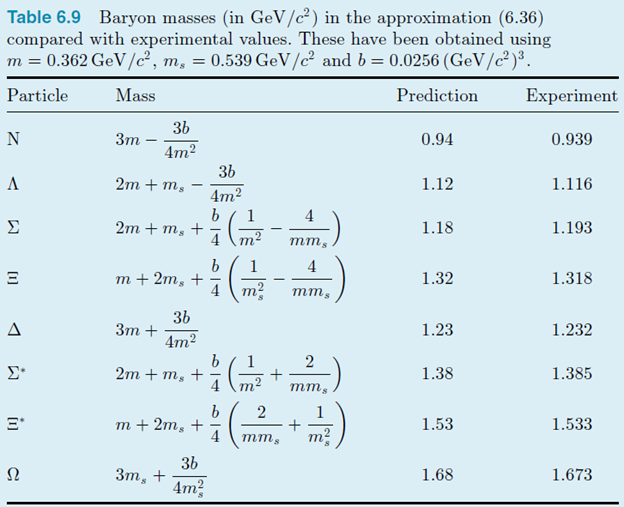
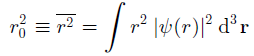
In Section 6.2.4 we used (6.36) to derive the masses of the Λ and Σˆ—baryons in Table 6.9. Derive the mass formulas for the remaining baryons listed in this table.25These analyses also determine the mean square radii of the various states, where the
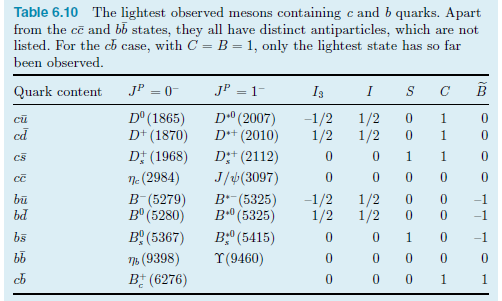
The branching ratios for the decays of the Dˆ—0(2007) (listed in Table 6.10) to D0Ï€0and D0γ are 0.62 and 0.38, respectively, while the branching ratios of the Dˆ—s+(2112) to D+sÏ€0and D+sγ are 0.06 and 0.93, respectively. Table
In the text we considered the simple quark model predictions for the baryons with angular momenta L12 = L3 = 0 containing 0 or 1 of the heavy quarks b,c. Extend this to baryons with (a) C = 2, B̃ = 0 and (b) C = 1, B̃ = −1, and draw the weight diagram for the supermultiplet in each
Calculate the quark model prediction for the magnetic moment of the Σ0(1193).
In Section 6.4.2 we showed that the confinement condition F̂1χCB = 0 led to the conditions α1 = −α2, α3 = −α4, α5 = −α6 for the coefficients αi in the general color wave function for baryons (6.55). Find the conditions resulting from the other confinement conditions (6.53). Show that
Use the methods of Appendix C to show that a state with I = 1, I3 = 0 cannot decay to π0π0 by strong interactions. Hence show that the d∗ resonance produced in reaction (6.46) has isospin zero, given that the deuteron has I = 0.
Showing 4800 - 4900
of 4962
First
36
37
38
39
40
41
42
43
44
45
46
47
48
49
50
Step by Step Answers

 Get 50% OFF
Claim Now
Get 50% OFF
Claim Now






![| [F} (2) – F (x)] dr 3+5, (a(z) – d(x)] dæ, 0.](https://dsd5zvtm8ll6.cloudfront.net/si.question.images/images/question_images/1544/1/9/5/4625c0a8d86d13311544178019187.jpg)

![12тГ Гиd M?/4(Е — М)? + Г?] Oud](https://dsd5zvtm8ll6.cloudfront.net/si.question.images/images/question_images/1544/1/9/5/8855c0a8f2d8e4111544178441865.jpg)











![[,. 3.]= iJ, [J. J.] = iJ., [J1] = id, (C.1)](https://dsd5zvtm8ll6.cloudfront.net/si.question.images/images/question_images/1544/4/3/3/3485c0e2ec42288a1544415917720.jpg)
![[J,3-] = 2.3, [3, JA] = +J4, (C.2)](https://dsd5zvtm8ll6.cloudfront.net/si.question.images/images/question_images/1544/4/3/3/3575c0e2ecd0245e1544415926593.jpg)


![C+ (I, I3) = +[(I+ I3)(I ± I3 + 1)]'/². (C.16b)](https://dsd5zvtm8ll6.cloudfront.net/si.question.images/images/question_images/1544/4/3/3/4185c0e2f0a4ab211544415987874.jpg)





![V (r, t) → V'(r, t) = exp[-iqf(r, t)] V (r, t), (D.8)](https://dsd5zvtm8ll6.cloudfront.net/si.question.images/images/question_images/1544/4/3/6/1135c0e3991d389b1544418683349.jpg)