New Semester
Started
Get
50% OFF
Study Help!
--h --m --s
Claim Now
Question Answers
Textbooks
Find textbooks, questions and answers
Oops, something went wrong!
Change your search query and then try again
S
Books
FREE
Study Help
Expert Questions
Accounting
General Management
Mathematics
Finance
Organizational Behaviour
Law
Physics
Operating System
Management Leadership
Sociology
Programming
Marketing
Database
Computer Network
Economics
Textbooks Solutions
Accounting
Managerial Accounting
Management Leadership
Cost Accounting
Statistics
Business Law
Corporate Finance
Finance
Economics
Auditing
Tutors
Online Tutors
Find a Tutor
Hire a Tutor
Become a Tutor
AI Tutor
AI Study Planner
NEW
Sell Books
Search
Search
Sign In
Register
study help
physics
particle physics
Principles And Practice Of Physics 2nd Edition Eric Mazur - Solutions
You want to hang an object from the ceiling of an elevator that has a maximum acceleration of \(4.0 \mathrm{~m} / \mathrm{s}^{2}\). (a) If you hang the object with fishing line that supports \(45 \mathrm{~N}\) of force, what is the maximum inertia the object can have if the line is not to break?
You need to lower a \(45-\mathrm{kg}\) safe from a window to the bed of a \(1800-\mathrm{kg}\) truck. You have a rope that is just long enough, but it will support no more than \(42 \mathrm{~kg}\). What must you be careful to do (or not to do) so that the rope does not break?
A \(10-\mathrm{kg}\) cart is connected to a \(20-\mathrm{kg}\) cart by a relaxed spring of spring constant \(1000 \mathrm{~N} / \mathrm{m}\), and both carts are placed on a low-friction track. You push the \(10-\mathrm{kg}\) cart in the direction of the \(20-\mathrm{kg}\) cart with a constant force
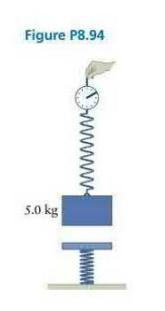
A 5. 0-kg block suspended from a spring scale is slowly lowered onto a vertical spring (Figure P8.94). (a) What does the scale read before the block touches the vertical spring? (b) If the scale reads \(40 \mathrm{~N}\) when the bottom spring is compressed \(30 \mathrm{~mm}\), what is \(k\) for the
You need to lift a heavy load of inertia \(m_{c}\) upward with an acceleration of magnitude \(g / 8\). You have two pulleys of inertia \(m_{\mathrm{p}} \ll m_{i}\), one attached to a beam above the loading dock and another that can be attached to the load. You consider a block-and-tackle system,
You and your uncle are fishing. You are using 22-N fishing line, which means the line can support that much tension without breaking. Your uncle challenges you to catch the biggest fish you can land in the boat with that line, with the provision that you have to hoist the fish out of the water with
Your \(70-\mathrm{kg}\) friend always thinks he can dominate you in contests of strength because, even though you are a very athletic gymnast, your inertia is \(63 \mathrm{~kg}\). This time, while the gym class watches, he has attached a pulley to the ceiling of the gym, passed a rope over it, and
A burst of compressed air pushes a pellet out of a blowpipe. The force exerted by the air on the pellet is given by \(F(t)=F_{0} e^{-t / \tau}\), where \(\tau\) is called a time constant because it has units of time. (a) What does \(F_{0}\) represent? (b) What is the momentum of the pellet after an
Thrust is the force that pushes a rocket forward. It is a force exerted on the rocket as the engine expels hot gases from the rear of the rocket. For most rockets, thrust is variable rather than constant during the "burn time" (the time interval during which fuel is consumed and expelled). However,
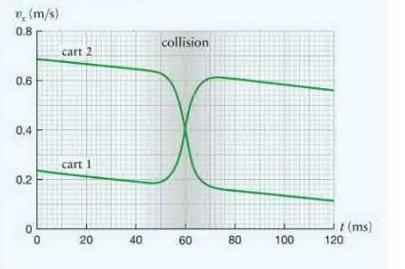
Figure 4.11 shows the \(v_{x}(t)\) curves for a collision between two identical carts moving not on a low-friction track but rather on a rough surface, so that friction affects their motion. Are the changes in the velocity of the carts caused by the collision still equal in magnitude?Data from
Cite at least two possible choices of system in each of the following situations. For each choice, make a sketch showing the system boundary and state which objects (excluding air) are inside the system and which are outside. (a) After you throw a ball upward, it accelerates downward toward Earth.
(a) Classify and give examples of the kinds of processes that can change (i) the number of loaves of bread in a bakery, (ii) the number of Lego pieces inside a house, and (iii) the number of coins in a safe that remains locked. (b) For each of these three cases, what is the system? Is the transfer
A small stone is fastened to the top of a standard cart of inertia \(1 \mathrm{~kg}\) to form a combination of unknown inertia \(m_{1}\). A second standard cart is then launched with an initial velocity given by \(v_{s x, i}=+0.46 \mathrm{~m} / \mathrm{s}\) toward the combination that is initially
Compare the magnitude of the momenta of a \(0.010 \mathrm{~kg}\) bullet fired from a rifle at \(1300 \mathrm{~m} / \mathrm{s}\) and a \(6.5-\mathrm{kg}\) bowling ball lumbering across the floor at \(4.0 \mathrm{~m} / \mathrm{s}\).
(a) A red cart with an initial speed of \(0.35 \mathrm{~m} / \mathrm{s}\) collides with a stationary standard cart \(\left(m_{\mathrm{s}}=1.0 \mathrm{~kg}\right)\). After the collision, the standard cart moves away at a speed of \(0.38 \mathrm{~m} / \mathrm{s}\). What is the momentum change for
A person standing on a skateboard on horizontal ground pulls on a rope fastened to a cart. Both the person and the cart are initially at rest. Use the Procedure box to identify an isolated system and make a system diagram.
A \(0.20-\mathrm{kg}\) rubber ball is dropped from a height of \(1.0 \mathrm{~m}\) onto a hard floor and bounces straight up. Assuming the speed with which the ball rebounds from the floor is the same as the speed it has just before hitting the floor, determine the impulse delivered by the floor to
Two carts give the same velocity-versus-time graphs when they collide with the same standard cart. Can you conclude from this information that the two carts are identical?
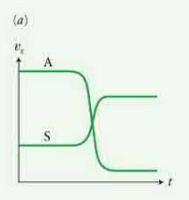
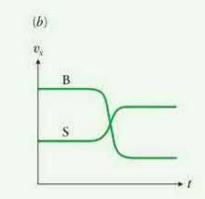
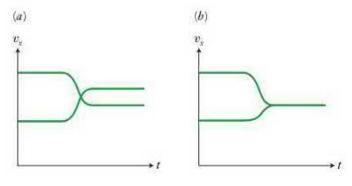
The graphs in Figures \(4.17 a\) and \(4.17 b\) show the effects of carts A and B colliding (separately) with a standard cart S. List the three carts in order of increasing inertia.Data from Figure 4.17 aData from Figure 4.17 b (a) A S
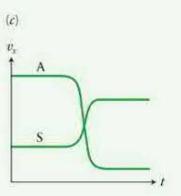
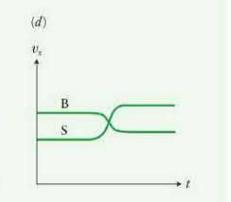
The graphs in Figures \(4.17 c\) and \(4.17 d\) show the effects of carts A and B colliding (separately) with a standard cart \(\mathrm{S}\). Which has greater inertia, \(\mathrm{A}\) or \(\mathrm{B}\) ?Data from Figure 4.17 cData from Figure 4.17 d (c) A S
You do not know whether or not carts A and B of question 3 are made of the same material. Can you tell from the graphs which cart contains a larger quantity of material?Data from question 3The graphs in Figures \(4.17 c\) and \(4.17 d\) show the effects of carts A and B colliding (separately) with
Imagine accounting for the number of cattle on a ranch. What do you choose as your system? What are the processes corresponding to input, output, creation, and destruction? Is transfer into and out of the system possible? Is the accountable quantity conserved?
(a) While driving a car at \(25 \mathrm{~m} / \mathrm{s}\), you pass a truck traveling in the same direction at \(22 \mathrm{~m} / \mathrm{s}\). If you assign the direction in which the two vehicles are moving as the positive \(x\) direction of a coordinate system, what is the truck's velocity
Suppose you have an isolated system in which two objects about to collide have equal and opposite momenta. If the collision is totally inelastic, what can you say about the motion after the collision?
Figure P5.3 shows velocity-versus-time graphs for two situations in which a pair of objects collide. For each situation, decide whether the collision is elastic, inelastic, or totally inelastic.Data from Figure P5.3 (b) == (27)
When you throw a tennis ball against a wall with some initial speed, is it possible for the ball to bounce back with a higher speed?
What does doubling an object's velocity do to its momentum and to its kinetic energy?
As a result of an elastic collision between carts 1 and 2, the kinetic energy of cart 1 doubles. Does the kinetic energy of cart 2 change? If so, by what amount?
A common energy unit used in food chemistry is the food calorie \((1 \mathrm{Cal}=1000 \mathrm{cal}=4186 \mathrm{~J})\). What must be the inertia of a person who is moving at a walking pace of \(1.0 \mathrm{~m} / \mathrm{s}\) and has kinetic energy numerically equal to the food energy in a jelly
(a) Write an expression for the kinetic energy of an object in terms of its momentum \(p\) and inertia \(m\). (b) If kinetic energy can be written in terms of momentum, how can the kinetic energy of a system change in an inelastic collision even though the law of momentum conservation forces the
If two objects \(\mathrm{A}\) and \(\mathrm{B}\) have the same momentum but \(\mathrm{A}\) has four times the kinetic energy of \(B\), what is the ratio of their inertias?
If two objects \(A\) and \(B\) have the same kinetic energy but A has four times the momentum of \(B\), what is the ratio of their inertias?
Object \(X\) has great inertia, and object \(Y\) has much less inertia. If the objects have the same momentum, which has more kinetic energy? If they have the same kinetic energy, which has greater momentum?
Draw a graph of kinetic energy versus distance fallen for a brick that is falling vertically from the top of a tall building.
You see a book on a table and give the book a push. It slides across the table and then comes to rest. Describe any changes in the physical state of the book-table system.
Which of the following interactions are reversible: (a) a collision between two billiard balls, \((b)\) a hand tossing a coin in the air, (c) a collision between hockey players on ice, (d) the firing of a cannon, (e) the lighting of a match?
When a loaded cannon is fired, which physical variables are affected?
A small bullet is fired into a large piece of wood. After the bullet penetrates the wood, the assembly moves as one unit along a low-friction track in the direction of travel of the bullet. (a) After the bullet is stuck in the piece of wood, is the momentum of the wood (not including the bullet)
A block slides with speed \(v\) across a low-friction, horizontal surface and collides with and sticks to an identical block at rest. The combination then strikes a spring attached to a fixed wall, bouncing off elastically. (a) Choose a system and discuss whether it is isolated. (b) Sketch energy
Is it possible for a change of physical state to occur in an isolated system? In a closed system?
Explain what is going on in terms of energy when your brakes overheat as you use them continuously coasting down a steep hill on a bike or in a car.
Imagine making two springy devices, each made up of a dozen or so metal blocks loosely connected by springs, and then making the two collide head-on. Do you expect the collision to be elastic, inelastic, or totally inelastic? If the collision is not elastic, where does the kinetic energy go?
Two cars come to a stop from the same initial speed, one braking gently and the other braking hard. Which car converts more kinetic energy to internal energy (for example, thermal energy in the brakes)?
In the past, cars were built to be fairly rigid in collisions. Now "crumple zones" (areas designed to crumple or deform during a collision) are deliberately engineered. Why do such zones make a car safer in a collision?
A ball of inertia \(m\) bounces elastically from the floor. It has \(x\) component of velocity \(+v\) just before it hits the floor. What is the magnitude of its change in momentum in the collision? What is the change in its kinetic energy? Are your two answers consistent with each other?
A \(1200-\mathrm{kg}\) car initially at rest undergoes constant acceleration for \(8.8 \mathrm{~s}\), reaching a speed of \(10 \mathrm{~m} / \mathrm{s}\). It then collides with a stationary car that has a perfectly elastic spring bumper. What is the final kinetic energy of the two-car system?
An elastic collision takes place between a \(0.080-\mathrm{kg}\) toy car moving at \(10 \times 10^{2} \mathrm{~m} / \mathrm{h}\) and a \(0.016-\mathrm{kg}\) toy car moving at \(20 \times 10^{9} \mathrm{~mm} / \mathrm{yr}\). What is the kinetic energy of the system in joules?
You want to give a third-grader a common example that illustrates how much energy a joule is. Show that a 0. 1\(\mathrm{kg}\) ring of keys falling out of your pocket develops about \(1 \mathrm{~J}\) of kinetic energy before hitting the ground. Can you think of another example?
You have an inertia of \(52 \mathrm{~kg}\) and are standing at rest on an iced-over pond in your skates. Suddenly, your \(60-\mathrm{kg}\) brother skates in from the right with a speed of \(5.0 \mathrm{~m} / \mathrm{s}\) and collides elastically with you. (a) What is the siblings' relative speed
Two carts, of inertias \(m_{1}\) and \(m_{2}\), collide head-on on a low-friction track. Before the collision, which is elastic, cart 1 is moving to the right at \(10 \mathrm{~m} / \mathrm{s}\) and cart 2 is at rest. After the collision, cart 1 is moving to the left at \(5 \mathrm{~m} /
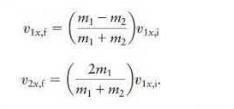
Show that in an elastic collision between two objects of inertias \(m_{1}\) and \(m_{2}\), with initial \(x\) components of velocity \(v_{1 \mathrm{i}}>0\) and \(v_{2 \mathrm{i}}=0\), the final \(x\) components of velocity areDiscuss the cases \(m_{1} \ll m_{2}, m_{1}=m_{2}\), and \(m_{1} \gg
Consider two hockey pucks identical in every respect except that one is black and the other is white. The black puck is initially at rest on the ice. A player shoots the white puck directly at the black one with velocity \(\vec{v}_{\text {white }}\). The white puck hits the black puck elastically
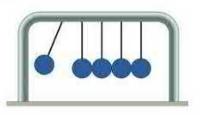
The device shown in Figure P5.31 is called a Newton's cradle. Any collision between the balls in the device in Figure P5.31 is elastic.(a) If one end ball is pulled back and let go, as shown, would it be a violation of conservation of momentum if two balls at the other end bounced up at half the
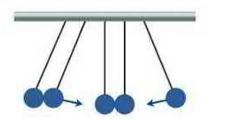
Figure P5.32 shows a pattern for the balls in a Newton's cradle just before collision. The arrows indicate the directions of motion of the balls. All the balls have the same size and inertia, and they collide elastically. Assume that all the collisions happen at the same instant. Sketch the pattern
A cart of inertia \(m_{1}\) and velocity \(\vec{v}_{1 i}\) collides elastically with a cart of inertia \(m_{2}\) initially moving at velocity \(-0.5 \vec{v}_{1}\). What is the speed of each cart after the collision?
Two carts are initially moving to the right on a low-friction track, with cart 1 behind cart 2 . Cart 1 has a speed twice that of cart 2 and so moves up and rear-ends cart 2 , which has twice the inertia of cart 1 . What is the speed of each cart right after the collision if the collision is
Cart A, with inertia \(0.400 \mathrm{~kg}\), is moving on a low-friction track at a speed of \(2.2 \mathrm{~m} / \mathrm{s}\). It collides with cart B, which is initially at rest. After the collision, cart A continues moving in its original direction at \(1.0 \mathrm{~m} / \mathrm{s}\), and cart B
A physics student driving a \(1200-\mathrm{kg}\) car runs into the rear of a \(2000-\mathrm{kg}\) car stopped at a red light. From the fact that the joined vehicles skidded forward \(4.0 \mathrm{~m}\), the investigating police officer calculates that the speed after the collision was \(6.6
A basketball is thrown horizontally at a heavy door that is free to move. For the two cases in which the ball is \((a)\) well inflated and \((b)\) flat, sketch a system diagram of the ball and the door, showing momentum vectors and energy bars just before and just after the collision. Make your
Draw a velocity-versus-time graph for a collision between a 2-kg object moving at an initial speed of \(4 \mathrm{~m} / \mathrm{s}\) and a \(6-\mathrm{kg}\) object initially at rest, if the coefficient of restitution is 0.25 .
Consider four identical cars. Two of them collide headon when both are traveling at \(34 \mathrm{~m} / \mathrm{s}\). The other two collide head-on when both are traveling at \(25 \mathrm{~m} / \mathrm{s}\). What is the ratio of the amount of kinetic energy converted to internal energy in the two
Take the common case where an object of inertia \(m_{1}\) collides totally inelastically with a stationary object of inertia \(m_{2}\). Show that the fraction of kinetic energy converted in the collision is \(m_{2} /\left(m_{1}+m_{2}\right)\). Comment on the amount of energy converted for the cases
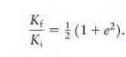
Show that when a moving object collides with an identical stationary object, the ratio of the final and initial kinetic energies is related to the coefficient of restitution \(e\) by Kf 2 K =(1+e).
A \(2000-\mathrm{kg}\) truck is sitting at rest (in neutral) when it is rear-ended by a \(1000-\mathrm{kg}\) car going \(25 \mathrm{~m} / \mathrm{s}\). After the collision, the two vehicles stick together.(a) What is the final speed of the car-truck combination? \((b)\) What is the kinetic energy
Which head-on collision between a small car and a large truck causes a larger conversion of kinetic energy: one in which their initial momenta have the same magnitude, or one in which their initial kinetic energies are the same? Assume the same kinetic energy for the two-vehicle system in both
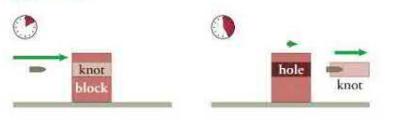
You shoot a \(0.0050-\mathrm{kg}\) bullet into a \(2.0-\mathrm{kg}\) wooden block at rest on a horizontal surface (Figure P5.44). After hitting dead center on a hard knot that runs through the block horizontally, the bullet pushes out the knot. It takes the bullet \(1.0 \mathrm{~ms}\) to travel
An experienced bartender knows just the right initial speed of a glass of beer to get it to come to a stop in front any customer sitting along the bar. Say the initial speed needed to move a glass all the way to the end of the bar is \(v_{\text {cnd. }}\). In terms of \(v_{\text {end }}\), with
A car goes into a skid and gradually comes to a stop, accelerating at a constant rate. At the midpoint of the skid, how much of its kinetic energy has it lost?
You roll a \(0.250-\mathrm{kg}\) wooden croquet ball toward a \(0.050-\mathrm{kg}\) golf ball at rest. (a) If the wooden ball travels at \(5.0 \mathrm{~m} / \mathrm{s}\) before the impact with the golf ball and then at \(4.0 \mathrm{~m} / \mathrm{s}\) after the impact, what is the speed of the golf
A \(1200-\mathrm{kg}\) car is backing out of a parking space at \(5.0 \mathrm{~m} / \mathrm{s}\). The unobservant driver of a \(1800-\mathrm{kg}\) pickup truck is coasting through the parking lot at a speed of \(3.0 \mathrm{~m} / \mathrm{s}\) and runs straight into the rear bumper of the car. (a)
Explain how a police officer at the scene of a car crash can judge whether or not you were speeding when you rear-ended a stopped car, based solely on the length of the skid marks after the collision. Is the speed the officer estimates for your speed just before the collision faster than, equal to,
A wagon is coasting along a level sidewalk at \(5.00 \mathrm{~m} / \mathrm{s}\). Its wheels have very good bearings. You are standing on a low wall, and you drop vertically into the wagon as it passes by. The wagon has an inertia of \(100 \mathrm{~kg}\), and your inertia is \(50.0 \mathrm{~kg}\).
The extinction of the dinosaurs is, by one theory, attributed to a collision between Earth and an asteroid about \(10 \mathrm{~km}\) in diameter moving at \(25 \mathrm{~km} / \mathrm{s}\) relative to Earth. Assume that the asteroid had about the same density as Earth. Estimate the energy released
Can you tell from the coefficient of restitution whether a collision has added kinetic energy to a system, taken some away, or left the system's kinetic energy unchanged?
If the video of an explosive separation (like the firing of a gun) is run backward, the event looks like a totally inelastic collision, with two or more originally separate pieces all sticking together. How are the coefficient of restitution for an explosive separation and that for a totally
At the peak of its vertical flight, a fireworks shell explodes into two pieces. Piece 1 has three times the speed of piece 2. What is the ratio of the inertias of the pieces? What is the ratio of their kinetic energies?
A \(52-\mathrm{kg}\) ice skater (this value includes her body, her clothing, and several \(1.0-\mathrm{kg}\) snowballs she is carrying) is at rest on the ice. She throws a snowball to the right at \(10 \mathrm{~m} / \mathrm{s}\). (a) What is her speed after the throw? Is her velocity to the left or
A mysterious crate has shown up at your place of work, Firecracker Company, and you are told to measure its inertia. It is too heavy to lift, but it rolls smoothly on casters. Getting an inspiration, you lightly tape a \(0.60-\mathrm{kg}\) iron block to the side of the crate, slide a firecracker
A two-stage rocket is traveling at \(4000 \mathrm{~m} / \mathrm{s}\) before the stages separate. The \(3000-\mathrm{kg}\) first stage is pushed away from the second stage with an explosive charge, after which the first stage continues to travel in the same direction at a speed of \(2500 \mathrm{~m}
A system consists of a \(4.0-\mathrm{kg}\) cart and a \(1.0-\mathrm{kg}\) cart attached to each other by a compressed spring. Initially, the system is at rest on a low-friction track. When the spring is released, an explosive separation occurs at the expense of the internal energy of the compressed
A space shuttle of inertia \(m\) is attached to a booster rocket that has an inertia nine times greater. This system is moving at a speed of \(800 \mathrm{~m} / \mathrm{s}\) in outer space, as seen by observers in a nearby space station. Then explosive bolts are detonated, separating the shuttle
A uranium-238 atom can break up into a thorium-234 atom and a particle called an alpha particle, \(\alpha-4\). The numbers indicate the inertias of the atoms and the alpha particle in atomicmass units ( \(1 \mathrm{amu}=1.66 \times 10^{-27} \mathrm{~kg}\) ). When a uranium atom initially at rest
A gun with inertia \(5.0 \mathrm{~kg}\) fires a \(10 \mathrm{~g}\) bullet at a stationary target located \(1.0 \mathrm{~km}\) away. After the bullet leaves the gun, its speed decreases (at the constant rate of accelcration \(a=-1.0 \mathrm{~m} / \mathrm{s}^{2}\) ) so that the bullet hits the target
An assembled system consists of cart A of inertia \(m_{A}\), cart B of inertia \(m_{\mathrm{B}}\), and a spring of negligible inertia, clamped together so that the fully compressed spring is aligned between the front end of cart B and the back end of cart A. The internal energy of the system,
Consider the same initial system of spring and carts \(A\) and B as in Problem 62. After the system is set in motion with common speed \(v_{i}\), the clamp is again released. What is the speed of cart \(A\) at the instant when the spring is still partially compressed and stores one-fourth of its
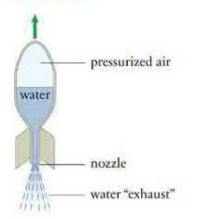
A toy water-rocket consists of an elongated plastic tank with a nozzle at one end (Figure P5.64). A hand pump is used to get pressurized air into the tank. If there is nothing but air in the tank, the performance is lackluster. If some water is put in the tank before it is pumped up with air,
A fictional subatomic particle, the solarino, is initially at rest. It then explodes into three particles: two lightons and a heavyon. The inertia of a heavyon is twice the inertia of a lighton. In the explosive separation, the three particles can be kicked out in either direction along a straight
Which has more kinetic energy: a \(0.14-\mathrm{kg}\) baseball traveling at \(45 \mathrm{~m} / \mathrm{s}\) or a \(0.012-\mathrm{kg}\) bullet traveling at 480 m/s ?
Why is it easier to hit a home run from a pitched fastball than from a ball tossed in the air by the batter?
You and a friend are playing catch with a medicine ball. The game has gotten a little unfriendly, and you'd like to knock your friend down with the next throw. To achieve this, should you suggest that your friend catch the ball with his hands or bounce it elastically back to you with his fists?
Your uncle works at the railroad freight yard, and he has asked you to watch the yard hands couple \(20,000-\mathrm{kg}\) boxcars together. As he leaves to get a sandwich, he tells you, "Whatever you do, don't let those cars bang together too hard. The couplings will take only \(10,000
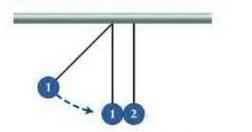
Two solid spheres hung by thin threads from a horizontal support (Figure P5.70) are initially in contact with each other. Sphere 1 has inertia \(m_{1}=0.050 \mathrm{~kg}\), and sphere 2 has inertia \(m_{2}=0.10 \mathrm{~kg}\). When Figure P5.70 pulled to the left and released, sphere 1 collides
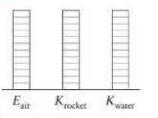
In the toy water-rocket of Problem 64, the pressurized air can store internal energy. Assume you have a rocket that expels water at a speed of \(15.0 \mathrm{~m} / \mathrm{s}\) and the opening through which the water leaves is \(10.0 \mathrm{~mm}\) in diameter.(a) Using Figure P5.72 as a template,
Suppose that, as it slides across the floor of a basketball arena, a hockey puck loses kinetic energy because of friction. The amount of energy lost is directly proportional to the distance the puck slides. Sketch a graph of kinetic energy versus time during this slide and then verify with a
While bowling one day, you begin to wonder about the inertia of a bowling pin. You know that balls and pins generally make elastic collisions and that your \(6.5-\mathrm{kg}\) bowling ball continues to move forward after a collision, even when you hit several pins to make a strike. As it happens,
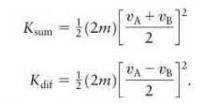
For a system of two identical cars, \(A\) and \(B\), of the same inertia \(m\) but moving at two different velocities, \(v_{\Lambda}\) and \(v_{\mathrm{B}}\), show that the kinetic energy of the two-car system can be expressed as the sum of two terms: the kinetic energy of a double car moving with
A \(1000-\mathrm{kg}\) car traveling with an \(x\) component of velocity of \(+20 \mathrm{~m} / \mathrm{s}\) collides head-on with a \(1500-\mathrm{kg}\) light truck traveling with an \(x\) component of velocity of \(-10 \mathrm{~m} / \mathrm{s}\). (a) If \(10 \%\) of the system's kinetic energy is
Your little brother is outside squirting a basketball with the stream of water from a garden hose. As the ball rolls across the yard, you begin to wonder what you would need to know in order to determine the rate at which momentum is transferred from the water to the ball. It should not be hard to
Two hockey players push off from a clinch, recoiling from rest. Jean-Claude has an inertia that is \(50 \%\) greater than Pierre's inertia. After they push off and move across the ice in opposite directions, they lose kinetic energy at the same rate until they come to a stop. (a) Who travels
Are the following collisions (for motion along the \(x\) axis) elastic, inelastic, or totally inelastic? (a) A red billiard ball moving at \(v_{\mathrm{r} x, i}=+2.2 \mathrm{~m} / \mathrm{s}\) hits a white billiard ball initially at rest. After the collision, the red ball is at rest and the white
Showing 4200 - 4300
of 4962
First
36
37
38
39
40
41
42
43
44
45
46
47
48
49
50
Step by Step Answers

 Get 50% OFF
Claim Now
Get 50% OFF
Claim Now