New Semester
Started
Get
50% OFF
Study Help!
--h --m --s
Claim Now
Question Answers
Textbooks
Find textbooks, questions and answers
Oops, something went wrong!
Change your search query and then try again
S
Books
FREE
Study Help
Expert Questions
Accounting
General Management
Mathematics
Finance
Organizational Behaviour
Law
Physics
Operating System
Management Leadership
Sociology
Programming
Marketing
Database
Computer Network
Economics
Textbooks Solutions
Accounting
Managerial Accounting
Management Leadership
Cost Accounting
Statistics
Business Law
Corporate Finance
Finance
Economics
Auditing
Tutors
Online Tutors
Find a Tutor
Hire a Tutor
Become a Tutor
AI Tutor
AI Study Planner
NEW
Sell Books
Search
Search
Sign In
Register
study help
physics
particle physics
Principles And Practice Of Physics 2nd Edition Eric Mazur - Solutions
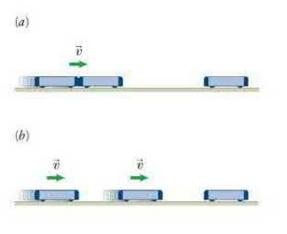
Two collisions are carried out to crash-test a \(1000-\mathrm{kg}\) car. (a) While moving at \(15 \mathrm{mi} / \mathrm{h}\), the car strikes an identical car initially at rest. (b) While moving at \(15 \mathrm{mi} / \mathrm{h}\), the car strikes an identical car moving toward it and also traveling
A space traveler discovers an object that accelerates in her reference frame. Which conclusion is correct? (a) Her reference frame is noninitial. (b) The object is not isolated. (c) You cannot tell.
A jogger starts from rest along a straight track. Consider the jogger-Earth system to be isolated. As the jogger's speed increases, does the speed of Earth change or remain constant?
Is it always possible to choose a zero-momentum reference frame for an isolated system that contains more than two objects?
Starting from rest, a car accelerates for \(7.0 \mathrm{~s}\) at \(3.0 \mathrm{~m} / \mathrm{s}^{2}\) and then travels at constant velocity for another \(4.0 \mathrm{~s}\). Make a motion diagram representing this motion.
You are bicycling at a steady \(6.0 \mathrm{~m} / \mathrm{s}\) when someone suddenly walks into your path \(2.5 \mathrm{~m}\) ahead. You immediately apply the brakes, which slow you down at \(6.0 \mathrm{~m} / \mathrm{s}^{2}\). Do you stop in time to avoid a collision?
Suppose a ball is dropped from height \(h=20 \mathrm{~m}\) above the ground. How long does it take to hit the ground, and what is its velocity just before it hits?
A stone is launched straight up from ground level at a speed of \(8.0 \mathrm{~m} / \mathrm{s}\). (a) How high does it rise? (b) How many seconds does it take for the stone to hit the ground?
Suppose an object initially at \(x_{\mathrm{i}}\) at \(t_{\mathrm{i}}=0\) has a constant acceleration whose \(x\) component is \(a_{x}\). Use calculus to show that the \(x\) component of the velocity and the \(x\) coordinate at some final instant \(t_{\mathrm{f}}\) are given by Eq. 3.10 and Eq.
Two stones are released from rest at a certain height, one \(1 \mathrm{~s}\) after the other. (a) Once the second stone is released, does the difference in their speeds increase, decrease, or stay the same? (b) Does their separation increase, decrease, or stay the same? (c) Is the time interval
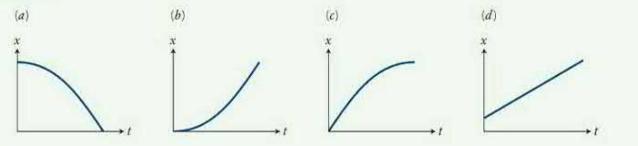
Which of the graphs in Figure 3. 12 depict(s) an object that starts from rest at the origin and then speeds up in the positive \(x\) direction?Data from Figure 3.12 (a) (b) (c) (d)
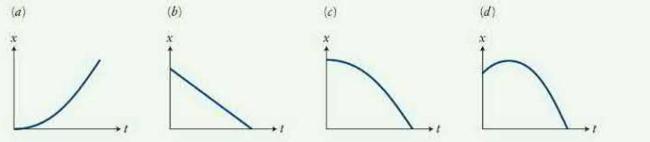
Which of the graphs in Figure 3. 13 depict(s) an object that starts from a positive position with a positive \(x\) component of velocity and accelerates in the negative \(x\) direction?Data from Figure 3. 13 P (d)
Draw a motion diagram for an object that initially has a negative \(x\) component of velocity but has a positive \(x\) component of acceleration. (Include motion in one direction only.)
Two identical hockey pucks slide over the same rough surface. The time interval needed for puck 2 to stop is twice that needed for puck 1 to stop. What explanation can there be for this?
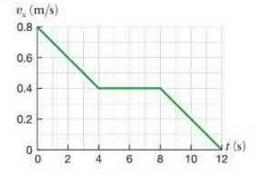
Figure P4.2 shows the velocity of a block of wood as a function of time. The block is sliding over a horizontal surface. Describe the physical processes that led to this graph.Data from Figure P4.2 v, (m/s) 0.8 0.6 0.4 0.2- 0 0 2 4 6 8 if(s) 10 12
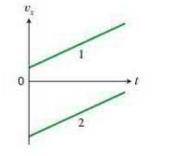
The velocity-versus-time graph in Figure P4.3 shows the motion of two different objects sliding across a horizontal surface. Could the change in the \(x\) component of velocity with time be attributed to friction in each case?Data from Figure P4.3 0 2
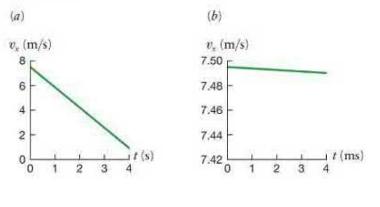
Consider the two velocity-versus-time graphs shown in Figure P4.4. Are the motions represented by these curves best described as similar or as different? Is the effect of friction on the motion plausibly more pronounced in one case?Data from Figure P4.4 (a) v, (m/s) 8 6 (b) v, (m/s) 7.50 7.48- 4
Two objects collide on a low-friction track. Object 1 experiences a magnitude of change in velocity \(\left|\Delta \vec{v}_{1}\right|=3 \mathrm{~m} / \mathrm{s}\), while object 2 has \(\left|\Delta \vec{v}_{2}\right|=1 \mathrm{~m} / \mathrm{s}\). How do the inertias of these two objects compare?
In a collision experiment, the ratio of the velocity change between two carts of equal inertia is found to equal 1. What happens to this ratio if the experiment is repeated in the following conditions? (a) The inertia of each cart is doubled, and the same initial velocities are used. (b) The
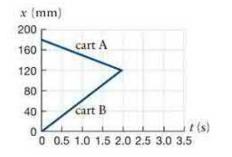
Two carts of equal inertia are moving in opposite directions toward each other. Figure P4.7 represents the positions of the carts until they collide. Sketch the positions of the carts after the collision.Data from Figure P4.7 x (mm) 200 160 cart A 120 80 40 cart B 0 t(s) 0 0.5 1.0 1.5 2.0 2.5 3.0
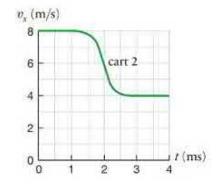
Cart 1 initially at rest is struck by cart 2 , which has twice the inertia of cart 1. Figure P4.8 shows the velocity of cart 2 as a function of time. Complete the graph by adding the velocity of cart 1 during the same time.Data from Figure P4.8 v, (m/s) 8 6 cart 2 4 2 0 (ms) 0 1 2 3 4
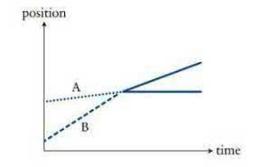
Figure P4.9 is the position-versus-time graph for a collision, along a straight line, between two identical amusement-park bumper cars A and B. The inertias of the passengers are different. (a) Which post-collision solid line is a continuation of the dotted line for car A? Which is a continuation
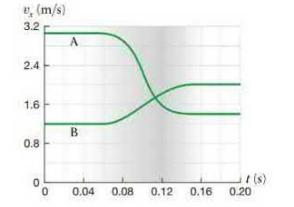
Figure P4.10 shows the \(v_{x}(t)\) curves for two carts, A and \(\mathrm{B}\), that collide on a low-friction track. What is the ratio of their inertias?Data from Figure P4.10 v, (m/s) 3.2 2.4 1.6 A B 0.8 0 t(s) 0.04 0.08 0.12 0.16 0.20
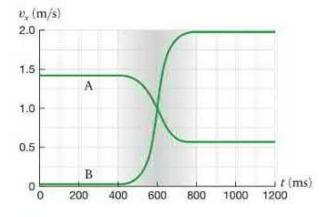
Figure P4.11 is a velocity-versus-time graph for two objects, A and B, before and after they collide. Object B is initially at rest. What factor relates the inertias of objects \(\mathrm{A}\) and \(\mathrm{B}\) ? Data from Figure P4.11 v, (m/s) 2.0 1.5 1.0 A 0.5 B r (ms) 0 200 400 600 800 1000 1200
Which has greater inertia: a 1-quart milk carton filled with feathers or the same carton filled with buckshot?
A jeweler pounds a small ingot of gold into a thin sheet. What happens to the inertia of the gold?
Five different objects are formed from a constant volume \(V\) of different materials, and the objects are placed on various surfaces. Rank the following objects in order of increasing inertia: a cubic lead block on ice, a cubic plastic block on ice, a sphere of lead on ice, a pyramid of plastic on
Which has greater inertia: a bottle full of water or the same bottle after the water has been drunk? Why is this so when the volume of the bottle does not change?
Does the inertia of a bicycle tire change when you add air to the tire?
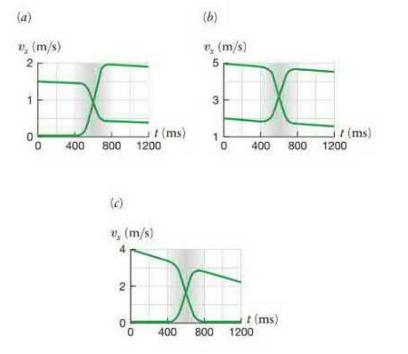
The velocity-versus-time graphs in Figure P4.17 all depict the motion of carts that have the same size and shape. The different graphs show motion on different tracks: a smooth icy track, a dusty unpolished track, and a rough damaged track. In one case metal carts are used, in one case plastic cars
The label on a bag of cookies lists the number of cookies in the bag, the serving size, and the number of calories per serving. Is each of these quantities intensive or extensive?
You are riding a bus and thinking about the number of passengers on board. (a) Is the number of passengers an extensive or intensive quantity? (b) Draw a system diagram to help account for the number of passengers. Where is the system boundary? (c) Does the number of passengers remain constant? (d)
A quart is a unit of volume. (a) If you have 1 quart of water in one container and 1 quart of water in another container and you pour all the water from both into a larger container, what volume of water do you end up with? (b) Suppose you have a 1-quart container filled with marbles and a large
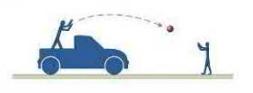
Figure P4.21 shows a person on a truck throwing a ball to a friend on the ground. In how many ways can you divide these things into a system and an environment?Data from Figure P4.21
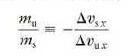
If two carts collide on a low-friction track, it is possible for both carts to slow down. Yet Eq. \(4.1\left(\frac{m_{1}}{m_{3}}=-\frac{\Delta v_{c x}}{\Delta n_{a x}}\right)\) seems to say that, because inertia is always positive, if one velocity increases, the other must decrease. Explain the
Cart A, of inertia \(1.0 \mathrm{~kg}\), is initially at rest on a low-friction track; cart \(\mathrm{B}\), of unknown inertia, has an initial velocity of \(+3.0 \mathrm{~m} / \mathrm{s}\) in your coordinate system. After the two carts collide, the final velocities are \(\vec{v}_{\mathrm{A}}=+2.0
A \(2.0-\mathrm{kg}\) cart collides with a \(1.0-\mathrm{kg}\) cart that is initially at rest on a low-friction track. After the collision, the \(1.0-\mathrm{kg}\) cart moves to the right at \(0.40 \mathrm{~m} / \mathrm{s}\) and the \(2.0-\mathrm{kg}\) cart moves to the right at \(0.30 \mathrm{~m}
A \(1-\mathrm{kg}\) standard cart collides with a \(5.0-\mathrm{kg}\) cart initially at rest on a low-friction track. After the collision, the standard cart is at rest and the \(5.0-\mathrm{kg}\) cart has a velocity of \(0.20 \mathrm{~m} / \mathrm{s}\) to the left. What was the initial velocity of
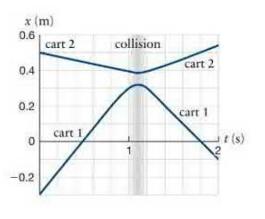
Figure P4.26 is the position-versus-time graph for a collision between two carts on a low-friction track. Cart 1 has an inertia of \(1.0 \mathrm{~kg}\); cart 2 has an inertia of \(4.0 \mathrm{~kg}\).(a) What are the initial and final velocities of each cart?(b) What is the change in the velocity of
The bumper boats at your local theme park each have an inertia of \(90 \mathrm{~kg}\). In boat 1 are a man of unknown inertia, a \(45-\mathrm{kg}\) woman, and a \(3.0 \mathrm{~kg}\) dog. In boat 2 are an \(80-\mathrm{kg}\) father, a \(50-\mathrm{kg}\) mother, and a \(30-\mathrm{kg}\) son. Boat 1
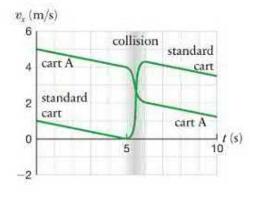
A 1-kg standard cart collides with a cart A of unknown inertia. Both carts appear to be rolling with significant wheel friction because their velocities change with time as shown in Figure P4.28. (a) What are the carts' velocities at \(t=0, t=5.0 \mathrm{~s}, t=6.0 \mathrm{~s}\), and \(t=10
Which has greater momentum: a \(0.14-\mathrm{kg}\) baseball pitched at \(45 \mathrm{~m} / \mathrm{s}\) or a \(0.012-\mathrm{kg}\) bullet fired at \(480 \mathrm{~m} / \mathrm{s}\) ?
The student next to you says, "Momentum is inertia times velocity. That means momentum is proportional to inertia, and so things with more inertia have more momentum." What would you say to the student to clarify the matter?
Two identical cars traveling at \(20 \mathrm{~m} / \mathrm{s}\) both slow to a stop. The driver of car A applies the brakes hard, so that the car comes to a stop in \(3.0 \mathrm{~s}\), while the driver of car B brakes gently and comes to a stop in \(7.0 \mathrm{~s}\). Which car has the greater
A bicyclist coasting along a road at speed \(v\) collides with a grasshopper flying in the opposite direction at the same speed. The grasshopper sticks to the bicyclist's helmet. Make a sketch showing \((a)\) the two velocity vectors and the two momentum vectors before the collision, (b) the
Is it possible for the momentum of a system consisting of two carts on a low-friction track to be zero even if both carts are moving?
A \(1.0-\mathrm{kg}\) standard cart A collides with a \(0.10-\mathrm{kg}\) cart B. The \(x\) component of the velocity of cart \(\mathrm{A}\) is \(+0.60 \mathrm{~m} / \mathrm{s}\) before the collision and \(+0.50 \mathrm{~m} / \mathrm{s}\) after the collision. Cart B is initially traveling toward
You're rolling solid rubber balls on the kitchen floor. Ball 1 has a density of \(1.00 \times 10^{3} \mathrm{~kg} / \mathrm{m}^{3}\) and a radius of \(25.0 \mathrm{~mm}\). Ball 2 has an unknown density and a radius of \(40.0 \mathrm{~mm}\) and is initially at rest. You roll ball 1 at an initial
What is the magnitude of the momentum change of two gallons of water (inertia about \(7.3 \mathrm{~kg}\) ) as it comes to a stop in a bathtub into which it is poured from a height of (2.0 m} ?
From what height would a car have to fall in order for the magnitude of its momentum to equal the magnitude of its momentum when it is moving on a highway at 30 m/s ?
(a) Write an expression relating the average acceleration, \(\Delta p\), and \(\Delta t\) for an object of constant inertia \(m\). (b) Given your result in part \(a\), what can you say about the magnitude of the acceleration of an object coming to rest after being dropped on a soft bed versus a
You drop a \(0.15-\mathrm{kg}\) ball to the floor from a height of \(2.0 \mathrm{~m}\), and it bounces to a height of \(1.6 \mathrm{~m}\). What is the magnitude of the change in its momentum as a result of the bounce?
When a rifle is fired, it recoils, kicking backward into the shooter's shoulder. Why?
A \(4.0-\mathrm{kg}\) rifle fires a \(10 \mathrm{~g}\) bullet at \(800 \mathrm{~m} / \mathrm{s}\). With what speed does the rifle recoil (move backward toward the shooter's shoulder)?
What is the magnitude of the momentum of the system that consists of all the molecules making up the air in your dorm room?
A car collides with a telephone pole. Which of the following form(s) an isolated system: \((a)\) the car alone; \((b)\) the car and the pole; \((c)\) the car, the pole, and Earth?
Start walking from a standstill. Can you consider your body an isolated system?
In a pairs skating competition, a \(75-\mathrm{kg}\) male skater moving at \(4.0 \mathrm{~m} / \mathrm{s}\) collides (gently) with his stationary, \(50-\mathrm{kg}\) female partner and raises her in a lift. Neither of them makes a horizontal push at the instant of the pickup. What is the speed of
A girl wearing ice skates stands in a skating rink and throws her backpack to a bench just off the ice. (a) If her skates are aligned parallel to the direction of the throw, what happens to her as a result? (b) When the backpack lands on the bench, it stops. Does the skater stop at the same
A cart moving on a low-friction track has a momentum of \(6 \mathrm{~kg} \cdot \mathrm{m} / \mathrm{s}\) to the right. At the end of the track is a wall. (a) What is the momentum of the system that consists of the cart and the wall? (b) After the cart collides with the wall, the cart's momentum is
What does conservation of momentum say about the motion of a single cart that doesn't collide with anything as it moves on a low-friction track?
The three carts described in the accompanying table collide simultaneously. What is the momentum of the system of three carts (a) before the collision and (b) after the collision?(c) Is the system of three carts isolated during the collision, according to these data?
Two carts collide on a low-friction track. Cart 1 has an initial momentum of \((+10 \mathrm{~kg} \cdot \mathrm{m} / \mathrm{s}) \hat{i}\) and a final momentum of \((-2.0 \mathrm{~kg} \cdot \mathrm{m} / \mathrm{s}) \hat{i}\). If cart 2 has a final momentum of \((-6.0 \mathrm{~kg} \cdot \mathrm{m} /
Two carts A and B collide on a low-friction track. Measurements show that their initial and final momenta are \(\vec{p}_{\mathrm{A}, \mathrm{i}}=(+10 \mathrm{~kg} \cdot \mathrm{m} / \mathrm{s}) \hat{i}, \vec{p}_{\mathrm{A}, \mathrm{f}}=(+2.0 \mathrm{~kg} \cdot \mathrm{m} / \mathrm{s}) \hat{\imath},
Two carts A and B collide on a low-friction track. Measurements show that their initial and final momenta are \(\vec{p}_{\mathrm{A}, \mathrm{i}}=(+3.0 \mathrm{~kg} \cdot \mathrm{m} / \mathrm{s}) \hat{\imath}, \vec{p}_{\mathrm{A}, \mathrm{f}}=(+1.0 \mathrm{~kg} \cdot \mathrm{m} / \mathrm{s})
A moving object collides with an object at rest. (a) Is it possible for both objects to be at rest after the collision? (b) Is it possible for just one object to be at rest after the collision? If so, which one? Ignore any effects due to friction.
Estimate the magnitude of impulse that you impart to a nail (and to whatever the nail is buried in) when you hit it with a hammer.
A \(1200-\mathrm{kg}\) automobile traveling at \(15 \mathrm{~m} / \mathrm{s}\) collides headon with a \(1600 \mathrm{~kg}\) automobile traveling at \(10 \mathrm{~m} / \mathrm{s}\) in the opposite direction. (a) Is it possible to predict the velocities of the cars after the collision? (b) Is it
A \(2.0-\mathrm{kg}\) cart and a \(3.0-\mathrm{kg}\) cart collide on a low-friction track. The \(3.0-\mathrm{kg}\) cart is initially moving at \(1.0 \mathrm{~m} / \mathrm{s}\) to the right, but after the collision it is moving at \(5.0 \mathrm{~m} / \mathrm{s}\) to the right. After the collision,
Warmly dressed in several layers of clothing, you are standing at the center of a frozen pond. There is not enough friction to permit you to walk to the edge of the pond. How can you save yourself? (Never mind how you got to the center of the pond.)
Two male moose charge at each other with the same speed and meet on a icy patch of tundra. As they collide, their antlers lock together and they slide together with one-third of their original speed. What is the ratio of their inertias?
An \(80-\mathrm{kg}\) physicist and a friend are ice-skating. The physicist, distracted, collides from behind at \(7.0 \mathrm{~m} / \mathrm{s}\) with his friend, who is skating at \(5.0 \mathrm{~m} / \mathrm{s}\) in the same direction. After the collision, the physicist continues in the same
You are driving your \(1000-\mathrm{kg}\) car at a velocity of \((20 \mathrm{~m} / \mathrm{s}) \hat{\imath}\) when a \(9.0 \mathrm{~g}\) bug splatters on your windshield. Before the collision, the bug was traveling at a velocity of \((-2.0 \mathrm{~m} / \mathrm{s}) \hat{i}\). Before the collision,
Sledding down a hill, you are traveling at \(10 \mathrm{~m} / \mathrm{s}\) when you reach the bottom. You (inertia \(70 \mathrm{~kg}\) ) then move across horizontal snow toward a \(200-\mathrm{kg}\) boulder but jump off the sled (inertia \(5.0 \mathrm{~kg}\) ) the instant before it hits the
A fire hose sprays water against a burning building. The stream of water has cross-sectional area \(A\) and density \(ho\) and moves with speed \(v\) toward the building. Assume the water splatters against the building without reflecting. What magnitude of impulse does the stream of water deliver
Playing pool, you send the cue ball head-on (that is, along the line joining the centers of the two balls) into the stationary 8 ball, and the cue ball stops as a result of the collision. (a) Describe the momentum of each ball before and after the collision. (b) Show that your answer to part \(a\)
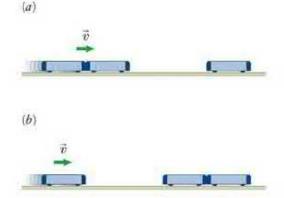
Three identical carts on a low-friction track have putty on their ends so that they stick together when they collide. In Figure P4.64a, two carts already stuck together and moving with speed \(v\) are about to collide with the third cart initially at rest. In Figure P4.64b, the single cart moving
A load of coal is dropped from a bunker into a railroad hopper car of inertia \(3.0 \times 10^{4} \mathrm{~kg}\) coasting at \(0.50 \mathrm{~m} / \mathrm{s}\) on a level track. The car's speed is \(0.30 \mathrm{~m} / \mathrm{s}\) after the coal falls. What is the inertia of the load of coal?
Three identical carts on a low-friction track have putty on their ends so that they stick together when they collide. In Figure P4.66a, two carts already stuck together and moving at speed \(v\) collide with the single cart initially at rest. In Figure P4.66b, there are two collisions: First the
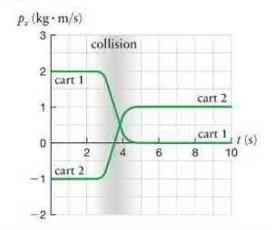
Figure \(\mathrm{P} 4.67\) is a momentum-versus-time graph for a collision between two carts. Carts 1 and 2 have inertias of \(1.0 \mathrm{~kg}\) and \(3.0 \mathrm{~kg}\), respectively. What are the \(x\) components of the initial and final velocities of (a) cart 1 and(b) cart 2?(c) What are the
Carts A and B collide on a low-friction track. Rank, from largest to smallest, the following four collisions according to the magnitude of the change in the momentum of cart B, which has twice the inertia of cart A. (a) A initially moving right at \(1.0 \mathrm{~m} / \mathrm{s}, B\) initially
A red cart and a green cart, both traveling at speed \(v\) on a low-friction track, approach each other head-on. The red cart is moving to the right; the green cart, whose inertia is three times that of the red cart, is moving to the left. A black cart that has a spring on its left end and putty on
A \(1.0-\mathrm{kg}\) standard cart collides on a low-friction track with cart \(\mathrm{A}\). The standard cart has an initial \(x\) component of velocity of \(+0.40 \mathrm{~m} / \mathrm{s}\), and cart A is initially at rest. After the collision the \(x\) component of velocity of the standard
A \(400-\mathrm{kg}\) shipboard cannon fires a \(20-\mathrm{kg}\) ball at \(60 \mathrm{~m} / \mathrm{s}\). The cannon's resulting recoil speed across the deck is regarded as excessive. How much inertia (in the form of sandbags, say) must be added to the cannon if its recoil speed must be reduced to
You point a tennis-ball serving machine straight up and put a piece of plastic wrap across the top of the barrel, placing a \(10 \mathrm{~g}\) marble on top of the barrel. When a \(58 \mathrm{~g}\) tennis ball in the machine is fired, it sends the marble into the air. The marble rises \(200
A golf ball has one-tenth the inertia and five times the speed of a baseball. What is the ratio of the magnitudes of their momenta?
A \(30,000-\mathrm{kg}\) trailer truck approaches a one-lane bridge at \(2.2 \mathrm{~m} / \mathrm{s} ;\) a \(2400-\mathrm{kg}\) minivan approaches the bridge from the other direction at \(30 \mathrm{~m} / \mathrm{s}\). Which vehicle has a momentum of greater magnitude?
You and a friend are bowling. She rolls her \(4.5-\mathrm{kg}\) ball at \(10 \mathrm{~m} / \mathrm{s}\); you roll your ball at \(8.0 \mathrm{~m} / \mathrm{s}\). What inertia must your ball have if its momentum is to be the same as hers?
Two identical carts collide in three experiments on a low-friction track. In each case, cart A initially has velocity \(\vec{v}\) and cart B is at rest. Sketch the velocity-versus-time graph for each cart \((a)\) if the carts stick together after the collision, (b) if cart A is stationary after
Draw diagrams that show the initial and final velocity vectors and the initial and final momentum vectors when a rapidly moving golf ball hits \((a)\) a golf ball at rest and \((b)\) a basketball at rest. In each case, assume that the golf ball moves along the line connecting the centers of the two
The position of a certain airplane during takeoff is given by \(x=\frac{1}{2} b t^{2}\), where \(b=2.0 \mathrm{~m} / \mathrm{s}^{2}\) and \(t=0\) corresponds to the instant at which the airplane's brakes are released at position \(x=0\). The empty but fueled airplane has an inertia of \(35,000
A bullet of inertia \(m_{\text {bullet }}\) is fired horizontally at a speed \(v_{\text {hullet, }}\) into a stationary wooden block of inertia \(m_{\text {block }}\) lying on a low-friction surface. The bullet passes through the block and emerges with a speed \(v_{\text {bullet,f. }}\). Determine
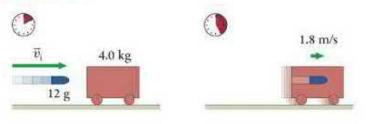
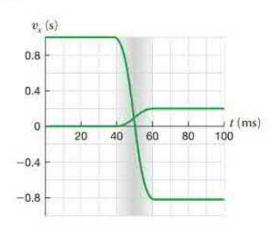
The speed of a bullet can be measured by firing it at a wooden cart initially at rest and measuring the speed of the cart with the bullet embedded in it. Figure P4.80 shows a \(12-\mathrm{g}\) bullet fired at a \(4.0-\mathrm{kg}\) cart. After the collision, the cart rolls at \(1.8 \mathrm{~m} /
The World War II-era rocket launcher called the bazooka was essentially a tube open at both ends. On the basis of momentum considerations, how is the firing of a bazooka different from the firing of a cannon, which is a tube open at one end only?
In a football game, a \(95-\mathrm{kg}\) player carrying the ball can run the \(50-\mathrm{m}\) dash in \(5.5 \mathrm{~s}\). Two opponents are available to stop him with a head-on tackle. One opponent has an inertia of \(110 \mathrm{~kg}\) and a \(50-\mathrm{m}\) time of \(6.6 \mathrm{~s}\); the
In the days before rocketry, some people argued that rocket engines would not work in space because there is no atmosphere for the exhaust to push against. Even today, some people think that a rocket requires a launch pad to push against in order to lift off. Refute such arguments with an argument
In some collisions, the velocity of one participant changes little while that of the other changes a lot, as Figure P4.84 illustrates. (a) In which direction (positive or negative) are the objects moving before the collision? (b) After the collision? (c) What is the ratio of the inertia of the
In a head-on collision between two cars of different inertias, you might prefer to be the driver of the car that has the greater inertia, at least if you considered momentum only. Why?
A single-stage rocket is in deep space coasting at \(v_{\text {rocket }, \mathrm{i}}=2.0 \times 10^{3} \mathrm{~m} / \mathrm{s}\). It fires its engine, which has an exhaust speed of \(v_{\text {exhaust }}=1.0 \times 10^{3} \mathrm{~m} / \mathrm{s}\). What is the rocket's speed \(v_{\text {rocker,f
In the process of moving out of your house, you are dropping stuff out a sccond-floor window to a friend \(4.0 \mathrm{~m}\) below. You are about to drop a \(6.0-\mathrm{kg}\) stereo speaker when you begin to worry that catching anything that has a momentum greater than \(50 \mathrm{~kg} \cdot
Showing 4400 - 4500
of 4962
First
36
37
38
39
40
41
42
43
44
45
46
47
48
49
50
Step by Step Answers

 Get 50% OFF
Claim Now
Get 50% OFF
Claim Now